BRANDEFENSE RESEARCH / EXPLOITS, TOOLING AND AI / DATA v1.0
Exploit trade press kit
Reusable figures with their denominators and limits. Quote the observation, not an estimate of the exploit, malware or AI-tool market.
Only 37 of 93 exploit seller posts using the word 0-day were coded as unnamed-exploit claims.
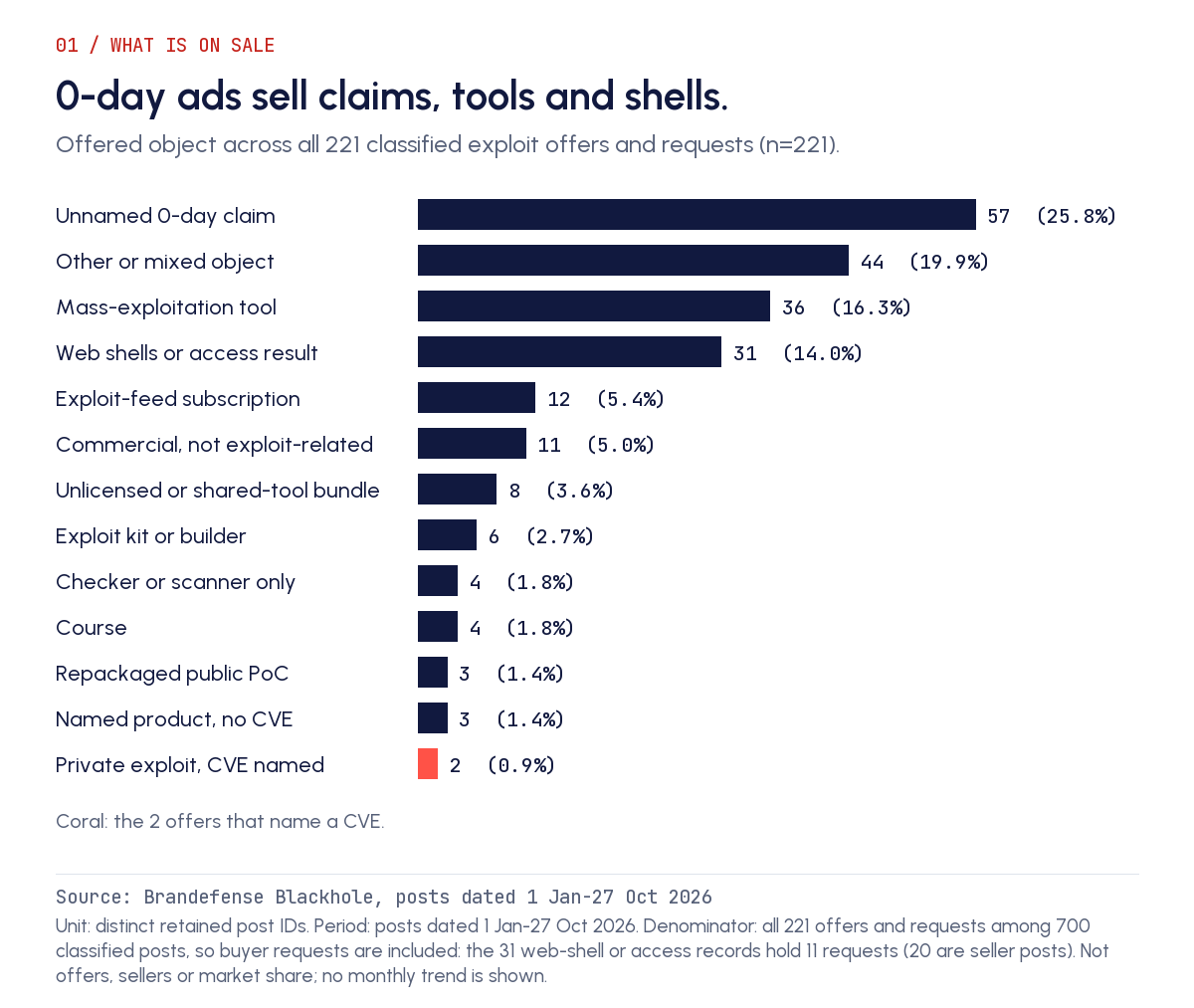
Among 182 exploit seller posts in a stratified sample of 700 classified Blackhole posts, 93 (51.1%) use 0-day or zero-day. Only 37 were coded as unnamed-exploit claims, a broad code that also covers research services, lists and chains. The rest are menus and other goods (25), mass tools (12), unlicensed/shared-tool bundles (8), feeds (5), kits (3) and 3 other items. None of the 93 gives a CVE; only 2 of all 221 offers and requests name one.
One-line description: Only 37 of 93 exploit seller posts using the word 0-day were coded as unnamed-exploit claims, and none names a CVE.
Limit: Base: 182 = 193 direct and service seller posts minus 11 off-topic. Sampled post IDs from a collection dominated by Telegram. A 0-day may have no public CVE yet, and sellers may omit identifiers, so a missing CVE is not proof of a false claim. Not a market measure.
Tools and web shells are comparable in number to coded exploit-claim posts.
Among 193 seller posts (the base for object and price counts), 56 sell a mass-exploitation tool or the web shells it produces. Another 47 are coded exploit-claim posts (unnamed-exploit, CVE-named or public-PoC codes). Web software is the largest stated target class (95 of 221 records, 43.0%); 71 name no target.
One-line description: 56 exploit seller posts sell tools or shells and 47 are coded exploit-claim posts, out of 193.
Limit: Derived sums of coded categories with a small margin, so the two groups are comparable rather than ranked; capabilities are text claims and no exploit was run. Not seller or sales counts.
Within single ads, price tiers separate copies, exclusivity, devices or service.
In the six ads compared, price tiers separate copies, exclusivity, device counts or a service. No priced seller post gives a CVE identifier: 70 of 193 seller posts show a stated amount, and the 2 CVE-named offers show none. So claimed capability or target cannot be ruled out as the driver.
One-line description: Price tiers inside individual exploit ads separate copies, exclusivity, devices or service; no priced ad names a flaw.
Limit: Six purposive catalogue ads, not a sample. Asking prices, not sales; a bare dollar sign is not USD. No averages or price index.
Tooling ads promise supply, not a detection outcome.
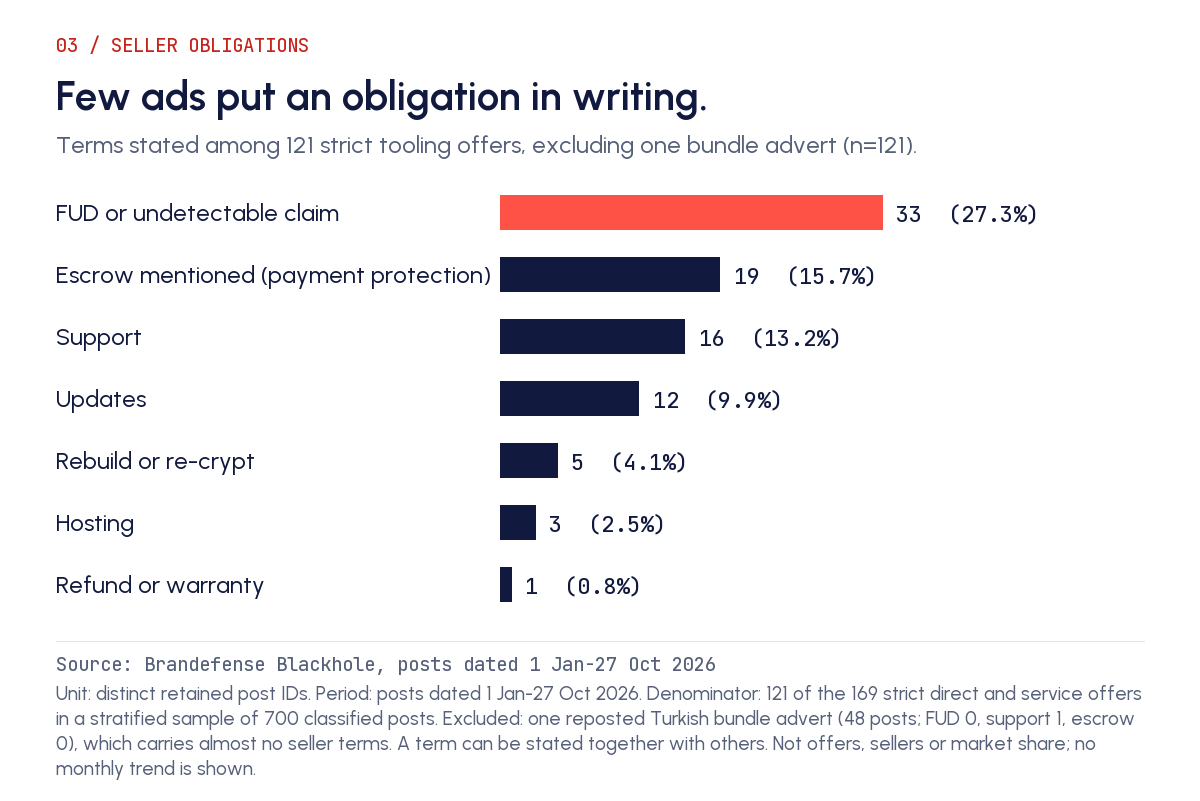
One reposted Turkish bundle advert is 48 of the 169 strict direct and service tooling offers. Of the other 121, 33 claim FUD or undetectability (27.3%) and 1 states a window (three days). Written seller duties are rare: support 16, updates 12, rebuild 5, refund 1, while 19 name escrow, a payment protection. Of 29 crypter, loader and AV-bypass offers, 18 claim FUD, 2 a rebuild and 1 a refund.
One-line description: 33 of 121 non-bundle strict tooling offers make a FUD claim; one states a duration.
Limit: Flags record what the ad text stated; absence is not evidence of absence. FUD-flag kappa 0.57. The bundle advert, reposted in several wording variants, is 48 of the 182 strict posts and carries almost no seller terms, so shares on all 169 offers are lower (FUD 19.5%); without it the strict share is 20.6%. Terms may be agreed in private messages.
AI-branded tool names mostly label an access point or a prompt.
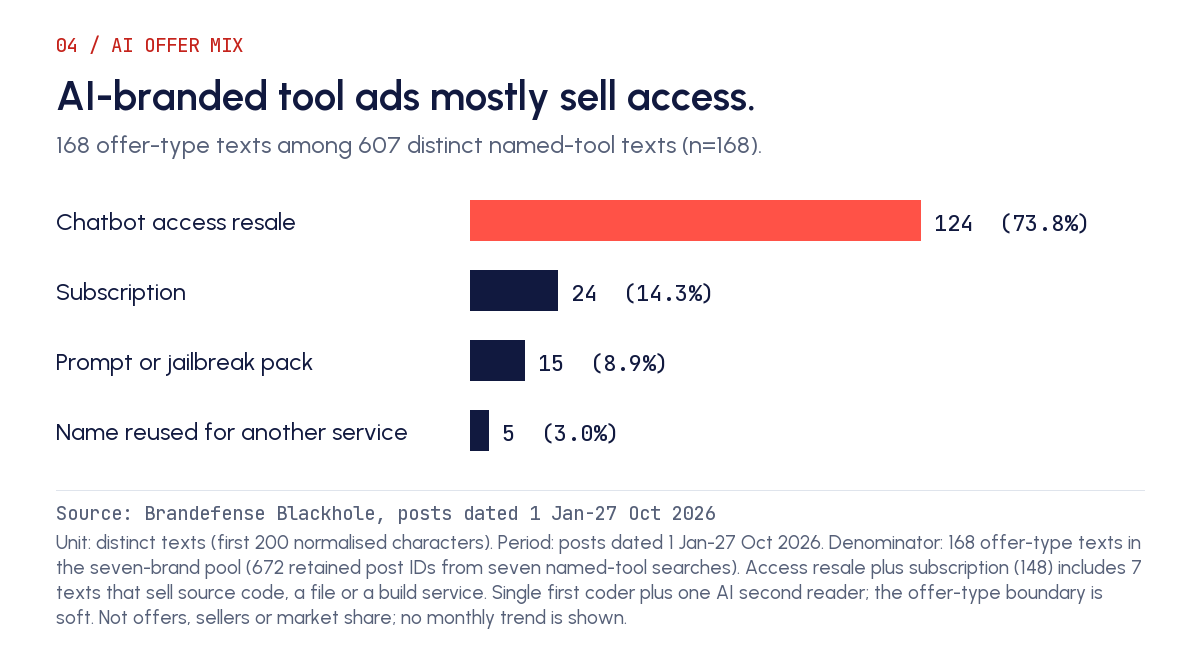
Of 607 distinct named-tool texts, 168 are offer-type (27.7%). Of 141 hosted-access texts, 122 state no backend model; 15 offers are prompt packs, and brand names also collide with unrelated services. The backend field has second-reader kappa 0.24, so backend counts are indicative.
One-line description: 168 of 607 distinct texts from seven AI-branded tool searches are offer-type; the names mostly label an access point or a prompt.
Limit: Single first coder plus one AI second reader; the offer-type boundary is soft. Texts are advertised claims; no tool was bought or tested.
Raw keyword counts overstate offers.
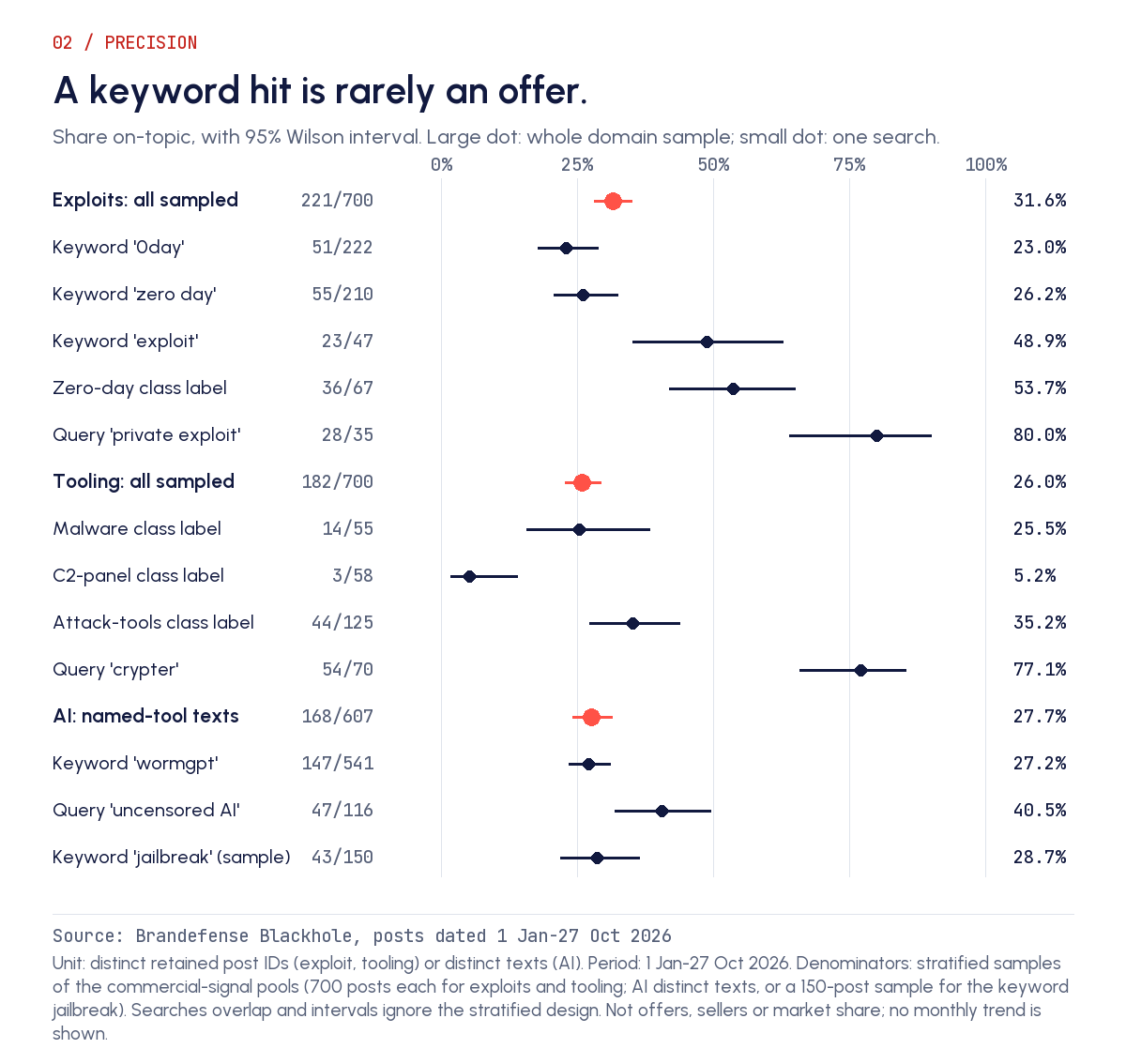
Only 31.6% of the 700 classified exploit posts were offers or requests; for posts matched by the keyword 0day alone the share was 23.0% (51 of 222). In the tooling sample 182 of 700 posts (26.0%) were strict on-topic offers.
One-line description: Only 31.6% of classified exploit-keyword posts were offers or requests.
Limit: Precision is measured on a stratified sample of each commercial-signal pool; intervals ignore the stratified design; sets with n below 25 are indicative only.
Download original figures
What is on sale in exploit offers and requests
·
Chart data (221 offers and requests)
Share of retained posts that were on-topic offers or requests
·
Chart data (sample sizes per row)
Terms stated in strict malware-tooling offers outside one bundle advert
·
Chart data (121 strict direct and service offers (bundle advert excluded))
AI-branded tool offer texts by type (seven-brand pool)
·
Chart data (168 offer-type texts)
Social images
· · ·
Source and reuse
Source: Brandefense Research Team, Exploits, Malware Tooling and AI-Assisted Crime, 2026, v1.0. Data: Brandefense Blackhole, 1 Jan–27 Oct 2026. Collected posts, not offers or market totals.
· · · Evidence catalogue ·
Brandefense Research Team · Brandefense Blackhole data · Prepared by Claude Opus 5.5, checked by Codex Astra and approved by Brandefense analysts.
In this chapter one AI reader (Claude Sonnet 5.5) assigned the labels and a second AI reader rechecked a blind sample and every catalogue record; both are AI readers and agreement is not accuracy. Brandefense analysts approved the findings.
Read the accessible report · The full-year PDF edition follows in early 2027.