BRANDEFENSE RESEARCH / FRAUD / DATA v1.0
Fraud research press kit
Reusable figures with their denominators and limits. Quote the observation, not an estimate of the fraud economy.
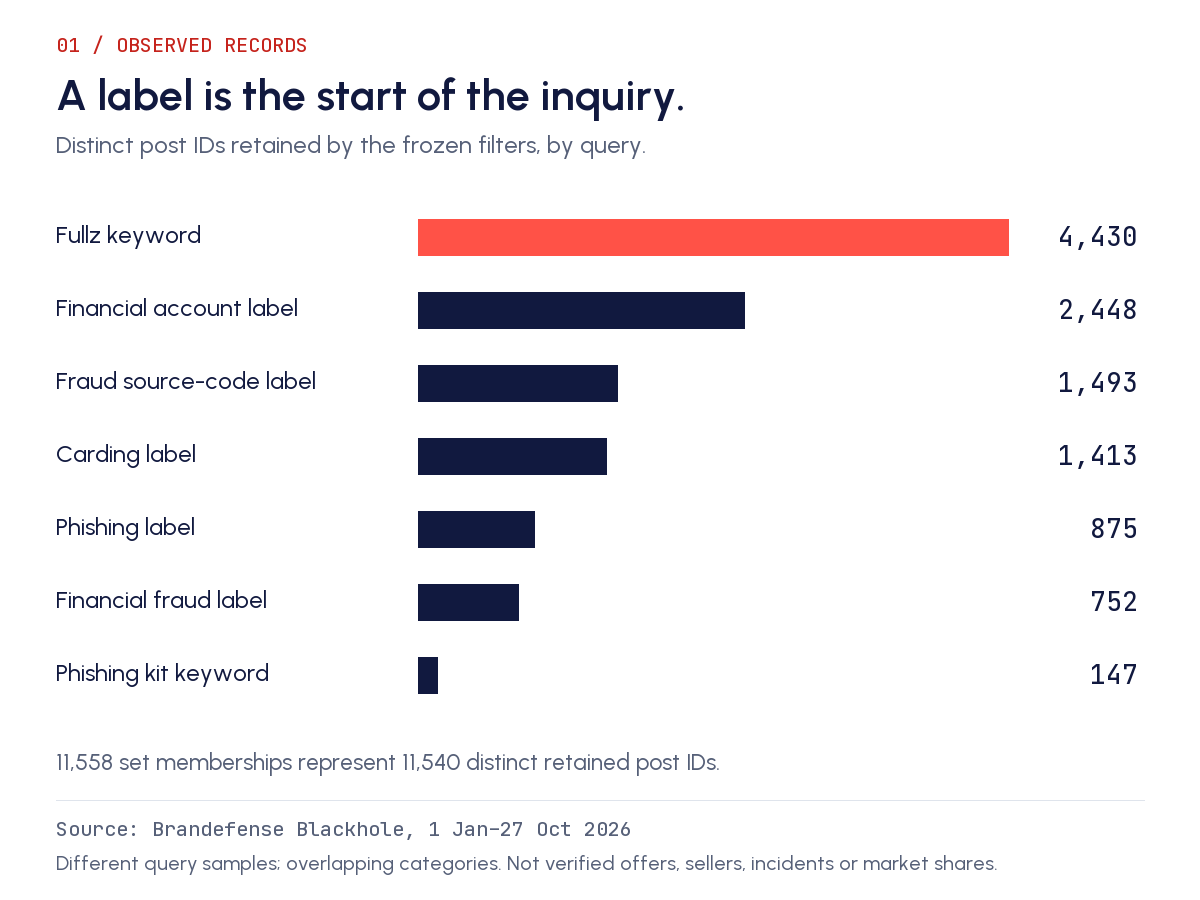
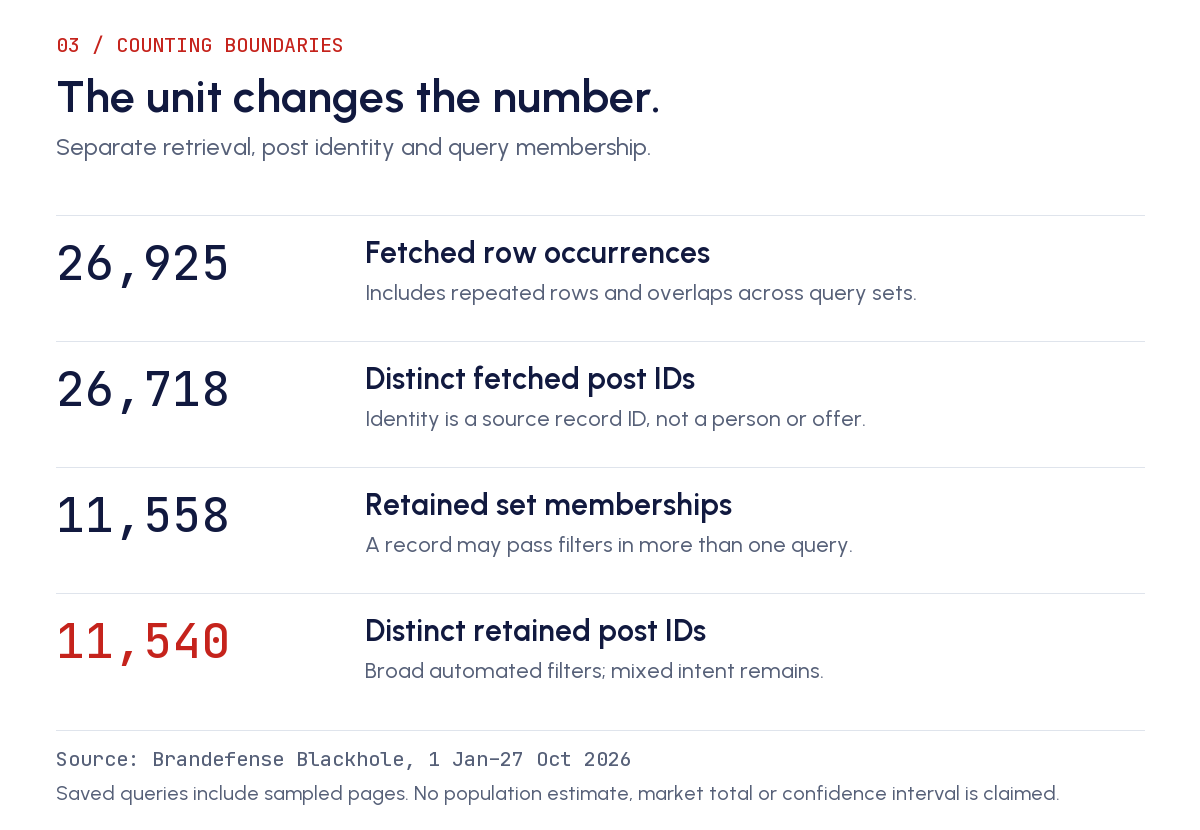
11,540 retained records; no claim of 11,540 offers.
Seven saved queries contain 26,925 fetched row occurrences. Their frozen filters retain 11,540 distinct post IDs across 11,558 set memberships.
Limit: Labels overlap and retained text has mixed intent; this is not market size.
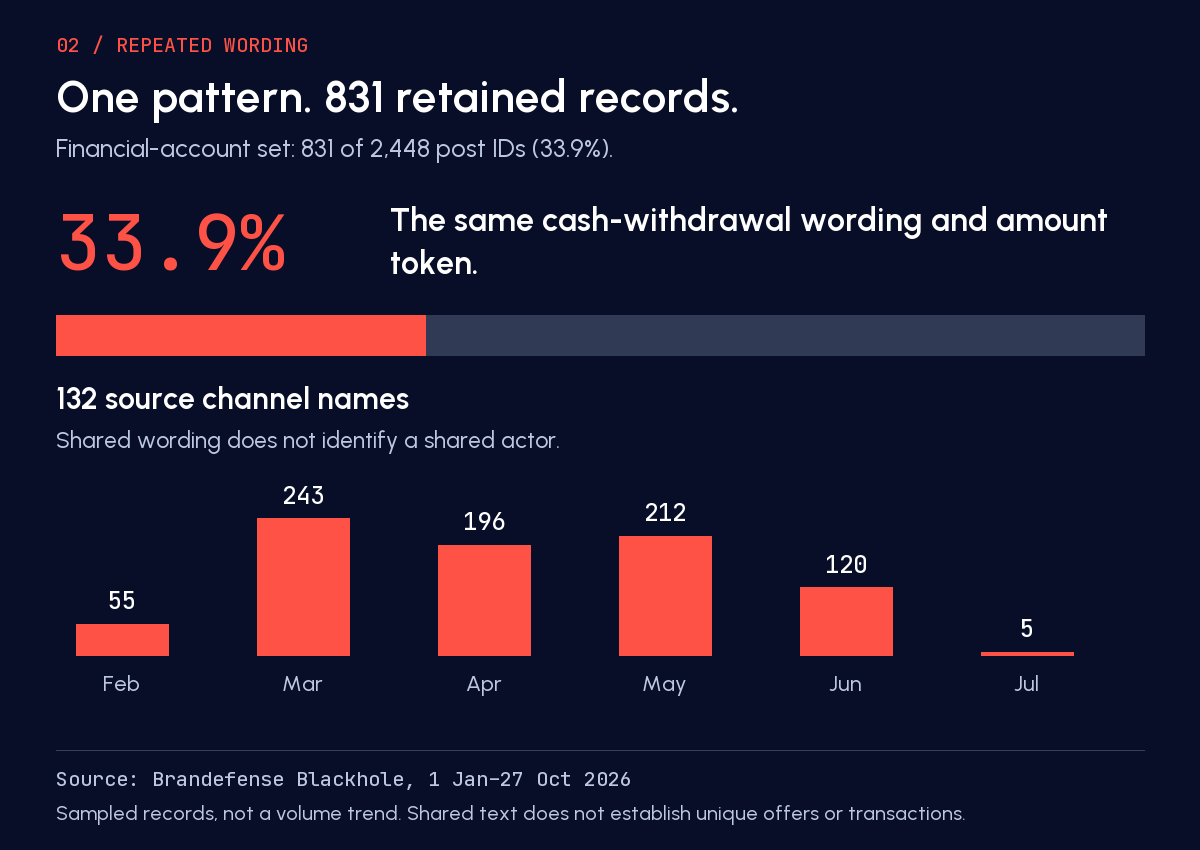
Repeated wording can dominate a filtered view.
831 of 2,448 retained financial-account records (33.9%) match one cash-withdrawal wording pattern, across 132 source channel names from February to July.
Limit: This does not mean 831 separate offers or 132 sellers.
Full text changes what can be checked.
40 of 147 retained phishing-kit records were cut at 1,500 characters in the earlier analysis file. Their raw originals are longer; this edition reads the originals.
Limit: The 147 records are a query-retained set, not 147 confirmed kits.
A full-fetch label does not guarantee complete retrieval.
The phishing-kit query saved 448 counted results but 435 fetched records. Nine full-labelled windows have a count mismatch.
Limit: The reason for the mismatch is not established from the saved files.
Download original figures
Seven query sets, one observed-record boundary
·
One wording pattern survives the filter 831 times
·
Counts change when the unit changes
·
Source and reuse
Source: Brandefense Research Team, Inside the Fraud Service Economy, 2026, v1.0. Data: Brandefense Blackhole, 1 Jan–27 Oct 2026. Observed records, not market totals.
· · · ·
Brandefense Research Team · Brandefense Blackhole data · Prepared by Claude Opus 5.5, checked by Codex Astra and approved by Brandefense analysts.
Why AI agents. Brandefense Blackhole, our cybercrime database, collects around 17 to 23 million dark web and Telegram posts a month. Reading that volume by hand, and linking a recruitment ad on one forum to a leak-site claim on another and a price list in a Telegram channel weeks later, is beyond what a human team can do alone.
Claude Opus 5.5 prepared the research: it searched the data, sorted and translated posts and drafted the text. Codex Astra then checked every number against the dataset files and tested each claim, and anything that did not hold was removed.
Brandefense analysts reviewed and approved the findings.
Full readable offer catalogue · ·
The full-year PDF edition follows in early 2027.
Read the accessible report