Research Edition v1.0
11,540 distinct retained records, 36 core catalogue records and separate card and phishing-method supplements. Observation window: 1 January-27 October 2026.
01 / The finding
An Account Offer With a Travel Budget.
A rental advertisement offers to cover travel, meals and accommodation. Those expenses tell us something the payment figure cannot.
The 24 July record, FR-O032, seeks rented accounts for a betting operation and promises TRY 15,000 per account. It also offers to cover participant expenses. No rental period is stated. The advertised arrangement gives the person a role that an access credential alone cannot describe.
A separate February record recruits people for in-person cash withdrawals and specifies several bank relationships. An access listing, by contrast, offers login information and email access. These selected advertisements describe different ways to obtain account use: acquire an access package or recruit a participant.
The distinction runs through the edition
| Question | What the selected evidence reveals |
|---|---|
| Who is expected to participate? | Account-recruitment ads describe bank relationships, physical presence and, in one case, covered expenses. |
| Who promises to do the technical work? | Hosted providers advertise infrastructure and support; source and executable packages allocate the work differently. |
| What relationship is being sold? | Identity menus offer components; a separate bundle promises that documents and selfies belong to the same person. |
These findings concern advertised arrangements in saved Brandefense Blackhole records. No service was purchased or tested. The collection does not establish actual participants, completed fraud, loss, or a market-wide shift.
02 / Account participation
The Person Is Part of the Proposition.
Travel expenses, bank relationships and face-to-face work make recruitment distinct from an access sale.
A recruitment ad cannot tell us whether anyone accepted. It can tell us which role the advertiser is trying to fill. The covered expenses and in-person terms make that role visible without requiring a verified transaction or a link between the posts.
| Recorded example | What is requested or offered | What the comparison adds |
|---|---|---|
| FR-O032 / 24 July | TRY 15,000 per rented account; travel, meals and accommodation covered. | The offer allocates a budget to participant logistics. |
| FR-O035 / 23 February | In-person cash withdrawals; four or five bank relationships; TRY 70,000 daily promise. | Existing banking relationships and physical participation are stated requirements. |
| FR-O034 / 6 January | Face-to-face work for five or six days; an 8% commission promise. | Participation is also framed as short-term work, rather than only a fixed daily amount. |
| FR-O036 / 2 February | Login information and email access; $95 ask and a separate $7,871 claimed balance. | An access package is a different advertised object. The source does not establish whether an account holder participates. |
For an account-risk review, the implication is specific: a scenario that starts and ends with an outsider stealing access leaves account-holder participation outside its frame. These advertisements justify examining that separate possibility. They do not show which control would detect it or how often it occurs.
All amounts are advertised claims. The commission base in FR-O034 is unspecified. The dollar denomination in FR-O036 is not stated; the claimed balance is not an asking price.
Inspect the catalogue records: FR-O032 · FR-O034 · FR-O035 · FR-O036
03 / The hosted proposition
The Provider Offers to Keep the Technical Work.
A hosted-dashboard ad says the customer need not supply a server or domain. That is a promise about responsibility, not merely a different billing period.
FR-O011 bundles dashboard access, a personal licence key and support. By removing the server and domain requirement from its advertised customer role, the post positions the provider as the party supplying the working environment. Its price is not stated.
FR-O007 makes the continuing relationship more explicit: access is offered for seven, fourteen or thirty days; a template library is included and a 24-hour trial is advertised. Messaging is billed separately by segment. The access fee therefore does not describe the whole advertised service.
| Advertised term | Its role in the offer |
|---|---|
| No customer server or domain / FR-O011 | A promise to remove an infrastructure requirement from the customer. |
| Time-limited dashboard access / FR-O007 | Continued use is attached to an access period. |
| Templates included; messaging separate / FR-O007 | The panel and the delivery charge remain different parts of the proposition. |
| Support and licence / FR-O011 | The offer includes a continuing provider relationship, not only a file. |
This reading explains how the ads divide work. It does not establish that the service ran, lowered a real customer’s skill requirements or bypassed any security control.
04 / Ownership of the work
A Source Purchase Can Still Leave a Support Bill.
The alternative to hosted access is not automatically independence from the seller.
FR-O004 distinguishes source-code packages from a one-device executable. It includes two months of support, then lists a monthly support charge. Buying a technical artefact and buying continued help are separate choices within the same advertisement.
FR-O003, an adjacent mailer and recovery-checking suite, similarly separates monthly access from a source-code option. The post does not establish source ownership or redistribution rights. The useful contrast is the advertised entitlement, not an assumption that one purchase transfers complete control.
Why the distinction matters to an investigation
Hosted services advertise a common product that can be supplied repeatedly. Similar templates or a shared product name can therefore be consistent with a common supplier, while saying little on their own about who controlled a particular incident. A technical resemblance and an operator relationship are different claims.
The source-and-support offer also prevents a false binary. The selected ads do not divide cleanly into fully independent buyers and fully managed customers. They advertise different combinations of software, access, help and separately charged work. That is the contribution of reading their terms together.
These are advertised product relationships, not observed customer deployments. No link between an offer and a confirmed incident is established here.
05 / Identity packages
The Pieces, and the Claim That They Fit.
A menu of identity material and a promise of same-person consistency are different advertised products.
FR-O015 lists a document scan, a document with a selfie, proof of address and a bill template as separate items. This is a menu of components. It does not, by itself, claim that every component belongs to one person.
FR-O017 expressly advertises matching document and selfie material, with a minimum of five pairs. The additional proposition is a relationship between the files. Business-related document packages and address evidence also appear in its menu.
| Offer | What is being added |
|---|---|
| FR-O015 / Separate component menu | Different material types, with separate asking amounts. |
| FR-O017 / Same-person bundle | An assertion that selected components correspond to one identity. |
| FR-O022 / Email and document package | A claim of email access alongside identity material. |
| FR-O019 / Unchecked packages | A counterexample to treating every advertised package as verified. |
For an identity review, the evidence points to separate questions: whether material is present, whether the pieces relate to each other, and whether that relationship connects to the person presenting them. The emails and documents named in an ad do not answer those questions independently.
Authenticity, consent, matching identities, working email access and successful verification were not tested. The comparison reveals the promises being marketed, not an observed verification failure.
Inspect the catalogue records: FR-O015 · FR-O017 · FR-O022 · FR-O019
06 / The limits of a bundle
Volume Does Not Supply the Missing Relationship.
A large archive claim answers a different question from a same-person package.
FR-O016 advertises a bulk identity-document collection for 40 USDT and claims 500 GB and at least 200,000 document sets. Those are volume claims. Even if the advertised files existed, the count alone would not establish how many people they concern or whether the components correspond.
The contrast with FR-O017 matters. One pitch foregrounds the amount of material; the other foregrounds the claimed relationship between items. Treating both as a single quantity of verified identities erases the distinction that the advertisements themselves make.
FR-O022 adds another dimension by advertising email access with document components. A file is a static object; claimed email access is an assertion about access to another account. The archive does not show that the access worked or that anyone used it in a recovery process.
The reader’s consequence
A package label should not carry the evidentiary weight of the checks it implies. An identity team can examine which relationships its own review establishes, rather than treating a collection of expected items as proof that those items belong together. This is a scenario derived from the ads, not a tested recommendation for a particular system.
07 / A recruitment message
Different Full Texts. The Same Stated Conditions.
All 831 matched posts have different complete texts. Three specific recruitment phrases nevertheless appear in every one.
| Comparison within 831 matched records | Distinct texts | Removed by exact deduplication |
|---|---|---|
| Original complete text | 831 | 0 |
| Complete text after the stated normalization | 831 | 0 |
The existing narrow predicate matches 831 of 2,448 retained financial-account IDs: 33.9%. We compared the entire saved text, then repeated the equality test after HTML-entity decoding, Unicode normalization, case folding and whitespace cleanup. No words, numbers or contacts were removed to force similarity.
After reading five complete examples selected by a fixed hash order, we checked three additional literal phrases across the unchanged group. Wording for fixed daily payment, in-person activity and four or five bank relationships appears in all 831 records. These are textual conditions, not observed actions.
The posts span 132 recorded source-name strings; the largest per-string count is fourteen. That describes recorded placements, not independent people, audience reach or common control. Other terms may differ even where the three checked phrases match.
Why exact-text novelty is insufficient
A queue that equates a new complete text with a new proposition would keep every member of this family as novel. Exact deduplication removes none. The comparison gives a concrete reason to distinguish a new placement from a change to the advertised terms, while retaining the record-level evidence.
Inspect the equality test, phrase checks and reproducibility
08 / Card material
A Refund Promise Has Conditions.
Selected card ads attach usability claims to expiry, linking and the terms of a remedy.
A 20 October card-data advertisement, FR-C001, lists refundable stock from $1.50 and non-refundable stock from $0.05. It also advertises a 50% discount for material nearing expiry. These are starting-price tiers, not matched prices for the same cards. The dollar denomination is unspecified.
| Selected record | Advertised condition | What it reveals |
|---|---|---|
| FR-C001 / 20 October | Refund eligibility and a near-expiry discount. | The offer attaches price to recourse and time. |
| FR-C002 / 9 August | Replacement or refund if dead or not added. | The remedy names a failed intended use. |
| FR-C003 / 9 July | Replacement or refund; five-minute check time. | A broad remedy sits beside a narrow stated window. |
The August record promotes wallet linking. The July menu does not explain how its check window is enforced. Neither source establishes usable cards, successful linking or delivered refunds. Their positive evidentiary value is narrower: the ads specify which failures they claim to cover.
Card data, identity bundles and online account access are different advertised objects. A separate June solicitation requires online access, so a card-only label would omit part of the stated request. No account-holder participation or theft can be inferred from that request alone.
The frozen carding selection contains 1,413 post IDs, not 1,413 stolen cards. The new examples form a separate selected supplement and do not enlarge the original 36-record catalogue. No card validity, inventory or market volume was measured.
09 / Phishing methods
The Bypass Claim Still Needs the User.
One advertised package claims broad two-factor bypass while describing a wait for the user’s approval or SMS.
The 16 May offer, FR-O004, assigns a role to the person signing in. That wording supports a reading about inducing an authentication step, not proof that a control was defeated. A short October listing makes a similar bypass claim without describing the same mechanism; its missing detail cannot be filled from the May record.
| Selected offer | Access or material advertised | Boundary |
|---|---|---|
| FR-O001 / Bank templates | Log collection alongside bank imitation. | The log contents are unspecified. |
| FR-O009 / Card phishing | Card-information collection; separate crypto-drainer design. | No collected cards or loss verified. |
| FR-O005 / Real-time claim | Cookies and SMS codes. | No effective access verified. |
| FR-O007 / Hosted dashboard | Credentials, session material, device-code and recovery-phrase features. | Multiple advertised paths; none tested. |
A single dashboard can advertise several access goals. An SMS or email feature describes delivery; it does not establish what the linked interaction seeks. The selected posts also name several imitation targets. Those are advertised service categories, not confirmed victims or a ranking of affected sectors.
For an incident review, separate the message channel, the service imitated, the information or approval requested and the access actually observed. This preserves a claimed session exposure without treating the advertiser’s headline as proof of an attack outcome.
10 / Collection scope
The Archive Behind the Comparisons.
These counts describe saved collection and filtering, rather than the size of a criminal market.
The seven queries returned 26,925 row occurrences representing 26,718 distinct post IDs. The frozen filters retained 11,558 post-set memberships, representing 11,540 distinct IDs. No expansion factor is applied.
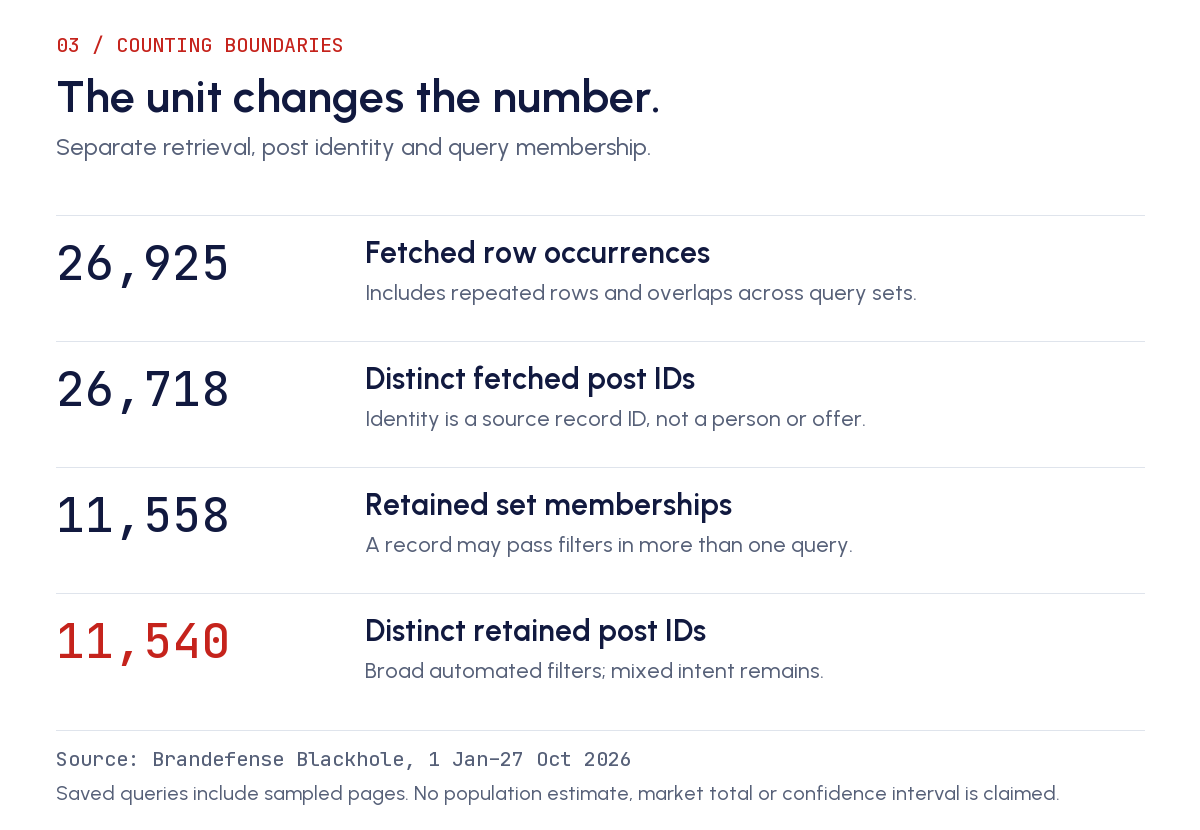
The 36 catalogue entries were selected for useful differences in advertised terms. They are not a representative sample of providers, working services or successful sales. The monetary table contains 60 role-labelled amount or percentage entries, not 60 comparable prices.
11 / Retrieval scope
A Query Label Is Not an Economic Category.
Broad searches contain mixed intent and unequal coverage.
The saved collection is dominated by Telegram, with limited forum coverage. It does not represent Tor marketplaces, closed communities or the wider underground. Class labels changed around May-July, and October is partial.
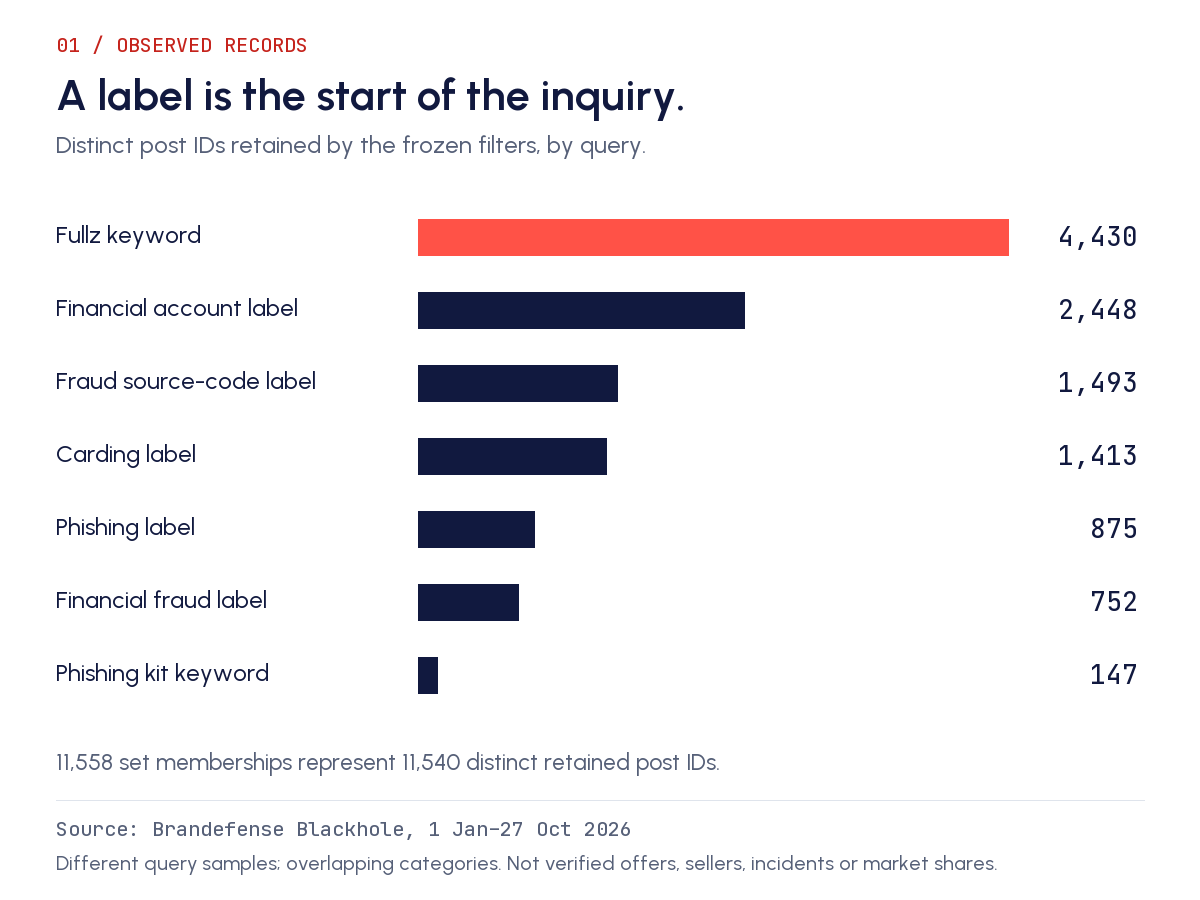
The narrative compares selected full-text records. It does not multiply these sample counts into a market value, annual growth rate or price index.
12 / Method
Read the Original. Preserve the Limits.
Local reanalysis of saved Blackhole records; no fresh collection, purchase or tool test.
The aggregate layer joins all 11,540 retained IDs back to raw originals. The earlier table supplies frozen selection flags only; its truncated text and weights do not support the substantive findings. Forty of 147 retained kit candidates had originals longer than the earlier 1,500-character excerpt.
The AI classification ledger covers 200 candidates: all 147 retained kit records, 32 fullz and 21 account candidates. All 36 selected catalogue records were inspected in full with exact evidence fragments. Long excluded guides, code, news and repeated quotations were classified from diagnostic original passages, not claimed word-by-word reading.
| Intent in the retained kit query | Records |
|---|---|
| Adjacent commercial promotion | 4 |
| Buyer request | 10 |
| Commercial promotion | 55 |
| Discussion or noise | 9 |
| Link only | 3 |
| News or relay | 15 |
| Product update | 2 |
| Prompt or AI response | 3 |
| Quoted or repeated promotion | 34 |
| Tutorial or code | 12 |
The 55 commercial-promotion records include broad menus. They do not establish 55 working kits or suppliers. The selected catalogue is purposive and does not estimate prevalence.
13 / Limits and reproducibility
The Dataset Cannot Answer Every Question.
The observed unit remains the source record and its stated claim.
No population extrapolation, weighted market total, confidence interval or price index is published. The former weighted estimates are excluded from this release. Public tables permit arithmetic checks; the private originals are required to repeat the full-text checks.
| Boundary | Consequence |
|---|---|
| Sampling | Larger windows used sampled pages. Unequal sample allocation prevents a market-composition reading. |
| Retrieval completeness | Eleven full-labelled windows mismatch the saved result count; nine are in the kit query. The reason is not established. |
| Dates | Queries used UTC window bounds. Findings and catalogue dates follow recorded source dates; some timestamps lack an offset. Dates are not first observation or transaction times. |
| Taxonomy and filters | Broad selection can retain noise and mixed intent. Class labels changed around May-July; October is partial. |
| Attribution | Shared wording and source-name strings do not establish people, providers, coordination or a campaign. |
| Outcomes | No purchase, delivery, effective tool, completed sale, realized loss or prevention result was verified. |
The saved collection is dominated by Telegram with limited forum coverage; it does not represent Tor marketplaces, closed communities or the wider underground.
14 / Complete evidence index
Catalogue Records 1-18.
Opaque references link to the complete public evidence record, pricing roles, terms and boundary.
| Reference | Recorded date | Advertised object |
|---|---|---|
| FR-O001 | 2026-02-05 | Bank-template phishing kit |
| FR-O002 | 2026-02-20 | Phishing panel with a percentage component |
| FR-O003 | 2026-04-07 | Mailer and recovery-checking suite |
| FR-O004 | 2026-05-16 | Browser-based phishing package |
| FR-O005 | 2026-08-14 | Real-time phishing kit advertised in Canadian dollars |
| FR-O006 | 2026-10-15 | Two service-specific phishing-kit options |
| FR-O007 | 2026-10-21 | Hosted phishing dashboard, October offer |
| FR-O008 | 2026-03-25 | Hosted phishing dashboard, March offer |
| FR-O009 | 2026-03-19 | Phishing and wallet-drainer design with hosting |
| FR-O010 | 2026-06-10 | Device-themed phishing panel |
| FR-O011 | 2026-06-29 | Hosted dashboard and licence-key bundle |
| FR-O012 | 2026-01-01 | Browser-session phishing platform description |
| FR-O013 | 2026-02-25 | Outsourced phishing-enabling service menu |
| FR-O014 | 2026-09-20 | Phishing-kit listing inside a wider shop menu |
| FR-O015 | 2026-03-03 | Identity documents and selfie add-on menu |
| FR-O016 | 2026-05-06 | Bulk identity-document database bundle |
| FR-O017 | 2026-08-08 | Same-person document and selfie packages |
| FR-O018 | 2026-06-29 | Bulk fullz file tiers |
Record dates do not establish when a service started or a transaction happened. Selected examples may share a service family or source; this is not a distinct-provider index.
15 / Complete evidence index
Catalogue Records 19-36.
Opaque references link to the complete public evidence record, pricing roles, terms and boundary.
| Reference | Recorded date | Advertised object |
|---|---|---|
| FR-O019 | 2026-03-03 | Unchecked fullz sold in USD quantity tiers |
| FR-O020 | 2026-02-05 | Fullz menu with unresolved quantity arithmetic |
| FR-O021 | 2026-01-02 | Fullz menu distinguishing stock labels |
| FR-O022 | 2026-04-02 | Fullz with claimed email and document components |
| FR-O023 | 2026-04-02 | Identity-lookup service menu |
| FR-O024 | 2026-05-18 | Identity-record listing with a small displayed price |
| FR-O025 | 2026-01-25 | Identity-document stock and replacement terms |
| FR-O026 | 2026-06-03 | Personal and business account menu |
| FR-O027 | 2026-01-11 | Gaming-fund account arrangement |
| FR-O028 | 2026-02-25 | Corporate-account provider recruitment |
| FR-O029 | 2026-04-20 | Account and KYC seller with a forum-deposit claim |
| FR-O030 | 2026-05-01 | Savings-account provider recruitment |
| FR-O031 | 2026-05-16 | Account-provider commission offer |
| FR-O032 | 2026-07-24 | Account-rental recruitment for a betting operation |
| FR-O033 | 2026-08-20 | Mixed-currency account-rental menu |
| FR-O034 | 2026-01-06 | Short-period account-provider recruitment |
| FR-O035 | 2026-02-23 | Repeated cash-out recruitment form |
| FR-O036 | 2026-02-02 | Bank-access listing with price and claimed balance |
Record dates do not establish when a service started or a transaction happened. Selected examples may share a service family or source; this is not a distinct-provider index.
16 / Sources and reuse
An Evidence Trail That Keeps Its Boundaries.
Brandefense Blackhole is the source for this local research edition. No external market estimate is used.
Data and evidence
Frozen counts, definitions, period and asset index.
Query-level counts; see retrieval-windows.csv for saved window mode and completeness checks.
Full offer catalogue
All 36 selected records with terms, pricing roles and evidence boundaries.
Selection, reading depth and the separation of public paraphrases from private evidence.
Charts and press kit
Original graphics, social assets and downloadable data.
Data dictionary
Definitions of each count and denominator.