Brandefense Research Team · Brandefense Blackhole data · Prepared by Claude Opus 5.5, checked by Codex Astra and approved by Brandefense analysts. Method and limits
A Turkish-language account-rental ad dated 24 July 2026 promised TRY 15,000 per account. For a stated betting operation, it offered to cover travel, meals and accommodation, without giving a rental period. Those expenses make the offer more revealing than its headline payment. The advertiser was making provision for a person to take part.
Brandefense’s saved examples include other explicit demands for human participation: face-to-face work, several bank relationships and cash withdrawals at a bank. Alongside them sits an offer to sell account login and email access. Comparing these advertisements shows two different promises: supplying access and recruiting someone to do something with an account.
These are advertised arrangements, not verified recruitment or transactions. The July record, FR-O032 in the evidence catalogue, does not show anyone travelling or receiving money. It does show which expenses the advertiser promised to assume. That is the starting point for understanding the role being offered.
The Offer Includes a Person’s Time
Another saved post, dated 23 February, sought people for in-person bank cash withdrawals. It said four or five bank relationships were sufficient and promised TRY 70,000 per day. In this advertisement, the account relationship was a requirement for participation. The person was being asked to perform an action, with a daily payment presented as the reward (FR-O035).
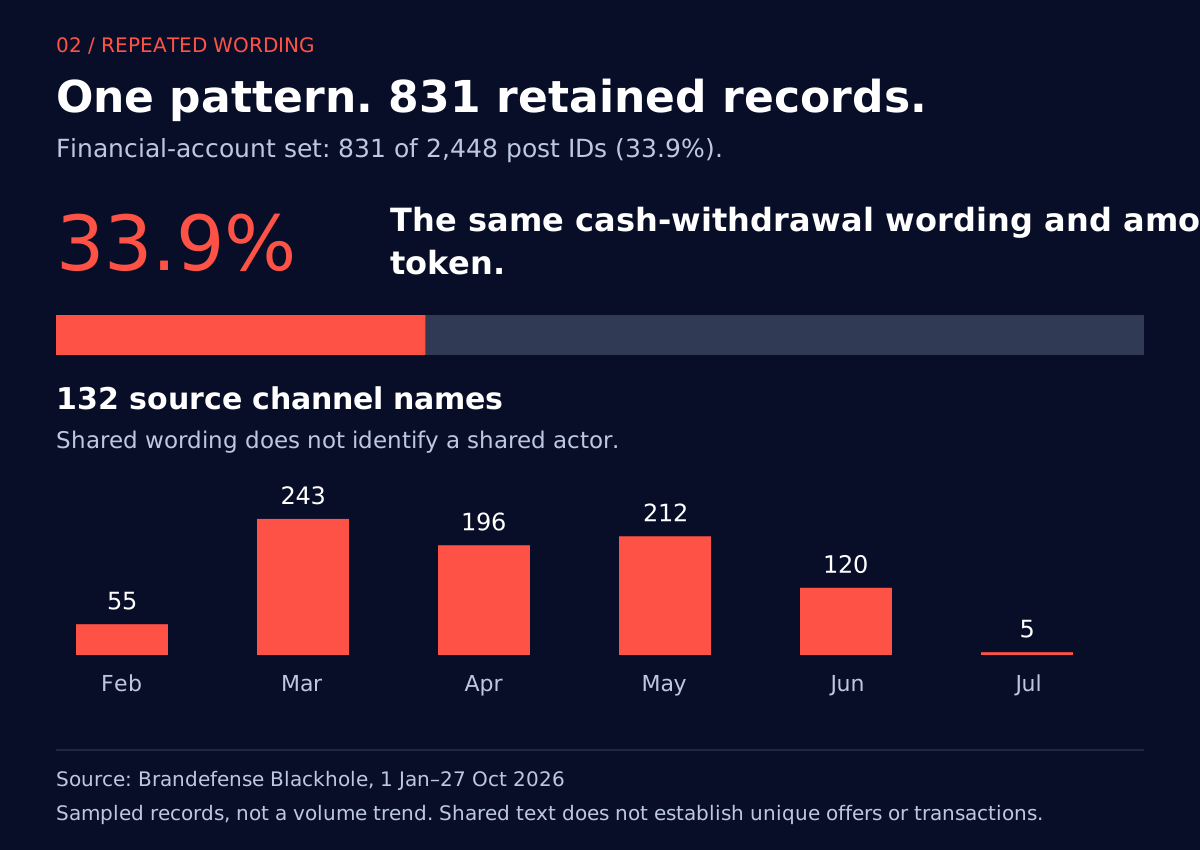
The July and February posts do not establish a shared operation, but each describes a participant’s role. One promises to meet the costs of travel and a stay. The other identifies a physical banking task. Both make the person’s involvement part of the advertised arrangement, rather than leaving the entire offer at account access.
That distinction changes the interpretation of the travel promise. Covering these expenses would shift some costs of attendance from the participant to the recruiter. It would not prove that the arrangement was safe, lawful or real. The promise is meaningful because it addresses a practical burden that a downloadable access package does not describe.
Different Payments Describe Different Commitments
A third post, dated 6 January, advertised five to six days of face-to-face work and an 8% commission. It also set an account-limit requirement. The post did not define the commission’s calculation base, so the promised percentage cannot be converted into earnings. Its stated work period nevertheless makes a time commitment explicit (FR-O034).
The July post names a payment per rented account, while the February post names a fixed daily payment for cash-withdrawal participation. The January post combines a short work period with a percentage. The amounts do not reveal which arrangement paid better. They reveal how each advertiser framed the proposed exchange.
The missing rental period in July also matters to that exchange. The reader knows what the advertiser promised per account, but not how long the account relationship would be used. January makes a period visible while leaving the percentage base open. These are distinct uncertainties about the participant’s commitment, not interchangeable gaps in a price list.
None of the amounts measures funds moved through an account. An account-limit requirement is also different from an observed transaction. The evidence supports a comparison of what the advertisements asked people to contribute and what they promised in return. It cannot supply a wage, revenue or loss calculation.
An Access Package Makes a Different Promise
A 2 February listing advertised login information and email access, with a separate asking price and claimed account balance. The object on sale was an access package. The advertisement did not verify that the access worked or that the claimed funds were available. The catalogue preserves that distinction in FR-O036.
Calling this a password-only sale would flatten its contents: email access was also advertised. Nor does the listing establish how access was obtained or whether an account holder helped. The narrower comparison is sound. This seller described information and access it would supply; the recruitment posts explicitly described someone taking part in an arrangement.
That is why an account-takeover label cannot do all the analytical work. It can frame a scenario involving unauthorized control. It does not, by itself, explain the role requested in an account-rental or face-to-face recruitment ad. The post’s stated request tells us more about that role than its placement in a financial-account search.
Separate the Account Relationship From the Requested Action
In the February post, several bank relationships are the stated qualification, while withdrawing cash in person is the requested action. Treating the whole post as “accounts available” would discard the action. Treating its daily payment as an account price would discard the work. The arrangement depends, in its own description, on both.
The July post names account rental and a betting operation, then promises participant expenses, without being specific about the work itself. It does not describe the bank cash-withdrawal task from the February example. That difference should stay visible. The archive gives us several advertised models of participation, not a single sequence assembled from their most vivid details.
The January example adds another distinction: a defined period of face-to-face work. It describes an account provider’s temporary commitment rather than establishing a permanent transfer of control. Across these examples, the person’s time, presence and account relationships appear in different combinations. Those combinations are the finding; no claim about their market share is needed.
A Recruitment Promise Can Also Be a Sales Tactic
Travel coverage, large payment promises and face-to-face language may also be sales tactics to make an offer sound credible. The January post includes reassurance about the work and says there is no advance. The meaning of that last condition is unclear. None of these assurances independently proves a real opportunity.
That alternative limits what we can say about outcomes, while leaving visible what the advertisers were asking readers to consider. Even an undelivered offer can be presented as an exchange involving a person’s account and participation. Our observation concerns that advertised model. We have no evidence here of a successful recruitment, an agreed deal or a completed withdrawal.
Include the Account Holder in the Scenario Review
For a fraud team, the practical consequence is to examine the assumption at the start of its account-abuse scenarios. Does each scenario begin with someone stealing access? The selected recruitment ads justify considering another starting point: a person being asked to contribute an account relationship and take part in its use.
A useful review would distinguish the access being supplied from the action being requested. The February example calls for attention to a participant’s role in withdrawals. The July example calls for attention to rental and attendance. These are reasons to include different forms of participation in an authorized assessment, not instructions to flag every travelling customer or cash withdrawal.
The fraud and brand protection role guide provides a route to the responsible team. Any account-specific conclusion must come from its own authorized records. An external advertisement cannot establish a customer’s involvement. The question raised by these offers is more precise: does the review cover abuse involving an account holder’s participation, as well as stolen access?
Evidence and Further Reading
This analysis compares selected full-text records from Brandefense’s saved Blackhole collection for 1 January to 27 October 2026. The broader catalogue contains 36 deliberately selected examples, from collection dominated by Telegram with limited forum coverage. Dates are recorded post dates; the offers were neither bought nor tested. The research methodology explains the scope and selection.
The card-offer comparison examines how card material differs from a request for online account access.
A separate investigation examines how identity offers package matching documents, email access and business context. The Fraud research edition brings together the evidence catalogue and related analysis. Here, the decisive detail is the human task: an account-rental ad that budgets for a person’s stay deserves to be read as a proposal for participation.