
What Does A Refund Promise Cover?
Refund eligibility, failed linking and expiry change the advertised terms attached to card material.
Read the card comparison →Stolen-card ads attach conditions to refunds. Phishing ads seek more than passwords. Account and identity offers add people, access and documents. We compare what these recorded offers promise, and what the evidence supports.
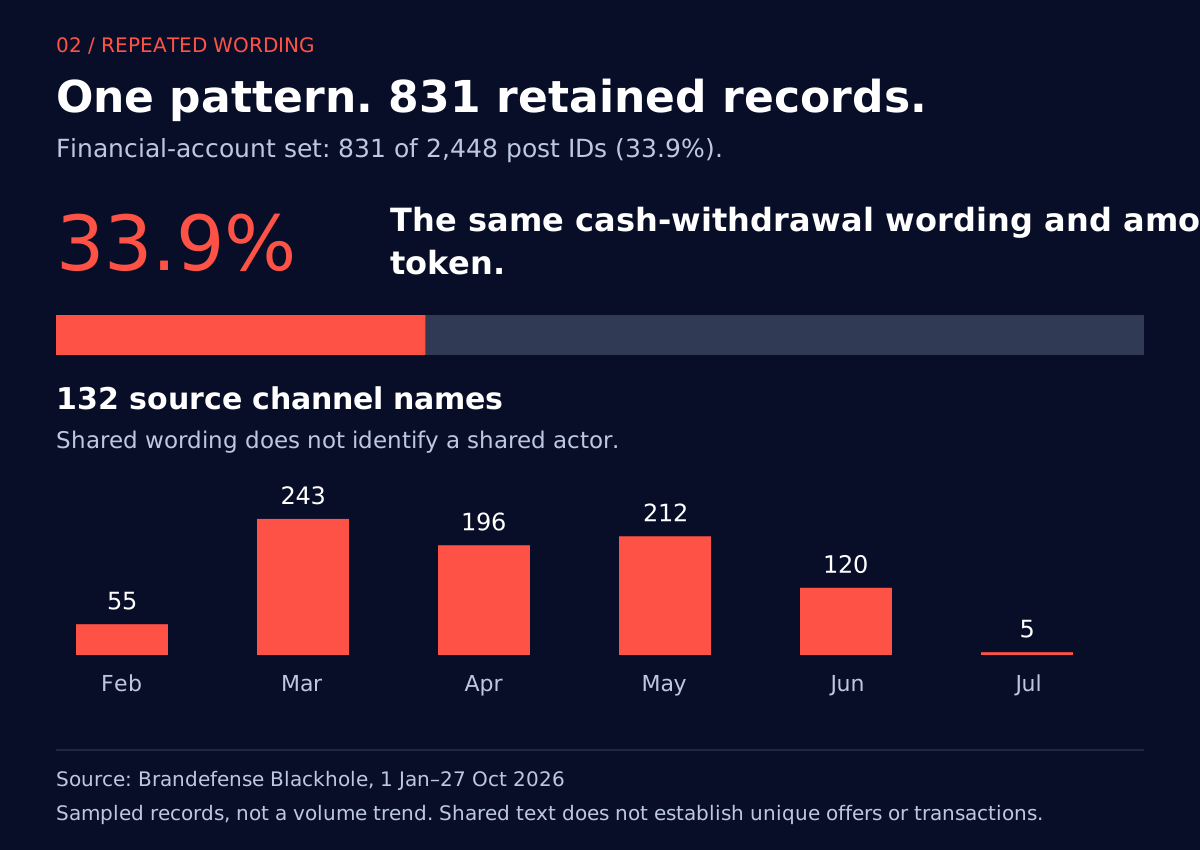
A narrow cash-withdrawal recruitment signature appears in 831 of 2,448 retained financial-account posts. The volume of the message is measurable; the number of people behind it is not.
Counts in the retained financial-account sample. This is the distribution of matched records, not a market trend.
| Month | Matched records |
|---|---|
| 2026-02 | 55 |
| 2026-03 | 243 |
| 2026-04 | 196 |
| 2026-05 | 212 |
| 2026-06 | 120 |
| 2026-07 | 5 |
All 831 complete texts differ, even after the stated normalization. Three specific recruitment phrases appear in every one. The 132 recorded source names describe placements, not people.
Follow the repeated recruitment pitch →Explore card material, phishing methods, account participation, identity packages and provider roles. Each investigation answers a different question from our saved records.
Travel. Meals. Accommodation.
A rental ad offers to cover all three, alongside a payment per account. The participant’s presence is part of the proposition.
Inspect the recorded offer ↗Advertised terms in FR-O032. No rental, payment or account use was verified.Refund eligibility, failed linking and expiry change the advertised terms attached to card material.
Read the card comparison →The selected offers describe different access goals, including card information, session material and wallet-recovery phrases.
Compare the access claims →A rental advertisement budgets for a person’s presence. Other offers seek bank relationships and in-person work.
Read the account investigation →Source code, hosted access and separately billed support describe different responsibilities for the seller and customer.
Read the service comparison →Every full text is different. Three recruitment phrases recur in all 831 records, and exact-text deduplication removes none.
Inspect the new comparison →A document menu, a same-person bundle and an email-access claim make different promises about identity and control.
Read the identity investigation →Compare hosted services, worker accounts, access transfer and account-data requests in our cross-chapter analysis.
Explore the work and control analysis ↗A card-data offer and a phishing service raise different questions. Our new comparisons follow the promised usable state, the interaction requested and the limits in the seller’s own wording.
One card-data ad separates refundable and non-refundable stock, then discounts material near expiry. Other ads tie a remedy to failed linking or state a five-minute check window.
These terms describe what the seller claims to cover. They do not verify usable cards, a delivered refund or the number of stolen cards in the market.
A phishing ad promises broad two-factor bypass, yet describes waiting for the user’s approval or SMS. Other offers name card information, session material and wallet-recovery phrases.
The message channel, imitated service and access sought are separate parts of the claim. None of these advertisements establishes that a control was defeated.
These selected records put the distinctions in view: software and support, identity components and matching claims, account access and participant recruitment. Separate supplements cover card material and phishing methods. None was purchased or tested.
The post calls the lower paired figures launch discounts. Two months of support are included, then $100 per month. The source and binary packages are different entitlements. Setup help is advertised, and the post lists requirements for running the delivered package.
One subscription is said to include all advertised templates. A free 24-hour trial is advertised. Messaging is described as separately billed per segment, without a stated segment price. The post says browsers run on the provider’s servers and customers need not manage those servers.
Dashboard access, a personal licence key and support are bundled. The post says the customer need not supply a server or domain.
The post lists separate document, selfie, address-proof and template options. The fullz line is a $7–25 range.
A minimum of five pairs is stated. The menu claims matching driving-licence, social-security and selfie material. Business-related document packages and address evidence are also advertised.
Travel, meals and accommodation are advertised as covered. No rental duration is stated.
The post recruits people for in-person cash withdrawals. It states that four or five bank relationships are sufficient. This is one dated representative of the separately measured repeated text pattern.
Login information and email access are advertised. The asking price and claimed balance appear on separate labelled lines.
These are selected examples, not a ranking of providers. “$” stays unspecified where the source did not identify the currency.
Open the full evidence catalogue ↗These are implications of the advertised arrangements, not measured control results. Each points to a different question for the team responsible for that risk.
Recruitment ads ask for a person’s bank relationships and in-person participation. A review centred only on stolen access leaves that advertised scenario outside its frame.
Read the account-participation finding →Hosted panels advertise reusable templates and support. Similar tooling can therefore be consistent with a common supplier; it cannot establish who controlled an observed incident.
Examine the advertised division of work →A document menu sells separate pieces. Another offer claims the documents and selfies belong to the same person. Their presence and their connection are different things to establish.
Read the identity-package finding →Find look-alike domains and fake pages that copy your brand, and get them taken down.
See how it works →Free exposure check. Enter your company domain and see what is visible from the outside, in about 30 seconds.
Distinct post IDs in the retrieved sample and records surviving the historical initial filters. Those filters still contain noise. Neither count is a count of victims, confirmed fraud cases or verified offers. The reviewed catalogue is a separate, selected set.
Read the story, inspect the catalogue and reuse the original aggregate charts with their source and limitations.
Original aggregate tables, charts and editorial paraphrases: CC BY 4.0. Keep the source, version, date range and measurement limits with reused figures.
30 October 2026 · Brandefense Research Team · Brandefense Blackhole data · Prepared by Claude Opus 5.5, checked by Codex Astra and approved by Brandefense analysts.
The Cybercrime Report 2026 reads eight kinds of activity in the same collection. Each chapter counts its own unit, so compare their limits before you compare their numbers.