
The September Surge in Access-Labelled Posts
Posts labelled as access sales rose 4.3x on 12 September 2026, but de-duplicated offer posts per day showed no detectable change. Five tests show why.
Read the investigation →We coded posts under Blackhole's "Initial Access Selling" label one by one. Most of the offers were footholds on websites and servers. Corporate network access was a thin, repetitive slice.
In September the label's count rose 4.3 times while access offers did not change detectably.
Each finding below is stated in its own unit, with the limit that comes with it. The investigations give the full reasoning and the evidence records.
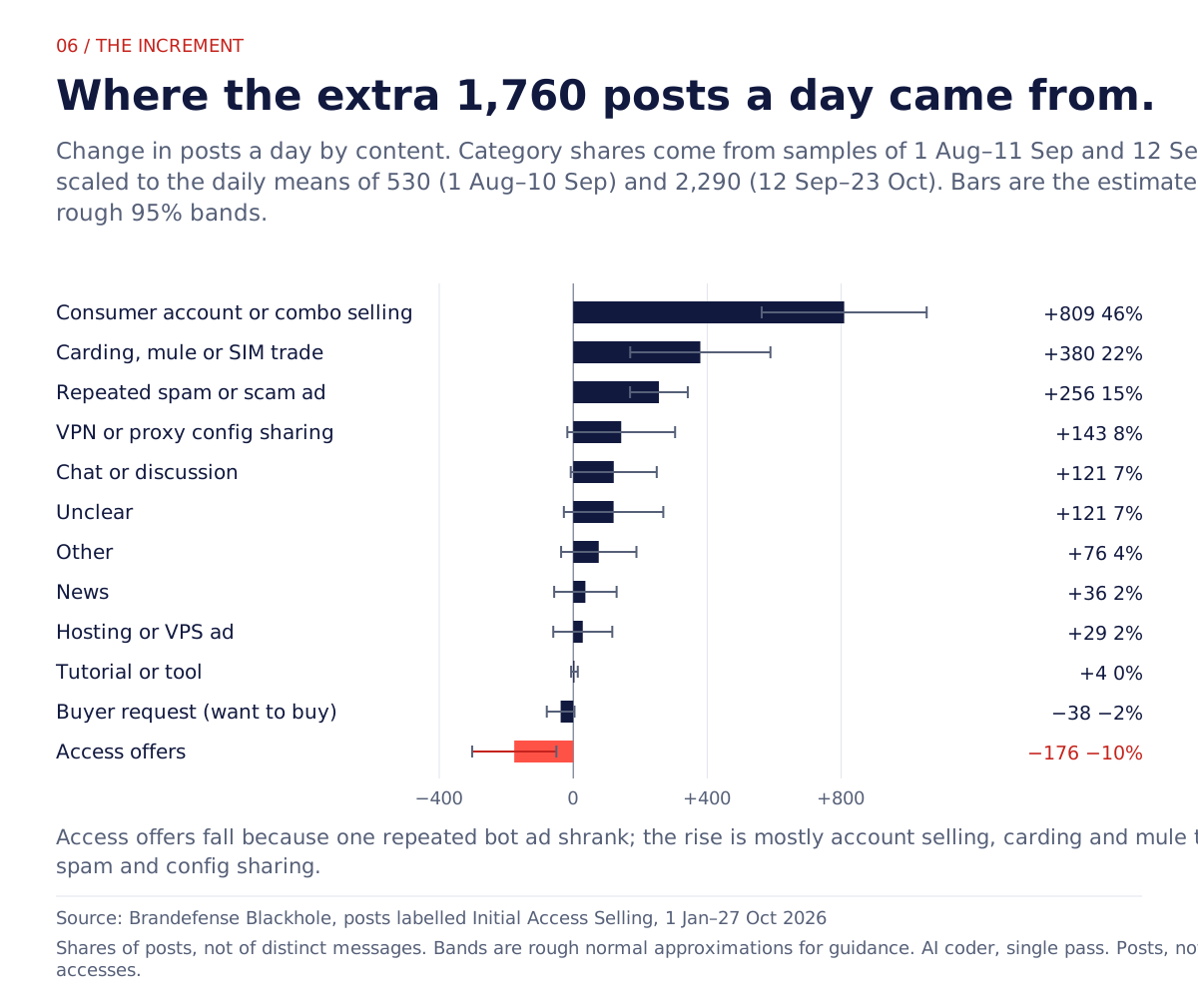
Change in posts a day by content. Category shares come from samples of 1 Aug–11 Sep and 12 Sep–27 Oct, scaled to the daily means of 530 (1 Aug–10 Sep) and 2,290 (12 Sep–23 Oct).
| Content | Change a day | Share of increment | Rough 95% band |
|---|---|---|---|
| Consumer account or combo selling | +809 | 46% | +563 to +1,055 |
| Carding, mule or SIM trade | +380 | 22% | +170 to +589 |
| Repeated spam or scam ad | +256 | 15% | +170 to +342 |
| VPN or proxy config sharing | +143 | 8% | −18 to +304 |
| Chat or discussion | +121 | 7% | −7 to +249 |
| Unclear | +121 | 7% | −28 to +269 |
| Other | +76 | 4% | −36 to +189 |
| News | +36 | 2% | −57 to +130 |
| Hosting or VPS ad | +29 | 2% | −60 to +117 |
| Tutorial or tool | +4 | 0% | −6 to +14 |
| Buyer request (want to buy) | −38 | −2% | −79 to +4 |
| Access offers | −176 | −10% | −302 to −50 |
Each investigation answers a different question from the same collected posts. Start with the main one, then follow the question that matters to your team.
Most Initial Access Offers We Read Sold Websites, Not Networks
Among posts labelled as access sales, most were not offers. The offers we read mostly sold web shells, cPanel, SMTP and RDP; corporate network access was a thin slice of 120.
Read the investigation →Posts labelled as access sales rose 4.3x on 12 September 2026, but de-duplicated offer posts per day showed no detectable change. Five tests show why.
Read the investigation →We read 120 corporate network access listings in full. Perimeter services and admin rights lead; revenue bands remain unverified seller claims.
Read the investigation →Cheap web shells, cPanel logins, SMTP and RDP are separate products with different price units. Averaging their prices describes none of them.
Read the investigation →These are implications of what the posts say, not measured control results. Each one points to a different decision.
Ask what the object is before you act: a website foothold, a rented server or a network. Each points to a different owner and check.
Know who can reach your firewall, VPN and remote-access admin interfaces: edge and remote-access services dominate the corporate listings once the repeated firewall family is counted once.
Treat a list that names your domain as a lead to check against your own logs, not as proof of a breach; lists carry sold and lost items.
Do not read a classifier's label count as a threat level; ask whether a feed number counts posts, distinct messages or coded offers.
See when your company's passwords, data or name show up on criminal forums and markets.
See how it works →Free exposure check. Enter your company domain and see what is visible from the outside, in about 30 seconds.
Seeded, stratified random sample of posts carrying the classifier label (n=150 Jan–Aug, n=180 after 12 Sep). Each post was coded in full by an AI coder against a written codebook; shares are population-weighted with Wilson 95% intervals (28.1–49.5% and 2.0–11.4%). A blind second AI pass agreed on offer vs not-offer in 89 of 90 posts.
Read the report, open the evidence records and reuse the charts with their source and limits.
Original aggregate tables, charts and editorial paraphrases: CC BY 4.0. Keep the source, version, date range and measurement limits with reused figures.
30 October 2026 · Brandefense Research Team · Brandefense Blackhole data · Prepared by Claude Opus 5.5, checked by Codex Astra and approved by Brandefense analysts.
The Cybercrime Report 2026 reads eight kinds of activity in the same collection. Each chapter counts its own unit, so compare their limits before you compare their numbers.