
Skip to content
NewCybercrime Report 2026 · Eight Chapters · A Post Is Not An Incident → Explore The ChaptersCybercrime Report 2026 → Explore
Brandefense Cybercrime Report 2026 · Hacktivism & DDoS

NoName Claim Lists: Political Headers, Listed Sites.

Hacktivist groups and DDoS-for-hire sellers both post target lists with a reachability-check link as proof. A hacktivist DDoS claim is a campaign notice, not an outage report; a for-hire ad sells time offline or rented capacity to a private buyer. One repeated advertisement template dominates the raw "ddos" volume.

1 January–27 October 2026 · Research edition 1.0
NoName057(16), 1 Jan–27 Oct 578
distinct NoName057(16) DDoS claim events (1 Jan–27 Oct 2026), carrying 2,920 claimed target entries
Merged across channels and languages. Claims, not confirmed outages.
Collected posts, not incidents or market totalsAdvertised terms, not tested services What this number measures →
01Key findings

Campaign Notices And Time Offline For Sale

Each finding below is stated in its own unit, with the limit that comes with it. The investigations give the full reasoning and the evidence records.

DDoS keyword volume · monthly

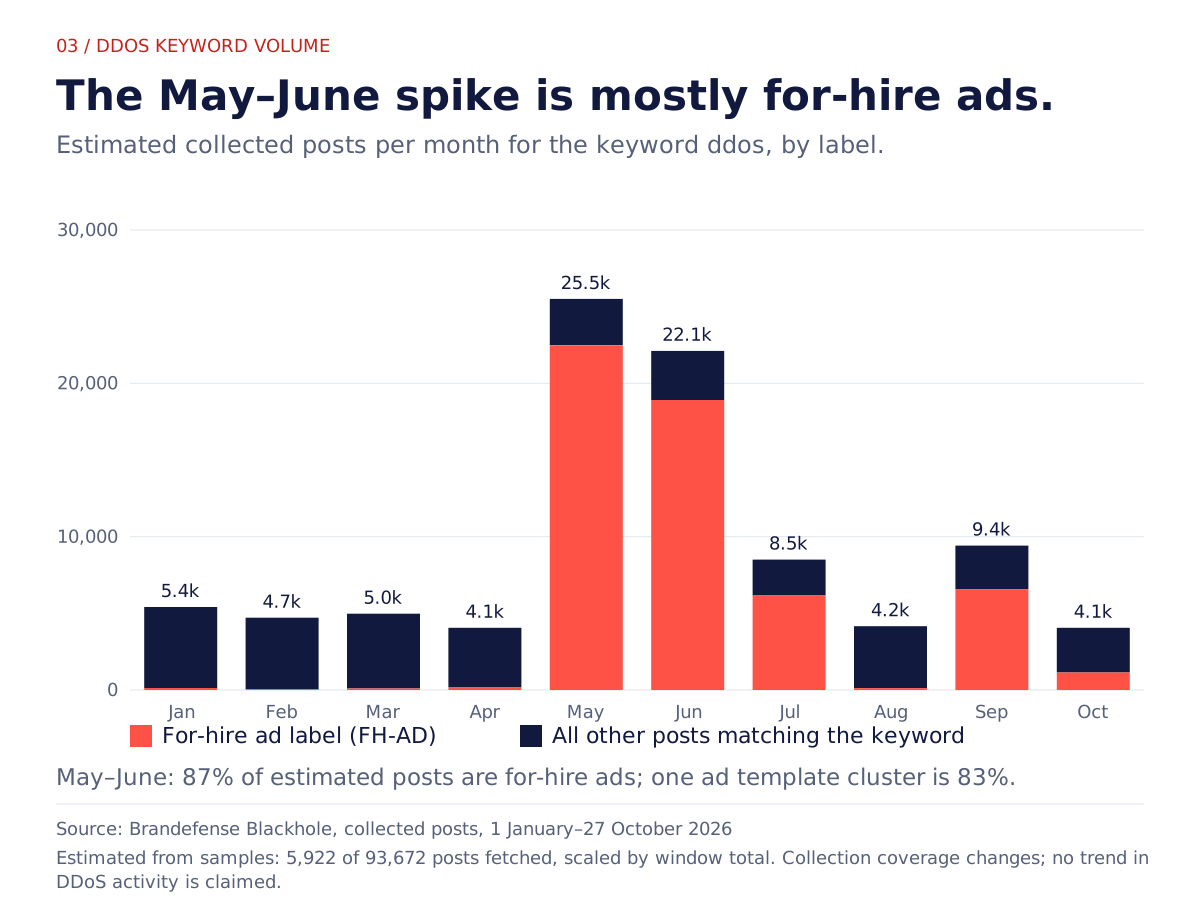
The May–June spike is mostly for-hire ads.

Estimated collected posts per month for the keyword ddos. The table splits each month into the for-hire ad label and all other posts.

Estimated collected posts
Estimated posts, keyword ddosMay–June spike* October ends on 27 October
May–June: 87% of estimated posts are for-hire ads; one ad template cluster is 83%. Source: Brandefense Blackhole, collected posts, 1 January–27 October 2026. Estimated from samples: 5,922 of 93,672 posts fetched, scaled by window total. Collection coverage changes; no trend in DDoS activity is claimed.
Chart dataCSV · 139.4 KBOriginal chartSVG · 96.7 KB
+View as table
MonthEstimated postsOf which for-hire ad label
2026-015,413131
2026-024,71460
2026-034,97999
2026-044,054161
2026-0525,50522,482
2026-0622,11818,914
2026-078,5076,163
2026-084,158123
2026-099,4196,572
2026-10 (to 27 Oct)4,0561,142
  1. 01A hacktivist DDoS claim post is a campaign notice. It has a political header tied to a news trigger in 216 of 578 events (37%), about five listed sites (median 5), and an outside reachability-check link for most entries. It records a claim, not an outage.
  2. 02The group marks its own "proof" as weak. 851 of 2,883 listed entries (29.5%) carry its own geo-block, dead-ping or placeholder remark. Outage wording appears in just 77 of 578 event headers (13%).
  3. 03Claims run in weekly country themes. 48 of 102 single-country runs reached five or more events (26 were a single event), and 42 of 48 longer runs began on a Monday. In 22 of 44 weeks, one country held 70% or more of that week's claimed entries (against a baseline of at most 2 weeks under random labelling).
  4. 04Commercial DDoS-for-hire sells one of two things, priced with the unit kept and never averaged. One is time a target is held offline (hold services, with refunds); the other is rented attack capacity (plans, slots, API or botnet access). Nearly one in five ad clusters (48 of 259) frames the service as removing a phishing or lookalike site. A lookalike page going dark is therefore a lead, not a confirmed takedown.
  5. 05Raw "ddos" volume is concentrated in one advertisement template cluster; seller count is unknown. A single Chinese-language order-taking advertisement accounts for 6,028 of 6,723 collected for-hire ad posts (89.7%). In the sampled May–June "ddos" keyword set, an estimated 86.9% of posts are for-hire ads and that one template accounts for 82.6%. These describe what the spike contained, not why it began.
  6. 06One real hacktivist claim becomes about 1.92 collected posts (2.25 in January–June, when three language mirrors were collected; 1.10 in July–August, English only). Defenders should therefore count claim events, not posts.
02The investigations

Three Questions. One Data Set.

Each investigation answers a different question from the same collected posts. Start with the main one, then follow the question that matters to your team.

03For defenders

When A Claim Changes A Triage Decision

These are implications of what the posts say, not measured control results. Each one points to a different decision.

  1. Treat a claim that names your country or sector as a dated notice to check against your own logs, not as an outage report. Map the listed pages to your services and read the claimant's own geo-block or ping remark on each.

  2. Count the claim event once, with its date and listed entries. Post totals depend on collected language mirrors, so these data cannot separate coverage changes from activity.

  3. For brand protection, a lookalike or phishing page that goes dark has not necessarily been taken down. Record why it went dark, keep a capture, and confirm removal with the host or registrar.

  4. A rise in "ddos" chatter on Telegram can be one seller re-posting one advertisement; do not read it as rising political activity or fold it into a hacktivist claim count.

Module

Dark Web Monitoring

See when your company's passwords, data or name show up on criminal forums and markets.

See how it works →
Free exposure check

Check Your Domain.

Free exposure check. Enter your company domain and see what is visible from the outside, in about 30 seconds.

Request a demo
04 / From research to monitoring

From Research To Monitoring.

05Method & limits

Counting Claim Events Across Mirrors

Source
Brandefense Blackhole.
Period
1 January–27 October 2026, by post time. October is partial.
Edition
Research edition 1.0.
Read the complete method →HTML · 19.2 KB

A claim event is one claim by one group against one set of targets on one day, after exact and near-duplicate posts are merged across channels and languages. Claimed target entries are the sites listed inside those claims. Both are counts of Blackhole-collected, Telegram-dominated posts, not confirmed attacks, outages or victims.

06Get the research

The Research. Ready To Inspect.

Read the report, open the evidence records and reuse the charts with their source and limits.

Original aggregate tables, charts and editorial paraphrases: CC BY 4.0. Keep the source, version, date range and measurement limits with reused figures.

30 October 2026 · Brandefense Research Team · Brandefense Blackhole data · Prepared by Claude Opus 5.5, checked by Codex Astra and approved by Brandefense analysts.