
What a Database Leak Post Actually Claims
A database leak post is a short claim with a field list, a unit, a year and a thread. Reading those four items shows which kinds of data posters say they hold.
Read the investigation →Of 9,409 Blackhole-collected posts mentioning a data breach, about three in five retell the news, and relay alerts repeat forum thread titles. Some of the rest are short claims whose fields, counts and dates are the poster’s own words. We read what they say and how the data is sold.
Each finding below is stated in its own unit, with the limit that comes with it. The investigations give the full reasoning and the evidence records.
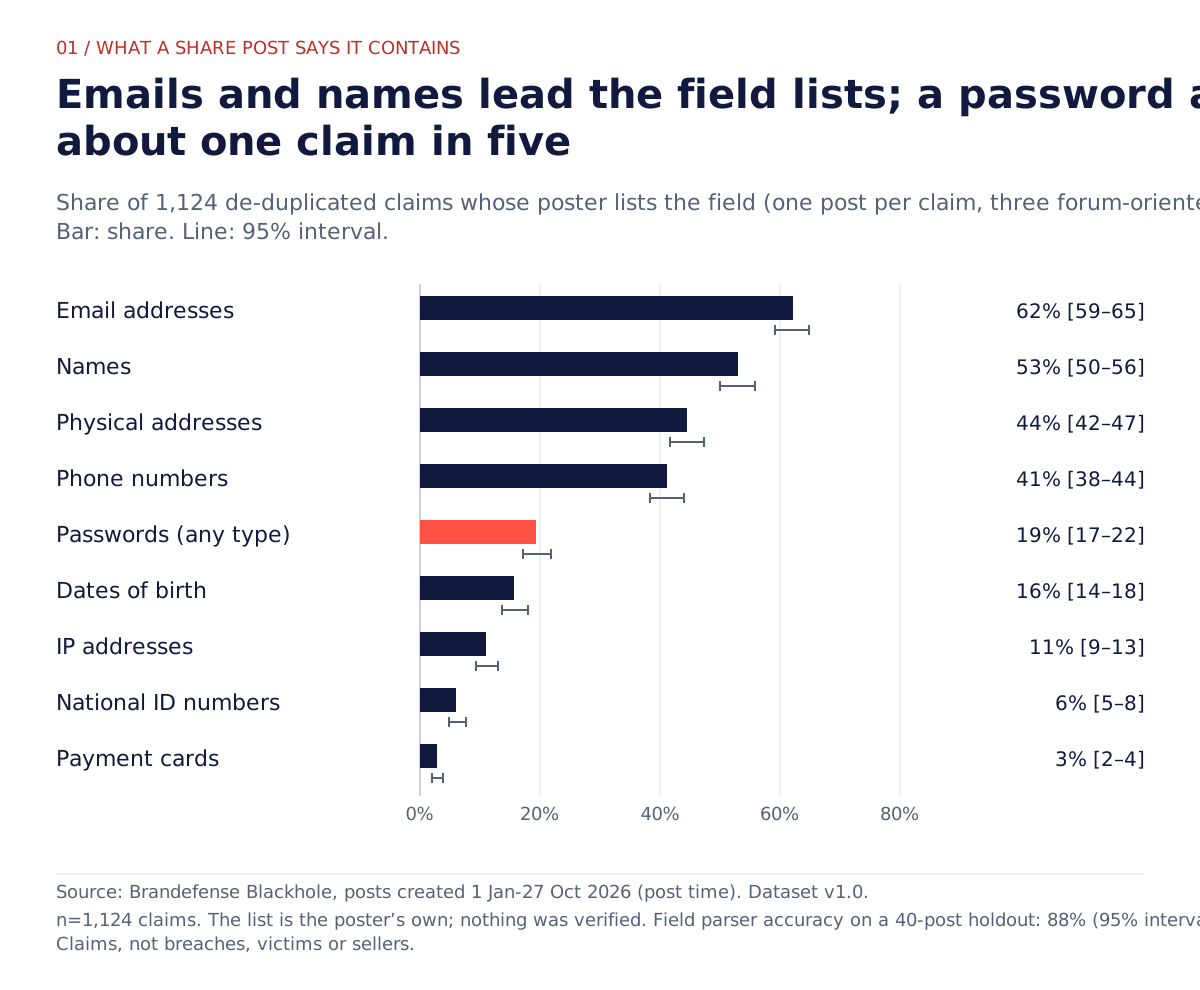
Share of 1,124 de-duplicated claims whose poster lists the field (one post per claim, three forum-oriented sets).
| Field | Share of claims | 95% interval | Claims |
|---|---|---|---|
| Email addresses | 62% | 59–65% | 1,124 |
| Names | 53% | 50–56% | 1,124 |
| Physical addresses | 44% | 42–47% | 1,124 |
| Phone numbers | 41% | 38–44% | 1,124 |
| Passwords (any type) | 19% | 17–22% | 1,124 |
| Dates of birth | 16% | 14–18% | 1,124 |
| IP addresses | 11% | 9–13% | 1,124 |
| National ID numbers | 6% | 5–8% | 1,124 |
| Payment cards | 3% | 2–4% | 1,124 |
Each investigation answers a different question from the same collected posts. Start with the main one, then follow the question that matters to your team.
A database leak post is a short claim with a field list, a unit, a year and a thread. Reading those four items shows which kinds of data posters say they hold.
Read the investigation →Data leak alerts are often relay cards pointing at forum adverts. See what a card, a retelling and a first-hand post each prove, and how to triage an alert.
Read the investigation →Breach database offers lean on a sample; lead lists more often promise validity, and some also promise replacement. One advertiser sits behind much of the lead-list pattern.
Read the investigation →These are implications of what the posts say, not measured control results. Each one points to a different decision.
Let the field list decide the response: contact and identity fields point to phishing and impersonation, so a password reset covers little of that exposure.
Treat a size as a claim with a unit: a third of claims give no count, and one post can give two counts far apart.
Log the type of every alert, and do not close an alert that names your organisation on the title alone.
Count a retold claim once: trace a news item or relay card back to the first claim behind it.
Route a sale post with two questions: is the file real, and are these people about to be contacted?
See when your company's passwords, data or name show up on criminal forums and markets.
See how it works →Free exposure check. Enter your company domain and see what is visible from the outside, in about 30 seconds.
Share of the ~9,400 posts matching the whole-word keyword "data breach" (47 of 48 weekly windows fetched in full) that fixed rules classify as news retelling (64%). We corrected that rule share for errors measured against 70 posts labelled by an AI reader working separately from the rules, giving 63% with a 95% range of 55–69%.
Roughly one in five (16–29%) shares, sells or relays data first-hand.
Read the report, open the evidence records and reuse the charts with their source and limits.
Original aggregate tables, charts and editorial paraphrases: CC BY 4.0. Keep the source, version, date range and measurement limits with reused figures.
30 October 2026 · Brandefense Research Team · Brandefense Blackhole data · Prepared by Claude Opus 5.5, checked by Codex Astra and approved by Brandefense analysts.
The Cybercrime Report 2026 reads eight kinds of activity in the same collection. Each chapter counts its own unit, so compare their limits before you compare their numbers.