
Skip to content
NewCybercrime Report 2026 · Eight Chapters · A Post Is Not An Incident → Explore The ChaptersCybercrime Report 2026 → Explore
Brandefense Cybercrime Report 2026 · Exploits, Tooling & AI

What Exploit And Tool Ads Really Sell.

Most keyword hits are not offers. Of 93 exploit seller posts using the word 0-day, only 37 were coded as unnamed-exploit claims, and none names a CVE. Tooling ads sell keys and builds, not a detection outcome.

Counts are post IDs in a Telegram-dominated slice, not offers, sellers or market size.

1 January–27 October 2026 · Research edition 1.0
Seller posts that say 0-day 37 of 93
exploit seller posts using the word 0-day that were coded as unnamed-exploit claims
One square = one post. Coral = 37 coded as unnamed-exploit claims (not always one flaw); for the rest, the word is sales vocabulary on tools, bundles and menus.
Collected posts, not incidents or market totalsAdvertised terms, not tested services What this number measures →
01Key findings

Unnamed Claims, Subscriptions And AI Labels

Each finding below is stated in its own unit, with the limit that comes with it. The investigations give the full reasoning and the evidence records.

What is on sale · n = 221

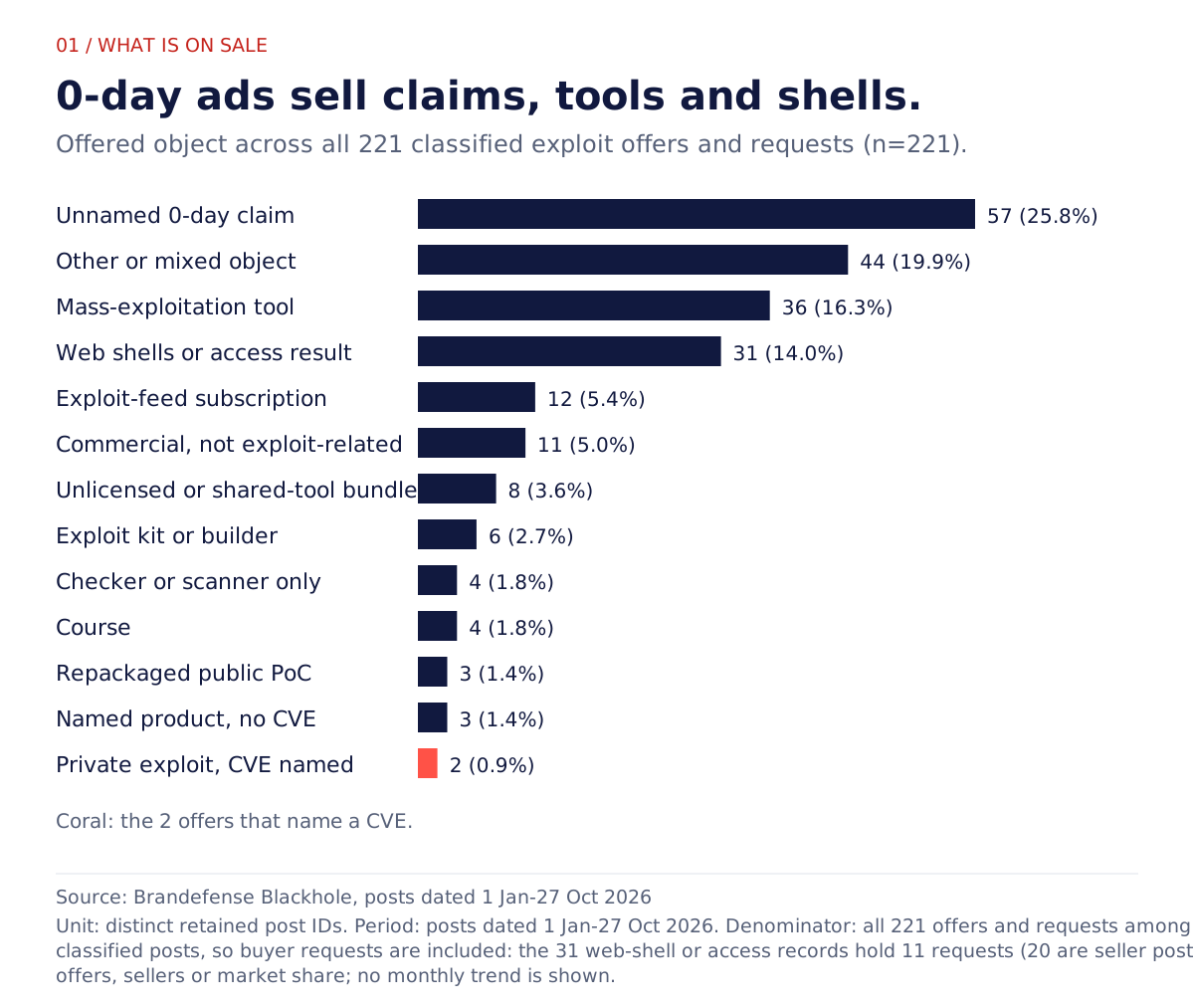
0-day ads sell claims, tools and shells.

Offered object across all 221 classified exploit offers and requests (n=221).

Distinct retained post IDs
Offered objectThe 2 offers that name a CVE
Denominator: all 221 offers and requests among 700 classified posts, so buyer requests are included: the 31 web-shell or access records hold 11 requests (20 are seller posts). Source: Brandefense Blackhole, posts dated 1 Jan-27 Oct 2026. Unit: distinct retained post IDs. Not offers, sellers or market share; no monthly trend is shown.
Chart dataCSV · 18.6 KBOriginal chartSVG · 95.9 KB
+View as table
Offered objectRecordsShare of 221
Unnamed 0-day claim5725.8%
Other or mixed object4419.9%
Mass-exploitation tool3616.3%
Web shells or access result3114.0%
Exploit-feed subscription125.4%
Commercial, not exploit-related115.0%
Unlicensed or shared-tool bundle83.6%
Exploit kit or builder62.7%
Checker or scanner only41.8%
Course41.8%
Repackaged public PoC31.4%
Named product, no CVE31.4%
Private exploit, CVE named20.9%
  1. 01Among 193 seller posts (the base for object and price counts), 56 sell a mass-exploitation tool or the web shells it produces. Another 47 are coded exploit-claim posts (unnamed-exploit, CVE-named or public-PoC codes). Web software is the largest stated target class (95 of 221 records, 43.0%); 71 name no target.
  2. 02In the six ads compared, price tiers separate copies, exclusivity, device counts or a service. No priced seller post gives a CVE identifier: 70 of 193 seller posts show a stated amount, and the 2 CVE-named offers show none. So claimed capability or target cannot be ruled out as the driver.
  3. 03One reposted Turkish bundle advert is 48 of the 169 strict direct and service tooling offers. Of the other 121, 33 claim FUD or undetectability (27.3%) and 1 states a window (three days). Written seller duties are rare: support 16, updates 12, rebuild 5, refund 1, while 19 name escrow, a payment protection. Of 29 crypter, loader and AV-bypass offers, 18 claim FUD, 2 a rebuild and 1 a refund.
  4. 04Of 607 distinct named-tool texts, 168 are offer-type (27.7%). Of 141 hosted-access texts, 122 state no backend model; 15 offers are prompt packs, and brand names also collide with unrelated services. The backend field has second-reader kappa 0.24, so backend counts are indicative.
Explore the edited evidence

Separate the Claim From the Evidence

Examine selected 0-day, AI-branded, FUD, lifetime, fresh and private claims. Each example keeps the recorded wording beside its evidence limits.

Explore the claim and evidence cards →
02The investigations

Three Questions. One Data Set.

Each investigation answers a different question from the same collected posts. Start with the main one, then follow the question that matters to your team.

03For defenders

What An Exploit Ad Adds To Patch Triage

These are implications of what the posts say, not measured control results. Each one points to a different decision.

  1. Treat a 0-day label as an unverified claim: only 37 of 93 exploit seller posts using the word were coded as unnamed-exploit claims, and none gives a CVE. Ask whether the post names a version, a CVE or checkable detail, and check for a vendor advisory or CISA catalogue entry before acting.

  2. Prioritise public web and CMS software by exposure, not by label. It is the largest stated target class in the records (43.0%), and tools and web shells make up 56 of 193 seller posts.

  3. Favour behaviour-based detection over hash or packer signatures: wrappers are rebuilt often and sold separately from the payload.

  4. Treat AI accounts and API keys like other credentials, do not rely on brand-name blocklists (names float and collide), and treat unknown AI apps and bots as untrusted software.

Use case

Vulnerability Intelligence

See which new vulnerabilities are being exploited and which of them touch your technology.

See how it works →
Free exposure check

Check Your Domain.

Free exposure check. Enter your company domain and see what is visible from the outside, in about 30 seconds.

Request a demo
04 / From research to monitoring

From Research To Monitoring.

05Method & limits

Tracing Tool Claims To Advertised Terms

Source
Brandefense Blackhole.
Period
1 January–27 October 2026, by post time. October is partial.
Edition
Research edition 1.0.
Read the complete method →HTML · 18.9 KB

182 exploit seller posts (193 minus 11 off-topic) in a stratified sample of 700 classified Blackhole posts, 1 Jan-27 Oct 2026. Of these, 93 use 0-day or zero-day in any form, and none gives a CVE. Only 37 were coded as unnamed-exploit claims, a broad code that also covers research services, multi-exploit lists and chains.

The rest are menus and other goods (25), mass tools (12), unlicensed/shared-tool bundles (8), feeds (5), kits (3) and 3 other items.

06Get the research

The Research. Ready To Inspect.

Read the report, open the evidence records and reuse the charts with their source and limits.

Original aggregate tables, charts and editorial paraphrases: CC BY 4.0. Keep the source, version, date range and measurement limits with reused figures.

30 October 2026 · Brandefense Research Team · Brandefense Blackhole data · Prepared by Claude Opus 5.5, checked by Codex Astra and approved by Brandefense analysts.