Seven complete investigations: programme roles, entry conditions, distribution and different tool rights beside 9,203 canonical claims from 177 groups.
Brandefense Research Team · Brandefense Blackhole data · Prepared by Claude Opus 5.5, checked by Codex Astra and approved by Brandefense analysts.
Chapter hub · The full-year PDF edition follows in early 2027.
Ransomware in 2026: 9,203 Claims, 177 Groups and Splits up to 95%
Advertised work beside the collected claim series.
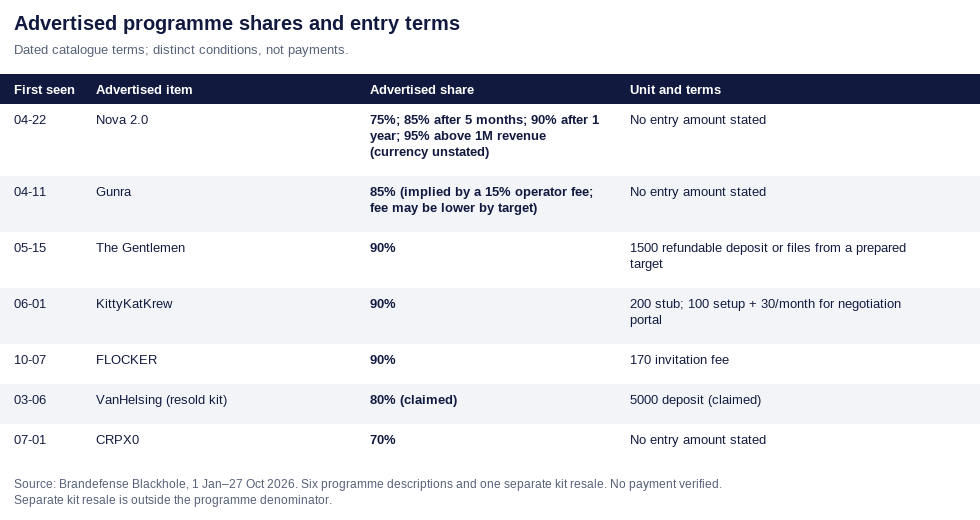
Nova’s catalogued 22 April offer starts a partner at 75%, lifts the share with tenure and attaches 95% to a 1M revenue threshold, with currency unstated. A headline split is therefore a contract with conditions. Other selected offers price a portal separately or make the affiliate conduct the talks.
The collected claim series answers a different question: 33 of 177 groups account for 5,950 of 9,203 canonical claims, or 64.7%, while appearing in at least eight months. This chapter connects the advertised division of work with that concentrated public output, without treating an ad as proof of an intrusion.
The collected series and retained catalogue
9,203
De-duplicated leak-site claims
177
Group labels after spelling-variant merges
33
Groups active in at least eight observed months
12
Recruitment items in the edited catalogue
Brandefense Blackhole, 1 Jan–27 Oct 2026; claims are canonical group–victim pairs
What Crews Offer Their Partners
Start with the money. In a ransomware-as-a-service deal, the crew supplies the locker, the panel and the leak site, and an affiliate breaks into the victim. The ads say how the ransom is divided.
The Gentlemen offered 90% with a proof-or-deposit entry rule. KittyKatKrew also advertised 90%, while FLOCKER added a $170 invitation fee. The affiliate-terms investigation compares what those conditions require from an applicant.
The catalogued Gunra offer keeps a 15% operator fee, implying an 85% partner share, with a lower fee possible depending on the target. The retained CRPX0 programme clause promises the partner a 70% commission on every successful payment. These are promises to participants, not observed payouts.
Six programme ads state or imply a split. CRPX0 offers the lowest of those, 70%. A 6 March reseller's pitch for a VanHelsing kit claims 80% and a $5,000 deposit; the kit itself was advertised for 700 Telegram Stars.
This is a resale offer, not recruitment by the original group. Nova and Gunra exclude CIS targets in their ads; Firestorm advertises a built-in CIS check.
Six catalogue programme-share descriptions and a separate kit resale. Conditions differ; no payment verified.
Vect, KRYBIT and Firestorm publish programme ads without a split. Two partner notices instead concern pressure on victims. The retained insider description does not say who would receive any percentage, so it is excluded from the share comparison.
Negotiation Became a Product
The ads describe different ways to staff the talks. Gunra says its own staff can negotiate, while The Gentlemen assign control to the affiliate. These examples distinguish the person conducting a chat from the provider of the locker and infrastructure.
The edited KRYBIT description says lawyers and journalists may be used to influence negotiations. The BLACKNET-00 description lists triple extortion, a public auction and ransom-discount management. Those advertised functions concern pressure and administration; the catalogue does not prove that the services were delivered.
A turnkey RaaS platform with victim chat and a branded leak site. The ad says the buyer keeps all profit.
The price
$5,000, one time.
Also on offer
A dedicated negotiation team, advertised in the crew's own recruitment post on 1 July.
KittyKatKrew: negotiation on the price sheetTelegram ad · 1 Jun 2026 · paraphrased
Advertised portal
$100 setup and $30 a month; a separate $200 upfront stub charge.
Advertised split
90% to the affiliate; no transaction or successful deployment was verified.
The pressure rules are published too. A notice first seen on 1 February, from the Mimic crew, told its partners how to force the talks. A target silent for two weeks gets an undated public entry on the leak site.
An older RaaS thread was first seen on 14 January and updated on 17 January. It announced a legal team that files paperwork against victims who stop talking or refuse to pay.
The catalogue records both as forum items. Its dates are first-seen dates, not original-publication dates. These are stated pressure tactics, not a guarantee of how a crew will behave.
Mimic: a published pressure ruleForum notice · first seen 1 Feb 2026 · paraphrased
The notice says
After two weeks without a response, partners should make an undated public entry to pressure the target.
What this establishes
A stated publication policy; the catalogue’s first-seen date does not establish when the original notice was written.
Two demand examples discussed in the catalogue are unverified: a $5,500 figure quoted from a 2022 case and the VanHelsing reseller’s claim of up to $500,000. They are examples, not an exhaustive inventory or current negotiated amounts.
Where Crews Recruit
Vect advertised its second version on 14 February. On 25 March it announced a partnership with a forum in the BreachForums mould, under which every member was offered an affiliate key. A post of 16 April claimed the keys were being sent to all registered users. The Gentlemen followed on 15 and 16 May with their own ad and a partnership announcement.
A Russian-language chat reported on 13 June that one forum had started to admit ransomware ads for a 0.5 BTC deposit.
On 28 January the FBI seized RAMP, the forum that ransomware crews had used openly since 2021 after Exploit and XSS banned such promotion, according to BleepingComputer.
The retained recruitment items appear on forums and Telegram. These venues show where this selection is visible. They do not establish movement from the seized forum, because the selected records are not a before-and-after sample of that venue.
Dated Tools and Platform Offers
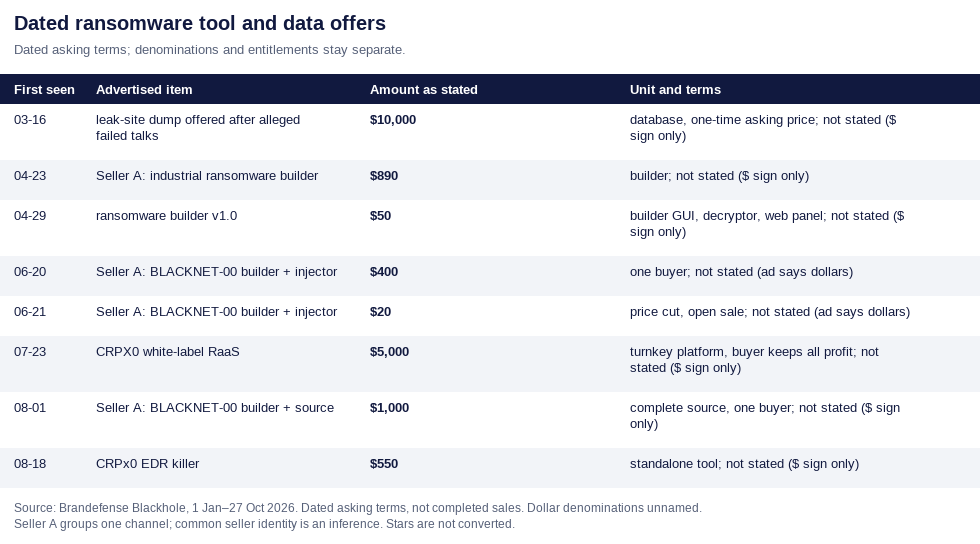
Amounts here are as the ads give them; none names a currency. A builder with a graphical interface, decryptor and web panel was advertised at $50 on 29 April. An industrial builder was offered at $890 on 23 April, and an EDR killer at $550 on 18 August.
The edited catalogue records a $5,000 one-time CRPX0 platform offer on 23 July, with affiliate management, a branded leak site and a negotiation portal. The buyer-keeping-profit clause belongs to this platform sale, separately from the 1 July affiliate commission.
Selected BLACKNET-00 offers appeared in the same Telegram channel and are grouped as Seller A; common seller identity is an inference. The catalogue records a one-buyer builder-and-injector package at $400 on 20 June, an open-sale $20 offer the next day and a $1,000 source-code offer on 1 August. Package and access terms change, so the sequence is not a market price curve.
Dated tool and data asking terms. Amounts, denominations and rights are not a common price axis.
Six catalogue items are classified as free-builder sharing, including descriptions of Petya-style, Chaos and Arsium code. Some items combine multiple posts or threads. The descriptions do not verify free access, delivery or safe code. This is a catalogue distribution category, not a comparable paid product tier.
The initial 60-item catalogue contains one EDR-killer price and no broader crypter market tied to ransomware; a separate five-offer price audit is covered in the EDR killer article. The catalogue is not a complete tooling-market inventory.
Who Wants In
We retained six catalogue items about seeking or supplying access to crews, including a reply under Vect’s recruitment thread. On 6 June, one description records access without malware skills and a request for a ready-to-deploy locker. This is a proposed division of work, not a verified intrusion or deal.
A different catalogue item, first seen on 3 February and repeated on 2 April, offers to monetise corporate access for a profit share. The two descriptions meet at the same dependency: a locker provider needs access, while an access holder may need a provider. We have not linked either item to a later claim.
The Claims Next to the Ads
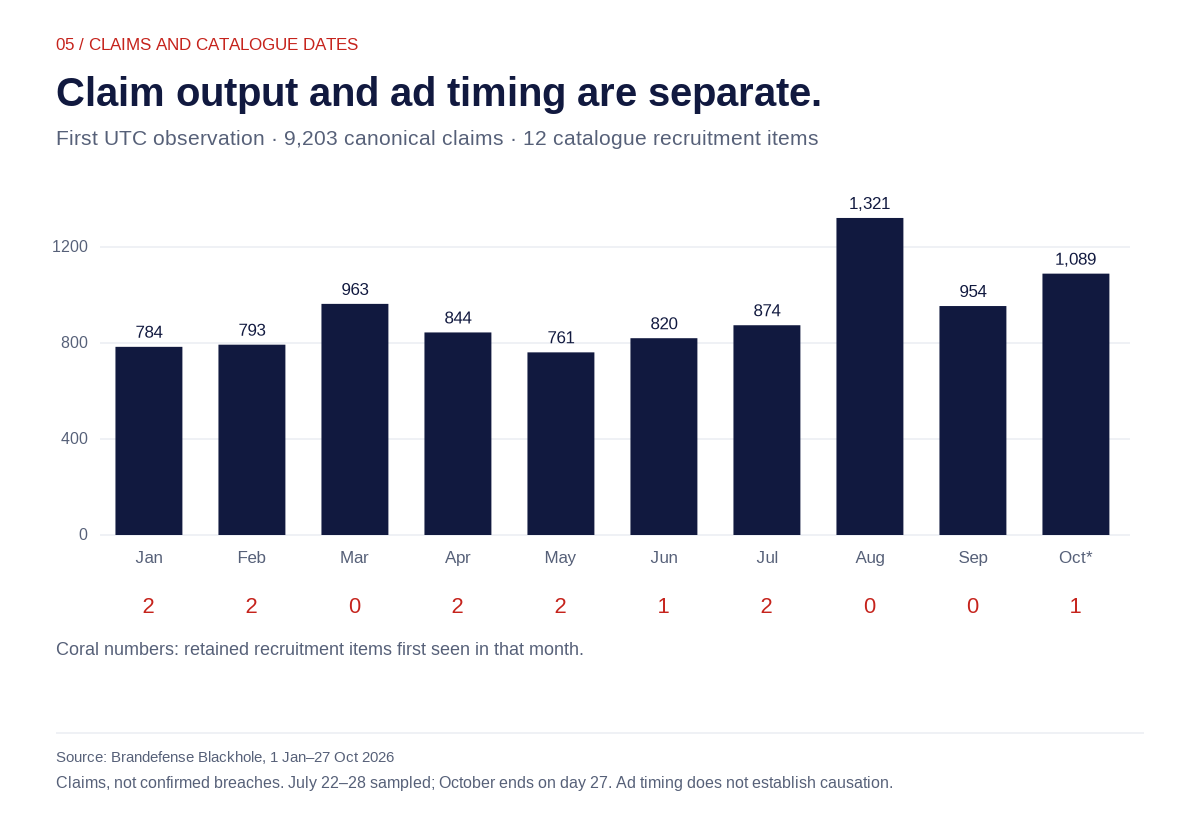
Now the leak sites. Between January and July, Blackhole counted between 761 and 963 claims a month, a mean of 834.1. August brought 1,321, the busiest month in the observed period, and 1,177 of those claims were seen by two or more relay bots.
September fell to 954 and October reached 1,089 by the 27th. NCC Group's count also peaked in August, at 1,073 attacks, its 2026 high; its September report puts September at 821. The two series use different collection methods and have not been reconciled.
Public trackers carry these claims too; nothing in the count itself is exclusive to us.
Recruitment ads were first seen in seven of the ten months, with none in March, August or September. August did contain reposts and sales posts: the gap is in first sightings of programme ads. It establishes no cause for the claim peak.
Monthly claims and first-seen dates of catalogue recruitment items. July 22–28 sampled; October through 27 October. No causal effect established.
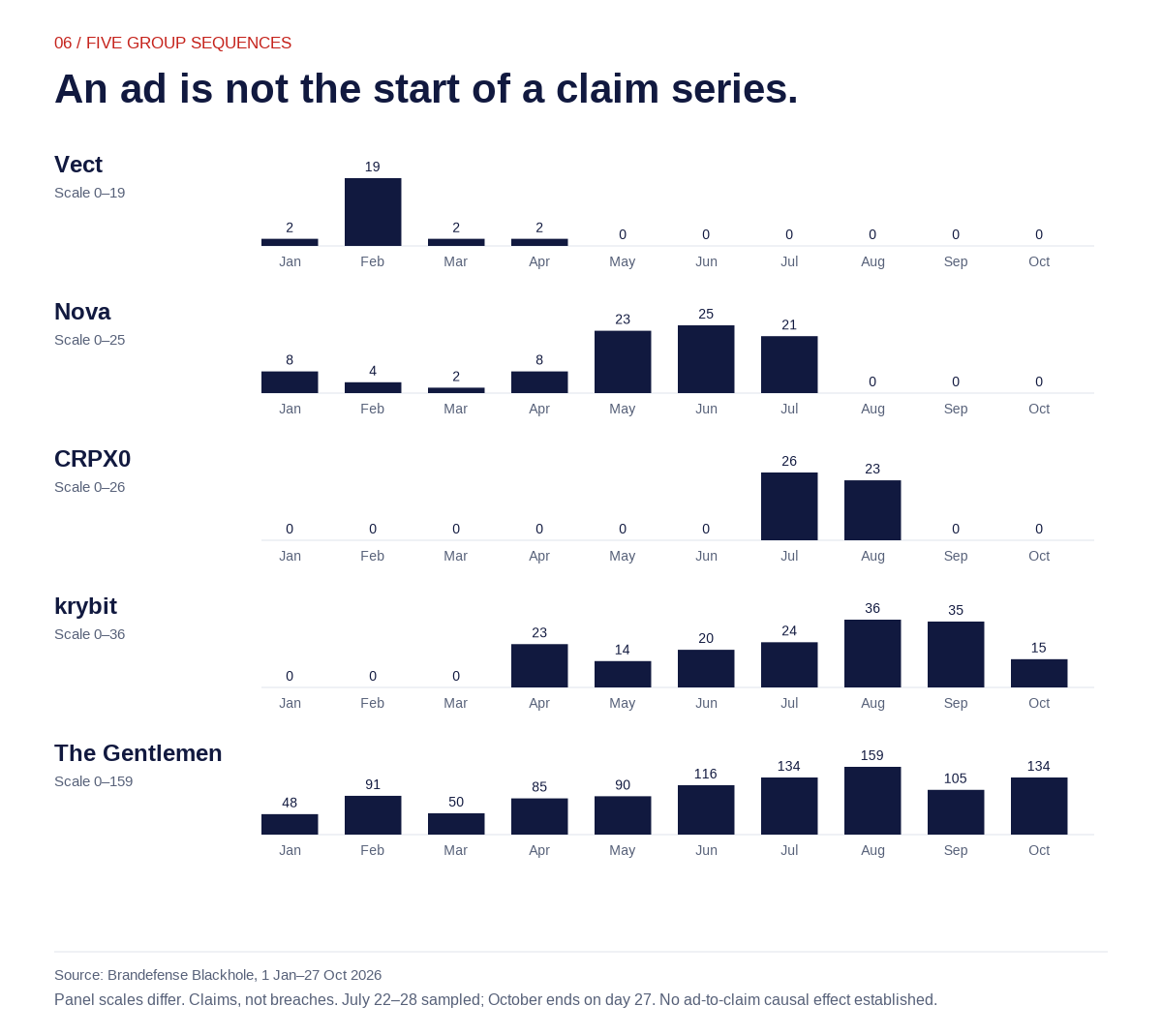
The group stories show that the order is mixed. Vect posted 19 of its 25 claims in February, the month of its second-version ad. Nova's relaunch ad came on 22 April, after 14 claims from January to March and 8 in April. Its claims peaked in the three months after, at 23, 25 and 21, with none in our dataset after July.
CRPX0 advertised on 1 July and posted 26 distinct claims that month and 23 in August, then none. KRYBIT claimed first, 23 in April, and advertised on 17 May. Gunra peaked at 15 claims in March and advertised in April.
The Gentlemen were already at 90 claims in May, the month of their ad, and reached 159 in August.
Vect, Nova, CRPX0, KRYBIT and The Gentlemen: monthly claim sequences. Panel scales differ; ad timing does not establish causation.
The field itself widened. Active groups rose from 58 in January to 92 in August and stood at 85 in October. Qilin (1,146 claims) and The Gentlemen (1,012) together made up 23.4% of everything.
The 33 groups that posted in eight or more months hold 64.7% of the claims. At the other end, 50 groups appear in a single month. n0n, a group first seen in September, posted 145 of October's 1,089 claims.
October is partial, so this is not a full-month comparison.
January’s Leaders Represented Less of September
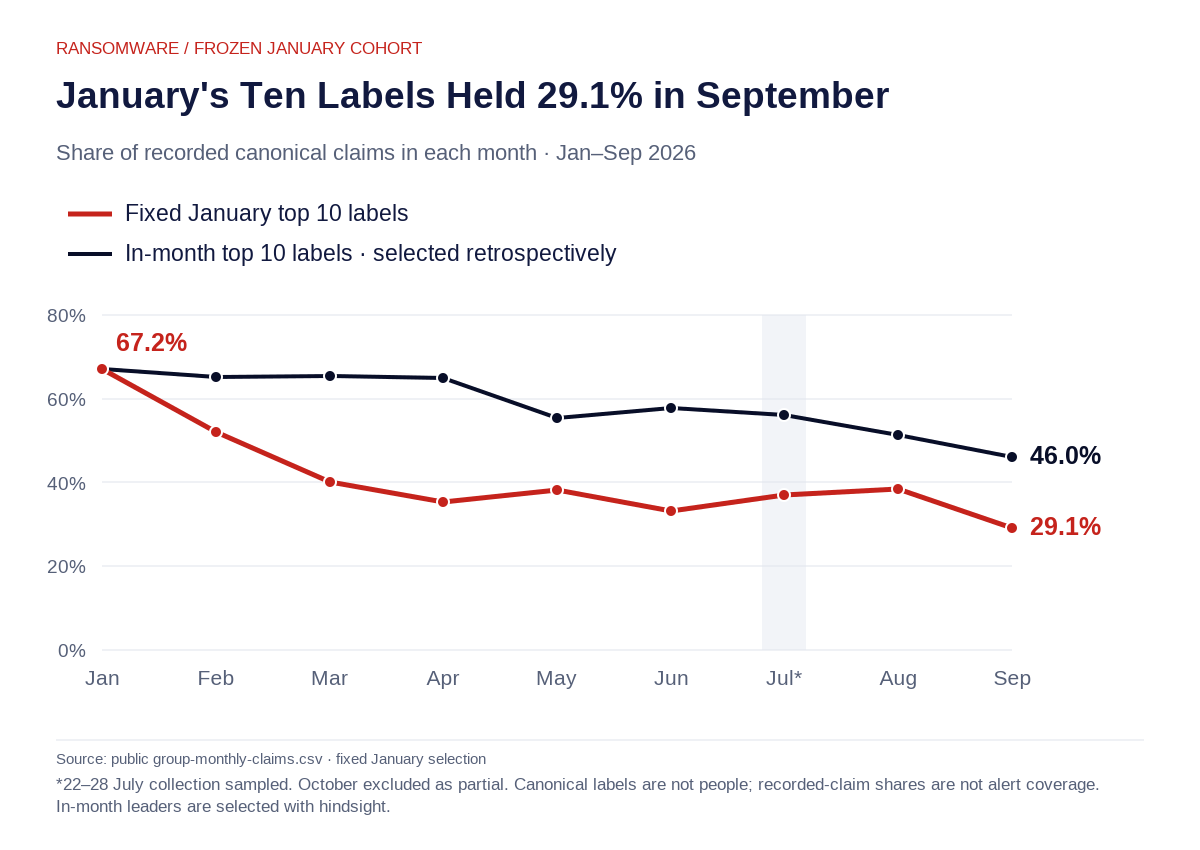
The ten labels with the most January claims accounted for 527 of 784 recorded claims (67.2%). Keeping that list fixed, their September share was 278 of 954 (29.1%). Each month's total recorded canonical group–victim pairs supplies the denominator.
September's own top ten held 439 claims (46.0%). Choosing leaders after seeing that month's results describes concentration with hindsight. It cannot show what a forward monitor would have captured.
This comparison separates January's leaders from the persistent core above, which is selected using the whole study. A fixed January list represents less of September's recorded output. Familiar names can remain prominent while a name-based summary becomes narrower. The K5 and K20 checks let readers inspect how list size affects this comparison.
Canonical labels do not identify people. Renaming and collection changes could affect the pattern. The result measures neither alert coverage nor detection effectiveness.
Scroll horizontally to inspect the chart on a small screen.
Recorded-claim shares, January–September 2026. Collection on 22–28 July was sampled. October is excluded as partial.
The catalogue describes alleged failed-talk listings with several routes: unpriced publication, reposting and an offer for sale. Some catalogue items combine multiple records, so we do not treat the item count as independent failed negotiations. The data-circulation investigation compares those routes and their limits.
One database went up for sale at $10,000 on 16 March. One was given away on 27 March. Two releases attributed to Everest appeared on 6 July after a countdown had expired.
This is leak-site material getting a second life.
The circulation article compares unpriced release, reposting and sale descriptions. It does not join those routes into a verified victim journey or use a publication interval as a response deadline.
The tail of one crew is visible too. CRPX0 offered a platform and an EDR killer in July and August, while its claims faded: 49 distinct claims in two months, none after August. Whether that was an exit or a sale of the brand, the data does not say.
Relay Speed Is a Distribution Measure
In the collected series, 7,862 claims, or 85.4%, appear through at least two relays. Among those claims, the median span between the earliest and latest first relay appearances is about 1.3 hours. This measures how a claim travels through the collection, not when an intrusion began or when a defender first could act.
A vulnerability advisory and a leak-site claim can concern different events. Without an event-level join, subtracting their dates would create a misleading warning interval. Defenders should investigate vendor warnings and their own telemetry without waiting for a leak-site name.
What These Sources Can Answer
The catalogue can describe a selected offer’s roles, fees and conditions. The claim series can show concentration and first-observation timing. Neither establishes a verified sale, the identity behind a channel or the reason a group became quiet. The useful result comes from keeping those questions separate while comparing the responsibilities advertised.
What the Price List Says
The ads describe a division of labour. Access, the locker, negotiation and publication can sit with different parties. A provider can sell the portal while the affiliate conducts the talk. Reading those terms beside the claim series separates the programme being offered from the output attributed to a group name.
If You See This, Do This
These steps follow the cases and the ads above. For the full monitoring process, see our guide to responding to leak site listings.
First signal, first move
Component
Description
Your name, domain or brand is in a claim
Treat it as day 0. Check edge devices, file transfer, VPN and EDR within hours, investigate possible data theft, preserve evidence, involve incident response and legal, and pre-write a holding statement.
A supplier or software vendor is claimed
Ask for written confirmation, rotate shared credentials and API keys, and review inbound connections.
A KEV-listed or vendor-warned flaw is in software you run
Apply the vendor remediation and hunt for compromise. Do not wait for a claim to investigate an actively exploited flaw in software you run.
A group claims your sector or country
Raise the watch level and check exposed VPN and edge devices.
A deadline or auction note appears
Plan for publication; a deadline is not a guarantee. One Mimic notice calls for an undated public entry after two weeks of silence; this is a stated policy, not a universal deadline. A stated deadline is not a verified publication schedule.
A ransom note points to a negotiation portal or victim chat
A service provider may be on the other side, not the crew itself. Keep your own channel and your own counsel, and do not assume the people behind the portal wrote the attack.
A claim looks odd
If a victim shows up under a new group, or a group vanishes, verify before you act. Claims are not confirmed breaches.
Combine monitoring with your own logs
14.6% of claims reached only one relay. Relay repetition is not independent confirmation. Check alerts against other sources and your own evidence.
Ransomware Negotiation for Sale: Staff, Affiliates and Portals
Ransomware talks, read through the crews' own ads.
The person who answers a ransomware victim may have a different job from the person who obtained access. The edited catalogue assigns talks to affiliates in The Gentlemen’s offer and allows affiliate or staff negotiation in Gunra’s. KittyKatKrew’s 1 June offer prices a hosted portal separately: $100 setup plus $30 monthly, with the dollar denomination unstated. The crew advertises a 10% share of any payout.
These offers are not isolated. Brandefense Blackhole found 12 retained recruitment items between January and October 2026: nine programme ads, two partner notices and one insider-access signature. The two partner notices go further: one sets a silence deadline, the other announces legal and call-centre pressure.
This piece is part of the Brandefense Cybercrime Report 2026. The wider picture, 9,203 de-duplicated leak-site claims from 177 groups, is in the ransomware chapter. Here we look only at the talks: who sells them, what they cost, who answers the victim and which rules the crews set in advance.
Negotiation in the ads, in four numbers
Roles
Crew staff, affiliate-run talks and hosted negotiation portals
$100
Setup price of a hosted negotiation portal, plus $30 a month
$5,000
One-time price of a white-label platform with victim chat
2 weeks
A notice threatens an undated listing when a target has not opened the negotiation chat within two weeks; the retained description does not establish when that clock starts.
Brandefense Blackhole, ads first seen 1 January to 27 October 2026, found in a keyword-led hunt; amounts as advertised, no currency named
A Portal and a Negotiator Are Different Products
A portal supplies a place to exchange messages. It does not establish who has authority to bargain. The catalogued Gunra panel permits affiliate or staff negotiation; The Gentlemen description assigns negotiation to the affiliate and forwards victim contact. The CRPX0 platform offer instead packages the technical infrastructure.
The role distinction matters during response. A message from the portal is a communication channel, not proof that its sender controls every copy of stolen data or every party involved.
The Price List for Talks
Negotiation is not only a feature. At least two sellers priced it. KittyKatKrew announced on 1 June that it was moving to an affiliate model.
Partners pay $200 once for a pre-compiled stub. For another $100 they can add a negotiation portal with dedicated hosting for their group, billed at $30 a month. The crew keeps 10% of any payout, and the affiliate keeps 90%.
Negotiation is billed apart from the malware. A year of the portal costs $460 ($100 plus 12 times $30), which is more than twice the $200 stub. The catalogue records a 10% operator share; this is an advertised term, not a measured payment.
CRPX0 went the other way. On 23 July it offered the whole operation under the buyer's own brand. The kit had a command panel and affiliate management.
It also had a branded leak site with countdown timers and a victim negotiation portal with per-victim chat. The price was $5,000 once, with no revenue share and support as advertised.
The platform offer sells infrastructure under the buyer’s brand. The no-revenue-share clause belongs to that one-time platform offer. It is a different contract from CRPX0’s earlier affiliate programme, which the reconciled terms catalogue describes as a 70% commission.
CRPX0 posted 49 distinct claims in July and August and none after; we cannot tell whether that is a sale, an exit or a rename.
Seller
First seen
What the ad offers for the talks
Price or cut, as stated
KittyKatKrew
1 Jun
Hosted negotiation portal with dedicated hosting, an add-on to a $200 stub
$100 setup, $30 a month (crew takes 10% of any payout)
CRPX0 platform
23 Jul
White-label RaaS with victim chat portal and branded leak site
$5,000 once, buyer keeps all profit
CRPX0 programme
1 Jul
Dedicated negotiation team handles victims
70% commission to the partner on every successful payment
Gunra
11 Apr
Crew staff can run the talks; affiliate or staff may negotiate
Operator fee 15%, lower by target
The Gentlemen
15 May
Affiliate controls the talks; crew forwards victim contact
Catalogue describes lawyers and journalists as pressure resources
Split not shown
Four tool or kit sale listings, such as the CRPX0 platform, also mention negotiation features. For the splits themselves, see the ransomware chapter.
Who Answers the Victim
The selected descriptions distinguish the person conducting the chat, the provider of a hosted portal and the supplier of pressure services. KRYBIT’s reference to lawyers and journalists is a different advertised responsibility from either staffing the chat or hosting it. These categories are not a common numerical support measure.
The edited 15 May description gives The Gentlemen’s affiliate 90% and responsibility for the negotiations, with victim contact forwarded to that affiliate. This is the relevant allocation of work; the catalogue does not establish the mechanism used to forward messages.
Here the crew asks the affiliate to carry the talks, while its own infrastructure is a leak site and a relay.
The edited Gunra description allows either the affiliate or staff to negotiate. Its terms record a 15% operator fee, which may be lower depending on the target. The availability of staff means the intruder and the person conducting talks need not be the same party.
Here crew staff sit in the chat, so the person typing may never have touched the victim's network. That is our reading of the ad, not a claim from the crew.
Two things follow for a victim. The voice in the chat may not belong to the intruder, so a promise from one party does not bind another. And the model can change from one crew to the next, so a negotiator who knows one group's habits cannot assume them for another.
The Pressure Rules Crews Publish
Some crews do not wait for the victim to speak. The Mimic partner programme posted a notice to partners, first seen on a Russian-language forum on 1 February, that sets a clock. A target that has not entered the negotiation chat within two weeks gets a public leak-site entry with no date. The stated aim is to pull the company into talks.
This makes the leak site a starting lever, not only the last step. The clock belongs to the crew, and the crew announced it to its partners in advance.
The 14 January catalogue description records a Russian-speaking partner requirement, call and mailing services, and contact look-up per target. It also describes a 17 January announcement of legal-violation paperwork against victims who go silent or refuse payment. We retain that as a catalogue account of a threat, not evidence that any filing or pressure campaign occurred.
Pressure is part of the product, in the seller's own words. We have no evidence that any of these threats was carried out. The post is a sales claim, and it tells partners what they may promise. Both this thread and the Mimic notice carry dates that are when Blackhole first saw them, not when they were written.
The 17 May KRYBIT catalogue description says lawyers and journalists can be used to influence negotiations. This describes a claimed pressure resource; it is not proof of actual professional participation or influence.
The edited descriptions offer paperwork, calls and mailings as pressure resources. They do not establish that these services were delivered.
After the Talks
A published pressure rule and the later circulation of a file answer different questions. Here the question is who runs the chat and what authority that person has. Our investigation of data after alleged failed talks follows unpriced publication, reposting and sale offers, without treating those routes as one victim journey.
What Victims and Negotiators Can Do With This
The ads give a defender something rare: the rules of the other side, in writing. Use them to plan before the note arrives. The CISA StopRansomware Guide covers the response steps. These additions come from the ads in this piece.
Before the first message in the portal
Component
Description
Treat a published deadline as policy
Silence can trigger a listing by rule, so decide on purpose who answers and by when.
Do not assume the crew itself is talking
A portal link in a note can mean a service provider or an affiliate is on the other side. Keep your own channel and counsel.
Expect pressure outside the portal
Calls, mailings and legal paperwork are advertised as pressure services. Line up legal and communications first.
Log who says what
Different voices may speak for the same crew. Note which promise came from which voice.
Verify the claim before you decide
A claim is not a confirmed breach. Check posted samples against your own logs.
Keep every page and message
Save portal pages, timestamps and chat logs for your incident team and for investigators.
Brandefense follows these claims through ransomware intelligence, which can help identify listings naming your organization. The glossary entry on ransomware-as-a-service explains the model behind the ads.
EDR Killer Offers in 2026: Builds, Custom Work and Limited Slots
What sellers ask for tools intended to disable endpoint security.
The selected five-offer EDR price audit preserves different entitlements: a per-build offer, custom work, a multiple-versus-single-buyer licence and limited slots. One 24 March listing names USD 8,000 per slot. The other amounts retain unspecified dollar denominations. These dated asking terms cannot be ranked as a common product price range.
An EDR killer is a tool intended to stop or impair endpoint security. Some ransomware intrusions use one before encryption. Many require administrator privileges, but their methods differ and an attempt can fail or trigger other alerts. If you want the basics of the product it targets, see our glossary entry on endpoint detection and response (EDR).
This piece is part of the Brandefense Cybercrime Report 2026. The wider picture, 9,203 de-duplicated leak-site claims from 177 groups, is in the ransomware chapter. Here we follow one tool: what it costs, how it is pitched, who sells it and what stops it.
Five dated offers, different entitlements
5
Selected priced offers, not a market census
Per build
3 January offer asks $550; dollar denomination unstated
Custom work
22 May offer asks $950; dollar denomination unstated
6 slots
24 March offer asks USD 8,000 per slot
Dated price clauses; asking terms, no payment or effectiveness verified
How an EDR Killer Fits Into a Ransomware Intrusion
Security agents defend themselves. Even an attacker with administrator rights has to get past that self-protection, and that is the job of the killer.
ESET tracked almost 90 EDR killers used in the wild and published its analysis in March 2026. Of those, 54 abuse a vulnerable but signed driver, a method called bring your own vulnerable driver (BYOVD). Together they use 35 different drivers.
Another 15 misuse anti-rootkit or other free tools, and 7 are scripts. ESET found no public proof of concept for 24 of the BYOVD tools, so it judges that their authors wrote them from scratch.
Some killers use no driver at all. ESET names EDRSilencer, which blocks the agent's connection to its backend, and EDR-Freeze, which makes the agent's processes hang. In both cases the agent still looks installed.
Ways EDR killers try to impair security
Category
Advertised or reported mechanism
Defensive implication
Driver abuse
Misuse of a signed vulnerable driver
Restrict privileged access and apply tested driver controls
Trusted helper abuse
Misuse of anti-rootkit or other privileged tools
Monitor unexpected helper execution and agent tampering
Driverless interference
Blocking agent communication or suspending processes
Correlate missing heartbeats with host and network telemetry
These are alternative technique categories described by ESET, not successive steps in one verified intrusion. Disabling one agent does not guarantee that encryption succeeds or that other monitoring stays silent.
What follows is the commercial side. ESET says sellers offer either source code or individual builds, and that prices are usually negotiated. ESET adds that disclosed prices ran from hundreds to thousands of US dollars.
Five Priced EDR Killer Offers, as the Sellers Wrote Them
The five retained clauses preserve each offer’s date, amount and entitlement. The table compares what is offered, rather than ranking technical performance.
First seen
Advertised object or right
Price as stated
Evidence scope
3 Jan
AV/EDR killer build
$550 per build
Retained dated price clause
18 Aug
CRPx0 standalone EDR killer offer
$550
Edited catalogue description
22 May
BYOVD build to order
$950
Retained dated price clause
7 Mar
Kernel-tool offer, multiple or single buyer
$5,000 to $100,000
Retained dated price clause
24 Mar
Kernel-tool offer, six advertised slots
USD 8,000 a slot
Retained dated price clause
These are asking terms, not verified sales or tests of the advertised builds. Only the 24 March clause names a currency (USD); the others use a bare $ sign. Named technical research below describes mechanisms independently of these offers.
Separate Builds Can Share an Asking Amount
The 3 January price clause states $550 per build. The edited catalogue records CRPx0’s separate $550 standalone-tool offer on 18 August. A shared amount does not establish a shared seller or a shared product. Neither observation demonstrates that the build can terminate the security products a buyer uses.
Custom Work Changes the Entitlement
The 22 May clause offers a build for $950 and describes BYOVD, abuse of a vulnerable driver, as its intended technique. The seller also claims a changed build. We can identify the advertised custom-work relationship without certifying novelty, a working driver or a successful evasion chain.
Scarcity Is Part of the Advertised Contract
The 7 March clause connects its own $5,000–$100,000 asking range to multiple buyers versus a single buyer. That within-ad relationship is supported. It is a price for access rights and scarcity, not measured quality. We do not compare it numerically with another advertisement.
The 24 March clause advertises six slots at USD 8,000 each. The named currency and slot unit belong to this offer. Six advertised slots do not establish six customers, revenue or delivery.
What the Offers Actually Differentiate
The price clauses distinguish a build, custom work and restricted access rights. That is a more defensible explanation of the variation than treating a larger amount as a stronger tool. A buyer may be paying for fewer people to receive a package, while the ability to impair a particular agent remains untested.
For defenders, the advertised business model and the technical mechanism answer separate questions. ESET’s mechanism research can inform detection and hardening. These offer clauses tell us what is being promised commercially; they cannot measure control effectiveness.
A Separately Priced Build and a Programme Tool
The selected offers distinguish standalone builds and restricted access rights. A programme may instead describe a wider bundle. The Gentlemen’s terms catalogue records a prepared-target or refundable-deposit entry alternative; it does not authenticate a complete inventory delivered to a partner.
Qilin and The Gentlemen account for 2,158 of 9,203 collected claims, or 23.4%. Claim volume cannot show whether a particular advertised killer worked or caused that output. The programme contract and the technical tool should therefore be investigated on their own evidence.
The EDR Killer Beside Other Advertised Ransomware Tools
The ransomware chapter lists other tools advertised for sale. The table sets them beside the killer offers, each with its own advertised terms.
Item
First seen
Price as stated
Ransomware builder with decryptor and web panel
29 Apr
$50
Selected BLACKNET-00 builder-and-injector and source-code offers; same-channel grouping, with common seller identity inferred
20 Jun to 1 Aug
$400, then $20, then $1,000
"Industrial" ransomware builder
23 Apr
$890
EDR killer, flat fee
3 Jan and 18 Aug
$550
EDR killer built to order
22 May
$950
White-label ransomware platform with victim chat and leak site
23 Jul
$5,000 once
Exclusive kernel EDR killer
7 Mar and 24 Mar
USD 8,000 a slot (24 Mar), or $5,000 to $100,000 (7 Mar)
Prices are given as each ad states them. Only the 24 March kernel ad names a currency, USD 8,000 a slot. The other ads use a bare $ sign or the word "dollars", so we do not convert them or rank them against each other.
The items also differ: a builder, a per-build killer, a platform and limited-buyer kernel access. The builder offers come from different channel contexts; that does not verify seller identities. We do not offer them as a market average.
How to Defend Against an EDR Killer
Many killers rely on privileged access and a way to interfere with the agent. These provide defensive opportunities, but requirements differ by tool and no fixed quiet period is established. ESET warns that blocking drivers is necessary but not enough, and that blocking too widely can break legitimate software. Talos says defenders should never rely on a single product.
Six steps against an EDR killer
Component
Description
Take away the administrator rights it needs
Remove local admin from daily accounts and protect the accounts that keep it.
Switch on the vulnerable driver blocklist
Microsoft turns it on by default on Windows 11 since the 2022 update, and enforces it with memory integrity (HVCI), Smart App Control or S mode. Microsoft updates it quarterly and through monthly updates.
Add the full list where HVCI is not possible
Microsoft offers a larger block policy for App Control. Test it in audit mode first. A driver that is already running stays loaded until a reboot.
Turn on the attack surface reduction rule for signed vulnerable drivers
The rule "Block abuse of exploited vulnerable signed drivers" stops a driver being written to disk. It does not remove one that is already there.
Turn on tamper protection and read its alerts
It keeps real-time protection, behavior monitoring and exclusions from being changed, and it blocks registry edits to Defender settings. In Defender, hunt for the action TamperingAttempt. With another EDR, use its own tamper protection.
Alert when an agent goes quiet
Driverless tools cut the agent off from its backend or freeze it, so a missing heartbeat is the signal. Also watch for new driver services and driver loads from non-Microsoft signers.
Microsoft is open about the limits. Its driver blocklist is not guaranteed to block every vulnerable driver, because some blocks are held back to avoid breaking software. This is why the list of steps is layered rather than a single switch.
If your name or domain appears in a leak-site claim, treat the first hours as an incident. Check whether your security agents are healthy before you assume the claim is old. For monitoring of such claims, see our ransomware intelligence page, and for the model behind the ads, our glossary entry on ransomware-as-a-service.
Where we observed ransomware recruitment after the RAMP seizure.
Two ransomware crews announced forum partnerships after the RAMP seizure: Vect on 25 March and The Gentlemen on 16 May. Vect promised an affiliate key to every forum member; The Gentlemen invited teams, pentesters and access brokers as an official forum partner. A separate 13 June commentary item describes a forum deposit without establishing which forum issued the rule.
BleepingComputer reported an FBI seizure banner on RAMP on 28 January 2026. We looked at where the ransomware recruitment posts in our data appeared after that date.
This piece is part of the Brandefense Cybercrime Report 2026. The wider picture, 9,203 de-duplicated leak-site claims from 177 groups, is in the ransomware chapter. The timing below is our observation, not proof that the seizure caused any of it.
After the RAMP seizure, in four numbers
2
Forum partnerships 52 days apart, 25 March and 16 May
19 of 25
Vect claims that fell in February, the month of its v2 ad
Keys vs invitations
The partnerships describe different ways to distribute a programme
0.5 BTC
Deposit described in anonymous commentary about one forum; the forum identity and policy are not verified
Brandefense Blackhole, 1 January to 27 October 2026, found in a keyword-led hunt
What the RAMP Forum Was and What Happened on 28 January
RAMP launched in July 2021 after the Exploit and XSS forums banned ransomware promotion. Its slogan said it was the only place where ransomware was allowed. Crews used it to promote ransomware operations openly. On 28 January 2026 BleepingComputer reported that the Tor site and the clearnet domain showed an FBI seizure banner, with no official announcement and no comment from the FBI.
Blackhole holds almost nothing from RAMP, XSS or Exploit, so we cannot see what RAMP carried before it closed. We can see the posts that appeared in the places Blackhole does cover: a handful of forums and a large set of Telegram channels. That is the view this piece describes.
The Twelve Recruitment Items by Venue
The 14 January item is the only retained recruitment item before the reported 28 January seizure. Its Russian-language forum description requires Russian-speaking participation and offers call and mailing services. This selected inventory does not establish all recruitment activity before the seizure.
The other eleven retained items are listed below. Dates are the catalogue’s first observations; programmes can appear in more than one venue.
First seen
Crew
Venue and language
Stated terms
31 Jan
Unnamed insider offer (forum signature)
English forum
The retained description does not say who would receive any percentage; excluded from the share comparison
1 Feb
Mimic
Russian forum
Notice to partners
14 Feb
Vect v2
English forum
Seeks pentesters, access specialists, affiliates
11 Apr
Gunra
English forum (EN/RU/ZH)
85% to affiliate, 15% operator fee
22 Apr
Nova 2.0
Russian forum
75%, rising with tenure and volume to 90% after a year and 95% above 1M revenue (currency not stated)
15 May
The Gentlemen
English forum
90% to affiliate
17 May
KRYBIT
Russian forum
Hiring pentest teams
1 Jun
KittyKatKrew
English Telegram
90% to affiliate, $200 stub
1 Jul
CRPX0
English Telegram
70% commission, negotiation team
24 Jul
Firestorm
Russian forum
Locker for bought corporate access
7 Oct
FLOCKER
English forum
90% to affiliate, $170 invitation fee
The first Telegram recruitment ad we found is dated 1 June. Splits and fees are what the sellers say, and the ransomware chapter compares them in detail.
One caution on the count: the seizure fell in the first month of our window, so almost any ad we found would come after it. The number 11 of 12 shows where recruitment was visible to us, not that it moved.
Forum Rules Are Also Advertised Claims
one forum lets ransomware programmes advertise for a 0.5 BTC deposit · 2026-06-13
The edited catalogue describes: Overview of which Russian-language forums allow ransomware ads: one new rule with 0.5 BTC deposit, one bans in words only, one on and off
Advertised terms as catalogued: 0.5 BTC deposit.
This item is an anonymous commentary account of forum policy, not a verified rule issued by that forum. Its 0.5 BTC deposit has a named denomination, but the catalogue cannot establish that anyone paid it or that the stated policy operated. We do not infer migration from the claim.
Two Crews Announced Forum Partnerships 52 Days Apart
The two partnerships describe different distribution designs. The 14 February Vect item advertises a v2 builder and recruits pentesters, access specialists and triple-extortion affiliates.
On 25 March Vect announced a partnership with an English-language leak forum and with the group behind the LiteLLM supply chain compromise. The catalogue item promises each forum member an affiliate key and deployment help, and records an April statement that keys had been sent. These are distribution promises, not a verified count of enrolled affiliates or successful deployments.
Group
Jan
Feb
Mar
Apr
May to Oct
Total
Vect
2
19
2
2
0
25
The Gentlemen
48
91
50
85
738 (peak 159 in August)
1,012
The table counts leak-site claims we linked to each group by month. Vect had 19 of its 25 claims in February, the month of its v2 ad. March and April each had two claims, and none were observed from May onward. Monthly totals cannot separate the days before and after the 25 March partnership.
The Gentlemen's claims were already high in January and rose to 159 in August. The sequence is all we can report.
The Gentlemen followed with a recruitment ad on 15 May and an official partnership announcement with the same forum on 16 May, 52 days after Vect. Its item invites teams, pentesters and access brokers; Vect’s promises keys to every member. This is a difference in what is offered to the audience, without a count of actual affiliates.
A third form of forum tie-in appears on 13 April. A Russian-language channel posted that a partner programme sponsored a ransomware forum's article contest. No amount is given.
Why the Sequence Does Not Measure Migration
The catalogue places the two forum partnership announcements after the reported seizure. It also contains recruitment descriptions from forums and Telegram. It does not contain comparable samples of the seized venue before and after its closure. A temporal sequence alone cannot show where recruitment moved or whether its volume changed.
The group-by-month table answers a narrower question. Vect already had 19 claims in February and no observed claims after April; The Gentlemen already had substantial claims before its May recruitment. Those sequences do not establish an effect of either partnership.
What Defenders Can Do With This
A seizure removes one address. Our data cannot show whether demand changed, so plan around programmes and brand names, not one forum. Our guide to hacker and leak forums explains how these venues work, and the entry on ransomware as a service covers the model.
After a forum takedown
Component
Description
Track the programme, not the forum
Crews in our data advertised on forums and on Telegram in the same year, so one venue gives an incomplete picture.
Read ads for the target profile
Gunra excludes CIS countries, Firestorm advertises a built-in CIS check, and Nova lists places not to attack. Use the terms in your threat model.
How selected catalogue descriptions present release, reposting and sale offers after alleged failed talks.
A leak-site deadline does not describe every later use of a file. Our selected catalogue descriptions distinguish an unpriced release, a later repost and an advertised sale. A re-share dated August 2026 quotes a sale text from 2022; the listing can outlast the negotiation story attached to it.
These are edited descriptions of alleged failed talks; some combine posts or threads. Dates are first observations. They do not authenticate negotiations or support a paid/unpaid outcome rate.
Three ways data is presented after alleged failed talks
Release
Publication without a stated sale price does not establish free or lasting access
Repost
Older sale or release wording can circulate; repetition is not independent corroboration
Sale offer
An asking price describes an offer, not a completed transaction
Edited catalogue descriptions; separate items, not one victim’s journey
A Release Can Carry Its Own Sales Story
subsea services company (293 GB) · 2026-07-04
The edited catalogue describes: 'No deal, no response, no ransom paid', full data released
Advertised terms as catalogued: free.
The edited description combines a claimed release with the phrase “no deal, no response, no ransom paid”. That wording gives the publication a negotiation story, but does not authenticate either the break-in or the outcome. It may be copied by someone who did not conduct the original extortion.
two Everest-attributed releases (93 GB, 147 GB) · 2026-07-06
The edited catalogue describes: Countdown timer expired, no deal, data uploaded
Advertised terms as catalogued: free.
The composite Everest-attributed item describes expired countdowns and publication. It combines releases and is not a single independently verified case. The release narrative does not authenticate an intrusion path or attack date.
Silence Is Used to Explain Publication
Serbian clinic database · 2026-03-27
The edited catalogue describes: Seller says the clinic ignored the ransom demand, so the database is given away
Advertised terms as catalogued: free.
Argentine hospital data · 2026-09-07
The edited catalogue describes: Poster says negotiations failed and publishes contact data
Advertised terms as catalogued: n/a.
These descriptions frame publication as a consequence of ignored demands or alleged failed talks. They show how a poster justifies release. They do not show that a particular victim refused, what files were accessible or whether a later paid offer concerns the same material.
A Later Listing Can Reuse an Older Negotiation Story
Asian manufacturer database · 2026-03-16
The edited catalogue describes: Seller says the victim did not negotiate, so the data goes on sale
Advertised terms as catalogued: $10,000.
Indonesian retailer (2022 case) · 2026-08-21
The edited catalogue describes: Post says $5,500 was demanded, victim did not pay in time, data put up for sale
Advertised terms as catalogued: $5,500 demand quoted.
The 16 March item states a $10,000 asking amount for a database. The 21 August item describes a 2022 case and quotes a $5,500 demand. One is an asking price for material; the other is an alleged historical demand. They are different objects, and the amounts cannot establish what a ransom compares with what data fetched.
The 2022 reference inside the 2026 catalogue item is the useful observation: a negotiation story can continue circulating after its original period. It does not establish that the material is genuine, unchanged or newly stolen.
A Composite Item Is Not a Count of Releases
ShinyHunters-attributed US fintech/finance dumps (5 threads, Jan-Apr) · 2026-01-24
The edited catalogue describes: Repost template says the victim 'refused to pay the ransom' and the group released the data (large US consumer and finance companies)
Advertised terms as catalogued: n/a.
The catalogue groups several January-to-April threads under one ShinyHunters-attributed item. It records reused non-payment wording, not independently authenticated releases. The composite item does not establish an exact thread-to-event map. A repeated narrative can explain circulation without proving a fresh breach.
What One Crew Promised Its Partners Would Happen to Victims Who Do Not Pay
A released data set is only one of the consequences crews advertise to their own partners. Two partner notices we found go further. One, first seen on 1 February, sets a deadline: a target that has not entered the chat within two weeks gets an undated public entry. Our piece on ransomware negotiation as a service covers that notice.
The edited 14 January description announces a legal team preparing violation paperwork against victims who go silent or refuse payment, alongside call and mailing services. That is enough to show pressure being offered to partners. The description does not establish that the advertised pressure occurred.
The card matters because it tells a victim what the crew's partners may threaten. Counsel and communications teams can prepare for it before the first call.
The same idea has a name in our glossary: double extortion, and its layered cousin triple extortion, where the pressure moves from the victim to its customers and regulators.
What This Evidence Cannot Tell You
The selected catalogue descriptions concern alleged failed talks. This selection contains no verified paid cases, so it cannot compare paid and unpaid outcomes or establish what payment buys. We cannot tell you how often a paid decryptor worked, whether data was deleted or whether paying victims were attacked again.
The US government has a clear view on that gap. In a September 2021 OFAC advisory, the US government says it "strongly discourages" paying ransom or extortion demands. It adds that "there is no guarantee that companies will regain access to their data or be free from further attacks themselves."
The advisory also warns that facilitating a payment can violate sanctions rules, including for insurers and forensic firms. Liability can apply even if the payer did not know the recipient was sanctioned. Read the OFAC advisory on ransomware payments before any talk of payment. It is a US document, so ask counsel what applies in your country.
Should You Pay Ransomware? Seven Questions to Settle First
This is not legal advice, and the decision belongs to your leadership with counsel and law enforcement at the table. The questions below come from what the posts show plus the CISA #StopRansomware Guide. Answer them in order, before any contact with the crew.
Before anyone talks about payment
Component
Description
Can you restore without the key?
Clean, tested backups can support recovery, but containment, system integrity, downtime and stolen-data exposure still need assessment. CISA advises checking for precursor malware before restoration.
Does a decryptor already exist?
CISA says to consult federal law enforcement about decryptors, because researchers have found encryption flaws in some ransomware families.
Is the data really gone?
Compare posted samples with your own logs. A claim is not a confirmed breach, and attacker write-ups can be wrong.
What would silence buy, and can you check it?
Nothing in our data lets a victim verify deletion. A composite catalogue item groups reused wording, and a separate 2026 item describes a 2022 case.
Who must you tell before the deadline?
CISA advises reporting to CISA, your local FBI field office, the FBI Internet Crime Complaint Center or the US Secret Service. OFAC treats prompt reporting as a significant mitigating factor. Add your insurer and counsel, and ask which breach-notice duties apply to you.
Is any payment lawful for you?
OFAC sanctions risk applies to payers and facilitators. Get counsel's answer in writing before any step toward payment.
What is your plan if the data appears anyway?
Prepare customer notices, password resets and a statement now. Watch forums and leak sites for your name after the deadline, and prepare for possible wider pressure.
The order matters. Questions one to four tell you whether paying could change anything. Questions five to seven remain relevant whether or not payment is considered.
This sample cannot compare release outcomes after payment with outcomes after non-payment. Our ransomware response playbook and checklist turns the steps into a printable plan.
Brandefense follows leak-site claims through ransomware intelligence, and alerts you to a listing that names your organization. The glossary entry on ransomware-as-a-service explains the model behind the crews in these posts.
What sellers ask for builders and platforms, with currency and access terms preserved.
Six dated BLACKNET-00 listings across 59 days describe changing packages and access terms. The launch listing asks $500. The 19 and 20 June source-code listings explicitly name USD 1,200 and USD 1,000. A one-buyer bundle asks $400, an open offer $20 and an August source-code listing $1,000 with the dollar denomination unstated. This is a package chronology, not a price index.
A separate April ad asked $50 for a builder, and a white-label platform was advertised at $5,000. The other selected dollar-denominated offers do not name the currency. These describe different packages, not verified sales.
The edited catalogue contains 14 tool-for-sale items and six free-builder items. Those are catalogue classifications, not counts of independent sellers, verified transactions or every offer in the collection. Fees for joining a programme are separate objects from prices for builders and platforms.
This piece is part of the Brandefense Cybercrime Report 2026. The wider picture, 9,203 de-duplicated leak-site claims from 177 groups, is in the ransomware chapter. Here we follow one thing: what the tools cost, who sells them and what cheap kits mean for smaller targets.
The ransomware price list, in four numbers
$50
Advertised price of a ransomware builder in a single short Telegram post on 29 April
6 dated listings
One builder brand with different packages/access terms across 59 days; not six comparable products
$5,000
Advertised one-time price of a white-label ransomware-as-a-service platform
6 catalogue items
Classified as free-builder sharing, dated 5 January to 16 September; access and delivery not verified
Brandefense Blackhole, 1 January to 27 October 2026, found in a keyword-led hunt; amounts as advertised; two source-code ads name USD; other dollar denominations unspecified
What Did a Ransomware Builder Cost in 2026?
A ransomware builder is a program that turns a few choices into a working encryptor. The buyer picks the file extension, the ransom note and the payout address, and the builder produces the locker. The table groups selected asking amounts with their dated packages. The two June source-code ads explicitly name USD; the other dollar amounts remain unspecified. Its order is not a currency conversion or a comparable-product price ranking.
Catalogue items classified as free-builder sharing come first and the offer priced in Telegram Stars comes last. Eight more sale items carried no price we could capture.
Price as stated
What is offered
First seen
Where
Classified as free-builder sharing
Six catalogue items describing cracked, leaked or re-shared builders; some combine multiple posts or threads. Free access, delivery and safe code are not verified.
5 Jan to 16 Sep
Forums and Telegram
$20
BLACKNET-00 builder with injector, open sale
21 Jun
Telegram
$50
Builder v1.0 with GUI, decryptor, web panel and countdown
29 Apr
Telegram
$400
BLACKNET-00 builder with injector, one buyer only
20 Jun
Telegram
$500
BLACKNET-00 builder platform, launch price
3 Jun
Telegram
$550
CRPx0 EDR killer, standalone
18 Aug
Telegram
$890
"Industrial" ransomware builder
23 Apr
Telegram
$1,000
BLACKNET-00 builder with complete source code, one buyer only
1 Aug
Telegram
USD 1,200
BLACKNET-00 builder, advertised final price with complete source code
VanHelsing ransomware-as-a-service kit offered for resale by a third party; no dollar price stated
6 Mar
Telegram
How to read this table. Every price is what a seller asked, and we saw no payment. Six dated listings are grouped by builder brand and channel context; a separate industrial-builder offer is grouped under the same channel, with common seller identity an inference. These are selected package descriptions, not a market rate.
BLACKNET-00’s selected sequence is associated with one builder brand and channel context. We group it for the package comparison; common seller identity is an inference. The dated audit preserves the named source-code amounts, while the edited catalogue records builder-and-injector and source-code packages.
The dated price audit records a $500 launch asking amount on 3 June. It does not authenticate every feature or the intended skill of buyers.
The sequence begins with a platform listing and later differentiates source-code and limited-buyer packages. Those rights are the analytical object here, rather than a claim about who bought the tool.
On 19 June a retained source-code price clause names an advertised final price of USD 1,200. On 20 June, a separate retained source-code price clause names USD 1,000. A separate 20 June listing offers the builder and injector as a $400 package for one buyer. Channel-level grouping does not authenticate a common seller.
The one-buyer condition sells restricted access. It is a different entitlement from the source-code terms, even when the offers appear in the same period.
A 21 June open offer asked $20, with the dollar denomination unstated.
The dated asking clauses do not establish a completed purchase or what a buyer received.
A 1 August listing asked $1,000 for the complete source code and advertised one-buyer rights.
The August source-code term is a different entitlement from a build or injector bundle. The advertisement does not establish why the terms changed.
The chronology changes the advertised package and rights. It does not establish completed payments, a buyer identity, a successful deployment or a reason for the changes.
Other Offers Describe Different Goods
ransomware builder v1.0 · 2026-04-29
The edited catalogue describes: Builder GUI, decryptor, web panel, countdown and BTC/XMR payout in a one-line chat ad
Advertised terms as catalogued: $50.
The $50 catalogue item advertises a builder GUI, decryptor, web panel and countdown. That package description does not establish a working encryptor. Algorithm-quality judgments are omitted: naming algorithms would not validate their implementation.
The edited catalogue describes: Builder pitched at industrial-control systems with the same posts claiming access to a US energy site; warns of attacks on US hospitals
Advertised terms as catalogued: $890.
The “industrial” label describes the pitch, not a tested capability against industrial systems. Its shared channel with later BLACKNET-00 offers permits a channel-level grouping, with common seller identity still an inference.
Six catalogue items are classified as free-builder sharing. They include cracked, leaked and re-shared builders. Those labels describe a distribution route, not a guarantee of free access, a safe download or a comparable paid product tier.
A Builder Purchase and a Programme Seat Buy Different Things
A standalone builder is a tool offer. A programme seat may bundle a locker, portal and support while leaving the affiliate responsible for access. FLOCKER advertised a $170 invitation fee; KittyKatKrew priced a stub separately from an optional hosted portal. Those terms are different objects from the source-code and one-buyer bundles above.
$5,000 for the Platform, $550 for the Defender Killer
The edited CRPX0 catalogue item records a $5,000 one-time white-label platform offer, including affiliate management, a branded leak site and a negotiation portal. The retained price clause says the buyer keeps profits and no revenue share follows launch. This is a platform contract, separate from the affiliate commission in the 1 July programme.
The relevant distinction is the contract: a buyer is offered infrastructure under a chosen brand, while a programme affiliate is promised a share.
The same crew advertised a smaller product on 18 August, in one line: an EDR killer for $550.
The 18 August offer advertises a tool intended to impair endpoint security before encryption. It is a separate intended function from generating a locker; no successful bypass was tested.
A third kind of offer is a kit listed for resale. On 6 March a Turkish-language channel listed the "open source" VanHelsing kit for 700 Telegram Stars. The text claims a $5,000 affiliate deposit, an 80% share and ransom demands of up to $500,000.
The edited catalogue classifies VanHelsing as a resale kit, separate from programme recruitment. It records 700 Stars and repeats programme claims. The catalogue does not establish a sales count.
A Tool Offer Does Not Supply the Way In
A builder, a source-code package and a programme seat solve different advertised tasks. The $50 offer describes a locker package; deploying any locker would still require access to a target system. The Gentlemen’s proof-or-deposit entry term makes that dependency explicit: the applicant may be expected to arrive with a prepared target.
The separate claim series cannot tie a builder price to an intrusion or to claim volume. It shows 33 groups active in at least eight months holding 5,950 claims, while 50 one-month groups hold 260. Those are observed persistence patterns, not evidence that low-priced tools created short-lived crews.
The practical consequence is to protect access and recovery as well as endpoints. Apply the CISA ransomware guide to exposed services, privileged accounts and tested backups. Asking amounts do not measure the cost of an incident or show how much an attacker spent.
Ransomware Affiliate Terms: Shares, Entry Gates and Different Responsibilities
What the crews promise, charge and forbid, in their own recruitment ads.
A high split does not mean an easy way in. Six programme ads in our selected 2026 sample state or imply a split, from 70% to 95%, and three say 90%. The same ads set entry conditions: an invitation fee, a deposit or files from a prepared target, and rules on whom not to attack.
The only 95% is a reward: Nova's 22 April ad starts affiliates at 75% and lifts them to 95% once their revenue passes 1M (currency not stated).
The entry terms attach money to different objects: an invitation, a pre-compiled stub, or a refundable deposit offered as an alternative to prepared-target files. These cannot be collapsed into a price range for one product. The selected descriptions also assign different responsibilities for negotiation.
Brandefense Blackhole, our cybercrime database, logged 9,203 de-duplicated leak-site claims from 177 groups in the same period. The numbers are in the ransomware chapter of the report. This piece reads the other side of that data: the terms offered to the people who do the break-ins.
What the terms distinguish
6
Programme ads state or imply a share
3
Advertise a fixed 90% share
Conditional share
Nova ties a higher rate to tenure or revenue
Entry gates
Invitation, stub purchase or prepared-target/deposit alternative
Edited catalogue and reconciled programme terms; promises, not payments
The Splits, Side by Side
The table lists every programme ad and partner post in our set that names money or terms, plus one kit resale offer that we keep apart. Dates are the day Blackhole first saw the post. Everything in it is what the seller says.
75%; 85% after 5 months; 90% after a year; 95% above 1M revenue (currency not stated)
Panel and build service described; add-on details omitted
CIS, poor countries, North Korea, China
The Gentlemen
15 May
90%
$1,500 refundable deposit, or files from a prepared target
Not established in the retained terms description
KittyKatKrew
1 Jun
90%
$200 for a stub; optional $100 setup and $30 a month for a portal
Not stated
FLOCKER
7 Oct
90%
$170 invitation fee
Not stated
Gunra
11 Apr
85% (implied by a 15% fee, lower for some targets)
None stated
CIS countries
CRPX0
1 Jul
70% commission on every successful payment; weekly payouts, no minimum
None stated
Not stated
Firestorm
24 Jul
Not stated
No key price established in the retained description
Built-in CIS restriction advertised
Vect v2
14 Feb
Not stated
Not stated
Not stated
KRYBIT
17 May
Not stated
Not stated
Not stated
VanHelsing kit resale offer
6 Mar
80% (claimed)
$5,000 deposit (claimed)
Not stated
Vect, KRYBIT and Firestorm publish programme ads without a split; two partner notices concern pressure on victims. An unnamed-insider recipient claim is omitted from this comparison because its original meaning is unverified. The separate VanHelsing kit resale claims 80% and a $5,000 deposit; it is not a recruitment notice by the original crew.
The reconciled Nova terms describe 75% at entry, 85% after five months, 90% after a year and 95% above 1M in revenue. The threshold currency is unstated. This within-offer ladder rewards tenure and an earnings condition. It does not establish what any participant received.
The edited Nova description records a panel, BTC wallet and mixer, a build service of about ten minutes and a double-extortion blog. The build-service description does not establish delivered support, storage or an actual recruitment outcome.
The card matters because Nova ties the split to tenure and earnings, so the ad promises a higher share to affiliates who stay and meet its revenue condition. Nova was not a debut under the same label. Blackhole logged 8, 4, 2 and 8 Nova claims in January to April, then 23, 25 and 21 in May to July, and none after July.
The flat offers sit at 90%. On a $200,000 payment, 75% leaves an affiliate $150,000 and 95% leaves $190,000, while at 90% the crew keeps $20,000 (our arithmetic, not a figure from any ad). Gunra's 11 April ad gives a fee instead of a split: the crew requires 15%, lower for some targets.
The lowest supported programme share in the selected descriptions is 70%: CRPX0 promised it in a 1 July demo-video post. The retained programme clause promises the partner 70% commission on every successful payment; it does not establish an actual payout.
Entry Charges Buy Different Things
The reconciled terms catalogue describes The Gentlemen’s entry condition as files from a prepared target or a 1,500 refundable deposit. The catalogue does not establish the exact refund trigger or whether a real applicant passed this gate. The positive observation is the alternative: existing target material can substitute for money.
KittyKatKrew’s 1 June description separates a $200 pre-compiled stub from an optional negotiation portal at $100 setup plus $30 monthly. The builder and source remain with the developers. The participant therefore receives a different level of control from someone offered source code.
FLOCKER’s 7 October description records a 90% share and a $170 invitation fee. An invitation is neither a builder nor a refund promise. The dollar denominations in these selected terms are unstated; no cross-ad price ranking is made.
Firestorm’s 24 July catalogue description asks for partners with corporate access and advertises a built-in CIS restriction. The retained description does not establish a per-key charge.
Together, these entry terms reveal a division of responsibility. A supplier can ask an affiliate to bring access or target material while retaining the builder, or charge for an invitation into its infrastructure. The headline share alone does not describe that contract.
Rules and Negotiation Belong to the Contract
The edited Nova and Gunra descriptions exclude CIS targets. Nova also names poor countries, North Korea and China. Firestorm advertises a built-in CIS check. These are programme rules as described in the catalogue, not a verified protection for any region.
Responsibilities differ as well. Gunra permits staff or affiliate negotiation; The Gentlemen assigns talks to the affiliate; KittyKatKrew prices a hosted portal; CRPX0’s programme description includes a dedicated team. These should be read as distinct advertised jobs. They are not four instances of one verified support service.
KRYBIT’s description refers to lawyers and journalists as pressure resources. The older Russian-speaking programme offers call and mailing services. Those claims show what a provider wants applicants to believe it can supply; the catalogue does not authenticate delivery.
Access Holders and Locker Providers Seek Each Other
The six access-related catalogue items include a reply under Vect’s recruitment thread. They are not six independent standalone threads. One 6 June item describes an access holder without malware skills seeking ready-to-deploy ransomware. Another, first seen on 3 February, offers to monetise access through a profit share.
These descriptions show complementary proposed inputs. One party says it has access and needs a locker; another says it has lockers and needs access. That supports an analysis of advertised labour, without verifying an intrusion, identifying a person or counting enrolled affiliates.
Interest, self-description and a distribution promise do not establish a completed partnership or a subsequent attack. Our forum-partnership investigation instead compares Vect’s key promise with The Gentlemen’s invitation to applicants.
Ads and Claims: Which Came First
We lined up each advertising crew's ad month against its monthly leak-site claims in Blackhole. The table covers seven of the nine programme ads (FLOCKER and Firestorm are not in it), and ads are matched to leak-site groups by name; we have no other link. The result is mixed, and it does not support the idea that an ad starts a crew's activity.
Crew
Ad month
Claims before the ad month
Claims from the ad month on
Total claims
Last month with a claim
Vect
Feb
2
23
25
Apr
Nova
Apr
14
77
91
Jul
Gunra
Apr
15
19
34
Sep
The Gentlemen
May
274
738
1,012
Oct
KRYBIT
May
23
144
167
Oct
CRPX0
Jul
0
49
49
Aug
KittyKatKrew
Jun
3
0
3
Feb
Six of the seven crews already had claims before the month of their ad. Vect posted 19 of its 25 claims in February, the month of its v2 ad. Gunra peaked at 15 claims in March and advertised in April, and KRYBIT claimed 23 in April before advertising in May. Only CRPX0 starts with the ad: 26 claims in July, 23 in August and none after.
KittyKatKrew logged 3 claims in February and none after its June switch to affiliates. Nova went quiet after July. The Gentlemen's monthly claims rose from 90 in May to 159 in August after its ad, but they were already high at 48 to 91 a month.
The seven crews together hold 1,381 claims, and The Gentlemen supply 1,012 of them (our sums from the table). The direction is mixed and we claim no cause.
The Provider Still Controls Access to the Programme
affiliate account cut off by Krybit · 2026-09-26
The edited catalogue describes: Ex-partner calls Krybit amateurs and thieves: account stopped working, support silent
Advertised terms as catalogued: n/a.
The edited 26 September item attributes an account lockout and unanswered support to a self-described former KRYBIT partner. It is one uncorroborated account. Its value here is to identify a dependency in the advertised model: a promised share requires continued access to infrastructure the provider controls. It does not authenticate the complaint or show a demand, payment or negotiated discount.
Reading the Terms as a Defender
The terms describe a division of labour: the crew supplies the locker, the panel and the leak site, and the affiliate supplies the way in. A defender can use that. The CISA StopRansomware Guide covers the response steps, the wider #StopRansomware resources list advisories on named groups, and these readings come from the ads in this piece.
What the programme terms say to a security team
Component
Description
Work on the way in
The ads tie revenue shares to payments. Some offers seek corporate access, so protecting remote access and credentials can reduce the opportunities available to affiliates.
Watch the access market too
A crew buying access for a profit share shows access offered as a separate input. A listing naming your company is a reason to investigate possible exposure.
Expect the target list to be chosen
The selected descriptions set target restrictions and seek corporate access. These ads show target-selection criteria, not a rule that size or sector determines every attack.
Do not read the CIS clause as a shield
Bars on Russia and the CIS say who the affiliate may not attack. They say nothing that protects anyone else.
Brandefense follows these crews through ransomware intelligence, which can help identify leak-site claims naming your organization. For the model behind the ads, read the glossary entry on ransomware-as-a-service; for the layers of pressure the ads sell, see our explainer on triple extortion. The tools that affiliates receive have their own price list in ransomware builder prices.
Method and Evidence Boundaries
The collected window is 1 January–27 October 2026 UTC. October is partial; 22–28 July is sampled. A claim is one canonical group–victim pair, not a confirmed breach. Two groups naming one organization remain two claims. The series excludes 190 claims attributed to 0APT and removes 171 spelling-variant duplicate pairs.
The complete group-by-month CSV contains 1,770 cells for 177 groups across ten months. Its sum is 9,203. Filtering groups active in at least eight months yields 33 groups and 5,950 claims, or 64.7%. Relay repetition measures distribution, not corroboration.
The edited catalogue contains 60 retained items, including nine programme descriptions, two partner notices and an insider signature. Counts describe this selected inventory. The programme-share comparison uses six descriptions; VanHelsing is a separate kit resale. A negotiation portal, a person conducting talks and pressure services are different responsibilities. No common support-service rate is inferred.
Catalogue descriptions and asking terms do not authenticate every original, completed payments, delivered capabilities or victim outcomes. Some non-payment items combine records. Dollar amounts without a named denomination remain unspecified; different goods and rights are not ranked on one price axis. Source-code asks that explicitly name USD retain that denomination.
Why AI agents. Brandefense Blackhole, our cybercrime database, collects around 17 to 23 million dark web and Telegram posts a month. Reading that volume by hand, and linking a recruitment ad on one forum to a leak-site claim on another and a price list in a Telegram channel weeks later, is beyond what a human team can do alone.
Claude Opus 5.5 prepared the research: it searched the data, sorted and translated posts and drafted the text. Codex Astra then checked every number against the dataset files and tested each claim, and anything that did not hold was removed.
Brandefense analysts reviewed and approved the findings.
Next Step
Use the advertised division of work to plan response ownership: protect access, preserve internal evidence, check recovery and identify who controls any negotiation channel. A claim is a trigger to investigate, not a verified incident timeline.