

The difference between account takeover and credential stuffing is that credential stuffing is a method and account takeover is the outcome. Credential stuffing tests stolen username and password pairs against other services. Account takeover means an attacker has gained control of a legitimate account, whether through stuffing, password spraying, brute force, phishing or session hijacking.
In a post-incident review, a security team describes their investigation: ‘We were hit by an ATO attack via credential stuffing.’ A vendor report calls the same incident ‘a brute force campaign.’ A third analyst writes it up as ‘a password spraying event.’ All three are describing the same breach. All three are using different terms. And all three teams have deployed different defenses as a result.
This is not a trivial naming problem. ATO, credential stuffing, password spraying, and brute force are four distinct attack types with different mechanics, different detection signatures, different root causes, and critically, different defenses. A control that completely stops a brute force attack provides zero protection against credential stuffing. A detection rule that catches password spraying may completely miss an ATO campaign conducted through session hijacking. Conflating these terms leads directly to misallocated defenses and undetected breaches.
This blog defines each attack type precisely, explains the technical difference between them, maps each to its specific detection signals and effective defenses, and shows how all four relate to each other in the context of a real attack pipeline. The goal is not just conceptual clarity: it is the specific operational changes that clarity enables.
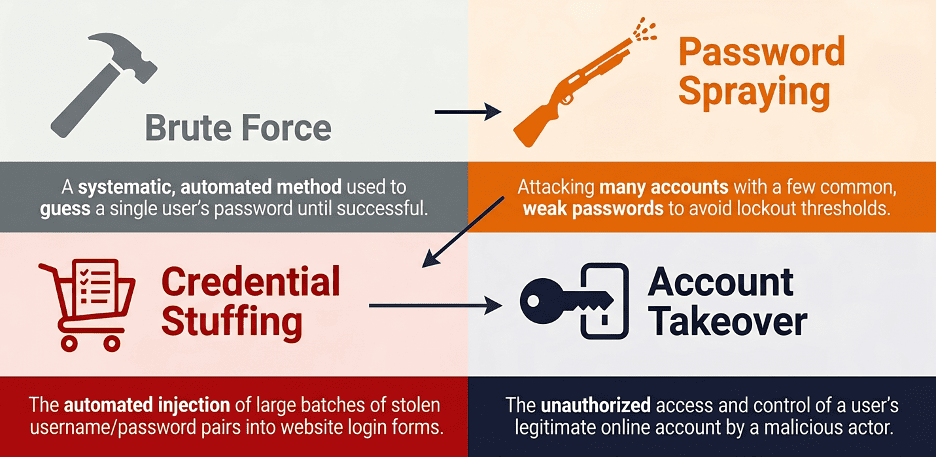
What Is the Difference Between Account Takeover and Credential Stuffing?
Before defining each attack type, one foundational distinction eliminates most of the confusion:
| ATTACK METHODS How attackers try to gain access | ATTACK OUTCOME What happens when access is gained |
| Brute Force Password Spraying Credential Stuffing | Account Takeover (ATO) ATO can result from any of the three methods on the left, or from phishing, session hijacking, SIM swapping, and other access techniques entirely separate from password-based attacks. |
💡 The Most Important Distinction ATO is what happens after a successful breach of an account. Brute force, password spraying, and credential stuffing are three of the methods that can produce that breach. When an organization says ‘we were hit by an ATO attack,’ they have described the outcome. They have not described the method. A complete incident analysis must identify both, because the correct remediation depends entirely on which method was used.
The Four Attack Types: Precise Definitions
1. Brute Force
| Brute Force Attack Systematically testing every possible password combination until the correct one is found |
| What it uses: No prior knowledge required. Generates passwords algorithmically: dictionary words, common patterns, all character combinations up to a defined length |
| Target: A single account or a small set of accounts at a single service |
| Volume: Extremely high: thousands to millions of attempts per account |
| Success driver: Weak passwords, no lockout policy, or no rate limiting |
| Detection signature: Many failed attempts against the same account from the same or rotating IP addresses |
| MFA effectiveness: Highly effective: each failed password attempt fails before reaching MFA |
| Cost to attacker: High: significant compute resources, time, and infrastructure required |
| Trend (2025): Declining as primary method: account lockout and rate limiting make pure brute force impractical at scale. Still used against offline hash cracking and legacy systems |
Brute force is the simplest to explain and the easiest to defend against. An account lockout after 5 to 10 failed attempts, combined with exponential backoff on repeated attempts, makes pure online brute force economically unviable for most targets. The more relevant brute force scenario in 2025 is offline hash cracking: when a database of hashed passwords is stolen, attackers run brute force algorithms locally against the hashes with no lockout constraint, then test the cracked credentials online through other methods.
2. Password Spraying
| Password Spraying Testing one or a few common passwords against many different accounts simultaneously |
| What it uses: A short list of universally common passwords: ‘Password1!’, ‘Welcome123’, ‘Summer2025’, ‘CompanyName1’ etc. No prior breach data required |
| Target: Many accounts across an organization, typically via Active Directory or a large consumer platform |
| Volume: Very low per account: 1 to 3 attempts per account, spread across many accounts |
| Success driver: Organizations with weak password policies, or users who choose predictable passwords that meet complexity requirements |
| Detection signature: Platform-wide: many different accounts each receiving a small number of failed attempts; typically invisible at the per-account level |
| MFA effectiveness: Effective when enforced on all accounts; any account without MFA is directly vulnerable |
| Cost to attacker: Low: no purchased data required, easily automated with standard tools (Spray, MSOLSpray, MailSniper) |
| Trend (2025): Actively used, particularly against Microsoft 365 and cloud SSO environments. Often used as reconnaissance to identify valid accounts before more targeted attacks |
Password spraying is the attack that most often evades per-account detection because it deliberately avoids triggering lockout thresholds. Each individual account sees only one or two failed attempts, far below any standard lockout threshold. Detection requires analyzing authentication patterns at the platform level, not the account level: when 500 different accounts each receive exactly one failed attempt with the same password within a five-minute window, that is a statistically impossible legitimate pattern.
3. Credential Stuffing
| Credential Stuffing Testing real stolen username-and-password pairs from prior breaches against new targets |
| What it uses: Combolists: structured files of real email:password pairs harvested from breaches, infostealer malware, or dark web markets. Attackers buy access to credentials validated at other platforms |
| Target: Any platform where the stolen credential might also be valid; exploits password reuse across services |
| Volume: One attempt per account per service; distributed across thousands of accounts simultaneously |
| Success driver: Password reuse: the median user reuses passwords across multiple services |
| Detection signature: Platform-wide authentication anomaly: elevated failure rates, unusual geographic distribution, new device fingerprints, atypical user-agent patterns |
| MFA effectiveness: Partially: defeats password-based credential stuffing but not session token theft via AiTM proxies |
| Cost to attacker: Very low: stolen combolists are cheap to buy. Automated tools are freely available |
| Trend (2025): Industrialized and growing. Primary feeder into the ATO pipeline for account fraud, BEC, and data exfiltration |
Credential stuffing is the dominant method feeding account takeover at scale in 2025 precisely because it is not a guessing attack. Attackers already know the password. They are testing whether the same password was reused somewhere else. With large aggregated credential datasets and infostealer malware continually stealing more, the supply of tested credentials is effectively unlimited. The success rate per attempt is low, but at the scale of millions of attempts, even a low success rate produces a large number of compromised accounts.
| RELATED READING: What Is Credential Stuffing? Attackers Don’t Crack Passwords, They Buy Them brandefense.io/blog/what-is-credential-stuffing/ Deep technical analysis of the credential supply chain: how combolists are assembled, priced, and deployed, and how Brandefense detects credential exposure before attackers run the campaign. |
4. Account Takeover (ATO)
| Account Takeover (ATO) Unauthorized access to and control of a legitimate user account; the outcome, not the method |
| What it uses: Any method that produces unauthorized access: credential stuffing, phishing, session hijacking (AiTM), SIM swapping, social engineering, infostealer malware, OAuth token theft, password reset abuse |
| Target: Any valuable account: financial accounts, corporate email, SSO sessions, cloud consoles, e-commerce accounts with stored payment methods |
| Volume: One successful authentication per compromised account; no failed attempts visible if method was session hijacking or phishing |
| Success driver: Dependent on the feeding method. Post-access persistence mechanisms (email forwarding rules, OAuth authorizations, MFA device registration) extend the damage window |
| Detection signature: Post-authentication behavioral anomalies: impossible travel, new device, unusual data access patterns, permission escalation, email rule creation |
| MFA effectiveness: Varies critically by MFA type and attack method: FIDO2 defeats AiTM; SMS/TOTP does not |
| Cost to attacker: Dependent on method. Credential stuffing ATO is cheap to run. AiTM phishing requires more infrastructure investment |
| Trend (2025): Primary outcome of the identity attack ecosystem. Post-access impact: BEC fraud, data exfiltration, ransomware staging, account resale |
| RELATED READING: CISO’s Guide to Account Takeover Prevention: Detection, Response, and Recovery brandefense.io/blog/ciso-guide-account-takeover-prevention-detection-response-recovery Complete ATO response framework: behavioral anomaly detection, dark web monitoring integration, incident response procedures, and regulatory disclosure considerations. |

Side-by-Side: The Complete Comparison
The following table maps all four attack types across every dimension relevant to detection and defense decisions. Each cell is designed to answer the specific operational question a security team faces when identifying which attack they are dealing with.
| Dimension | Brute Force | Password Spraying | Credential Stuffing | Account Takeover |
| Input data | Generated | Common passwords | Stolen credentials | Any method |
| Requires prior breach | No | No | Yes | No (depends on method) |
| Attempts per account | Very high (1K-1M+) | 1 to 3 | 1 per service | 1 (or 0 if phishing) |
| Accounts targeted | 1 to few | Many (org-wide) | Many (1 per account) | 1 (targeted) |
| Primary detection point | Per-account failure rate | Platform-wide failure pattern | Platform-wide auth anomaly | Post-auth behavior |
| MFA stops it? | Yes, always | Yes, if enforced | Partially (FIDO2: yes) | Depends on MFA type |
| Account lockout stops it? | Yes | Mostly (if per-org threshold) | No (1 attempt per account) | Not applicable |
| Dark web data required? | No | No | Yes (combolist) | Depends on method |
| Attack speed | Slow (compute-bound) | Medium | Fast (automated) | Fast after access |
| Attacker skill required | Low (automated tools) | Low | Low | Varies by method |
| Primary defense | Lockout + rate limiting | Platform-level anomaly detection | Breached pwd detection + dark web monitoring | Behavioral analytics + FIDO2 MFA |
How Do the Four Attacks Relate in an Attack Pipeline?
These four attack types are not isolated incidents. In practice, they form a pipeline: earlier stages in the pipeline feed later stages, and the same attacker or criminal ecosystem often operates across multiple stages simultaneously.
| STAGE 1 Credential Supply Brute force + Infostealer + Phishing + Breach databases | => | STAGE 2 Validation Credential stuffing + Password spraying: test which credentials are valid | => | STAGE 3 Account Takeover Confirmed access exploited: fraud, BEC, data theft, ransomware staging | => | MONETIZE Sell access, commit fraud, deploy ransomware |
The implication of this pipeline structure: defending only at Stage 2 (preventing credential stuffing and password spraying from succeeding) is incomplete. If stolen credentials are already validated and sold on IAB markets, Stage 2 has already happened before the target organization is aware. Defense must operate across the full pipeline, with the earliest and most impactful layer being Stage 1: detecting that credentials have been stolen before they are validated and used.
| ⚠️ The MFA Confusion Problem Many security programs say ‘we have MFA, so we are protected against ATO.’ This statement confuses the method with the outcome. MFA is highly effective against brute force and password spraying. It is partially effective against credential stuffing (FIDO2 stops AiTM proxy attacks; SMS/TOTP does not). It provides zero protection against ATO that occurs via session hijacking, infostealer malware, or OAuth token theft, because those methods bypass the authentication layer entirely. Accounts with MFA enabled can still be taken over, which does not mean MFA failed: it means some victims encounter attack methods that operate above the authentication layer. |
Defense Strategies: What Actually Works Against Each Attack Type
Because each attack type has different mechanics, the defenses that work are specific to each. The following maps each attack type to the controls that are most effective, controls that are partially effective, and controls that provide no meaningful protection.
Defending Against Brute Force
| Category | Defense |
| Highly Effective | Account lockout after 5-10 failed attempts with exponential backoff | Rate limiting per IP and per account | CAPTCHA on login forms | MFA enforcement (completely stops online brute force regardless of MFA type) |
| Partially Effective | Strong password policy (raises the search space but does not prevent offline hash cracking) | IP reputation blocking (attackers rotate infrastructure) |
| Not Effective | Dark web credential monitoring (brute force does not require prior breach data) | Behavioral analytics (triggers at authentication, not pre-authentication) |
Defending Against Password Spraying
| Category | Defense |
| Highly Effective | Platform-level authentication anomaly detection (not per-account) | MFA enforcement on all accounts (any account without MFA is directly vulnerable) | Banning universally common passwords at password creation (HaveIBeenPwned password API or similar) |
| Partially Effective | Per-account lockout (attackers intentionally stay below threshold) | IP reputation blocking (only catches known-bad infrastructure) | User awareness training (cannot detect externally valid passwords) |
| Not Effective | Dark web credential monitoring (spraying does not use prior breach data) | CAPTCHA alone (automated tools bypass CAPTCHAs) | Password complexity requirements alone (attackers choose passwords that meet complexity requirements) |
Defending Against Credential Stuffing
| Category | Defense |
| Highly Effective | Dark web credential monitoring: detect your users’ credentials in combolists before attackers validate them | Breached password detection at login: check submitted credentials against known breach databases and force reset on match | FIDO2/hardware key MFA: defeats AiTM proxy attacks that credential stuffing campaigns increasingly use for MFA bypass |
| Partially Effective | CAPTCHA + bot detection: raises the cost of credential stuffing automation but does not stop sophisticated operators | IP reputation and geolocation anomaly: slows campaigns using datacenter proxies but residential proxy networks bypass this | Device fingerprinting: catches some automation but not emulated browser environments |
| Not Effective | Per-account lockout (1 attempt per account never triggers lockout) | Password complexity requirements (attackers already have the correct password) | Rate limiting per IP (distributed across residential proxy networks, effectively invisible per IP) |
Defending Against Account Takeover
| Category | Defense |
| Highly Effective | Post-authentication behavioral analytics: impossible travel, new device, unusual data access, permission escalation, email rule creation | FIDO2/hardware key MFA: eliminates the most common AiTM attack vector | Continuous dark web monitoring: detect credential exposure and infostealer infections before attackers use them | Short session token lifetimes with re-authentication for sensitive operations |
| Partially Effective | SMS/TOTP MFA: stops basic credential stuffing ATO but not AiTM session hijacking | IP reputation blocking: catches some account access from known-bad infrastructure | User awareness training: helps with phishing-delivered ATO but not with automation |
| Not Effective Against All ATO Vectors | Single-factor authentication controls (if ATO is via session hijacking or OAuth token theft, authentication controls are irrelevant) | Standard lockout and rate limiting (ATO via valid credentials triggers no rate limits) | Signature-based endpoint detection on managed devices (ATO via infostealer on unmanaged BYOD device is outside managed endpoint scope) |
Which Attack Are You Actually Dealing With?
When your SOC detects suspicious authentication activity, the first question is: which attack type is this? The answer determines which investigation path to follow and which containment actions to take. The following decision framework provides a structured triage approach.
| What You Observe | Most Likely Attack Type | First Response Action |
| Hundreds of failed attempts against ONE account from rotating IPs | Brute Force | Lockout the account, enable CAPTCHA, block attacking IP ranges. Low urgency unless account is privileged. |
| Many accounts each receiving 1-3 failed attempts with the SAME password in a short window | Password Spraying | Enable platform-wide authentication monitoring, alert on all accounts in the affected window. Audit for successful attempts with that password. |
| Platform-wide elevated failure rate, distributed IPs, varied user-agents, 1 attempt per account | Credential Stuffing | Check dark web for combolist targeting your domain. Force reset for any accounts with successful logins from new devices/locations in the window. |
| Successful login from new location/device followed by anomalous post-auth activity (forwarding rules, data export, privilege requests) | ATO via Credential Stuffing | Session revoke, account suspend, OAuth audit, email rule audit. Escalate to full ATO IR procedure. |
| Successful login with valid MFA from unrecognized device, normal geographic location | Possible ATO via Infostealer (session token theft) | Device fingerprint analysis, check for device in stealer log distributions, review all access from that session. |
| No failed login attempts; anomalous post-auth behavior only | ATO via Session Hijacking or OAuth Token Theft | Session revoke immediately. Review OAuth application authorizations. Check for new authorized apps. This attack bypassed authentication entirely. |
How Brandefense Covers the Full Attack Pipeline
Effective protection against all four attack types requires intelligence and monitoring that operates earlier in the attack pipeline than any authentication control. Brandefense’s threat intelligence platform provides the external visibility that closes the detection gap between when credentials are stolen and when they reach your login page.
| Attack Type | Brandefense Capability | What It Detects |
| Brute Force | External Attack Surface Monitoring | Exposed login endpoints without rate limiting or lockout controls; externally visible authentication infrastructure that can be targeted for brute force campaigns |
| Password Spraying | Threat Actor Targeting Intelligence | Dark web forum discussions where attackers share valid accounts and organization names as targets for spraying campaigns; early warning before the campaign runs |
| Credential Stuffing | Dark Web Credential Monitoring | Your organization’s domain credentials in combolist distributions, stealer logs, and credential marketplaces; the supply chain that feeds credential stuffing campaigns |
| Credential Stuffing | Infostealer Log Intelligence | Your employees’ devices appearing in infostealer output; when a device is infected, all credentials on that device must be treated as available for credential stuffing |
| Account Takeover | Phishing Domain Monitoring | Lookalike domains and AiTM phishing infrastructure targeting your brand; the upstream infrastructure that converts phishing victims into ATO statistics |
| Account Takeover | Post-Breach Credential Validation | When a third-party service your employees use is breached, Brandefense identifies which of your employees were registered there and provides an actionable reset list |
| All Four | 24/7 Analyst Coverage | AI does the work and analysts verify critical findings with escalation for high-severity exposures requiring immediate organizational response across all four attack type categories |
The terminology matters because the defenses are different. An organization that calls every authentication incident ‘an ATO attack’ and responds by tightening per-account lockout controls has misidentified credential stuffing as brute force and deployed a control that provides zero protection against the actual attack. An organization that calls every failed login attempt ‘a credential stuffing attempt’ and only monitors for high per-account failure rates will completely miss a password spraying campaign that never triggers per-account thresholds.
Precision in defining the attack type leads directly to precision in deploying the right defense. That precision starts with knowing what each term means.