




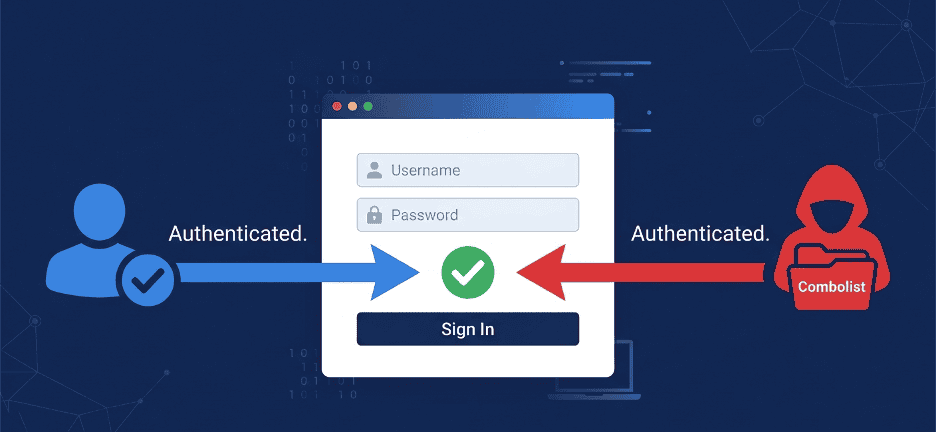
Account takeover is not a breach event. It is a business failure. When an attacker logs into your systems using credentials that belong to one of your employees, administrators, or customers, they are not breaking in. They are walking through a door your organization already opened. And they arrive with the full trust, access rights, and operational privileges that you assigned to the legitimate account holder.
In 2025, 74 percent of organizations worldwide experienced at least one account takeover attack, according to Proofpoint research. The average cost of a corporate ATO breach reached $5 million per incident. Global ATO fraud losses are projected to hit $17 billion for the year. And the underlying mechanism driving this surge has not changed: stolen credentials, bought for dollars on dark web markets, tested at machine speed against every platform they might unlock.
This guide is written for the CISO who needs to understand ATO not as an abstract threat category but as an operational problem with a defined attack chain, detectable signals, and a structured response program. It covers the technical mechanisms through which accounts are compromised, the detection architecture required to surface active takeovers, the incident response steps that contain damage when detection succeeds, and the recovery and hardening measures that close the gap afterward.
This guide covers: the ATO attack chain from credential acquisition to operational exploitation; the detection signals that separate ATO from legitimate authentication; a structured incident response playbook; recovery and post-incident hardening; and how dark web intelligence closes the detection gap before exploitation begins.
| 74% of organizations experienced at least one ATO attack in 2024 (Proofpoint 2025) | $5M average corporate cost per ATO breach incident (Security.org 2025) | 88% of basic web application attacks in 2025 involved stolen credentials (Verizon DBIR) | 70% password reuse rate among users exposed in two or more breaches (SpyCloud 2025) |
Understanding the Account Takeover Attack Chain
Account takeover is not a single technique. It is a chain of interconnected stages, each building on the previous, each presenting a potential detection opportunity. Understanding the full chain is the precondition for building a detection architecture that covers every stage rather than only the most visible one.
Credential Acquisition
The attack begins long before any login attempt. Attackers acquire valid credentials through three primary channels: purchasing from dark web combolist marketplaces (where billions of credential pairs from prior breaches are bought and sold for as little as $2 per pair), harvesting fresh credentials through infostealer malware deployed via phishing campaigns or malicious downloads, or receiving credentials from prior breaches in which the organization itself was targeted. In 2025, 46 percent of infostealer-infected devices were unmanaged or BYOD endpoints, making this initial harvest harder to detect with standard endpoint security controls.
Credential Testing
With a combolist assembled, the attacker moves to automated credential testing: running the acquired username-password pairs against target login endpoints using specialized tools that rotate IP addresses, mimic browser fingerprints, and handle CAPTCHA challenges. Akamai recorded 26 billion credential stuffing attempts per month globally in 2025. Because each account is tested once from a different IP address, traditional per-account lockout mechanisms do not trigger. The attack is statistically invisible to account-level monitoring.
Access Establishment
When a credential pair successfully authenticates, the attacker establishes persistent access: changing recovery email addresses and phone numbers, adding new authentication methods, revoking existing sessions belonging to the legitimate account holder, and creating new API tokens or application credentials. This phase moves fast. The window between successful authentication and account lockout of the legitimate owner is frequently measured in minutes.
Lateral Movement and Escalation
Depending on the account’s access level, the attacker moves laterally within the environment: using the compromised account’s SSO session to access connected applications, pivoting from a standard user account toward privileged access by exploiting internal trust relationships, or harvesting additional credentials from internal systems accessible to the compromised account. In enterprise environments, a single compromised employee account with broad SaaS access can provide entry points to dozens of connected platforms.
Exploitation and Monetization
The final stage varies by attacker objective: data exfiltration targeting customer records, financial data, or intellectual property; BEC (Business Email Compromise) fraud using the compromised account to redirect wire transfers or approve fraudulent invoices; ransomware deployment using the access established through the takeover; or resale of the validated access to other threat actors on dark web markets. The FBI reported $262 million in ATO fraud losses in the first months of 2025 alone, from over 5,100 confirmed complaints.
| 💡 The Three Attack Chain Vectors That Feed ATO Every ATO attack draws on at least one of three technical mechanisms: credential stuffing (automated testing of combolist credentials), session hijacking (stealing authenticated session tokens to bypass login entirely), or phishing via lookalike domains (harvesting credentials directly through fraudulent login pages). Understanding which vector produced a specific ATO event determines which detection layer failed and which hardening measure addresses the gap. Each vector is covered in dedicated Brandefense research linked throughout this guide. |
| 📄 RELATED READING: RELATED READING: CREDENTIAL STUFFING What Is Credential Stuffing? Attackers Don’t Crack Passwords, They Buy Them How combolist supply chains, infostealer MaaS platforms, and automated testing tools turn password reuse into industrial-scale account takeover. Covers the 2025 Australian Superannuation case and The North Face repeat incidents. brandefense.io/blog/what-is-credential-stuffing |
ATO Detection: The Signals That Separate Attackers From Legitimate Users
Account takeover detection is architecturally different from perimeter security. The attacker has valid credentials. They authenticate successfully. Every control designed to block unauthorized access has, from the system’s perspective, succeeded. Detection must rely on behavioral and contextual signals rather than authentication outcomes.
Proofpoint’s 2025 research noted that doing ATO detection correctly requires a combination of real-time data elements continuously analyzed with a sophisticated detection engine that uses multiple techniques simultaneously. No single indicator is a reliable tell; the detection program must correlate signals across authentication logs, endpoint telemetry, application behavior, and external threat intelligence.
Authentication Anomaly Signals
The most directly actionable detection signals appear in authentication logs when an attacker’s session deviates from the account holder’s established behavioral baseline.
| Detection Signal | What It Indicates / Caveat |
| Impossible travel | Authentication from two geographically distant locations within a time window that precludes physical travel. High fidelity when the time delta is minutes; weaker when hours pass and VPN or proxy use is possible. |
| New device or browser fingerprint | Authentication from a device not previously associated with the account. More reliable for accounts with stable device profiles; generates false positives for frequent travelers or IT staff. |
| Unusual authentication time | Login at a time significantly outside the account’s historical pattern. Correlate with user’s time zone and work schedule before escalating; remote workers across time zones reduce signal fidelity. |
| Immediate password or MFA change post-login | Change of recovery contact information, MFA settings, or password within minutes of authentication. A strong indicator of access establishment behavior; legitimate users rarely do this immediately after login. |
| Mass data access or download | Bulk file access, export requests, or email forwarding rule creation not consistent with the account’s historical activity. Often indicates the exfiltration phase of an established takeover. |
| Application integration changes | New OAuth authorizations, API key creation, or third-party application grants added to the account. Attackers frequently add their own integrations to maintain persistent access after credentials are rotated. |
| Session token reuse from different context | The same session token used from a different device, IP, or user-agent than the one that created it. A high-fidelity indicator of session hijacking where the stolen cookie is being replayed from attacker infrastructure. |
Platform-Level Detection: Credential Stuffing at Scale
Individual account-level anomaly detection does not surface credential stuffing attacks, because each compromised account shows only one successful authentication from an unusual source. The attack pattern is only visible at the platform level: an elevated ratio of failed authentication attempts across the total authentication volume, a sudden increase in successful logins from residential proxy IP ranges, or a statistical spike in new-device authentications across many accounts simultaneously.
The Verizon 2025 DBIR found that in the median case, credential stuffing attacks account for 19 percent of all daily authentication attempts on major platforms. A platform-wide authentication failure rate above baseline is the most reliable early indicator of an active stuffing campaign, requiring aggregated authentication analytics rather than per-account alerting rules.
Dark Web Detection: The Pre-Breach Window
The most operationally valuable detection layer is the one that operates before any login attempt occurs. When an organization’s employee credentials appear in a dark web combolist or infostealer log distribution, there is typically a window of hours to days before those credentials are tested against the organization’s systems. Dark web credential monitoring that detects this exposure and triggers forced password resets converts what would have been a successful ATO into a failed one.
SpyCloud’s 2025 Identity Exposure Report found a 70 percent password reuse rate among users exposed in two or more breaches in the last year. This means that credentials stolen from an unrelated third-party breach have a 70 percent probability of unlocking the same user’s corporate account, if the organization does not detect the exposure and force a reset first. Dark web monitoring is the detection layer that closes this window.
| 🔍 The 46 Percent Blind Spot SpyCloud’s 2025 research found that 46 percent of devices infected with infostealer malware, devices that had all saved credentials harvested and exfiltrated, were unmanaged endpoints: personal devices used to access corporate systems, contractor laptops, or BYOD devices outside standard MDM enrollment. These devices do not appear in endpoint telemetry. The credentials they expose are not visible in identity logs until they are used in an attack. Dark web infostealer log monitoring is the only detection layer that surfaces this exposure regardless of the device’s management status. |
ATO Incident Response: A Structured Playbook
When an account takeover is detected or suspected, the response program must operate on two parallel tracks simultaneously: containing the immediate breach and preserving the forensic evidence needed to understand its scope and prevent recurrence. The following playbook is structured around confirmed ATO events where active attacker access to one or more accounts has been identified.
Phase 1: Immediate Containment (0 to 30 Minutes)
The first 30 minutes of an ATO response determine how much additional damage the attacker can cause before access is revoked. Speed is the primary variable.
Terminate All Active Sessions
Invalidate all active session tokens for the compromised account across every connected application. This includes SSO sessions, API tokens, OAuth grants, and mobile application sessions. Session termination must be comprehensive: an attacker who retains one valid session token can re-establish access even after the account password is rotated.
Force Credential Reset and MFA Re-Enrollment
Initiate a forced password reset for the compromised account and require MFA re-enrollment before any new session is permitted. If the attacker has already modified the recovery contact information (email address or phone number), this change must be reverted before reset notifications are sent, or the attacker will receive the reset link.
Audit and Revoke New Integrations
Review all OAuth authorizations, API keys, email forwarding rules, and third-party application grants created under the compromised account during the attack window. Revoke all integrations added after the first anomalous authentication event. Attackers routinely add persistence mechanisms during the access establishment phase specifically to survive credential rotation.
Notify the Account Holder
Contact the legitimate account holder through an out-of-band channel (phone, not email, if the email account was compromised) to confirm the incident, verify that the account holder did not initiate the activity, and gather any relevant context about recent phishing attempts or unusual account activity they may have observed.
Phase 2: Scope Assessment (30 Minutes to 4 Hours)
Containment stops ongoing damage. Scope assessment determines how much damage has already occurred and whether the initial account was used as a pivot point to compromise additional accounts or systems.
- Pull the full authentication log for the compromised account from the first anomalous event: every IP address, device fingerprint, application accessed, and action taken during the attacker-controlled session. This timeline is the forensic foundation for every subsequent decision.
- Identify every application, system, and data store accessed during the attacker session. Prioritize applications containing sensitive customer data, financial records, or credentials that could facilitate further compromise.
- Check for lateral movement: identify whether the compromised account’s SSO session was used to authenticate into additional applications, and whether any of those applications show evidence of further suspicious activity.
- Assess whether any data was exfiltrated: bulk downloads, email forwarding rules, file sharing events, or API exports initiated during the attacker session. Exfiltration scope determines notification obligations and regulatory reporting requirements.
- Determine whether additional accounts show evidence of compromise using the same attacker infrastructure: IP addresses, session fingerprints, or timing patterns from the confirmed incident correlated against authentication logs for other accounts.
Phase 3: Notification and Regulatory Response (4 to 72 Hours)
Depending on the data accessed and the jurisdiction in which the organization operates, ATO incidents that expose personal data may trigger mandatory breach notification requirements under GDPR, CCPA, HIPAA, or sector-specific regulations. The scope assessment in Phase 2 provides the data needed to determine whether notification thresholds have been met.
Regulatory notifications have specific content requirements and timeline obligations that vary by jurisdiction. Legal and compliance teams should be engaged immediately when exfiltration of personal or protected data is confirmed. The notification timeline clock typically begins at the point the organization determines a breach has occurred, not when it is first detected: accurate scoping documentation from Phase 2 is critical to meeting regulatory deadlines.
| ⚠️ Customer Notification Timing When ATO events expose customer account data or result in fraudulent transactions affecting customers, proactive notification reduces both regulatory exposure and reputational damage. Research shows that 75 percent of consumers stop using a brand after a cybersecurity incident, and 80 percent of consumers victimized by ATO stop shopping with the affected organization. Early, transparent communication demonstrating that the organization detected the incident, contained it, and is taking remediation steps materially improves customer retention outcomes compared to delayed or reactive notification. |
Recovery and Post-Incident Hardening
Recovery is not restoration of the previous state. The previous state contained the gap that allowed the ATO. Recovery means restoring operations while simultaneously closing the specific vulnerability the attack exploited, and implementing systemic improvements that reduce the attack surface for future attempts.
Immediate Recovery: Account Restoration and Verification
Before returning access to the affected account, verify the account holder’s identity through a process that does not rely on the compromised credentials or the potentially compromised recovery channels. This may require in-person verification, video call confirmation, or hardware token issuance. The compromised account should not be returned to operational status until every session, integration, and setting changed during the attack has been reviewed and restored to the pre-incident baseline.
Credential Hygiene Across the Organization
A confirmed ATO is a signal about the organization’s broader credential hygiene posture. A 70 percent password reuse rate means that any credential exposed in any prior breach has a high probability of still being valid for other accounts. Post-incident hardening should include a forced password reset for accounts in the same organizational group as the compromised account, a search of dark web credential sources for other employee accounts from the same domain, and a review of whether the breach was first detected via dark web monitoring or only after successful exploitation.
MFA Maturity Assessment
ATO incidents frequently reveal that existing MFA implementations are weaker than assumed. SMS-based OTP is interceptable through SIM swapping and real-time AiTM phishing proxies. Application-based TOTP codes can be phished in real time by adversary-in-the-middle infrastructure. Only FIDO2-compliant hardware keys or passkeys provide phishing-resistant authentication that defeats both credential stuffing and session hijacking attack vectors.
Post-incident, assess which authentication methods are in use across high-privilege accounts and what proportion have already enrolled phishing-resistant MFA. High-privilege accounts that still use SMS-based MFA represent the highest-priority remediation target.
| 📄 RELATED READING: RELATED READING: MFA BYPASS TECHNIQUES MFA Doesn’t Protect You: Cookies Give You Away — The Rise of Session Hijacking How AiTM phishing proxies intercept TOTP codes in real time, and how infostealer malware harvests authenticated session cookies that bypass MFA entirely. Essential context for evaluating MFA maturity post-incident. brandefense.io/blog/mfa-cookies-session-hijacking |
Detection Architecture Review
Every ATO incident reveals a detection gap: the point at which the attack chain was invisible to existing monitoring. A post-incident detection review maps the attacker’s actions against the organization’s existing detection layers and identifies the earliest point at which a signal was available but not surfaced.
Common findings in post-ATO detection reviews: credential exposure on dark web markets that was not monitored, authentication anomalies that did not trigger alerts because thresholds were set too high, platform-level stuffing signals visible in aggregate authentication metrics but not analyzed, and session token reuse events that were logged but not correlated across applications. Each finding corresponds to a specific detection layer that needs to be built or tuned.
| 💡 The Pre-Breach Detection Priority The most cost-effective ATO prevention investment is detection that operates before any login attempt occurs: continuous dark web monitoring that surfaces credential exposure from infostealer logs and combolist distributions and triggers forced resets before attackers test the credentials. Organizations that add this layer report that it converts the majority of what would have been successful ATOs into prevented ones, because the credentials are invalidated before they can be used. This is the detection layer that traditional authentication monitoring cannot provide. |
ATO Prevention Framework: Controls Across the Attack Chain
Effective ATO prevention requires controls at every stage of the attack chain, not just at the authentication layer. The following framework maps preventive controls to the specific attack stage they address.
| Attack Stage | Preventive Control | Brandefense Coverage |
| Credential acquisition | Dark web monitoring for domain credential exposure in stealer logs and combolist markets; forced reset workflows triggered by exposure detection | Dark Web Credential Monitoring + Infostealer Log Detection |
| Phishing and lookalike domain harvest | Continuous phishing domain monitoring; CT log surveillance; lookalike domain takedown before campaigns launch | Phishing Domain Intelligence + Brand Protection |
| Session hijacking | Cookie security header enforcement; session token binding to device fingerprint; AiTM detection via authentication context analysis | CTI Intelligence + External Threat Monitoring |
| Credential testing (stuffing) | Rate limiting at authentication endpoint; bot detection and behavioral analytics; breached password detection at login | EASM + External Attack Surface Monitoring |
| Access establishment | Immediate alerting on MFA/recovery contact changes post-login; application integration audit automation | Real-Time Alert Platform |
| Lateral movement | Least-privilege access enforcement; SSO session monitoring across connected applications; privileged account behavioral analytics | 24/7 Analyst Coverage + CTI |
| Exfiltration | Data loss prevention controls; bulk access alerting; API export rate monitoring | Threat Intelligence Platform |
How Brandefense Protects Against Account Takeover
Account takeover prevention requires intelligence that operates ahead of the attack, not just detection that responds to it. Brandefense’s threat intelligence and digital risk protection platform covers the pre-breach detection window where most ATO events can be disrupted before they reach the authentication layer.
| Brandefense Capability | ATO Prevention Coverage |
| Dark Web Credential Monitoring | Real-time scanning of combolist markets, stealer log distributions, and dark web forums for your organization’s domain credentials; alerts before compromised credentials are tested against your authentication systems |
| Infostealer Log Detection | Continuous monitoring of infostealer malware output for credentials, session cookies, and access tokens belonging to your employees; covers unmanaged and BYOD endpoints invisible to standard endpoint security |
| Phishing Domain Intelligence | Detection of lookalike domains, AiTM phishing infrastructure, and credential harvesting campaigns targeting your organization’s login pages; prevents phishing-sourced credential theft from reaching your authentication layer |
| Session Token Exposure Monitoring | Scanning of dark web markets for stolen session cookies and authentication tokens linked to your organization’s applications; enables proactive session invalidation before tokens are replayed by attackers |
| External Attack Surface Management | Continuous visibility into your organization’s externally exposed authentication endpoints, identifying misconfigured login pages, exposed admin panels, and unprotected application access points |
| Threat Actor Targeting Intelligence | Monitoring of dark web forums and ransomware group activity for discussions of your organization as an ATO target; early warning when threat actors are specifically assembling credentials and infrastructure for a campaign against your systems |
| 24/7 Analyst-Supported Response | All credential exposure detections supported by continuous analyst review; high-severity exposures receive direct escalation with recommended immediate actions including forced reset workflows and session invalidation |
Account takeover is not a problem that authentication controls alone can solve. 74 percent of organizations already experiencing ATO attacks is not a failure of MFA policy. It is a failure of pre-breach visibility: the inability to detect credential exposure in the dark web supply chain before those credentials are tested, and the inability to detect phishing infrastructure before it reaches employees.
The organizations that consistently prevent ATO are those with the earliest warning: continuous monitoring that surfaces credential exposure, phishing campaigns, and attacker targeting signals before any login attempt occurs. The detection layer that matters most is the one that operates before authentication, not the one that analyzes authentication logs after the fact.