


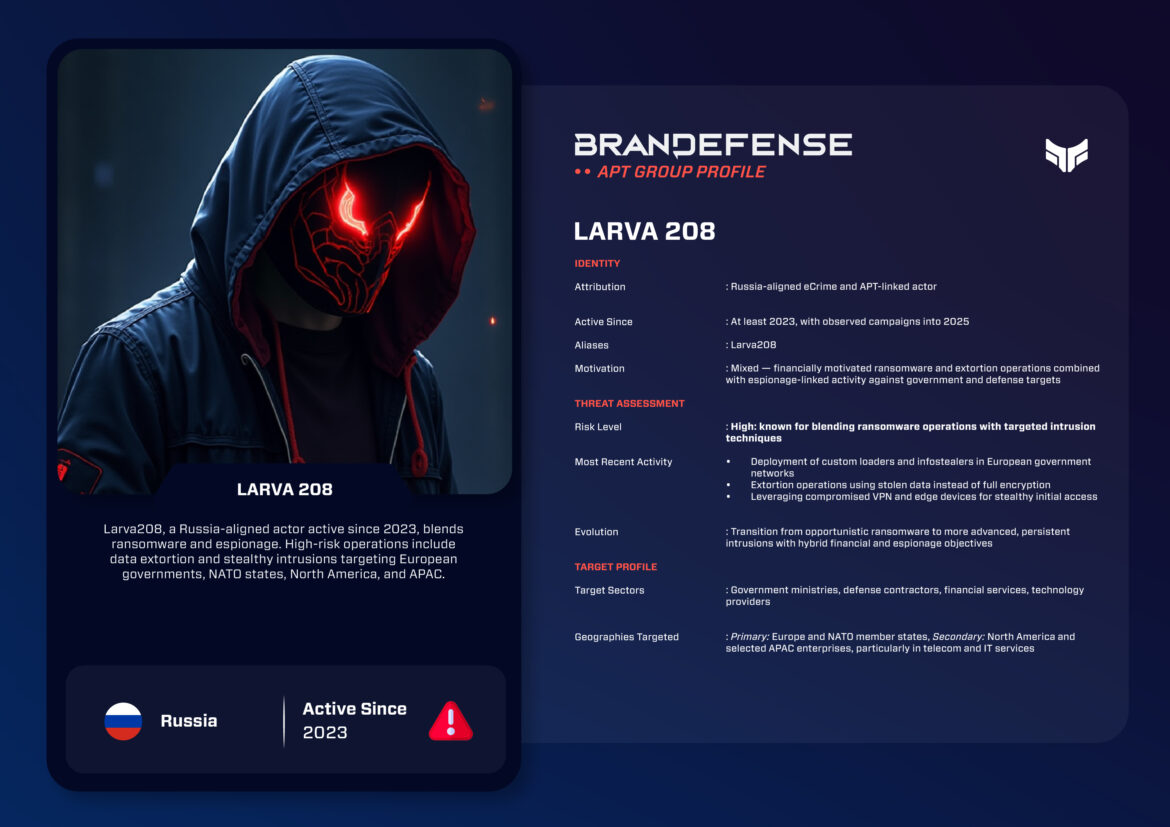
What is Larva208?
Larva208 is a threat actor that this post describes as Russia-aligned and hybrid, mixing ransomware for money with espionage against governments and defense contractors. Malpedia, a public malware research library, lists Larva-208 as a financially motivated actor also called EncryptHub and records no Russia link. Its methods include VPN and edge device flaws, spearphishing and stolen credentials.
Larva208 has evolved into one of the more disruptive actors to emerge in the rapidly evolving cyber threat landscape of 2023-2025. The post says that as early as 2023 the group was shown to run financially motivated ransomware (sources differ: Malpedia dates the actor from June 2024). It also set itself up as a hybrid actor with espionage-oriented campaigns, combining eCrime type operations with espionage/combat. As alignment to Russian interests, and targeting European government contractors and NATO organizations, is particularly alarming adversary for 2025.
Identity and Motivation
Attribution: sources differ. This post calls it a Russia-aligned hybrid threat actor engaging in eCrime and state-sponsored intrusion; Malpedia lists a financially motivated actor and records no Russia link
Active: sources differ. This post says at least 2023, with a consistent increase in campaigns throughout 2024 and 2025; Malpedia lists the actor as active since June 2024
Alias: Larva208
Motivation: Dual motivations. “Financial gain through ransomware and extortion, as well as cyberespionage to compromise and collect intelligence against governments and defense contractors”.
What tactics and techniques does Larva208 use?
Larva208 incorporated APT (Approved Threat) along with old-school cyber-criminal tactics and techniques:
Initial Access: Using VPN and edge device vulnerabilities, spearphishing campaigns using malicious attachments, and stealing credentials.
Persistence: Scheduled tasks, tunneling utilities, and stolen administrator account abuse to maintain long-term access.
C2 infrastructure: Proxy-based networks, TOR anonymization, and bitted servers used as staging points.
Malware and Tools: Custom loaders, off-the-shelf RATs, infostealers, and ransomware payload all being changed as needed for selective use.
Techniques: Data theft before encryption, selective extortion campaigns afterwards, pledging that stolen data would be used likely without a full ransomware step.
- Initial accessVPN and edge device flaws, spearphishing attachments or stolen credentials
- PersistenceScheduled tasks, tunneling utilities and stolen administrator accounts
- Command and controlProxy-based networks and Tor anonymization
- Data theftData is taken before any encryption
- ExtortionSelective extortion, sometimes without a full ransomware step
Previous Operations
2023 – Initial Ransomware Campaigns (per this post; Malpedia dates the actor from June 2024): The main aim was financial gain, through opportunistic attacks on eastern European enterprises.
2024 – Telecom and IT Intrusions in APAC: Multiple VPN zero-day exploitations against providers to likely create footholds base for intelligence gains
2025 – European Governments Networks: Deployments of custom loaders and infostealers against ministries and later selective extortion campaigns
2025 – North America Financial services context: A series of campaigns stole data first and demanded ransom later. The group knew that encryption was not needed for the attack, or was only a last choice. This showed a tactical re-calibration.
- 2023Initial ransomware campaigns (per this post; Malpedia: from June 2024)Mainly financially motivated, opportunistic attacks on eastern European enterprises.
- 2024Telecom and IT intrusions in APACMultiple VPN zero-day exploits against providers, likely to create footholds for intelligence gains.
- 2025European government networksCustom loaders and infostealers against ministries, then selective extortion.
- 2025North America financial servicesData exfiltrated to demand ransom later, with encryption not needed or a last choice.
Recent Developments
As of 2025, Larva208 has shifted from straightforward ransomware operations to complex blended campaigns that combine espionage and extortion. It has updated its models and techniques to go undetected while keeping its leverage as high as possible. It has also moved into supply chain and VPN exploitation. Its shifts in tactics and techniques are more numerous than in previous Russian-linked activity across various Russian fronts.
Conclusion
Larva208 continues to be a harbinger of a wave of emerging hybrid threat actors. These actors meld traditional eCrime, as represented by groups like (w)Rap, with espionage that they are unlikely to step back from. Larva208 includes both. The hybrid strategy Larva208 uses combines motivation and ability as adversary characteristics. It also makes the group a sophisticated adversary that government and defense organizations should monitor in 2025.
Takeaways for Defensive Action:
- Emphasize strengthening monitoring capabilities related to vulnerabilities of VPN and edge infrastructure
- Emphasize layered identity protection to protect VPN access including use of MFA and conditional access
- When evaluating ransomware incidents, consider them in the context of open source collection of ransomware activity. Put the emphasis on detecting data extraction, not only encryption-based ransomware
- Seek proactive defensive hunting against infostealer driven activity and custom loaders
Larva208 has illustrated that we cannot just view eCrime and nation-state based activities in separate domains. Organizations must plan for adversaries that have blended eCrime and nation-state threat capabilities as one threat.
You can download and review the sheet for all the details!
