




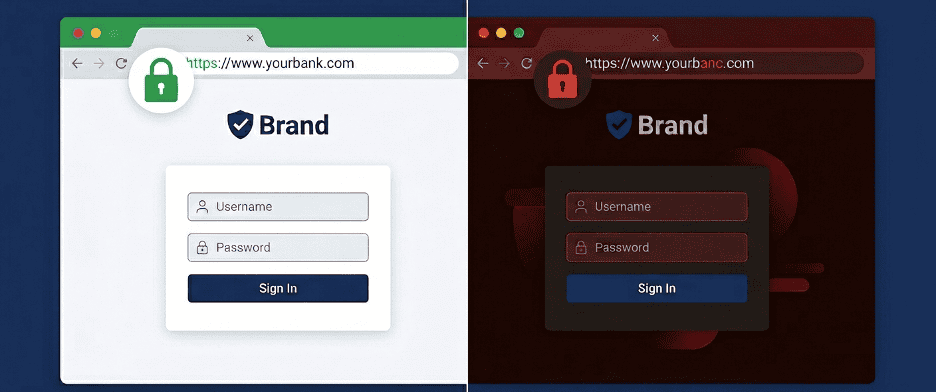
Your customers trust your domain. They type it from memory, click links that carry it, and hand over their credentials the moment your login page appears. That trust is the asset attackers are targeting when they register a domain that looks exactly like yours, with one character swapped, one letter transposed, or one Cyrillic lookalike replacing a Latin letter that no human eye can distinguish.
Lookalike domains, also called typosquatting domains or impersonation domains, are one of the most cost-efficient and persistently effective tools in the modern threat actor’s kit. A single domain registration costs less than fifteen dollars. It takes minutes to set up. And it can remain live and actively harvesting credentials for months before a brand team notices it, if they notice it at all.
In 2025, Infoblox threat researchers detected more than 20,000 suspicious lookalike domains every single week. A separate analysis found over 28,000 domains actively impersonating major global brands at any given moment. Across the 500 most-visited websites, Zscaler identified more than 30,000 lookalike domains in a single research window, with over 10,000 confirmed as actively malicious. These are not edge cases. They are industrial-scale brand abuse operating continuously against organizations that often have no real-time visibility into what is being registered in their name.
This blog explains what lookalike domains are and how they are technically constructed; the five most common attack techniques in active use; what attackers actually do with them once they are live; a documented 2025 campaign that shows how invisible these attacks have become; and how to detect and take down impersonation domains before your customers become victims.
| 20,000+ suspicious lookalike domains detected every week by Infoblox threat researchers (2025) | 28,000+ domains actively impersonating major global brands at any given time (Decode, 2025) | 50% of malicious phishing domains carry valid HTTPS certificates; the padlock no longer signals safety | 84% increase in infostealers delivered via phishing domains year-over-year (IBM X-Force 2025) |
What Is a Lookalike Domain?
A lookalike domain is any domain name registered with the intent of visually resembling a legitimate brand’s domain, for the purpose of deceiving users, intercepting traffic, or building fraudulent infrastructure. The deception can be as simple as a single transposed letter or as sophisticated as the replacement of a Latin character with a visually identical Cyrillic counterpart that no browser renders differently.
The term encompasses several related attack techniques that share the same underlying objective: make the domain look legitimate enough that users, employees, email recipients, and security tools treat it as trustworthy. The attack works because human beings process URLs as visual patterns, not as strings of precisely ordered characters. We read ‘amazon’ and our brain confirms it is Amazon. It does not parse each Unicode code point.
Why They Are So Effective in 2025
Three structural factors make lookalike domain attacks persistently effective despite years of awareness campaigns.
First, the economics are asymmetric. A domain registration costs under fifteen dollars. Automated tools can generate thousands of permutations of any target domain in seconds. With registration costs this low, threat actors can secure hundreds of variants simultaneously, operate them in rotation, and absorb takedowns as a negligible cost of doing business.
Second, the SSL padlock problem. Nearly half of all malicious phishing domains now carry valid HTTPS certificates, obtained for free from certificate authorities. The visual signal that users have been trained to associate with legitimacy, the padlock in the browser bar, is present on fake domains as reliably as on real ones. The advice ‘check for HTTPS’ has been operationally obsolete for years.
Third, AI-assisted phishing infrastructure. In 2025, automated tools can generate pixel-perfect copies of any login page, combine them with a convincing lookalike domain, and deploy the full package within hours. The technical barrier to setting up a convincing impersonation site has collapsed. What previously required web development skill now requires only a template and a domain registration.
| 💡 The Trust Transfer Problem When a user lands on a lookalike domain, they are not encountering an unknown website. They believe they are on a known, trusted brand’s site. Every piece of security conditioning they have received, check for HTTPS, look for the logo, recognize the login page, is satisfied. The attack works precisely because the site looks correct. There is no suspicious signal to catch. Detection must happen at the infrastructure layer, not the user layer. |
The 5 Lookalike Domain Techniques Attackers Use Most in 2025
Lookalike domain attacks are not a single technique. They are a family of approaches that exploit different aspects of how domain names are visually perceived and technically processed. Understanding the specific mechanics of each technique is essential for building a detection program that catches them all.
1. Typosquatting: Exploiting the Mistyped Character
The original and still most widely deployed technique. Attackers register domains with common typographical errors: character transpositions, omitted letters, doubled letters, or adjacent-key substitutions. A user who types ‘amazno.com’ instead of ‘amazon.com’ has made a one-character transposition that lands them on attacker-controlled infrastructure.
Typosquatting domains are most effective against high-traffic destinations where the volume of mistyped visits generates a steady stream of misdirected users. But they are equally used in targeted campaigns, where the domain is embedded in a phishing email rather than waiting for organic typographical errors.
| Real Domain | Lookalike Domain | Technique Used |
| amazon.com | amazno.com | Character transposition (on/no) |
| microsoft.com | microsofft.com | Character doubling (f) |
| paypal.com | paypa1.com | Character substitution (l -> 1) |
| google.com | gooogle.com | Character addition (extra o) |
| linkedin.com | linekdin.com | Character transposition (ke/ek) |
2. Homoglyph Attack: The Invisible Character
The most technically sophisticated and visually undetectable technique. Attackers register domains that contain characters from non-Latin scripts (Cyrillic, Greek, Armenian, Japanese) that render identically to Latin characters in virtually every font and browser context. To a human reading the URL, the domain is correct. To a computer parsing the actual byte values, it is an entirely different domain.
The Cyrillic alphabet contains eleven lowercase characters that are visually identical or nearly identical to their Latin counterparts: ‘а’ (Cyrillic) and ‘a’ (Latin) are indistinguishable at every standard screen resolution. A domain that replaces the Latin ‘a’ in a brand name with the Cyrillic equivalent looks exactly correct while pointing to a completely different server. This is technically called an IDN homograph attack (Internationalized Domain Name homograph attack) and represents the attack category where user training provides zero protection: there is nothing for the user to see.
| 🔴 The Training-Proof Attack: Every security awareness program tells users to ‘carefully check the URL before entering credentials.’ That advice fails entirely against homoglyph attacks. A domain constructed from Cyrillic lookalikes will pass visual inspection by even the most security-aware employee because the characters are visually identical, not just similar. No amount of careful looking reveals the substitution. Detection requires automated systems that analyze domains at the Unicode character level, comparing code points rather than rendered appearance. |
3. Combosquatting: Adding Words to Build False Legitimacy
Rather than misspelling a domain, combosquatting adds words to it: ‘paypal-verification.com’, ‘amazon-support.net’, ‘microsoft-account-secure.com’. The brand name is spelled correctly, making these domains immune to typo-detection tools. Instead, they exploit the fact that users expect legitimate companies to use descriptive subdomains and hyphenated service domains.
Combosquatting is particularly effective in BEC (Business Email Compromise) scenarios and targeted spear-phishing campaigns, where the domain appears in a context that makes the additional word feel natural: ‘Please verify your account at paypal-security.com’ reads as an expected communication from a payment provider’s security team. Zscaler research found that combosquatting variants now outnumber pure typosquatting registrations in active phishing campaigns.
4. TLD Substitution: Same Name, Different Extension
Registering the same brand name under a different top-level domain: ‘.co’ instead of ‘.com’, ‘.net’ instead of ‘.org’, or newer generic TLDs such as ‘.services’, ‘.support’, or ‘.account’. TLD substitution exploits the fact that users focus on the domain name itself and rarely scrutinize the extension carefully.
The technique is most effective when paired with the context of a particular service: ‘company.support’ or ‘company.account’ feel like legitimate branded subdomains to most users. Combined with a pixel-perfect copy of the target brand’s login page and a valid TLS certificate, TLD substitution produces phishing infrastructure that is visually indistinguishable from the real site.
5. Doppelganger Domains: The Missing Dot
A doppelganger domain omits a separator character from a legitimate domain, most commonly the dot between ‘www’ and the domain name. ‘wwwcompany.com’ (no dot) is a different domain from ‘www.company.com’ but is visually almost identical when rendered in many display contexts. Email clients, messaging platforms, and document viewers often do not render the distinction clearly.
What makes doppelganger domains particularly concerning is their historical use for passive intelligence collection. Security researchers have documented Fortune 500 companies whose doppelganger domains had already been registered by external entities with MX records configured but no web content: ready to intercept any email accidentally addressed to the doppelganger rather than the real domain, without ever needing to serve a phishing page.
| ⚙️ The Certificate Transparency Advantage: Every TLS certificate issued, including for lookalike domains, is logged publicly in Certificate Transparency (CT) logs. This means that when an attacker registers a lookalike domain and obtains an HTTPS certificate for it, the registration creates a public record before any phishing campaign launches. Organizations that monitor CT logs for their brand name and common permutations receive an early warning signal: the infrastructure is being built before the attack begins. This detection layer is independent of whether the domain has been used yet. |
What Attackers Do With Lookalike Domains Once They Are Live
Registering the domain is only the first step. The operational use of lookalike domains spans four distinct attack objectives, and sophisticated campaigns often combine several simultaneously.
Credential Harvesting
The most direct use: serve a pixel-perfect copy of the target brand’s login page. When the user submits their credentials, they are sent to the attacker’s infrastructure and the user is transparently redirected to the real site, often without any indication that something went wrong. The stolen credentials are then used for account takeover, sold on dark web markets, or fed into credential stuffing campaigns against other platforms where the same user may have reused the password.
In 2025, credential harvesting via lookalike domains is increasingly combined with session token theft: adversary-in-the-middle (AiTM) proxy techniques that sit between the user and the real site, capturing not just credentials but active session tokens that bypass MFA entirely. The user completes their real authentication including MFA; the attacker’s proxy captures the resulting authenticated session and uses it independently.
Business Email Compromise and Invoice Fraud
Lookalike domains serve as the sender infrastructure for BEC attacks. An email appearing to come from ‘finance@company-invoices.com’ (combosquatted domain) or from a homoglyph variant of the CFO’s email domain carries visual legitimacy that a completely unrelated domain cannot achieve. The recipient’s email client displays the sender domain in a font that makes the substitution invisible.
In wire fraud scenarios, the attacker’s domain is used to send modified payment instructions or urgent requests for fund transfers. Once a wire transfer is initiated to an attacker-controlled account, recovery is typically impossible. The FBI Internet Crime Complaint Center has consistently identified BEC, often facilitated by lookalike domain infrastructure, as the highest total-dollar-loss category in its annual cybercrime reports.
Malware Distribution
Lookalike domains hosting malicious software downloads are particularly effective when the target brand is a software vendor or developer tool provider. A user who intends to download legitimate software from a vendor’s site but lands on a lookalike domain instead will receive a trojanized installer that is functionally identical to the real software while silently installing malware in the background.
IBM X-Force’s 2025 Threat Intelligence Index documented an 84 percent year-over-year increase in infostealers delivered via phishing infrastructure, with lookalike domains as a primary delivery mechanism. The infostealer payload harvests saved browser credentials, session cookies, and cryptocurrency wallet keys, creating a secondary breach event that extends far beyond the initial victim.
Targeted Visitor Profiling
A significant development documented by Infoblox researchers in late 2025: the most sophisticated lookalike domain operations no longer serve the same content to every visitor. Automated systems profile each visitor using IP geolocation, device fingerprinting, and behavioral signals; then route traffic differently based on whether the visitor appears to be a security researcher, a corporate network user, or a genuine residential victim.
Security tools scanning from known research IP ranges see benign parking pages or redirect to the legitimate brand. Residential IP addresses from target geographies receive credential harvesting pages or malware. This behavioral differentiation is specifically designed to defeat automated security scanning tools that check whether a domain is serving malicious content: during the scan, it isn’t. The attack only activates against genuine human victims.
2025 Case Study: When Visual Identity Becomes Weaponized
| Unit42 July 2025: A Phishing Campaign Where Nothing Looked Wrong to Any Human Source: Palo Alto Networks Unit42 research, July 2025; Allure Security analysis; publicly documented campaign reporting |
In July 2025, Palo Alto Networks Unit42 researchers documented a phishing campaign that illustrated the current ceiling of homoglyph attack sophistication. The campaign targeted enterprise employees with phishing emails that, upon visual inspection, contained no detectable signs of deception.
The attackers combined character substitutions across every visible element of the email simultaneously: the display name, subject line, and body text all contained Cyrillic and Greek characters replacing their Latin equivalents at positions chosen for maximum visual impact. The display name rendered as ‘Confidential Ticket’ to every recipient, but contained Cyrillic substitutions that made it a completely different string to any text-matching security filter. The subject line referencing a ‘Financial Statement’ was similarly constructed: visually identical to a legitimate subject, technically distinct at the character level.
The email chain then bounced through a series of apparently benign intermediate websites before landing on a credential harvesting page protected by a custom CAPTCHA: specifically designed to block automated security scanning tools while presenting no obstacle to human users. The CAPTCHA served the dual purpose of defeating automated analysis and adding a layer of apparent legitimacy (real sites often have CAPTCHAs) to the final credential collection page.
| 0 visual signals available to even the most security-aware employee to identify the attack | 3 layers of deception: homoglyph display name, homoglyph subject, intermediate redirect chain | 1 custom CAPTCHA deployed to defeat automated security scanning while passing human victims through |
The Unit42 case is significant not because it represents an unprecedented technique, but because it represents the industrialization of a technique that was previously considered edge-case. The combination of homoglyph manipulation at multiple simultaneous points in the email chain, intermediate redirect infrastructure to defeat URL scanning, and victim-profiling CAPTCHA deployment represents a campaign built specifically to operate undetected through every standard defensive layer.
| 🔴 Key Lesson: User Training Cannot Catch What Users Cannot See: Security awareness programs consistently teach employees to examine email headers and URLs carefully before entering credentials. That advice assumes there is something to see. Homoglyph attacks are specifically engineered to be invisible: the deceptive characters are selected because they are visually indistinguishable from the characters they replace. No level of employee training addresses this attack class. Detection requires infrastructure-level analysis: automated systems that compare domain character code points, flag mixed-script registrations, and identify the infrastructure signatures associated with malicious intent before any email is sent. |
| Is Your Brand Being Impersonated Through Channels You Cannot See? Brandefense monitors homoglyph domain registrations, certificate transparency logs, and phishing infrastructure targeting your brand across all channels; including attack types that are invisible to visual inspection. -> See Brandefense Brand Protection -> brandefense.io |
How to Detect and Respond to Lookalike Domain Attacks
Effective lookalike domain defense requires multiple detection layers operating simultaneously. Because no single mechanism catches all attack types, and because attackers actively tune their infrastructure to defeat individual controls, the program must be layered and continuous.
Certificate Transparency Log Monitoring
Every TLS certificate issued for any domain is logged publicly in Certificate Transparency logs within minutes of issuance. Monitoring CT logs for your brand name, common permutations, and known combosquatting patterns gives you visibility into lookalike domain infrastructure at the moment it is being built, before any phishing campaign launches. An attacker who registers ‘brandname-support.com’ and obtains a certificate for it has created a public record. Organizations monitoring CT logs receive this signal before their first customer receives the first phishing email.
DNS and Domain Registration Monitoring
Automated monitoring of new domain registrations for brand name permutations, typosquatting variants, and combosquatting patterns across all TLDs provides a second early warning layer. Tools that generate the full enumerated set of possible lookalike domains for a given target and continuously check whether those variants have been registered enable proactive detection rather than reactive response.
Registration monitoring should include homoglyph variants: domains that contain Unicode characters from Cyrillic, Greek, Armenian, and other scripts that visually resemble Latin characters. This requires Unicode-aware comparison rather than simple string matching, because a string comparison of the Latin and Cyrillic variants of a domain would not flag them as related.
Passive DNS and Infrastructure Pattern Analysis
When a lookalike domain is registered and moves from parking to active infrastructure, it creates signals in passive DNS records: nameserver changes, hosting provider assignment, and IP address resolution patterns that differ from legitimate brand infrastructure. Continuous passive DNS monitoring identifies when previously dormant lookalike domains become active, providing a second detection window between domain registration and active campaign launch.
Dark Web Intelligence
Lookalike domain campaigns do not appear from nowhere. The phishing kits designed to impersonate specific brands, the lists of registered lookalike domains assembled for specific targeting campaigns, and the credentials harvested from active campaigns all circulate on dark web forums and in underground markets. Organizations with continuous dark web monitoring receive signals about campaigns in preparation: phishing kits targeting their brand being sold or shared, lists of registered lookalike domains assembled by threat actors, and post-campaign credential dumps that confirm an active campaign has been running.
Takedown Response
Detection without response is incomplete. When a lookalike domain is identified, the objective is rapid takedown through the domain registrar, hosting provider, and any relevant platform. Pre-established relationships with takedown service providers and documented takedown procedures dramatically reduce the time between detection and removal. For homoglyph domains that successfully impersonate a brand, UDRP proceedings through WIPO provide a legal mechanism for domain transfer, though the timeline (typically 45-60 days) makes pre-takedown mitigation through the hosting provider the faster first response.
| 🔍 Why Continuous Monitoring Is Non-Negotiable: Lookalike domain attacks scale with automation: tools that generate and register thousands of domain permutations in an afternoon mean that the threat surface is not static. New lookalike domains targeting any given brand appear every week. Periodic scans, run monthly or quarterly, create detection gaps that extend for weeks during which active phishing campaigns operate undetected. The 20,000 new suspicious lookalike domains detected weekly by Infoblox represent a threat that requires continuous detection to match. |
Lookalike Domain Defense: A Practical Checklist
| DETECTION AND MONITORING | |
| ✓ | Monitor Certificate Transparency logs continuously for your brand name, common permutations, and combosquatting variants. CT log signals appear before any phishing email is sent. |
| ✓ | Implement automated domain permutation monitoring across all TLDs, including Unicode-aware scanning for homoglyph variants that use Cyrillic, Greek, and other non-Latin characters. |
| ✓ | Monitor passive DNS records for lookalike domains transitioning from registered-but-parked to active infrastructure: the window between infrastructure setup and campaign launch is your highest-value detection opportunity. |
| ✓ | Integrate dark web monitoring for phishing kit sales, assembled lookalike domain lists, and post-campaign credential dumps targeting your brand. |
| ✓ | Monitor WHOIS and registrar data for bulk registrations of brand-adjacent domains; bulk registration patterns are a reliable early indicator of campaign preparation. |
| DEFENSIVE REGISTRATION AND RESPONSE | |
| ✓ | Defensively register the highest-risk typosquatting variants of your primary domain: common character transpositions, adjacent-key substitutions, and .co, .net, and .io TLD variants for your primary .com domain. |
| ✓ | Implement DMARC, DKIM, and SPF records at enforced policy levels to prevent spoofed emails from being delivered from domains that are not yours; this does not stop lookalike domain abuse but does close the direct spoofing vector. |
| ✓ | Establish documented takedown procedures with pre-identified contacts at major registrars, hosting providers, and takedown service partners; response speed is the primary determinant of how much damage a live phishing campaign causes. |
| ✓ | For domains confirmed as actively phishing your customers, pursue hosting-level takedown before UDRP proceedings; hosting providers typically respond faster than domain registrar processes. |
How Brandefense Detects Lookalike Domains Targeting Your Brand
Brandefense’s Digital Risk Protection platform monitors the full lifecycle of lookalike domain attacks: from domain registration and certificate issuance through active campaign infrastructure to post-campaign credential distribution on dark web markets.
| Brandefense Capability | What It Covers in Lookalike Domain Defense |
| Phishing Domain Monitoring | Continuous monitoring of new domain registrations, certificate transparency logs, and DNS resolution data for typosquatting variants, combosquatting patterns, TLD substitutions, and doppelganger domains targeting your brand |
| Homoglyph and IDN Detection | Unicode-aware scanning that identifies lookalike domains constructed with Cyrillic, Greek, Armenian, and other non-Latin characters visually identical to your brand name; detects the attack category that bypasses visual inspection entirely |
| Certificate Transparency Intelligence | Real-time monitoring of CT log entries matching your brand name and known permutations; delivers early warning signals when lookalike infrastructure is being built before campaigns launch |
| Phishing Infrastructure Takedown | Coordinated takedown support for confirmed phishing domains through registrars, hosting providers, and relevant platforms; pre-established relationships that compress response time |
| Dark Web Phishing Kit Intelligence | Monitoring of underground markets and forums for phishing kits targeting your brand, assembled lookalike domain lists, and post-campaign credential dumps that confirm active impersonation campaigns |
| Social Media and App Store Impersonation | Extension of brand monitoring beyond domains to social media profiles and mobile application stores where lookalike accounts and fake apps impersonate your brand to the same customer base |
| Real-Time Alert and Analyst Escalation | Automated alerts for new lookalike domain detections with analyst review for high-severity cases requiring immediate takedown response or customer notification |
The 20,000 lookalike domains detected weekly represent a threat that scales faster than any manual monitoring program can track. The organizations that protect their customers effectively are not those with the most comprehensive takedown procedures. They are those with the earliest warning: continuous detection that identifies lookalike infrastructure at registration and certificate issuance, before any customer has been redirected, before any credential has been stolen, and before the brand has been damaged.