




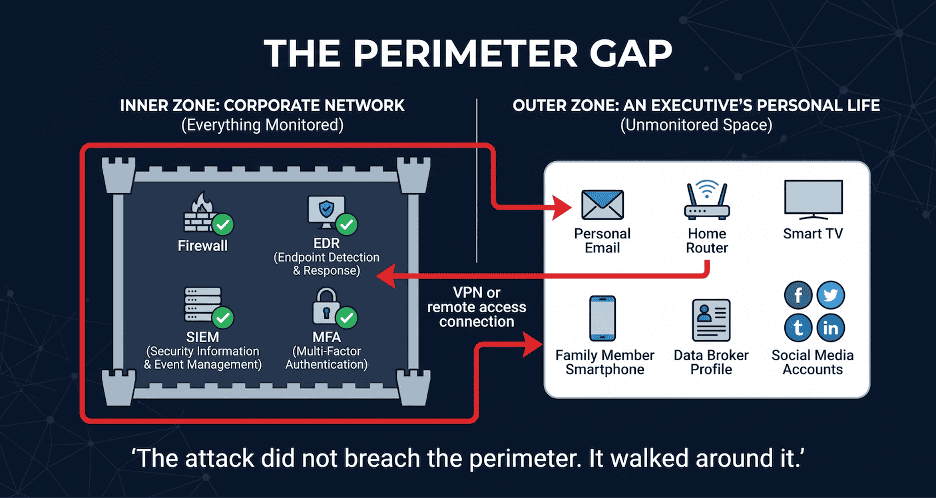
Corporate security programs are designed around a boundary. On one side: the organization’s systems, networks, and identities, managed, monitored, and protected. On the other: everything else. The assumption embedded in most security architectures is that threats cross from the outside in. Attackers breach the perimeter, exploit a vulnerability, or compromise a credential, and the response system is built to detect that crossing.
Against executive-targeted attacks, this architecture has a structural blind spot. The personal life of a senior executive is not inside the corporate perimeter. Personal email accounts, home networks, family members’ devices, and the data that data brokers have assembled about an executive’s private life are all outside the boundary that corporate security monitors. And they are all, in documented and recurring attacks, used as the path into the corporate environment.
This is not a theoretical risk. In 2026, 83.6% of cybersecurity professionals surveyed by Optery said home addresses are easily obtainable for targeted attack planning. More than 77% said personal email addresses are readily accessible. Attackers have learned that the fastest route to a well-defended corporate network runs through the least-defended part of the executive’s life: the part that is entirely off the corporate security team’s radar.
| 83.6% of security professionals say home addresses are easy to obtain for social engineering | 36% of all corporate incidents began with social engineering as initial access vector | 442% increase in voice phishing targeting executives since H2 2024 (CrowdStrike 2026) | 62% of organizations experienced a deepfake-related social engineering incident in the past 12 months |
Why the Personal Life Is the New Corporate Attack Surface
The logic behind targeting an executive’s personal life rather than their corporate environment is straightforward: the corporate environment is harder. Enterprise email systems have spam filters, DLP, and logging. Corporate endpoints run EDR. VPN access requires MFA. The help desk has (in theory) identity verification processes.
The personal environment has none of these. A personal Gmail or iCloud account has whatever security settings the user configured. A home network has whatever the ISP provided, often an unpatched consumer router with default credentials still intact. A family member’s device has no corporate security policy, no MDM enrollment, and no monitoring whatsoever.
Critically, the personal environment is directly connected to the corporate one. Executives work from home. They access corporate systems from personal devices. They use personal email to share work documents when the corporate system is slow or unavailable. The connection between the personal and the corporate surface exists by design, but only one side of it is monitored.
| The Data Broker Problem: Your Executive’s Dossier Is Already Assembled Data brokers aggregate public records, consumer data, and breach data to create detailed profiles of individuals. For executives, these profiles are extensive: home address, phone number, family member names, vehicle registration, historical employers, property records, and email addresses accumulated over decades of public and semi-public activity. The Optery 2026 Enterprise Social Engineering Survey found that 82.7% of cybersecurity professionals said breached credentials tied to personal contact information are accessible for targeted attack planning, and 82.2% said personal mobile numbers are easy to find. These are not classified intelligence capabilities. They are services available for a few dollars per record, used by threat actors as a first step before any technical attack begins. The assembled dossier reduces the cost and effort of every downstream attack. A spear phishing email built from data broker intelligence references accurate personal details. A voice phishing call that includes the executive’s home street address, their spouse’s name, and their car model is a different kind of call than a generic impersonation attempt. The personal data makes every attack vector more credible. |
Attack Vector 1: Personal Email as a Bridge to Corporate Access
Personal email accounts are the most direct bridge between an executive’s private life and their corporate access. They are used to receive personal correspondence, manage subscriptions, and often to handle work that flows outside the corporate system: board communications, investor updates, confidential discussions with advisors, and documents shared informally when the corporate system is not the most convenient channel.
The security posture of a personal email account is determined entirely by the individual user. Most personal email accounts do not have MFA enforced by policy. Password reuse between personal and corporate accounts is common. Consumer email platforms do not have the logging, DLP, or anomaly detection that corporate email systems provide. And they are accessible from any device, anywhere, without the network controls that surround corporate access.
How Personal Email Breach Translates to Corporate Access
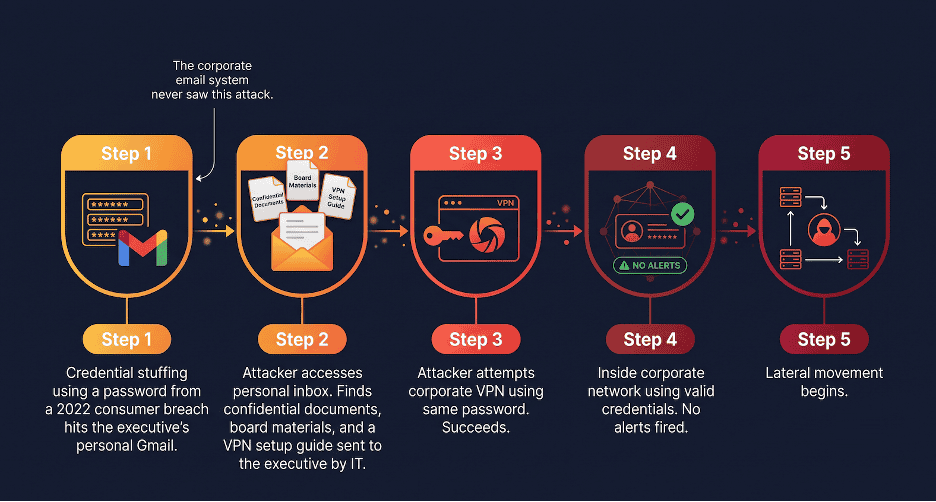
The translation from personal email compromise to corporate network access follows several documented pathways. Password reuse is the most direct: an executive who uses the same password for their personal email and their corporate VPN provides a single credential that unlocks both. Even where passwords differ, personal email accounts frequently contain the recovery addresses, backup codes, and security question answers that protect other accounts, including corporate ones.
Personal email also contains the artifacts of professional life: email threads with board members, attachments of confidential documents, calendar invitations with dial-in codes, and correspondence with advisors and counsel. A compromised personal email account is a reconnaissance source that feeds subsequent, more targeted attacks against corporate systems. The attacker does not need to be inside the corporate network to learn what the executive is working on. They just need to be in the Gmail account.
| The Shadow IT Channel: When Personal Email Becomes a Corporate Data Store In a 2025 incident response case documented by a major consulting firm, an executive’s personal email account was found to contain three years of board meeting minutes, quarterly financial projections, and M&A due diligence materials that had been shared informally outside the corporate email system. The personal account was compromised via credential stuffing using a password exposed in a 2022 consumer data breach. The corporate email system had not been compromised. The DLP system had not generated an alert. The SIEM had no relevant logs. The breach was invisible to every corporate security control because it occurred entirely within the personal account that the security program had no visibility into. |
Attack Vector 2: Home Network Exploitation
The home network of a senior executive is simultaneously one of the least secured environments in their digital life and one of the most valuable to an attacker. It connects to the internet through a consumer-grade router that receives infrequent or no firmware updates, lacks enterprise-grade segmentation, and typically runs with default or weak credentials on administrative interfaces. It hosts a mixture of personal devices, smart home technology, children’s devices, and, for executives who work from home, corporate laptops connected to corporate systems via VPN.
The security posture of a consumer home network is structurally weaker than almost any enterprise environment an attacker might face. There is no network monitoring, no intrusion detection, no firmware management program, and no incident response capability. If a device on the home network is compromised, it will generally remain compromised until the device is replaced or a visible symptom prompts investigation.
How Home Network Compromise Reaches Corporate Systems
| Attack Path | Mechanism | Corporate Consequence |
| Router compromise via default credentials | Attacker identifies executive’s home IP through data broker records or ISP enumeration; accesses router admin interface using default or previously exposed credentials | Traffic interception for VPN credentials, DNS manipulation to redirect corporate portal traffic, persistent monitoring of all home network activity |
| Man-in-the-middle on unencrypted traffic | Compromised router intercepts traffic between home devices and the internet, including sessions where the executive’s corporate laptop is connected but not yet on VPN | Credential harvesting from cloud services, internal web applications accessed before VPN activates, and browser-based corporate tools |
| Lateral movement from IoT device | Smart TV, home assistant, or connected device with unpatched firmware is compromised; attacker uses it as a pivot point to access other devices on the same network segment | Corporate laptop on the same network segment becomes accessible from the compromised IoT device; can lead to credential dumping or persistent malware installation |
| Family device as entry point | Child’s gaming device, spouse’s laptop, or shared tablet is compromised via a consumer-targeted attack; attacker uses home network access to pivot to the executive’s devices | If corporate and personal devices share a network segment without isolation, access to any home device can become access to the corporate device |
| VPN credential interception | Attacker captures VPN credentials as they are entered on the executive’s corporate laptop before the VPN tunnel is established, or intercepts the pre-tunnel traffic | Valid VPN credentials with no indicators of compromise; attacker connects to corporate network using legitimate executive credentials from a different location |
Attack Vector 3: Family Members as Social Engineering Targets
The family members of senior executives represent an attack surface that virtually no corporate security program is designed to address. Spouses, children, parents, and siblings have their own digital footprints, their own devices, and their own exposure to social engineering. They are not covered by corporate security awareness training. They have no reason to verify the identity of someone who contacts them about their family member. And they are, in documented cases, specifically targeted precisely because they are undefended.
The family attack vector operates on a simple insight: an executive who would reject a suspicious direct approach may respond very differently to a crisis that appears to involve someone they care about. The emotional urgency created by a family threat bypasses the skeptical caution that security training attempts to build.
Documented Family Member Attack Patterns
SIM Swap via Family Members
SIM swapping, in which an attacker convinces a mobile carrier to transfer a victim’s phone number to an attacker-controlled SIM, is a documented technique for bypassing SMS-based multi-factor authentication. When targeted at family members, it can be used to hijack a child’s or spouse’s phone number and then impersonate them in emotionally charged communications designed to pressure the executive into taking actions, including bypassing MFA, approving unusual transactions, or providing remote access to their device.
Family members’ phone numbers are available through the same data broker services that expose executives’ direct contact details. The attack does not require any corporate system compromise. It requires carrier impersonation and a family member who is not prepared for the specific social engineering scenario being used against them.
Child Extortion and Pressure Campaigns
In documented incidents, attackers have used personal information about executives’ children, obtained from data brokers, social media, and breach data, to construct extortion scenarios. The pattern involves threatening to expose information about or affecting the child unless the executive takes a specific action: installing software, providing credentials, or approving a transaction. The child is not the target. The executive’s decision-making under emotional pressure is the target.
This attack type is designed to create a psychological state in which the executive’s security training is overridden by the instinct to protect a family member. It does not require any technical sophistication. It requires accurate personal information and a willingness to exploit it.
Impersonation of Family Members in Pretexting
Voice cloning technology can now replicate a recognizable voice from three seconds of recorded audio. For family members who post publicly on social media, three seconds of usable audio is trivially easy to obtain. Attackers have used cloned family member voices to contact executives directly, impersonating a spouse or child in apparent distress, with the request for help including a step that provides attacker access: ‘I’m locked out of the house and need you to reset my email password’ or ‘I downloaded something that broke my laptop, can you give me your IT admin login to fix it.’
The call arrives from a phone number the executive does not recognize because the call was made using a different device. The voice is familiar. The emotional context creates urgency. The specific request is something that would never pass through a corporate approval process but feels like a private family matter in the moment it is made.
| Why Security Training Does Not Prepare for This Corporate security awareness training teaches employees to be skeptical of unexpected requests for credentials, to verify identity through official channels, and to escalate suspicious communications. All of this training is implicitly framed around a corporate context: an email that looks like it is from IT, a call that claims to be from the help desk. A call from someone who sounds exactly like the executive’s child, describing a personal crisis, is not a corporate context. The skeptical mindset that security training develops does not automatically activate when the apparent threat is not to the organization but to someone the executive loves. Attackers targeting executives through family members are specifically exploiting the gap between what training prepares people for and what actually happens to them. |
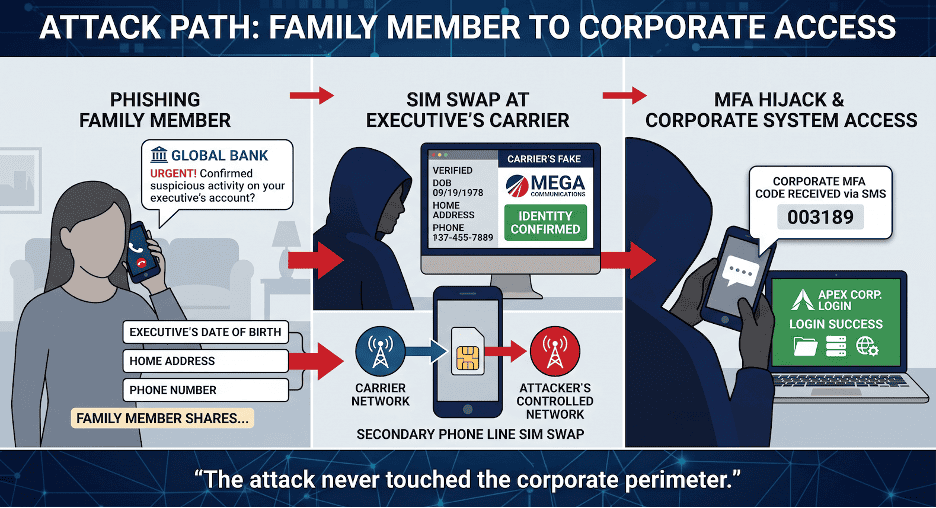
How Attackers Build an Executive Profile Before the First Contact
Every attack described in this blog begins with reconnaissance, and that reconnaissance is increasingly automated, inexpensive, and comprehensive. The intelligence gathering phase for a targeted executive attack typically combines four sources.
| Intelligence Source | What It Provides | Cost to Attacker |
| Data broker aggregators | Home address, family member names, vehicle registration, phone numbers, historical employers, property records, political donations | Under $50 for a comprehensive report; automated scraping tools available for bulk collection |
| Social media and public profiles | Family structure, vacation patterns, school affiliations, relationship details, photographs that contain location metadata and home details | Free; open source intelligence tools automate collection across platforms |
| Breach and infostealer databases | Personal email credentials, historical passwords, financial account fragments, device identifiers from consumer breaches | $10 to $200 per record set on dark web markets; freely available in older breach dumps |
| LinkedIn and professional networks | Reporting structure, direct reports, travel schedule, recent corporate events, speaking engagements, conference attendance | Free; provides the organizational context that makes social engineering approaches credible |
| Dark web forums and markets | Packaged executive profiles assembled by other threat actors, prior targeting intelligence, and active campaign coordination | Varies; executive data packages sell for $200 to several thousand dollars depending on seniority and data completeness |
Building a Protection Program That Covers the Personal Surface
An effective response to executive personal attack vectors requires accepting that the protection program must extend beyond the corporate perimeter, and that some of the most important defensive actions are things the executive must take in their personal capacity with organizational support and guidance.
Layer 1: Personal Digital Footprint Reduction
- Conduct a baseline data broker audit for each covered executive: identify which platforms hold home addresses, phone numbers, and family member information, and initiate systematic removal requests across the major aggregators
- Establish an ongoing monitoring and removal cadence; data broker profiles re-populate from public records sources and must be addressed continuously, not once
- Provide executives and their family members with guidance on what to share publicly on social media and what creates actionable reconnaissance material: location tags, school affiliations, vehicle photographs, and home exterior images
- Support executives in separating personal and professional email: a dedicated personal email account used only for personal correspondence, with a strong unique password and hardware MFA, significantly reduces credential reuse risk
Layer 2: Home Network Security
- Provide covered executives with enterprise-grade router hardware as part of an executive protection program; consumer routers are an indefensible home network foundation
- Require network segmentation on home networks used for remote corporate work: corporate devices should operate on an isolated network segment separate from IoT devices, family devices, and smart home equipment
- Establish a firmware update program for executive home network equipment; automatic updates for critical network devices should be enforced rather than left to the executive’s discretion
- Provide executives with a hardware VPN device that ensures all corporate traffic is encrypted from the moment it leaves the home network, not just after the software VPN client activates on the laptop
Layer 3: Family Member Awareness and Protocols
- Brief family members of covered executives on the specific social engineering scenarios that target executive families: impersonation calls, requests for personal information under the pretense of verification, and emotional pressure tactics
- Establish family-specific verification protocols: a shared safe word or phrase that family members can use to authenticate identity in unexpected or high-pressure situations, separate from anything used in corporate contexts
- Provide family members with a direct escalation contact, typically the executive’s security team or a designated security officer, who can verify suspicious situations without requiring the family member to make judgments they are not equipped to make
- Conduct regular briefings as attack techniques evolve; voice cloning and deepfake technology change what ‘sounds like your family member’ means, and family members need updated context on what attacks now sound like
Layer 4: Continuous Monitoring and Early Warning
- Monitor dark web markets and breach databases for personal identifiers belonging to covered executives and their immediate family members: email addresses, phone numbers, and home addresses appearing in breach data are early indicators of targeting activity
- Establish alert thresholds for SIM swap activity on executive and family member phone accounts; carriers can be configured to require enhanced identity verification before number transfers
- Track data broker profile changes for covered executives; new or updated profiles that appear after removal requests may indicate active intelligence gathering by a threat actor
- Monitor dark web forums for executive names, family member names, and home addresses appearing in threat actor discussions, which can provide early warning of a targeting campaign before any direct attack attempt is made
How Brandefense Covers This
| Capability | How It Protects Against Personal Attack Vectors |
| Personal identifier monitoring | Tracks executive names, personal email addresses, home addresses, phone numbers, and family member identifiers across dark web markets, breach databases, and data broker aggregators |
| Credential exposure detection | Surfaces personal email and consumer account credentials appearing in infostealer logs and breach dumps before they are used for credential stuffing or account takeover |
| Dark web forum surveillance | Monitors threat actor communication for executive names, personal data, and targeting discussions that indicate a campaign is being planned or assembled |
| Social media impersonation detection | Identifies accounts impersonating covered executives or using their name and likeness, including accounts that may be used as social engineering infrastructure against family members |
| Data broker monitoring | Tracks the appearance and re-appearance of executive personal data across major data broker platforms, supporting ongoing removal programs and identifying when personal data is being actively compiled |
| 24/7 continuous monitoring | Provides real-time alerting on personal exposure events so that the window between first exposure and first attack attempt is as small as possible |
| RELATED READING VIP Security Beyond the Bodyguard: https://brandefense.io/blog/executive-digital-protection/ : the integrated framework connecting digital and physical executive protection Why Your CISO Is Your Organization’s Highest-Value Attack Target: https://brandefense.io/blog/why-your-ciso-is-your-organizations-highest-value-attack-target : the targeting logic that makes executive protection a security program priority |