

Executive cybersecurity is the work of protecting senior leaders, including the CISO, who are high-value attack targets. Executives hold wide system access and authority, and their public profiles give attackers material for personalized attacks. The post covers whaling, deepfake voice, quishing and home network attacks, which controls built for all staff often miss.
A CFO at a mid-size financial services firm receives a Teams voice message. It sounds exactly like the CEO: the same cadence, the same verbal habits, the same tone used for urgent operational matters. The message asks for an immediate wire transfer of $2.4 million to close a time-sensitive acquisition. Only a manual call-back to the real CEO, made by a suspicious finance analyst, stops the transfer in time.
The deepfake voice was built from eighteen months of publicly available conference calls, earnings calls, and recorded interviews. Every piece of source material was publicly accessible. The attacker did not breach any system to obtain it. They simply listened.
This is the attack environment facing your executive team in 2025. Attackers go after executives deliberately, yet many organizations still protect them with the same controls they apply to every employee.
The reason executives are disproportionately targeted is not because they are easier to breach. It is because breaching them is worth so much more.
This blog explains why C-suite executives attract attack volume that no other employee category does; what specific data about your executives is circulating on the dark web right now; how each major executive role creates a distinct and uniquely damaging attack surface; and what a real VIP security program looks like beyond the standard security awareness training that most organizations incorrectly apply to this problem.
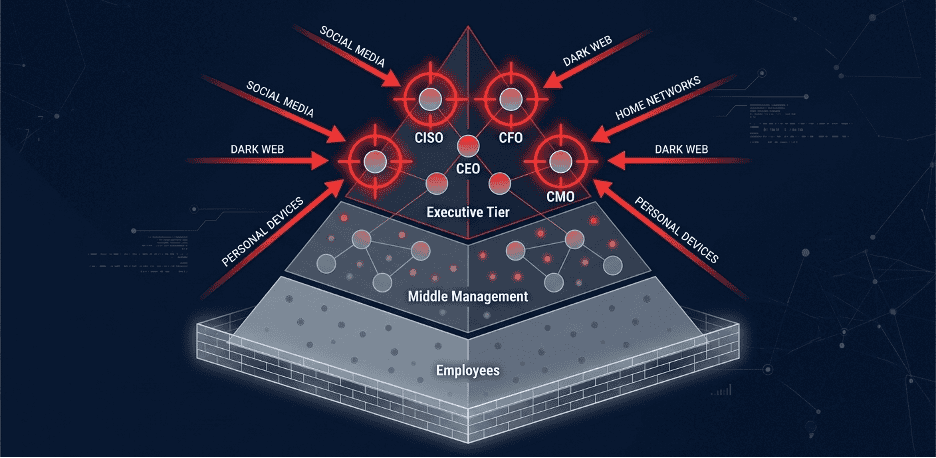
Why Executives Are the Primary Target: The Economics of Access
Attackers are rational actors making investment decisions. When they choose a target, they are weighing the expected return against the expected cost. A standard employee account, when compromised, provides access to the systems that employee can reach and the data in their purview. A CISO account, a CFO account, or a CEO account provides something categorically different.
The Access Asymmetry
Executive accounts carry disproportionate system access by design. A CFO has authorization to initiate large wire transfers, approve vendor payments, access financial reporting systems, and communicate directives that other departments execute without question. A CISO has administrative access to security infrastructure, threat detection systems, and security tooling across the entire organization. A CEO has the organizational authority whose name alone, appearing in an email or a voice message, triggers compliance from every recipient.
This is not a security misconfiguration. It is how organizations function. The same authority that makes executives operationally effective makes them extraordinarily valuable to attackers. An attacker who compromises a CFO account inherits not just that account’s technical permissions, but the social permission structure built around that role: every employee who receives a CFO instruction follows it.
The Information Asymmetry
Executives are systematically more exposed online than any other employee category. Their names appear in press releases, SEC filings, conference speaker bios, LinkedIn profiles, board memberships, and media interviews. Their professional history, educational background, business relationships, and organizational authority are all part of the public record. A company’s standard employee has a fraction of this exposure.
Attackers use this exposure to build personalized attack profiles: what conferences this executive recently attended, which colleagues they reference most, which topics they are publicly engaged with. That personalization feeds directly into attack techniques that target humans rather than systems.
| 💡 The Personalization Premium A generic phishing email landing in an executive’s inbox has a low success rate because executives receive high volumes of communication and are trained to be skeptical. A spear-phishing email that references the executive’s recent board presentation, their colleague’s name, and a current strategic initiative they are known to be driving has a dramatically higher success rate. The public information trail that every executive builds in the course of doing their job is the raw material attackers use to construct that personalization. The executive’s public visibility is both a professional asset and a security liability. |
Attack Surface by Role: Why Each Executive Is Targeted Differently
Not all executive roles carry the same attack value. Attackers select their targets based on what that specific role enables them to accomplish. Understanding the distinct attack surface of each C-suite role enables security programs to apply differentiated protection rather than uniform controls.
| CEO — The Authority Figure |
| System Access: Full organizational authority; SSO access to all major platforms; board-level communication access Dark Web Profile Value: High: CEO identity is used for impersonation at scale; personal data packaged for targeted fraud Primary Threat Vector: Impersonation for BEC and wire fraud; whaling; deepfake voice/video for fraudulent approval Attacker ROI: A single successful impersonation can trigger a large fraudulent wire transfer or authorize data exfiltration |
| CFO — The Financial Gateway |
| System Access: Wire transfer authorization; financial system access; M&A and strategic financial data Dark Web Profile Value: Very High: CFO accounts specifically sought for financial system credentials Primary Threat Vector: BEC targeting finance team; account takeover for unauthorized transfers; M&A intelligence theft Attacker ROI: Direct path to wire fraud; highest immediate dollar value of any executive role |
| CISO — The Security Blind Spot |
| System Access: Security infrastructure admin; access to all monitoring tools; incident response authority; can disable controls Dark Web Profile Value: Critical: CISO credentials provide ability to blind the organization’s own defenses Primary Threat Vector: Credential theft for security tool access; targeted to neutralize detection; insider threat amplification Attacker ROI: A compromised CISO account can disable monitoring, whitelist malicious activity, and delay incident detection |
| CTO/CISO — The Infrastructure Key |
| System Access: Cloud infrastructure admin; source code repositories; CI/CD pipelines; development environment access Dark Web Profile Value: High: technical executive credentials open development and cloud infrastructure Primary Threat Vector: Supply chain compromise via stolen credentials; cloud console access for data exfiltration Attacker ROI: Access to source code, API keys, cloud resources, and the ability to inject malicious code into products |
| CHRO — The Employee Database |
| System Access: Full employee PII access; payroll system authorization; HR platform admin Dark Web Profile Value: Medium-High: HR admin credentials provide access to every employee’s personal data Primary Threat Vector: Payroll redirect fraud; employee PII exfiltration for downstream credential attacks Attacker ROI: Access to the personal data of every employee at scale; direct path to payroll fraud |
| 🔴 Why the CISO Is the Highest-Value Target of All Security teams often underestimate CISO-targeting risk because the assumption is that the CISO is the most security-aware person in the organization. That is precisely why targeting the CISO is so effective. An attacker with CISO credentials can access security monitoring infrastructure, review active detection rules, identify what the SOC is currently watching for, disable alerting for specific indicators, and whitelist attacker infrastructure as legitimate. The CISO account does not just bypass the security program. It enables the attacker to control it. |

What Is Actually Being Sold About Your Executives on the Dark Web?
The dark web market for executive personal data is structured and commercially sophisticated. Threat actors compile, package, and sell executive intelligence products that are specifically designed to enable targeted attacks. Understanding what these products contain clarifies why executive exposure is not merely an abstract risk.
Executive Personal Data Packages
Dark web markets offer structured data packages specifically targeting named executives at named organizations. These packages are assembled from multiple sources: data broker aggregations, prior breach databases, social media scraping, public records, and infostealer logs. A typical executive data package contains:
| Data Category | Attack Application |
| Personal email addresses | Primary vector for spear-phishing outside corporate email filters; personal accounts often have weaker MFA |
| Home address and phone number | Social engineering entry point; SIM-swapping attacks; physical security risk; family-targeting operations |
| Family member names and relationships | Highly personalized phishing lures; family member impersonation; emotional manipulation in social engineering |
| Personal device identifiers | Targeted exploit delivery to known devices; device-specific vulnerability exploitation |
| Financial account information | Direct fraud; blackmail material; leverage for coercive extortion |
| Travel and schedule information | Timing attacks aligned with travel (when corporate oversight is reduced); physical security risk |
| Historical credentials from prior breaches | Credential stuffing against personal and corporate accounts; password pattern analysis |
| Social network connections and communication patterns | Building convincing impersonation profiles; identifying trusted contacts to spoof |
| ⚠️ The Family Extension Threat actors deliberately target family members because they often have weaker personal security hygiene, the executive’s emotional response to a family member being targeted reduces rational decision-making, and family members may have access to personal devices or accounts that share credentials with corporate systems. Executive digital protection that does not account for the family attack surface is incomplete. |
The Five Attack Vectors Disproportionately Used Against Executives
1. Whaling: Spear-Phishing Engineered Specifically for High-Value Targets
Whaling is not a variant of standard phishing. It is a distinct attack category that invests significant research time in a single target. Attackers study a target executive’s LinkedIn activity, recent press coverage, conference participation, and business relationships for weeks before crafting a single message. The message references real colleagues, real ongoing projects, and real organizational context that makes it impossible to dismiss as generic.
The same user awareness training that protects employees from generic phishing provides limited protection against a whaling message that references a specific deal the executive is working on.
2. Deepfake Voice and Video Impersonation
In 2025, AI-generated voice impersonation of executives is operationally deployed, not experimental. The FBI issued a formal warning in May 2025 about AI-generated voice messages impersonating senior US officials.
The source material for executive voice deepfakes is entirely public: earnings calls, conference presentations, recorded interviews, investor days. An attacker with eighteen months of public recordings and widely available voice synthesis software can produce output that is indistinguishable from the real executive’s voice by recipients who know them well. The finance lead receiving a ‘CFO voice message’ approving an urgent transfer has no mechanism to verify the authenticity of that message through standard communication channels.
3. QR-Code Phishing (Quishing) Targeted at Executive Mobile Workflows
Executives are an attractive target for QR-code phishing. They have mobile-heavy workflows and are accustomed to scanning QR codes for conference access, travel, and quick authentication. QR codes bypass email link filters entirely, as the link content is embedded in an image rather than plain text.
Quishing campaigns targeting executives typically impersonate internal IT communications (MFA re-enrollment, security update, account verification) or conference and travel services that executives use regularly. The QR code directs to an adversary-in-the-middle proxy that captures valid session tokens after MFA completion, bypassing MFA protection entirely.
4. Business Email Compromise via Executive Impersonation
BEC is one of the costliest cybercrime categories in the FBI’s Internet Crime Complaint Center reporting: the 2024 Internet Crime Report records about $2.77 billion in reported BEC losses, second only to investment fraud. The pattern is consistent: an attacker who has studied an executive’s communication style, tone, and typical request patterns sends a message that appears to come from that executive authorizing an urgent financial transaction.
The effectiveness of BEC is fundamentally a function of organizational authority structure: employees comply with instructions that appear to come from senior executives without applying the same verification scrutiny they would apply to requests from peers. This is a human vulnerability that cannot be addressed by technical controls alone. Social media impersonation of executives creates additional channels for attackers to establish false context before launching BEC attempts.
5. Personal Device and Home Network Exploitation
Enterprise security architectures protect corporate devices and corporate networks. They do not protect the personal MacBook that an executive uses to read board documents on Sunday morning, or the home WiFi network that the CEO uses to join acquisition negotiation calls from their home office.
Personal devices used for corporate access are systematically outside MDM enrollment, EDR coverage, and corporate network monitoring. They run personal applications that the executive chose, not applications vetted by the security team. They connect to home networks that the executive controls but that have no enterprise-grade monitoring. They represent the largest unprotected attack surface in most organizations’ executive security programs, and most organizations have no program component specifically addressing it.
| RELATED READING: CISO’s Guide to Account Takeover Prevention: Detection, Response, and Recovery brandefense.io/blog/ciso-guide-account-takeover-prevention-detection-response-recovery How AiTM phishing, session hijacking, and infostealer malware enable account takeover even against MFA-protected executive accounts; full detection and response framework. |
Why Do Standard Security Programs Fail to Protect Executives?
Most organizations apply identical security controls to every employee regardless of their attack surface. The same phishing awareness training, the same MFA enrollment, the same device management policies. For the majority of employees, this standardized approach is appropriate. For executives, it systematically misses the specific vectors through which they are disproportionately targeted.
Standard Awareness Training Does Not Address Whaling Generic phishing training teaches employees to spot generic indicators: spelling errors, suspicious links, unfamiliar senders. Whaling emails have none of these characteristics. They are well-written, they reference real context, and they come from addresses that appear legitimate. The same training that protects an entry-level employee from a generic phishing email provides essentially zero protection against a whaling message that accurately references the executive’s current strategic priorities.
Corporate MFA Policies Do Not Protect Personal Accounts An executive who uses the same password on their corporate SSO and their personal email, or who has a personal email that is linked to their corporate account for recovery purposes, has created a vulnerability that corporate MFA enrollment does not address. Personal account compromise is the entry point for a significant proportion of executive-targeted attacks, and personal accounts are structurally outside the scope of corporate security controls.
Perimeter Security Has No Coverage Over Personal Devices and Home Networks Executive breaches can occur through home office environments. Corporate firewalls, email gateways, and network monitoring provide no visibility into traffic on personal devices or home networks. An executive who reads a malicious link on their personal iPad at 10pm, or who joins a sensitive call on a home network that has been compromised, is operating entirely outside the organization’s security perimeter.
Dark Web Monitoring Programs Rarely Cover Personal Identifiers Most organizational dark web monitoring programs monitor corporate email domains and corporate IP ranges. They do not monitor executives’ personal email addresses, home phone numbers, or personal identity data, which are the identifiers most commonly found in executive-targeted dark web data packages. The organization’s monitoring program has no visibility into the data that feeds the most damaging executive-targeted attacks.
What Does Executive Cybersecurity Look Like in Practice?
Effective executive security is not a more expensive version of standard employee security. It is a structurally different program that addresses the specific attack surface, threat vectors, and data exposure patterns that make executives disproportionately targeted.
| Area | Standard employee program | Executive program |
|---|---|---|
| Training | Generic phishing indicators | Whaling that references real deals and context |
| Monitoring | Corporate domains and IP ranges | Personal email, phone, address and family identifiers |
| Reporting | Standard IT helpdesk ticket | Direct low-friction channel to the security team |
1. Executive Digital Footprint Assessment
The starting point is understanding what is already publicly available and what is circulating on dark web markets about each executive. A digital footprint assessment maps every data point that an attacker has available: data broker listings, prior breach exposure, social media footprint, property records, family member connections, and dark web data package availability. The assessment produces a prioritized remediation roadmap: which personal data should be removed from public sources, which credentials need immediate rotation, and which attack vectors are currently most active against that specific executive.
2. Personal Identifier Dark Web Monitoring
Continuous monitoring of dark web sources for executive personal email addresses, home phone numbers, home addresses, and family member identifiers provides early warning when executive-targeted attack preparation is underway. When an executive’s personal data package appears on a dark web forum, or when their personal credentials appear in a stealer log distribution, the organization receives a signal that targeted attack activity may be imminent. This monitoring must extend beyond corporate domain credentials to the personal identifiers that executive-targeting campaigns specifically seek.
3. Executive-Specific Incident Response Procedures
Executives who receive targeted social engineering attempts, suspicious communications, or evidence of impersonation need a specific, low-friction reporting channel that does not require them to navigate standard IT helpdesk procedures. High-value social engineering attempts against executives are time-sensitive: a CFO who receives a suspicious wire transfer request needs to be able to reach the security team immediately, not log a ticket. Pre-established direct communication channels between executives and the security team, and pre-defined verification protocols for high-risk financial transactions, are operational requirements, not optional enhancements.
4. Verification Protocols for High-Risk Actions
The single most operationally impactful control against executive impersonation fraud is an out-of-band verification protocol for high-risk transactions. Any wire transfer request, vendor payment instruction, or access privilege change that arrives via email or voice message from an executive should require independent verification through a separate channel before execution. The CFO who calls the CEO on their known personal number to confirm a wire transfer request is implementing the control that would have stopped the deepfake voice attack described in the opening of this blog.
- Treat the request as unconfirmedWire transfers, vendor payments and access changes from an executive.
- Use a separate channelCall the executive on a known number.
- Execute only after confirmationDo not act on the first message alone.
| 🔍 The Engagement Gap Executives who feel they are treated as security liabilities can disengage from security programs rather than engage with them. Executive security programs that are designed around executive behavior patterns, rather than designed to retrofit employee controls onto executive roles, tend to see better adoption. |
How Brandefense Protects Executive Digital Identities
Brandefense’s VIP Security and Digital Risk Protection capabilities provide the continuous monitoring infrastructure that standard security programs do not extend to executive personal identifiers and targeted attack preparation.
| Brandefense Capability | Executive Protection Application |
| Executive Personal Identifier Monitoring | Continuous dark web monitoring for named executives’ personal email addresses, home phone numbers, and personal identity data; detecting targeted data packages before they are weaponized in spear-phishing or social engineering campaigns |
| Executive Credential Exposure Detection | Real-time scanning of stealer log distributions and credential markets for executives’ personal and corporate account credentials; detecting exposure before attackers deploy stolen credentials in account takeover attempts |
| Social Media Impersonation Detection | Monitoring of LinkedIn, Twitter/X, and other platforms for fake profiles impersonating your executives; detecting impersonation infrastructure used to build rapport with employees before BEC attacks |
| Executive Mention Surveillance | Dark web forum and threat actor communication monitoring for discussions referencing named executives by name, role, or organization; early warning when executives are being actively researched as attack targets |
| Phishing Domain Detection for Executive Impersonation | Monitoring of domain registrations for lookalike domains targeting executive email addresses or executive-associated brands; detecting phishing infrastructure before campaigns launch |
| Deepfake and Voice Clone Intelligence | Monitoring of dark web AI tooling markets for voice cloning and deepfake services being deployed against your executive team; tracking the commercial infrastructure that enables impersonation fraud |
| 24/7 Analyst Coverage with Executive Escalation | High-severity detections involving named executives receive immediate analyst escalation; direct notification protocols to the CISO and executive’s personal security contact rather than standard IT queue processing |
The CFO who receives a deepfake voice message approving a wire transfer has already lost. The detection window that matters is not at the moment the deepfake is deployed. It is weeks earlier, when the attacker is assembling the source material, building the target profile, and preparing the attack infrastructure. That is where continuous executive monitoring provides the earliest and most operationally impactful signal.
Executives are being actively targeted, and many organizations give them no additional protection. That gap is not a resource problem. It is a program design problem. The solution is not applying more of the same employee-scale controls to executives. It is building the specific monitoring, detection, and response capabilities that the executive attack surface requires.