CONCENTRATION
A small persistent core accounts for most claims.
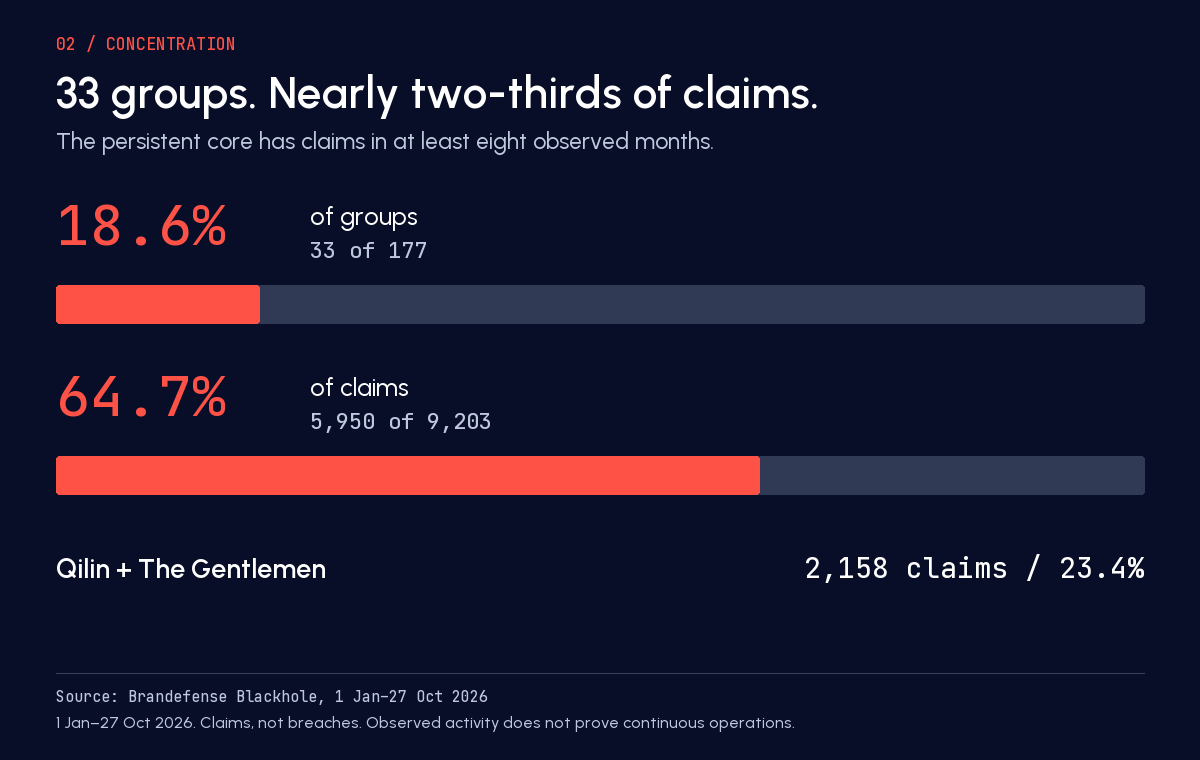
33 groups with claims in at least eight observed months account for 5,950 of 9,203 claims (64.7%).
Press and research kit · Original findings, chart assets and reusable aggregates.
Local review edition. This kit describes a Brandefense research chapter prepared from our own Brandefense Blackhole dataset. Its availability here does not imply publication.
Brandefense’s ransomware research pairs 9,203 canonical leak-site claims from 177 groups with a close reading of recruitment and service advertisements. A persistent core of 33 groups accounts for 64.7% of the collected claims. The advertisements show tools, revenue-sharing terms and negotiation infrastructure offered as separate services. The chapter distinguishes what sellers promise from what the collected claims show; neither source establishes a confirmed breach, sale or payment.
CONCENTRATION
33 groups with claims in at least eight observed months account for 5,950 of 9,203 claims (64.7%).
LEADERS
Qilin (1,146) and The Gentlemen (1,012) together account for 2,158 claims, or 23.4% of the collected total.
MONTHLY
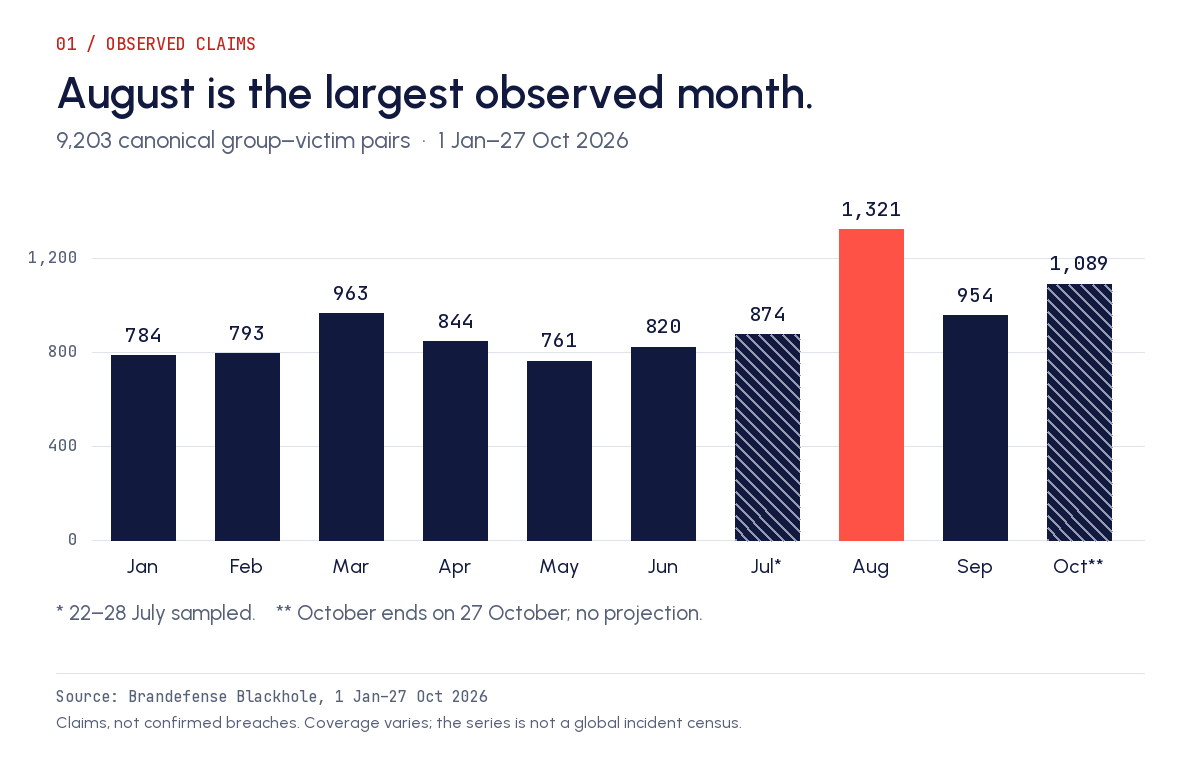
The collected series records 1,321 claims in August, compared with 761–963 per month from January through July.
NEGOTIATION
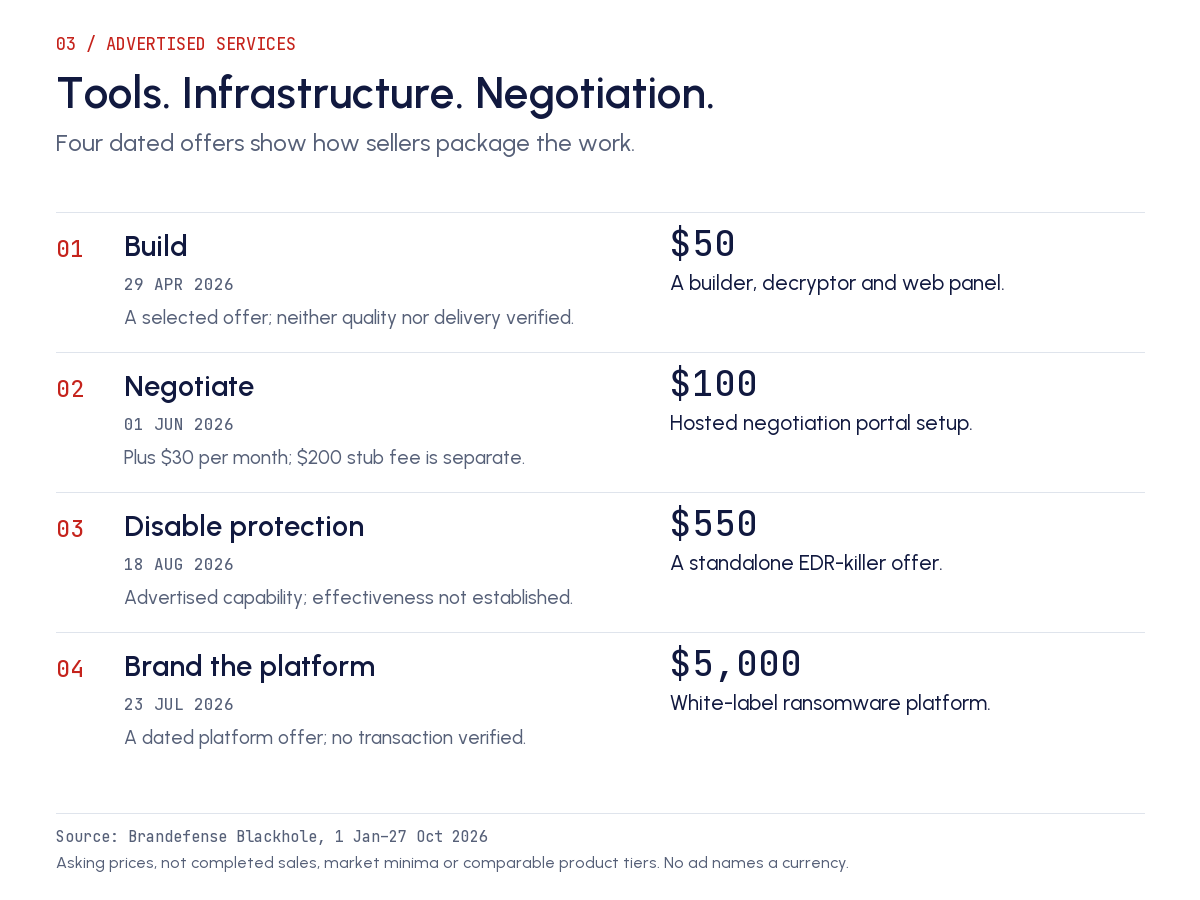
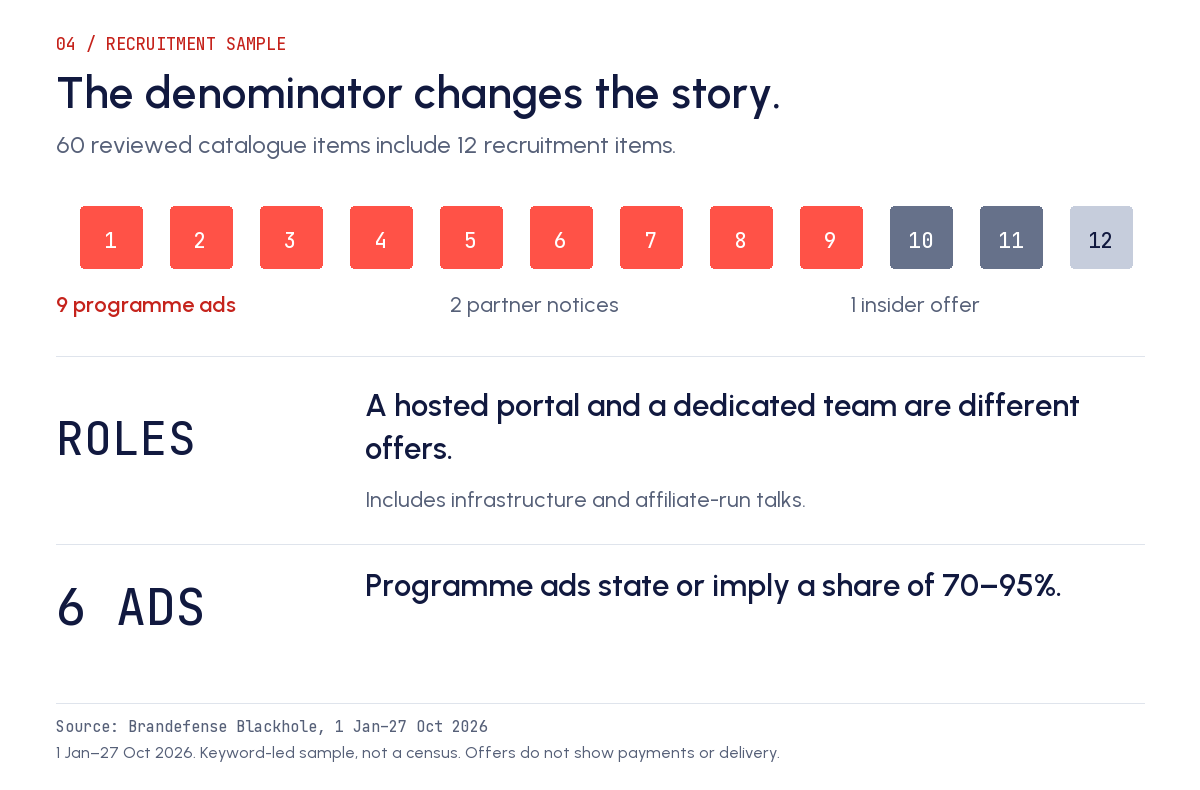
Programme ads describe different support roles. One advertises a hosted portal at $100 setup plus $30 per month.
SPLITS
Six programme ads state or imply a partner share, ranging from 70% to 95%; three advertise a fixed 90%.
RELAYS
7,862 claims (85.4%) appear through more than one relay in the collected data.
Download a PNG for a presentation or an SVG for scalable use. Keep the source note and limitations visible; do not crop a qualification out of a reused chart.
Source: Brandefense Research Team, Inside the Ransomware Economy, 2026, v1.3. Data: Brandefense Blackhole, 1 Jan–27 Oct 2026. Claims, not confirmed breaches.
Link the attribution to the research page when a public edition is available. This local review edition does not provide a public publication URL. Original aggregate data and charts: CC BY 4.0.
Brandefense Research Team · Brandefense Blackhole data · Prepared by Claude Opus 5.5, checked by Codex Astra and approved by Brandefense analysts. Why AI agents. Brandefense Blackhole, our cybercrime database, collects around 17 to 23 million dark web and Telegram posts a month. Reading that volume by hand, and linking a recruitment ad on one forum to a leak-site claim on another and a price list in a Telegram channel weeks later, is beyond what a human team can do alone. Claude Opus 5.5 prepared the research: it searched the data, sorted and translated posts and drafted the text. Codex Astra then checked every number against the dataset files and tested each claim, and anything that did not hold was removed. Brandefense analysts reviewed and approved the findings.
Read the method and limitations before reusing a finding.
Inspect how January-selected labels represent later recorded claims. Method and limits, , , and .