01 / Read this first
A Leak Post Is a Claim, and a Claim Is Not a Breach.
Blackhole-collected posts about data leaks are mostly news retellings, forum thread titles repeated by an alert bot, and short claims whose fields, counts and dates are the poster’s own words. This report reads what the posts say and what a defender can do with it.
Three investigations ask separate questions of the same collection, 1 January to 27 October 2026. The first reads 1,124 database-share claims. The second asks what relay "Data leak" cards and news retellings prove. The third compares how organisation databases and marketing lead lists are advertised.
| Investigation | What it answers |
|---|---|
| What a Database Leak Post Actually Claims | A database leak post is a short claim with a field list, a unit, a year and a thread. Reading those four items shows which kinds of data posters say they hold. |
| When a Data Leak Alert Is an SEO Ad: Reading Dark Web Brand Alerts | Data leak alerts are often relay cards pointing at forum adverts. See what a card, a retelling and a first-hand post each prove, and how to triage an alert. |
| Breach Databases and Lead Lists Are Sold on Different Terms | Breach database offers lean on a sample; lead lists more often promise validity, and some also promise replacement. One advertiser sits behind much of the lead-list pattern. |
Numbers to quote, with their limits
| Measure | Value | Limit |
|---|---|---|
| News retelling in the "data breach" keyword pool | 55% to 69% (rule label 64%); n=9,409 posts | Corrected with 70 posts read by one AI reader; Telegram-dominated pool. |
| First-hand posts in the same pool | 16% to 29% | Includes relay cards; a post, not an incident. |
| Stated data age of two years or more | 28% (25% to 32%); n=614 claims | The poster’s statement. 45% of claims state no year. |
| Relay cards pointing at a service, SEO advert or job | 24% of 200 cards read | A card repeats a forum thread title; the "Data leak" tag is constant. |
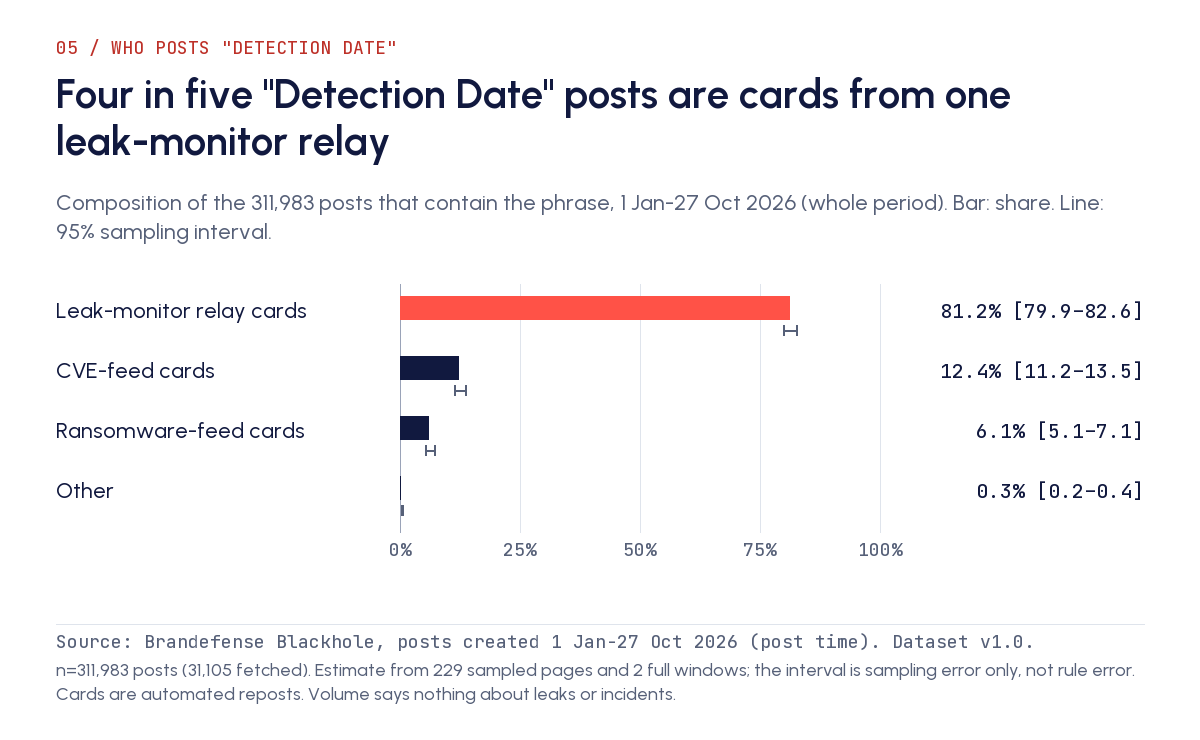
| "Detection Date" posts that are leak-monitor relay cards | 81.2%; n=311,983 posts | Estimated from a sample; volume is not leak volume. |
Posts are not incidents, victims, sellers or transactions. We make no statement that leaks, forums or the dark web grew or shrank, and no forum month-by-month statement, because forum dates in the data are partly day-and-month swapped.
02 / Main investigation
What a Database Leak Post Actually Claims
An investigation of what a first-hand database leak post asserts, and what a defender can take from it.
Brandefense Research Team · Brandefense Blackhole data · Prepared by Claude Opus 5.5, checked by Codex Astra and approved by Brandefense analysts.
Key takeaways
• Email is listed in 62% of 1,124 claims in database shares and a password in 19%; contact and identity data is listed about three times as often as passwords.
• A third of claims give no count, and a post can give two counts far apart; a number needs its unit and its sentence.
• 45% of claims state no obtained year. Among the 614 that do, 28% are at least two years old. None of the 45 sampled older-claim openings used freshness wording to present an old breach as new.
• An estimated 5.5% to 13% of the 1,811 short forum replies we scanned challenge a claim, with recounts, sample requests or earlier leaks.
• These are claims in posts, not verified incidents, victims or sales; the field list should drive the response.
One catalogued post says a consumer web platform lost its data in late 2025. Its narrative claims millions of rows, while its file summary, a few lines lower, provides a record count that is about fifty times smaller (DB-E008 in the evidence catalogue). The gap may reflect a difference of unit rather than a contradiction, but the post never says so.
A database leak post has two layers. The poster states a field list, a count, a year and an access condition, and the replies below then test some of those statements. Both layers tell a defender more than a headline count does.
Our pool is 1,124 claims, de-duplicated by post title (1,098 titles plus 26 posts without one). They are carried by 1,967 posts in three forum-oriented sets, collected between January and 27 October 2026. One AI reader read 100 template posts: 72 were a first-hand share, and the rest were replies, sale advertisements or not a share at all. Every figure below describes what posts say, not what happened.
A Count Means Nothing Without Its Sentence
A third of the claims (33%) give no count at all. Of all claims, 31% state a count in users, 16% in records, 5% in rows, 5% in lines and 1% in files. An additional 9% give an unqualified number such as "5M" with no unit of measurement. Among the 750 claims that do state a count, the magnitude varies enormously: 10% are under ten thousand and 19% are above ten million.
Units matter because they are not interchangeable. A compilation post in our catalogue provides a headline count, a deduplicated count about 14% lower and a file count about 24% lower (DB-E009). Another post provides two record counts that differ by about a factor of two (DB-E002). One reader of a different thread calculated that the unique email count sat about 2% below the stated user count (DB-E042).
For an organisation, the number closest to people is usually the unique one, which is the figure that posters mention least. A post that states "rows" may count lines in a log, and a post that states "records" may count one person several times. Without its sentence, a count cannot be reconciled with any record that you hold.
In Database Shares, Contact Data Outnumbers Passwords
The field lists consistently point in one direction, with email appearing in 62% of claims, name in 53%, physical address in 44% and phone in 41%. A password appears in 19%, date of birth in 16%, IP address in 11%, national ID in 6% and a payment card in 3%.
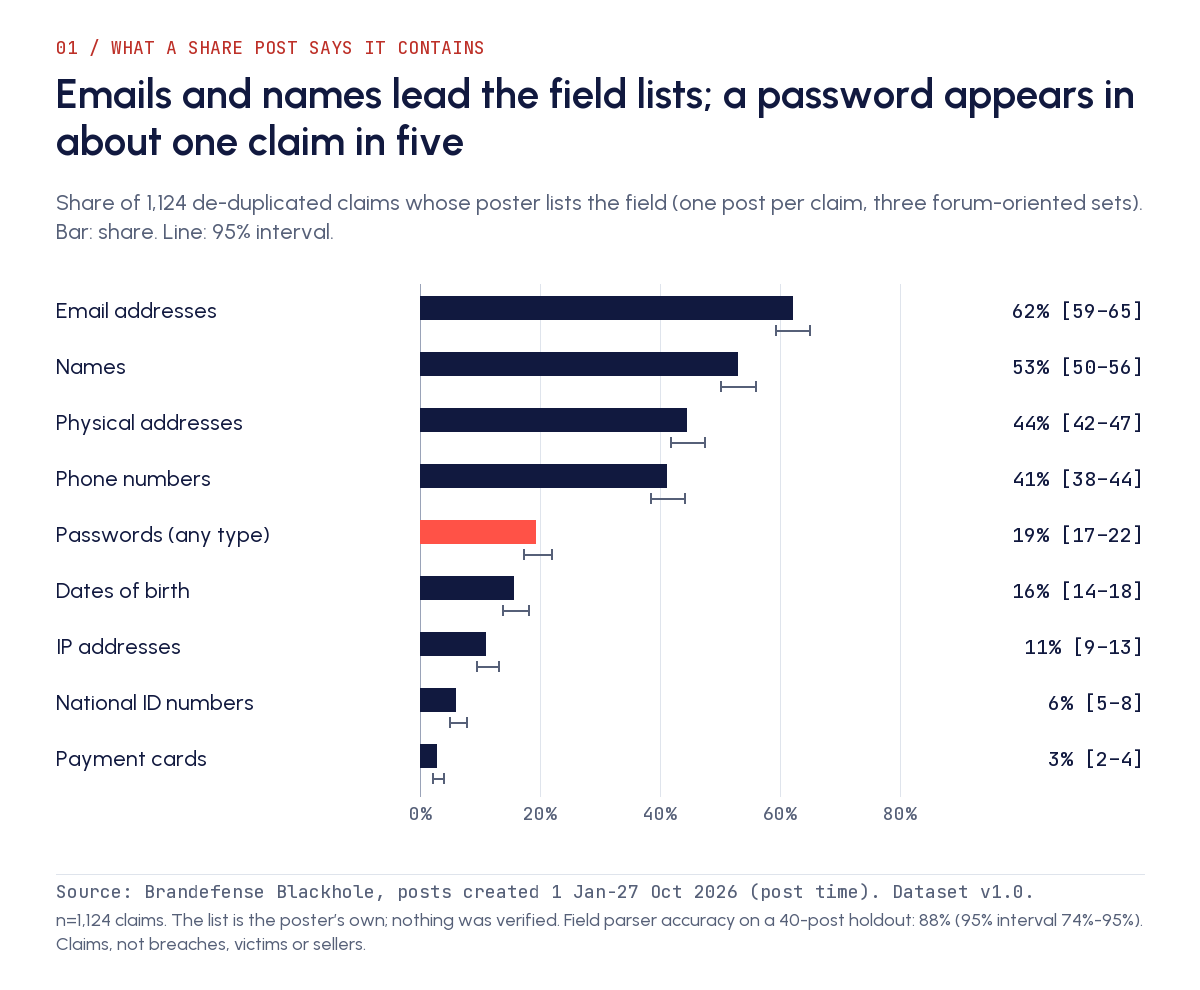
So in this pool, email is listed about three times as often as a password, and name, address and phone each appear more often than a password does. One in five claims (19%) lists five or more field categories, which could support targeted contact with the people concerned. An additional 23% list none of the nine categories we track; one three-line post gives only a title count and a link (DB-E012).
Where a password is listed, the post often does not say what kind. Of the 218 claims that mention one, 40% state hashed, 12% state plaintext and 47% give no type, and a named algorithm appears in 32%. Across all claims, that is about 8% stating hashed passwords and about 2% stating plaintext.
A stated field list can also contradict its own post. One lists emails and passwords formally, yet its own sentence says only a very small number of lines carry an email and a bcrypt hash (DB-E007). Another provides a field list, a named algorithm and a count in the millions, yet its 20-row sample contains short placeholder strings in the password column (DB-E014). A field list is what the poster asserts, not what the file actually contains.
The composition of the pool matters for this comparison, because it holds posts that share databases while credential lists sit elsewhere by design. Our stolen-credentials chapter covers combolists and account dumps, where passwords are the product, and the infostealer chapter covers the logs that often feed them.
The base rate does two jobs. It sets a prior for the posts that list none of the nine categories we track, nearly one in four. It also argues against defaulting to a credential playbook when a post is silent.
Testing the Old-Data-as-New Explanation
There is a competing interpretation of these posts: perhaps they recycle old breaches under fresh titles, so that an organisation wrongly believes the exposure is new. The most consequential finding bears on that interpretation directly. Of all claims, 45% state no obtained year, so for nearly half of them the post cannot establish for a reader whether the data is recent. Recirculation makes that gap matter.
One catalogued reply quotes an automated upload from 2023 about a breach that was already several years old. In 2026 it requests a repost because the link is dead (DB-E003). A second post separates the breach month from the month the data "circulated more widely" a few months later (DB-E010). A reader who sees only the later date would reasonably take the data for recent.
For the other claims, we could test the idea. Among the 614 that state a year (55% of the pool), counting back from 2026, 49% date the data to this year and 23% to the year before. An additional 16% state two to four years, 9% state five to nine and 3% state ten or more. In total, 172 claims (28%) are at least two years old, and 12% are at least five.
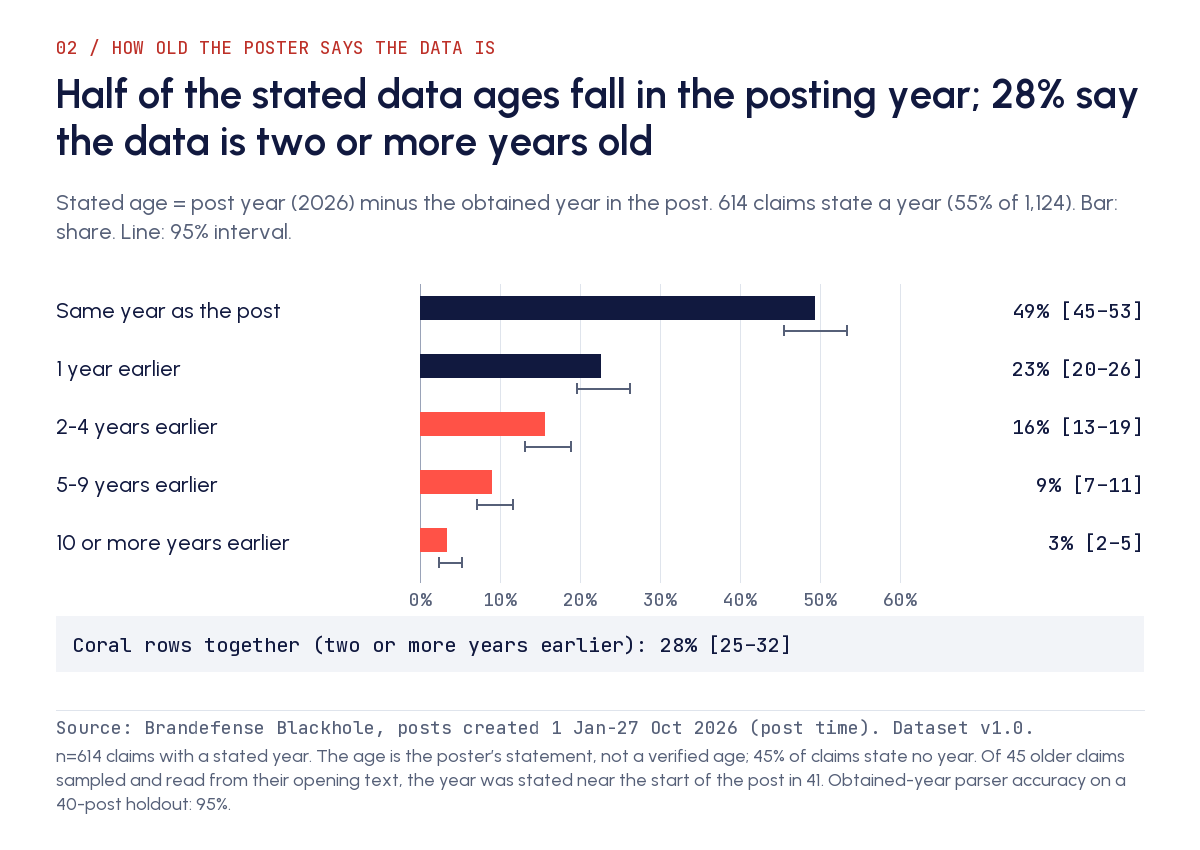
We sampled 45 of 173 distinct claim keys with at least one copy stating data two or more years old. The separate richest-copy age table contains 172 such claims. We read the opening text, approximately 650 characters, alongside the parsed fields.
In 41 of them the year appears within the first 400 characters, and three say the file is a re-upload; the 45 were chosen because a year was stated. We also scanned all 173 distinct claim keys for words such as "fresh", "latest" and "new leak", and five matched. On reading, all five were something else, such as a combolist advertisement or an unrelated recent event.
The opening-text and keyword checks found no older breach introduced with freshness wording. They do not establish what every full post said. About 4% of claims carry a re-upload marker. The test cannot be run for the 45% with no year, which is precisely the undated half in which an old file could pass for a new one.
Access Gates Shape the Thread
The access terms specify who can obtain the data. Of the claims, 29% give an open link, 29% are restricted behind a reply lock and 23% behind a credit or points lock. A further 10% use priced or sale wording, and 8% state no access condition at all.
That split depends on the unit of counting, since open links are 29% of claims, 38% of posts and 19% of opening posts. Our access classification was also only 90% accurate on a 40-post check, so treat it as a rough ordering, not as precise proportions.
Access gates also blur the distinction between sharing and selling. One post opens with the forum's free-share greeting. It then says the thread is "for you to buy", sets a single price and requests payment by direct message (DB-E013).
Reply locks may add short replies that quote the opening post, and 791 of the 1,967 posts are replies, so raw post counts overstate the number of claims. We did not test that mechanism. Our companion on how breach databases and lead lists are sold examines the terms of priced offers.
The Thread Does Some of the Checking
The replies contain information that the opening post lacks. We scanned 1,811 short forum replies across the fetched sets, and one AI reader read in full every reply that used wording about samples, earlier leaks, fakes or counts. Of the 106 hits, 73 (69%) were a reader challenging or testing a claim.
Allowing for challenges the wording missed, an estimated 5.5% to 13% of the replies do this, roughly 1 in 13 at the midpoint. The confirmed minimum is 4%.
The verification attempts are concrete, and some need only arithmetic:
• One reader recounted a file and found that about 6% of its lines were duplicate records (DB-E041).
• A second reader noted that the sample already held almost every record the sale offered (DB-E037).
• A third verified the email addresses against the service and found them already present in earlier lists (DB-E036).
• A fourth pointed out that a health file listed the patient name before the ID, while the sample showed the reverse (DB-E043).
Some of the signal is an echo. In one thread, at least ten near-identical short replies quote the same parent post (DB-E011), so the number of independent readers is smaller than the reply count. Readers also cite the forum's own rule that a sale without a sample is assumed to be a scam (DB-E040).
For a defender, a thread can answer questions that the post cannot, and a reader's remark that the data was already public elsewhere is an indicator on timing (DB-E035). A recalculation is a more reliable size estimate than the title. Each is one person's statement rather than confirmation, but both are worth reading before a number is quoted in an internal report.
A Checksum Is Not a Password Hash
Many posts in this template carry a line with the archive's own checksum next to the field list, and our first automated parse read that line as a password hash. It reported that 75% of password claims were hashed, whereas after correction the share is 40%. A "hashed passwords" line near a checksum may therefore describe the download file rather than the data inside it. The checksum itself says nothing about how passwords were stored.
Reading a Post Against Your Own Records
Four checks turn a post into a decision, and the first one decides the rest:
1. Read the field list and sort the post into contact and identity data, credentials, or neither stated. That sorting decides which team needs it.
2. Check which unit the count uses, and look for a unique-email figure. Rows and records can count one person several times.
3. Check whether the post states a year. Without one, it cannot tell you the data is recent.
4. Read the replies for a recount or a link to an earlier leak, since both change the size and age you should assume.
The response follows the field list. If the post lists contact and identity fields, which is the more frequent scenario, a password reset addresses little of that exposure. The risk sits closer to phishing, impersonation and support-desk pretexting against the people named, so customer-facing teams need the field list.
If a password is listed, treat its type as unknown unless the post names an algorithm, and test whether any credentials of yours are in scope. If no field is listed, do not borrow a playbook, and let the poster's sentences and the thread establish what the post actually claims.
If the claim matches your records, the post-breach steps in our glossary apply. Our data leak detection page describes how such exposure is found in the first place.
Where the alert reached you as an automated card rather than a post, remember that the card reproduces a forum thread title and a constant "Data leak" tag. Our companion on relay cards and news retellings shows how to read those. For ongoing coverage of sources like these, see Brandefense dark web monitoring. The full evidence is in the data breach and leaks chapter.
Scope and Method
The pool holds share posts from three forum-oriented Blackhole sets, 1 January to 27 October 2026, reduced to 1,124 claims by post title, keeping the richest copy of each. Telegram, Discord and paste together account for 187 of the 1,967 posts (about 9.5%) and 13% of the claims. Another 322 posts (16%) are free shares or file drops, such as source code, account dumps or course files, so the pool is not only databases.
Forum post dates in Blackhole are partly day-and-month swapped, so we state period-level shares only and make no month-by-month statement. Counts are posts collected by Blackhole, not incidents, victims, sellers or transactions, and the data was not bought or tested. One AI reader (Claude) labelled the 100 template posts and the catalogue records, working separately from the parsing rules, with no second rater.
The first parser read field lists correctly in 63 of 100 posts. The corrected parser did so in 35 of 40 on a separate holdout (88%). Field shares therefore carry about three points of sampling error plus a few points of unknown classification bias. The reply-challenge range comes from a keyword scan of 1,811 replies plus a read of 100 non-hits.
Why AI agents. Brandefense Blackhole, our cybercrime database, collects around 17 to 23 million dark web and Telegram posts a month. Reading that volume by hand, and linking a recruitment ad on one forum to a leak-site claim on another and a price list in a Telegram channel weeks later, is beyond what a human team can do alone.
Claude Opus 5.5 prepared the research: it searched the data, sorted and translated posts and drafted the text. Codex Astra then checked every number against the dataset files and tested each claim, and anything that did not hold was removed.
Brandefense analysts reviewed and approved the findings.
03 / Alerts, relay cards and news
When a Data Leak Alert Is an SEO Ad: Reading Dark Web Brand Alerts
A signal-by-signal reading of what dark web and Telegram data leak alerts prove, and what to check next.
Brandefense Research Team · Brandefense Blackhole data · Prepared by Claude Opus 5.5, checked by Codex Astra and approved by Brandefense analysts.
Key takeaways
• In 200 relay cards read by an AI reader, the relayed thread was most often general discussion (57), a service or SEO advertisement (47) or a combolist (37). An organisation's own database was the topic in 0 of 200.
• The "Data leak" tag is the same on every relay card, so a card proves only that a forum thread with that title was seen.
• About 48% of the 200 cards named a company, brand, platform or domain, often the advertiser's own name. Roughly seven in ten of those were advertisements or chat, and three in ten were credential files or account sales.
• News retelling is the largest part of the "data breach" keyword pool: about 64% by fixed rules, and 55% to 69% after correcting against 70 AI-labelled posts. First-hand posts, which include relay cards, are 16% to 29%.
• Never close an alert that names your organisation on the title alone, and log the signal type with every alert.
One card in our Telegram collection carries the tag "Data leak" and lists a source, a content line, a detection date and a type. The source is a marketing forum, and the content line advertises search-ranking backlinks, so nothing in the card refers to stolen data (record DB-E015).
The tag did not come from the thread, because an automated monitor writes the same Type value on every card, and all 26,282 cards we fetched carry it. A second card, from a Russian-language forum, places an earnings slogan under the same tag (DB-E016). Data leak alerts of this kind are common: the phrase "Detection Date" alone matches about 312,000 posts between 1 January and 27 October 2026.
An estimated 81% of those posts are leak-monitor relay cards over the whole period, although the share declines from roughly 91% in January to roughly 70% in October. CVE-feed cards (12%) and ransomware-feed cards (6%) account for nearly all of the remainder.
If a card like this names your brand, what does it tell you? We examined 200 of them, then compared the results with the news retellings and first-hand posts that arrive under a "data breach" label. Counts are Blackhole-collected posts, mostly from Telegram, and they are not incidents, victims or sellers.
What 200 Relay Cards Were About
An AI reader classified the content line of 200 cards, 100 from the full week of 8 March and 100 from a sampled September week. The relayed thread was most often general discussion or another topic (57 of 200, including 12 proxy lists), a service or SEO advertisement (47) or a combolist (37). Carding or fraud advertisements accounted for 24, and the remaining 35 were hacking tools, courses, ransomware or news threads, stealer logs and access sales.
An organisation's own database was the topic in 0 of 200 cards, an upper bound of 1.9% at 95% confidence. That zero depends on one classification choice, because three cards were credential-line files named after a company, which we coded as combolists. Counting those three as organisation leaks would give 3 of 200 (1.5%).
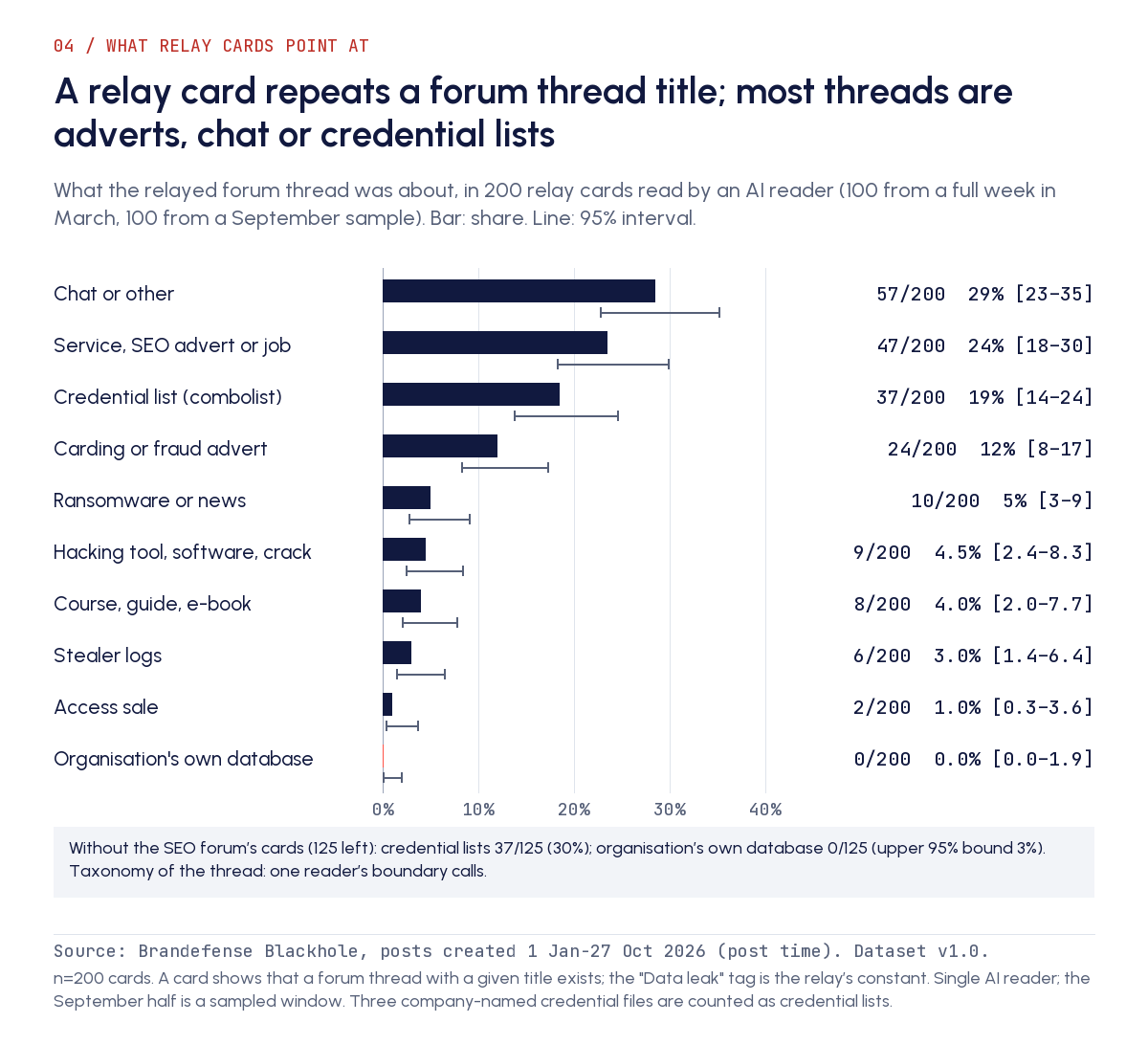
The SEO marketing forum could be producing the zero, because it supplied 75 of the 200 cards and none of them was a combolist or a database. Without it, none of the remaining 125 cards concerned an organisation's database (upper bound 3%), and combolists rise to 30% of what is left. In the full week of 8 March, the 6,539 cards came from 26 forums, and 32% came from that one SEO forum, which is not a breach forum.
An earlier AI read looked different at first sight, because it found 4 of 32 relay cards on-topic. Those cards came from pools that the platform classifier had already labelled for data breach, database sharing or data leak, which a random sample of cards does not do.
Cards That Name a Company
Readers care most about cards that name them, so we also identified which of the 200 name a company, brand, platform or domain. Ninety-five did (48%), often the advertiser's own name, and the proportion was similar in both frames. Of those 95, 67 were advertisements or general discussion, while 28 offered credentials, logs, combos or account and card data.
The 28 were 16 combolists or credential files, one stealer-log file and 11 account or card-data sales, and none offered an organisation's own database. A card that names a company, mostly an advertiser or a service named in a credential list, is therefore an advertisement or general discussion about seven times in ten. It is a credential file or an account sale about three times in ten, and the tag cannot distinguish between the two, because it is identical on every card.
A title that points at a data claim does exist, and one catalogued card names a company and a seven-figure count (DB-E017). It gives no field list, breach date or price, so it cannot tell a free share from a sale or a repost.
Because we selected it for the catalogue, it illustrates the form of such a card and not a rate. The classifications in this section are one AI reader's judgment, and seller-brand names were counted as named.
Where News Retellings Fit
Cards are one signal among several. The keyword pool for "data breach" holds about 9,400 posts collected between 1 January and 27 October 2026. News retelling is the largest component at 64% by rule, or 55% to 69% after correcting for the measured error of the rules. First-hand posts are 16% to 29%, and they include relay cards, since about three in five Telegram first-hand posts by rule are cards.
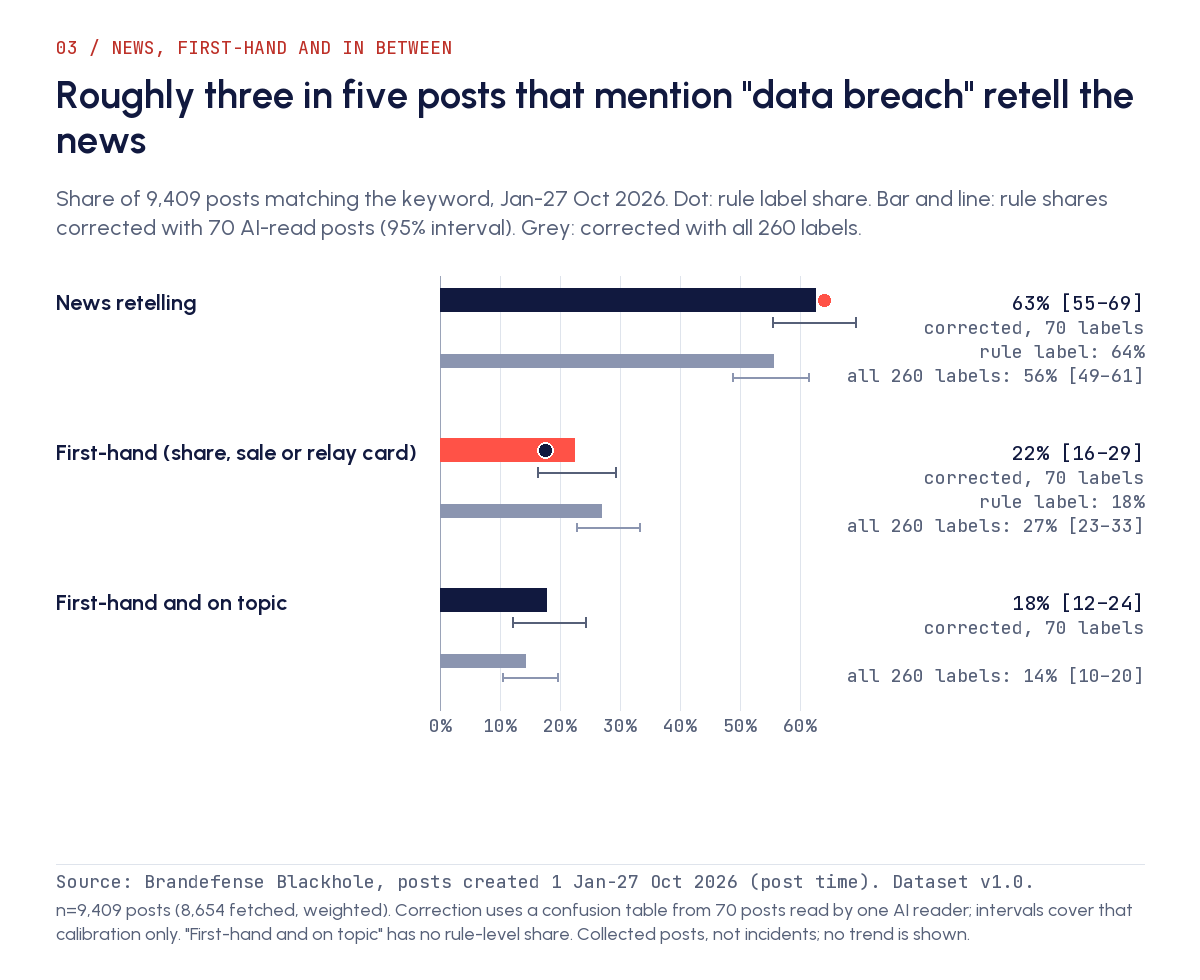
One news aggregator channel carries 36% of the pool, and 99% of its posts are retellings. We therefore tested the result without that channel, which leaves 6,002 posts, and news is still the largest type by rule at 44%, ahead of first-hand at 27%. On Telegram alone, where post dates are reliable, news retelling accounts for 73% to 85% of the pool's posts in every month.
Whether fewer leaks were posted as the year went on is a question this pool cannot answer. Forum dates in the collection are partly day-and-month swapped, so we say nothing about when forum posts changed.
A retelling can also duplicate a single claim. A Telegram threat-intel channel said an actor "allegedly leaked" a platform's user database, listed the claimed fields and relayed the actor's complaint that the company ignored contact (DB-E019). The post followed the forum release by a day and reproduced its field list almost word for word, so a feed that counted both would count the claim twice.
That is one example and not a measured rate, but it shows how an alert feed can count a single claim twice. Our own rule engine labelled a similar retelling as a sale offer because of the word "demands" (DB-E020), although reading it showed no offer.
Signal by Signal: What Each One Proves
The table sets the signal types side by side. Its third column matters most for anyone who must decide whether to escalate an alert.
| Signal | What it proves | What it does not prove | Check next |
|---|---|---|---|
| Relay card tagged "Data leak" | A forum thread with that title was seen by the automated monitor. | That any data was published, or that the thread is about a database at all. | Read the content line for your names, then retrieve the original thread. |
| News headline with a link | An outlet or a news channel reported a security incident. | That anyone is sharing or selling the data it describes. | Follow the link to the affected organisation's own notice. |
| Retelling of a forum release | A forum claim existed and another channel repeated it. | That the channel repeating the claim holds the data. | Find the first claim and count the alert only once. |
| First-hand share on a forum | A poster asserted holding data and gave fields, size or age. | That the data is genuine, complete or recent. | Examine the post itself, as the main investigation explains. |
| Priced sale offer | Someone advertised data under stated commercial terms. | That any sale or delivery actually took place. | Read the sale terms, as the sale-terms companion explains. |
A Triage Rule for Brand Alerts
Apply these steps in order. No alert that names your organisation should be closed on the title alone.
1. Name the form of the item, because a relay card or a headline is only a pointer, whereas a specific claim about data sits in the body of a post.
2. Read the content line for your names, listing your brand, domains and product identifiers in advance. A card that names none of them and no data can be logged as a keyword match, but a card that names you proceeds to step 3.
3. Trace the item to the original by retrieving the thread through your monitoring provider, or by finding the first claim behind a retelling so that you count it once.
4. Route the alert by what the original is. In our read, about three in ten cards that named any company were credential files or account sales. If the original shows credentials tied to your service, route it to credential reset and fraud review, and compare a database claim with your own records.
For the response itself, see what to do after a breach in our glossary. Credential files and combolists are covered in our stolen accounts and combolists chapter, and stealer logs in the infostealer chapter.
Log the Type, Not Just the Count
Record the signal type on every alert. A quarterly figure for "dark web mentions" built from relay cards would consist mostly of service advertisements, combolists and carding or fraud advertisements. Those groups held 47, 37 and 24 of our 200 cards. Such a figure would follow the relay's own sources and not your exposure.
Counted by type, the same quarter shows how many items were pointers, retellings and claims about your data. A team that uses dark web monitoring or a data leak detection workflow can then report the claims separately, since only they bear directly on breach risk.
Where the Other Pieces Go
Our main investigation of data-leak posts shows what first-hand claims list. The companion on breach database sales and lead lists covers the sale terms behind priced offers. Ransomware-feed cards make up an estimated 6% of "Detection Date" posts, so the same form-first reading applies in the ransomware chapter. The whole set sits in the data breach chapter of the Cybercrime Report 2026.
Scope and Method
The pool shares come from fixed rules, corrected with a sample of 70 keyword-pool posts labelled by an AI reader working separately from the rules, so they are ranges. On news retelling the rules matched that reader on 44 of 48 posts (92%). Calibrating on all 260 labels from six pools would give 49% to 61% news. The rules found 9 of the 13 first-hand posts in the 70, so the first-hand range rests on small numbers.
The 200 cards and the brand-name tags were read by one AI reader with no second rater, and the 100 September cards are a sample, not a full week. Records DB-E015 to DB-E020 come from the evidence catalogue of selected posts, read by an AI reader, and selection is not prevalence.
Posts are not incidents, victims, sellers or transactions. The data covers 1 January to 27 October 2026 by post time, October is partial, and the collection is dominated by Telegram.
Why AI agents. Brandefense Blackhole, our cybercrime database, collects around 17 to 23 million dark web and Telegram posts a month. Reading that volume by hand, and linking a recruitment ad on one forum to a leak-site claim on another and a price list in a Telegram channel weeks later, is beyond what a human team can do alone.
Claude Opus 5.5 prepared the research: it searched the data, sorted and translated posts and drafted the text. Codex Astra then checked every number against the dataset files and tested each claim, and anything that did not hold was removed.
Brandefense analysts reviewed and approved the findings.
04 / How the data is sold
Breach Databases and Lead Lists Are Sold on Different Terms
A comparison of the terms on which organisation databases and marketing lead lists are advertised.
Brandefense Research Team · Brandefense Blackhole data · Prepared by Claude Opus 5.5, checked by Codex Astra and approved by Brandefense analysts.
Key takeaways
• Only 68 of 126 sale-labelled posts read in full were a seller's own offer (54%), and one advertisement accounts for 25% of the kept sale posts.
• The 16 lead lists come from 9 channels, and the 8 row-block tier lists are near-copies of one advertisement, so that unit describes one advertiser.
• Validity promises point the same way after de-duplication (2 of 11 breach-database channels against 7 of 9 lead-list channels) and separate by template. Samples, stated prices and unit wording do not separate the groups.
• All 13 breach-database offers were sold whole or without a stated unit, and only two mention escrow or a guarantee.
• A lead list sells contactability, anchored by a validity promise; a breach database sells a claim about a file. Terms describe how data is sold, not where it came from.
One Indonesian-language advertisement offers contact details of online-casino players in four quality tiers. Each tier has its own price list in rupiah, for blocks of rows from hundreds to tens of thousands. The seller promises unlimited replacement of invalid or unresponsive contacts and adds two words: "no tester" (DB-E026).
An English-language forum post offers a database from a single services business. It shows no price, accepts escrow and pastes tables of sample rows (DB-E021). Both posts look like breach database sales in a keyword count, yet they sell different things, and their terms say which. This piece compares those terms and then asks how many separate advertisers stand behind the pattern.
Half of the "Sale" Posts Are Not Offers
Among the posts we fetched for this chapter, our fixed rules labelled 2,303 as sale offers. An AI reader working separately from the rules read 126 of them in full, drawn across platforms and languages. Only 68 of the 126 were a seller's own offer (54% unweighted, 95% interval 45% to 62%; 53% after weighting to the platform and language mix).
The others were channel directories, news, recruitment advertisements and lookup output (21), marketplace-bot digests (10), and replies or bumps (8). The companion piece on relay cards and news retellings covers those post types, and the main investigation reads what leak claims actually list.
Repetition dominates the volume. One Chinese-language one-line advertisement for "first-hand global databases" appears 576 times after normalisation, which is 25% of the kept sale posts. Thirteen templates with five or more near-copies account for 802 posts (35%), so a substantial part of the post volume comes from a few repeated templates; these are not counts of distinct products.
The coded offers show the same concentration: the 13 breach-database offers are 13 distinct texts from 11 channels. The 16 lead lists are 16 texts, yet they come from only 12 template keys and 9 channels. Eight of them, all the rupiah row-block tier lists, are near-copies of one advertisement from one channel. We count advertisements, not sellers or sales, so for lead lists the channel is the safer unit.
Offer Terms Side by Side
Of the 68 offers, 13 sell data from one organisation and 16 sell marketing or lead lists, and each cell gives channels first and posts second. Counts are small, so they indicate a pattern and not a market share.
| Term | Organisation breach database (11 channels, 13 posts) | Marketing lead list (9 channels, 16 posts) |
|---|---|---|
| What is sold | Records that the advertisement attributes to one organisation. | Contact rows for outreach, grouped by market or category. |
| Validity or freshness promise | 2 of 11 channels (2 of 13 posts). | 7 of 9 channels (14 of 16 posts). |
| Guarantee, replacement or escrow | 2 of 11 channels (2 of 13 posts). | 4 of 9 channels (11 of 16 posts). |
| Sample offered or shown | 7 of 11 channels (9 of 13 posts). | 7 of 9 channels (7 of 16 posts). |
| Sample refused | 0 of 11 channels (0 of 13 posts). | 2 of 9 channels (8 of 16 posts). |
| Price amount stated | 4 of 11 channels (5 of 13 posts). | 5 of 9 channels (12 of 16 posts). |
| Unit not stated | 6 of 11 channels (6 of 13 posts). | 3 of 9 channels (3 of 16 posts). |
| Unit tiered by block of rows | 0 of 11 channels (0 of 13 posts). | 1 of 9 channels (8 of 16 posts). |
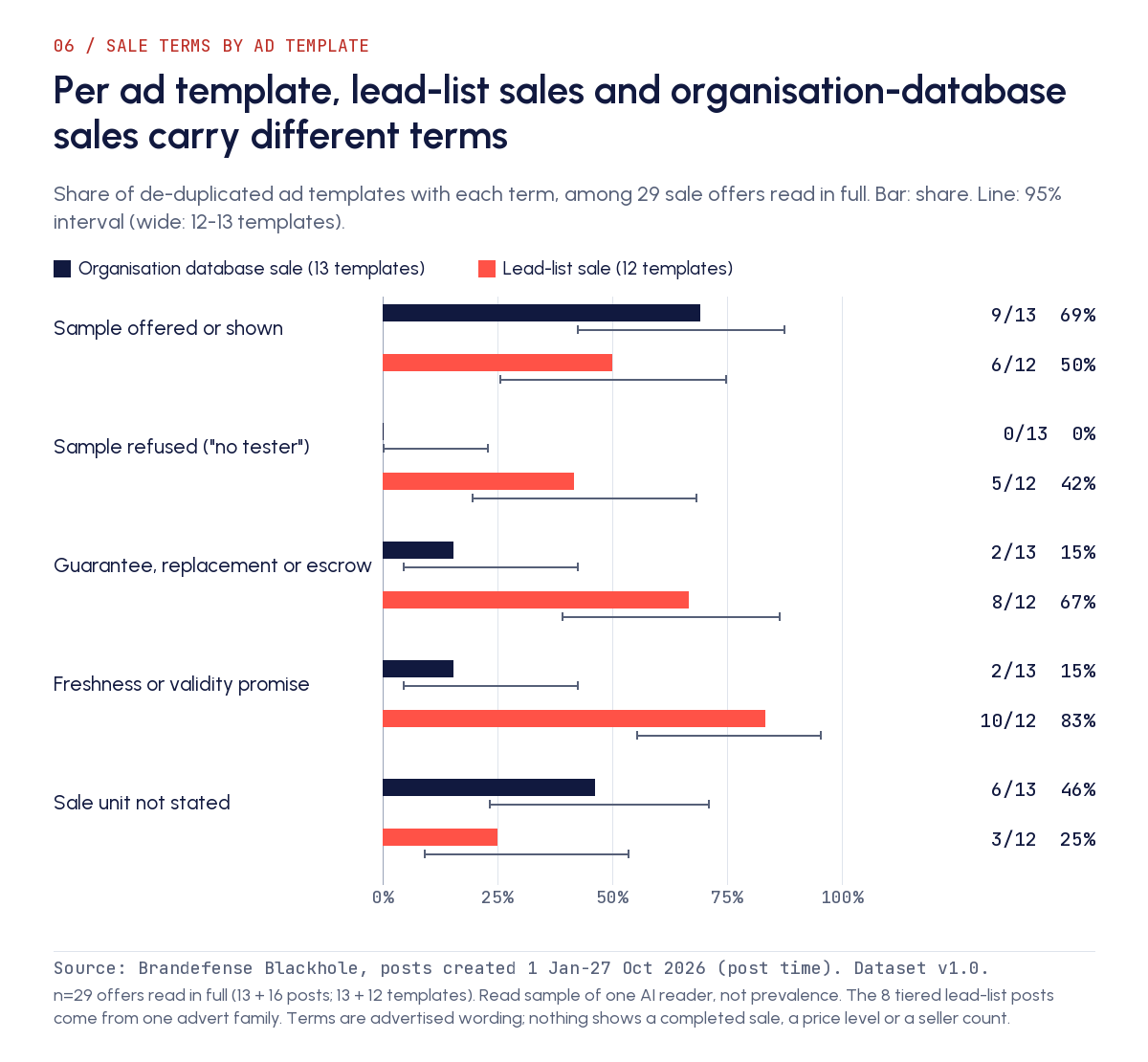
Not every contrast survives de-duplication. The row-block tier unit comes from one advertiser, so it describes an advertisement and not a type of product. Sample refusal appears in two of nine lead-list channels (five of 12 templates) and in none of the breach-database channels, which is a thin but consistent difference.
The validity promise survives best: 2 of 11 breach-database channels against 7 of 9 lead-list channels, and 2 of 13 against 10 of 12 templates. By template the intervals separate (4% to 42% against 55% to 95%); by channel they overlap slightly (5% to 48% against 45% to 94%).
The guarantee gap points the same way (2 of 11 channels against 4 of 9) but its intervals overlap. Offering a sample, stating a price and omitting the unit do not separate the two groups at all.
What the Terms Reveal About the Product
A sample does not distinguish the two products, because lead-list sellers offer samples in 7 of 9 channels. The stronger distinction in this sample is an advertised validity promise. DB-E026 also promises replacement of invalid or unresponsive contact rows; replacement is not universal across the selected lead-list offers.
The validity promise is the term that most consistently marks this product. In DB-E026, the advertised product is contact data expected to be reachable, with a replacement promise attached. We did not test the records or observe a purchase.
Where sellers refuse a free test, we interpret it as protecting the product, since a sample of contacts is itself usable contacts. The sellers themselves do not state this reason. A Chinese-language advertisement pairs "no free test" with "after-sales guaranteed" (DB-E027), and another seller caps samples at a few hundred lines, on request only (DB-E024).
A breach-database seller promises a file and little else. The typical offer sells the whole database, shows rows, lists what the file contains and carries no guarantee. DB-E022 is an example: a file-by-file inventory, rows shown and a "starting at" price. Only two of the 13 mention escrow or a guarantee, namely DB-E021 and DB-E023, so those two are exceptions and not the norm.
With no validity promise, the sample is the only evidence the buyer can verify, and forum readers do verify it, as the main investigation documents from their replies. In short, a lead list sells contactability, anchored by a validity promise that a replacement clause sometimes reinforces. A breach database sells a claim about a file, backed by whatever the sample proves.
One confound limits this. Thirteen of the 16 lead lists were on Telegram and eight were Indonesian-language, while breach databases split 7 forum and 6 Telegram. Some of the contrast may reflect venue norms and not the product, and our data cannot separate the two.
Are Lead Lists Just Relabelled Breach Data?
The strongest alternative is that "lead list" is a sales label on stolen data, so the different terms are packaging only. Some records point that way, although none proves it. One seller offers contact data attributed to customers of a single company and says it is "not selling the database" (DB-E024), yet the post does not state the origin. Another advertisement lists provenance words such as scraped, crawled, hijacked and obtained through intrusion (DB-E027).
A bundle sold once pairs property-owner lists with a large consumer-platform database (DB-E032), which fits the alternative. Other lead products make no breach claim, such as a consumer email list for one country sold as "fresh" marketing data with free lists as a funnel (DB-E033).
The evidence cannot show where any of the 16 lead lists came from. Provenance words are the seller's, and we tested no file. It can show something narrower: the terms describe how data is being sold, and a post's origin claim is a separate question to assess on its own.
Does the Split Extend to Accounts and Bundles?
A reasonable test of the argument is whether products that must keep working after payment carry a promise. Three records fit that pattern, although three is too few to count as a result.
• Verified accounts are priced per account with a 30-day insurance (DB-E031).
• A mixed-data channel is sold by subscription period, with weekly updates and escrow (DB-E028).
• A lookup bot sells credits and per-report answers, not a file (DB-E030).
Each sells something that must keep functioning, and the first two come with a promise about it. Identity-document and KYC offers are covered in the Fraud chapter and its identity-offer investigation, and credential files belong to the stolen credentials chapter.
Reading a Sale Post by Its Terms
The terms determine what each team should do with a post that mentions its organisation or customers.
• Victim organisation. A seller's post alone does not establish a compromise of your systems. If the sample matches your field names, record structure and data months, treat it as a candidate incident and involve incident response and counsel, and do not contact the seller. Our glossary entry on data breaches covers the next steps.
• Fraud team. The lead lists in our read targeted casino players, loan and insurance prospects and consumers, not one customer base. If a post attributes contact rows to your customers, the product on offer is contact data. Establish which fields the post lists and whether your customers' channels show unusual outreach; the post does not show how the contacts would be used.
• Privacy and legal team. A post is a seller's claim and may carry no origin at all (DB-E024), or no breach claim (DB-E033). Notification duties depend on your own findings and jurisdiction, so use the sample and your own logs to decide, not the post's wording.
The terms also tell you which question to ask first. A breach-database sale asks whether the file is real, and a lead-list sale asks whether these people are about to be contacted. The first goes to incident response and legal, the second to the fraud and customer-protection teams.
Brandefense dark web monitoring and the data leak detection use case cover sale posts that name your brand. The Data Breach and Leaks chapter holds the wider evidence, and the Cybercrime Report 2026 hub links the other chapters.
Scope and Method
The read covers posts created from 1 January to 27 October 2026 in Brandefense's Blackhole collection, where Telegram supplies 1,667 of the 2,303 kept sale posts and forums 632. The 126 posts are a quota sample by platform and language, with at most two posts per ad template. One AI reader coded them, with no second rater, so category shares carry wide intervals and unknown coding bias.
All terms are asking terms: we observed no purchase, tested no file and computed no prices. Currencies are named only where an ad names them. Forum post dates are partly day and month swapped, so this piece makes no month-by-month statement. Invisible characters occur in 30% of the kept sale posts, so repetition counts use normalised text.
Why AI agents. Brandefense Blackhole, our cybercrime database, collects around 17 to 23 million dark web and Telegram posts a month. Reading that volume by hand, and linking a recruitment ad on one forum to a leak-site claim on another and a price list in a Telegram channel weeks later, is beyond what a human team can do alone.
Claude Opus 5.5 prepared the research: it searched the data, sorted and translated posts and drafted the text. Codex Astra then checked every number against the dataset files and tested each claim, and anything that did not hold was removed.
Brandefense analysts reviewed and approved the findings.
05 / Method and data
How the Posts Were Collected, Typed and Checked.
Local reanalysis of Blackhole posts by post time, in windows of seven days or less, typed by fixed rules and checked against AI readers.
Every date is the post time, never the ingest time. Each query was pulled in windows of at most seven days inside one month, so the 10,000-result cap never hid posts; totals are exact API totals. A window is full (every post fetched), sample (random pages) or count-only. Blackhole is Telegram-dominated and forums are a small share of it.
| Set | Kind | Full | Sample | Count | Exact total | Fetched |
|---|---|---|---|---|---|---|
| Phrase "Detection Date" | phrase | 2 | 46 | 0 | 311,983 | 31,105 |
| Phrase "Compromised data" | phrase | 47 | 0 | 1 | 2,088 | 2,087 |
| Phrase "database leak" | phrase | 48 | 0 | 0 | 2,958 | 2,958 |
| Phrase "leaked database" | phrase | 46 | 2 | 0 | 8,623 | 5,152 |
| Phrase "database for sale" | phrase | 41 | 0 | 7 | 143 | 143 |
| Keyword "data breach" | keyword | 47 | 1 | 0 | 9,409 | 8,654 |
| Breach-forum ecosystem keyword | keyword | 48 | 0 | 0 | 3,055 | 3,037 |
| Classifier label Data Breach | class | 7 | 23 | 18 | 24,437 | 3,042 |
| Classifier label Database Sharing | class | 4 | 26 | 18 | 308,193 | 3,252 |
| Classifier label Data Leak | class | 0 | 27 | 21 | 576,224 | 2,677 |
| Classifier label PII | class | 4 | 26 | 18 | 482,696 | 2,765 |
| Classifier label PII / KYC | class | 4 | 26 | 18 | 596,937 | 2,672 |
Rules and readers
Posts were typed by fixed rules (version dbl-rules-1.3, frozen before any AI-reader label was seen): relay alert, forum share, sale offer, buy request, lookup service, news retelling, community admin, other, ambiguous. An AI reader working separately from the rules labelled 260 posts; the 70 from the keyword pool calibrate the headline composition.
| Rule type | Precision, all 260 posts | Precision, keyword pool (70) |
|---|---|---|
| news retelling | 87% (75%-93%), n=52 | 92% (80%-97%), n=48 |
| relay alert | 100% (90%-100%), n=35 | 100% (44%-100%), n=3 |
| forum share | 92% (74%-98%), n=24 | 100% (44%-100%), n=3 |
| sale offer | 66% (50%-79%), n=38 | 25% (5%-70%), n=4 |
| first-hand group (share, sale, relay) | 90% (82%-94%), n=97 | 90% (60%-98%), n=10 |
Nine-class agreement between rules and reader is 65% overall and 77% in the keyword sample, so type labels are not published as precise counts for weak types (buy request, lookup, ambiguous). The field parser read field lists correctly in 88% of a 40-post holdout (first parser: 63% of 100). All reading and labelling was done by AI agents, one reader per study; intervals describe sampling error only.
Composition of the "Detection Date" phrase
Two defects that shape every claim
Forum dates. In the raw items the recorded forum post date is later than first collection by more than a day for 933 of 7,133 forum posts (13.1%); for Telegram it never happens. Day and month are swapped in those cases and cannot be checked for another share. We publish no forum monthly series. The date-reliable monthly view is Telegram only: news retelling was 73% to 85% of Telegram posts in the keyword pool in every month.
Taxonomy break. Classifier labels changed between May and July 2026 (Data Breach exists only January to June, Data Leak only from May). Class labels are never compared across that break; keyword and phrase sets carry any time view.
06 / Limits
What This Report Can and Cannot Claim.
| Can be claimed | Cannot be claimed |
|---|---|
| Shares of collected posts in a named pool, with period, sample size and interval. | That posts, cards or claim keys equal incidents, breaches, victims, sellers, actors or transactions. |
| What a post says: a stated size, field list, year, access type or sale term, as "the post says". | That a stated size, age or field list is true, or that a database is real, fresh or complete. |
| That a relay card carries a forum thread title, and what a read sample of those threads was about. | That a "Data leak" tag verifies a leak, or that the dark web, forums or leaks grew or shrank. |
| That news retelling is the largest type in the "data breach" keyword pool. | Any forum monthly statement, class trend across May to July, price level, early-warning lead time or market size. |
Counts depend on what Blackhole collected; the corpus ingests late, so totals can change if the windows are pulled again after mid-November. Examples in the evidence catalogue are paraphrased and coarsened: month only, generic sector, orders of magnitude, no region beside a sector and size, no price amounts.
07 / Evidence catalogue
Catalogue Records DB-E001 to DB-E044.
Selected evidence records. Each link opens the full paraphrase, terms and claim boundary. A record shows what a post said, not that a database exists or a sale happened.
| Record | Month | Kind | Title |
|---|---|---|---|
| DB-E001 | 2026-01 | template | Re-upload of an online-platform database, hash claim, partial email coverage |
| DB-E002 | 2026-01 | template | Plaintext-password claim in a consumer-service breach post |
| DB-E003 | 2026-01 | template | Reply asking for a repost of an older breach |
| DB-E004 | 2026-01 | template | Re-upload of an older customer file, points lock |
| DB-E005 | 2026-01 | template | Hashed-password claim naming software, not an algorithm |
| DB-E006 | 2026-10 | template | A fourteen-year-old leak shared on a smaller forum, points lock |
| DB-E007 | 2026-02 | template | Field list says passwords, body says very few rows |
| DB-E008 | 2026-01 | template | Millions of rows or hundreds of thousands of records in the same post |
| DB-E009 | 2026-01 | template | A compilation of many membership databases with three different counts |
| DB-E010 | 2026-02 | template | Breach month and circulation month differ |
| DB-E011 | 2026-04 | template | Echoed reply under an older population-data claim bundled with others |
| DB-E012 | 2026-01 | template | Two breach dates in a three-line post |
| DB-E013 | 2026-01 | template | Template post that turns into a priced sale |
| DB-E014 | 2026-03 | template | A millions-of-users claim whose sample looks like a template |
| DB-E015 | 2026-01 | relay | Relay card tagged 'Data leak' whose content is a marketing thread |
| DB-E016 | 2026-03 | relay | Relay card tagged 'Data leak' whose content is an earnings slogan |
| DB-E017 | 2026-05 | relay | Relay card whose content reads like a database title |
| DB-E018 | 2026-03 | news | News headline and link about a ransomware incident |
| DB-E019 | 2026-03 | news | Threat-intel channel retells a forum release |
| DB-E020 | 2026-03 | news | Another retelling, tagged as a sale by the rule engine |
| DB-E021 | 2026-01 | sale | Breach database for sale: no price shown, contact by message, escrow accepted |
| DB-E022 | 2026-02 | sale | Public-body database sold whole, with a file inventory and a 'starting at' price |
| DB-E023 | 2026-01 | sale | Whole-file sale with line count, data year and escrow |
| DB-E024 | 2026-02 | sale | Lead-style sale: per line, minimum order, capped sample |
| DB-E025 | 2026-06 | sale | Very large customer file for sale, one flat price, rows as sample |
| DB-E026 | 2026-08 | sale | Gambling-player lead lists priced in rupiah per block of rows, no tester |
| DB-E027 | 2026-06 | sale | Categorised lead data: no free test, after-sales promised |
| DB-E028 | 2026-09 | sale | Subscription to a private channel of mixed stolen-data types |
| DB-E029 | 2026-05 | sale | Credential-file subscription with a 'new drop' claim |
| DB-E030 | 2026-01 | sale | Search-bot credits for identity lookups |
| DB-E031 | 2026-03 | sale | Verified accounts priced per account with a 30-day insurance |
| DB-E032 | 2026-10 | sale | One-time sale of a bundle of eight lead and customer lists |
| DB-E033 | 2026-09 | sale | Consumer email list sold per list, with free lists as a giveaway |
| DB-E034 | 2026-04 | sale | Same advert template: public-body beneficiary dataset with a dollar price |
| DB-E035 | 2026-01 | buyer | Reader says the data was public on another forum last year |
| DB-E036 | 2026-02 | buyer | Reader tests emails, finds earlier leaks, asks for a few hundred samples |
| DB-E037 | 2026-02 | buyer | Reader finds the sample is nearly the whole file |
| DB-E038 | 2026-02 | buyer | Reader objects to a points lock with no sample |
| DB-E039 | 2026-03 | buyer | Moderator-style notice: already on the forum |
| DB-E040 | 2026-01 | buyer | Forum rule quoted: a sale without a sample is assumed to be a scam |
| DB-E041 | 2026-03 | buyer | Reader recounts the file and finds about 6% duplicate lines |
| DB-E042 | 2026-01 | buyer | Reader deduplicates and reports a lower count |
| DB-E043 | 2026-03 | buyer | Reader confirms the record count and notes a field-order mismatch |
| DB-E044 | 2026-01 | buyer | Reader looks for own username, calls it 'an old database' |
Inclusion in the catalogue is not prevalence. Months follow the recorded post date, swap-corrected where the forum date is later than first collection.
08 / Sources and reuse
An Evidence Trail That Keeps Its Limits.
Brandefense Blackhole is the source. No external market estimate is used.
- Headline metrics with definitions, chart data, limits.
- Set, window, exact total, fetched, mode.
Precision and validation - Rule precision, relay-card study, parser accuracy.
Evidence catalogue - All records with terms and boundaries.
Methodology - Windows, rules, cleaning, defects.
Data dictionary - Every file and column.
Press kit - Charts, social cards, quotable figures.
Related research in this edition
What a Database Leak Post Actually Claims
When a Data Leak Alert Is an SEO Ad: Reading Dark Web Brand Alerts
Breach Databases and Lead Lists Are Sold on Different Terms
Attribution and disclosure
Source: Brandefense Research Team, Data Breach and Leaks Research 2026, v1.0. Data: Brandefense Blackhole, 1 Jan-27 Oct 2026. Counts are collected posts, not incidents, victims or sellers. Original aggregates and charts: CC BY 4.0; raw source posts and third-party material are excluded.
Brandefense Research Team · Brandefense Blackhole data · Prepared by Claude Opus 5.5, checked by Codex Astra and approved by Brandefense analysts.
Why AI agents. Brandefense Blackhole, our cybercrime database, collects around 17 to 23 million dark web and Telegram posts a month. Reading that volume by hand, and linking a recruitment ad on one forum to a leak-site claim on another and a price list in a Telegram channel weeks later, is beyond what a human team can do alone.
Claude Opus 5.5 prepared the research: it searched the data, sorted and translated posts and drafted the text. Codex Astra then checked every number against the dataset files and tested each claim, and anything that did not hold was removed.
Brandefense analysts reviewed and approved the findings.