01 / The chapter at a glance
Stolen Accounts, Botnet Logs and Combolists
What do posts labelled stolen accounts, botnet logs and combolists actually offer, what do their prices measure, and how often does the same text come back? Four investigations of collected Blackhole posts, 1 January to 27 October 2026.
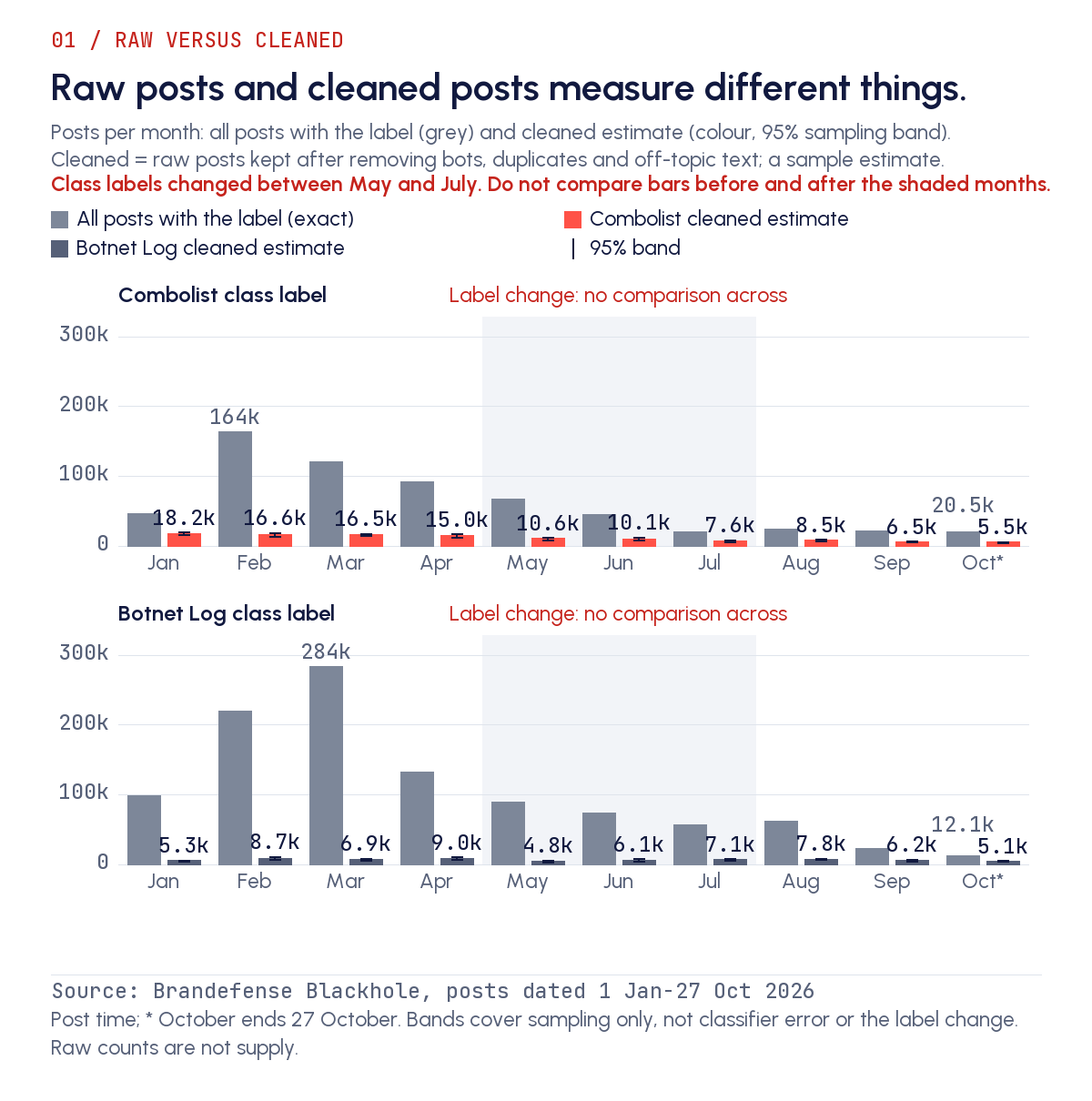
Raw label counts in this collection are dominated by automated posting. After cleaning, 18.5% of raw Combolist-class posts and 6.4% of raw Botnet Log-class posts remain. Sampling bands per month in observed-records.csv; class labels changed in May-July.
Findings in the data package
6.4% of raw Botnet Log posts remain after cleaning. Raw posts carrying the Combolist and Botnet Log labels shrink to 18.5% and 6.4% once noise, template bots, mirrors, off-topic text and duplicates are removed.
Limit: Raw counts measure automated posting at least as much as offers; they are not supply.
About 115,032 cleaned Combolist-class posts and 66,979 Botnet Log-class posts. Estimated cleaned posts, 1 January to 27 October 2026, sum of monthly estimates with monthly sampling bands in observed-records.csv.
Limit: Collected posts, not offers or sellers. Class labels changed in May-July; no comparison across it.
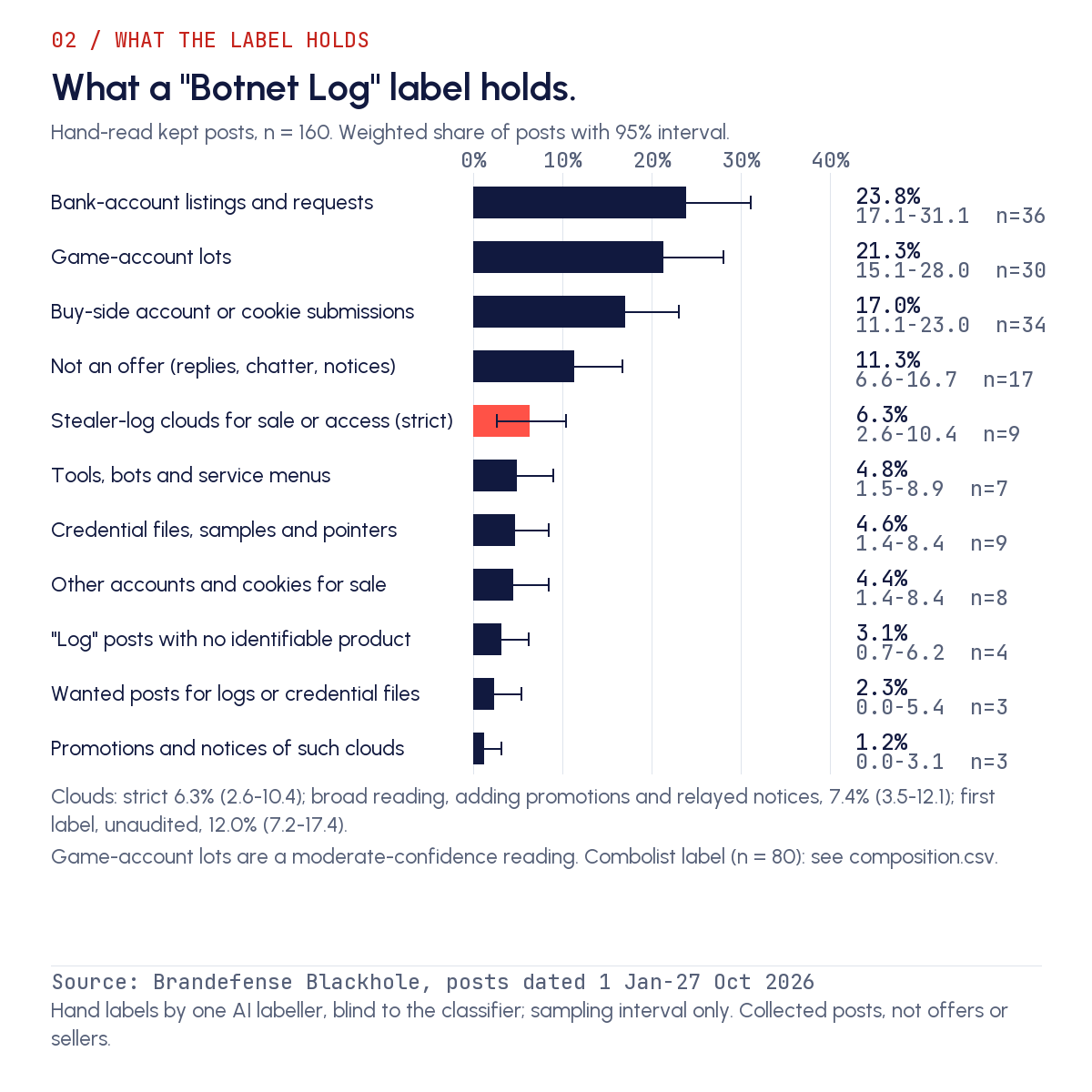
Bank-account listings lead what the Botnet Log label holds (23.8%). In 160 hand-read posts, bank-account listings and requests are 23.8% (17.1-31.1); stealer-log clouds offered for sale or access are 6.3% (2.6-10.4), 7.4% on the broad reading; all are weighted estimates. Unweighted, strict clouds are 9 of 160 posts (5.6%).
Limit: One AI labeller; sampling interval only.
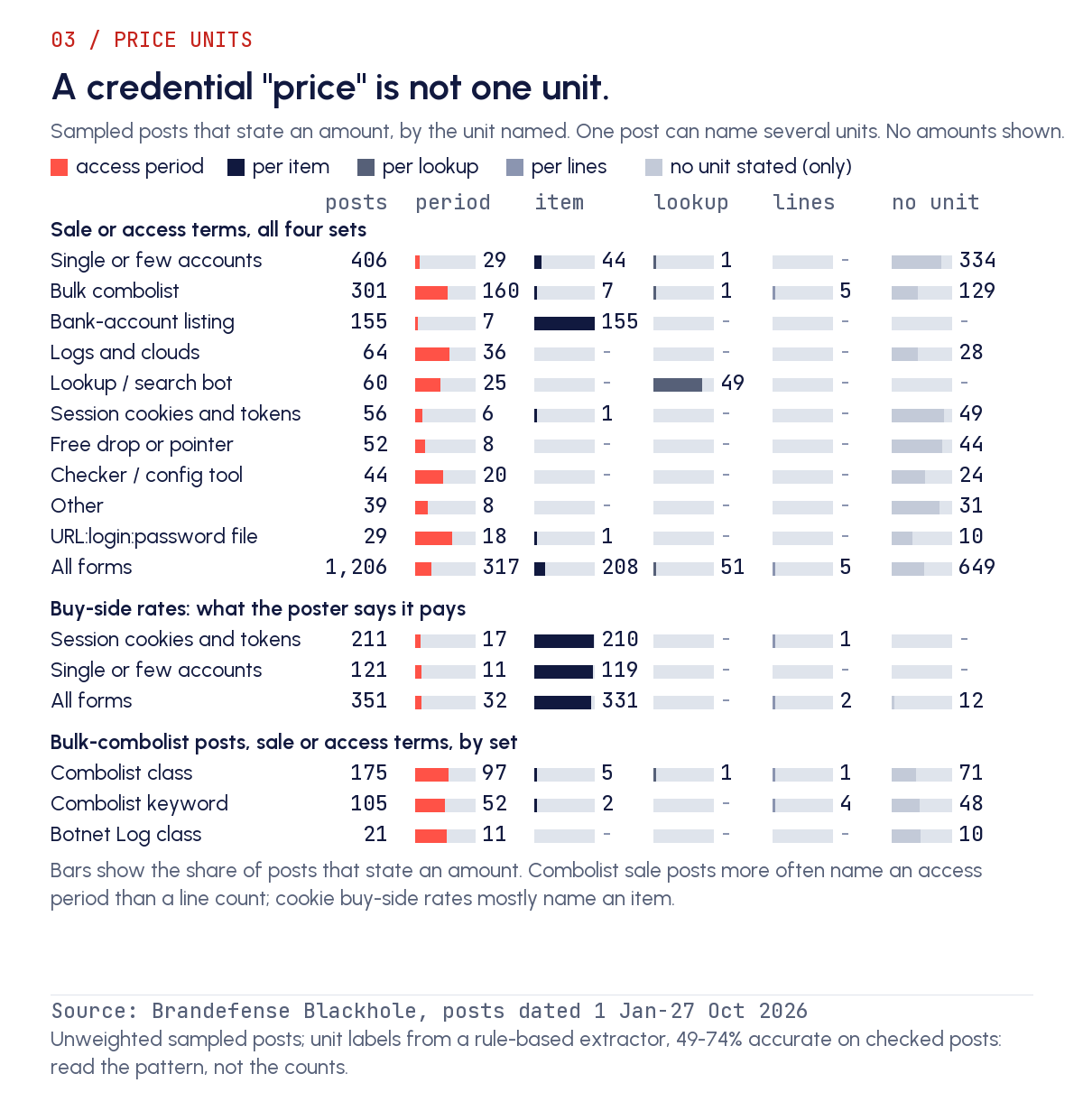
Combolist sale posts more often name an access period than a line count (160 of 301 posts that state an amount). Among 301 sampled bulk-combolist sale or access posts that state an amount, 160 name an access period and 5 price per lines; 129 give no unit.
Limit: Unweighted posts; unit extractor 49-74% accurate on checked posts; amounts never pooled.
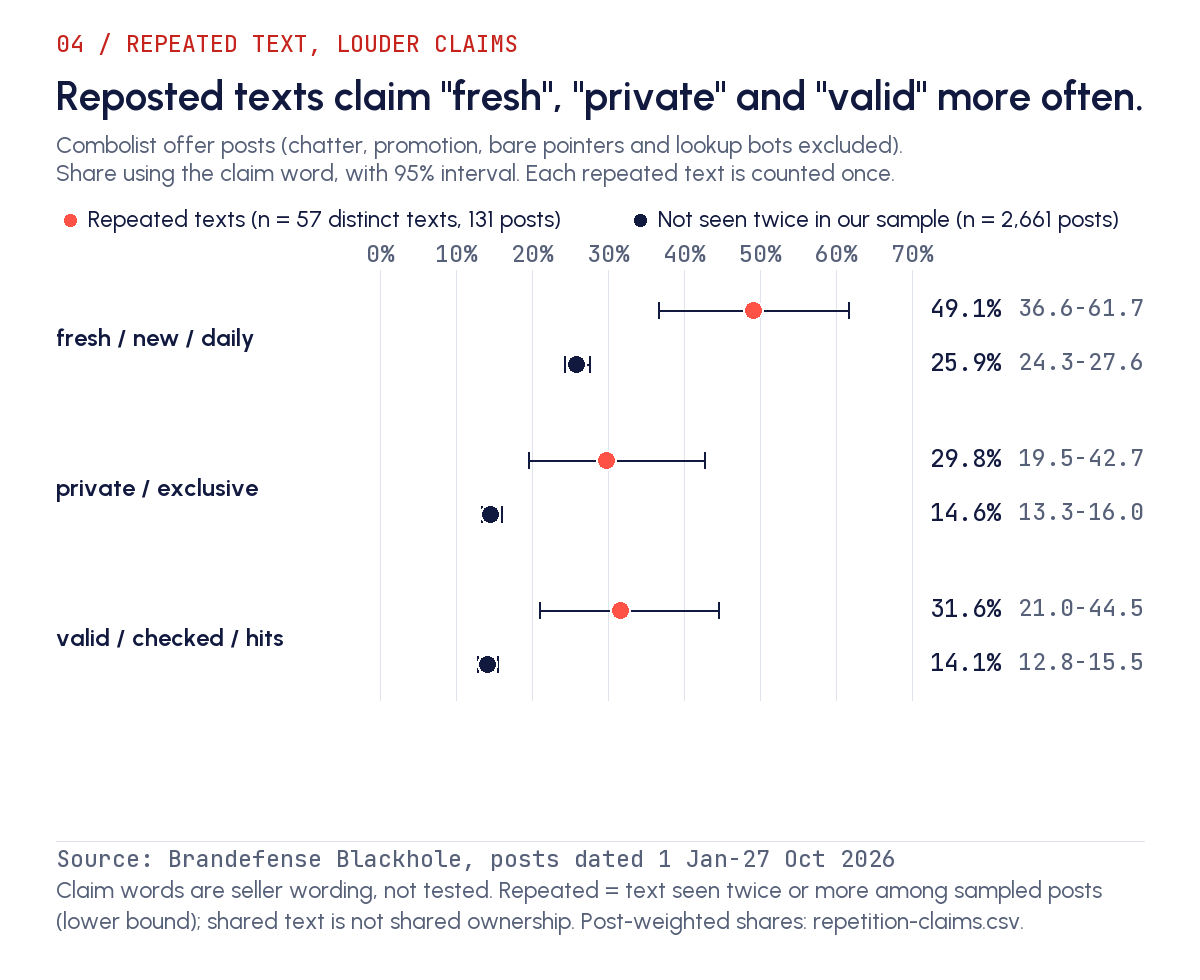
Repeated Combolist texts say "fresh" more often (49.1% vs 25.9%). 131 repeated offer posts are 57 distinct texts. Counting each text once, they say "private" in 29.8% against 14.6%, and "valid" in 31.6% against 14.1%.
Limit: Seller wording, not tested; repeated posts are 4.8% of kept Combolist posts (lower bound).
Four investigations
- What "Botnet Log" and "Combolist" Posts Actually Sell (main). Hand-read Botnet Log and Combolist posts hold bank listings, game lots, rate sheets and subscriptions. Strict stealer-log clouds are 6.3% of Botnet Log, a weighted estimate.
- Account Buyer Rate Sheets: What They Ask Suppliers For (companion). Account buyer rate sheets treat a 2FA secret, a cookie and friend count as deliverables. Same-sheet pairs show which of them moves the stated rate.
- Why a Credential List Subscription Gets Cheaper by the Day (companion). Credential lists are advertised as time-limited plans, and in 144 of 174 eligible ladder segments the daily cost falls at every step. The adverts do not show what is delivered.
- Fresh, Private, Valid: How Combolist Claims Differ in Reposted Text (companion). Reposted Combolist texts say fresh, private and valid about twice as often as texts not seen twice. The words track advert copying, not exposure.
02 / Main investigation
What "Botnet Log" and "Combolist" Posts Actually Sell
What the "stolen accounts", "botnet log" and "combolist" labels hide, and which defence each product calls for.
Key takeaways
- In 160 hand-read Botnet Log posts, bank listings (23.8%), game-account lots (21.3%) and buy-side rate sheets (17.0%) outnumber strict stealer-log clouds (6.3%); all four are weighted estimates.
- Credential files and pointers are the largest group of Combolist posts (36.8% of 80 read). Where a price is shown, it is more often an access period than a line count.
- Each form exposes a different asset: reused passwords, live sessions, bank accounts, an infected device or personal data. The defence follows the form.
- Label noise is real, but the mix comes from hand readings, cross-checked by a second AI reader (94% agreement on form group).
- The shares describe collected posts under these labels. They do not measure sales, sellers, exposure size or a trend.
A bank-account listing dated 1 January 2026 asked CAD 190, with a separate line claiming a chequing balance of "9k" and no currency. It carries the "Botnet Log" label in our collection (SC-O001). Nothing in the post says the data came from an infected machine, and the balance is the poster's untested claim.
That gap between label and goods is the subject of this article. In the posts we read between 1 January and 27 October, the same labels cover bank listings, game accounts, buyer rate sheets, credential-file subscriptions and personal-data lookups. Each exposes a different asset, so each needs a different response.
What a Botnet Log Post Actually Offers
We read 160 kept posts from the Botnet Log class, drawn at random with weights and labelled blind to our classifier. Bank-account listings and requests came to 23.8% (95% interval 17.1 to 31.1). Game-account lots, mostly Indonesian-language (24 of 30) and described by their in-game contents, came to 21.3% (15.1 to 28.0), a moderate-confidence reading (SC-O008, SC-O010).
Buy-side posts made up 17.0% (11.1 to 23.0). In these, the poster pays for accounts or cookie files that others submit. One sheet lists three Facebook products with per-ID rates in taka, rising from 12.00 to 13.00 for larger batches of the first (SC-O011). It states what the poster says it pays, and it does not say where the accounts come from.
Strict stealer-log clouds were a weighted 6.3% (2.6 to 10.4), or 7.4% if unpriced promotions are added. Unweighted, they were 9 of the 160 posts read (5.6%). "Strict" means priced or joinable feeds and log packs said to come from infected machines. One post separates credential lines, full logs and a live feed into weekly and monthly tiers (SC-O019).
A further 11.3% contained no offer, such as a forum reply stub (SC-O040). Tools, credential files, other account lots and unidentifiable "log" posts share the rest.
Across the Combolist, Botnet Log and keyword sets together, about 190,000 cleaned posts, strict clouds come to roughly 2.2% (0.9 to 6.0). That figure leaves out the breach-bot set, whose posts are personal-data queries. The interval combines the Botnet Log hand sample, an upper bound of 3 in 80 for Combolist and unaudited classifier shares for the keyword set. The Botnet Log share is the number that matters for the label itself.
Combolist Posts Sell Files, Pointers and Time
In the 80 Combolist posts we read, credential files and pointers were the largest group at 36.8% (25.8 to 47.7). Accounts offered for sale were 18.9%, buy-side posts 11.9% (4.6 to 20.7), requests for logs or files 7.0%, and about a fifth were not offers. Free shares made up 21.4% of the class by commercial mode, so the money sits elsewhere.
A locked free drop advertises a paid cloud, with a three-day trial at $7 and a monthly plan at $50 (SC-O027). Another cloud lists three days for $5 and three months for $90, and calls its lists fresh, private and verified (SC-O028).
The free file is the advert. The product on sale is continuing access to a cloud, priced by the period. Among 175 bulk-combolist asking posts in the Combolist class that state an amount, 97 state an access period and one a per-line price; most of the rest give no unit. Our unit extractor is only 49 to 74% accurate, so read that as a pattern, not a count.
That is the product sellers advertise, not a measured exposure. The posts do not show what a buyer receives while a plan runs, or whether it is renewed.
The breach-bot class is a third thing. A pay-per-query service lists SSN and date-of-birth lookups at $2.4 each (SC-O021). That sells a query over personal data, not an account. A calibrated estimate puts lookup services at about half of the kept posts in that class (52%, interval 42 to 62).
Why Sellers Call Any Packaged Account a "Log"
In these posts a "log" can be any packaged account, whatever its source. An Indonesian lot of game accounts is priced "per log" (SC-O010), and the bank listing that opened this article uses the same word. The stealer-cloud tiers use it for raw machine output. Because one word spans such different goods, a feed that counts "logs" counts the word, not the product.
The products are not fully separate, though. Credential files and clouds can be linked in supply, since combined URL, login and password files are often compiled from stealer output. Cookie and session files can likewise come from infected browsers. The posts rarely say, so the origin question belongs to the infostealer chapter, which covers the stealer families and the log supply chain.
Each Product Calls for a Different Control
Set side by side, the products differ in their unit of sale and in what a buyer would hold afterwards. That second column decides the defence.
| Product in the posts | Unit in the post | What it exposes | Control it calls for |
|---|---|---|---|
| Combolist file or cloud subscription (SC-O028, SC-O027) | Access period; per-line prices are rare | Credential pairs, useful where people reuse passwords; origin often unstated | Breached-password screening, login rate limits and MFA against credential stuffing |
| Session package or cookie material (SC-O035) | Per piece; 0.22 USD in one messaging-app package | A logged-in session, if still live; origin not shown | Session revocation, short lifetimes, re-authentication for risky actions |
| Bank-account listing (SC-O001 to SC-O005) | Per listing; claimed balance kept separate | A claimed bank-account login, sometimes with its mailbox | Fraud controls on new devices, payees and withdrawals |
| Game-account lot (SC-O008 to SC-O010) | Per lot or per account; unit and currency often unstated | A consumer game account | Mostly platform-side recovery |
| Buy-side rate sheet (SC-O011 to SC-O013) | Per submitted ID, implied | Demand: the platforms and attributes wanted, such as cookie or 2FA secret | A signal for platform trust and safety, not an exposure of your users; see buyer rate sheets |
| Stealer-log cloud (SC-O019, SC-O020) | Weekly or monthly subscription | What the seller says came from infected machines: credentials and cookies | If your users match, treat the device as compromised: reset, revoke sessions, clean the endpoint |
| Lookup bot (SC-O021) | Per query | Personal data, not an account | Do not rely on knowledge-based identity checks |
Cookie material is the case where a password reset alone may leave the session alive, which is why session revocation matters in the session hijacking pattern. Bank listings belong to the Fraud chapter, which applies the same rule we do: an asking price and a claimed balance are different quantities and are never compared. One listing claims that the linked mailbox has no 2FA (SC-O005).
Is This Just a Noisy Classifier?
The strongest objection is that the labels are noise, so the mix describes the labelling and not the trade. Part of that is true, because the class label comes from the collection and is loose. About 11% of the hand-read Botnet Log posts and about a fifth of the Combolist posts contained no offer. Only 6.4% of raw Botnet Log posts and 18.5% of raw Combolist posts survive cleaning, mostly because the rest is off-topic text or repeated bot output.
The composition, however, comes from full-text readings and not from our classifier. That classifier agrees with the hand labels at group level only 70 to 74% of the time. Its errors on stealer clouds run both ways, with precision of 0.375 on the clean evaluation sample and 0.45 on a tuned one.
We therefore quote hand labels. A second AI reader re-labelled 50 posts blind and agreed on the form group in 94% of cases (kappa 0.90), which is a cross-check and not a human audit.
The shares describe kept posts, not sellers or sales, and one cloud post can front far more credentials than one game lot. A small post share is therefore not a small exposure. The intervals run about seven points either way for Botnet Log and wider for Combolist, and class labels changed between May and July, so we draw no trend. The text of each post is cut at 1,500 characters in our cleaned copy.
Corporate Accounts Are a Small Share
The share is small and the evidence thin. An October post offers Office 365 mailboxes with cookies and contact lists but shows no price (SC-O036). An August post is a menu of corporate and education access types, at the boundary with access sales (SC-O037).
Three of the 240 hand-read posts, all in Botnet Log, carried a corporate flag. The flag has a precision of only 0.33 to 0.67, so these are examples and not a rate. Access sales proper belong to the initial access chapter.
Sort Alerts by Product Before Choosing a Response
A feed item saying "botnet logs mention your brand" does not say which product it is. The evidence says to ask that first, because the responses differ. In our sample about a quarter of Botnet Log posts are bank listings, a job for the fraud team, and a fifth are game lots, rarely yours to fix. Strict stealer clouds are a minority, a weighted 6.3%, but they are the form that most clearly points to an infected machine.
Three routines follow. Send cookie and session material to identity operations, with revocation as the action; the account takeover lifecycle shows where that fits. Send bank listings to fraud, with payee and device controls. For combolist mentions, reset and test for reuse first, and escalate to endpoint work if the material matches live session data or claims a recent capture.
Raw counts cannot tell you which of these you face. A dark web monitoring workflow earns its value when it records the form of each item, and the corporate impact of credential stuffing explains why the reuse check matters.
Method and Scope
Why AI agents. Brandefense Blackhole, our cybercrime database, collects around 17 to 23 million dark web and Telegram posts a month. Reading that volume by hand, and linking a recruitment ad on one forum to a leak-site claim on another and a price list in a Telegram channel weeks later, is beyond what a human team can do alone.
Claude Opus 5.5 prepared the research: it searched the data, sorted and translated posts and drafted the text. Codex Astra then checked every number against the dataset files and tested each claim, and anything that did not hold was removed.
Brandefense analysts reviewed and approved the findings.
Scope: posts collected from 1 January to 27 October 2026, by post time, from a collection dominated by Telegram with limited forum coverage. Counts are collected posts, not offers, sellers, victims or transactions. Prices are advertised terms and were not tested. Records are selected examples, not a sample.
Read the full methodology or the Stolen accounts research hub. Companion pieces cover why a credential list subscription gets cheaper by the day and fresh, private and valid claims.
Frequently Asked Questions
Are botnet log posts the same as stealer logs?
Mostly not. In 160 hand-read Botnet Log posts, strict stealer-log clouds were a weighted estimate of 6.3% (2.6 to 10.4). Bank listings, game-account lots and buyer rate sheets made up most of the rest.
What do combolist posts sell?
The largest group is credential files and pointers, often shared free as an advert for a paid cloud. Where a price is shown it is more often an access period, such as three days or one month, than a line count. Some files may be compiled from stealer output, which the posts rarely state.
Which defence fits which product?
Combolists call for credential-stuffing defences and breached-password screening. Cookie material calls for session revocation. Bank listings call for fraud controls. A matching stealer-cloud entry calls for treating the device as compromised. Lookup bots expose personal data, not accounts.
Does the composition prove how the trade works?
No. It describes kept posts in a Telegram-dominated collection from 1 January to 27 October 2026. It does not measure offers, sellers, sales or change over time.
03 / Companion investigation
Account Buyer Rate Sheets: What They Ask Suppliers For
What buyers' rate sheets ask suppliers to deliver, and which attributes change the stated rate.
Key takeaways
- Of 59 rate posts in a hand-coded sample of 69 buy-side texts, 47.5% (35.3 to 60.0) require a 2FA-secret column and 57.6% a cookie column.
- Nine sheets hold 11 same-sheet pairs: 7 swap a cookie for 2FA and 4 add a field. In 9 pairs the 2FA variant, or the one with both fields, paid more, usually by 0.5 to 1.0 tk.
- Across sheets, friend count goes with a larger rate gap than the 2FA or cookie field. Zero-friend Hotmail medians are 8.0 to 8.5 tk; 30-plus-friend ones are 11.5 to 13.5.
- A required 2FA-secret column fits supplier-enrolled accounts better than accounts handed over as found; 75.4% of texts say nothing on origin.
- The defender signals are enrolment and session behaviour, and one of three depends on the bulk-registration reading.
On 15 April 2026 a Bengali-language post listed three Facebook account and cookie products. The first paid a members rate of 12.00 tk, 12.50 tk from 100 IDs and 13.00 tk from 300.
The third product, accounts registered with a phone number, zero friends and 2FA, carried a members rate of 5.5 tk. An admin rate was available by message (SC-O011). The poster was buying, and account buyer rate sheets like this read as purchase orders.
Buy-side submissions are 17.0% of the Botnet Log class in our hand-read sample (95% interval 11.1 to 23.0, 160 posts), and the main investigation covers the wider mix. This article asks a narrower question: what do the sheets ask suppliers to hand over, and which of those attributes actually move the rate?
What 69 Hand-Coded Sheets Require of Suppliers
We coded a hand-read sample of 69 distinct buy-side texts, drawn from 371 candidates. Of these, 31 are multi-product rate sheets and 28 are single-product rate posts, so 59 state rates. The other ten are submission notices or requests without rates. The shares below are of those 59, with 95% intervals:
- A 2FA secret as a required column in at least one product: 47.5% (35.3 to 60.0). A cookie column: 57.6% (44.9 to 69.4).
- A friend or follower count specified: 66.1% (53.4 to 76.9). A sign-up route, by number or any mail: 45.8% (33.7 to 58.3).
- A report time or acceptance percentage: 57.6% (44.9 to 69.4). Separate admin and member rates: 37.3% (26.1 to 50.0).
- Volume tiers by batch size: 20.3% (12.0 to 32.3).
A sheet therefore specifies the secret, the session, the profile's friend count, its sign-up route and how fast it must be reported. These count distinct texts, not suppliers.
Does a 2FA Field or a Cookie Change the Rate?
The cleanest test is a same-sheet pair: one sheet prices two variants of the same base product that differ only in the 2FA field, the cookie field or both. Nine of the 31 multi-product sheets contain such a pair, 11 pairs in all. In seven pairs variant A has cookies and B has 2FA, a swap; in the other four B adds a field to A. Rates are as written, in taka.
| Base product | Variant A | Variant B | B minus A |
|---|---|---|---|
| Facebook, number sign-up | cookies 4.20 | 2FA 4.80 | +0.60 |
| Facebook, number sign-up | cookies 5.30 | 2FA 6.00 | +0.70 |
| cookies 4.0 | 2FA and cookies 4.5 | +0.5 | |
| Number sign-up, zero friends | cookies 4.50 | 2FA 5.50 | +1.00 |
| Number sign-up, zero friends | cookies 4 | 2FA 5 | +1 |
| Number or any mail, zero friends | cookies 5.20 | 2FA 5.20 | 0 |
| cookies 4.00 | 2FA 3.80 | -0.20 | |
| Hotmail, zero friends | cookie 8.20 | 2FA 8.80 | +0.60 |
| Hotmail, zero friends | cookie 6.80 | 2FA and cookie 7.30 | +0.50 |
| Hotmail, 30 friends | 2FA 11.00 | 2FA and cookie 11.50 | +0.50 |
| Hotmail, 30-plus friends | 2FA 15 | 2FA and cookie 19 | +4 |
In nine of the 11 pairs the 2FA variant, or the variant with both fields, pays more. In one the two are equal and in one the Instagram 2FA line pays less.
Eight of the nine increases are 0.5 to 1.0 tk, and the median increase is about 13% of the lower variant (our calculation). That is a modest premium in this small set, close to the volume tier on SC-O011, where 300 or more IDs lifts 12.0 to 13.0 tk (8%).
Across the whole parsed set, taka unified, the stated rate per submitted ID is a median 3.5 for Instagram with 2FA (69 sheets) and 4.0 for Instagram cookies (15). For Facebook number or any-mail accounts it is 5.0 for cookies (104), 5.5 for 2FA (45) and 6.2 for both (7).
Friend count is associated with larger gaps across sheets. Hotmail or Outlook with zero friends sits at 8.0 to 8.5 (24 to 37 sheets per variant), against 11.5 to 13.5 for 30-plus friends (10 to 32).
A 5 October sheet fits this, listing rates of 16 tk, 10 tk and 3 TK. The selected rates do not isolate a country, name or reporting-time premium.
These are stated rates per submitted ID on the sheets, with the unit implied by the sheet wording. They show what posters say they pay, not market prices, and each median stays within its own product type.
Admin and Members Rates Point to a Layered Chain
Separate admin and member rates appear on 37.3% of rate posts. SC-O011 offers a members rate on the sheet and an admin rate by message. A 21 October post wants 100 zero-friend cookie files at 4.5 tk. It says samples go to a buyer for checking and claims a daily intake of ten thousand IDs if they pass.
The simplest reading is an intermediary between many small suppliers and an end buyer, with the lower member rate as the supplier-facing price. The acceptance wording supports it: 57.6% of rate posts state a report time or acceptance percentage, which puts the risk of a bad batch on the supplier. The alternative is that "admin" is simply the group owner's own tier. Either way the text shows a layered chain and not who sits at its end.
Demand for lists reads differently. A combolist request (SC-O045) sets a "private only" condition, so this one request judges a list on exclusivity where account sheets judge on attributes. A Russian-language buy-up advert (SC-O014) shows no rates. A single selected advert does not establish repetition or how many buyers exist.
Who Enrolled the Second Factor?
Three readings fit the sheets: bulk-registered accounts, accounts taken from their holders and then re-secured, and resold aged accounts. Of the 69 texts, 75.4% (64.0 to 84.0) say nothing about origin. Six give naming or registration rules, three use creation wording and four ask the supplier to live-check an account before submitting. Four more give a method pointer or a buyer-check line.
The 2FA column helps to choose between them. A time-based authenticator seed is created when the account holder enrols, and a thief who takes over an account generally cannot read the victim's seed.
A sheet that makes the secret a required column therefore fits supplier-enrolled accounts better than accounts handed over as found. The supplier may have enrolled the factor at registration or after taking the account. That is the stronger reading, not a fact. It would weaken if a sheet asked for an original seed or paired a theft claim with the column.
SC-O018 shows only demand for the cookie step: the poster supplies a login and wants the cookie string within an hour.
What Should Platform and Identity Teams Look For?
If the valuable object is a profile with its own second factor and a session, the useful signals sit in enrolment and session behaviour. The first follows directly from the required columns; the second combines coded cues with the bulk-registration reading; the third uses mailbox-recovery background.
- A second-factor enrolment and a long-lived session followed shortly by use from a different network and device. This follows from the 2FA and cookie columns, and it holds under every reading. NIST's SP 800-63B-4 describes timeouts and reauthentication for this surface.
- Bursts of new accounts with zero friends registered by one route. This follows from the friend-count (66.1%) and sign-up route (45.8%) cues, and it fits only the bulk-registration reading.
- Mailbox accounts with 2FA, which hold the higher rates when the friend count is higher. A mailbox often sits in recovery chains for other services, which is background knowledge and not from our data.
None of these proves theft, and the sheets do not address enterprise mailboxes. They do suggest that, on accounts like these, the second factor is part of what the supplier hands over. If that reading holds, its presence tells a platform little about who now controls the account.
Our account takeover lifecycle guide shows where a transferred account sits in the attack, and the write-up of session hijacking and cookie theft covers the defender side. Dark Web Monitoring is where posts like these are tracked. For the other side of the trade, see how credential list subscriptions are priced.
Method and Scope
Why AI agents. Brandefense Blackhole, our cybercrime database, collects around 17 to 23 million dark web and Telegram posts a month. Reading that volume by hand, and linking a recruitment ad on one forum to a leak-site claim on another and a price list in a Telegram channel weeks later, is beyond what a human team can do alone.
Claude Opus 5.5 prepared the research: it searched the data, sorted and translated posts and drafted the text. Codex Astra then checked every number against the dataset files and tested each claim, and anything that did not hold was removed.
Brandefense analysts reviewed and approved the findings.
Scope: Telegram-dominated posts, 1 January to 27 October 2026, counted as distinct texts, not buyers or suppliers. Classifier recall for wanted posts is about 0.6, so classifier counts may miss buy-side posts. We use the hand-coded sample to describe their share; recall alone does not establish a lower bound. Parsed medians can include wrong splits, and catalogue records are selected examples. See the full methodology and the Stolen accounts research hub.
Frequently Asked Questions
What do account buyer rate sheets require suppliers to hand over?
In a hand-coded sample of 59 rate posts, 47.5% require a 2FA-secret column, 57.6% a cookie column and 66.1% a friend or follower count. Rates are stated per submitted ID.
Does a 2FA secret or a cookie raise the stated rate?
Slightly. In 9 of 11 same-sheet pairs the 2FA variant, or the variant with both fields, paid more. Most increases were 0.5 to 1.0 tk, a median of about 13% of the lower variant.
Do the sheets show the accounts are stolen?
No. 75.4% of texts say nothing about origin. A required 2FA-secret column fits accounts whose second factor the supplier enrolled better than accounts taken as found, but that is a reading, not a fact.
External source
NIST SP 800-63B-4 Digital Identity Guidelines: Authentication and Authenticator Management
04 / Companion investigation
Why a Credential List Subscription Gets Cheaper by the Day
How credential lists are priced by access period, and what the tier ladders show.
Key takeaways
- From 233 distinct plan texts we extracted 174 eligible ladder segments (three or more core tiers); in 144 of them (83%) the computed per-day cost falls at every step.
- The longest tier costs a median 0.40 of the shortest per day; lifetime is a median 4.3 times the 30-day price.
- A trial tier appears in 34.5% of plans with two or more tiers and plausibly works as a sampling device for buyers who cannot check files.
- A bare "$" does not establish a common denomination across advertisements. These plan prices do not support a cross-ad quality or exposure ranking.
- The plans advertise recurring drops for a set period; what is actually delivered or renewed is not known, so reset or revoke on a verified match of your own accounts.
An 18 April advertisement priced one credential list subscription six ways, from $60 for a week to $1,450 for a year (SC-O020). The post never states a daily rate. Dividing each price by its days, which is our calculation, gives about $8.57 a day for the week and $3.97 for the year.
That slope is typical. We collected 233 distinct plan texts of this kind, and this article asks why credential lists are sold as time-limited plans and what the ladder shows about the product. The adverts show the pattern; the reasons we give are our reading, not something sellers state. The main investigation covers what the streams contain.
What Does a Typical Ladder Look Like?
The 233 texts come from the Combolist and Botnet Log classes and the combolist keyword set. They are distinct texts, not sellers, and 220 of them list two or more tiers. Four tiers is the most frequent size, with 63 texts.
One text can list more than one ladder, for example one per product, so we count ladder segments. The commonest is seven days and thirty days (28 segments), followed by seven days, thirty days and lifetime (17) and a three, seven, ten and thirty day ladder (17).
Sellers wrap the ladder in claims. Of the 220 plans with two or more tiers, 81.8% say "private" and 64.1% say "fresh" or "daily", while 31.8% say "valid". A trial tier appears in 34.5% and a lifetime tier in 42.7%. All of these are the seller's own words, and none was tested.
A credential "price" is not one unit
Sampled posts that state an amount, counted by the unit they name. One post can name several units, so a row does not add up. No amounts are shown or pooled.
| Product form | Posts with an amount | Access period | Per item | Per lookup | Per lines | No unit stated |
|---|---|---|---|---|---|---|
| Single or few accounts | 406 | 29 | 44 | 1 | - | 334 |
| Bulk combolist | 301 | 160 | 7 | 1 | 5 | 129 |
| Bank-account listing | 155 | 7 | 155 | - | - | - |
| Logs and clouds | 64 | 36 | - | - | - | 28 |
| Lookup / search bot | 60 | 25 | - | 49 | - | - |
| Session cookies and tokens | 56 | 6 | 1 | - | - | 49 |
| Free drop or pointer | 52 | 8 | - | - | - | 44 |
| Checker / config tool | 44 | 20 | - | - | - | 24 |
| Other | 39 | 8 | - | - | - | 31 |
| URL:login:password file | 29 | 18 | 1 | - | - | 10 |
| All forms | 1,206 | 317 | 208 | 51 | 5 | 649 |
| Group | Posts with an amount | Access period | Per item | Per lookup | Per lines | No unit stated |
|---|---|---|---|---|---|---|
| Buy-side: session cookies and tokens | 211 | 17 | 210 | - | 1 | - |
| Buy-side: single or few accounts | 121 | 11 | 119 | - | - | - |
| Buy-side: all forms | 351 | 32 | 331 | - | 2 | 12 |
| Bulk combolist, Combolist class | 175 | 97 | 5 | 1 | 1 | 71 |
| Bulk combolist, Combolist keyword | 105 | 52 | 2 | - | 4 | 48 |
| Bulk combolist, Botnet Log class | 21 | 11 | - | - | - | 10 |
The Day Gets Cheaper the Longer You Commit
We found 174 ladder segments with three or more core tiers, in 167 of the 233 texts. In 144 of those 174 (83%) the computed daily cost falls at every step, and in 152 (87%) it never rises. The longest tier costs a median 0.40 of the shortest tier per day (middle half 0.29 to 0.53). The table shows the April ladder in full.
| Period | Price as written | Computed per day |
|---|---|---|
| 1 week | $60 | $8.57 |
| 2 weeks | $100 | $7.14 |
| 1 month | $180 | $6.00 |
| 3 months | $450 (420 beside it) | $5.00 |
| 6 months | $800 (720 beside it) | $4.44 |
| 1 year | $1,450 (1200 beside it) | $3.97 |
The ad does not explain the second figure beside the long tiers, so we use the first. The per-day column is an illustrative ratio inside one ladder, not a market price, and a bare "$" does not name a currency. Nothing here compares one seller's ladder with another's.
The lifetime tier shows the same logic at the far end: take the 99 ladder segments that list both a 30-day tier and a lifetime tier. Lifetime costs a median 4.3 times the 30-day price (middle half 3.1 to 6.7 times). A buyer who expects the feed to last that long prepays at a discount, and the seller is paid for the whole period up front. Whether "lifetime" means the buyer's life or the channel's is not stated.
Why Give Away a Trial?
A buyer cannot easily check a credential list before paying, which would explain why sellers offer a cheap look. The commonest trial prices as written are $10 (32 plans), $5 (9) and $7 (8). One locked free drop advertises a three-day trial at $7, a weekly plan at $20 and a monthly plan at $50 (SC-O027), and the free file is the sample.
Renewal is a smaller lever. Only 3.6% of the 220 multi-tier plans use renewal wording. One cloud charges $20 to renew a $25 week and $40 to renew a $50 month (SC-O023), 20% below the first purchase. Read together, the trial and this one renewal discount fit a funnel: sample cheaply, commit longer, stay.
Can an Asking Price Rank Exposure?
The within-plan ratios above compare tiers in the same advertisement. They do not establish that a bare "$" names the same denomination across different advertisements, or that the underlying products are comparable.
We therefore do not pool those amounts to test whether "private", "valid", "fresh" or "daily" claims command a premium. Those are advertising words; we did not test the delivered material.
To assess exposure, check the material you actually see against your own accounts and known exposures. An asking price does not supply that evidence.
What a Rolling Window Does and Does Not Show
The product advertised is access for a set period to recurring drops, not one dated file. The main investigation counts 175 priced Combolist-class asking posts for the bulk-combolist form. Of these, 97 state an access period and one a per-line price, from an extractor that is only 49 to 74% accurate. Money buys time; what actually arrives while the plan runs, and whether it is renewed, the adverts do not show.
So an advert of this kind does not date or size any exposure on its own. What can be checked is a file you actually see. Match it against your own domains and users, and record the date you saw it (or the breach date, if known). Reset or revoke on a verified match.
A trial tier adds a second caution. It is best read as a sampling device, so one free file says little about the full feed, in either direction.
Both points support continuous Dark Web Monitoring over a single check, and the credential stuffing guide covers the reset side.
Two sibling articles cover the other price questions. The buyer rate sheet analysis reads prices that run the other way, from poster to supplier. The piece on fresh, private and valid claims tests the wording that wraps these ladders.
Method and Scope
Why AI agents. Brandefense Blackhole, our cybercrime database, collects around 17 to 23 million dark web and Telegram posts a month. Reading that volume by hand, and linking a recruitment ad on one forum to a leak-site claim on another and a price list in a Telegram channel weeks later, is beyond what a human team can do alone.
Claude Opus 5.5 prepared the research: it searched the data, sorted and translated posts and drafted the text. Codex Astra then checked every number against the dataset files and tested each claim, and anything that did not hold was removed.
Brandefense analysts reviewed and approved the findings.
Scope: Telegram-dominated posts, 1 January to 27 October 2026. Plan counts are distinct texts, not sellers, and extraction is rule-based, so prices are advertised terms and not sales. Per-piece, lookup and bank prices fall outside the ladders; for bank listings, the Fraud investigation explains why a price and a claimed balance stay apart. See the full methodology and the Stolen accounts research hub.
Frequently Asked Questions
Why are credential lists sold as subscriptions?
The adverts read as a way to turn short, sampled access into a longer prepaid commitment. Per-day cost falls at every step in 144 of 174 eligible ladder segments (83%), and trials let buyers sample cheaply.
Can the price of a credential list rank its risk?
This study does not establish that relationship. A bare "$" does not establish a common denomination across plans, and the adverts do not show the delivered material. The within-plan ratios describe the tier structure, not exposure.
What does a subscription mean for exposure?
The advert sells access to recurring drops for a set period, not one dated file. It does not show what is actually delivered or renewed. Match each file you actually see against your own accounts, record the date you saw it (or the breach date, if known), and reset or revoke on a verified match.
05 / Companion investigation
Fresh, Private, Valid: How Combolist Claims Differ in Reposted Text
What the words fresh, private and valid, and reposted text, show about exposure in combolist and stolen-account posts.
Key takeaways
- 57 distinct repeated Combolist texts (131 posts) say fresh 49%, private 30% and valid 32%; 2,661 posts whose text we did not see twice say 26%, 15% and 14%.
- The gap stays positive within form and commercial mode, at about 14 to 21 points. But only 12 of 42 groups hold both kinds of post, and subscriptions and the keyword set show no gap.
- Repeated text is only 3.8 to 4.8% of kept Combolist, Botnet Log and keyword-set posts, because a large share of raw repetition is removed before the kept sample.
- Raw volume and freshness wording cannot count new exposure; class labels changed between May and July, so no trend is drawn.
- Match your own domains and users once per distinct file, reset passwords and revoke sessions on a match; claim words trigger nothing.
Combolist claims of "fresh", "private" and "valid" appear about twice as often in reposted text as in text we did not see twice. Among 57 distinct reposted Combolist texts (131 posts), 49% say fresh, 30% private and 32% valid. Among 2,661 posts whose text we did not see twice, the shares are 26%, 15% and 14%.
The gap is real in this sample, but it describes how adverts are copied. It does not show what a file contains, when it was captured or who else holds it. The evidence is Brandefense's Blackhole collection of Telegram-dominated posts from 1 January to 27 October 2026; counts are collected posts, not offers, sellers or victims.
Reposted Texts Claim More, on Every Word
We normalised each kept post by removing links, handles and digits, then grouped identical texts of 25 characters or more. Chatter, channel promotion, file pointers and lookup bots are excluded. A text seen at least twice in our sample is "repeated".
Our sample is a small part of most collection windows: a median of about 4% of posts for the Combolist class and 2% for Botnet Log. A text we saw once may have been posted many times, so we call those "not seen twice".
Copies of one text are not independent evidence. The 131 repeated posts are 57 distinct texts: 42 pairs, 13 triples and 2 groups of four, spread over 61 channels. Every copy within a group carries the same claim words, so the table counts each distinct text once.
| Claim word | Repeated texts | Not seen twice |
|---|---|---|
| Fresh, new, daily | 49% (37-62) | 26% (24-28) |
| Private, exclusive | 30% (20-43) | 15% (13-16) |
| Valid, checked, hits | 32% (21-44) | 14% (13-16) |
The chapter's weighted post-level shares, which count all 131 posts, read 52%, 38% and 34% against 28%, 15% and 14%. We use the unweighted distinct-text basis here because it does not count a copy twice.
Two other sets do not follow the pattern. In Botnet Log (37 repeated texts, 80 posts, against 1,533) fresh is 24% against 14%, private 14% against 15% and valid 8% against 5%. In the combolist keyword set (49 repeated texts, 118 posts, against 1,180) the shares are 31% against 32%, 29% against 30% and 27% against 24%. The result belongs to the Combolist class label alone.
Are Repeated Posts Just Better Advertisements?
The strongest alternative is that reposted text is simply more commercial and so uses more marketing words. We tested it three ways.
First, the mix: sale modes (priced, subscription or sale without a price) make up 58.0% of repeated offers and 58.9% of the others. Repeated posts are more often free shares (27% against 15%) and less often buy-side requests (11% against 17%). They are not more often sales.
Second, length: the median repeated post has 129 characters and the median other post 137, so longer copy does not explain the gap.
Third, we compared within the same product form and commercial mode, and resampled whole texts to allow for copies. The difference stays positive: about 21 points on fresh (interval 7 to 34), 14 on private (2 to 27) and 14 on valid (2 to 27).
The support is thinner than that suggests. Only 12 of 42 form-and-mode groups contain both kinds of post, and only 5 of those hold ten or more repeated posts. Labels for form and mode come from a classifier with about 0.70 group-level precision.
Single groups agree where they are large. Among sales with no price shown (49 repeated posts from 20 texts, against 993), private appears in 40% of the repeated texts and 10% of the others.
Subscriptions are different. The five repeated texts do not claim "private" more often than the 205 others (40% against 63%), and "private" already sits in most of the posts not seen twice. In the Botnet Log, the stratified difference on "private" is negative: about 11 points lower, with an interval from 21 points lower to level.
Why Might "Private" Travel With Copied Text?
This paragraph is our interpretation, not a measurement. A seller who wants many readers reposts, and a seller who reposts has every reason to call the stock private, so the wording scales with the audience. Free shares, which are more common among repeated posts (27% against 15%), and teasers also fit the pattern. The 63% rate in subscription posts fits this reading: there "private" looks like the name of a product tier, not a count of holders.
The catalogue shows the pattern in single records. Record SC-O028 advertises a private cloud with 5 to 20 thousand "fresh" combos a day, "verified". Record SC-O023 shows an 83-line teaser called fresh and exclusive, then sells the whole cloud by access period, so "exclusive" need not mean one holder.
Record SC-O027 pairs a locked free drop with a private-cloud price list, in a pattern its entry says recurs under several names. How subscription tiers are priced is the subject of our credential prices companion.
Shared wording does not show common ownership: two channels may copy one template, or one operator may post twice, and our sample cannot tell which.
Repetition is also small among kept posts. Repeated text is 4.8% of kept Combolist posts, 4.3% of Botnet Log and 3.8% of the keyword set, all lower bounds. The largest Combolist group has four sampled posts.
Across bulk, file, cloud, free-drop and single-account posts in all four sets, 19 of 245 advertised size signatures appear in two or more channels. Fourteen of those span two or more months. A signature is a number plus a unit word such as "lines"; round numbers can coincide, so these are leads, not proof of reposting.
Why Raw Volume and Freshness Words Cannot Show New Exposure
A large share of raw repetition is removed before the kept sample. We estimate 1.05 million raw Botnet Log posts, of which 6.4% were kept and 26.3% were removed as template-bot near-duplicates, four times the kept share. Combolist had about 622,000 raw posts: 18.5% kept, 11.9% removed as template bots and 0.6% as exact duplicates.
Breach-lookup bots show the extreme. Repeated text covers 38.6% of their kept posts (interval 32.9 to 44.7), and 30.6% sit in clusters seen in two or more channels. Record SC-O044 is an automated availability-output example. One selected line does not establish a daily frequency or a count of new victims. Because class labels changed between May and July, we draw no trend from raw or cleaned counts in either direction.
Freshness wording fails for a separate reason. "Fresh" is a seller's word; we tested no file, and the flag detects words with a precision of about 0.5 to 0.9. A post saying "fresh" can describe an old file, and a post silent on it can describe a new one.
What a Defender Can Use Instead
Use the material, not the adjectives. Match your own domains and user names against the actual lists and logs, through dark web monitoring or files you can lawfully obtain. A match on one of your users is a fact about your estate, while a post that says "private" is not.
Let the match trigger the response, and match once per distinct file, not once per post. If the same file is reposted under ten adverts, one match is one finding, so a queue that counts reposts inflates itself.
Then check whether the matched material includes session data. If it does, revoke active sessions as well as resetting the password, because stolen cookies can bypass MFA. NIST SP 800-63B-4 expects a verifier to force a password change when there is evidence of compromise, and a match is that evidence; a claim word is not.
Our guides to credential stuffing and the account takeover lifecycle cover what follows a match, and the main investigation covers what these products offer.
Method and Scope
The repeat key is normalised text of at least 25 characters without links, handles or digits. The comparison covers kept Combolist offer posts drawn from 3,776 kept sampled posts, and claim flags are word matches with precision about 0.5 to 0.9. Channel identifiers were used only to count clusters.
The distinct-text and within-group comparisons are our own read-only checks over the same posts, and the scripts and output are saved with the manuscript. No file was downloaded or tested, and nothing here shows that a claim was true.
Why AI agents. Brandefense Blackhole, our cybercrime database, collects around 17 to 23 million dark web and Telegram posts a month. Reading that volume by hand, and linking a recruitment ad on one forum to a leak-site claim on another and a price list in a Telegram channel weeks later, is beyond what a human team can do alone.
Claude Opus 5.5 prepared the research: it searched the data, sorted and translated posts and drafted the text. Codex Astra then checked every number against the dataset files and tested each claim, and anything that did not hold was removed.
Brandefense analysts reviewed and approved the findings.
Method details: methodology. Hub: Stolen accounts research hub.
Frequently Asked Questions
Do "fresh" claims in combolist posts show a recent leak?
No. They are seller wording that we did not test. Reposted texts use the words more often than texts not seen twice, which points to copied advert text, not to when credentials were captured.
Are repeated combolist posts the same seller?
Not necessarily. Shared text does not show common ownership; templates are copied and operators can post more than once.
What should a security team do instead of reading claim words?
Match its own domains and users against the actual material, for example through dark web monitoring, and reset passwords and revoke sessions for matched users.
External source
NIST SP 800-63B-4 Digital Identity Guidelines: Authentication and Authenticator Management
06 / Method and limits
Method and Limits
Local reanalysis of saved Blackhole records. No fresh collection, purchase or tool test. Query windows of at most 7 days, never across a month boundary.
Method figures: 300 stable-panel channels, 1000 bootstrap draws for the monthly bands and 1000 for the hand-label intervals. Claim-flag precision on checked samples runs 46.4% to 94.1%; the price-unit extractor is 49.0% to 73.9% accurate on checked posts.
The platform changed its class labels around May-July 2026. Class sets must not be compared across that window, and no trend is read across it. The keyword set is not affected by the label change but is affected by coverage shifts.
Limits
- These are collected posts in saved Blackhole queries, not offers, sellers, victims, transactions or a market total.
- Telegram dominates the collection; forum coverage is small (forum share of kept posts by month shown in observed-records.csv).
- Counts are estimates from random pages of up to 50 posts per window. Monthly bands cover sampling only, not classifier error, October back-fill or the label change.
- Class labels changed around May-July 2026. No trend across that window is claimed. October ends on 27 October.
- Raw label counts are dominated by automated posting; raw-to-cleaned ratios say how much of the stream is removed, not how much supply exists.
- Hand labels come from one AI labeller blind to the classifier. A second AI reader re-labelled 50 posts blind (form-group agreement 94.0%, kappa 0.90); this is a cross-check, not a human audit. Intervals show sampling error only.
- Prices are advertised terms; units differ by product form and are never pooled, averaged or converted.
- Shared text across posts does not show common ownership; claim words (fresh, private, valid) are seller wording, not tested properties.
- Corporate/SaaS naming and no-2FA wording are rare and flagged with low precision; they support one qualified sentence, not a stand-alone claim.
- Actor and channel counts are not people. No global market, loss or capability claim is made. Brandefense analysts approved the findings.
AI disclosure
Why AI agents. Brandefense Blackhole, our cybercrime database, collects around 17 to 23 million dark web and Telegram posts a month. Reading that volume by hand, and linking a recruitment ad on one forum to a leak-site claim on another and a price list in a Telegram channel weeks later, is beyond what a human team can do alone.
Claude Opus 5.5 prepared the research: it searched the data, sorted and translated posts and drafted the text. Codex Astra then checked every number against the dataset files and tested each claim, and anything that did not hold was removed.
Brandefense analysts reviewed and approved the findings.
07 / Sources and reuse
Sources and Reuse
Source: Brandefense Blackhole, 1 January to 27 October 2026. No external market estimate is used.
Data and evidence
: Counts, definitions, period and asset index.
: Monthly counts and sampling bands.
Evidence catalogue: Public paraphrases of selected records with terms and evidence boundaries.
: Hand-label shares with intervals.
: Posts by the unit they name.
: Claim-word shares by repeated and single texts.
Methodology and reproduction: Sampling, cleaning, hand labels and checks.
Data dictionary: Definitions of each count and denominator.
Attribution and licence
Source: Brandefense Research Team, Stolen Accounts, Botnet Logs & Combolists, 2026, v1.0. Data: Brandefense Blackhole, 1 Jan-27 Oct 2026. Collected posts, not offers or a market total.
CC BY 4.0 for original aggregates, charts and editorial paraphrases; raw source content is excluded.
About Brandefense
Brandefense is an AI-driven threat intelligence platform that unifies Cyber Threat Intelligence, Digital Risk Protection and External Attack Surface Management.
Next Step
Assess your organization’s exposed accounts with Dark Web Monitoring