




| ACTIVE EXPLOITATION CONFIRMED CVE-2026-76461: CVSS 9.8 Critical SQL injection in Cisco AsyncOS for Secure Email Gateway. Attack vector: send a crafted email. No authentication, no admin access, no interaction from victim. Root command execution on the appliance OS. Exploitation confirmed in the wild before public disclosure (zero-day). CISA KEV catalog entry: September 14, 2026. Federal remediation deadline: September 17, 2026. No workaround available. Upgrade only. Fixed releases: AsyncOS 15.5.5-014 / 16.0.4-302 / 16.5.0-780 (recommended). Cisco Secure Email Cloud already updated. |
| 9.8 CVSS 3.1 Critical | AV:N/AC:L/PR:N/UI:N | no credentials, no clicks required | 0 workarounds available according to Cisco’s official advisory; patch is the only mitigation | 400+ internet-exposed Cisco SEG appliances identified by Shadowserver as of September 2026 | 3 affected AsyncOS release branches: 15.5 and earlier, 16.0, 16.5: all below fixed versions |
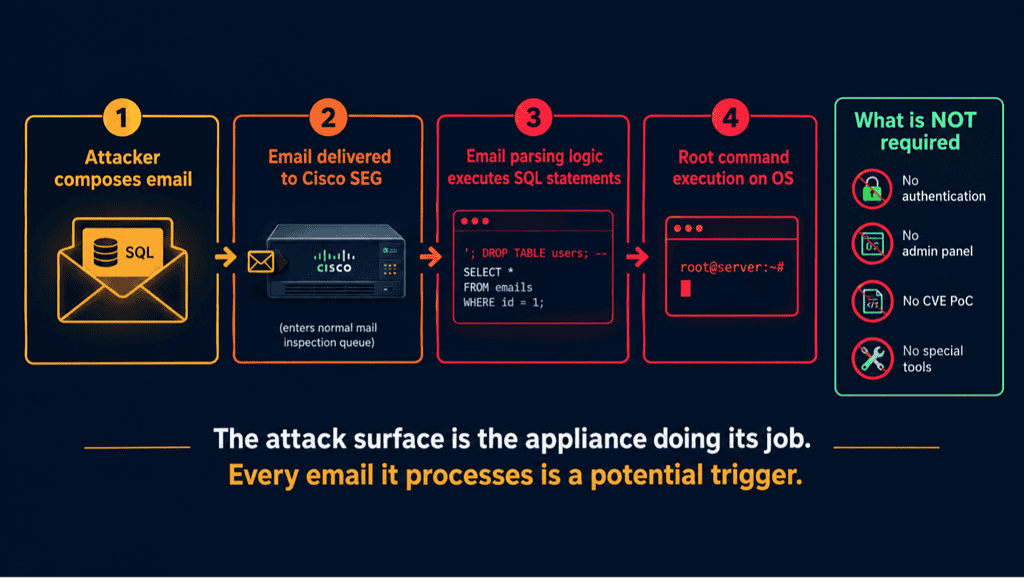
The email gateway SQL injection zero-day in Cisco AsyncOS is the clearest example this year of a vulnerability that is maximally easy to exploit because the attack surface is the device’s primary function. Cisco Secure Email Gateway exists to receive, inspect, and route emails. CVE-2026-76461 allows an attacker to achieve root command execution on the appliance’s underlying operating system by sending a crafted email through it. The email does not need to reach a recipient. It does not need to come from a trusted sender. It does not need to pass any delivery condition. It only needs to be processed by the gateway’s email parsing logic, which is what the appliance does with every email it handles.
Cisco’s Product Security Incident Response Team became aware of active exploitation in September 2026, when the vulnerability was already being used in attacks. The bug was not discovered by a security researcher who responsibly disclosed it to Cisco. It surfaced during the resolution of a customer Technical Assistance Center support case, meaning an organization was experiencing symptoms of exploitation before the vulnerability was even formally named.
The vulnerability was added to CISA’s Known Exploited Vulnerabilities catalog on the same day it was publicly disclosed, September 14, 2026. A KEV listing on disclosure day is the most direct signal that exploitation in the wild predated the advisory. Federal agencies were given until September 17, three days, to remediate.
Root Cause: How the Email Gateway SQL Injection Works
| Field | Value |
| CVE | CVE-2026-76461 |
| Advisory ID | cisco-sa-esa-inj-2bLVGmhX |
| Bug ID | CSCwu56234 |
| CWE | CWE-89 (SQL Injection) |
| CVSS 3.1 Score | 9.8 Critical |
| CVSS Vector | AV:N/AC:L/PR:N/UI:N/S:U/C:H/I:H/A:H |
| Product | Cisco AsyncOS Software for Cisco Secure Email Gateway (formerly IronPort ESA) |
| Affected Scope | Physical and virtual appliances; all configurations |
| Not Affected | Cisco Secure Email and Web Manager; Cisco Secure Web Appliance |
| Disclosed | September 14, 2026 |
| Advisory Status | Final (v1.1, updated September 17, 2026) |
| Source | Cisco TAC support case (not researcher disclosure) |
| Workaround | None |
| In-the-Wild Exploitation | Confirmed (zero-day) |
| CISA KEV | Listed September 14, 2026; federal deadline September 17, 2026 |
| Snort Rules | 67109-67110 |
The root cause is insufficient validation in the email parsing logic of AsyncOS. When the Secure Email Gateway receives an email for inspection, it passes the message through a parsing pipeline that examines headers, body, attachments, and metadata to classify the message and enforce policy. This pipeline is the gateway’s core function: it handles every inbound and outbound message the appliance processes.
The insufficient validation allows an attacker to embed SQL statements directly in the email content in a way that the parsing logic executes rather than treats as data. The SQL execution does not remain contained within the database layer. Through a second escalation step, arbitrary SQL execution translates into command execution at the operating system level with root privileges.
| Why This Attack Is Trivially Easy to Attempt at Scale The Cisco Secure Email Gateway is, by design, accessible to the entire internet for inbound mail delivery. Any organization using the appliance for inbound email has necessarily opened SMTP (port 25) to all senders. An attacker does not need to identify a specific vulnerability in the admin interface, pass authentication, or enumerate any target-specific configuration. They need the target’s MX record and a crafted email. MX records are publicly queryable from DNS. The attack is as easy to initiate as sending a spam email. This is a structural property of email security appliances, not a configuration error. The previous Cisco SEG zero-day, CVE-2025-20393, required an internet-exposed Spam Quarantine to be exploitable. CVE-2026-76461 requires only that the gateway process an email. The bar dropped significantly. |
Affected Versions and Fixed Releases
| AsyncOS Release Branch | Vulnerable | First Fixed Release | Notes |
| 15.5 and earlier | Yes, all versions | 15.5.5-014 | Cisco strongly recommends migrating to 16.5.0-780 rather than patching to this branch |
| 16.0 | Yes, all versions below fix | 16.0.4-302 | Cisco strongly recommends migrating to 16.5.0-780 |
| 16.5 | Yes, all versions below fix | 16.5.0-780 | Cisco’s strongly recommended target version for all customers |
| Cisco Secure Email Cloud | Was affected | Cisco-managed (16.5.0-780 already applied) | Cisco directly contacted customers where malicious activity was detected on cloud devices |
| Migration Recommendation Cisco’s advisory explicitly states: ‘Cisco strongly recommends that customers who are running releases earlier than Release 16.5 migrate to Release 16.5.0-780.’ This is not merely a patch; it is a version migration. Organizations running 15.5.x or 16.0.x branches should treat this as an urgent platform upgrade, not a routine patch cycle item. |
Detection: Indicators of Compromise from the Official Advisory
Cisco’s advisory provides a specific detection command and a critical caveat: because successful exploitation gives the attacker root access to the appliance, evidence of exploitation and indicators of compromise may be removed or hidden before defenders can review them. Local log analysis is a starting point but cannot be relied upon as the definitive evidence source.
CVE-2026-76461: IoC detection (Source: Cisco advisory cisco-sa-esa-inj-2bLVGmhX)# Detection: check mail_logs for SQL injection indicators |
Cluster Risk: One Compromised Node Means Every Node Is at Risk
Cisco SEG appliances are frequently deployed in cluster configurations for high availability and centralized management. SSH key pairs are used for mutual authentication between cluster members. The September 17 advisory update (version 1.1) added an explicit warning about this: a successful exploitation of any single cluster member gives the attacker access to the SSH private keys used for cluster authentication on that device.
Those keys can then be used to authenticate to other cluster members without any additional exploitation. An organization that identifies one compromised cluster member and patches that appliance while leaving others online has not contained the threat: the attacker’s access to the SSH private keys remains usable against every other member in the cluster.
| Cisco’s Cluster Remediation Guidance ‘Cisco strongly recommends restoring to a secure configuration each member of a cluster that contains at least one compromised appliance.’ This is not a recommendation to patch all cluster members simultaneously. It is a recommendation to assume that every cluster member must be treated as potentially compromised and restored to a known-good state, not merely patched. For virtual appliances, Cisco’s recommended remediation is: deploy a new virtual machine instance running a fixed release, rebuild the product configuration, renew all credentials and cryptographic materials. For physical appliances, Cisco recommends contacting TAC. In both cases, attempting to patch in place on a potentially compromised appliance is explicitly not recommended. |
Same Release: Four Companion Vulnerabilities
The September 14, 2026 fixed releases also address four additional vulnerabilities disclosed in a companion advisory covering the Secure Email Gateway and Secure Email and Web Manager hardening release. These additional CVEs (CVE-2026-76440, CVE-2026-76441, CVE-2026-20353, CVE-2026-76443) were identified through an internal comprehensive security review of the product lines. Cisco groups them as an internal hardening release, distinct from the actively exploited CVE-2026-76461.
The practical implication is that upgrading to the fixed release addresses CVE-2026-76461 and the companion vulnerabilities in a single operation. Organizations upgrading solely to address the actively exploited vulnerability receive remediation for the entire disclosure batch, which is the expected behavior for a coordinated hardening release.

Immediate Actions
Priority 1: Upgrade to Fixed AsyncOS (No Workaround Exists)
- Upgrade all on-premises physical and virtual Cisco SEG appliances to AsyncOS 15.5.5-014 (branch 15.5), 16.0.4-302 (branch 16.0), or 16.5.0-780 (recommended target for all branches). The upgrade can be initiated from System Administration > System Upgrade in the web management interface or via the CLI using the ‘upgrade’ command followed by ‘DOWNLOADINSTALL.’
- Cisco strongly recommends migrating to 16.5.0-780 regardless of current branch. Organizations on 15.5.x or 16.0.x should treat this as a version migration rather than a patch update.
- Cisco Secure Email Cloud appliances have already been updated by Cisco. Administrators on cloud deployments should verify their release version and contact Cisco Cloud support if any uncertainty exists about patch status.
Priority 2: Check for Indicators of Compromise Before Patching
- Before patching, run the detection command against mail_logs on each appliance and each cluster member: grep -i ‘COPY.*TO PROGRAM’ against the IronPort Text Mail Log (default name: mail_logs). Any result is a potential exploitation indicator.
- Cross-check external network and firewall logs for unexpected outbound connections from the SEG appliance to external IP addresses. Local logs on a compromised appliance may have been tampered with; external evidence is more reliable.
- If exploitation is suspected on a physical appliance: contact Cisco TAC and enable remote access to the device before proceeding. For virtual appliances: deploy a new instance from a fixed release, rebuild configuration from a known-good backup, and renew all credentials and cryptographic materials.
Priority 3: Cluster Containment
- If any cluster member shows IoC indicators, treat the entire cluster as potentially compromised. The SSH private keys used for cluster authentication were accessible to anyone with root access on the compromised node.
- Do not simply patch the identified compromised appliance and consider the cluster contained. Cisco’s guidance is explicit: restore each cluster member to a secure configuration, renew SSH key materials, and verify clean state through external evidence rather than the appliance’s own logs.
Priority 4: Hardening After Patching
- Prevent direct internet access to the management interface of the SEG appliance. Mail delivery (SMTP) necessarily reaches the appliance; management access should not.
- Separate mail processing and management traffic onto distinct network interfaces. This reduces the exposure of the management plane even in the event of future vulnerabilities in the mail processing path.
- Deploy the SEG behind a filtering device or firewall that restricts management access to known, trusted administrator hosts and protocols.
- Forward SEG logs to an external SIEM or log management platform with sufficient retention for post-incident investigation. Root-level compromise allows an attacker to modify or delete local logs; external log forwarding preserves evidence.
- Disable HTTP access to the admin portal; use HTTPS only. Disable any network services not required for mail delivery or management (FTP, unnecessary listening services).
- Enable strong authentication (SAML or LDAP) for administrator access. Default credentials should be changed; create role-based accounts with minimum required privilege rather than shared admin accounts.
Context: Why Cisco SEG Is a High-Value Target
Cisco Secure Email Gateway processes every inbound and outbound email for the organizations that deploy it. Depending on deployment configuration, a compromised SEG has access to email content, attachments, and routing metadata for every message flowing through the organization’s mail infrastructure. Beyond the email content, the appliance’s network position, sitting in the mail delivery path between the internet and internal mail servers, provides a privileged vantage point for further network activity.
The previous AsyncOS zero-day, CVE-2025-20393, was linked to Chinese-associated threat groups in late 2025. Attribution for CVE-2026-76461 exploitation has not been publicly established as of September 21, 2026, and Cisco’s advisory makes no attribution claim. The CISA KEV listing confirms active exploitation; the identity of the threat actors and their specific objectives are not yet documented in public sources.
The pattern of two critical AsyncOS zero-days in close succession, each discovered through customer support cases rather than through proactive research, reflects a broader targeting of network security infrastructure by state and financially motivated actors. Organizations running internet-facing security appliances from any vendor should treat appliance firmware currency as a Tier-1 security control, not a lower-priority maintenance item.
Source: Network World September 17, 2026
Brandefense Coverage for CVE-2026-76461
| Modül | Coverage for Cisco SEG Zero-Day Exposure |
| Entity Discovery + Security Findings | Continuously discovers internet-facing assets associated with organizational domains and IP ranges, including Cisco SEG appliances (physical and virtual). Products are defined in vendor:product format (e.g. cisco:secure_email_gateway), enabling automatic mapping of all related CVE findings to discovered infrastructure. Appliances deployed by subsidiaries or entities not yet in the central IT inventory are surfaced through EASM continuous scanning. Routes: /attack-surface/entities and /attack-surface/security-findings |
| Vulnerability Intelligence | CVE-2026-76461 and the four companion CVEs from the September 14-16 advisory cycle are tracked in the Vulnerability DB. Each entry shows: CVE, Affected Products, Related Entities, CWE, CISA KEV Listed, Exploit Available, Trending, and Priority Score. Priority Score combines CVSS, EPSS, KEV listing, exploit availability, and community activity into a 0-100 value, providing patch priority context beyond CVSS alone. Discovered cisco:secure_email_gateway assets are automatically linked to all relevant CVE records. Route: /modules/vulnerability-intelligence |
| Cyber Threat Intelligence | Threat actors targeting email security appliances and network perimeter hardware are tracked through Threat Landscape (Relevant Threats with Profile Match badge) and Threat Actors profiles. The Relevant Threats view filters global feed by the customer’s own threat profile, surfacing only actors and campaigns relevant to the organization’s sector and asset footprint. Routes: /threat-intel/dashboard and /investigation/threat-actors |
| Breach Monitoring + DarkWeb Monitoring | After a perimeter appliance compromise, organizational credentials and data exfiltrated through that gateway may surface in dark web markets, Telegram channels, or breach forums. Breach Monitoring tracks leaked accounts and Compromised Devices, with separate breach date and incident date columns to indicate when data was stolen versus when it was detected. DarkWeb Monitoring provides AI-enriched post streams with 0-10 Threat Signal scoring filtered by relevance. Routes: /digital-risk-protection/breach-monitoring and /investigation/darkweb-monitoring |
RELATED READING
Vulnerability Exploitation Trends: H1 2026: What Threat Actors Are Actually Using: https://brandefense.io/blog/vulnerability-exploitation-trends-h1-2026/ : network edge devices were the most exploited category of H1 2026, and an email security appliance sits squarely in that class.
From Disclosure to Exploit: How Fast Are Threat Actors Weaponizing New CVEs?: https://brandefense.io/blog/disclosure-to-exploit-speed/ : why a KEV listing on the day of disclosure means an emergency patch cycle rather than the standard patching window.
Merger, Acquisition, Forgotten Domain: How M&A Activity Quietly Expands Your Attack Surface: https://brandefense.io/blog/ma-attack-surface-easm-due-diligence/ : how SEG appliances inherited through M&A can sit outside the central inventory and miss the patch cycle.
Agentic Ransomware: What Happens When Malware Doesn’t Need a Human Operator to Decide Who to Hit Next?: https://brandefense.io/blog/agentic-ransomware-autonomous-attack-defense/ : the same pattern of a known vulnerability on an unpatched internet-facing service, exploited at machine speed.