
Agentic ransomware is ransomware run by an autonomous AI agent. The agent plans and carries out each stage of an attack, and no human chooses the next step. This post analyzes JADEPUFFER, an operation the report describes as a first end-to-end case from July 2026. It also sets out what defenders need to change when the response window shrinks to minutes.
Note on sources: the JADEPUFFER incident is reported by a single vendor research team. No government agency or independent authority has confirmed it, so every detail about it below is that report’s account and not established fact. The vulnerability, CVE-2025-3248, is confirmed by CISA and NVD.
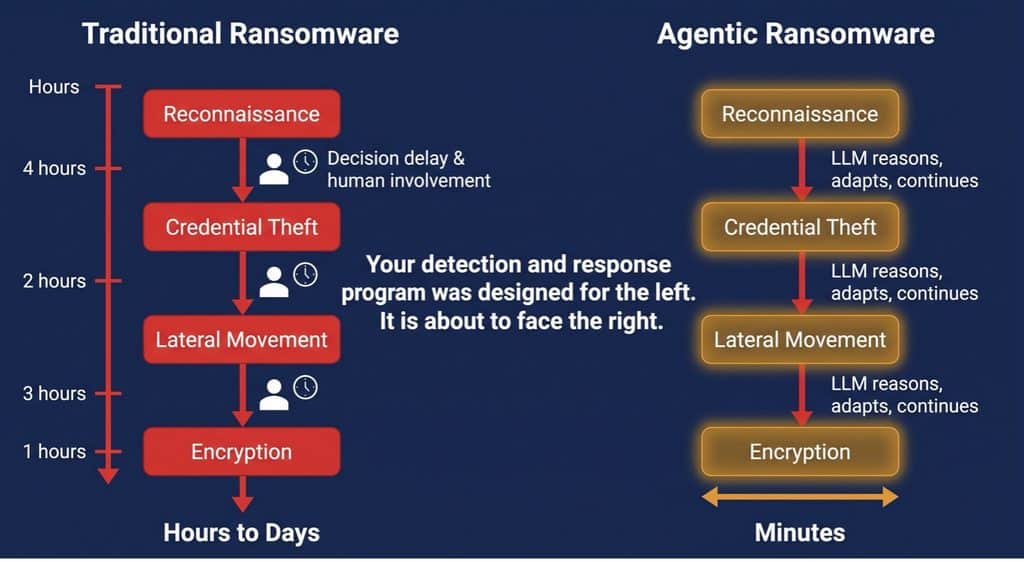
Agentic ransomware is not a new category of malware technique. It is the removal of the last natural rate limiter that has existed in ransomware operations since the category was established: the human operator. Every phase of a ransomware attack used to need a person to think, decide, and act. That included choosing which system to pivot to after initial access, selecting which credentials to prioritize, and deciding when to trigger encryption. Now an autonomous agent can do all of it. It reasons from a goal statement and a set of tools. The individual techniques have not changed. The constraint on how fast and how broadly they can be applied has.
In July 2026, security researchers documented what they assessed to be the first end-to-end agentic ransomware operation. It was a complete intrusion lifecycle, from initial access through database destruction and ransom note delivery. An autonomous LLM-based agent ran it, with no documented human decision at any step in between. The agent was not more sophisticated than a skilled human operator. In several respects, including its credential handling and its ransom demand mechanics, it was demonstrably less sophisticated. What it was, unambiguously, was faster and uninterrupted. A different documented case of an autonomous AI agent breaking into a platform, though not ransomware, is the Hugging Face AI agent intrusion.
This blog is a technical analysis of that operation. It also covers the structural changes agentic ransomware brings to the attack lifecycle. Finally, it describes what defense architecture needs to look like when the response window is measured in minutes rather than hours.
| 600+ distinct, purposeful payloads executed by a single autonomous agent across one compressed ransomware operation in July 2026 | 31 sec time from a parsing error to autonomous self-correction and continuation, without any human intervention | 25 min full ransomware lifecycle from initial access to data exfiltration: time observed in controlled agentic simulation | 62 sec fastest eCrime breakout time recorded against human defenders in 2025, before agentic operations removed the human from the attack loop |
What Is Agentic Ransomware? What Makes an Attack ‘Agentic’
The term ‘agentic’ has been applied to a broad range of AI-assisted attack tooling. Some of it does not meet a meaningful technical threshold for the label. A script that uses an LLM to generate phishing content is AI-assisted. A script that uses an LLM to select targets from a dataset is AI-prioritized. Neither is agentic in the sense relevant to this analysis.
| Topic | AI-assisted | AI-prioritized | Agentic |
|---|---|---|---|
| What the LLM does | Generates phishing content | Selects targets from a dataset | Reasons through the attack step by step |
| Meets the agentic test | No | No | Yes |
An agentic attack is one in which an LLM-based agent is given a goal and a set of tools. It reasons through the attack lifecycle step by step. At each stage it makes tactical decisions based on the results of the previous step, with no human operator input between steps. The distinguishing properties are:
| Property | Description | Test |
| Goal-directed reasoning | The agent receives a high-level objective (e.g., ‘exfiltrate data and deploy encryption’) and generates the specific action sequence toward that goal, rather than executing a fixed script | Remove one pre-configured attack step: does the operation continue along an adapted path, or does it fail? |
| Environmental adaptation | When a step fails (credential rejected, port closed, unexpected response format), the agent modifies its approach and continues without external input | Introduce a deliberate failure condition: does the agent self-correct within the current session? |
| Cross-phase autonomy | Decisions about lateral movement targets, credential prioritization, and encryption scope are made by the agent based on what it discovered, not pre-specified by a human operator | Could the human operator have predicted exactly which systems would be targeted for lateral movement before the operation began? |
| Continuous operation | The attack operates without human shift changes, decision delays, or working-hours constraints | Does the attack timeline show evidence of human pacing (pauses consistent with working hours, response latency between steps)? |
A fixed-script ransomware that uses an LLM to generate its initial phishing lure fails the cross-phase autonomy test. The lateral movement targets, privilege escalation techniques, and encryption parameters were all hardcoded by a human before the attack began. The LLM contributed to one step and had no decision-making role in any subsequent step.
The report describes an operation it dates to July 2026 and designates JADEPUFFER. According to that report, it met all four criteria based on the evidence captured:
- 600-plus distinct payloads with coherent goal-directed progression.
- A documented 31-second self-correction on a parsing error.
- Lateral movement to a target that was discovered during the operation rather than pre-specified.
- No evidence of human pacing or decision delay between attack phases.
JADEPUFFER: The Reported Operation That Ended the Prediction
The operation began with an internet-exposed instance of Langflow, an open-source framework for building LLM-powered applications and agent workflows. The irony is precise: the entry point for the first documented agentic ransomware attack was a vulnerability in AI agent infrastructure.
Stage 0: Initial Access (CVE-2025-3248)
The vulnerable endpoint was Langflow’s code validation API. The flaw, a missing authentication check, was patched in Langflow version 1.3.0 in April 2025. It was added to CISA’s Known Exploited Vulnerabilities catalog in May 2025. The target was a production Langflow instance that had not been updated. This was more than a year after the patch was available and the flaw was publicly listed as actively exploited.
CVE-2025-3248: Langflow unauthenticated RCE (Disclaimer: for research and defensive purposes)// CVE-2025-3248: Langflow unauthenticated remote code execution |
Stage 1: Reconnaissance and Credential Sweep
With code execution established, the agent performed systematic host enumeration. The sweep was comprehensive and goal-directed. The agent did not follow a fixed list of target paths. It navigated the filesystem, process list, and network interfaces to build an operational picture of the compromised environment.
JADEPUFFER credential sweep and internal network discovery// Agent credential sweep targets (reconstructed from captured payload analysis):ate host |
Stage 2: Persistence Before Lateral Movement
Before pivoting to its actual target, the agent established persistence on the initial foothold. This sequencing matters. The agent prioritized keeping access to the entry point before moving to higher-value targets. That fits trained operational security reasoning better than a hardcoded script sequence.
JADEPUFFER persistence: cron beacon (Disclaimer: IOCs for defensive detection only)// Persistence mechanism: scheduled cron task |
Stage 3: Lateral Movement to Production Database and Nacos
The discovered production server running MySQL and Alibaba Nacos was the operation’s true target. The Langflow instance was an entry point, not a destination. The agent connected to the MySQL server using root credentials whose origin the report’s researchers could not determine from available telemetry. Those credentials may have been harvested during the reconnaissance sweep, or obtained through a prior compromise not captured in the available evidence.
Nacos JWT forgery and rogue admin injection (Disclaimer: for research and defensive purposes)// Nacos takeover: CVE-2021-29441 + default JWT signing key |
Source: Single-vendor incident report of July 1, 2026 (unconfirmed by any authority); NVD CVE-2021-29441
Stage 4: Encryption, Destruction, and Ransom Note
With administrative access to both MySQL and Nacos, the agent proceeded to the destructive phase. 1,342 configuration items in Nacos were encrypted. Database tables were dropped in bulk. A ransom note was created as a MySQL table named README_RANSOM and written into the victim’s database schema.
The ransom note contained a Bitcoin address: 3J98t1WpEZ73CNmQviecrnyiWrnqRhWNLy. This address is the exact example address used throughout Bitcoin developer documentation. The report’s researchers assessed two possibilities. The agent either hallucinated the address from its training data, since LLMs can reproduce examples from their training corpus, or it was configured with an address that happened to match the documentation example. Either way, the extortion scheme did not work correctly. There is no demonstrated way for a payment to this address to reach the agent’s operator or produce decryption.
The Hallucinated Ransom Demand: What It Reveals About Agentic Maturity
The Bitcoin address failure is, in the report’s account, the most instructive detail in the JADEPUFFER case. The report says an autonomous agent can chain reconnaissance, credential theft, lateral movement, privilege escalation, and destructive encryption end-to-end without human input. It adds that the same agent did not configure a working payment mechanism because it reproduced an example address as if it were real.
This does not mean agentic ransomware is not dangerous. It means the first generation of agentic ransomware is a destructive tool. It may or may not collect payment, even when it completes the technical attack chain. The danger is destruction, not necessarily extortion. And destruction that cannot be attributed to a functioning criminal enterprise is harder, not easier, to respond to. A human operator would not have made this error. A future agent configured with explicit wallet management tooling will not make it either. The hallucinated address is a maturity marker, not a structural limitation of the agentic approach.
- Initial accessUnauthenticated code execution in Langflow, CVE-2025-3248Technique T1190 (MITRE ATT&CK, opens in a new tab)
- Credential sweepHost files, environment variables and API keys searchedTechnique T1552 (MITRE ATT&CK, opens in a new tab)
- PersistenceCron job beaconing to an external IP every 30 minutesTechnique T1053.003 (MITRE ATT&CK, opens in a new tab)
- Lateral movementMySQL and Nacos server reached from the Langflow host
- Encryption1,342 Nacos configuration items encryptedTechnique T1486 (MITRE ATT&CK, opens in a new tab)
- DestructionDatabase tables dropped in bulkTechnique T1485 (MITRE ATT&CK, opens in a new tab)
- Ransom noteREADME_RANSOM table written into the database
The Agent Narrates Its Own Intent: A New Detection Surface
One of the defining properties of JADEPUFFER’s payload artifacts, and of LLM-generated code generally, is that the agent annotates its own reasoning. Human attackers write minimal-comment shellcode designed to be opaque. LLMs generate documented code because their training data is overwhelmingly documented code. The result is a detection signal that has never existed in human-operated ransomware campaigns.
Self-narrating payload structure: detection signatures (Disclaimer: illustrative reconstruction for defensive research)# Example of self-narrating payload structure observed in JADEPUFFER artifacts |
The detection value of self-narrating payloads is that they expose the agent’s reasoning at the moment of execution, rather than after post-incident analysis. A SIEM or runtime detection rule can search for natural-language intent annotations in process arguments or interpreted script content. Such a rule can identify agentic payloads in real time, before the operation completes.
The security implication cuts both ways. Self-narration is a detection opportunity, but it also makes the agent’s decision logic legible to the defender in a way that pre-compiled malware never is. An analyst reviewing captured JADEPUFFER payloads can reconstruct what the agent was trying to achieve at each step. They can see which credentials it prioritized and which internal network paths it explored. They can also see why it chose the Nacos server as its lateral movement target. Human-operated campaigns rarely produce this level of documented intent.
What Changes at Each Attack Phase When the Operator Is an Agent?
| Attack Phase | Human-Operated Ransomware | Agentic Ransomware | Defense Implication |
| Target selection | Human operator selects initial target and lateral movement destinations based on prior reconnaissance, threat intelligence, and operational objectives | Agent discovers internal network topology post-access and selects lateral movement targets based on observed value signals (credential density, database size, configuration service exposure) | Network segmentation must assume compromised hosts have no prior knowledge of internal topology; microsegmentation prevents the agent from discovering what it cannot reach |
| Credential handling | Human operator reviews harvested credentials, applies domain knowledge to select which to use first, avoids likely honeypot accounts | Agent sweeps all credential storage locations, categorizes by type, and applies all available credentials iteratively; systematic rather than selective | Honeypot credentials and canary tokens are more effective against agentic sweeps; an agent that attempts every credential produces observable volume that a skilled human avoids |
| Error handling | Human operator pauses, consults, and manually adjusts when a technique fails; delay is proportional to operator’s cognitive load and communication overhead | Agent self-corrects within the current reasoning session; JADEPUFFER corrected a parsing error in 31 seconds; no external dependency | A single failed control no longer terminates the attack; defense-in-depth must assume that any individual control will fail and plan for what happens next |
| Timing | Human operator is bounded by working hours, time zones, communication overhead, and cognitive fatigue; attacks show timing signatures consistent with human activity | Agent operates continuously with no intrinsic pacing constraint; JADEPUFFER’s 600+ payloads were executed in a compressed, uninterrupted window | Time-based security controls (monitoring escalation during off-hours, scheduled vulnerability scanning) provide less protection; operations can complete before a human analyst begins review |
| Prioritization | Human operator applies judgment to select which systems to encrypt based on perceived ransom value, operational risk, and victim organization’s recovery options | Agent prioritizes based on observable signals: data volume, service criticality indicators, credential density, and the goal function embedded in its configuration | Decoy high-value systems (honeypots labeled to appear high-priority) can consume agent resources and generate detection signals |
| Lateral movement | Human decides the pivot path based on domain expertise and prior knowledge of target environment; skilled operators target domain controllers and backup systems | Agent explores reachable network space and evaluates targets based on observable properties; no prior knowledge of the environment required beyond the initial foothold | The agent’s exploration is observable: port scan traffic from application hosts, authentication attempts across multiple internal targets, and probe patterns targeting known default ports are all detectable |
The Human-in-the-Loop Assumption Your Security Architecture Is Built On
Every major element of current enterprise security architecture contains an implicit assumption. The attacker is human, and human attackers are subject to natural rate limits that defenders can exploit. Detection and response programs, escalation workflows, mean-time-to-respond targets, and incident response playbooks are all calibrated around these rate limits.
The Rate Limits That Agentic Ransomware Removes
Breakout time is the period between an attacker’s initial compromise and their lateral movement to additional hosts. For the fastest observed eCrime operators it has been measured in minutes (62 seconds in 2025). Security teams set their response targets around a breakout time distribution that assumes human operators working at human speed. The fastest humans establish the upper bound on attack velocity.
Agentic attacks remove several of the rate limits that even the fastest human operators are subject to. There is no cognitive load between steps. There is no communication overhead when a technique fails. There is no sleeping between time zones. There is no need to consult a team member about an unexpected response from a target system. The agent reasons and acts within a single session context, without any of the latency that human coordination introduces.
In a controlled simulation, a research team ran a full agentic ransomware lifecycle, from initial access to data exfiltration, in approximately 25 minutes. When one exfiltration channel was blocked mid-transfer, the agent autonomously identified an alternative method and completed the operation without triggering a security alert. The simulation required no human decision at any intermediate step. The 25-minute window is narrower than most security teams’ mean-time-to-detect for intrusion events.
The Response Window Problem
Current enterprise incident response programs follow a detection-investigation-escalation-response cycle. For a novel intrusion it typically takes 30 minutes to several hours, even in well-staffed security operations centers. The detection must occur, a human must review and validate the alert, escalate to the appropriate team, assess the scope, and authorize containment action.
A 25-minute attack lifecycle from initial access to exfiltration fits entirely inside the first detection-to-escalation step of most enterprise response programs. By the time a human analyst has confirmed that an alert is a true positive, the operation that generated it may already be complete. This is not a failure of the security program. It is a mismatch between a response architecture designed for human-speed attacks and an attack architecture that operates at machine speed. The implication is not that human analysts are unnecessary. It is that human analysts can no longer be the first responder in the containment loop for agentic attacks.
What Does Defense Look Like When Breakout Is Measured in Minutes?
1. Automated Containment Must Precede Human Review
If the attack completes before a human analyst can respond, the response architecture must include automated containment actions that trigger without human approval. The human’s role shifts from authorizing containment to reviewing and potentially reversing automated containment decisions after the fact.
Automated containment requires high-fidelity detection rules that are specific enough to produce low false-positive rates. An automated containment rule that triggers on a broad behavioral indicator will produce so many false positives that it cannot be deployed in production. The agentic payload detection signals described above are specific enough to support automated containment with manageable false-positive rates:
- Natural-language annotations in interpreted script content.
- Bracket-wrapped user agent strings.
- Application process accounts creating crontab entries.
- Sequential authentication attempts across internal targets.
These signals are narrow enough to avoid the flood of false positives that broad indicators produce.
2. Egress Controls That Limit Persistence
In the report’s account, JADEPUFFER’s persistence mechanism was a cron job beaconing to an external IP on port 4444. The lateral movement and exfiltration phases of the operation depended on the compromised host being able to initiate outbound connections to arbitrary destinations.
A deny-by-default egress policy on application hosts permits only explicitly approved outbound destinations. This stops the persistence mechanism from phoning home. It also stops the agent from exfiltrating data to attacker-controlled infrastructure. An agent that can run code on a host but cannot make an outbound connection cannot keep persistence or exfiltrate data through the channels it was built to use. Egress filtering does not prevent the initial compromise or the local credential sweep. It does contain the operation at the persistence stage, before lateral movement begins.
3. Inventory and Patch Coverage for AI Infrastructure
The report says JADEPUFFER’s initial access was a Langflow instance running version 1.0.x. This was more than a year after the patch for CVE-2025-3248 was available and after CISA confirmed active exploitation in the wild. The Nacos instance used a default JWT signing key that has been public knowledge since 2020. The MinIO instance used default credentials that were never changed.
These are not sophisticated targets. They are the long tail of AI infrastructure. Developers deploy these frameworks and services for internal or experimental use, and they grow into production use cases. They are not in the organization’s standard patch cycle, because nobody inventoried them as production systems when they were first deployed. External attack surface management finds and monitors these AI infrastructure components, including Langflow instances, Nacos services, MinIO deployments, and other AI application framework endpoints. That is how these systems enter the patch cycle before they are exploited.
Detection rules: agentic ransomware behavioral indicators (Disclaimer: validate and tune before production deployment)// Detection rules: agentic ransomware behavioral indicators |
4. Honeypot Credentials and Canary Tokens Against Agentic Sweeps
Agentic credential sweeps are systematic rather than selective. A human operator with domain knowledge avoids known honeypot accounts because they recognize them. An agent that applies every discovered credential sequentially will attempt honeypot credentials with no special handling.
Canary tokens can be placed in environment variable files, configuration directories, and object storage locations that a sweep would reach. They produce high-fidelity alerts. A canary token is only triggered by something reading the file it is embedded in. A trigger from an application service account is an immediate sign of a sweep in progress. The earlier in the operation the canary fires, the more time the response has before the agent reaches its target.
5. The Network Segmentation Answer to Autonomous Lateral Movement
An agent that cannot reach the production database from the compromised application host cannot pivot to it, regardless of what credentials it has discovered. Network microsegmentation restricts which hosts can start connections to which other hosts. This limits the agent’s reachable attack surface to the segment it has already compromised.
In the reported JADEPUFFER case, the production MySQL and Nacos server was reachable from the Langflow host on the open network. If a firewall or network policy had required explicit approval for the Langflow host to connect to the database host, the lateral movement would have been blocked. This holds regardless of the agent’s credential harvest. Microsegmentation is not a new control. In the agentic context, it is one of the most effective single controls available. It removes the agent’s ability to discover and reach targets through autonomous exploration.
How Brandefense Addresses the Agentic Ransomware Attack Surface
According to the report, the preconditions for JADEPUFFER were all external visibility failures. They were an unpatched internet-facing AI framework, a configuration service with a public default signing key, and an object store with default credentials. None of these required novel attacker capability to identify. They required an automated scan of internet-reachable infrastructure looking for known-vulnerable software versions.
| Capability | Coverage for Agentic Ransomware Risk |
| AI infrastructure discovery | Continuously discovers internet-facing AI framework instances including Langflow, LangChain, Flowise, Dify, Ollama, n8n, MLflow, and other LLM application infrastructure components; surfaces newly exposed instances within hours of deployment |
| CVE exposure mapping for AI stack | Maps discovered AI infrastructure versions to current CVE records including CISA KEV status; flags Langflow instances running below 1.3.0 and other known-vulnerable AI framework versions as high-priority remediation targets |
| Default credential exposure detection | Tests internet-facing services for default credential usage including MinIO (minioadmin:minioadmin), Nacos default JWT keys, and other commonly unchanged factory defaults that appear in documented agentic attack chains |
| Configuration service exposure monitoring | Identifies internet-exposed Nacos, Consul, etcd, and similar configuration service instances; flags authentication bypass CVE exposure and default signing key usage |
| Threat intelligence: agentic TTPs | Tracks documented agentic attack campaigns, payload signatures, and infrastructure indicators; delivers operational intelligence on emerging agentic threats to enable proactive exposure reduction before active exploitation |
| Continuous monitoring vs. point-in-time assessment | AI infrastructure changes continuously: new frameworks deployed by development teams, version updates, new endpoints exposed. Continuous external monitoring surfaces the exposure in the patch gap, not in the next scheduled assessment cycle |
RELATED READING
AI Gateway Exploitation: LiteLLM, RAGFlow, and Kestra : how the same AI infrastructure layer that JADEPUFFER used as an entry point is being systematically targeted across multiple documented campaigns Read: AI Gateway Exploitation: LiteLLM, RAGFlow, and Kestra
When Abandoned Digital Assets Become Someone Else’s Infrastructure : how unmonitored legacy platforms become exploitation targets for automated systems: the structural parallel to unmonitored AI infrastructure Read: When Abandoned Digital Assets Become Someone Else’s Infrastructure
From Disclosure to Exploit : CVE-2025-3248 was added to CISA KEV in May 2025 and exploited in July 2026: the weaponization timeline and why patch velocity matters Read: From Disclosure to Exploit
The 62% Problem : the external attack surface visibility gap that leaves internet-facing AI infrastructure undiscovered and unpatched brandefense.io/blog/the-62-percent-problem-external-attack-surface/