




| 3 actively exploited AI orchestration platforms: LiteLLM, RAGFlow, and Kestra | CVSS 10.0 maximum severity for the LiteLLM chain (CVE-2026-42271 + CVE-2026-48710) and Kestra (CVE-2026-49869) | KEV CISA Known Exploited Vulnerabilities catalog confirmed active LiteLLM exploitation, June 8, 2026 | Tier-0 recommended classification for AI gateways: they aggregate every model provider secret in one process |
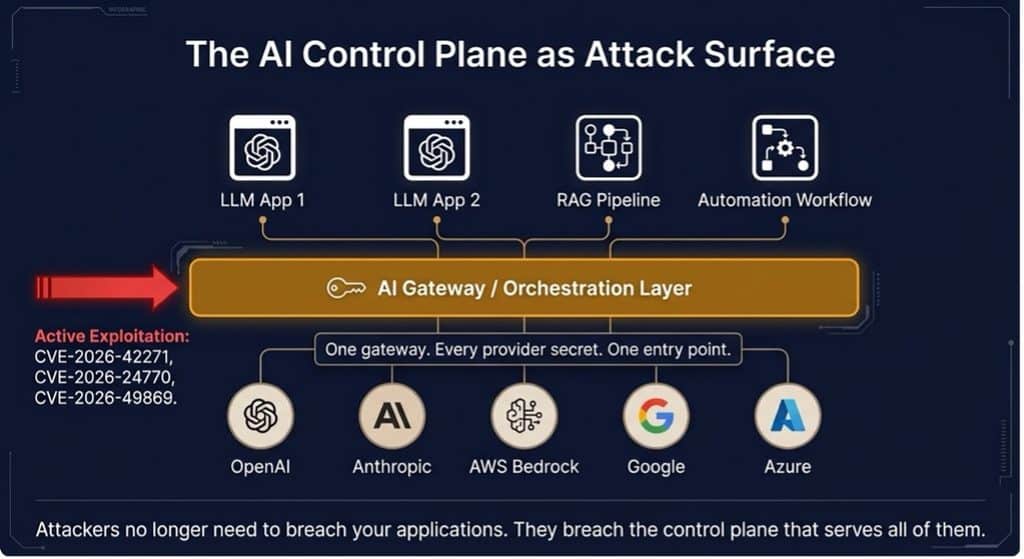
AI gateway exploitation is no longer a theoretical risk category. Brandefense’s analysis of active campaigns (INT-2608-e7a5) confirms that threat actors have shifted focus from application-layer targets toward the AI infrastructure layer: the gateways, orchestration platforms, and retrieval engines that sit between organizational applications and model providers. Three platforms are at the center of this shift: LiteLLM, RAGFlow, and Kestra.
The strategic logic of this shift is straightforward. An AI gateway concentrates every model provider API key, every database connection string, and every configured secret for an organization’s entire LLM infrastructure in a single process. A direct breach of that gateway is not a single application compromise; it is simultaneous access to every downstream system that has ever been configured through it. From an attacker’s perspective, the gateway is the most efficient target in the AI stack.
The three campaigns Brandefense documented differ in their technical approach and post-access objectives, but share a common pattern: public-facing AI infrastructure components, deployed without network-level access controls or treated as lower-security tooling, becoming entry points for credential theft, lateral movement, and resource hijacking.
Why AI Gateway Exploitation Represents a New Threat Category
Traditional attack surface thinking categorizes risk around the criticality of direct system access: what can an attacker do if they reach this system? AI gateways require a different framework because their value to an attacker is not what they can execute but what they know.
A production LiteLLM proxy, for example, is configured with API keys for every model provider the organization uses, database connection strings for its configuration and virtual key storage, and potentially keys for every integrated service in the application stack. All of this is accessible from the process environment at runtime. An attacker who achieves code execution on the gateway process inherits all of it immediately, without any lateral movement or privilege escalation.
| AI Infrastructure Component | What It Holds | Breach Consequence |
| AI Gateway (LiteLLM) | Model provider API keys (OpenAI, Anthropic, Azure, Google, Bedrock, Cohere, Mistral), virtual key configurations, rate limit policies, database connection strings, budget configurations | Single gateway compromise exposes every provider credential and enables impersonation of any configured virtual key across all downstream applications |
| RAG Engine (RAGFlow) | Document embeddings, database connection strings, LLM provider credentials injected at startup, embedding model configurations, retrieval index access | Credential theft at the embedding layer grants direct access to the organization’s AI provider accounts; document corpus exposure enables data exfiltration |
| Workflow Orchestration (Kestra) | Environment variable secrets, Docker socket access, database credentials, API tokens for integrated services, AI provider configurations used in workflow steps | Root-level container compromise with Docker socket access provides lateral movement to all containers on the host; complete secret enumeration |
The Single Point of Failure Problem
Security architecture principles emphasize eliminating single points of failure. An AI gateway, by design, aggregates credentials that were previously distributed across individual application configurations. This is operationally convenient: developers configure their API keys once in the gateway and all applications use virtual keys with managed rate limits and budgets. But it is also a security consolidation that creates exactly the high-value concentrated target that sophisticated attackers prioritize. Brandefense’s INT-2608-e7a5 assessment recommends organizations treat AI gateways as Tier-0 infrastructure, subject to the same security controls applied to identity providers and certificate authorities. The typical current state, where AI gateways are deployed as development tooling with internet-facing exposure and default configurations, represents a significant and growing organizational risk.
LiteLLM: CVE-2026-42271 Chained With CVE-2026-48710 (CVSS 10.0)
LiteLLM is an open-source AI gateway and Python SDK that provides a unified OpenAI-compatible API across more than 100 model providers. It is deployed at thousands of enterprises as the single outbound chokepoint for all LLM traffic, making it the highest-value target in the AI infrastructure layer.
| Field | Value |
| CVE-2026-42271 | CVSS 8.7, command injection in LiteLLM MCP server test endpoints |
| CVE-2026-48710 | CVSS 6.5, Starlette ‘BadHost’ Host header validation bypass |
| Chained severity | CVSS 10.0 Critical, unauthenticated RCE |
| Affected versions | LiteLLM 1.74.2 through 1.83.6; Starlette 1.0.0 and earlier |
| Fixed version | LiteLLM 1.83.7 (May 8, 2026) |
| CISA KEV | Added June 8, 2026; confirmed active exploitation |
| Vulnerability class | Command injection via MCP stdio subprocess configuration |
Root Cause: Subprocess Injection via MCP Test Endpoints
The vulnerability resides in two Model Context Protocol test endpoints introduced in LiteLLM version 1.74.2 (March 2026) alongside MCP integration support. These endpoints were designed to allow administrators to verify MCP server configurations before deployment.
CVE-2026-42271: command injection via MCP stdio endpoint (Disclaimer: for research purposes only)// Vulnerable endpoints in LiteLLM 1.74.2 through 1.83.6: |
The Authentication Bypass: CVE-2026-48710 Converts to Unauthenticated RCE
CVE-2026-42271 alone required a valid proxy API key, limiting its exploitability to insiders or compromised accounts. CVE-2026-48710, a Host header validation bypass in the Starlette ASGI framework, removes this requirement entirely.
Starlette versions 1.0.0 and earlier validate the HTTP Host header against a configured trusted hosts list. The vulnerability, known as ‘BadHost’, allows an attacker to bypass this validation by manipulating the Host header in a way that satisfies the middleware’s pattern matching without corresponding to a legitimately trusted host. When this bypass is applied to LiteLLM’s authentication middleware, the API key verification step is skipped.
Chained exploit: unauthenticated RCE in one HTTP request (Disclaimer: for research purposes only)// CVE-2026-48710 + CVE-2026-42271 chained: unauthenticated RCE |
RAGFlow: CVE-2026-24770 Zip Slip and Python Credential Hook Injection
RAGFlow is an open-source Retrieval-Augmented Generation engine that manages document ingestion, embedding, retrieval, and LLM query routing. The campaign targeting RAGFlow followed a two-stage approach: initial access via file parsing exploitation, followed by persistent credential harvesting via startup path injection.
| Field | Value |
| CVE-2026-24770 | CVSS 9.8, Zip Slip path traversal in MinerU parser component |
| Affected versions | RAGFlow 0.23.1 and earlier |
| Attack class | Unauthenticated file upload path traversal leading to arbitrary file write and RCE |
| Campaign objective | Credential theft (model provider API keys) rather than resource monetization |
| Distinguishing characteristic | Python startup hook injected to intercept credentials during LLM provider configuration, persisting across service restarts |
Stage 1: Zip Slip Path Traversal (CVE-2026-24770)
RAGFlow’s MinerU parser processes uploaded ZIP archives without validating file path components for directory traversal sequences. An attacker submits a crafted archive containing filenames with path traversal sequences, causing files to be written outside the intended extraction directory.
CVE-2026-24770: Zip Slip exploitation (Disclaimer: for research purposes only; reconstucted from documented campaign behavior)// CVE-2026-24770: Zip Slip path traversal in RAGFlow MinerU parser |
Stage 2: Startup Hook Injection for Persistent Credential Harvesting
The second stage of the RAGFlow campaign is more sophisticated and more persistent than the initial file write. Rather than extracting credentials once, attackers modified RAGFlow’s application startup path to inject a Python hook that intercepts new LLM provider credentials at the moment they are configured.
By overwriting an application module that executes during service initialization, the hook is re-executed every time the RAGFlow service restarts, capturing any provider credentials configured through the application’s normal interface. This creates a persistent intelligence collection mechanism that survives credential rotation: every time an administrator enters a new API key, it is captured and exfiltrated.
The campaign focus on credential theft rather than cryptomining is operationally significant. Cryptomining converts compute access into revenue directly. Credential theft converts model provider access into persistent, undetected presence in the victim’s AI infrastructure. OpenAI and Anthropic API keys obtained through this method provide ongoing access to models, quota, and any associated organizational context stored in the provider account.
Kestra: CVE-2026-49869 Authentication Bypass and Docker Socket Escalation (CVSS 10.0)
Kestra is an open-source event-driven workflow orchestration platform. Its exploitation is technically distinct from the LiteLLM and RAGFlow campaigns: rather than exploiting a parsing vulnerability or injection point, attackers leveraged a fundamental logic error in Kestra’s authentication filter implementation.
| Field | Value |
| CVE-2026-49869 | CVSS 10.0, authentication bypass via suffix matching error in AuthenticationFilter |
| Affected versions | All Kestra OSS versions prior to 1.0.45 and 1.3.21 |
| Fixed version | 1.0.45 and 1.3.21 |
| Root cause | request.getPath().endsWith(‘/configs’) suffix match instead of exact path match |
| Exploitation result | Unauthenticated workflow creation and execution; RCE as root inside Kestra worker container |
| Escalation path | Official docker-compose.yml mounts /var/run/docker.sock; root in container = Docker daemon access = host compromise |
| Post-compromise | Container enumeration, environment variable secret harvesting, XMRig deployment via workflow execution, SSH key persistence |
Root Cause: One Line, Maximum Severity
The vulnerability is a single-line logic error in Kestra’s AuthenticationFilter. The filter is designed to whitelist the public configuration endpoint (/api/v1/configs) from Basic Authentication requirements, allowing unauthenticated clients to retrieve the Kestra server configuration. The implementation uses a suffix match rather than an exact path match.
CVE-2026-49869: authentication bypass and unauthenticated RCE (Disclaimer: for research purposes only)// CVE-2026-49869: AuthenticationFilter.java (vulnerable version) |
Docker Socket Escalation: From Container Root to Host Compromise
Kestra’s official docker-compose.yml, the deployment configuration most production users adopt, mounts the Docker daemon socket (/var/run/docker.sock) into the Kestra worker container. Since CVE-2026-49869 grants root access inside the worker container, and since a root user with access to the Docker socket can issue Docker API commands to the host daemon, the escalation path from container root to host-level access is direct.
Docker socket escalation from Kestra container to host (Disclaimer: documented for defensive research purposes only)// Docker socket escalation from compromised Kestra container: |
The Professionalization Signal: AI-Assisted Malware Development
Payload analysis across all three campaigns identified a pattern that Brandefense attributes to AI-assisted development in the malware tooling: robust cross-platform error handling, organized and commented imports, modular function structure designed for portability, and consistent variable naming conventions across all campaign artifacts.
Traditional malware is written by humans under time pressure, typically showing signs of haste: inconsistent style, minimal error handling, hardcoded values, and poor documentation. The payload files identified in the LiteLLM, RAGFlow, and Kestra campaigns show the opposite: clean style, comprehensive try/except blocks, and descriptive comments that suggest either a sophisticated team or AI-augmented development. This professionalization significantly increases the portability of these payloads across diverse Linux kernel versions and containerized environments.
The practical consequence for detection is that malware quality is decoupling from attacker skill level. Signature-based detection of ‘badly written’ malware becomes less reliable when AI tooling can produce professional-quality code on demand. Behavioral detection, focused on what the malware does rather than how it is written, is the appropriate response.
Indicators of Compromise (INT-2608-e7a5)
Network IOCs (defanged)# IPv4 Addresses |
Domain IOCs (defanged)# Domains |
File IOCs# File Hashes (SHA-256) |
Immediate Actions and Detection
This AI gateway exploitation campaign requires immediate action across all three affected platforms.
Patch Status
| Platform | Vulnerability | Fixed Version | Action |
| LiteLLM | CVE-2026-42271 + CVE-2026-48710 (CVSS 10.0) | 1.83.7 (May 8, 2026) | Update immediately; CISA KEV deadline applies to federal agencies |
| RAGFlow | CVE-2026-24770 (CVSS 9.8) | Beyond 0.23.1 (commit 64c75d5) | Update to patched version; review for unauthorized file modifications in /tmp and /etc/cron.d |
| Kestra | CVE-2026-49869 (CVSS 10.0) | 1.0.45 or 1.3.21 | Update immediately; audit for unauthorized workflow definitions and executions |
Architectural Controls
- Classify all AI gateways and orchestration platforms as Tier-0 infrastructure. Apply the same network segmentation, access controls, and monitoring standards used for identity providers and certificate authorities.
- Implement strict deny-by-default egress filtering on all AI infrastructure components. Allow outbound connections only to validated model provider endpoints (api.openai.com, api.anthropic.com, specific AWS Bedrock regional endpoints, etc.). Block all other outbound traffic.
- Remove Docker socket mounts from AI orchestration containers unless explicitly required. If required, implement socket proxy controls (such as a docker-socket-proxy) that limit which Docker API endpoints are accessible from within the container.
- Use a managed secret store (HashiCorp Vault, AWS Secrets Manager, Azure Key Vault) for all model provider API keys. Do not inject API keys as environment variables into AI gateway processes; environment variables are accessible via /proc/1/environ to any process running on the same PID namespace.
- Disable or remove MCP test endpoints (/mcp-rest/test/connection and /mcp-rest/test/tools/list) from internet-facing LiteLLM deployments if MCP functionality is not required. These endpoints serve no production purpose and represent the LiteLLM attack surface.
Detection
Detection rules: AI gateway exploitation campaigns# Host-based detection signatures |
How Brandefense Detected and Tracks This Campaign
The intelligence underlying this analysis (INT-2608-e7a5) was produced by Brandefense through monitoring of underground forums, analysis of attack infrastructure, and correlation with technical vulnerability research. This intelligence was delivered to Brandefense platform subscribers as operational intelligence before it appeared in public threat reporting.
| Brandefense Capability | Coverage for AI Infrastructure Threats |
| External Attack Surface Management (EASM) | Continuously discovers internet-facing AI gateway and orchestration instances across customer domains; maps discovered instances to current CVE exposure; alerts on newly internet-exposed AI infrastructure components |
| Vulnerability intelligence | Tracks CVEs affecting AI infrastructure components (LiteLLM, RAGFlow, Kestra, LangChain, MLflow, Dify, n8n, and others) from disclosure through KEV listing; delivers exploitability context, not just CVSS scores |
| Campaign infrastructure monitoring | Identifies and tracks attack infrastructure (C2 domains, IPs, payload hosts) associated with AI-targeting campaigns; delivers IOCs with campaign context before mass exploitation begins |
| Dark web and underground monitoring | Monitors for organizational API keys, model provider credentials, and AI infrastructure access appearing in dark web markets and threat actor channels following a gateway compromise |
| Threat Intelligence | INT-2608-e7a5 and similar operational intelligence reports are delivered to subscribers through the Brandefense platform with structured IOCs, MITRE ATT&CK mapping, and actionable recommendations |
RELATED READING
From Shadow IT to Shadow AI: Clawdbot (Moltbot/Openclaw) and the Rise of Unmanaged Agent Gateways: https://brandefense.io/blog/unmanaged-shadow-ai-agent/ : the same exposure pattern one layer up, where the unmanaged agent rather than the gateway is the internet facing asset.
API Sprawl: The Attack Surface Nobody Put On the Inventory: https://brandefense.io/blog/api-sprawl-shadow-zombie-api-attack-surface/ : why an AI gateway is just another undocumented endpoint, and why inventory accuracy is the control that fails first.
From Disclosure to Exploit: How Fast Are Threat Actors Weaponizing New CVEs?: https://brandefense.io/blog/disclosure-to-exploit-speed/ : the timing data behind this article, including the ten hour disclosure to exploit window on internet facing infrastructure.
The 62% Problem: Why Most Enterprises Only See Two-Thirds of Their Real Attack Surface: https://brandefense.io/blog/the-62-percent-problem-external-attack-surface/ : the visibility gap that keeps AI gateways outside the asset inventory in the first place.