




On 9 September 2026 an attacker reached the inside of an email marketing platform and used it the way its customers use it: to send campaigns. One of those customers was a hardware wallet manufacturer, and the emails that went out carried its real sending address, its real branding and a warning about a critical vulnerability in its own product. Roughly 347,000 people received that message. A marketing platform breach is not a marketing problem, because the thing an attacker takes from it is not data. It is your permission to speak to your customers.
| 347,000 Opt-in newsletter addresses exposed through a single third-party platform incident (Source: victim brand’s incident disclosure, September 2026) | 120 Customer accounts affected at the marketing platform in the same incident (Source: victim brand’s incident disclosure, September 2026) | 2,500 Recipients who clicked the malicious link before the domain was disabled (Source: victim brand’s incident disclosure, September 2026) | 20 min Time taken to disable the phishing domain at the DNS level (Source: victim brand’s incident disclosure, September 2026) |
What a Marketing Platform Breach Actually Sends
Work through the mechanics of what the recipients saw, because every step is legitimate until the very last one.
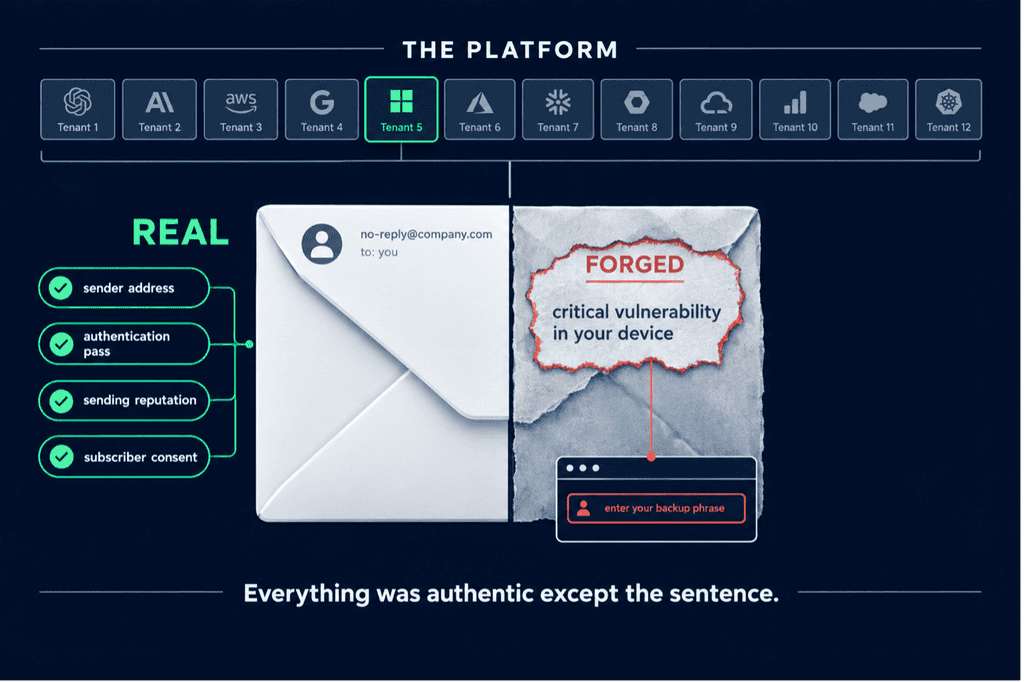
The attacker did not register a domain. They did not build a sending infrastructure, warm up an IP address or find a way past a mail gateway. They logged into a platform that was already authorised to send on the brand’s behalf, and they pressed send. The message left with the brand’s genuine sending address on it. It passed sender authentication because it was, in the technical sense the protocols measure, authentic mail from an authorised sender.
It arrived looking exactly like every other newsletter those recipients had chosen to receive, because it came from the same system that produced all the others. The content was the only forged element: a security alert claiming a hardware flaw, and a link to an application that asked the user to enter their wallet backup phrase. That is the whole attack. Everything except the sentence itself was real.
The same incident touched 120 accounts on that platform. This was not a campaign against one brand. It was a campaign against a sending capability, and every brand attached to it was a separate opportunity.
Every Control You Bought Assumes the Sender Is Fake
Brand protection has spent a decade building defences around one assumption: the attacker has to impersonate you, and impersonation leaves evidence. That assumption is load bearing for almost everything in the stack.
• Sender authentication proves a message came from an authorised system, and in this case it did, so the check passed and told the recipient the truth.
• Lookalike domain detection finds the domain an attacker registers to imitate you, and here no such domain was needed for the sending side at all.
• Awareness training teaches people to inspect the sender address before trusting a message, and the sender address was correct.
• Gateway reputation scoring weighs the sending infrastructure, which in this case had years of clean reputation built by your own legitimate campaigns.
None of those controls failed. They reported accurately on the questions they were designed to answer. The attack simply did not involve the forgery they exist to detect, which is a harder problem than a control that breaks, because a control that breaks produces an alert.
The mailing list is the payload, not the collateral
It is tempting to read 347,000 exposed email addresses as the loss here. Email addresses are cheap and most of those people are in a dozen other breach corpora already.
The value is not the addresses. It is the segmentation. An opt-in newsletter list for a specific product is a verified roster of people who own that product and care enough about it to subscribe. For a hardware wallet, that list is a directory of people who hold cryptocurrency and take its custody seriously. No amount of general purpose breach data assembles that audience. The brand assembled it, carefully, over years, and the attacker inherited it intact along with the authority to write to it.
This is why a marketing platform breach outperforms a generic phishing campaign by a wide margin. The targeting, the trust and the delivery all arrive in the same package.
The Twenty Minute Number Is the Real Lesson
Out of 347,000 recipients, 2,500 clicked. That is a small fraction of the reachable audience, and the reason is a single operational fact: the phishing domain was disabled at the DNS level within 20 minutes.
Twenty minutes is not luck. It requires three things to already be in place before the incident starts. Someone has to see the message, which means monitoring that covers your own brand as a sender rather than only as a target. Someone has to identify the attacker infrastructure quickly, which means the domain and its hosting are resolvable to an owner and an abuse path without an afternoon of research. And someone has to have the standing authority to act on a Wednesday evening without assembling a committee.
Most organisations have none of those three at the speed this incident required. The gap between 20 minutes and 20 hours in a campaign of this kind is not a proportional increase in damage. It is the difference between a contained incident and a permanent change in how a customer base reads your email.
Your Marketing Stack Is Security Infrastructure Nobody Classified That Way
The email platform in this case is one instance of a much larger category. Look at what else holds both a customer list and a sending identity on your behalf: the CRM, the transactional mail provider, the push notification service, the SMS gateway, the in-app messaging tool, the review request system, the shipping notification integration.
Every one of those can speak as you. Most of them were selected by a team whose evaluation criteria were deliverability, templates and price. Most of them were never assessed against the question that matters here, which is not whether they protect your data but what an attacker could do with your voice if they got inside.
That is a different question from the one a vendor questionnaire asks, and it produces a different tier. A platform with sending authority for your domain belongs in the same risk tier as a system holding your customer database, because in practice it holds something more directly weaponisable: a trusted channel to the people who trust you, the exact opening a marketing platform breach provides.
What the contract should already say
There are three provisions that turn a twenty hour response into a twenty minute one, and they are cheaper to negotiate at renewal than to invent during an incident. A notification commitment measured in hours rather than business days. A named technical contact reachable outside working hours. And a defined mechanism for you to suspend your own account’s sending capability yourself, immediately, without waiting for the vendor’s support queue.
What to Do This Week
• List every third party with authority to send under your domain or your brand name, including the ones procured outside IT, and treat that list as an asset inventory rather than a procurement record — the inventory that limits blast radius the next time a marketing platform breach happens.
• Confirm you can suspend each platform’s sending capability yourself, and confirm who holds that credential outside office hours.
• Monitor for messages sent in your name as a detection surface in its own right, including seeded addresses on your own marketing lists, because in this scenario the first evidence is a message rather than a domain registration.
• Keep a standing takedown path for attacker infrastructure so the response is an execution rather than a project, since the twenty minute figure is the entire difference in outcome.
• Pre-write the customer communication for the case where a fraudulent message went out under your real sending identity, because the reflex to say the message was not from us is the one statement you will not be able to make.
How Brandefense Addresses Trusted Sender Abuse
The defence for this pattern is not a better spam filter. It is visibility into what is being sent in your name and what condition the platforms sending it are in. That visibility is what turns a marketing platform breach from an open-ended crisis into a contained one.
| Capability | How It Addresses Marketing Platform and Trusted Sender Abuse |
| Brand abuse and impersonation monitoring | Detects campaigns running under your brand name and creative, including the case where the sending identity is genuine and only the message is fraudulent. |
| Phishing infrastructure detection and takedown | Identifies the landing page and download host behind the message and drives the takedown path, which is where the twenty minute figure in this incident came from. |
| Certificate transparency and domain monitoring | Surfaces the infrastructure staged for the campaign at the moment certificates are issued, often before the first message is sent. |
| Vendor and platform exposure monitoring | Watches the external condition of the marketing and messaging platforms that hold sending authority for your domain, between assessments rather than at renewal. |
| Dark web credential monitoring for vendor accounts | Flags exposed credentials belonging to the platform accounts your teams use, which is the access an attacker needs to send as you in the first place. |
RELATED READING
Lookalike Domains: How a Single Character Difference Becomes a Brand’s Worst Nightmare https://brandefense.io/blog/lookalike-domains-brand-impersonation/ : Read this for the attack this one deliberately avoided, and for why detection built around registered imitation domains leaves a gap when no imitation is needed.
Your Security Vendors Are Your Highest-Privilege Third Parties, and Your TPRM Program Scores Them Low https://brandefense.io/blog/security-vendor-risk-tprm/ Read this for the tiering argument applied to a different category, because a platform that speaks as you has the same scoring problem as a tool that runs inside you.
Why Vendor Security Questionnaires Don’t Work (And What Actually Does) https://brandefense.io/blog/why-vendor-security-questionnaires-dont-work/ Read this for why an annual assessment of a marketing platform tells you nothing about its condition on the day it is used against you.
Phishing-as-a-Service 2.0: The Kits That Bypass MFA Without a Fake Login Page https://brandefense.io/blog/phishing-as-a-service-mfa-bypass-device-code/ Read this for the wider pattern, where the most effective phishing of the last two years works by removing the forgery rather than improving it.