




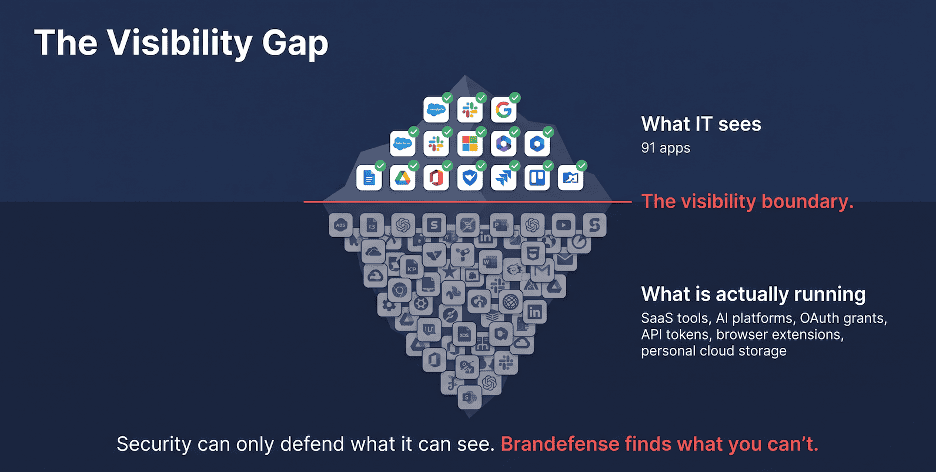
Ask the average enterprise security team how many cloud services the organization uses. The number they give you, drawn from procurement records, approved vendor lists, and the tools they actively monitor, is typically around 91. The real number, measured by actual network traffic and identity provider logs, averages 1,220. That gap, a factor of more than thirteen, is the shadow IT problem in a single statistic.
Shadow IT is not a new concept, but its scale and security implications have changed fundamentally in the SaaS era. When shadow IT meant a rogue server in a closet or an unauthorized desktop application, the risk was bounded. The asset was physical, it was on-premises, and the worst case was a security policy violation with local consequences. When shadow IT means 1,129 unaccounted cloud services, each with its own credential set, data flows, API connections, and third-party integrations, the worst case is an attack surface that the security program has no ability to see, monitor, or defend.
This blog examines why shadow IT has become the entry point security teams most consistently underestimate: what assets are hiding in it, why employees create it, how attackers exploit it, and what a visibility-first response looks like.
| 1,220 average cloud services actually in use per organization vs 91 believed | 8% of organizations have full visibility into their shadow IT footprint | 80% of employees use SaaS applications without IT approval | $670K additional breach cost when shadow AI tools are involved (IBM Cost of Data Breach 2025) |
What Is Shadow IT?
Shadow IT refers to technology assets, including hardware, software, cloud services, SaaS applications, and AI tools, that are in use within an organization without the knowledge, approval, or oversight of the IT or security team. The word ‘shadow’ is precise: these assets are not hidden in the sense that employees are trying to conceal them. They are shadow assets in the sense that they exist and operate entirely outside the security team’s monitoring perimeter.
Shadow IT is almost never malicious in intent. It exists because legitimate business needs outrun procurement timelines. A marketing team that needs a file-sharing tool for a campaign launching Friday does not have the three weeks IT approval typically takes. A developer who uses a personal AI coding assistant to move faster is solving a real problem. A finance analyst who stores a spreadsheet in a personal cloud folder because the shared drive is slow is making a practical choice. Every one of these decisions is rational in context. Collectively, they create an attack surface the organization cannot see.
| Shadow IT Category | Common Examples | Why Employees Adopt It |
| Unauthorized SaaS applications | Project management tools, collaboration platforms, file sharing services, survey tools, marketing automation | Sanctioned alternatives are slow, limited in functionality, or require lengthy IT approval processes |
| Personal AI and generative AI tools | Consumer LLM accounts, AI writing assistants, code completion tools, browser AI extensions | Sanctioned AI tools are not yet available or are perceived as less capable; 65% of employees now use AI tools, 52% received no training on the risks |
| Personal cloud storage | Personal Google Drive, Dropbox, iCloud accounts used for work files | Corporate storage is slow, has capacity limits, or cannot be shared easily with external partners |
| SaaS-to-SaaS OAuth integrations | Third-party apps connected to corporate email, calendar, or CRM via OAuth without IT awareness | Employees grant OAuth access to improve workflow integrations without understanding what access they are authorizing |
| Browser extensions | Grammar tools, productivity extensions, AI-powered assistants installed in the corporate browser | Extensions install silently and are not perceived as IT assets; many request access to page content and can read form data |
| Free trial and freemium SaaS accounts | Department-level accounts opened with corporate email addresses on free tiers of enterprise tools | No budget approval required; IT visibility depends on the corporate email being the notification destination |
| Shadow AI agents | Autonomous AI agents created by employees to automate workflows, connected to email, calendar, and CRM | Emerging category; 82% of CIOs report employees creating AI agents faster than IT can govern them (Gartner April 2026) |
Why Shadow IT Is the Most Dangerous Attack Surface You Are Not Defending
The security implications of shadow IT are not theoretical. They derive directly from a single characteristic: these assets cannot be monitored, patched, configured to policy, or included in incident response because the security team does not know they exist. Every security control the organization has deployed, firewalls, endpoint detection, DLP, SIEM correlation, vulnerability scanning, operates against a picture of the environment that excludes the majority of the actual environment.
Unmonitored Entry Points
An unauthorized SaaS application that stores corporate credentials creates an entry point that the security team has no instrumentation for. If that application has a vulnerability, the organization will not receive an alert and will not know to patch it. If the application is compromised by a third party, the organization will not know until the consequences appear inside the corporate environment. If an employee’s credentials for that application are exposed in an infostealer log, the credential monitoring program will not be watching for them.
The mid-market enterprise running 291 hidden applications, as observed in data covering 12 million enterprise identities, has approximately 1,700 credential sets and API tokens sitting outside any security monitoring tool or secrets vault. Each of these is a potential initial access vector. None of them appear in vulnerability scans. None of them trigger EDR alerts. None of them are covered by the organization’s incident response plan.
| The Trello Incident: How a Low-Risk Tool Becomes a High-Impact Breach A marketing specialist posted a public Trello board so external contractors could track an email campaign. The board was indexed by search engines within hours of creation. Attackers scraped 120,000 email addresses from the board, used them against password databases for credential stuffing, and drained loyalty-point balances across five regional storefronts. The Trello board stored no payment data. It was a project management tool used for coordination, exactly the kind of low-risk shadow IT deployment that IT teams deprioritize. The breach happened because the tool was connected, through shared credentials and password reuse, to systems that did store payment-adjacent data. The entry point was invisible. The consequences were not. |
Credential Reuse and the OAuth Token Problem
The average employee uses the same password, or a slight variant of it, across personal and professional accounts. When an unauthorized SaaS tool is compromised in a breach, the credentials used to access it are tested against corporate systems. This is credential stuffing at its most efficient: the attacker does not need to break the corporate perimeter. They need the credentials the employee used for a free project management account, and those credentials exist in a breach database the organization’s credential monitoring program has never seen.
OAuth tokens compound the problem. When an employee connects an unauthorized application to their corporate email, calendar, or CRM via OAuth, they grant that application delegated access to corporate data. The OAuth token often outlives the user who created it, carries broad permissions, and is not subject to the MFA requirements that protect the original account. A single OAuth grant to a consumer application can provide persistent, MFA-bypassing access to corporate systems long after the employee has forgotten they created it.
| The Non-Human Identity Explosion Behind every human-facing SaaS account in a cloud-native organization sits an average of 10 to 50 machine identities: OAuth tokens, API keys, service accounts, and agent credentials. A single ‘free trial’ workspace typically spawns three API tokens, two unmanaged credential sets, and at least one OAuth grant exempt from MFA, according to data covering 12 million enterprise identities. 46% of organizations struggle to monitor non-human identities and 56% report concerns about overprivileged API access. These are not credentials that appear in the corporate identity provider. They are not subject to the organization’s password policy or MFA requirements. They are credentials that exist and remain active in applications the security team has never seen. |
Shadow AI: The Newest and Fastest-Growing Attack Surface
Shadow AI is the 2025 and 2026 extension of the shadow IT problem. It encompasses any AI tool, model, or feature used inside an organization without security team approval or visibility, including employees pasting customer data into consumer LLM accounts, granting AI agents OAuth access to corporate email and CRM, and enabling AI features inside sanctioned SaaS applications without reassessing what data those features can access.
IBM’s 2025 Cost of Data Breach Report introduced shadow AI as a formal breach category for the first time, finding that organizations with high shadow AI involvement incurred $670,000 in additional breach costs and took a median of 247 days to detect the incident. One in five breaches in the report involved shadow AI. In 43% of cases, employees were sharing sensitive work information with AI tools they had adopted without IT knowledge.
The agent dimension adds a further layer. Shadow AI agents differ from shadow SaaS in a critical way: a shadow SaaS application passively receives data. A shadow AI agent actively initiates connections to external services, executes code, and may persist access credentials. Gartner projected in April 2026 that by 2028 the average Fortune 500 enterprise will have more than 150,000 AI agents in use, up from fewer than 15 in 2025. 82% of CIOs report employees are creating AI agents faster than IT can govern them.

How Attackers Exploit Shadow IT
Attackers do not need to find shadow IT themselves. They use the same automated scanning and enumeration tools that security researchers use, and they find it faster. Internet-facing assets, including subdomain enumerations, certificate transparency logs, and cloud service metadata, expose shadow IT infrastructure that organizations believe is invisible but is in fact publicly discoverable.
| Attack Path | How Shadow IT Enables It | Real Consequence |
| Credential stuffing via shadow SaaS breach | Unauthorized SaaS tool is breached by a third party; employee’s credentials, often reused from corporate accounts, are exposed | Attacker uses exposed credentials to access VPN, SSO, or other corporate systems; no internal alert fires because the source breach was in an unmonitored application |
| OAuth token abuse | Employee granted OAuth access to an unauthorized app connected to corporate email or CRM; token persists after app is abandoned or after employee departure | Attacker who compromises the unauthorized app inherits the OAuth access to corporate systems without triggering MFA or authentication anomaly alerts |
| Subdomain takeover via abandoned SaaS | Employee signed up for a SaaS trial using a corporate subdomain; trial ended, DNS record still points to the SaaS provider’s infrastructure | Attacker registers the expired SaaS account, takes control of the subdomain, issues a valid certificate, and uses it for phishing or credential harvesting against the organization’s users |
| Data exfiltration through shadow storage | Sensitive documents stored in personal cloud accounts by employees working around file size or sharing limitations | Attacker compromises the personal account (which has no corporate security controls) and accesses months or years of corporate data; no DLP alert fires |
| Shadow AI data exfiltration | Employee pastes sensitive data into a consumer LLM or connects an AI agent to corporate email via OAuth | Corporate data enters a third-party AI provider’s infrastructure with no consent management, no DLP coverage, and no ability to retrieve or delete it |
| Initial access via forgotten dev environment | Developer spun up a cloud workload for a project, never decommissioned it; no security controls applied, no patch management in place | Attacker discovers the exposed workload via internet scanning, exploits an unpatched vulnerability, and uses it as initial access into the corporate environment |
Why Shadow IT Is the Preferred Initial Access Surface for IABs
Initial access brokers, the threat actors who sell corporate network access to ransomware affiliates, specifically target the unmonitored perimeter. VPN credentials purchased from infostealer logs frequently originate from personal devices or shadow SaaS applications where the credential was also used. Cloud management console access purchased on dark web markets frequently derives from API keys or service account credentials that were generated by shadow IT deployments and never rotated.
The reason is structural: shadow IT assets are systematically less protected than sanctioned infrastructure. They may have never had MFA enforced. They may be running on unpatched software. Their credentials may never be rotated. And critically, no security alert will fire when they are accessed by an unauthorized party, because no monitoring is in place to detect unauthorized access.
Why Shadow IT Keeps Reappearing After You Clean It Up
Shadow IT is not a one-time cleanup problem. It reappears because the conditions that create it are permanent features of how modern organizations work, not temporary lapses in policy.
The provisioning gap never closes
Teams adopt tools at the speed of a corporate card, while formal procurement and security review run on quarterly cycles. Every gap between the two produces a new unmanaged asset. Removing today’s shadow assets does nothing to the process that produced them.
Cloud and SaaS create assets that outlive their owners
Staging environments, trial tenants, marketing subdomains and short-lived campaign infrastructure are created by people who leave the team, change roles or forget the asset exists. The asset stays reachable from the internet long after the person who needed it stopped needing it.
Inventories describe a moment, not a state
A discovery exercise produces a list that is accurate on the day it is run. Certificates are issued, DNS records change, third parties spin up subdomains on your behalf. Any inventory that is not continuously refreshed begins drifting from reality the day it is completed.
Mergers, agencies and third parties inherit assets you never created
Acquired companies, marketing agencies and technology partners bring their own domains, subdomains and hosting into your attack surface. These assets are yours in the eyes of an attacker long before they appear in any internal system of record.
This is why shadow IT is treated as a monitoring problem rather than a cleanup project. Brandefense runs external asset discovery continuously and alerts on newly appearing assets, so the reappearance is detected as it happens instead of at the next audit.
How to Address Shadow IT: A Visibility-First Framework
Addressing shadow IT begins with accepting a counterintuitive premise: the goal is not to prohibit unauthorized tools. It is to achieve visibility over them. Prohibition without discovery is ineffective because employees will continue to use tools that meet legitimate needs regardless of policy; the only effect of prohibition without discovery is that the security team has even less information about what is running. Visibility, followed by governance and risk-tiered response, is the only approach that actually reduces exposure.
Layer 1: Continuous External Asset Discovery
- Deploy external attack surface management to continuously discover internet-facing assets associated with the organization’s domain, IP ranges, and brand: this surfaces shadow SaaS subdomains, forgotten cloud workloads, and abandoned development environments that do not appear in the official asset inventory
- Monitor Certificate Transparency logs for new SSL certificates issued for organizational domains; legitimate deployments that IT is unaware of appear here before they appear in any other monitoring system
- Track DNS records for subdomains that point to third-party SaaS infrastructure, a reliable indicator of shadow SaaS usage that has been formalized enough to have a dedicated subdomain
- Conduct periodic assessments of cloud provider metadata across AWS, Azure, and GCP for organizational identifiers that appear in publicly visible cloud workloads outside sanctioned accounts
Layer 2: Identity and OAuth Monitoring
- Audit OAuth grants connected to corporate identity provider accounts on a recurring basis; any grant connected to an unauthorized application should be reviewed and revoked if not business-justified
- Monitor for non-human identities, including API keys, service accounts, and OAuth tokens, that are not associated with known sanctioned applications; orphaned credentials from shadow IT deployments persist indefinitely without active management
- Implement identity lifecycle controls that automatically flag and revoke OAuth connections when an employee departs; shadow IT OAuth grants are the most commonly overlooked asset in offboarding processes
- Enforce MFA at the identity provider level for all OAuth-connected applications, including those not on the sanctioned list, where technically possible
Layer 3: Risk-Tiered Governance
- Classify discovered shadow IT assets by risk tier rather than applying blanket prohibition; a personal AI tool with no corporate data access presents different risk from an unauthorized cloud workload with a public API endpoint
- Establish a fast-track approval process for tools that meet common employee needs; the primary driver of shadow IT is procurement friction, and reducing that friction for low-risk tools reduces the incentive to bypass the process entirely
- Define data classification rules that prohibit specific data categories from entering any unsanctioned application regardless of tier, with technical controls to enforce the prohibition for the highest-sensitivity classifications
- Treat shadow AI as a distinct category requiring its own governance approach; the data exfiltration and intellectual property risks from AI tools require AI-specific acceptable use policy, not just extension of existing SaaS governance
Layer 4: Dark Web Monitoring for Shadow IT Exposure
- Monitor dark web credential markets and infostealer log repositories for credentials associated with organizational domains appearing in unauthorized application contexts
- Track dark web discussions and IAB forum posts that reference organizational subdomains, IP ranges, or cloud workloads not present in the official asset inventory
- Correlate dark web credential exposure events with the asset discovery layer to identify which shadow IT assets may already be known to threat actors
How Brandefense Addresses Shadow IT Exposure
| Capability | How It Addresses the Shadow IT Attack Surface |
| External Attack Surface Management (EASM) | Continuously discovers internet-facing assets associated with your organization, including unauthorized SaaS subdomains, forgotten cloud workloads, and shadow IT infrastructure that does not appear in official inventories |
| Certificate Transparency monitoring | Detects new SSL certificates issued for organizational domains, surfacing shadow IT deployments that have formalized enough to acquire their own certificate but remain unknown to the security team |
| Subdomain and DNS monitoring | Tracks DNS records pointing to third-party SaaS infrastructure, identifying shadow SaaS usage and flagging orphaned records that may be vulnerable to subdomain takeover |
| Dark web credential monitoring | Detects organizational credentials appearing in infostealer logs and breach databases, including credentials from shadow SaaS applications that are not monitored by the corporate credential monitoring program |
| Shadow IT discovery for DORA and NIS2 compliance | Supports Register of Information completeness and asset inventory requirements under DORA and NIS2 by surfacing ICT assets not captured in official procurement records |
| Continuous 24/7 monitoring | Provides ongoing detection rather than periodic assessment, closing the gap between shadow IT deployment and security team awareness |
| RELATED READING Third-Party Risk: How Your Supplier’s Vulnerability Becomes Your Breach: https://brandefense.io/blog/third-party-risk-management-vendor-breach-cascade/ how shadow IT in the vendor ecosystem creates downstream exposure Why Vendor Security Questionnaires Do Not Work: https://brandefense.io/blog/why-vendor-security-questionnaires-dont-work/ why point-in-time assessments cannot surface shadow IT that neither party knows about NIS2 and DORA Compliance for TPRM: https://brandefense.io/blog/nis2-dora-third-party-risk-management/ the regulatory requirements that mandate shadow IT visibility as part of asset inventory obligations Account Takeover CISO Guide: https://brandefense.io/blog/cisos-guide-to-account-takeover-prevention/ : how shadow IT credential exposure feeds the ATO attack chain |