
People data vendors, such as HR assessment and psychometric testing platforms, hold sensitive profiles of a company’s leaders and staff, yet most third-party risk programs do not assess them. One breach at a shared platform can lead to claims against many clients at once. Adding these vendors to TPRM scope closes that blind spot.
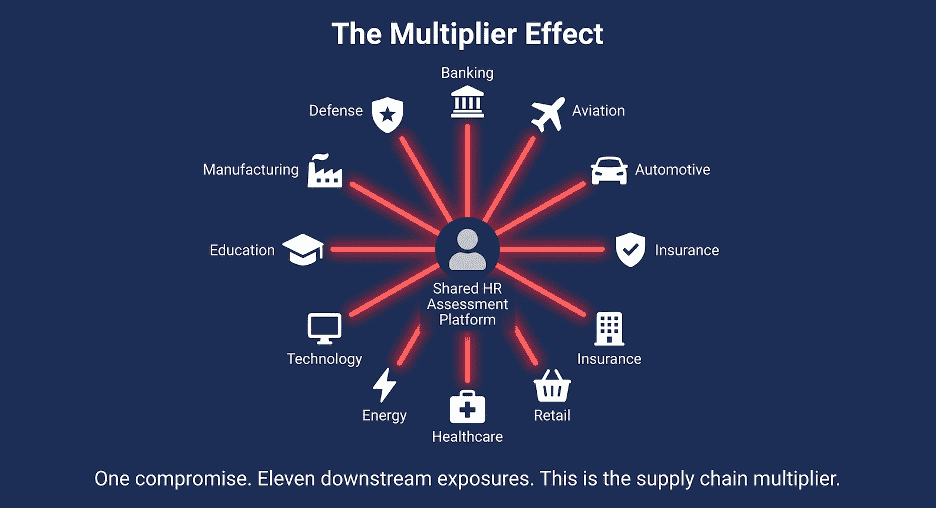
A threat actor recently claimed to have breached the data of eleven organizations in a single announcement. Defense contractors. Banks. Insurance companies. Automotive manufacturers. Airlines. Each of them from different sectors, different regulatory frameworks, and different security maturity levels. A simultaneous breach of eleven separate organizations of this profile would be extraordinary. It would represent one of the most sophisticated multi-target operations ever publicly attributed to a financially motivated actor.
But the more probable explanation, and the one that Brandefense CTI’s analysis supports, is considerably simpler and considerably more instructive: there was likely one breach, not eleven. One shared vendor. One platform that many of these organizations used for something they considered peripheral to their security program, something that did not appear in their IT asset inventory, something that almost certainly did not receive the same scrutiny as their cloud providers, their managed service providers, or their enterprise software vendors.
The category is HR assessment and psychometric evaluation. And this event is a signal that every TPRM program that defines its scope around technology vendors is blind to its people data vendors — the platforms that hold psychometric and behavioral data on the organization’s own workforce.
| 1 likely vendor breach that produced simultaneous claims against multiple large organizations | A large volume of psychometric profiles, executive assessments, and HR data allegedly exfiltrated | Many corporate clients potentially affected by a single third-party HR platform compromise | A claimed period of undetected access to the HR vendor’s systems before exfiltration was complete |
The Question Every Board Should Be Asking: How Many Breaches Were There?
When a threat actor publishes a list of eleven organizations it claims to have compromised, the natural response is to focus on the list. Who is on it? What data was taken? What is the exposure? These are the right questions for the organizations named. But for security leaders at organizations not on the list, and for those thinking about program design, there is a more important question embedded in the structure of the event itself.
How does a financially motivated actor breach eleven organizations across five sectors simultaneously, including organizations with mature security programs, without any of the individual organizations detecting the intrusion? The answer, almost always, is that they did not. They breached one thing those organizations had in common.
The shared vendor model is the defining feature of supply chain attacks at scale. A managed file transfer platform serves thousands of organizations simultaneously. A payroll processor handles the compensation data of hundreds of thousands of employees across hundreds of employers. An HR assessment platform stores psychometric profiles for executives across every corporate client that has used it over years of operation. In each case, the attacker gains multiplicative returns from a single intrusion. One set of credentials. One persistent foothold. One exfiltration pipeline. Dozens or hundreds of downstream victims.
- One intrusionA single set of credentials gives the attacker entry to the shared platform.
- Persistent footholdThe attacker stays in the platform.
- Exfiltration pipelineData is taken out through one route.
- Downstream victimsDozens or hundreds of client organizations are affected.
The Multiplier Question
Before your security program treats a multi-organization breach claim as evidence of sophisticated multi-target operations, ask: what did these organizations have in common? The answer to that question is more important than the list of victims. Because whatever they had in common is the entry point your program needs to examine, not just for this event, but for every shared platform your organization uses that you have not formally assessed.
Why HR Assessment Data Is Not a Peripheral Security Concern
The instinct to classify HR and people data as a lower-priority security concern comes from a reasonable place. Psychometric assessments and personality profiles are not financial records. They do not enable direct fraud. They do not contain credentials. They do not provide access to systems. Under the traditional breach impact framework, a financial services organization might reasonably prioritize the protection of transaction data and customer credentials above the protection of HR files.
That framework is wrong in 2026, and this event illustrates why.
What Psychometric Data Enables That Financial Data Does Not
A stolen database of credit card numbers enables financial fraud. It is serious, expensive to remediate, and damaging to customer trust. But the attack path from stolen card numbers to organizational compromise is bounded: the attacker impersonates a customer, not an insider.
Psychometric assessment data is different in kind, not just degree. An attacker with access to executive personality profiles, behavioral stress tests, communication style analyses, and documented individual vulnerabilities is not equipped to impersonate a customer. They are equipped to manipulate a specific person. At the executive level, that manipulation capability translates directly into organizational risk.
| Data Type | What an Attacker Can Do With It | Organizational Risk Level |
| Financial records and transaction data | Identity fraud, account takeover, customer impersonation | High for affected individuals; bounded organizational impact |
| Login credentials and passwords | System access, lateral movement, data exfiltration | High; directly enables network compromise |
| Executive psychometric profiles and personality assessments | Targeted social engineering calibrated to individual psychological vulnerabilities; deepfake and voice clone training data from interview recordings; counterintelligence targeting of specific high-value individuals | Critical; enables attacks that bypass every technical control by targeting human decision-making |
| HR selection documentation and candidate profiles | Phishing lure construction using real candidate names and recruitment context; impersonation of recruiting processes to target employees and candidates | High; enables highly credible targeted phishing at scale |
| Interview recordings (audio and video) | Voice cloning for phone-based social engineering; deepfake video generation for video conference impersonation attacks | Critical; removes the last verification layer most executives rely on (visual and voice recognition) |
| Internal recruitment correspondence | Mapping of unreported internal relationships, pending promotions, and organizational tensions; leverage for targeted coercion or manipulation | High; intelligence asset with durable value beyond the immediate attack |
The combination of psychometric profiles and interview recordings is particularly consequential. Psychometric data tells an attacker how a specific executive responds to pressure, which arguments they find persuasive, what their decision-making weaknesses are, and how they communicate under stress. Interview recordings provide voice and video samples sufficient for AI-based cloning. Together, they constitute a targeting package that enables social engineering attacks calibrated at the individual level, executed with voice and appearance that passes basic human verification.
This is not a theoretical risk. Deepfake-enabled fraud targeting executives is documented, increasingly automated, and growing in frequency. The data that makes those attacks credible, accurate personal detail, natural voice cadence, known colleague references, is exactly what HR assessment platforms hold.
The Deepfake Amplification Problem
Most executives have been briefed on deepfake risk in general terms: be skeptical of unusual video calls, verify unusual financial requests. What they have not been told is that their psychometric profile is the training data that makes deepfakes targeted rather than generic. A generic deepfake call impersonating a CFO will be scripted around publicly available information. A deepfake call built on stolen psychometric data will reference details the victim recognizes as things only a real colleague would know: their communication style, their specific concerns about a project, their personal motivations. The stolen HR data is not just sensitive in itself. It is the intelligence layer that makes every downstream attack against that executive more effective.
Why Do People Data Vendors Fall Outside Standard TPRM Programs?
The reason HR assessment vendors escape scrutiny in most TPRM programs is structural. Third-party risk management frameworks were built to address a specific threat model: an external vendor with technical access to organizational systems creates a pathway for attackers to reach those systems. The control framework follows: assess the vendor’s security controls, require contractual security provisions, audit their SOC 2 or ISO 27001 certification, monitor their external attack surface.
This framework functions well when the risk is technical access. It fails when the risk is data custody without technical access. An HR assessment platform does not typically have an integration into the organization’s network. It does not sit in a privileged position relative to internal systems. It does not have credentials that could be used to pivot into corporate infrastructure. By the criteria most TPRM programs use to prioritize vendor risk, it would score low.
But it holds something that a network integration does not: years of accumulated, highly sensitive, deeply personal data about the organization’s leadership and workforce. The risk is not that the attacker will use the vendor as a pivot point into systems. The risk is that the attacker will use the data itself as a weapon against the people those systems are meant to protect.
| Topic | Technical access | Data custody |
|---|---|---|
| What TPRM programs were built for | An external vendor with technical access to systems | A vendor that holds sensitive data about people |
| Network integration | Pathway into the organization’s systems | Typically none |
| Privileged position or credentials | Can be used to pivot into infrastructure | Typically none |
| How it usually scores | Higher, because of system access | Low, by the criteria most programs use |
| Where the risk sits | In access to systems | In the data used as a weapon against people |
The Three Gaps in Standard TPRM Scope
Gap 1: Vendor Category Assumptions
Most TPRM programs categorize vendors by the nature of their technical relationship to the organization: critical, high, medium, or low risk, based on the level of system access and the sensitivity of the data they process. HR assessment vendors typically land in the medium or low category because they do not have persistent network access, do not process payment card data, and do not sit in a privileged technical position relative to core infrastructure.
This categorization misses the data sensitivity dimension entirely. A vendor that processes no financial data and has no network integration but holds psychometric profiles for an organization’s most senior executives is not a medium-risk vendor. It is a high-risk vendor of a type that the categorization framework was not designed to identify.
Gap 2: Data Type Blind Spots
TPRM data classification frameworks are typically built around regulated data categories: personally identifiable information, protected health information, payment card data, and financial records. These categories determine which vendors receive enhanced scrutiny and which contractual requirements apply.
Psychometric assessment results, personality analyses, behavioral profiles, and interview recordings do not fit neatly into standard PII frameworks. They are personal data, but they are not the kind of personal data that triggers enhanced vendor scrutiny in most programs. They are also not financial data, health data, or regulated data under most frameworks in use today. The gap between what matters for organizational security and what the classification framework recognizes as sensitive creates exactly the blind spot that this type of event exploits.
Gap 3: The Indirect Exposure Problem
Even when an organization’s TPRM program is mature and comprehensive, it typically assesses the direct vendor relationship: what data does this vendor hold for our organization, and how do they protect it? The indirect exposure problem is different: the same vendor holds the same categories of data for hundreds of other organizations, and a breach of those other organizations’ data in the same platform creates risk for your organization even if your specific data is not compromised.
In the event that prompted this analysis, the risk to any single organization was not only that its own data might have been taken. It was that data belonging to executives who also interacted with partner organizations, clients, and counterparties held by the same platform might inform attacks on those executives. The shared platform created a risk interconnection between organizations that had no visibility into each other’s exposure.
The Questionnaire Problem
A standard vendor security questionnaire would ask the HR assessment platform about its encryption practices, access controls, incident response procedures, and certification status. It would not ask: how many other organizations’ executive data do you hold, and what is the aggregate attack value of a complete breach of your platform? That question is not in any standard questionnaire framework. But it is the question that determines the real risk of a platform breach to any individual client.
What Does a TPRM Program That Covers People Data Look Like?
Closing the people data blind spot in a TPRM program requires three changes: expanding the vendor categorization framework, adding a data sensitivity dimension that captures non-regulated but organizationally critical data, and establishing continuous monitoring for the vendor ecosystem rather than relying on point-in-time assessments.
Expanding the Vendor Category Framework
The vendor categorization question should not only be: what technical access does this vendor have to our systems? It should also be: what data does this vendor hold that, if compromised, would enable attacks against our people, our executives, or our organizational decision-making?
Under this expanded framework, HR assessment platforms, psychometric testing providers, executive coaching and development firms, background check providers, recruitment process outsourcing vendors, and organizational development consultants all become vendors that warrant enhanced scrutiny regardless of their technical access level. They hold data whose sensitivity is not captured by standard frameworks but whose compromise creates real and serious organizational risk.
The Five Questions Every Board Should Ask
| Question | Why It Matters | What the Answer Reveals |
| Which of our vendors hold psychometric, personality, or behavioral assessment data for our executives or senior leaders? | Executive psychological profiles are primary targets for social engineering and deepfake attack preparation | The scope of people data exposure the organization has accepted without formal risk assessment |
| How many other organizations’ leadership data does each of those vendors hold on the same platform? | The aggregate value of a platform breach to an attacker scales with the number and seniority of individuals across all clients | The organization’s indirect exposure through the shared platform risk model |
| When did we last formally assess each of those vendors’ security posture, and what did the assessment cover? | Point-in-time questionnaires do not detect breaches in progress or recently completed | Whether the assessment program covers people data vendors and whether it is current |
| What data does each of those vendors hold that is more than two years old, and is deletion or return of that data possible? | Historical assessment data creates persistent exposure long after the business relationship has ended | Whether data minimization controls exist for people data vendors |
| If any of those vendors were breached today, what would our response plan cover, and what would it miss? | People data breaches require a different response than financial or credential breaches: executive social engineering briefings, deepfake awareness alerts, targeted phishing warnings | Whether the incident response plan addresses the specific consequences of people data compromise |
Continuous Monitoring for People Data Vendors
Point-in-time vendor assessments, whether questionnaires, certifications, or audit reports, provide a snapshot of a vendor’s security posture at a specific moment. They do not detect a breach that occurred in the interval between assessments. They do not surface the dark web activity that precedes a breach. And they do not provide the early warning that allows an organization to begin protecting its executives before the attacker has finished building their targeting package.
Continuous monitoring for people data vendors requires the same capabilities applied to technology vendors: external attack surface monitoring of the vendor’s internet-facing infrastructure, dark web surveillance for vendor credential exposure and data leak postings, and threat intelligence for threat actor activity targeting the vendor’s sector and platform type.
The claimed access window in this event is the monitoring gap. An organization that receives an alert when its HR vendor’s credentials appear in a dark web market, or when the vendor’s infrastructure shows signs of compromise, has warning that the standard assessment cycle does not provide. That window is the difference between a proactive response and a reactive one.
What Organizations Should Do When a People Data Vendor Is Compromised
The response to a people data vendor compromise is different from the response to a technology vendor compromise. The attacker’s goal is not system access. It is intelligence that enables human-targeted attacks. The response program must address that goal directly.
Immediate: Executive Risk Briefing
- Brief all potentially affected executives on the elevated social engineering risk. Do not limit briefings to the most senior leaders. The data that was taken covers recruitment and assessment processes that may include middle management and high-potential employees as well.
- Specifically address the deepfake and voice cloning risk. Executives who know their voice may have been sampled in interview recordings need to understand what that enables and how to verify unusual contact attempts.
- Establish or reinforce out-of-band verification protocols for any financial, access, or sensitive operational request. A phone call from a voice that sounds familiar is not a verification method against an attacker with voice clone technology calibrated on interview recordings.
Short-Term: Data Exposure Assessment
- Request from the vendor a complete account of what data they hold for your organization, what was potentially exposed, and what evidence exists of actual access to your specific data versus other clients’ data.
- Inventory which executives had psychometric or behavioral assessments on the platform, when those assessments were conducted, and what categories of data the results contain. This inventory determines the scope of the social engineering risk for each individual.
- Review whether interview recordings exist on the platform for any executives and, if so, what the recording quality and duration are. Higher quality, longer recordings create greater voice cloning risk.
Strategic: TPRM Program Expansion
- Formally add people data vendors to the TPRM program scope. Build a complete inventory of every vendor that holds assessment, coaching, recruitment, or behavioral data for organizational leaders.
- Establish a data sensitivity classification category for organizationally sensitive non-regulated data, specifically covering psychometric and behavioral assessment results, voice and video recordings of executives, and documents that reveal individual vulnerabilities or decision-making patterns.
- Apply the same continuous monitoring standard to people data vendors as to technology vendors: external attack surface monitoring, dark web credential surveillance, and threat intelligence for vendor targeting activity.
- Add data minimization requirements to vendor contracts for people data: maximum retention periods, data return or destruction on contract termination, and restrictions on data aggregation across clients.
How Brandefense Addresses People Data TPRM Risk
| Capability | How It Closes the People Data TPRM Gap |
| Vendor ecosystem discovery | Identifies third-party relationships your organization has not formally inventoried, including HR assessment platforms and people data vendors that do not appear in the official procurement record |
| Dark web vendor monitoring | Tracks dark web markets and forums for data leak postings, credential exposure, and sale listings associated with your vendors, providing early warning of a vendor compromise before your organization’s specific data is affected |
| Executive personal data monitoring | Monitors for organizational executive names, assessment results, and personal identifiers appearing in threat actor channels or dark web listings, detecting downstream targeting activity after a vendor breach |
| Threat actor targeting intelligence | Surfaces threat actor campaign activity targeting the sectors and platform types used by your people data vendors, providing warning before a campaign activates against a vendor you share |
| Vendor external attack surface monitoring | Continuously assesses the security posture of your vendor ecosystem’s internet-facing infrastructure, including HR and assessment platforms, providing ongoing visibility beyond point-in-time assessments |
| Continuous 24/7 monitoring | Closes the assessment interval gap with real-time detection, providing the early warning that a questionnaire cycle cannot deliver within the window between vendor compromise and organizational impact |
RELATED READING
Breaches That Start With a Vendor: brandefense.io/blog/the-rise-of-supply-chain-cyber-attacks/ : the statistical case for supply chain risk as the dominant breach vector
NIS2 and DORA Compliance for TPRM: brandefense.io/blog/nis2-dora-third-party-risk-management/ : the regulatory obligations that now mandate vendor risk management programs covering this gap
Why Vendor Security Questionnaires Do Not Work:brandefense.io/blog/why-vendor-security-questionnaires-dont-work/: why the assessment tools most organizations rely on cannot detect the risks this event created