


Key takeaways
- Odin found 112 servers exposing hidden AI agent folders over plain HTTP; 100 hold real user files.
- Agents keep keys in transcripts, context summaries and backups, so resets and deletions miss them.
- 26 servers run two or three agents together, often with the same key copied into each.
- Bundled skill-pack examples inflate secret scans; exclude them before opening incidents.
- Block non-loopback file servers, deny dotfile paths, and wipe agent folders when rotating keys.
In a two-week observation window ending 18 November 2026, Odin by Brandefense found 112 servers exposing the hidden folders of five AI agents over plain HTTP. The agents are Claude Code, OpenAI Codex CLI, Cursor, OpenClaw and Hermes Agent. One hundred of the servers hold real user files: full conversations, API keys, cloud tokens and bot tokens. Most belong to developers who made a simple mistake. For defenders, the risk is that keys your engineers pasted into an agent can end up public, in places your normal secret scans do not look.
How does a private agent session become public?
Developers increasingly run AI coding agents on rented Linux servers instead of laptops. They paste keys and database URLs into the conversation so the agent can work. The agent saves everything to hidden folders such as ~/.claude/ or ~/.codex/.
Later, the developer wants to move a file or preview a web page. They run python3 -m http.server or turn on directory listing in Nginx, from their home folder. Neither tool hides dotfile folders. Every agent folder is now readable by anyone who asks.
These servers rarely sit on port 443. Of the 112, 44 use port 8080, 11 use 8888 and 10 use 8000. The rest use other development ports such as 8899, 9999 and 4000.
Why doesn't deleting the key fix it?
Agents do not keep secrets in one place. They spread them across four layers on disk.
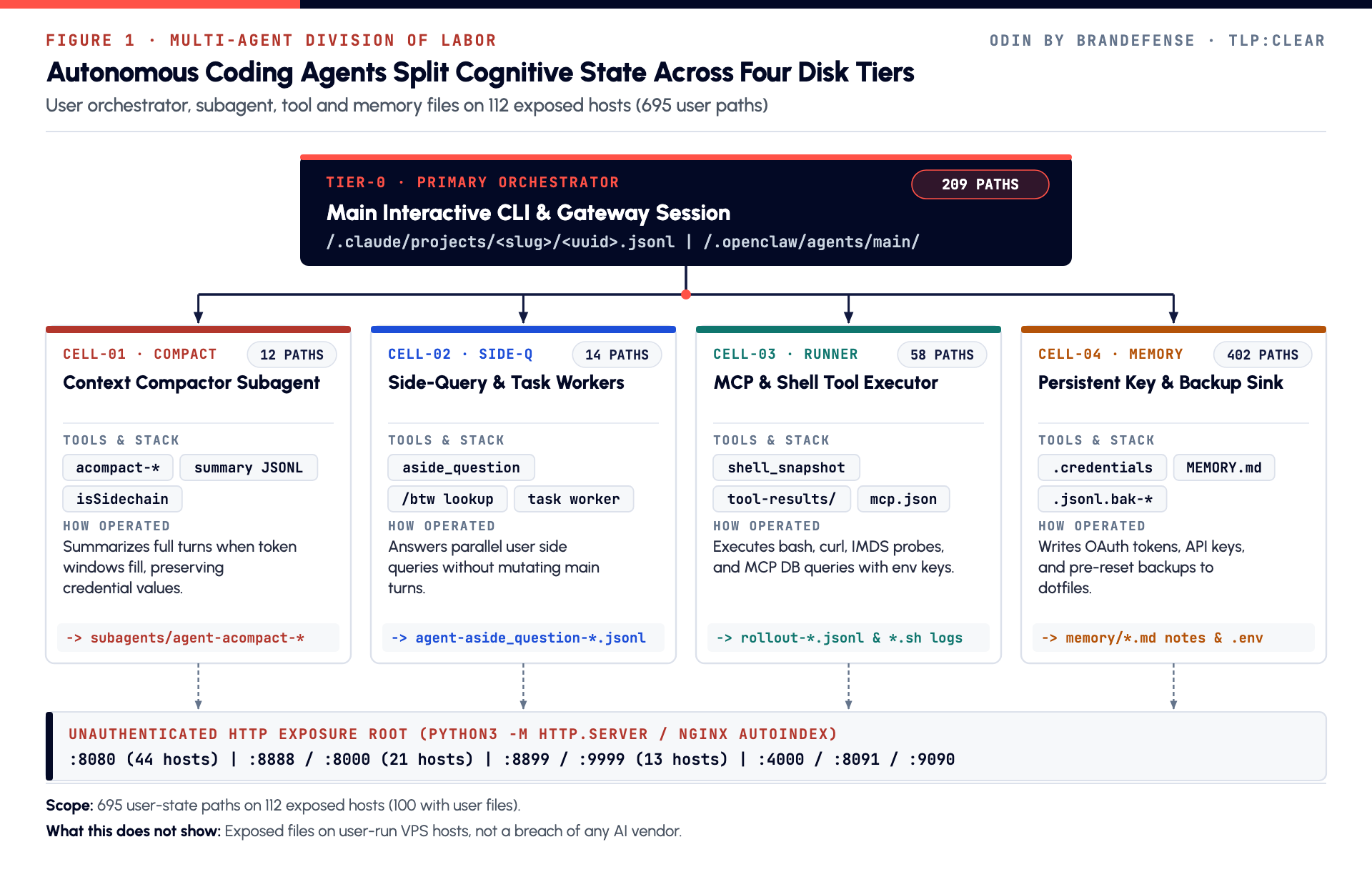
The first layer is the main session log, which records every prompt and tool output. The second is a set of helper "subagents". When a conversation gets too long, Claude Code writes a summary of it to a new file, and the keys carry over into that summary. The third layer captures shell commands and their output. The fourth holds credential files, memory notes and backups.
Across the 100 servers with user files, there are 695 such user file paths. The largest group, 402 paths, is credential stores and backups.
One case shows why this matters. Two European servers expose the same Claude Code workspace, copied from one machine to the other. A single block of cloud and bot credentials appears in a memory note, the main sessions, six summary files, two side-question logs and two file-history versions. Deleting the note would leave every other copy in place.
OpenClaw servers show the same pattern with resets. Resetting a session leaves .bak and .reset copies behind, and one of them still held a Google API key.
What kinds of secrets leak?
Excluding bundled examples, the servers held 3,145 secret and session matches. AI model keys lead with 919 matches, mostly DeepSeek, Stability AI, Anthropic, OpenRouter and OpenAI. URLs that look like command-and-control or callback endpoints come next at 553. Many of these are webhooks or test endpoints, not proof of attacker infrastructure.
The most damaging finds are the keys that let someone go further. These include up to 68 private keys, 111 GitHub tokens, 67 Google Cloud OAuth secrets, 48 DigitalOcean tokens, 48 Tailscale mesh keys and 327 Telegram or Discord bot tokens. Whether the credentials still worked was not tested.
Why do some servers run several agents?
Of the 112 servers, 26 (23.2%) run two or three agents in the same account. A common pattern is a developer using Claude Code or Codex to build and manage a background OpenClaw or Hermes bot.
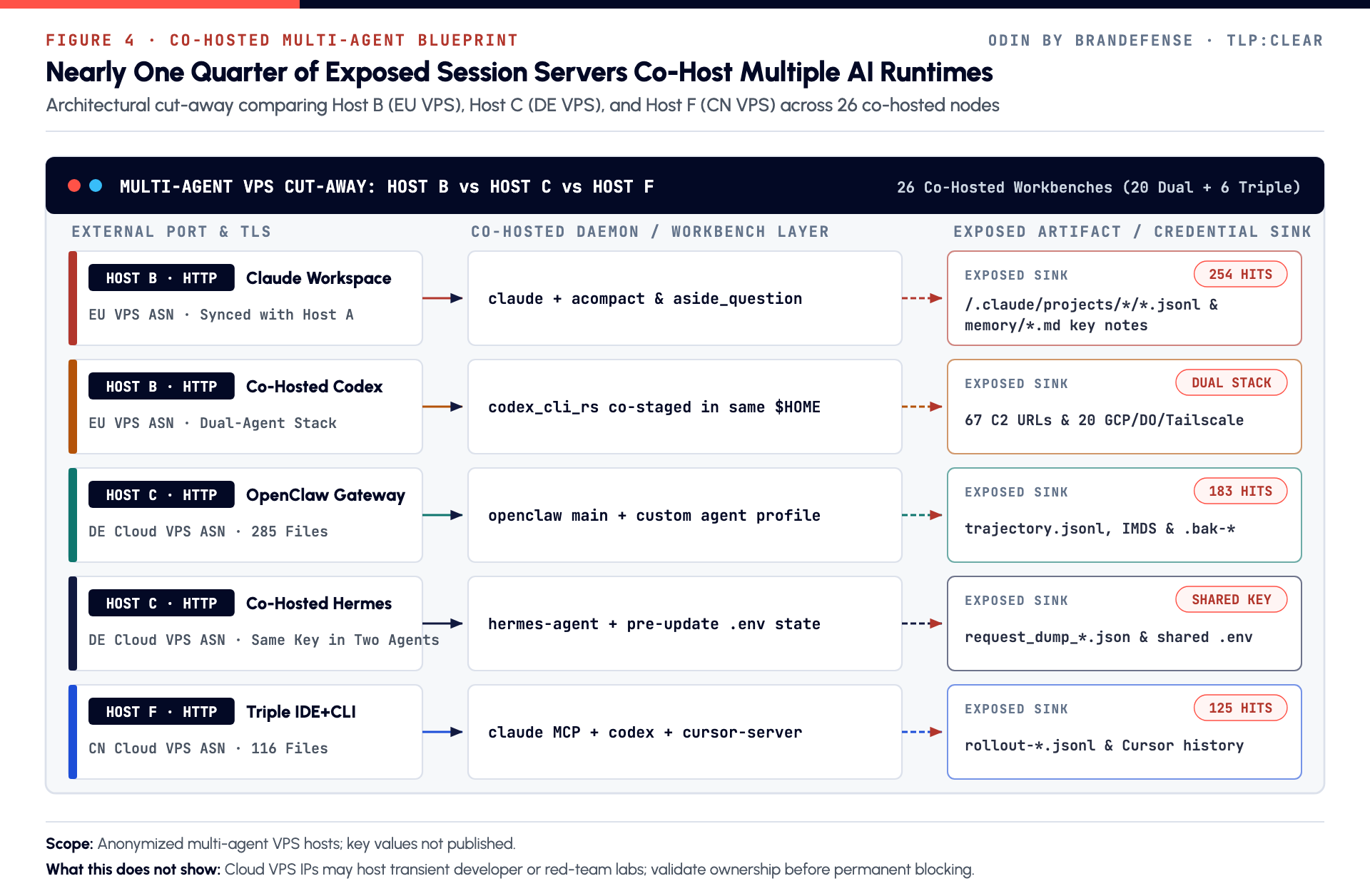
On these servers, keys are often copied from one agent to the next. On one German server, the same Anthropic key sits in both an OpenClaw profile file and a Hermes backup. On an Asia-Pacific server, the same DeepSeek key appears in a Codex log and an OpenClaw script. If you rotate a key in one agent's config, the old copy in the other agent stays exposed.
Are these servers run by attackers?
Mostly not. Our analysis weighed three explanations, as a working model. Of the 112, 83 servers (74.1%) look like developer machines exposed by mistake. Another 21 (18.8%) look like multi-agent build or red-team labs. Eight (7.1%) hold session logs with dense callback URLs, cloud metadata queries or a reverse shell string.
Even for those eight, the logs show what an agent discussed or ran on its own server. They do not show a breach of anyone else. We treat all 112 owners as users who exposed their own data.
Scan counts can also mislead. Open-source skill packs ship example keys and local URLs, above all in Hermes folders. Scanning without excluding them sends analysts chasing fake leaks.
What about indicators?
This report publishes no indicators. Every server is an exposed developer or operator machine, and publishing addresses, file names or key hashes would help others harvest the same secrets. Hunt with the folder paths and the detection rules instead.
What to do now
- Ban open file servers in home folders. Require
--bind 127.0.0.1forpython3 -m http.serverand similar tools, and block public access to development ports such as 8080, 8888, 8000 and 9999. - Deny dotfile paths at every proxy. Requests for
/.claude/,/.codex/,/.cursor/,/.openclaw/and/.hermes/should return 403 or 404. - Wipe agent folders when you rotate keys. Delete summary files, file history,
.bakand.resetcopies and shell snapshots, and check every agent on the host for the same key. - Lock down cloud metadata. Enforce IMDSv2 on AWS and the equivalent controls on other clouds, so an agent cannot read instance credentials.
- Deploy the rules. The full report's Detection rules tab has Suricata, Sentinel KQL, Sigma and YARA rules for agent dotfile access and home-folder file servers.
The full report covers the file layouts, secret categories, co-hosting patterns and rule logic in detail.
What is…?
Short explanations of the tools and families named in this study.
What is OpenClaw?
OpenClaw is an open-source autonomous agent gateway that keeps trajectories, auth profiles and session logs on disk.
More about OpenClawAI agentWhat is Claude Code?
Claude Code is Anthropic's command-line coding agent. It stores project sessions and settings in a .claude folder.
More about Claude CodeAI agentWhat is Hermes Agent?
Hermes Agent is an open-source autonomous AI agent from Nous Research. It keeps sessions, profiles, skills and scheduled jobs in a .hermes folder.
More about Hermes AgentFrequently asked questions
How does a private agent session become public?
Developers increasingly run AI coding agents on rented Linux servers instead of laptops. They paste keys and database URLs into the conversation so the agent can work. The agent saves everything to hidden folders such as ~/.claude/ or ~/.codex/.
Why doesn't deleting the key fix it?
Agents do not keep secrets in one place. They spread them across four layers on disk. The first layer is the main session log, which records every prompt and tool output. The second is a set of helper "subagents". When a conversation gets too long, Claude Code writes a summary of it to a new file, and the keys carry over into that summary. The third layer captures shell commands and their output.
What kinds of secrets leak?
Excluding bundled examples, the servers held 3,145 secret and session matches. AI model keys lead with 919 matches, mostly DeepSeek, Stability AI, Anthropic, OpenRouter and OpenAI. URLs that look like command-and-control or callback endpoints come next at 553. Many of these are webhooks or test endpoints, not proof of attacker infrastructure.
Why do some servers run several agents?
Of the 112 servers, 26 (23.2%) run two or three agents in the same account. A common pattern is a developer using Claude Code or Codex to build and manage a background OpenClaw or Hermes bot.
Are these servers run by attackers?
Mostly not. Our analysis weighed three explanations, as a working model. Of the 112, 83 servers (74.1%) look like developer machines exposed by mistake. Another 21 (18.8%) look like multi-agent build or red-team labs. Eight (7.1%) hold session logs with dense callback URLs, cloud metadata queries or a reverse shell string.
What about indicators?
This report publishes no indicators. Every server is an exposed developer or operator machine, and publishing addresses, file names or key hashes would help others harvest the same secrets. Hunt with the folder paths and the detection rules instead.