


Key takeaways
- Odin mapped 2,674 ARTEX and DarkSword endpoints on 2,468 hosts; 526 are confirmed C2.
- Two providers host 82.7% of confirmed ARTEX controllers, each behind one shared certificate.
- Over half of DarkSword's 362 endpoints sit on one provider, CNServer LLC.
- Only two unconfirmed hosts carry both families, so they are not one proven group.
- Block confirmed endpoints, watch the rest, and hunt traffic to ports 8787, 8790, 8888 and 2000.
In a two-week observation window ending 18 November 2026, Odin by Brandefense mapped 2,674 internet-facing endpoints on 2,468 hosts that carry the ARTEX or DarkSword family labels. Of these, 526 endpoints on 516 hosts are confirmed command-and-control (C2) servers. Most of the fleet sits on cheap virtual private servers leased in bulk from a handful of regional resellers. For defenders, that means a small set of providers, certificates and ports explains most of what they will see.
What are ARTEX and DarkSword?
ARTEX is the family label for ARTEX, an autonomous red-team console that Odin covered in Monographs 04 and 11. Its default console port is 8787. In this study it makes up 2,312 endpoints on 2,157 hosts. Of these, 498 are confirmed controllers, mostly on ports 443 and 80.
"DarkSword" is a label that comes from an upstream threat feed. We did not tie it to any published vendor report, so it is not attribution. It covers 362 endpoints on 313 hosts, and 28 of them are confirmed.
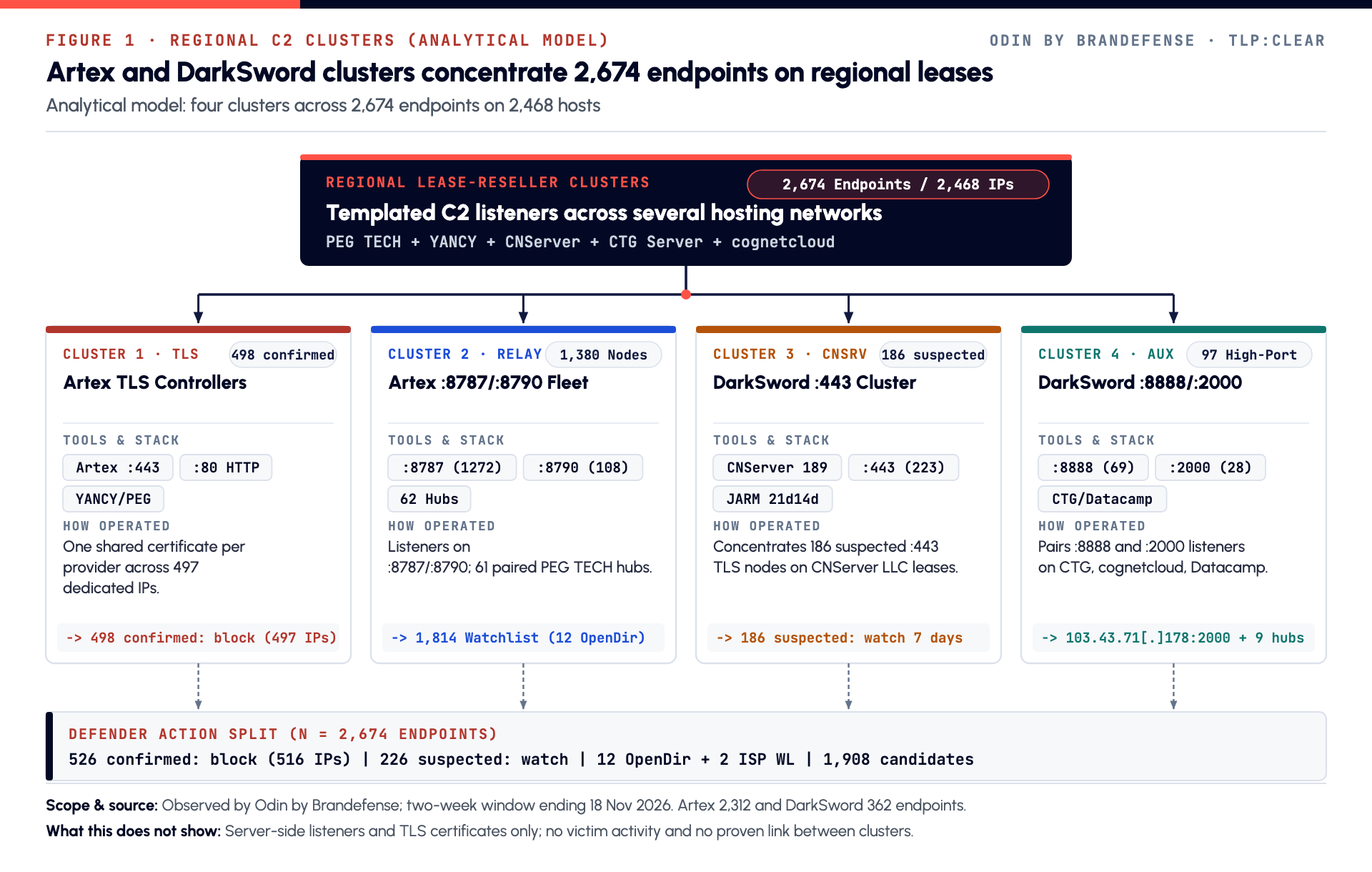
We group the endpoints into four clusters by family, port and provider. The clusters are an analytical model. Inside a cluster, hosts share a certificate or a TLS fingerprint. Between clusters, the only shared element is the hosting provider. Just two hosts carry both families, and both are unconfirmed. Nothing in the data shows that one group runs both.
How do the operators scale?
They rent many servers from the same provider and stamp them from one template. YANCY LIMITED hosts 237 confirmed ARTEX controllers, and PEG TECH INC hosts 175. Together that is 82.7% of all confirmed ARTEX controllers.
Every controller on YANCY presents the same TLS certificate. Every controller on PEG TECH presents a different, but equally shared, certificate. The JARM value, a fingerprint of how a server answers a TLS handshake, repeats almost as often.
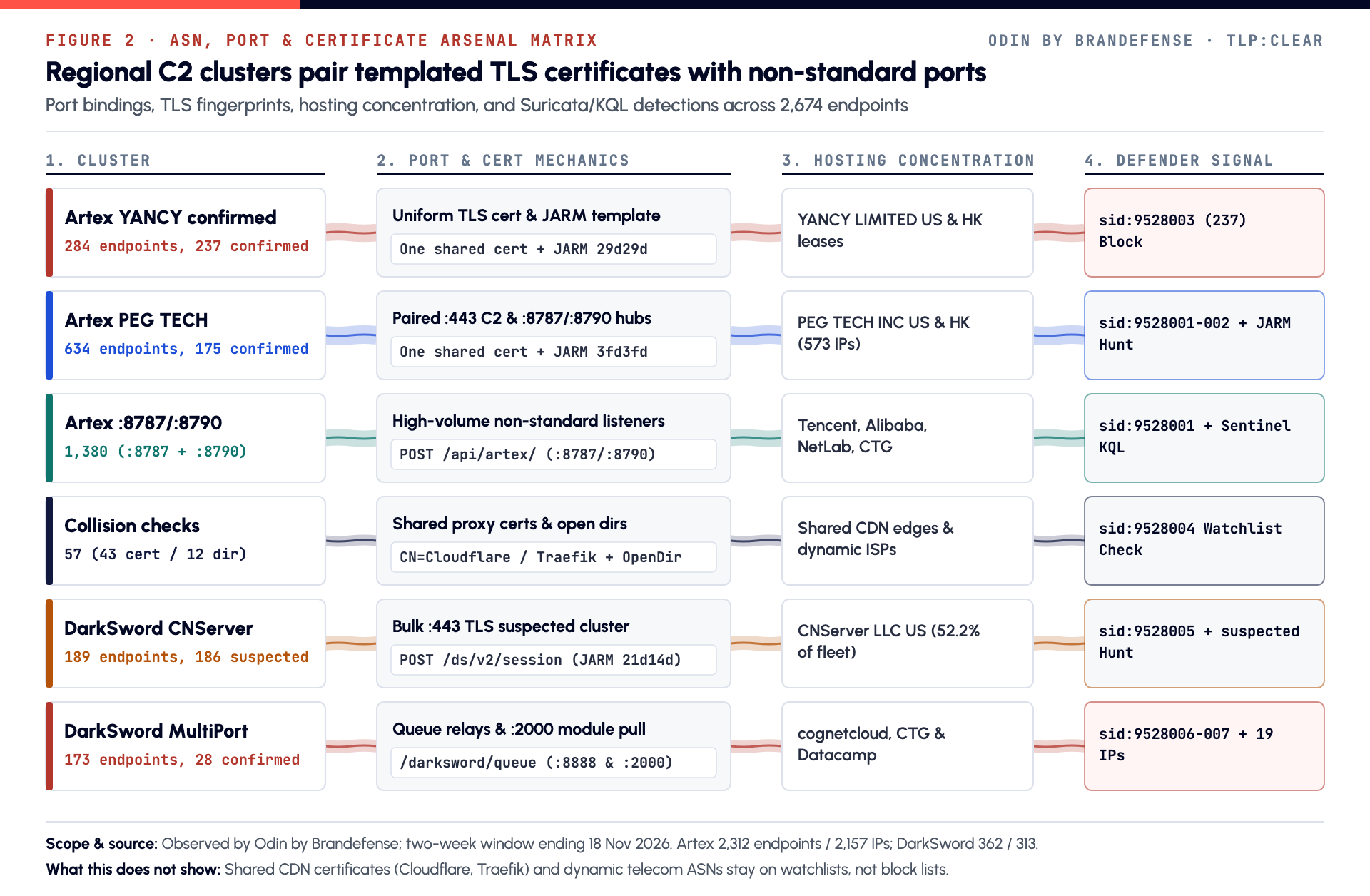
The same certificates also appear on many unconfirmed listeners. On PEG TECH, 167 listeners on port 8787 carry the PEG TECH certificate. That ties them to the confirmed controllers next door, even though each one alone shows only an open port.
DarkSword follows a similar pattern on a different provider. CNServer LLC hosts 189 of its 362 endpoints (52.2%). Of these, 186 are suspected listeners on port 443, and 174 share one JARM value. The 28 confirmed DarkSword endpoints sit elsewhere and often pair ports 80, 443, 8443, 8888 and 2000 on one host.
Why not block all 2,674?
Because most of them are not proven, and some are shared. Only 526 endpoints (19.7%) are confirmed. The other 2,148 include several kinds of address that a blunt block would get wrong.
| Group | Endpoints | Why it needs care |
|---|---|---|
| Shared CDN or ingress certificates | 43 | Cloudflare, Traefik and Kubernetes edges serve many unrelated sites |
| Open directories | 12 | Leads for hunting, not confirmed C2 |
| Dynamic telecom addresses | 2 | Subscriber addresses pass between customers |
| Suspected listeners | 226 | Strong match, but no full confirmation |
| Uncorroborated candidates | 1,908 | Mostly listeners on 8787, 8790, 8888 or 2000 |
Ports add to the risk. RStudio Server uses 8787 by default, Jupyter often uses 8888, and MikroTik routers answer on 2000. A port match alone cannot tell these apart from a C2 listener.
The practical answer is two lists. Block confirmed controllers on dedicated hosting and review the block every 30 days, since leased addresses change hands. Keep everything else on watchlists that expire in 24 hours to 7 days, unless a second signal appears.
What can defenders hunt for?
The templates that make these fleets cheap also make them visible.
- Certificates and JARM values. Three JARM values cover 850 endpoints (31.8%). The full report lists them, along with the providers where they cluster.
- Port pairs. Sixty-two hosts bind 8787 and 8790 together, 61 of them on PEG TECH INC. Nine candidate hosts pair 8888 and 2000.
- Non-browser egress. A script or service on a workstation that talks to 8787, 8790, 8888 or 2000 on these providers deserves a look.
The full report's Detection rules tab holds Suricata signatures, a Microsoft Sentinel query, three Sigma rules and four YARA rules. Every rule file loads without errors in its engine (Suricata 7.0.12, YARA-X, pySigma, Kusto.Language); the rules were not replayed against live traffic. The full report's Indicators tab holds 20 confirmed endpoints; the 2 JARM values for hunting are in the full report.
What to do now
- Block the 20 confirmed endpoints in the full report's Indicators tab, plus the six confirmed DarkSword hubs listed in the full report, with a 30-day review.
- Keep shared and dynamic addresses off automated block lists. Route shared CDN certificates, mail ports and telecom subscriber ranges to short watchlists.
- Restrict egress to ports 8787, 8790, 8888 and 2000 outside documented development subnets, and allowlist sanctioned RStudio or Jupyter servers by exact host.
- Hunt the shared JARM values across proxy and network logs on PEG TECH, YANCY and CNServer ranges.
- Ask for a second signal, such as a URI, certificate or process match, before blocking any suspected or candidate address.
The full report covers the clusters, port pairs, TLS fingerprints, indicators and rule logic in detail.
What is…?
Short explanations of the tools and families named in this study.
What is ARTEX?
ARTEX is an autonomous red-team console that chains AI agents and security tools. Operators fork and rebrand it; its default listener port is 8787.
More about ARTEXFeed labelWhat is DarkSword?
DarkSword is a family label from an upstream threat feed for multi-port TLS and HTTP C2 servers. It names a fingerprint group, not an actor.
More about DarkSwordTechniqueWhat is JARM?
JARM is an open TLS server fingerprinting method from Salesforce. It hashes how a server answers a set of crafted TLS handshakes.
More about JARMFrequently asked questions
What are ARTEX and DarkSword?
ARTEX is the family label for ARTEX, an autonomous red-team console that Odin covered in Monographs 04 and 11. Its default console port is 8787. In this study it makes up 2,312 endpoints on 2,157 hosts. Of these, 498 are confirmed controllers, mostly on ports 443 and 80.
How do the operators scale?
They rent many servers from the same provider and stamp them from one template. YANCY LIMITED hosts 237 confirmed ARTEX controllers, and PEG TECH INC hosts 175. Together that is 82.7% of all confirmed ARTEX controllers.
Why not block all 2,674?
Because most of them are not proven, and some are shared. Only 526 endpoints (19.7%) are confirmed. The other 2,148 include several kinds of address that a blunt block would get wrong.
What can defenders hunt for?
The templates that make these fleets cheap also make them visible. The Detection rules tab holds Suricata signatures, a Microsoft Sentinel query, three Sigma rules and four YARA rules. Every rule file loads without errors in its engine (Suricata 7.0.12, YARA-X, pySigma, Kusto.Language); the rules were not replayed against live traffic. The Indicators tab holds 20 confirmed endpoints; the 2 JARM values for hunting are in the full report.