
Key takeaways
- An open Apache directory on a Japan-routed server (Workbench A) recorded on 26 November 2026 staged 144 sized files totaling 827,500,373 bytes (827.50 MB) across 21 directories.
- Sixty-three PowerMTA v5 entries (414.33 MB) pair PowerMTA5.0.rpm (56.45 MB) with patched pmtad (34.67 MB) and pmtahttpd (41.20 MB) binaries.
- Fifty-one entries (234.50 MB) include MailWizz and Interspire panel archives plus four installer scripts; three measured installers span 3,869–3,959 lines.
- Five dumps in /Install/dbs/ total 213.30 MB (213,299,034 B), led by mw_email_blacklist.sql (112.81 MB) and email_banned_emails.sql (60.80 MB).
- Hold newly registered domains even when SPF, DKIM, and DMARC pass, enforce DMARC p=reject and MTA-STS, and block cloud port-25 egress.
An open Apache HTTP directory on TCP 80 of a Japan-routed server (Workbench A) staged 144 bulk-mail kit files totaling 827,500,373 bytes (827.50 MB). Odin by Brandefense recorded the complete 21-directory tree and 38 endpoint and secret findings on 26 November 2026, alongside initial batch files dated 4-9 August 2026.
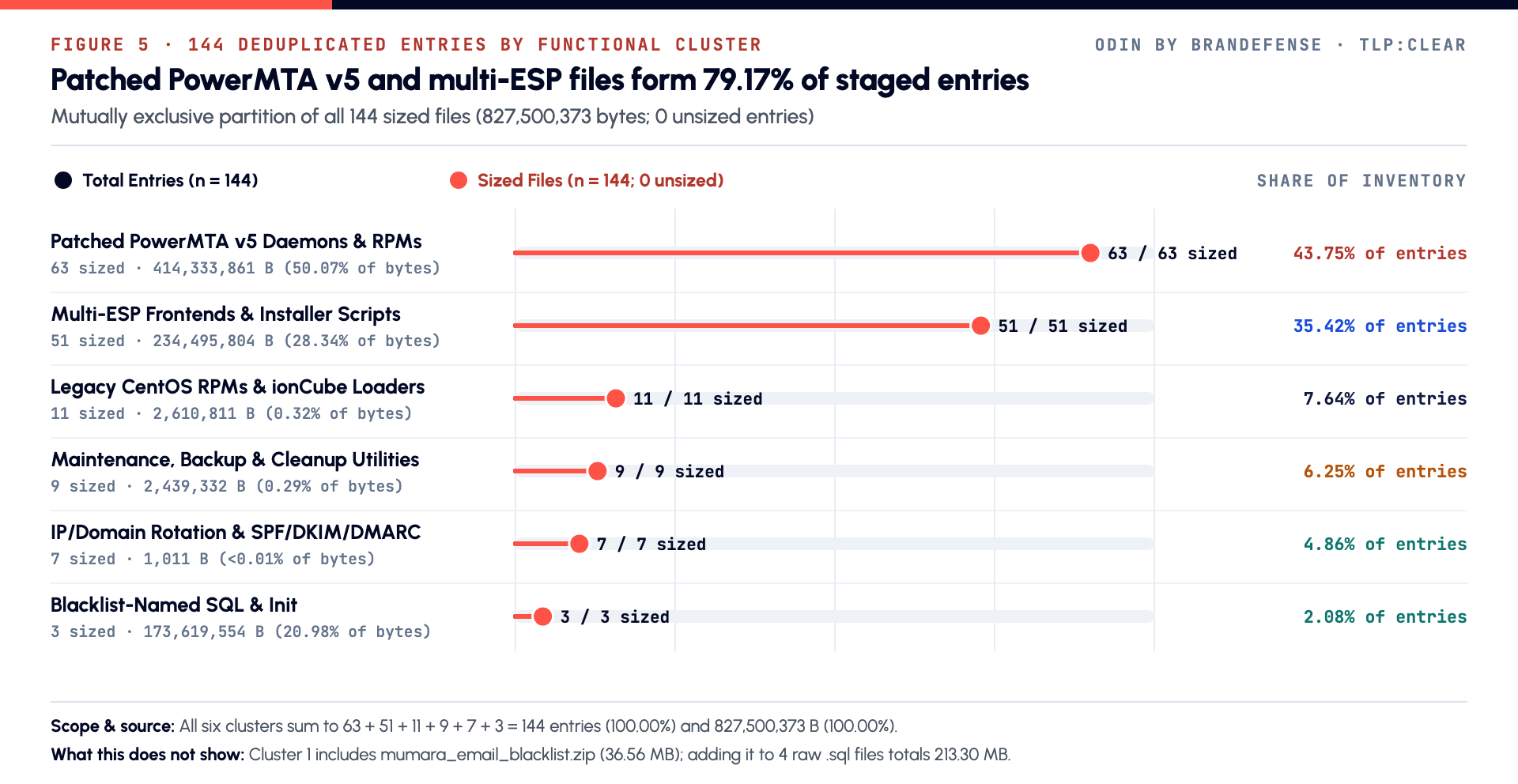
Patched PowerMTA v5 relay files (63 entries) and multi-ESP archives and installers (51 entries) form 79.17% of all staged files (78.41% of bytes).
All 144 deduplicated entries carry exact byte sizes with 0 unsized entries. Workbench A is assessed consistently as an adversary bulk-mail staging workbench (T1583.003, T1608.002). Its IPv4 address, file SHA-256 digests, 4 script password records, and kit vendor domains are withheld.
What was staged across the 21 open Apache directories?
Bulk phishing and spam operators rarely build mail relays from scratch. Instead, they stage ready-to-run kits on rented cloud servers so fresh virtual machines can pull cracked relays, web panels, and bounce lists over HTTP. Security teams can use external attack surface management to uncover open Apache staging directories across cloud networks. Pairing that visibility with cyber threat intelligence turns staged kit paths into network and host rules.
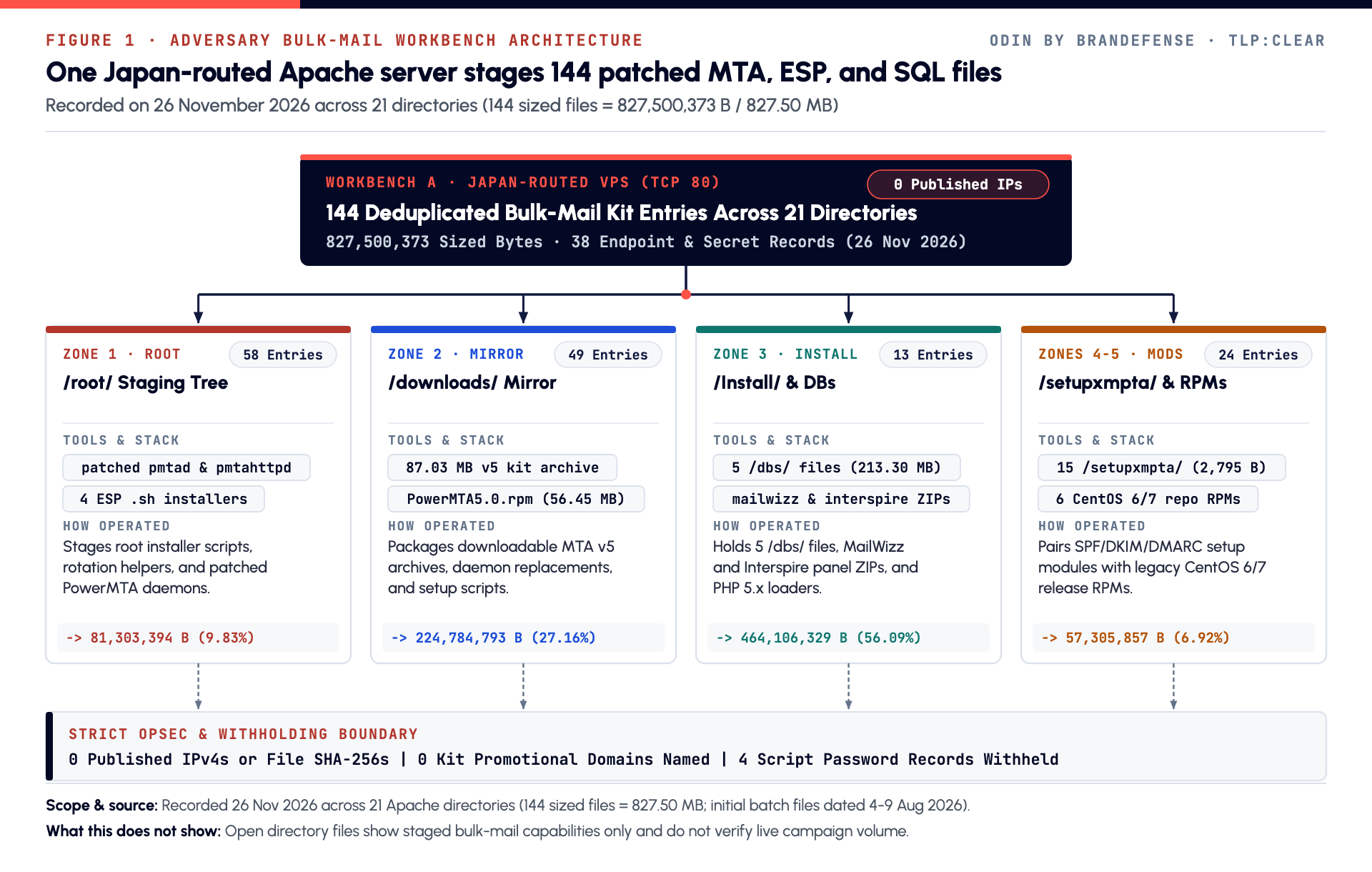
Across Workbench A, /root/ (58 entries, 81.30 MB) and /downloads/ (49 entries, 224.78 MB) mirror the core patch and installer scripts (74.31% of files). Meanwhile, /Install/ (13 entries, 464,106,329 bytes) holds 56.09% of byte volume across five database dumps, five ZIPs, PowerMTA5.0.rpm, and two ionCube modules. Fifteen /setupxmpta/ files (2,795 B) and nine /osupdatex/, /images/, and root RPM files (57.30 MB) complete all 144 entries.
Functional cluster on Workbench A | Entries | Share (%) | Sized bytes | Core staged files |
|---|---|---|---|---|
| Patched PowerMTA v5 Daemons & RPMs | 63 | 43.75% | 414,333,861 | PowerMTA5.0.rpm (56.45 MB x 3), 87.03 MB v5 archive, patched pmtad & pmtahttpd. |
| Multi-ESP Frontends & Installers | 51 | 35.42% | 234,495,804 | mailwizz.zip, interspire-2015.zip, mumara_email_blacklist.zip, 4 .sh installers. |
| Legacy CentOS RPMs & ionCube Loaders | 11 | 7.64% | 2,610,811 | ioncube_loader_lin_5.6.so & 5.3.so, 6 CentOS 6/7 repo RPMs. |
| Maintenance, Backup & Cleanup Utilities | 9 | 6.25% | 2,439,332 | index.zip (1.67 MB), 2 /images/*.jpg files, clean.sh + .1-.3 backups. |
| IP/Domain Rotation & SPF/DKIM/DMARC | 7 | 4.86% | 1,011 | Seven /setupxmpta/ DNS, IP, MTA, proxy, DMARC, DKIM, and SPF scripts (141-149 B). |
| Blacklist-Named SQL & DB Init | 3 | 2.08% | 173,619,554 | mw_email_blacklist.sql (112.81 MB), email_banned_emails.sql (60.80 MB), 4dbintil.sh. |
Total (Workbench A) | 144 | 100.00% | 827,500,373 | All 144 sized files (827.50 MB; 0 unsized) across 21 directories. |
How do patched PowerMTA binaries pair with four ESP installer scripts?
Commercial SMTP relays enforce license keys and volume controls. To bypass those checks, Workbench A stages PowerMTA5.0.rpm (56,454,004 bytes in three paths) beside two /patch/usr/sbin/ directories in /root/ and /downloads/. Those patch folders carry replacement ELF binaries for pmtad (34,673,216 bytes) and pmtahttpd (41,204,416 bytes). Copying them over /usr/sbin/ after RPM setup is built to skip license checks while keeping virtual-MTA (vmta) IP rotation.
On top of pmtad, four monolithic shell scripts are staged to set up web campaign panels:
- MailWizz and Interspire bundles. Script
mailwizzinstaller7.sh(155,121 B; 3,869 lines) deploysmailwizz.zip(105.91 MB) andmailwizz.sql(540.98 KB). Scriptinterspireinstaller6.sh(159,236 B; 3,959 lines) deploysinterspire-2015.zip(41.15 MB),addons.zip(33.49 MB), andinterspire-2015.sql(2.57 MB). - Mumara, SparkMail, and legacy PHP 5.x modules. Scripts
mumarainstaller6.sh(153,415 B, line count unrecorded) andsparkmail.sh(158,681 B; 3,947 lines) complete the four installer scripts without staged Mumara or SparkMail panel archives. Older PHP add-ons requireioncube_loader_lin_5.6.so(1.48 MB),ioncube_loader_lin_5.3.so(1.04 MB),phpMyAdmin-4.2.1.zip(9.62 MB), and CentOS 6/7 RPMs. Running end-of-life OS and PHP packages widens the operator's own attack surface on public cloud hosts.
Why does the kit include 213.30 MB of suppression and schema files?
Early hard bounces and spam-trap hits burn a fresh VPS IP before lures reach real inboxes. Inside /Install/dbs/, five database files total 213,299,034 bytes (213.30 MB), combining four raw .sql dumps (176,734,207 B) with mumara_email_blacklist.zip (36,564,827 B). Three of those files (210.18 MB) carry blacklist file names: mw_email_blacklist.sql (112,814,881 B), email_banned_emails.sql (60,804,540 B), and mumara_email_blacklist.zip. The file names suggest data intended to limit bounces; no email rows, imports, or sending outcomes were verified.
When a domain or IP hits blocklists, four rotation scripts rewrite panel domains and vmta IPs. Those four scripts are trocadominio-2015.sh (8,051 B), mwchangedomain.sh (7,998 B), iemchangedomain.sh (7,965 B), and changeip.sh (4,465 B).
Alongside them, /setupxmpta/ (15 files, 2,795 B) stages 12 numbered setup modules and 3 helpers. Key modules cover 12spfupdate.sh, 11dkimpuyr.sh, 10dmarcsys.sh, 2dnsupdate.sh, 6ipconfig.sh, 8mtamaster.sh, and 9proxysetup.sh. Under RFC 7208, RFC 6376, and RFC 7489, passing SPF, DKIM, and DMARC on a look-alike domain confirms domain control, not sender safety.
What should email, cloud, and SOC teams do first?
Static directory files on Workbench A show staged tooling rather than verified live SMTP waves, and zero recipient rows or passwords were tested. Defenders can harden email gateways and cloud networks in three practical steps:
- Gate newly registered domains even when
SPF,DKIM, andDMARCpass. Apply < 30-day domain-age holds and URL sandboxing on inbound mail. Enforcev=DMARC1; p=reject;,-allSPF, andMTA-STS(RFC 8461) across owned domains. - Block direct cloud
TCP 25relay and unapproved SMTP submission. Deny outboundTCP 25, 465, 587, and 2525 from non-relay cloud subnets, and restrict any configured PowerMTA web monitor with inbound access controls. - Hunt kit downloads, daemon overwrites, and blacklist SQL imports. Deploy Suricata
sid:9571001-9571007 behind HTTP proxies, and run Sentinel KQL and Sigma Rules 1-3 for/patch/usr/sbin/pmta*and ESP installers. Scan staging hosts with bounded YARA Rules 1-4.
The full report's Detection rules tab ships Suricata (sid:9571001-9571007), Sentinel KQL, Sigma, and YARA rules, while the full report's Indicators tab holds 0 IPs and 0 hashes. The full report details all five zones, six clusters, and rule checks.
Frequently asked questions
What was staged across the 21 open Apache directories?
Bulk phishing and spam operators rarely build mail relays from scratch. Instead, they stage ready-to-run kits on rented cloud servers so fresh virtual machines can pull cracked relays, web panels, and bounce lists over HTTP. Security teams can use external attack surface management to uncover open Apache staging directories across cloud networks. Pairing that visibility with cyber threat intelligence turns staged kit paths into network and host rules.
How do patched PowerMTA binaries pair with four ESP installer scripts?
Commercial SMTP relays enforce license keys and volume controls. To bypass those checks, Workbench A stages PowerMTA5.0.rpm (56,454,004 bytes in three paths) beside two /patch/usr/sbin/ directories in /root/ and /downloads/. Those patch folders carry replacement ELF binaries for pmtad (34,673,216 bytes) and pmtahttpd (41,204,416 bytes). Copying them over /usr/sbin/ after RPM setup is built to skip license checks while keeping virtual-MTA (vmta) IP rotation.
Why does the kit include 213.30 MB of suppression and schema files?
Early hard bounces and spam-trap hits burn a fresh VPS IP before lures reach real inboxes. Inside /Install/dbs/, five database files total 213,299,034 bytes (213.30 MB), combining four raw .sql dumps (176,734,207 B) with mumara_email_blacklist.zip (36,564,827 B). Three of those files (210.18 MB) carry blacklist file names: mw_email_blacklist.sql (112,814,881 B), email_banned_emails.sql (60,804,540 B), and mumara_email_blacklist.zip. The file names suggest data intended to limit bounces; no email rows, imports, or sending outcomes were verified.
What should email, cloud, and SOC teams do first?
Static directory files on Workbench A show staged tooling rather than verified live SMTP waves, and zero recipient rows or passwords were tested. Defenders can harden email gateways and cloud networks in three practical steps: