
Key takeaways
- One open US web server exposes 3,508 reported files across 21 directory listings, including four custom Python tool suites.
- Three Windows browser report bundles on the server pair renamed Microsoft Edge login and cookie SQLite databases with DPAPI Local State JSON files.
- Co-located C2 and modular Python folders add Windows service droppers, PowerShell beacons, web IDOR/SQLi testing scripts and Layer-2 ARP spoofers.
- All 2,695 endpoints examined across eight commodity stealer families remain unconfirmed, including three AuroraStealer-labelled hosts observed on 13 November 2026.
- Keep unconfirmed stealer feed addresses off automatic block lists, hunt the six TLS JARM fingerprints, and harden Microsoft Edge credential stores.
One US server exposed four custom Python tool suites, while all 2,695 commodity stealer feed endpoints remained unconfirmed for automatic blocking. Odin by Brandefense examined these separate datasets in a two-week observation window ending 20 November 2026. The exposed server and the stealer feed hosts were not linked.
The two datasets call for different defensive responses. On one US server with an open web directory, 21 directory listings reported 3,508 files across four custom Python tool suites. Separately, we examined 2,695 endpoints across eight commodity infostealer families (from 2,770 feed records). None carried the independent adversary signal needed for a firewall block list.
This short read explains how the custom Python suites work, why the commodity stealer feed entries stayed off our block list, and what defenders should do first. The full report carries the complete technical tables, indicators and detection rules for defenders using cyber threat intelligence.
What was sitting on the open Python server?
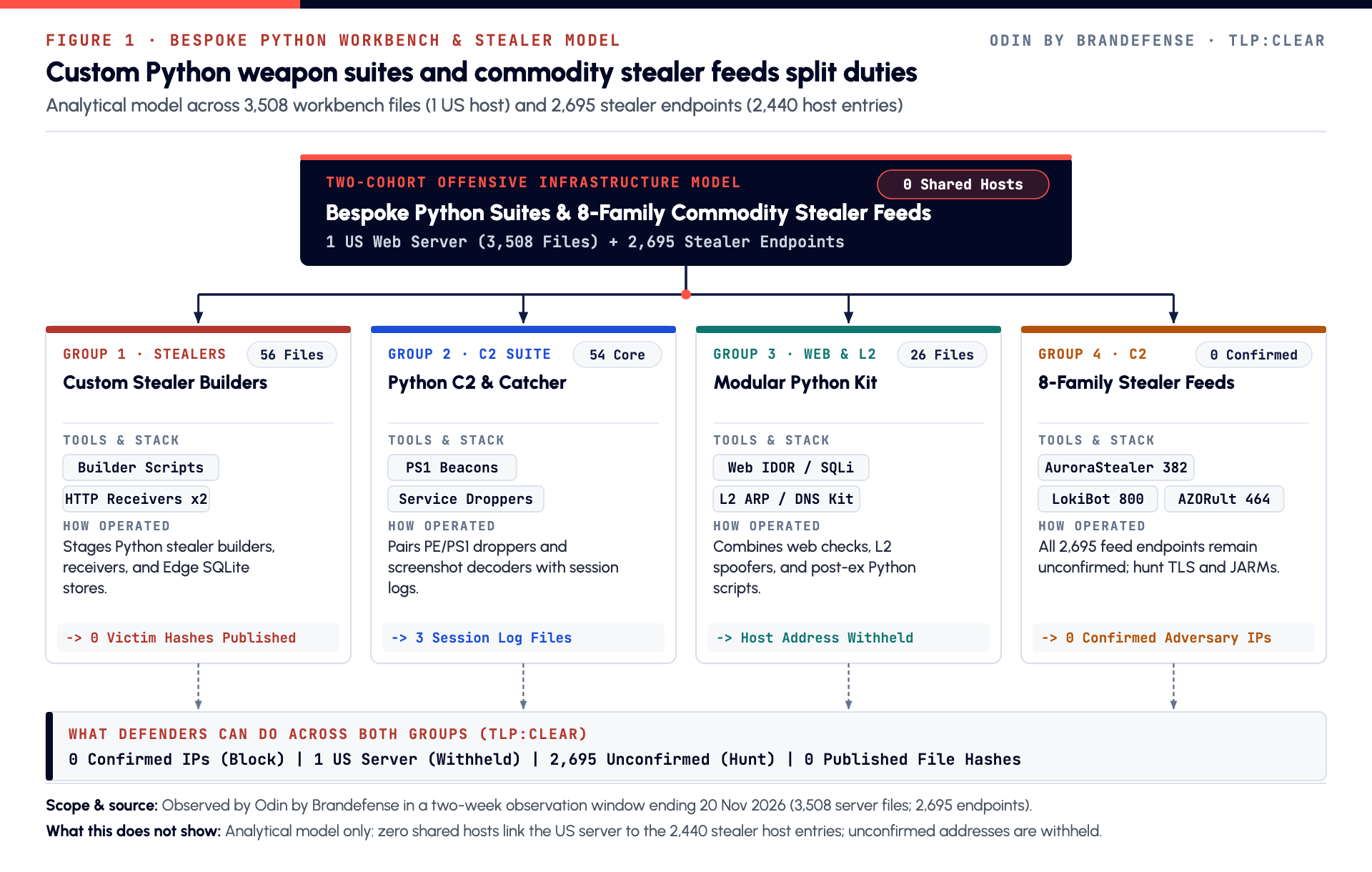
Across 21 directory listings (with 981 unique file entries examined across 18 directory slices), files on the US server carried timestamps from 8 to 14 August 2026. Those August dates are the server's own file timestamps rather than our observation period. Defenders can use external attack surface management to find similar exposed directories. Alongside 889 co-hosted web-application and cloud maintenance files and 306 root files, the directory tree exposed four custom Python tool suites:
- Two custom Python stealer builder and collector suites (41 files across three folders; paths withheld). A 37-file Git repository holds a Python stealer payload generator script and a payload binder script. A three-file primary collector folder holds an 8,174-byte HTTP upload receiver script, a 1,435-byte report viewer script and a 213-byte listener monitor script. A third folder holds an expanded 11,049-byte HTTP receiver script.
- Three Windows browser report bundles (15 files; paths withheld). Dated 8 August 2026 in their folder timestamps, each bundle pairs a compressed upload archive (10,988 bytes in the first bundle), a 511-byte JSON metadata file and a 3,403-byte HTML summary report. Each bundle also holds renamed Microsoft Edge login and cookie SQLite databases and a DPAPI state JSON file. Microsoft Edge encrypts saved logins in
Login Dataand cookies inCookieswith an AES-256-GCM key stored inLocal Stateunder Windows DPAPI. Stealers must grab all three files together. - Custom Python C2 and reverse-shell workspace (50 core files, 4 log files and 2,177 Python 3.12 library files; paths withheld). This folder pairs an operator authentication file (411 bytes; path withheld) and a desktop screenshot decoder script with a Flask and Socket.IO backend. It also holds a dropper builder script, two compiled Windows PE droppers (including a Windows service installer) and two PowerShell stagers (a persistent beacon and a privilege-escalation script). The root directory adds a 1,346-byte PowerShell beacon, a 235-byte HTML Application launcher for
mshta.exeand four reverse-shell logs. - Modular Python web, network and post-exploitation kit (26 files across three folders; paths withheld). This kit groups six web testing scripts covering insecure direct object reference checks, SQL injection, cross-site scripting, session cookie analysis, directory enumeration and site mapping. It also holds five Layer-2 and Layer-4 network scripts (ARP cache poisoning, DNS spoofing, packet capture, brute-forcing and SYN floods), a Python keylogger script and a reverse-shell generator script.
We withhold the server's IPv4 address and port, its directory paths and filenames, all file hashes and all credential contents. One suite uses a vocational-education acronym common in Australia and Commonwealth countries. Publishing the host address or paths would also expose downloadable browser SQLite files. Zero runnable offensive code appears in our reports.
Why did none of the 2,695 stealer feed endpoints make the block list?
Commercial infostealers steal the same browser SQLite and DPAPI files at industrial scale, and the logs they produce are what dark web monitoring tracks once they are sold. Blocking every IP in a stealer feed therefore sounds tempting. Our data shows why that breaks production networks.
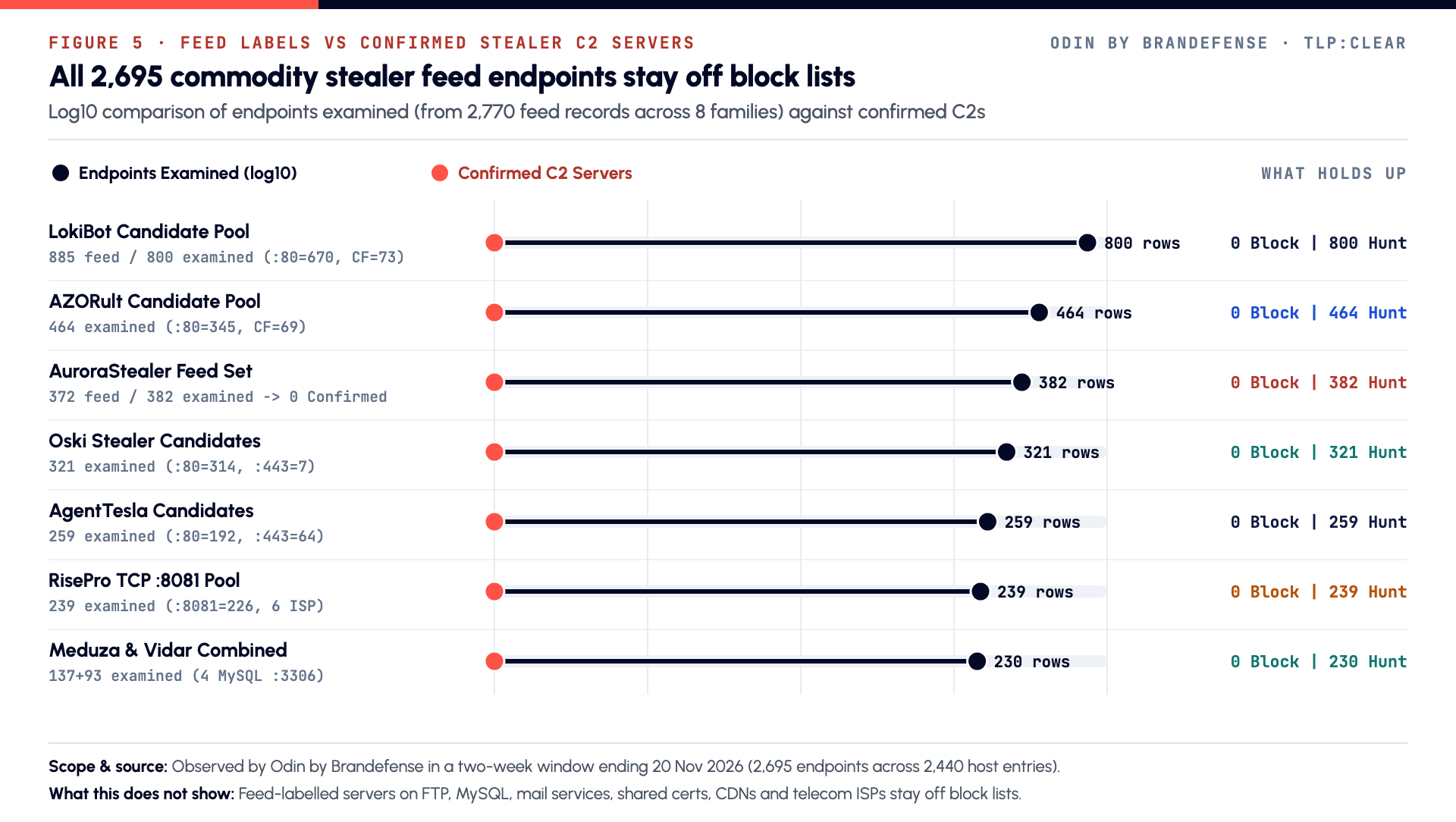
Across eight families (LokiBot, AZORult, AuroraStealer, Oski, AgentTesla, RisePro, Meduza and Vidar), upstream feeds listed 2,770 records, giving 2,695 unique endpoints on 2,440 host entries. Three AuroraStealer-labelled endpoints observed on 13 November 2026 remain unconfirmed pending an independent adversary signal.
| Family | Address and primary port | Country and hosting provider | Machine certificate CN |
|---|---|---|---|
| AuroraStealer | Address and port withheld | Finland, Hetzner Online GmbH | subject withheld |
| AuroraStealer | Address and port withheld | United States, Majestic Hosting Solutions, LLC | subject withheld |
| AuroraStealer | Address and port withheld | Russia, UFO Hosting LLC | subject withheld |
All three hosts also matched older AuroraStealer feed records carrying the exact same machine certificates and TLS JARM fingerprints. Because the dataset records no live protocol response, beacon or workbench link for those hosts, we withhold their addresses, ports and certificate subjects and retain their JARMs for hunting only.
The other 2,692 remain unconfirmed. Some show CDN, certificate, port or ISP collisions; most lack corroborating evidence.
- Upstream "confirmed" collisions. Three other AuroraStealer rows carried a "confirmed" tag in the feed, yet all three mapped to one unconfirmed host with FTP and shared-hosting certificate signals; its ports are withheld.
- CDN, MySQL and mail collisions.
Cloudflare, Inc.accounted for 152 rows (mostly LokiBot and AZORult). Four Vidar rows pointed to MySQL port 3306, and four AuroraStealer rows mapped to one Russian server with mail-service and parked-domain signals (ports and certificate subject withheld). Another 14 rows presented shared Cloudflare Origin, Kubernetes Ingress or Plesk certificates. - Broadband ISP churn. Eight RisePro and Meduza rows sat on dynamic telecom networks in the Netherlands and Russia, where blocking an IP punishes the next subscriber.
Are the Python server and the AuroraStealer hosts linked?
No evidence links them. Zero hosts overlap between the US Python server and the 2,440 commodity stealer host entries. We present them side by side as an analytical model comparing custom Python stealer and C2 kits against high-noise commercial stealer feeds.
What to do now
- Hunt the six TLS JARM fingerprints across outbound TLS traffic instead of blocking unverified feed addresses.
- Enable Microsoft Edge Application-Bound Encryption. Alert when
python.exe,powershell.exe,pwsh.exeormshta.exereadsLogin Data,CookiesorLocal Stateor copies browser SQLite databases outside the user profile. - Enable DHCP snooping and Dynamic ARP Inspection on internal VLANs to reduce ARP spoofing. Monitor DNS responses separately, and enforce object-level authorization against IDOR enumeration.
- Scan your own cloud and lab hosts on high HTTP ports (8000 to 9000) for open
Directory listing for /pages exposing.git/,.venv/or security tools. - Keep CDN, FTP, MySQL, mail and telecom ISP feed matches out of automatic block lists. Hunt instead with the Suricata, KQL, Sigma and YARA rules in the full report's Detection rules tab.
What is…?
Short explanations of the tools and families named in this study.
What is Aurora Stealer?
Aurora Stealer is a Go-based infostealer sold as malware-as-a-service.
More about Aurora StealerTechniqueWhat is JARM?
JARM is an open TLS server fingerprinting method from Salesforce. It hashes how a server answers a set of crafted TLS handshakes.
More about JARMInfostealerWhat is Vidar Stealer?
Vidar Stealer is a Windows infostealer sold on criminal forums since 2018 that steals passwords, cookies, cloud tokens and crypto wallets; it finds its servers through Telegram and Steam profiles, and a rewritten Vidar 2.0 appeared in 2025.
More about Vidar StealerFrequently asked questions
What was sitting on the open Python server?
Across 21 directory listings (with 981 unique file entries examined across 18 directory slices), files on the US server carried timestamps from 8 to 14 August 2026. Those August dates are the server's own file timestamps rather than our observation period. Defenders can use external attack surface management to find similar exposed directories. Alongside 889 co-hosted web-application and cloud maintenance files and 306 root files, the directory tree exposed four custom Python tool suites:
Why did none of the 2,695 stealer feed endpoints make the block list?
Commercial infostealers steal the same browser SQLite and DPAPI files at industrial scale, and the logs they produce are what dark web monitoring tracks once they are sold. Blocking every IP in a stealer feed therefore sounds tempting. Our data shows why that breaks production networks.
Are the Python server and the AuroraStealer hosts linked?
No evidence links them. Zero hosts overlap between the US Python server and the 2,440 commodity stealer host entries. We present them side by side as an analytical model comparing custom Python stealer and C2 kits against high-noise commercial stealer feeds.