


Key takeaways
- A stolen Google Cloud service-account key is enough to rewrite WordPress code when a bucket feeds the web root.
- The playbook is written to overwrite a theme's 404.php and functions.php and hide a pax_cmd command gate.
- Twin Behinder webshells show the same fix-and-retry habit, rebuilt to run on PHP 8.
- Archived swarm logs claim attacks on a crypto exchange, but none of the claims is confirmed.
- Lock bucket writes to CI/CD accounts, remove workstation keys and block pax_cmd at the WAF.
In a two-week observation window ending 18 November 2026, Odin by Brandefense found an attacker's playbook in an exposed archive. It uses a stolen Google Cloud service-account key to rewrite WordPress theme files stored in a cloud bucket. Once written, a hidden pax_cmd parameter is meant to let anyone run commands on the site. No server login is needed. For defenders, the message is plain: if a bucket feeds your web root, whoever can write to that bucket can change your website's code.
What did we find?
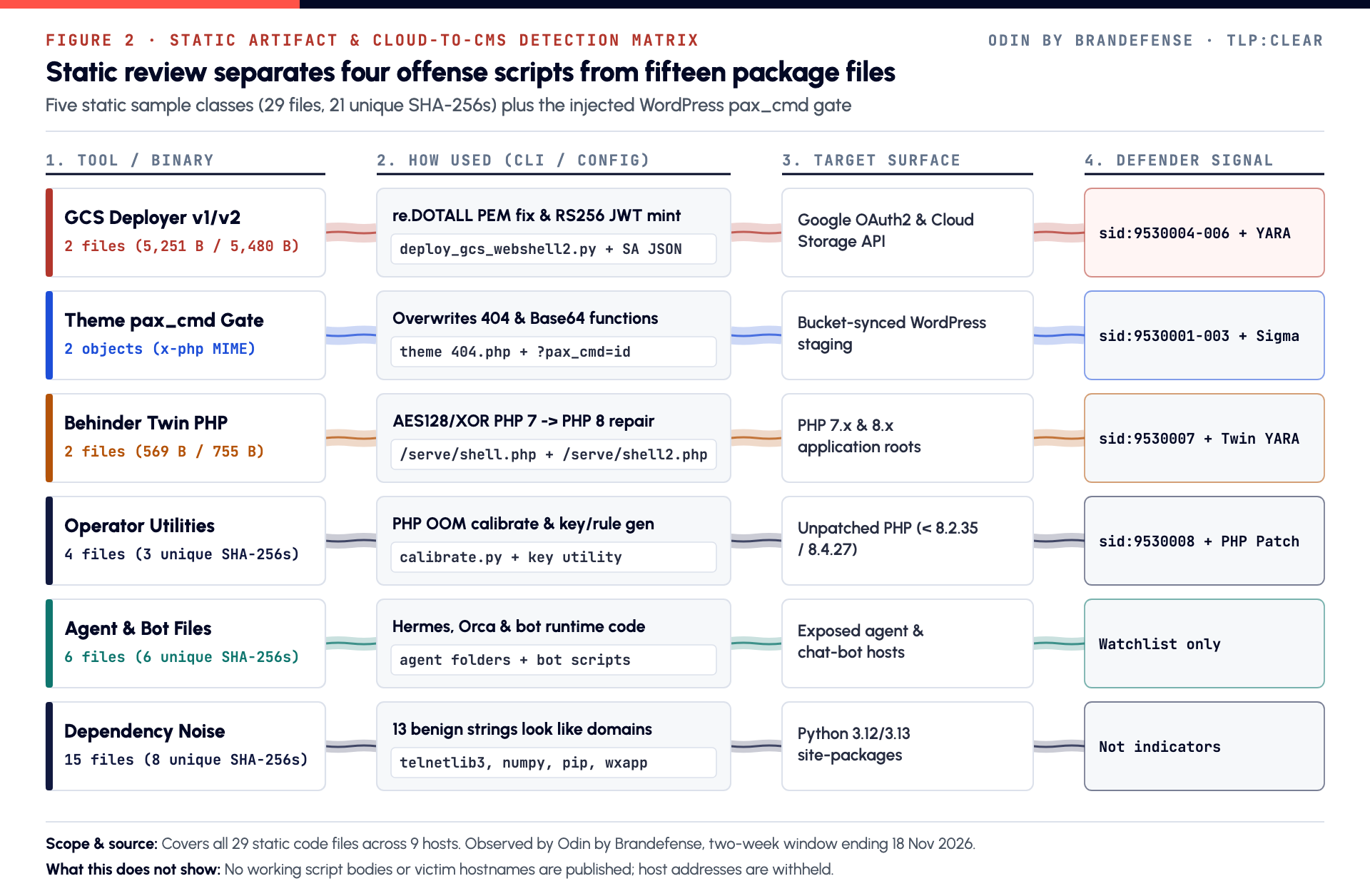
Nine open web directories held 29 code files. Only four are offensive scripts. Fifteen are ordinary Python and JavaScript package files, and the rest are utilities and developer agent folders.
The core find is a pair of Python scripts, deploy_gcs_webshell.py and deploy_gcs_webshell2.py. They sit in an exposed archive from ARTEX, an autonomous red-team framework, next to the records of an iGaming task with 1,231 worker runs.
A second open directory holds two small PHP webshells that speak the Behinder protocol. Behinder is a public webshell manager that encrypts its traffic. All host addresses in this study are withheld, and so are the victim's bucket, theme and site.
The package files carry a lesson of their own. A simple domain search over them returns 13 strings that look like domains but are only docstring words and method names. None of them is attacker infrastructure. Teams that pull indicators from exposed directories should drop library folders first, or their watchlists fill with noise.
Three of the nine hosts hold only AI coding-agent folders, bot scripts or package files. Their owners may be ordinary developers with badly configured servers, so we treat them as users, not attackers.
How does the attack chain work?
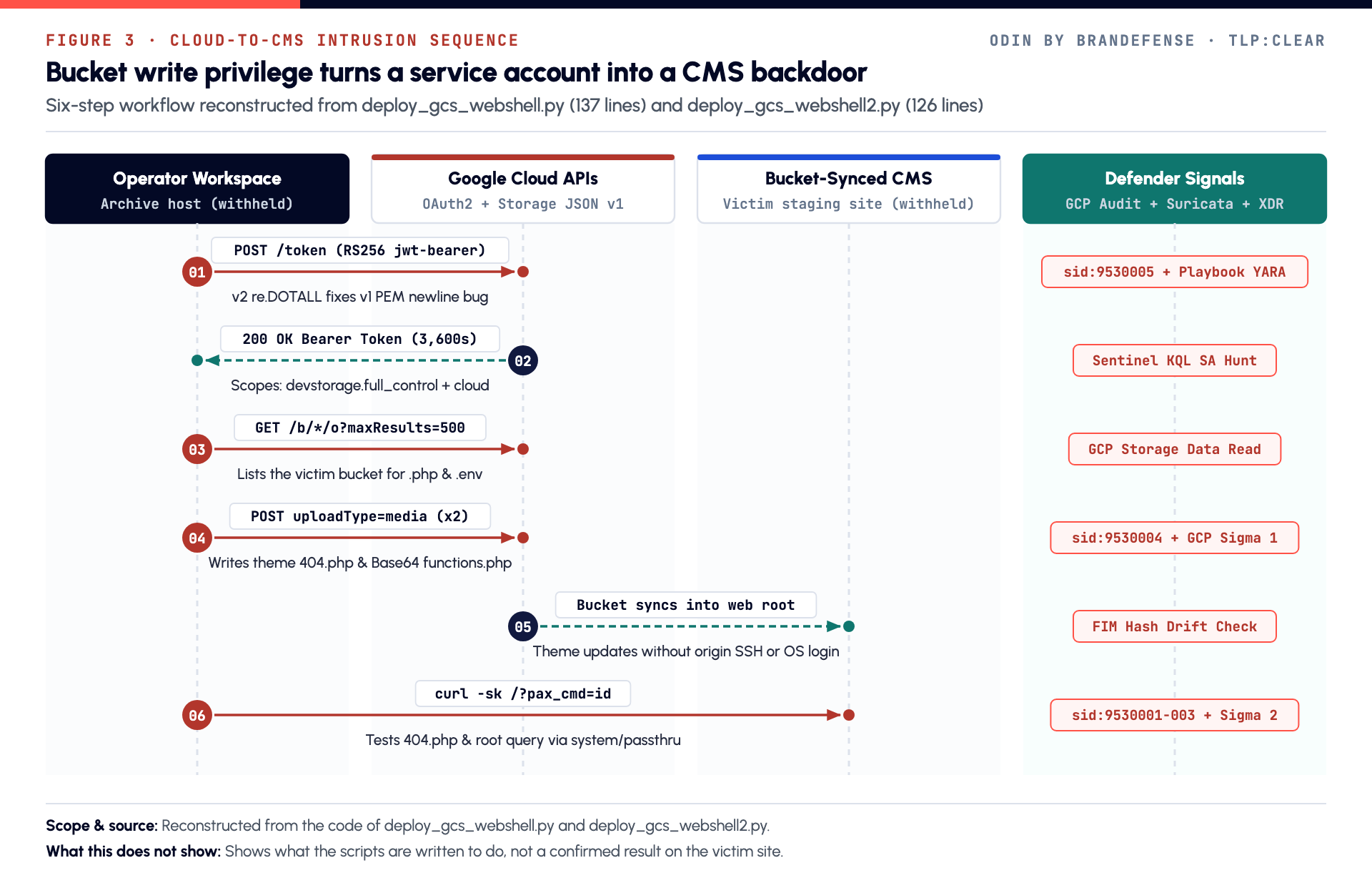
Many WordPress platforms keep themes and media in cloud storage and sync them into the web root. The playbook is built around that design. The steps are:
- Sign in with a stolen key. The script reads a service-account key and builds a signed token request. Google returns a one-hour access token with full storage rights.
- List the bucket. It lists up to 500 files, looking for
.php,wp-config, 404 and.env. These names show the bucket holds a live WordPress site. - Rewrite the theme. It uploads a new
404.phpandfunctions.phpinto the active theme. WordPress loadsfunctions.phpon every page. - Test the gate. It sends a request such as
/?pax_cmd=idto check whether the hidden parameter runs a command.
The two versions show an operator fixing a bug. Version 1 strips line breaks from the key file, which corrupts the private key and breaks signing. Version 2 fixes that with a better parser and hides the new functions.php in Base64.
We read the scripts as code. Nothing we saw confirms that the upload or the test worked against the victim's staging site.
Why do the webshells matter?
The two webshells show the same fix-and-retry habit. Both decrypt incoming commands with AES-128, or a 16-byte XOR fallback, using Behinder's public default key.
The first version relies on a PHP function that was removed in PHP 8.0, so it fails on modern servers. The second version swaps in buffered eval and runs on PHP 8. Because both keep the public default key, standard Behinder signatures and the file hashes on the full report's Indicators tab both apply.
Another host holds a calibration script named after CVE-2026-109618, a critical PHP flaw fixed on 21 October 2026. Patch PHP to 8.2.35, 8.3.36, 8.4.27 or 8.5.12. PHP 7.x and 8.1 are end-of-life and get no fix.
What else does the archive claim?
The same archive holds swarm logs for 76 anonymized targets. Payments, fintech and Web3 firms make up more than half. One task records 2,178 worker runs against a Southeast Asian crypto exchange.
Its logs claim SQL injection into a linked database server, a webshell on a backup NAS and a cloud key taken from a staff workstation. These are the attacker's own records, written partly by an AI model. We did not confirm any of them. Treat them as a threat model for your own database, NAS and cloud IAM segmentation.
Our analysis links the archive to a wider set of exposed servers through shared hashes, reused secrets and the same open-directory habits. We treat this as one operator in an analytical model of 731 nodes, not as a named group.
Some features of the archive could fit a contracted red team. Even so, an unprotected command gate in a live theme file puts the site at risk from anyone who finds it.
What to do now
- Lock down buckets that feed web roots. Only named CI/CD accounts should write theme files. Alert on any PHP file written by anyone else, and turn off PHP execution on media folders.
- Remove service-account keys from workstations. Use short-lived federated tokens, block new key creation by policy and strip project-editor rights.
- Block
pax_cmdat the WAF and alert when PHP workers start shells such assh,bashorid. - Watch your theme files. Record hashes of each theme's
404.phpandfunctions.php, and alert on any change outside a release. - Patch PHP to a fixed release for CVE-2026-109618 and retire end-of-life versions.
The full report's Indicators tab lists 4 file hashes; the full report adds 8 more indicators. The full report's Detection rules tab has Suricata, Sentinel KQL, Sigma and YARA rules. The full report covers the chain, the webshells and the rule logic in detail.
What is…?
Short explanations of the tools and families named in this study.
What is pax_cmd?
pax_cmd is the request parameter used by a WordPress theme backdoor described in Monograph 30. Any request carrying it can run commands on the server.
More about pax_cmdWebshell managerWhat is Behinder?
Behinder is a public Chinese webshell manager that encrypts its traffic to evade inspection.
More about BehinderAI offensive toolWhat is ARTEX?
ARTEX is an autonomous red-team console that chains AI agents and security tools. Operators fork and rebrand it; its default listener port is 8787.
More about ARTEXTechniqueWhat is xp_cmdshell?
xp_cmdshell is a SQL Server extended stored procedure that runs operating system commands. Attackers enable it to move from database access to the host.
More about xp_cmdshellFrequently asked questions
What did we find?
Nine open web directories held 29 code files. Only four are offensive scripts. Fifteen are ordinary Python and JavaScript package files, and the rest are utilities and developer agent folders.
How does the attack chain work?
Many WordPress platforms keep themes and media in cloud storage and sync them into the web root. The playbook is built around that design. The steps are: The two versions show an operator fixing a bug. Version 1 strips line breaks from the key file, which corrupts the private key and breaks signing. Version 2 fixes that with a better parser and hides the new functions.php in Base64.
Why do the webshells matter?
The two webshells show the same fix-and-retry habit. Both decrypt incoming commands with AES-128, or a 16-byte XOR fallback, using Behinder's public default key. The first version relies on a PHP function that was removed in PHP 8.0, so it fails on modern servers. The second version swaps in buffered eval and runs on PHP 8.
What else does the archive claim?
The same archive holds swarm logs for 76 anonymized targets. Payments, fintech and Web3 firms make up more than half. One task records 2,178 worker runs against a Southeast Asian crypto exchange.