
Key takeaways
- Nearly three in five examined IoT and Linux botnet endpoints (1,696 of 2,851, or 59.5%) sit on subscriber broadband, mobile, or regional telecom networks; their feed labels do not by themselves confirm infection.
- Mozi (840 endpoints) and Hajime (837 endpoints) use serverless BitTorrent DHT peer meshes and produce zero central C2 addresses to block.
- Of 66 Mirai endpoints marked confirmed by upstream feeds, 63 sit on Ethiopian, Taiwanese, and Indian fixed or cable broadband carriers; three sit on dynamic telecom networks.
- Go-based Kaiji clusters on commercial VPS providers (63.6% on ports 10081, 808, and 8080), while its single feed-confirmed VPS endpoint remains uncorroborated as C2 and is withheld.
- Require key-only SSH on Linux servers, hunt Kaiji operator ports, and detect UDP DHT and BusyBox stagers on internal VLANs instead of blocking raw feed lists.
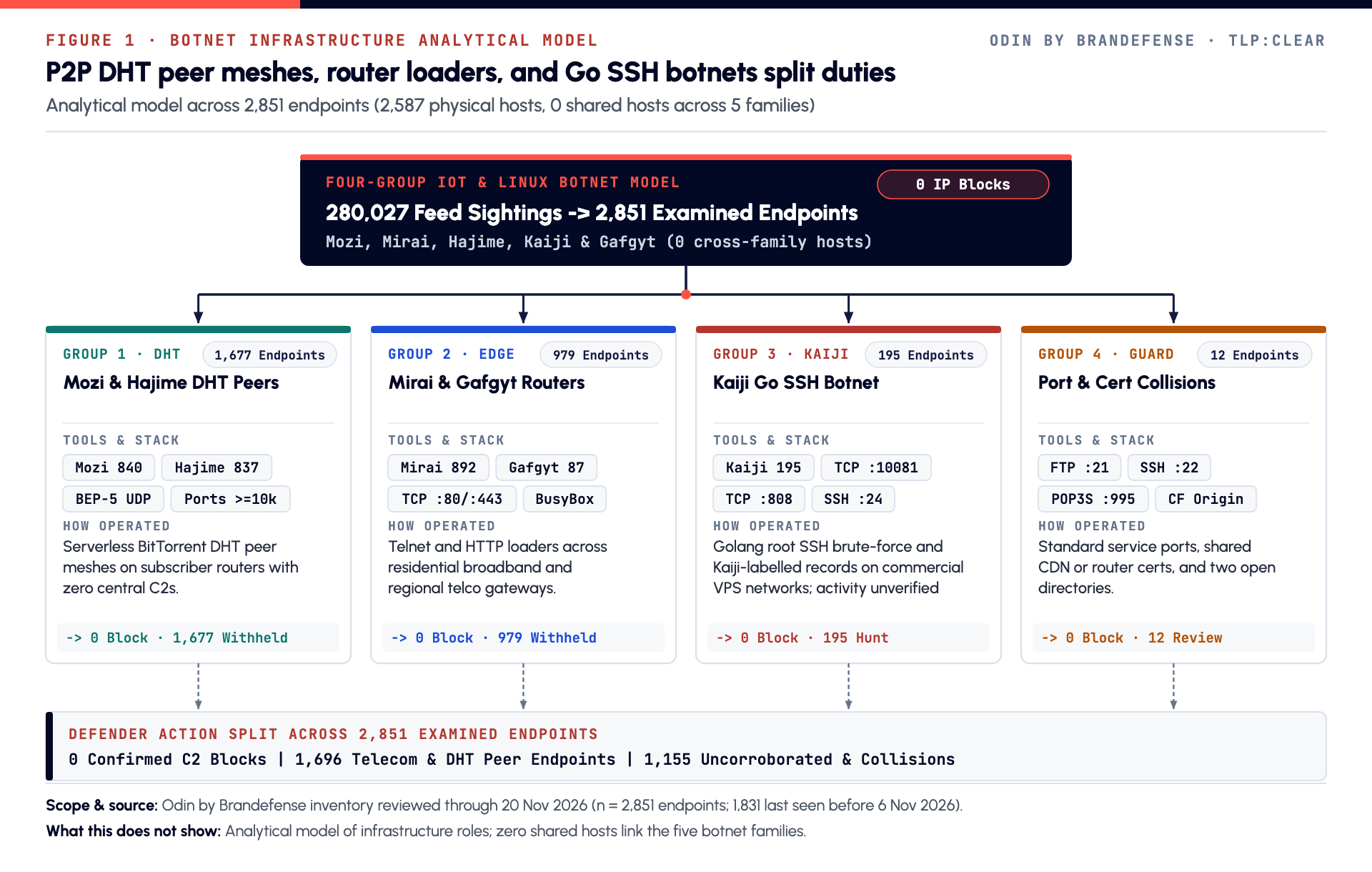
Of 2,851 examined endpoints, 1,696 sit on subscriber or regional telecom networks and should stay off automatic block lists. When a botnet targets home routers or uses a peer-to-peer mesh, subscriber gateways appear in scan feeds as candidate nodes. Blocking those addresses cuts off broadband customers after DHCP lease rotation without touching the botnet's command channel.
Odin by Brandefense reviewed an inventory of 2,851 endpoints across 2,587 physical hosts through 20 November 2026. Those endpoints came from 280,027 global sightings for Mozi, Mirai, Hajime, Kaiji, and Gafgyt. Upstream records span earlier years, with 1,831 of 2,851 last seen before 6 November 2026, including 189 Kaiji and all 87 Gafgyt rows. Nearly three in five examined endpoints (1,696, or 59.5%) sit on telecom networks, and zero met the confirmation bar for an automatic block.
This short read explains how defenders can use cyber threat intelligence to choose different defenses for router peer swarms and Linux SSH botnets. The full report holds the complete hosting breakdown, the seven published JARM indicators in the full report's Indicators tab, and the rules in the full report's Detection rules tab.
Why do Mozi and Hajime have zero central C2 servers to block?
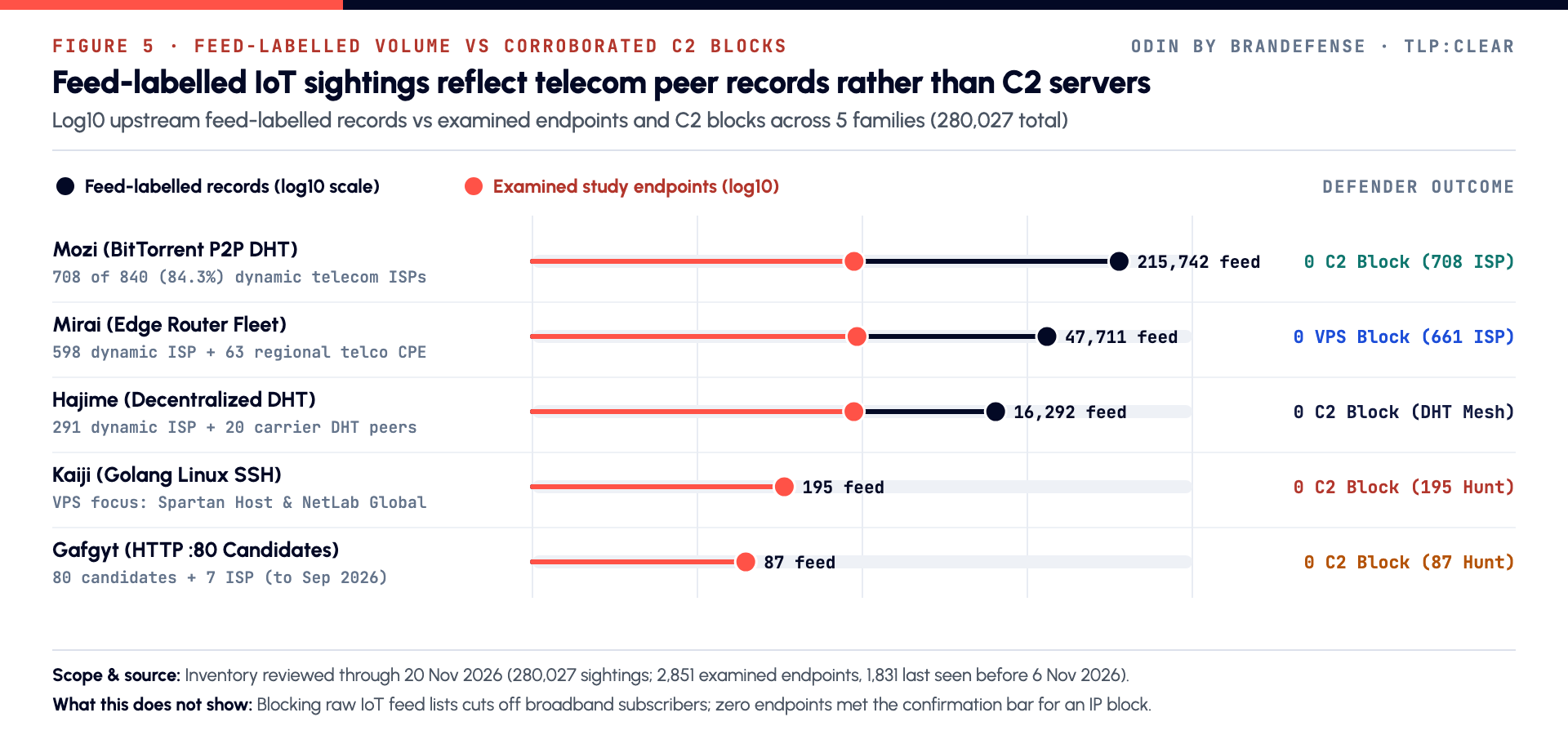
Mozi (215,742 feed sightings; 840 examined endpoints) and Hajime (16,292 sightings; 837 examined endpoints) do not rely on a central command server. Both families build serverless peer-to-peer meshes on top of the BitTorrent Mainline Distributed Hash Table (DHT) protocol. In public analyses of both families, each node joins a UDP swarm, looks up peers with d1:ad2:id20: queries, and relays signed configuration updates.
Port and network numbers show how differently a DHT swarm behaves on the internet:
- Randomized high ports. Exactly 788 of 840 Mozi endpoints (93.8%) and 649 of 837 Hajime endpoints (77.5%) use ports 10000 and above. Those endpoints span more than 700 distinct port numbers in each family.
- Broadband and carrier hosting. Dynamic residential and mobile ISPs host 708 Mozi endpoints (84.3%), including all seven port 80 Mozi entries marked confirmed by upstream feeds on a Pakistani telecom network. In Hajime, 19 of the 20 entries marked confirmed by feeds sit inside one Spanish wholesale fiber subnet (LYNTIA NETWORKS S.A.). The twentieth sits on a Jordanian telecom provider (Batelco Jordan) and shares an embedded device certificate with two Iranian telecom endpoints.
- Port 5555 listings. Three Hajime-labelled records list port 5555; defenders can verify the exposed service with external attack surface management before treating it as ADB.
Because subscriber gateways belong to broadband customers and feed labels alone do not confirm infection, all Mozi and Hajime host addresses are withheld. On corporate or industrial VLANs where BitTorrent is prohibited, an outbound UDP d1:ad2:id20: query flags DHT traffic for investigation, though it does not by itself confirm infection.
Why did 66 feed-confirmed Mirai endpoints stay off the block list?
Mirai accounts for 47,711 global sightings (892 examined endpoints on 680 hosts) and Gafgyt accounts for 87 sightings (87 examined endpoints on 77 hosts). Both families spread across routers and cameras via Telnet brute-force attacks and /bin/busybox shell one-liners that fetch /bins/ ELF stagers.
Most Mirai endpoints (598, or 67.0%) sit on dynamic mobile and residential broadband backbones in China, the Philippines, Indonesia, South Africa, and Ethiopia. Upstream feeds marked 66 Mirai endpoints as confirmed, including three inside those 598 dynamic telecom rows. The other 63 feed-confirmed Mirai endpoints (48 hosts) sit on six national fixed-line, cable, or fiber broadband carriers:
| Country | Carrier network | Mirai endpoints |
|---|---|---|
| Ethiopia | EthioNet | 34 |
| Taiwan | Taiwan Fixed Network, Telco and Network Service Provider. | 19 |
| Taiwan | Hoshin Multimedia Center Inc. | 6 |
| India | ACT Fibernet (2), Quadrant Televentures (1), RailTel (1) | 4 |
All 18 HTTPS endpoints on EthioNet present the same self-signed CPE certificate seen on four Mozi-labelled endpoints. Three JARM hashes also span Mozi, Mirai, and Hajime across 120 endpoints; common JARMs alone do not confirm infection or establish the cause of TLS similarity. Together, telecom and broadband networks account for 661 of the 892 Mirai endpoints (74.1%). Meanwhile, all 87 Gafgyt entries carry upstream record dates ending in September 2026 and remain uncorroborated.
How does the Go-based Kaiji Linux SSH botnet operate?
Kaiji was written from scratch in Go to brute-force root SSH logins on Linux servers. It hides binaries in /usr/bin/lib/, hooks /etc/init.d/, reads .ssh/known_hosts for lateral movement, and launches raw-socket DDoS floods.
Its hosting profile is the mirror image of Mozi and Mirai. Only 9 of our 195 Kaiji endpoints (4.6%) sit on dynamic telecom networks. Instead, Kaiji concentrates on commercial VPS providers led by Spartan Host Ltd (38 endpoints) and NetLab Global (14), using only 39 distinct ports across 182 hosts:
- Uncorroborated VPS lead. One Kaiji-labelled NetLab Global record in the United States lists port 80, but it lacks a second adversary signal and is withheld from block lists.
- Core operator ports. Ports 10081 (59 endpoints), 808 (49), and 8080 (16) account for 124 of the 195 Kaiji endpoints (63.6%).
- Historical port 24, 60000, and 60001 records. Three Kaiji-labelled host tokens have historical records for ports 24, 60000, and 60001 at different times; the records do not establish a simultaneous port triad or bot control.
Zero hosts overlap across Mozi, Mirai, Hajime, Kaiji, and Gafgyt. We present the four groups in Figure 1 as an analytical model of infrastructure roles, not as a single threat actor.
What to do now
- Monitor and restrict outbound traffic to Kaiji operator ports (10081, 808, 8080, 8087, and 8888) from Linux servers at perimeter firewalls and web proxies.
- Require key-only SSH sign-in (
PasswordAuthentication noandPermitRootLogin no) on every Linux server, and alert on binaries inside/usr/bin/lib/or outbound SSH to port 24. - Segment IP cameras, DVRs, and branch routers onto isolated VLANs, and block inbound WAN access to Telnet (23), Android Debug Bridge (5555), and router management ports (7547).
- Deploy the Suricata, Sentinel KQL, Sigma, and YARA rules from the full report's Detection rules tab to catch UDP
d1:ad2:id20:DHT queries,/bins/and/bin/busyboxstagers, and Kaiji operator ports. - Keep broadband ISPs, regional telcos, DHT peer lists, and JARM-only matches out of automatic firewall block lists, and use the seven JARM fingerprints in the full report's Indicators tab strictly for hunting.
What is…?
Short explanations of the tools and families named in this study.
What is Mirai?
Mirai is an IoT botnet malware whose source code leaked in 2016. Its many variants hijack routers and cameras for DDoS attacks.
More about MiraiIoT botnetWhat is Mozi?
Mozi is a peer-to-peer IoT botnet built on Mirai code. A kill switch disabled most of it in 2023, but old nodes still appear in feeds.
More about MoziTechniqueWhat is JARM?
JARM is an open TLS server fingerprinting method from Salesforce. It hashes how a server answers a set of crafted TLS handshakes.
More about JARMFrequently asked questions
Why do Mozi and Hajime have zero central C2 servers to block?
Mozi (215,742 feed sightings; 840 examined endpoints) and Hajime (16,292 sightings; 837 examined endpoints) do not rely on a central command server. Both families build serverless peer-to-peer meshes on top of the BitTorrent Mainline Distributed Hash Table (DHT) protocol. In public analyses of both families, each node joins a UDP swarm, looks up peers with d1:ad2:id20: queries, and relays signed configuration updates.
Why did 66 feed-confirmed Mirai endpoints stay off the block list?
Mirai accounts for 47,711 global sightings (892 examined endpoints on 680 hosts) and Gafgyt accounts for 87 sightings (87 examined endpoints on 77 hosts). Both families spread across routers and cameras via Telnet brute-force attacks and /bin/busybox shell one-liners that fetch /bins/ ELF stagers.
How does the Go-based Kaiji Linux SSH botnet operate?
Kaiji was written from scratch in Go to brute-force root SSH logins on Linux servers. It hides binaries in /usr/bin/lib/, hooks /etc/init.d/, reads .ssh/known_hosts for lateral movement, and launches raw-socket DDoS floods.