
Key takeaways
- An open HTTP server in France exposed 843 reported files (599 sampled unique entries) across four co-hosted layers.
- Nine anonymized session folders held 220 task outputs: 113 subagent symlinks and 107 background shell logs totaling 7.59 MB across 72 sized files.
- Alongside Go scope-polling files, a staged Maven directory listed a Java source file, a JAR, and a POM (coordinate, filenames, and paths withheld).
- Forty-two credentials sat exposed on the same host, including 29 AWS access keys, seven analytics workspace tokens, and five database strings.
- Pin Maven and Gradle builds to internal HTTPS proxies, enforce SHA-256 and PGP verification, and lock cluster library installs.
Odin by Brandefense examined directory records dated 3 to 16 August 2026 from an open HTTP server in France. Across 12 directory sections, the listings reported 843 files. The server held agent recon queues, a Go scope-polling project, staged Maven package files, and 42 credential findings.
Across those 12 directory sections, 599 unique entries were sampled. For defenders, the takeaway is clear: lock Java builds and analytics clusters to internal HTTPS package proxies, and use external attack surface management to find open agent directories.
What was sitting on the exposed HTTP server?
Twenty-five directory index records on the server reported 843 files. Deduplicating those listings left 599 unique sampled paths (71.1%) and 244 un-sampled entries (28.9%). Directory listings on the server carry file dates of 3 to 16 August 2026. We inspected directory metadata and path structures only, ran no code, and contacted no target systems.
An open-source scope poller and textbook Java test filenames can belong to a bug-bounty hunter or security researcher. Their server may have been left open by mistake. For that reason, we withhold the server's IP address, port, project name, exact host paths, Maven coordinate and filenames, file hashes, session UUIDs, and third-party organization names.
Sorting the 599 sampled paths shows four tools sharing the same root directory:
- Unattended agent task queues. Two exposed workspace trees held task outputs beside an overnight summary, an API response file, and a setup log; exact host paths are withheld.
- Go scope-polling files. A Go project tree lists storage, polling, sitemap, and Cloudflare Compose files for bug-bounty scope collection; exact host paths and project name are withheld.
- A staged Maven repository. A Java source file, JAR, and POM were listed in a staged Maven directory; their coordinate, filenames, and host paths are withheld.
- Forty-two exposed credentials. Automated secret checks flagged 29 AWS access keys, seven cloud analytics workspace tokens, five database connection strings, and one paired AWS secret key.
How do the unattended agent queues and scope poller work?
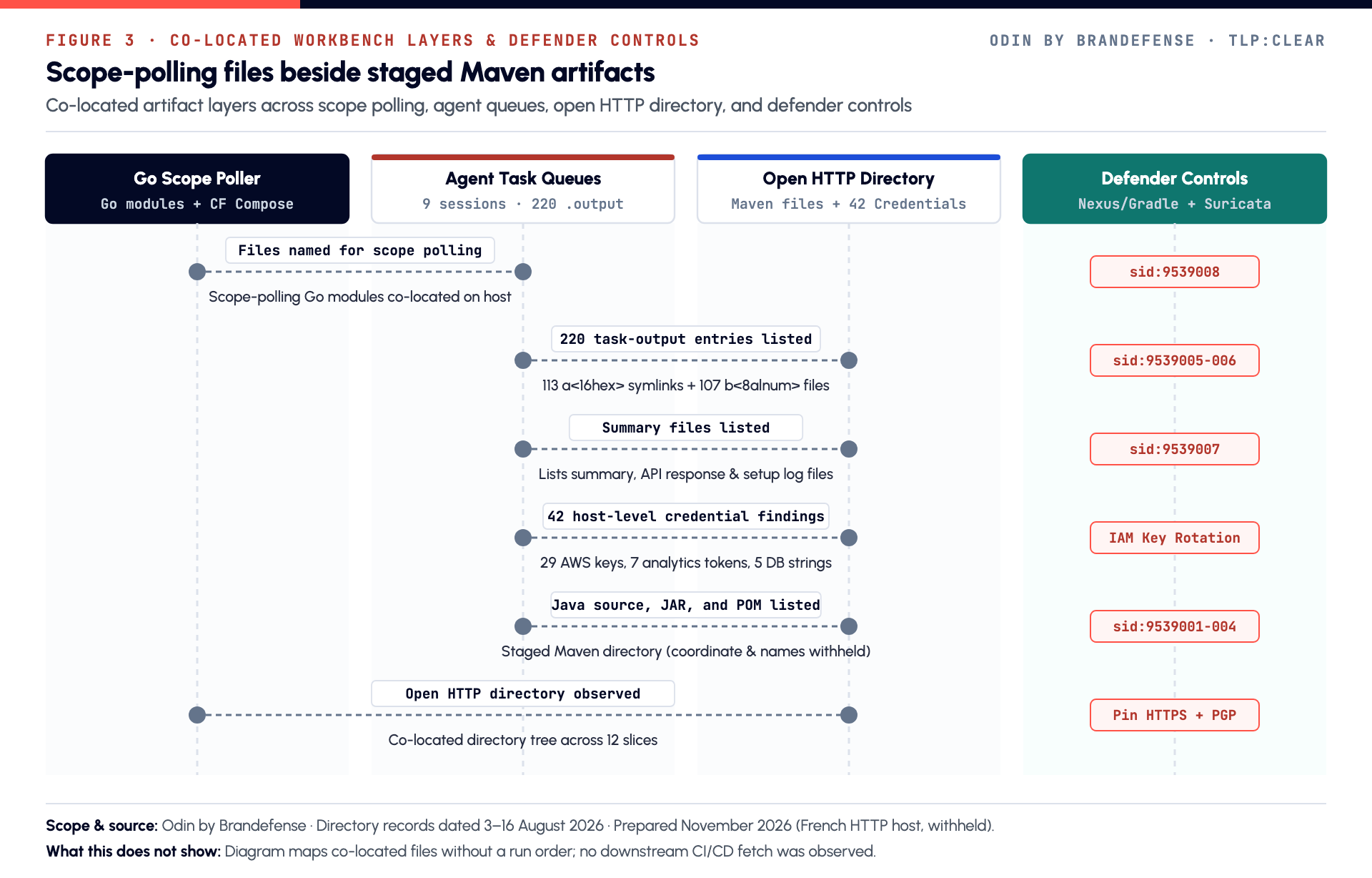
Modern CLI coding agents let an operator hand off reconnaissance loops that run all night; defenders can investigate these with a cyber threat intelligence platform. While the Go poller tracks public bounty programs for new domains or APIs, the agent queues store delegated subagent and shell outputs beside an overnight summary file.
Inside the cloud-analytics workspace tree, 220 itemized .output files (36.7% of the 599 sampled entries) span nine anonymized session folders. The remaining 379 sampled entries (63.3%) cover the second workspace tree, three root files, the Go tree, and the Maven files. Every itemized .output file matches one of two runtime naming patterns without exception:
- 113 subagent symbolic links (
a<16hex>.output, 51.4%). Listed with extensionoutput@, these POSIX symlinks point to delegated subagent transcripts (10 sized files from 91,392 to 254,783 bytes; 103 directory stubs). - 107 background shell logs (
b<8alnum>.output, 48.6%). Listed with regular extensionoutput, these files capture command output from background shell tasks (62 sized files from 33,043 to 261,889 bytes; 45 stubs).
Across all 72 sized .output files, log volume reaches 7.59 MB (7,585,435 bytes), with a median file size of 88,382 bytes and 148 unsized stubs. All 220 entries have an initial listing timestamp of 4 August 2026 (07:45:35Z). Their last listing timestamps fall on 15 August: 81 at 22:34:01Z and 139 at 22:36:04Z.
Three anonymized session queues hold 181 of the 220 files (82.3%), led by Session 1 (84 files), Session 2 (54 files), and Session 3 (43 files). Session 3 alone holds 4,808,890 bytes across 40 sized files (63.4% of total byte volume). The source inventory marks 12 task logs: nine with cloud-credential tags, including one also tagged for exposed secrets, and three with exploit-code tags.
Why does a staged Maven repository on an open HTTP server matter?
Next to the Go project tree, the staged Maven directory follows the standard layout that Maven and Gradle expect when resolving a versioned coordinate. Nothing we observed confirms that any external CI runner or cluster ever downloaded the staged JAR. Even so, the setup highlights three software supply chain security risks.
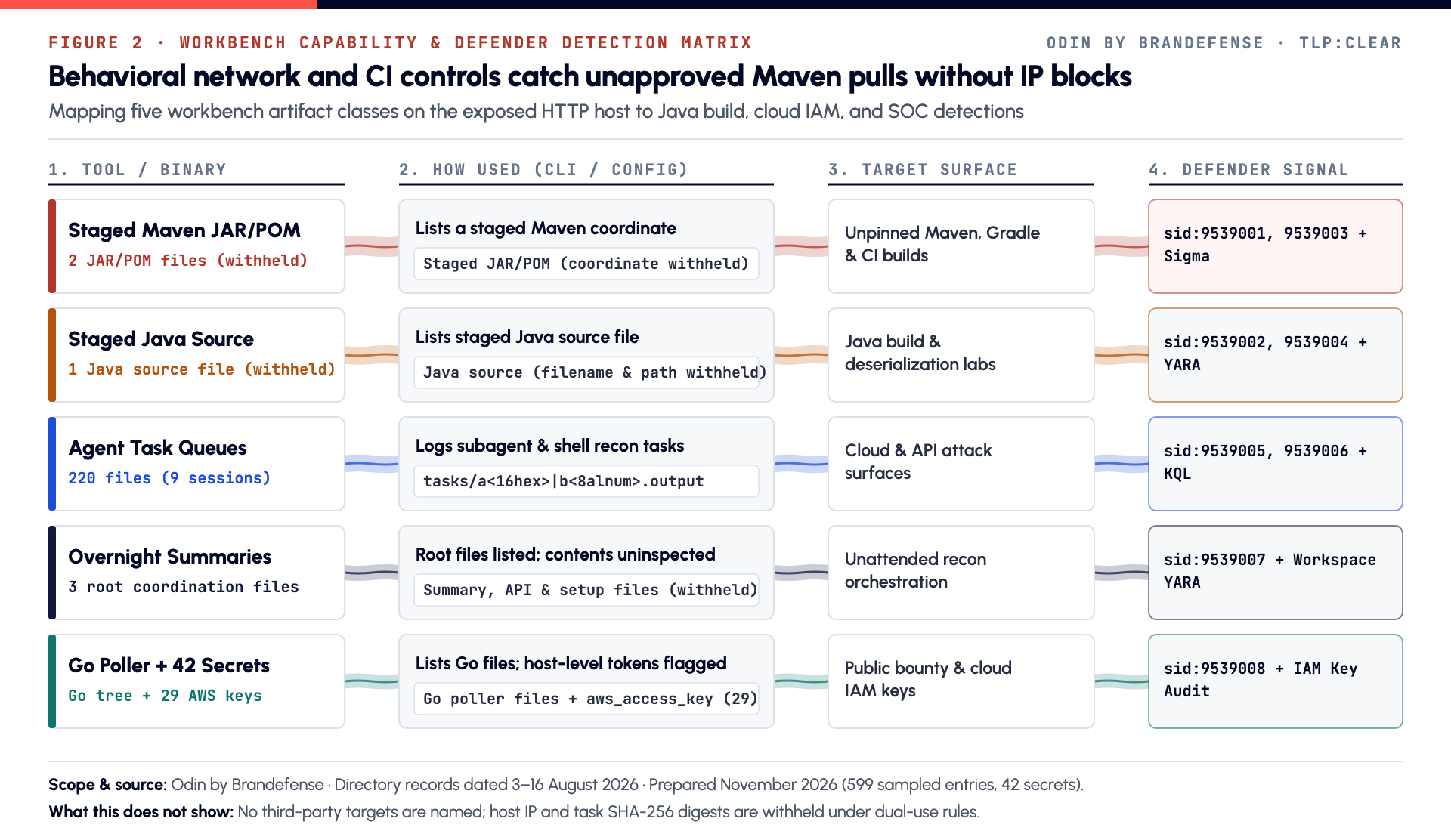
Maven 3.8.1 and newer block external HTTP repositories by default. Teams can override that mirror in settings.xml, while Gradle can permit HTTP with allowInsecureProtocol = true. The Maven Wagon flag relaxes HTTPS certificate checks; it does not enable blocked HTTP repositories. Once HTTP is allowed, a <repositories> block in a pull request can make a build runner fetch a staged JAR from an external server.
Cloud data and analytics platforms also let users or workspace token holders attach custom Maven coordinates from external repository URLs onto compute clusters. Seeing seven analytics_workspace_token secrets and 220 analytics-scope task logs on the same server as the Maven directory shows why cluster library sources must be locked down.
In addition, researchers and attackers stage custom Java source and JAR files to test server-side request forgery (SSRF) and remote Java class-loading flaws.
Why are 42 leaked credentials a warning for security teams too?
AWS IAM credentials make up 30 of the 42 secret findings on the host (71.4%). That total includes 29 access key IDs (69.0%) and one secret key (2.4%). Seven analytics workspace tokens (16.7%) and five database connection strings (11.9%) account for the rest.
Two of the nine cloud-credential task logs carry measured sizes (33,043 and 45,400 bytes, or 78,443 bytes combined). Seventy untagged logs hold the remaining 7,506,992 measured bytes. File hashes are withheld on 123 task files, and 97 carry no hash.
CLI coding agents often echo environment variables and raw API responses into .output logs. An open python3 -m http.server listener can expose credentials in its served directory tree. The host-level summary does not identify which files held all 42 findings. Whether the operator is an authorized bug-bounty researcher or an opportunist, open agent directories put both operator keys and target scopes in danger.
What to do now
- Pin Maven and Gradle to internal HTTPS proxies. Use
<mirrorOf>*</mirrorOf>insettings.xmland repository rules in Gradleinit.gradle. Route all package fetches throughnexus.corp[.]internalorartifactory.corp[.]internal, with upstream HTTPS limited torepo.maven.apache[.]organdplugins.gradle[.]org. - Verify dependency checksums and signatures. Enable Gradle dependency verification (SHA-256 and PGP) and strict Maven checksum checking (
-C). Fail CI builds usingallowInsecureProtocol = true, enforce an approved-repository policy at egress, and verify context before blocking. - Restrict cluster library attachment. Allow cloud analytics compute clusters to install Maven libraries only from approved internal repositories, never arbitrary HTTP URLs.
- Rotate exposed keys and lock workspace tokens. Audit AWS keys with IAM Access Analyzer, move scripts to short-lived OIDC roles, and bind analytics workspace tokens to corporate IP allowlists.
- Audit internal agent sandboxes and deploy behavioral detections. Ban open
http.serverlisteners on research VMs and purge.outputtranscripts holding tokens. Deploy our Suricata (sid:9539001to 9539008), Sentinel KQL, Sigma, and YARA rules.
The full report's Indicators tab holds 0 IP addresses and 0 file hashes under our dual-use rules. The full report lists 12 generic Maven layout, task-glob, CLI, and build-config patterns (with coordinates, filenames, project name, port, and 15 host paths withheld) beside the full report's Detection rules tab.
Frequently asked questions
What was sitting on the exposed HTTP server?
Twenty-five directory index records on the server reported 843 files. Deduplicating those listings left 599 unique sampled paths (71.1%) and 244 un-sampled entries (28.9%). Directory listings on the server carry file dates of 3 to 16 August 2026. We inspected directory metadata and path structures only, ran no code, and contacted no target systems.
How do the unattended agent queues and scope poller work?
Modern CLI coding agents let an operator hand off reconnaissance loops that run all night; defenders can investigate these with a cyber threat intelligence platform. While the Go poller tracks public bounty programs for new domains or APIs, the agent queues store delegated subagent and shell outputs beside an overnight summary file.
Why does a staged Maven repository on an open HTTP server matter?
Next to the Go project tree, the staged Maven directory follows the standard layout that Maven and Gradle expect when resolving a versioned coordinate. Nothing we observed confirms that any external CI runner or cluster ever downloaded the staged JAR. Even so, the setup highlights three software supply chain security risks.
Why are 42 leaked credentials a warning for security teams too?
AWS IAM credentials make up 30 of the 42 secret findings on the host (71.4%). That total includes 29 access key IDs (69.0%) and one secret key (2.4%). Seven analytics workspace tokens (16.7%) and five database connection strings (11.9%) account for the rest.