
1. Executive Summary
In short
Between 13 and 26 November 2026, Odin by Brandefense analyzed Workbench A, a 313-entry adversary staging directory on TCP port 8000 of a Netherlands server totaling 3.85 megabytes. The workspace pairs web API fuzzing and SQL probes with Polkit and Dirty COW escalation helpers, UID-0 OpenSSH scripts, and Rust bore tunnels. Patch CISA KEV baselines, audit OpenSSH AllowUsers policies, and restrict server TCP egress.
Linux servers running messaging APIs and partner web portals rely on layered perimeter, kernel, daemon, and network controls. An application flaw on an unpatched Linux host can expose local privilege-escalation tools, secondary root accounts, and outbound TCP tunnels. Workbench A brings each of those operational layers into one open directory.
Between 13 and 26 November 2026, Odin by Brandefense studied Workbench A on TCP 8000 of a Netherlands server. The live directory was first recorded on 13 November 2026 and last verified on 26 November 2026 at 22:09 UTC. Across every artifact group, Workbench A is assessed consistently as an adversary staging workbench.
Deduplicated indexing captured all 313 reported entries. Those entries span 311 sized files totaling 3,847,708 bytes (3.85 megabytes) and 2 unsized root entries, with 4 snapshot files retained in full.
Workbench A scopes a regional messaging gateway and holds captured HTTP request templates. Odin by Brandefense therefore publishes zero IPv4 addresses, zero file SHA-256 digests, and zero organization or customer names. Two target-suffixed upload script names are also withheld.
First, web API discovery, HTTP templates, and frontend scripts make up 232 of the 313 entries.
Those 232 items (1,560,301 bytes across 230 sized files and 2 unsized entries) map endpoints and parameters of a regional messaging gateway. Key files include api_doc.pdf (635,631 bytes), ffuf.log (293,402 bytes), 12 /burp_requests/ templates, and 7 /jsdl/ JavaScript files.
Second, thirty-three shell scripts stage numeric SQL probes, schema checks, and multipart upload tests.
Totaling 20,215 bytes across 33 sized files, this group tests numeric SQL parameters, database schemas, and PHP upload handlers. Directory files alone do not confirm database extraction or upload execution on the external target.
Third, ten local escalation items sit beside nine UID-0 OpenSSH persistence scripts.
Ten escalation files (1,150,699 bytes) pair Dirty COW binary /dc (1,146,296 bytes) with Polkit pwnkit.c (1,267 bytes) and eight shell wrappers. Nine SSH scripts (3,229 bytes) stage a secondary UID-0 toor account, RSA keys, and sshd_config AllowUsers edits.
Fourth, twenty-seven Rust bore items and two cleanup scripts prepare outbound TCP relays and log deletion.
Archive /bore.tgz (1,097,869 bytes) pairs with 26 shell scripts (12,707 bytes) exposing local ports over TCP 80 and 443. Two cleanup scripts (2,688 bytes) target host logs, though all 313 workspace entries remain staged preparation rather than verified target impact.
Three Decisions for Enterprise Security Leaders
- Verify CISA KEV patch levels across Linux Polkit and kernel packages. Confirm every DMZ and web Linux server runs Polkit packages with January 2022 vendor patches, verify each kernel against its vendor's Dirty COW fixed package, and upgrade unsupported releases.
- Audit Linux UID-0 accounts and OpenSSH AllowUsers directives daily. Alert on any non-
rootaccount carrying UID 0 in/etc/passwdand lock/etc/ssh/sshd_configAllowUsersandPermitRootLoginsettings under file integrity monitoring. - Block direct server TCP egress and stream Linux audit logs off-host. Force application server traffic through authenticated proxies to block raw TCP
boretunnels on ports 80, 443, and 7835, while forwardingauth.logandauditdevents in real time.
2. Workbench Architecture, 313-Entry Reconciliation, and Timeline Scope
Workbench A ran on a Netherlands commercial virtual private server (address withheld) assessed consistently as an adversary staging workbench. The server exposed an open HTTP directory on TCP 8000 containing 258 iterative offensive .sh scripts, recon logs, escalation helpers, and tunnel archives. Infrastructure teams use vulnerability intelligence to spot unpatched Linux Polkit and kernel packages across internet-facing fleets.
Odin by Brandefense first recorded Workbench A on 13 November 2026 and last verified the directory on 26 November 2026 at 22:09 UTC. Detection teams also apply cyber threat intelligence to turn staged shell wrappers and tunnel patterns into network and host rules. Figure 1 maps the four operational tracks across all 313 entries.
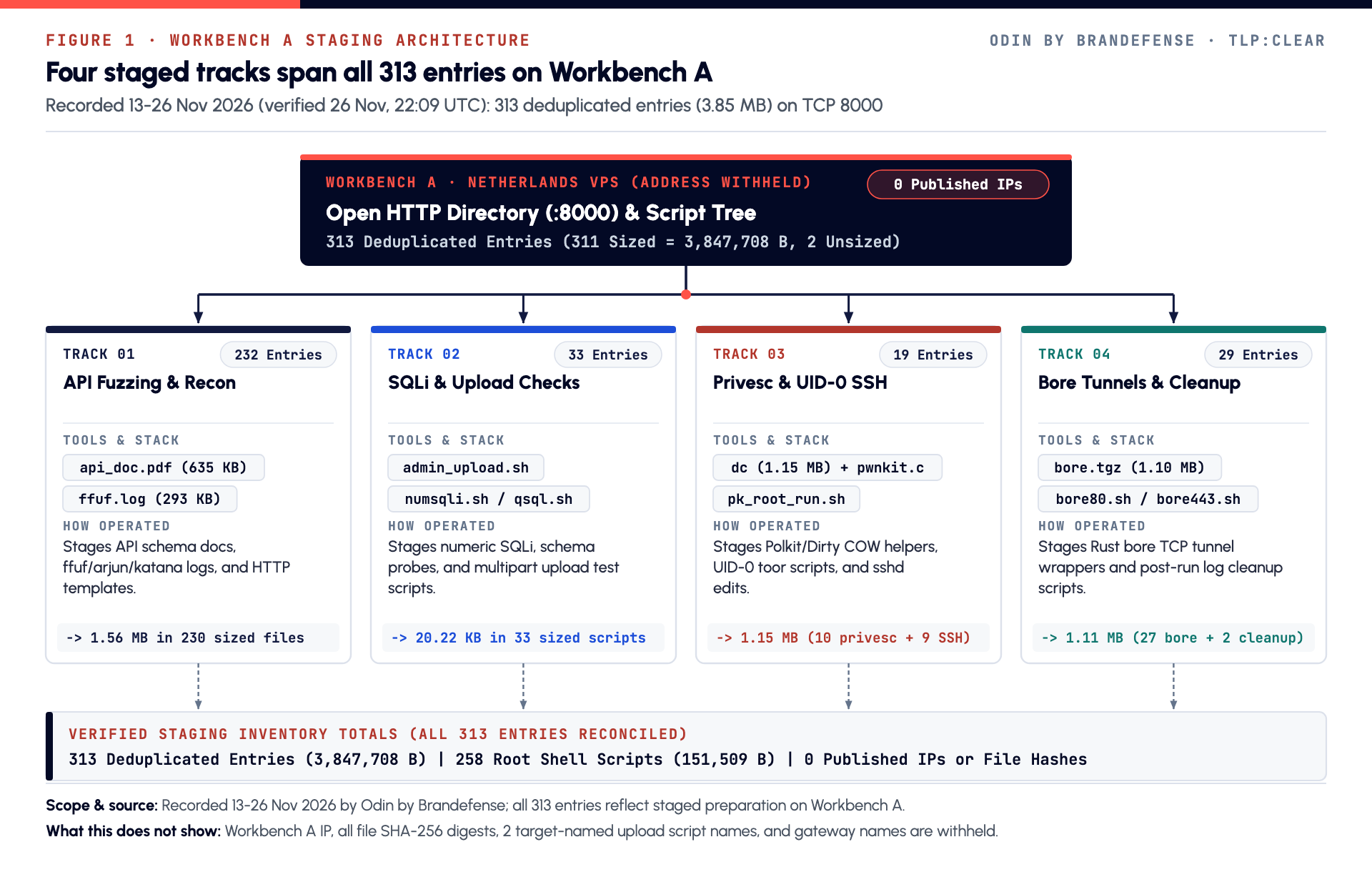
Complete 313-Entry Reconciliation Across Zones and File Types
Workbench A's live directory listing reported 313 files, matching our deduplicated count of 313 entries one-for-one. Those 313 entries consist of 311 sized files totaling 3,847,708 bytes (3.85 MB) and 2 unsized extensionless entries in (root). Four snapshot files, including ffuf.log (293,402 B), were stored in full.
Across folders, (root) holds 294 entries (292 sized files totaling 3,526,949 B plus 2 unsized items). Two subdirectories hold the remaining 19 sized entries (320,759 B). Folder /burp_requests/ holds 12 HTTP templates (2,461 B, built by make_burp_requests.sh [918 B]; 3,379 B combined), and /jsdl/ holds 7 JavaScript files (318,298 B).
| Workspace zone | Subdirs | Deduplicated entries | Share (%) | Sized files | Unsized entries | Sized bytes | Operational role |
|---|---|---|---|---|---|---|---|
Root Iterative Shell Scripts (258 .sh Files) | 0 (root) | 258 | 82.4% | 258 | 0 | 151,509 | 258 root .sh scripts covering API fuzzing, SQLi and upload checks, escalation wrappers, UID-0 toor edits, bore tunnels, and cleanup. |
| Root Recon Logs, Wordlists & Binaries | 0 (root) | 36 | 11.5% | 34 | 2 | 3,375,440 | /dc (1,146,296 B), /bore.tgz (1,097,869 B), /api_doc.pdf (635,631 B), /ffuf.log (293,402 B), recon logs, pwnkit.c, 1 .php, and 2 unsized items. |
Captured HTTP Templates (/burp_requests/) | 1 | 12 | 3.8% | 12 | 0 | 2,461 | 12 HTTP templates (2,461 B; built by make_burp_requests.sh [918 B], 3,379 B combined) modeling messaging gateway calls. |
Frontend JavaScript Assets (/jsdl/) | 1 | 7 | 2.2% | 7 | 0 | 318,298 | 7 frontend .js files (318,298 B), led by app.js (111,747 B), jquery.js (96,763 B), and jquery.min.js (94,840 B). |
| Combined deduplicated inventory | 2 subdirs + root | 313 | 100.0% | 311 | 2 | 3,847,708 | Exact parity (294 root + 19 subdir entries; shares rounded to 0.1%). |
A second breakdown reconciles the same 313 entries (311 sized, 2 unsized, 3,847,708 bytes) by file kind. Scripts (266 entries, 85.0%) and text/log/source files (42 entries, 13.4%) represent 98.4% of entry counts. Three root files (/dc, /bore.tgz, and /api_doc.pdf) account for 2,879,796 bytes (74.8% of sized bytes).
Artifact class (kind) | Deduplicated entries | Share (%) | Sized files | Unsized entries | Sized bytes | Verified extensions & contents |
|---|---|---|---|---|---|---|
Executable & frontend scripts (script) | 266 | 85.0% | 266 | 0 | 470,163 | 258 root .sh scripts (151,509 B), 7 .js files in /jsdl/ (318,298 B), and 1 root .php file (356 B). |
Logs, wordlists, templates & C source (text) | 42 | 13.4% | 42 | 0 | 497,749 | 31 .txt files (api_doc.txt, plist.txt, gau_*, /burp_requests/), 5 .log files (ffuf.log, arjun.log, httpx_install.log, katana.log, 1 recon log), 4 .json, and 2 .c files. |
Unsized root items (other) | 2 | 0.6% | 0 | 2 | 0 | 2 extensionless unsized entries in (root). |
Compiled Linux binaries (exe) | 1 | 0.3% | 1 | 0 | 1,146,296 | 1 extensionless binary /dc (1,146,296 B, 29.8% of sized bytes) paired with cow_restart.sh. |
Compressed tool archives (archive) | 1 | 0.3% | 1 | 0 | 1,097,869 | 1 .tgz archive /bore.tgz (1,097,869 B, 28.5% of sized bytes) staging the Rust bore binary. |
API specification documents (doc) | 1 | 0.3% | 1 | 0 | 635,631 | 1 .pdf document /api_doc.pdf (635,631 B, 16.5% of sized bytes) for a regional messaging gateway. |
| Total | 313 | 100.0% | 311 | 2 | 3,847,708 | Exact byte parity (3.85 MB; shares rounded to 0.1%). |
Figure 5 divides all 313 entries into six mutually exclusive clusters designated CL-01 through CL-06 (232 + 33 + 27 + 10 + 9 + 2 = 313). Web API recon (CL-06, 232 items) holds 74.1% of entries and 40.6% of bytes. Together with escalation helpers (29.9% of bytes) and bore tunnels (28.9% of bytes), three clusters hold 99.3% of workspace bytes.
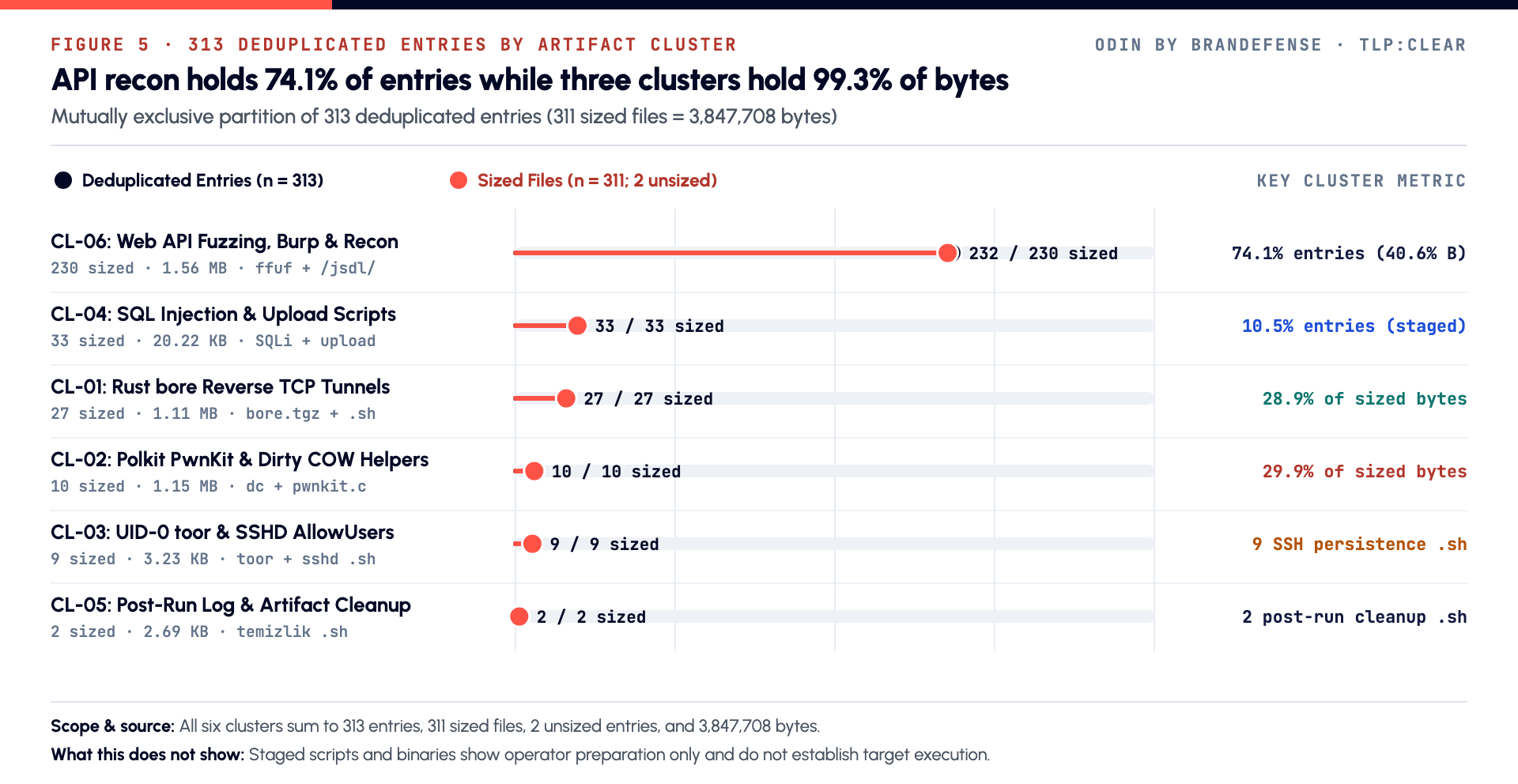
Observation Dates Versus Iterative Script Revisions
Odin by Brandefense recorded Workbench A between 13 November 2026 and 26 November 2026 (22:09 UTC). Numbered revisions across the 258 shell scripts, including db_data4.sh and bore_restart3.sh, reflect iterative staging on Workbench A.
Those revisions do not measure runtime duration or external impact. Without target-side logs, none of the 313 workspace entries confirm execution on the scoped regional messaging gateway.
3. Web API Fuzzing, Captured HTTP Templates, and SQL/Upload Probes
Messaging and dealer gateways expose HTTP endpoints for bulk dispatch, account credits, delivery reports, and file imports. Figure 3 shows an analytical model of five staged steps on Workbench A. Every step uses dashed arrows to show staged preparation rather than verified target execution.
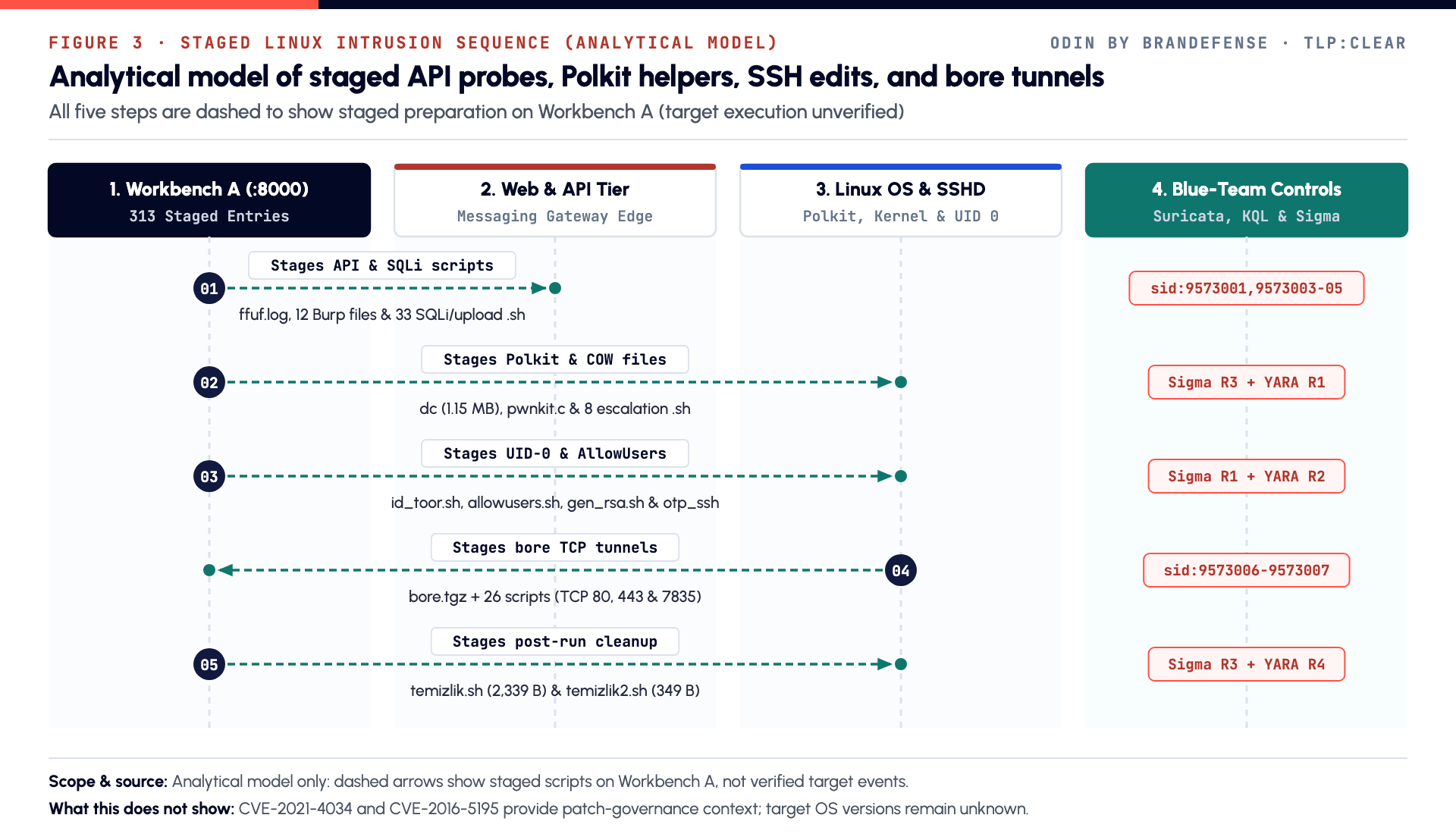
Endpoint Discovery, API Schema Files, and HTTP Templates (CL-06, 232 Entries)
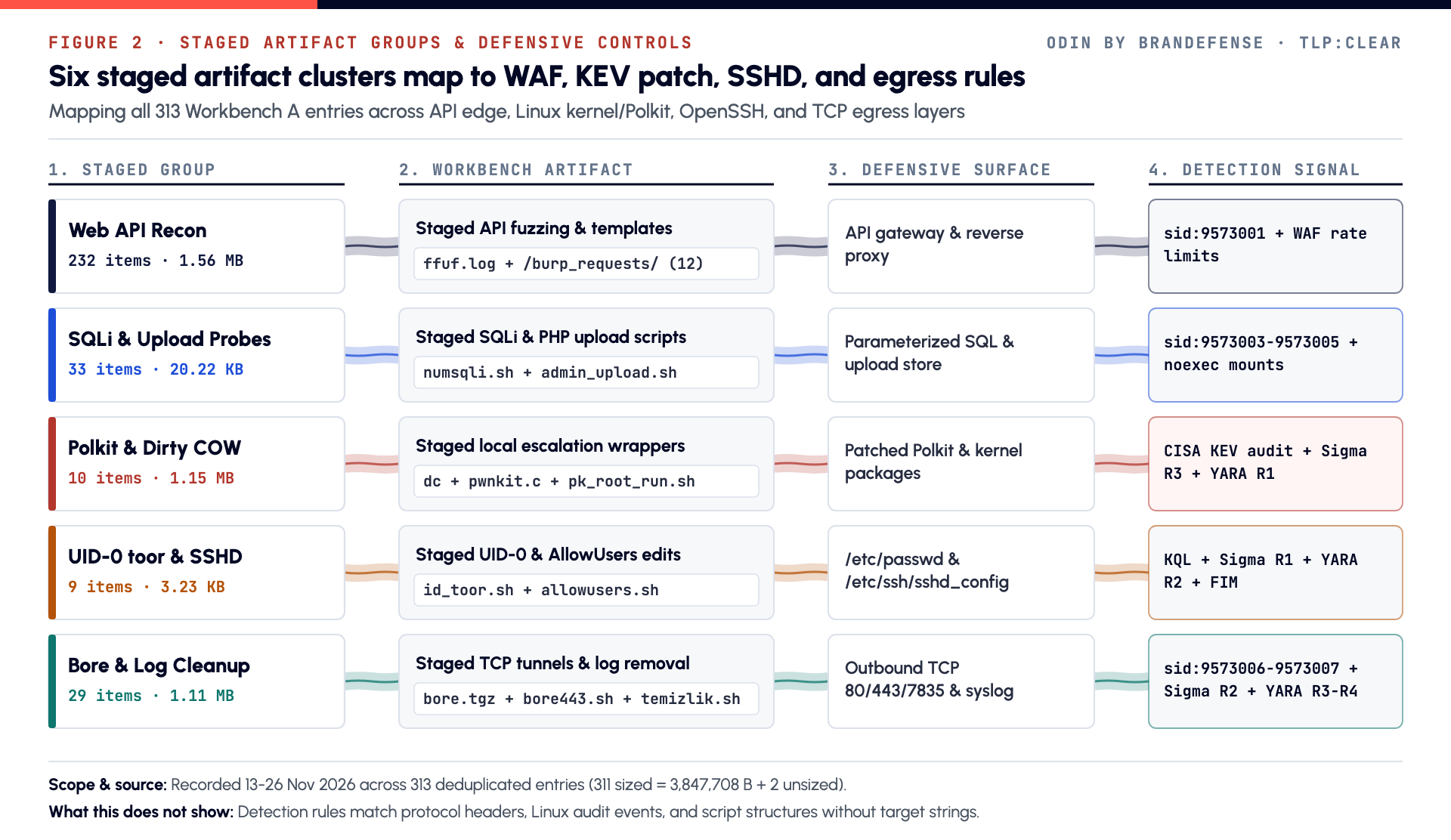
Cluster CL-06 holds 232 entries (230 sized files totaling 1,560,301 bytes plus 2 unsized root items) scoping a regional messaging gateway whose name and domain are withheld. Root holds api_doc.pdf (635,631 B), extracted text api_doc.txt (22,693 B), and parameter list plist.txt (20,030 B). Those files document endpoint paths, authentication headers, and request schemas.
Six scanner logs and URL lists total 366,636 bytes in (root). Stored log ffuf.log (293,402 B) sits beside arjun.log (25,865 B) and gau_urls.txt (16,840 B). Three more files cover httpx_install.log (14,937 B), gau_paths_normalized.txt (14,275 B), and katana.log (1,317 B).
Two subdirectories store repeatable request and frontend files. Folder /burp_requests/ holds 12 HTTP templates (2,461 B), built by make_burp_requests.sh (918 B; 3,379 B combined across 13 items). Folder /jsdl/ holds 7 JavaScript files (318,298 B), led by app.js (111,747 B), jquery.js (96,763 B), and jquery.min.js (94,840 B).
Staged SQL Injection and Multipart Upload Validation Scripts (CL-04, 33 Entries)
Cluster CL-04 (33 sized scripts totaling 20,215 bytes, 10.5% of entries) tests database inputs and file-upload routes. Numeric IDs and pagination parameters expose SQL tables when backend code concatenates unquoted integers instead of binding typed parameters. Storing uploads on object buckets or noexec mounts outside PHP interpreter paths blocks script execution even if extension filters fail.
CL-04 script subgroup | Representative staged artifacts | Defensive control focus |
|---|---|---|
| Numeric SQL & schema probes | db_data4.sh (1,016 B), sms_test2.sh (995 B), qsql.sh (855 B), numsqli.sh (829 B), sqli_scan.sh, mysql_try.sh, dbadmin.sh/2.sh, db_data.sh/2.sh, smsschema.sh. | Bind typed SQL parameters on all numeric fields and alert via sid:9573003–9573004. |
| Multipart upload checks | admin_upload.sh (1,427 B), upload_final.sh (908 B), upload_try.sh, phptest.sh, loop_payload.sh, 1 root .php (356 B), plus 2 withheld target-suffixed scripts (1,059 B and 986 B; 2,045 B). | Enforce strict upload extension allowlists, mount upload paths noexec, and alert via sid:9573005. |
4. Staged Polkit/Dirty COW Escalation, UID-0 SSH Persistence, and Bore Tunnels
Alongside web API and SQL probes, Workbench A holds 48 Linux post-exploitation, OpenSSH, tunnel, and cleanup files (2,267,192 bytes, 58.9% of sized bytes). Figure 4 shows the TCP 8000 directory layout across (root), /burp_requests/, and /jsdl/.
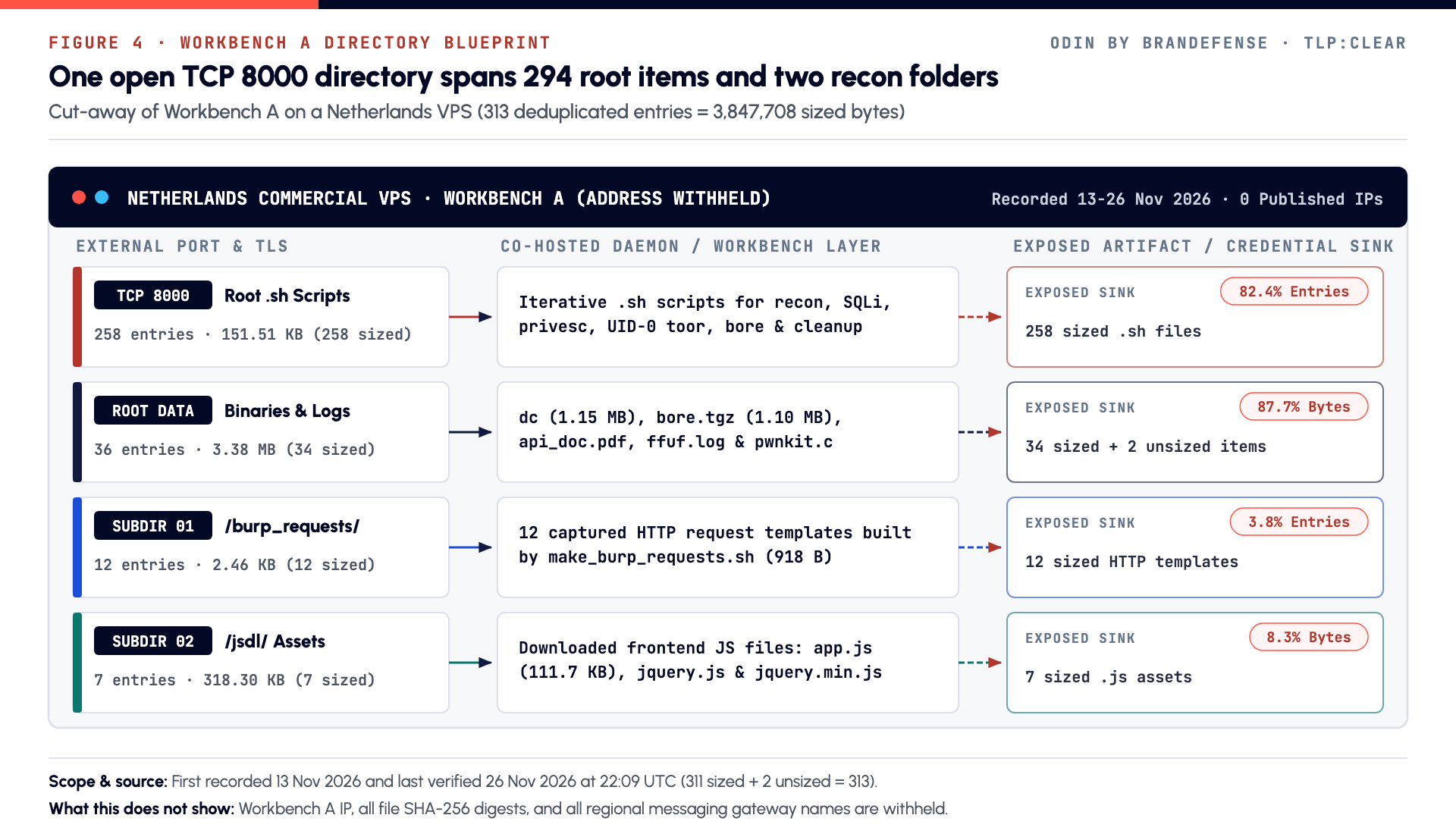
CISA KEV Patch Baselines: Polkit CVE-2021-4034 and Dirty COW CVE-2016-5195 (CL-02, 10 Entries)
Cluster CL-02 (10 sized items totaling 1,150,699 bytes, 29.9% of sized bytes) stages local Linux privilege-escalation helpers (T1068; [REF-06]). Root holds compiled binary /dc (1,146,296 B), C source /pwnkit.c (1,267 B), and 8 shell scripts (3,136 B).
Those 8 wrappers start with pk_root_run.sh (932 B), root_run.sh (926 B), pk_go.sh (350 B), and suid.sh (263 B). Four smaller scripts cover cow_restart.sh (247 B), pk_test.sh (226 B), pwnkit.sh, and pk_dbg.sh.
Both flaws sit in CISA's catalog of known exploited vulnerabilities ([REF-03]). Under NVD record CVE-2021-4034 ([REF-01]), Polkit's pkexec utility was vulnerable in polkit versions up to 0.120 before January 2022 vendor updates. Out-of-bounds environment handling when invoked with zero arguments let local users gain root privileges.
Under NVD record CVE-2016-5195 ([REF-02]), Dirty COW affected mm/gup.c across Linux kernel 2.x through 4.x before 4.8.3. Improper copy-on-write handling of read-only memory mappings let local users escalate privileges. Operators still bundle both helpers for unmaintained Linux appliances; both CVEs serve strictly as patch-baseline context.
Auditing UID-0 toor Accounts and OpenSSH AllowUsers Directives (CL-03, 9 Entries)
Cluster CL-03 (9 sized .sh scripts totaling 3,229 bytes) stages UID-0 accounts and OpenSSH edits (T1136.001, T1098.004; [REF-05], [REF-07], [REF-08]):
Staged script in CL-03 | Size (bytes) | Defensive audit surface |
|---|---|---|
persist.sh | 932 | Background persistence and session maintenance wrapper. |
otp_ssh.sh | 795 | SSH authentication and PAM or one-time token policy check script. |
allowusers.sh | 379 | Edits /etc/ssh/sshd_config AllowUsers directives ([REF-05]) to permit added accounts. |
sshd_diag.sh | 346 | Inspects OpenSSH daemon settings, active listeners, and login rules ([REF-05]). |
setsid_test.sh | 311 | Detaches background sessions (setsid) from web worker process groups. |
rsh.sh | 165 | Remote shell helper staged beside SSH configuration scripts. |
gen_rsa.sh | 123 | Generates SSH RSA key pairs for authorized_keys persistence ([REF-08]). |
id_toor2.sh | 117 | Second revision of secondary UID-0 toor account setup ([REF-07]). |
id_toor.sh | 61 | Initial script staging a secondary UID-0 toor local account ([REF-07]). |
Cluster CL-03 total | 3,229 | Exact byte total across all 9 SSH persistence scripts. |
Per sshd_config(5) ([REF-05]), an explicit AllowUsers directive blocks every login account omitted from that allowlist, including UID-0 accounts. OpenSSH checks UID 0 when enforcing PermitRootLogin no, so a secondary UID-0 username (toor) is also denied SSH login despite appearing in AllowUsers. Defenders must monitor /etc/passwd for non-root UID-0 rows and audit effective OpenSSH policy with sshd -T.
Egress Control: Rust bore Tunnels and Cleanup Scripts (CL-01 & CL-05, 29 Entries)
Cluster CL-01 (27 sized entries totaling 1,110,576 bytes, 28.9% of sized bytes) stages reverse TCP relays (T1572; [REF-04], [REF-09]). Archive /bore.tgz (1,097,869 B) packages ekzhang/bore ([REF-04]), a single-binary Rust TCP tunnel client. Twenty-six shell scripts (12,707 B) wrap tunnel deployment, port selection, and restarts across 14 core bore wrappers and 12 relay helpers.
Standard ekzhang/bore frames control handshakes as null-delimited JSON ({"Hello":<port>}) over cleartext TCP ([REF-04]). Default bore uses TCP 7835, whereas bore80.sh and bore443.sh target TCP 80 and 443 to bypass port-only egress filters.
Cluster CL-05 (2 sized scripts totaling 2,688 B) stages temizlik.sh (2,339 B) and temizlik2.sh (349 B) for post-run cleanup (T1070.004; [REF-10]). Figure 2 maps all six clusters to defensive controls.
| Tunnel or cleanup group | Count | Sized bytes | Verified Workbench A artifacts |
|---|---|---|---|
Rust bore archive (CL-01) | 1 | 1,097,869 | /bore.tgz (1,097,869 B) packaging the ekzhang/bore TCP tunnel binary ([REF-04]). |
Tunnel & relay .sh wrappers (CL-01) | 26 | 12,707 | 14 core bore, tunnel2.sh (810 B), and portproxy.sh wrappers (bore443.sh 1,043 B, bore_vhost2.sh 979 B, bore80.sh) plus 12 relay scripts (relay_shell.sh, root_tunnel.sh, bore_vhost.sh). |
Post-run cleanup scripts (CL-05) | 2 | 2,688 | temizlik.sh (2,339 B) and temizlik2.sh (349 B) targeting temporary files and host logs ([REF-10]). |
5. Enterprise API, Linux Patch, OpenSSH, and Egress Exposure Analysis
Blue teams should verify five defensive controls mapped to Workbench A before assuming external impact occurred:
| Exposure layer | Observed Workbench A evidence | Control to verify | Operational risk |
|---|---|---|---|
| Web API docs & fuzzing | 232 CL-06 entries (1.56 MB), api_doc.pdf (635,631 B), ffuf.log (293,402 B), 12 /burp_requests/ files. | Verify whether API specs require login and gateways enforce rate limits and schema checks. | Exposed specs and unthrottled fuzzing reveal hidden parameters and legacy dealer routes. |
| SQL & upload handlers | 33 CL-04 scripts (20,215 B): numsqli.sh, qsql.sh, smsschema.sh, admin_upload.sh, upload_final.sh; execution unverified. | Verify whether SQL queries bind typed parameters and uploads sit on noexec storage. | Numeric SQL flaws expose tables, while executable upload paths allow web-worker code execution. |
| Polkit & kernel KEV baseline | 10 CL-02 items (1,150,699 B): /dc (1.15 MB), pwnkit.c (1,267 B), pk_root_run.sh, cow_restart.sh; execution unverified. | Verify whether polkit carries January 2022 vendor patches (<= 0.120, CVE-2021-4034), each kernel matches its vendor's CVE-2016-5195 fixed package, and unsupported releases are upgraded ([REF-01], [REF-02], [REF-03]). | Unpatched KEV flaws let low-privilege web accounts escalate to UID 0 (T1068; [REF-06]). |
UID-0 & sshd_config | 9 CL-03 scripts (3,229 B): id_toor.sh, id_toor2.sh, allowusers.sh, sshd_diag.sh, gen_rsa.sh, otp_ssh.sh. | Verify whether FIM alerts on non-root UID-0 accounts, authorized_keys, and AllowUsers edits ([REF-05]). | A secondary UID-0 toor account is root-equivalent locally, but PermitRootLogin no still blocks its SSH login (T1136.001, T1098.004). |
| TCP egress & host logs | 27 CL-01 bore items (1,110,576 B; bore80.sh, bore443.sh) and 2 CL-05 cleanup scripts (2,688 B). | Verify whether servers block direct TCP egress on 80, 443, and 7835 and ship auth.log/auditd off-host ([REF-04], [REF-10]). | Raw TCP bore relays expose SSH (T1572), while local log wiping erases host trails (T1070.004). |
6. Alternative Hypotheses
| Hypothesis | Evidence for | Evidence against | Assessment |
|---|---|---|---|
| Staged scripts achieved root access on the gateway | Scripts iterate across id_toor.sh/id_toor2.sh, bore_restart.sh–3.sh, db_data.sh–4.sh, and temizlik.sh. | Workbench A holds no target /etc/shadow files, target sshd_config outputs, or target logs confirming execution. | Unverified. Treat all 313 entries strictly as staged preparation on Workbench A. |
Legacy CVE-2016-5195 and CVE-2021-4034 files reflect an old archive | CVE-2016-5195 dates to 2016 and CVE-2021-4034 dates to January 2022 ([REF-01], [REF-02]). | The files shared a directory available in November; their creation and execution dates are unknown. | Unresolved. The live listing establishes November availability, but the package lacks file creation or execution dates that would rule out an older archive. |
| Benign developer host or authorized test server | Holds standard recon tools (ffuf, arjun, httpx, katana) and API PDF docs. | Co-stages UID-0 toor accounts, AllowUsers edits, TCP 80/443 bore relays, temizlik.sh log wiping, and open TCP 8000 templates. | Contradicted. Covert UID-0 SSH scripts, log wiping, and open staging confirm an adversary workbench. |
| Adversary workbench pairing gateway recon with reusable Linux scripts | All 6 clusters (API recon, SQLi/upload, privesc, UID-0 SSH, bore, cleanup) sit together on Workbench A. | Generic Linux scripts (CL-01–CL-03, CL-05) can also be reused across other Linux targets. | Supported. Assess Workbench A as an adversary workbench combining gateway recon with modular Linux scripts. |
7. Validated Detection Rules
Zero IPv4 addresses and zero file SHA-256 digests are published. Blue teams should deploy protocol, Linux process, OpenSSH policy, and file-structure detections. Static checks passed in the Odin Suricata linter (0 problems across 6 rules) and structural checks across KQL, 3 Sigma rules, and 4 filesize-bounded YARA rules. Because live suricata -T, Kusto.Language, pySigma, and YARA binaries were not run locally, teams should test each rule in staging first.
7.1 Suricata 7.x Network Signatures (sid:9573001, sid:9573003–9573007)
Rule sid:9573001 detects inbound Fuzz Faster U Fool (ffuf) HTTP scanner headers. Rules sid:9573003–9573005 alert on inbound INFORMATION_SCHEMA. SQL probes in URIs (SELECT) and bodies (UNION) plus multipart .php upload posts.
Outbound rule sid:9573006 alerts on HTTP GET requests ending in /bore.tgz. Rule sid:9573007 matches outbound cleartext Rust bore JSON-null control handshakes ({"Hello":<port>}; [REF-04]) over TCP 80, 443, or 7835. None of these six alert rules block traffic inline. The five HTTP rules (sid:9573001, sid:9573003–9573006) need cleartext HTTP or proxy decryption, while sid:9573007 inspects raw bore TCP streams on 80, 443, and 7835.
# Odin by Brandefense - Monograph 73 Suricata 7.x Ruleset
# Static syntax checked with Odin Suricata linter (0 problems); test with suricata -T before deployment.

alert http $EXTERNAL_NET any -> $HOME_NET any (msg:"ODIN-R73 Inbound ffuf Web API Fuzzing User-Agent"; flow:established,to_server; http.user_agent; content:"Fuzz Faster U Fool"; fast_pattern; classtype:web-application-attack; sid:9573001; rev:1;)
alert http $EXTERNAL_NET any -> $HOME_NET any (msg:"ODIN-R73 Inbound SQLi INFORMATION_SCHEMA URI Probe"; flow:established,to_server; http.uri; content:"INFORMATION_SCHEMA."; nocase; fast_pattern; content:"SELECT"; nocase; classtype:web-application-attack; sid:9573003; rev:1;)
alert http $EXTERNAL_NET any -> $HOME_NET any (msg:"ODIN-R73 Inbound SQLi INFORMATION_SCHEMA Body Probe"; flow:established,to_server; http.request_body; content:"INFORMATION_SCHEMA."; nocase; fast_pattern; content:"UNION"; nocase; classtype:web-application-attack; sid:9573004; rev:1;)
alert http $EXTERNAL_NET any -> $HOME_NET any (msg:"ODIN-R73 Inbound Multipart PHP Upload Probe"; flow:established,to_server; http.method; content:"POST"; bsize:4; http.request_body; content:"Content-Disposition: form-data"; nocase; fast_pattern; content:".php"; nocase; classtype:web-application-attack; sid:9573005; rev:1;)
alert http $HOME_NET any -> $EXTERNAL_NET any (msg:"ODIN-R73 Outbound HTTP Fetch of bore.tgz Archive"; flow:established,to_server; http.method; content:"GET"; bsize:3; http.uri; content:"/bore.tgz"; endswith; fast_pattern; classtype:trojan-activity; sid:9573006; rev:1;)
alert tcp $HOME_NET any -> $EXTERNAL_NET [80,443,7835] (msg:"ODIN-R73 Outbound Rust bore TCP Control Hello Frame"; flow:established,to_server; content:"{|22|Hello|22|:"; fast_pattern; content:"}|00|"; distance:0; within:8; classtype:policy-violation; sid:9573007; rev:1;)
7.2 Microsoft Sentinel KQL Hunt
Replace the two placeholder FQDNs in ApprovedAdminAndBastionHosts with your approved Linux bastion and security audit hosts before scheduling.
// Odin by Brandefense - Monograph 73
// Hunts Linux UID-0 toor account creation, sshd_config AllowUsers edits, Rust bore tunnel processes, and unexpected daemon egress.
let Lookback = 7d;
let ApprovedAdminAndBastionHosts = dynamic(["linux-bastion-01.corp.example", "sec-audit-01.corp.example"]);
let LinuxPrivescSshAndBoreProcessEvents =
    DeviceProcessEvents
    | where Timestamp >= ago(Lookback)
    | where not(DeviceName in~ (ApprovedAdminAndBastionHosts))
    | where (
        (FileName in~ ("useradd", "usermod", "chpasswd") and ProcessCommandLine has "toor")
        or (FileName in~ ("sed", "tee", "awk", "cp", "mv") and ProcessCommandLine has "/etc/ssh/sshd_config" and ProcessCommandLine has_any ("AllowUsers", "PermitRootLogin"))
        or (FileName =~ "bore" and ProcessCommandLine has "local" and ProcessCommandLine has "--to")
        or (ProcessCommandLine has_any ("bore.tgz", "pwnkit", "cow_restart", "id_toor", "allowusers.sh", "temizlik"))
    )
    | project Timestamp, DeviceName, AccountName, SignalType = "LinuxSshPersistenceOrBoreProcess", Detail = strcat(FileName, ": ", ProcessCommandLine);
let UnexpectedLinuxTunnelPublicEgress =
    DeviceNetworkEvents
    | where Timestamp >= ago(Lookback)
    | where not(DeviceName in~ (ApprovedAdminAndBastionHosts))
    | where RemoteIPType == "Public"
    | where (
        InitiatingProcessFileName =~ "bore"
        or (InitiatingProcessFileName in~ ("sshd", "php-fpm", "apache2", "nginx") and RemotePort in (80, 443, 7835, 8000))
    )
    | project Timestamp, DeviceName, AccountName = InitiatingProcessAccountName, SignalType = "UnexpectedLinuxTunnelOrDaemonEgress", Detail = strcat(InitiatingProcessFileName, " -> ", RemoteIP, ":", tostring(RemotePort));
union LinuxPrivescSshAndBoreProcessEvents, UnexpectedLinuxTunnelPublicEgress
| summarize FirstSeen = min(Timestamp), LastSeen = max(Timestamp), EventCount = count(), Signals = make_set(SignalType, 6), SampleDetails = make_set(Detail, 5) by DeviceName, AccountName
| order by LastSeen desc
7.3 Portable Sigma and YARA Rules
The three Sigma rules hunt Linux process creation outside the named administration hosts. Rule 1 matches account or SSH policy commands that reference toor, AllowUsers, or the staged script names. Rule 2 matches bore launches, archive fetches, and wrapper names. Rule 3 matches Polkit or Dirty COW helpers and cleanup scripts.
title: Linux Secondary UID-0 Account or SSHD AllowUsers Modification
id: 73a4d912-5c38-4e21-8b44-73c10f92a301
status: experimental
description: Detects Linux account utilities or text processors referencing a secondary toor account or modifying OpenSSH AllowUsers and persistence scripts outside configuration management hosts.
author: Odin by Brandefense
date: 2026-11-27
logsource:
  category: process_creation
  product: linux
detection:
  selection_bin:
    Image|endswith:
      - '/useradd'
      - '/usermod'
      - '/chpasswd'
      - '/sed'
      - '/tee'
      - '/sh'
      - '/bash'
  selection_args:
    CommandLine|contains:
      - 'toor'
      - 'AllowUsers'
      - 'id_toor'
      - 'allowusers.sh'
      - 'otp_ssh.sh'
  filter_cfg_hosts:
    ComputerName:
      - 'cfg-mgmt-01.corp.example'
  condition: selection_bin and selection_args and not filter_cfg_hosts
falsepositives:
  - Approved configuration management runs updating OpenSSH AllowUsers baselines on allowlisted administration hosts
level: high
tags:
  - attack.persistence
  - attack.t1136.001
  - attack.t1098.004
---
title: Linux Rust Bore Reverse TCP Tunnel Execution or Archive Fetch
id: 73a4d912-5c38-4e21-8b44-73c10f92a302
status: experimental
description: Detects execution of the Rust bore TCP tunnel client, bore wrapper scripts, or bore.tgz archive retrieval outside designated developer tunnel gateways.
author: Odin by Brandefense
date: 2026-11-27
logsource:
  category: process_creation
  product: linux
detection:
  selection_bin:
    Image|endswith:
      - '/bore'
      - '/sh'
      - '/bash'
      - '/tar'
      - '/curl'
      - '/wget'
  selection_cli:
    CommandLine|contains:
      - 'bore local '
      - 'bore.tgz'
      - 'bore80.sh'
      - 'bore443.sh'
      - 'bore_vhost'
      - 'bore_restart'
  filter_tunnel_hosts:
    ComputerName:
      - 'tunnel-gw-01.corp.example'
  condition: selection_bin and selection_cli and not filter_tunnel_hosts
falsepositives:
  - Authorized developer local port forwarding on approved sandbox gateways
level: high
tags:
  - attack.command-and-control
  - attack.t1572
---
title: Linux Polkit or DirtyCow Escalation Wrapper and Post-Run Cleanup
id: 73a4d912-5c38-4e21-8b44-73c10f92a303
status: experimental
description: Detects Linux command lines referencing staged Polkit CVE-2021-4034 wrappers, Dirty COW CVE-2016-5195 helpers, or post-run cleanup scripts outside isolated audit hosts.
author: Odin by Brandefense
date: 2026-11-27
logsource:
  category: process_creation
  product: linux
detection:
  selection_bin:
    Image|endswith:
      - '/sh'
      - '/bash'
      - '/pkexec'
      - '/gcc'
      - '/cc'
  selection_markers:
    CommandLine|contains:
      - 'pwnkit'
      - 'pk_root_run'
      - 'pk_go.sh'
      - 'cow_restart'
      - 'temizlik'
  filter_audit_hosts:
    ComputerName:
      - 'sec-audit-01.corp.example'
  condition: selection_bin and selection_markers and not filter_audit_hosts
falsepositives:
  - Authorized kernel and Polkit patch validation inside isolated security test hosts
level: high
tags:
  - attack.privilege-escalation
  - attack.t1068
  - attack.defense-evasion
  - attack.t1070.004
Four filesize-bounded YARA rules in odin_pwnkit_uid0_ssh_and_bore_artifacts.yar detect Polkit and Dirty COW wrappers (< 32KB) alongside UID-0 toor and AllowUsers scripts (< 16KB). Two companion rules (< 16KB) match Rust bore tunnel wrappers and Linux log-cleanup scripts.
/*
   Odin by Brandefense - Monograph 73 YARA Suite
   4 filesize-bounded structural rules covering Polkit/Dirty COW escalation wrappers,
   UID-0 toor and OpenSSH AllowUsers persistence scripts, Rust bore TCP tunnel wrappers,
   and post-run Linux log cleanup scripts (zero victim or vendor identifiers).
*/

rule ODIN_R73_Polkit_or_DirtyCow_Wrapper_Script
{
    meta:
        author = "Odin by Brandefense"
        monograph = "73"
        description = "Detects staged Linux shell wrappers referencing Polkit pkexec CVE-2021-4034 or Dirty COW CVE-2016-5195 markers"
        date = "2026-11-27"
    strings:
        $sh1 = "#!/bin/sh" ascii
        $sh2 = "#!/bin/bash" ascii
        $p1 = "pkexec" ascii
        $p2 = "GCONV_PATH" ascii
        $p3 = "pwnkit" ascii nocase
        $c1 = "/proc/self/mem" ascii
        $c2 = "cow_restart" ascii nocase
    condition:
        filesize < 32KB and ($sh1 or $sh2) and (2 of ($p*) or ($c1 and $c2))
}

rule ODIN_R73_UID0_Toor_and_SSHD_AllowUsers_Script
{
    meta:
        author = "Odin by Brandefense"
        monograph = "73"
        description = "Detects scripts staging a secondary toor account or changing OpenSSH sshd_config AllowUsers"
        date = "2026-11-27"
    strings:
        $u1 = "toor" ascii
        $u2 = "/etc/passwd" ascii
        $u3 = "useradd" ascii
        $s1 = "sshd_config" ascii
        $s2 = "AllowUsers" ascii
        $s3 = "authorized_keys" ascii
    condition:
        filesize < 16KB and (($u1 and ($u2 or $u3)) or ($s1 and $s2))
}

rule ODIN_R73_Rust_Bore_TCP_Tunnel_Wrapper
{
    meta:
        author = "Odin by Brandefense"
        monograph = "73"
        description = "Detects shell wrappers launching the Rust bore TCP tunnel binary or unpacking bore.tgz"
        date = "2026-11-27"
    strings:
        $b1 = "bore local" ascii
        $b2 = "bore.tgz" ascii
        $t1 = "--to " ascii
        $t2 = "--port" ascii
        $t3 = "setsid" ascii
        $t4 = "nohup" ascii
    condition:
        filesize < 16KB and ($b1 or $b2) and $t1 and 1 of ($t2, $t3, $t4)
}

rule ODIN_R73_PostRun_Log_and_History_Cleanup_Script
{
    meta:
        author = "Odin by Brandefense"
        monograph = "73"
        description = "Detects post-run Linux shell scripts targeting authentication logs, shell history variables, and temporary staging paths"
        date = "2026-11-27"
    strings:
        $sh1 = "#!/bin/" ascii
        $l1 = "/var/log/auth.log" ascii
        $l2 = "/var/log/secure" ascii
        $l3 = ".bash_history" ascii
        $l4 = "/var/log/wtmp" ascii
        $c1 = "HISTFILE" ascii
        $c2 = "/tmp/" ascii
    condition:
        filesize < 16KB and $sh1 and 2 of ($l*) and $c1 and $c2
}
8. Behavioral and Protocol Hunt Markers (0 Published IPs or Workbench SHA-256s)
Zero IPv4 addresses or file SHA-256 digests appear in the indicator feeds. Workbench A holds target-specific HTTP request templates and upload script names that are withheld under victim-protection rules. Defenders can hunt using the nine behavioral and host markers below.
| Marker category | Pattern / protocol or host artifact | Layer | Defensive hunt & control |
|---|---|---|---|
| API fuzzing header | User-Agent: Fuzz Faster U Fool (ffuf.log, 293,402 B) | TCP 443 / HTTP | Rate-limit API fuzzing at the WAF edge and alert via sid:9573001. |
| SQL catalog probe | INFORMATION_SCHEMA. + SELECT / UNION (numsqli.sh, smsschema.sh) | TCP 443 / HTTP | Enforce parameterized SQL queries and alert via sid:9573003–9573004. |
| PHP upload check | POST Content-Disposition: form-data + .php (admin_upload.sh) | TCP 443 / HTTP | Enforce upload allowlists, mount upload paths noexec, and alert via sid:9573005. |
| Polkit & COW wrappers | pkexec / GCONV_PATH / pwnkit & cow_restart (10 CL-02 items) | Linux local OS | Verify January 2022 polkit fixes and vendor CVE-2016-5195 fixed kernel packages ([REF-01], [REF-02]), Sigma Rule 3, YARA Rule 1. |
| Duplicate UID-0 account | Secondary UID-0 toor entry in /etc/passwd (id_toor.sh, id_toor2.sh) | TCP 22 / Linux | Use FIM to confirm non-root UID-0 accounts ([REF-07]); KQL and Sigma Rule 1 hunt related commands, while YARA Rule 2 hunts staged scripts. |
| OpenSSH policy edit | /etc/ssh/sshd_config AllowUsers & authorized_keys edits (allowusers.sh) | TCP 22 / SSHD | Audit sshd -T policy baselines ([REF-05], [REF-08]) and alert via FIM, KQL, and Sigma Rule 1. |
| Tunnel archive fetch | Outbound HTTP GET /bore.tgz (1,097,869 B archive + get_bore.sh) | TCP 8000 egress | Enforce outbound HTTP proxy allowlists and alert via sid:9573006. |
bore TCP handshake | {"Hello":<port>}x00 cleartext frame (bore80.sh, bore443.sh) | TCP 80/443/7835 | Block direct server TCP egress ([REF-04], [REF-09]) and alert via sid:9573007, KQL, Sigma Rule 2. |
| Post-run log cleanup | HISTFILE suppression & auth.log / wtmp removal (temizlik.sh, 2,339 B) | Linux syslog | Stream auth.log and auditd to append-only SIEM ([REF-10]), Sigma Rule 3, and YARA Rule 4. |
9. Hardening Priorities for Linux Hosts, OpenSSH Daemons, and Egress Gateways
Linux platform, application, and network defenders should execute five controls in priority order:
- Verify CISA KEV Polkit and Linux kernel baselines (
0–48 Hours). Confirm DMZ and web Linux servers carry January 2022polkitfixes (<= 0.120,CVE-2021-4034;[REF-01],[REF-03]). Verify each kernel against its vendor'sCVE-2016-5195fixed package, upgrade unsupported releases ([REF-02]), and remove unneeded SUID bits from/usr/bin/pkexec([REF-06]). - Enforce UID-0
/etc/passwdinvariants and locksshd_config(0–72 Hours). Verify daily thatrootis the sole UID-0 user in/etc/passwd([REF-07]). Audit OpenSSH settings viasshd -T([REF-05]), setPermitRootLogin no, lockAllowUsersandauthorized_keys([REF-08]), and monitor/etc/ssh/sshd_config. - Block unproxied outbound TCP tunnels from server subnets (
Days 1–7). Deny direct outbound TCP sessions from application servers to public hosts onTCP 80, 443, 7835, and 8000 ([REF-04],[REF-09]). Requiring authenticated HTTP/TLS forward proxies stops raw TCPborecontrol channels on ports 80 and 443. - Harden messaging API schemas, SQL queries, and file uploads (
Days 7–14). Gate dealer and messaging API specs (api_doc.pdf) behind authentication and bind typed SQL parameters on numeric fields. Isolate uploads onnoexec,nosuid,nodevmounts or external object storage. - Stream authentication and
auditdlogs to append-only collectors (Days 14–30). Ship/var/log/auth.log,/var/log/secure, andauditdevents off-host in real time. Lockauditdrules (-e 2) so cleanup scripts (temizlik.sh,temizlik2.sh;[REF-10]) cannot erase host records.
10. Scope, Limits, and External References
Odin by Brandefense analyzed Workbench A on TCP 8000 of a Netherlands VPS. The open directory was first recorded on 13 November 2026 and last verified on 26 November 2026 at 22:09 UTC. Deduplicated indexing captured all 313 reported entries across 311 sized files totaling 3,847,708 bytes (3.85 MB) and 2 unsized root items. Those entries span 294 root items, 12 /burp_requests/ templates, and 7 /jsdl/ assets, with 4 snapshot files stored in full.
All 313 entries represent staged preparation on Workbench A and do not confirm SQL extraction, local escalation, UID-0 account creation, or bore tunnel use on any target. Both CVE-2021-4034 and CVE-2016-5195 serve strictly as CISA KEV patch-governance context. Workbench A's IPv4 address, all SHA-256 digests, 2 target-suffixed upload script names, and all messaging gateway identifiers are withheld.
[REF-01]NIST National Vulnerability Database, *CVE-2021-4034 Detail: Polkit pkexec Local Privilege Escalation* (verified on 27 November 2026).[REF-02]NIST National Vulnerability Database, *CVE-2016-5195 Detail: Linux Kernel Copy-on-Write Dirty COW Privilege Escalation* (verified on 27 November 2026).[REF-03]Cybersecurity and Infrastructure Security Agency (CISA), *Known Exploited Vulnerabilities Catalog* (verified on 27 November 2026).[REF-04]Official Source Repository, *ekzhang/bore: Modern Simple TCP Tunnel in Rust* (verified on 27 November 2026).[REF-05]OpenBSD Manual Pages, *sshd_config(5): OpenSSH Daemon AllowUsers and PermitRootLogin Directives* (verified on 27 November 2026).[REF-06]MITRE ATT&CK, *Exploitation for Privilege Escalation (T1068)* (verified on 27 November 2026).[REF-07]MITRE ATT&CK, *Create Account: Local Account (T1136.001)* (verified on 27 November 2026).[REF-08]MITRE ATT&CK, *Account Manipulation: SSH Authorized Keys (T1098.004)* (verified on 27 November 2026).[REF-09]MITRE ATT&CK, *Protocol Tunneling (T1572)* (verified on 27 November 2026).[REF-10]MITRE ATT&CK, *Indicator Removal: File Deletion (T1070.004)* (verified on 27 November 2026).
Frequently asked questions
How Were the 313 Entries on Workbench A Organized Across Scripts and Folders?
Workbench A was first recorded on 13 November 2026 and last verified live on 26 November 2026 at 22:09 UTC. The open TCP 8000 listing reported 313 files, matching our deduplicated index of 313 entries across 311 sized files totaling 3,847,708 bytes (3.85 MB) and 2 unsized root items.
How Do Staged API Probes, Polkit Helpers, UID-0 SSH Edits, and Bore Tunnels Connect?
Four staged operational tracks span Workbench A, and every cluster represents operator preparation rather than confirmed external impact:
What Should Linux Platform, OpenSSH, and Network Teams Do First?
Blue teams can close each of these staged paths with three concrete steps: