
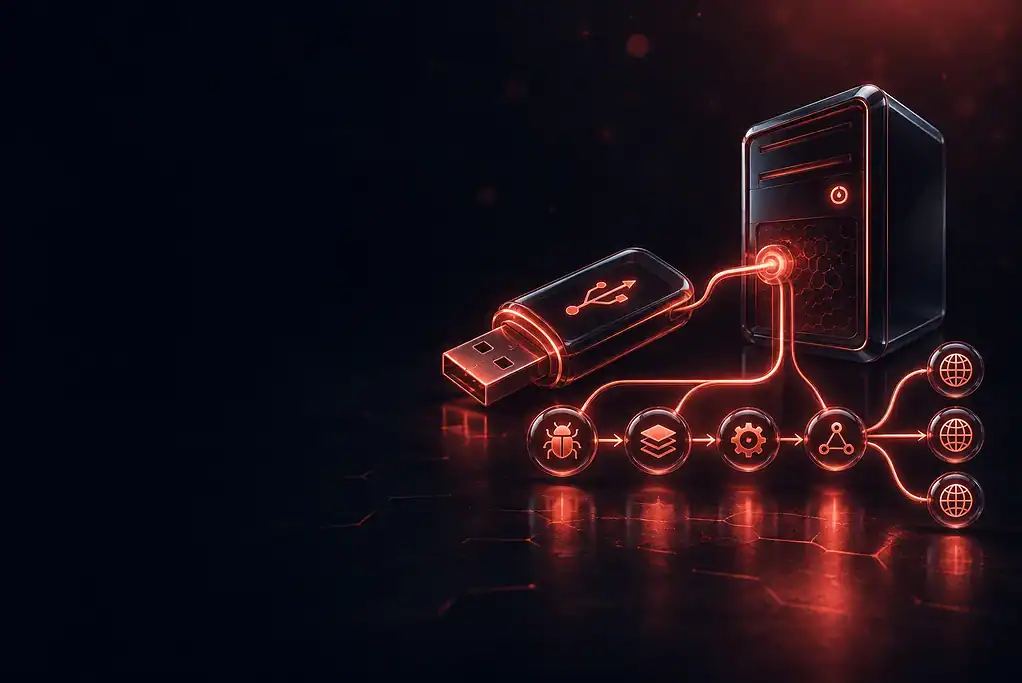
Retadup CoffeeLoader activity links an old USB worm to a newer malware delivery chain. In research published on November 16, 2026, Kaspersky says Retadup infrastructure has served CoffeeLoader since early 2025. Its August 2026 analysis found a changed CoffeeLoader package and downloader, while the older worm still provided an initial route onto Windows systems.
The distinction matters for response. A removable drive can introduce Retadup, but later command traffic and CoffeeLoader persistence are separate events to investigate. Kaspersky says its products blocked Retadup infection attempts on around 15,000 systems during the first three quarters of 2026. That is a count of systems with blocked attempts, not a count of successfully infected systems.
What Is the Retadup CoffeeLoader Connection?
Retadup is a worm first identified in 2017, according to Kaspersky. It copies itself onto connected USB and external drives as hidden files and shortcut files. A person opening the shortcut on another Windows computer can move the worm to that machine. Once installed, Retadup can receive commands and download additional malware.
Kaspersky describes a second life for Retadup’s command infrastructure. French law enforcement took control of its servers in July 2019 and used them to remove the worm from more than 850,000 infected machines over subsequent weeks. According to Kaspersky, someone began re-registering former command domains in 2024. Those servers first delivered SmokeLoader and began serving CoffeeLoader in early 2025.
The research does not identify who revived the infrastructure. Retadup’s command protocol is simple enough that control of a former server does not establish control by the original worm author. Treat the operational link as observed delivery, not attribution to a named actor. The malware glossary gives teams a shared term for the worm, downloader and final payload without treating them as one executable.
How Does the USB Worm Lead to a Loader?
The first stage is physical media. Kaspersky says an infected drive carries hidden worm files and deceptive shortcuts. The shortcut requires a user action on a second computer; simply finding a drive in inventory does not show that execution happened. An investigation should therefore connect drive insertion, shortcut execution and subsequent endpoint activity.
After Retadup is present, a command server can tell it to retrieve another program. Kaspersky observed this older worm channel serving CoffeeLoader, including a 2017 Retadup variant still able to communicate in 2026. That finding explains why a legacy worm detection can be the start of a current incident. It does not mean every historical Retadup infection received CoffeeLoader.
- Infected driveRemovable mediaUser opens a shortcut
- Retadup wormWindows hostReceives a later command
- Command infrastructureRemote serviceDelivers another program
- CoffeeLoader installerWindows hostStarts the new package
- Persistent downloaderWindows hostFetches the main body
- CoffeeLoader main moduleWindows host
This path summarizes Kaspersky’s described stages, rather than proving that each stage ran on every host. For an organization managing removable media, the useful decision is where to inspect the chain. Drive controls address introduction, while endpoint and network records help establish what happened afterward. cyber threat intelligence can support the correlation of a legacy worm alert with a current delivery campaign.
What Changed in the August 2026 CoffeeLoader Variant?
Kaspersky detected the new CoffeeLoader variant in August 2026. Its installer used a modified archiver library that carried a changed Armoury packer. Kaspersky says the older packer used OpenCL for GPU-assisted decryption, while the newer version uses OpenGL. This is a packaging change, not evidence that the worm’s USB spread itself changed.
The packer now opens an intermediate CoffeeLoader downloader. Kaspersky says this downloader combines installation, process staging and retrieval of the main malware body. It can copy its library under a Windows application-data location and create a Run registry entry for logon persistence. The registry Run keys technique profile explains why that startup location matters to defenders.
After persistence, the downloader injects into a Windows process and contacts the CoffeeLoader server over HTTPS. Kaspersky says it checks a server response signature and checksum before running the downloaded body. The main CoffeeLoader module still supports receiving and running further payloads. This makes removal of a visible second-stage process insufficient when the downloader and startup entry remain.
Kaspersky found changes to communication and response verification in the main module, but says its observed payload-running functions did not change. The process injection technique profile is relevant to the host investigation. Analysts should verify the parent process, loaded library and timing locally before treating a generic injection alert as this campaign.
Where Should Defenders Check First?
Start with the removable media and the first endpoint that reported Retadup. Review device connection records, shortcut launches and the process history around that time. Then check whether Retadup made subsequent command connections or started another installer. This separates an attempted USB introduction from an installed worm and from a later CoffeeLoader stage.
On hosts with a credible second stage, compare new Run entries and libraries under application-data directories with the approved baseline. Kaspersky’s observed downloader used generated names, so a name match alone is a weak test. Pair startup changes with process injection telemetry and outbound HTTPS activity from the same host. Preserve the sequence before removing files or changing registry entries.
- Confirm introductionReview USB connection and shortcut execution on the first host.
- Establish worm activityCheck Retadup detections and later command traffic in time order.
- Inspect persistenceCompare new Run entries and application-data libraries with the host baseline.
- Check the second stageCorrelate suspicious process injection with outbound HTTPS and installer activity.
- Contain and recoverIsolate confirmed hosts, preserve evidence, remove persistence and verify clean startup.
This checklist is our response sequence based on Kaspersky’s reported chain. A blocked worm attempt does not by itself prove that a downloader ran. Conversely, clearing a USB drive does not resolve a host that already has a persistent downloader. Scope every response step to evidence from the affected machine and its timeline.
What Do the Available Numbers Say About Risk?
Kaspersky’s first-three-quarters 2026 measure covers around 15,000 systems where its products blocked Retadup worm infection attempts. Kaspersky says most of those systems were in Peru, Angola, Russia and Bolivia. The unit is systems with blocked attempts in its product telemetry, not confirmed infections or all global exposure. The geography should guide local prioritization only alongside an organization’s own asset and media records.
Brandefense Blackhole recorded 10 dark-chat posts matching Retadup from August 18 through November 16, 2026. The measured unit is matching posts, and separate source counts may overlap. Discussion volume cannot establish CoffeeLoader delivery, a victim count or the identity of the operator. Kaspersky’s malware analysis remains the basis for the delivery claim.
The main uncertainty is attribution and the number of completed infections. Kaspersky does not identify whether the original Retadup author or another operator reused the infrastructure. Its blocked-attempt figure cannot answer how many hosts went on to run CoffeeLoader. For a defender, the actionable question is narrower: did a specific host progress from removable-media execution to worm traffic, persistence and a later payload?
Frequently Asked Questions
How can Retadup reach another Windows computer?
Kaspersky says the worm copies itself to connected drives as hidden files and shortcuts. Opening an infected shortcut on another computer can move it there.
Does a Retadup alert prove CoffeeLoader ran?
No. Confirm a later command, installer activity, persistence and downloader evidence on that host before concluding CoffeeLoader executed.
What should a defender inspect after a suspicious USB shortcut?
Review device and shortcut execution records first. Then correlate worm command traffic, new Run entries, application-data libraries, process injection and outbound HTTPS.
Are the 15,000 systems confirmed Retadup infections?
No. Kaspersky describes systems where its products blocked Retadup infection attempts during the first three quarters of 2026.
