


Key takeaways
- An open server exposed a mitmproxy root CA private key, a proxy auto-config script and two logs.
- Anyone with that key can forge certificates that endpoints trusting the root will accept.
- Odin counted 2,992 mitmproxy, GoPhish, ScopeSentry, Yakit and Nemo endpoints; most are candidates, but 26 of 34 Yakit backends are confirmed or suspected.
- A separate 314-file server staged PowerSploit loaders and lures, likely for an assessment.
- Audit root certificate stores and lock proxy auto-config settings to approved hosts.
Odin by Brandefense found an open server exposing the private key of a mitmproxy root certificate authority (CA). Next to it sat a proxy auto-config script and two large logs. We also found a separate 314-file server staging PowerSploit loaders and phishing material, and 2,992 endpoints running interception, phishing and reconnaissance tools. For defenders, the lesson is simple. A root certificate in your trust store is only as safe as its private key, and that key can leak.
Why does a leaked root key matter?
mitmproxy is a popular tool for reading HTTPS traffic. It creates its own root CA. To intercept a device's traffic, that device must trust the root. Developers, red teams and attackers all set this up.
Once a device trusts the root, the root's private key can sign a certificate for any website. The device will accept a fake certificate for a cloud login page, an internal portal or a bank without any warning. Normally only the person who ran mitmproxy holds that key.
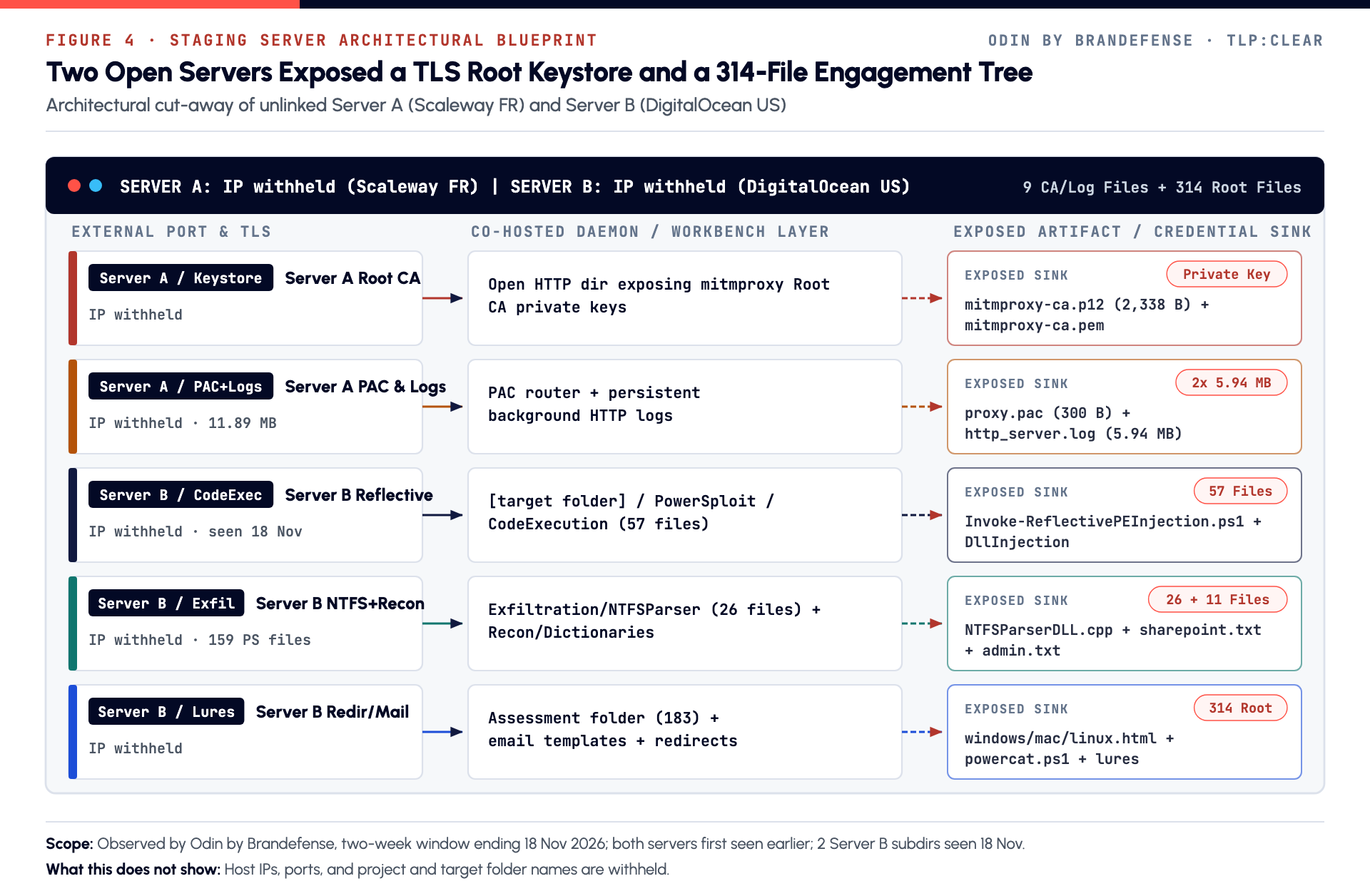
On Server A, a Scaleway host in France, the key sat in an open web directory. It was there in both PEM and PKCS#12 form. Anyone who fetched it gained the same power over every device that trusts this root. We withhold the server's address and port so that nobody can retrieve the key.
The server was first seen before this window. We could not confirm that the server was still online in November. The risk does not depend on that. Any device that trusts this root stays exposed until the root is removed.
How could traffic reach an interception proxy?
The server also held a 300-byte proxy.pac file. A proxy auto-config (PAC) file is a small script that tells a browser which proxy to use for each website. If a device's settings point to an external PAC file, that script decides where traffic goes.
This is a quiet way to intercept traffic. The script can send only chosen sites, such as a login portal, to an interception proxy on a high port. Everything else goes direct, so users notice nothing.
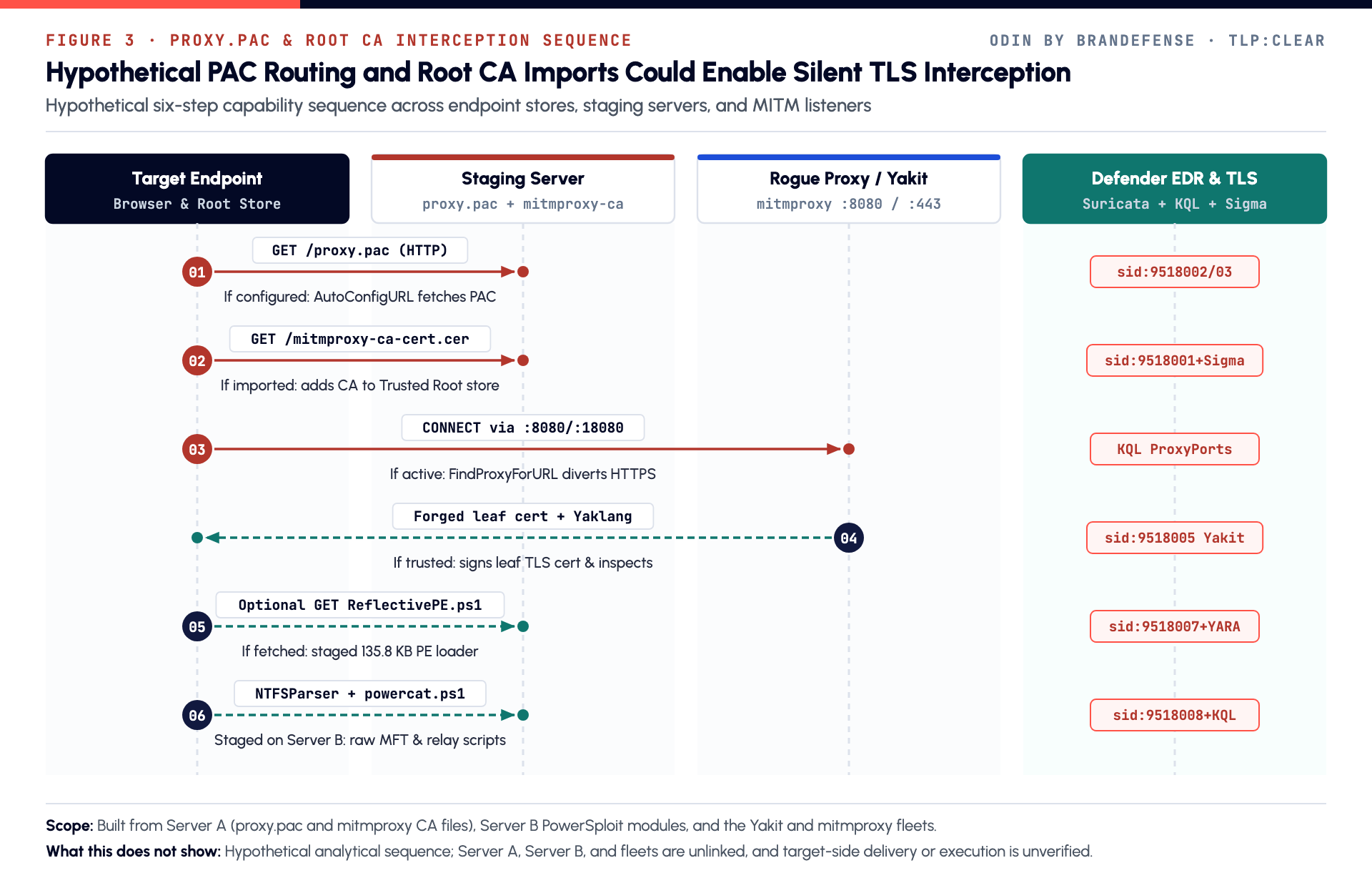
The figure above is a model, not an observed attack. It shows how a PAC file, a trusted root and a proxy listener could work together. We saw the parts. We did not see them used against any target.
What tools are out there?
Across five tool families, Odin by Brandefense counted 2,992 endpoints on 2,170 IPv4 addresses in a two-week observation window ending 18 November 2026.
| Tool | What it does | Endpoints | Actionable |
|---|---|---|---|
| mitmproxy | Programmable TLS interception proxy | 2,066 | 208 |
| GoPhish | Phishing campaign server | 766 | 152 |
| ScopeSentry | Attack surface discovery console | 120 | 10 |
| Yakit (Yaklang) | All-in-one GUI with MITM, fuzzing and PoC scanning | 34 | 26 |
| Nemo | Automated asset discovery | 6 | 6 |
Most mitmproxy, GoPhish and ScopeSentry endpoints are uncorroborated candidates. Many mitmproxy listeners sit inside commercial proxy networks, and security teams use all three tools legitimately. Blocking them by port alone would cause real damage.
Yakit and Nemo are the opposite: small fleets, mostly confirmed. Yakit combines a desktop interface with a remote engine that can intercept traffic, fuzz web parameters and run exploit checks from one console. 26 of its 34 endpoints are confirmed or suspected.
What was on the second server?
Server B, on DigitalOcean in the United States, held 314 files in 33 directories. It mixed phishing email templates, redirect pages for Windows, macOS, Linux and Android, and a 159-file copy of PowerSploit.
PowerSploit is a well-known open-source post-exploitation toolkit. The staged copy includes loaders that run a program straight from memory, code that reads raw NTFS disk volumes, a PowerShell relay tool, and wordlists for probing SharePoint and admin portals. Two of its subfolders were seen again on 18 November 2026.
Folder names suggest an authorized red-team or awareness assessment, not hostile staging. We withhold the address and the folder names, which point to a target organization. The files show tooling and intent. They do not show that anything ran against a target. We keep this server on a review watchlist and publish its file hashes for hunting.
Nothing links Server A, Server B and the five fleets to one operator. We describe them together because they cover the same chain of capabilities: map the target, send a lure, intercept traffic, then stage tools.
What to do now
- Audit root certificate stores. Compare Windows, macOS and browser root stores with your approved list. Remove any
CN=mitmproxyroot nobody approved, and alert on command-line certificate imports. - Lock proxy auto-config. Set
AutoConfigURLthrough Group Policy or MDM, disable unauthenticated WPAD fallback, and alert on browsers fetchingproxy.pacfrom external hosts. - Watch proxy-port egress with care. Flag browser traffic to ports such as 8080, 18080, 31280 and 32300 outside approved gateways. Block it only when a PAC or root certificate signal agrees.
- Watch PowerShell loaders. Turn on Script Block Logging and AMSI, and alert on
Invoke-ReflectivePEInjection,Invoke-DllInjectionandpowercat.ps1. - Use the published rules and hashes. The full report's Detection rules tab has Suricata, Sentinel KQL, Sigma and YARA rules. The full report's Indicators tab has 9 file hashes from Server B.
The full report covers the server contents, fleet ports and hosting, and the logic of each detection rule in detail.
What is…?
Short explanations of the tools and families named in this study.
What is mitmproxy?
mitmproxy is an open-source interactive HTTPS proxy. It installs its own root certificate to read encrypted traffic.
More about mitmproxyOffensive frameworkWhat is PowerSploit?
PowerSploit is an archived open-source collection of PowerShell modules for post-exploitation.
More about PowerSploitSecurity testing suiteWhat is Yakit?
Yakit is a security testing suite with a desktop interface and a remote engine that can intercept traffic, fuzz web parameters and run exploit checks.
More about YakitPhishing frameworkWhat is GoPhish?
GoPhish is an open-source phishing simulation framework. Companies use it for awareness training and attackers use it for real campaigns.
More about GoPhishReconnaissance platformWhat is ScopeSentry?
ScopeSentry is an open-source asset discovery and scanning platform that maps subdomains, ports and web services.
More about ScopeSentryReconnaissance platformWhat is Nemo?
Nemo is an open-source asset collection and reconnaissance platform with a web console.
More about NemoFrequently asked questions
Why does a leaked root key matter?
mitmproxy is a popular tool for reading HTTPS traffic. It creates its own root CA. To intercept a device's traffic, that device must trust the root. Developers, red teams and attackers all set this up.
How could traffic reach an interception proxy?
The server also held a 300-byte proxy.pac file. A proxy auto-config (PAC) file is a small script that tells a browser which proxy to use for each website. If a device's settings point to an external PAC file, that script decides where traffic goes.
What tools are out there?
Across five tool families, Odin by Brandefense counted 2,992 endpoints on 2,170 IPv4 addresses in a two-week observation window ending 18 November 2026. Most mitmproxy, GoPhish and ScopeSentry endpoints are uncorroborated candidates. Many mitmproxy listeners sit inside commercial proxy networks, and security teams use all three tools legitimately. Blocking them by port alone would cause real damage.
What was on the second server?
Server B, on DigitalOcean in the United States, held 314 files in 33 directories. It mixed phishing email templates, redirect pages for Windows, macOS, Linux and Android, and a 159-file copy of PowerSploit.