


1. Executive Summary
In short
Odin by Brandefense found an open server exposing a mitmproxy root CA private key, a separate 314-file PowerSploit staging server, and 2,992 proxy, workbench and phishing endpoints. Nothing links these to one operator, so we group them in an analytical model, not a campaign. A leaked root key lets anyone sign certificates that every endpoint trusting that root will accept. Audit your root certificate stores for mitmproxy roots, and lock proxy auto-config settings to approved corporate hosts.
TLS interception tools such as mitmproxy are standard kit for developers and red teams. They become dangerous when their root certificate sits in an endpoint's trust store and the private key is no longer private. This report looks at two exposed servers and five tool fleets that cover reconnaissance, phishing, interception and post-exploitation staging.
An open server exposed a mitmproxy root CA private key.
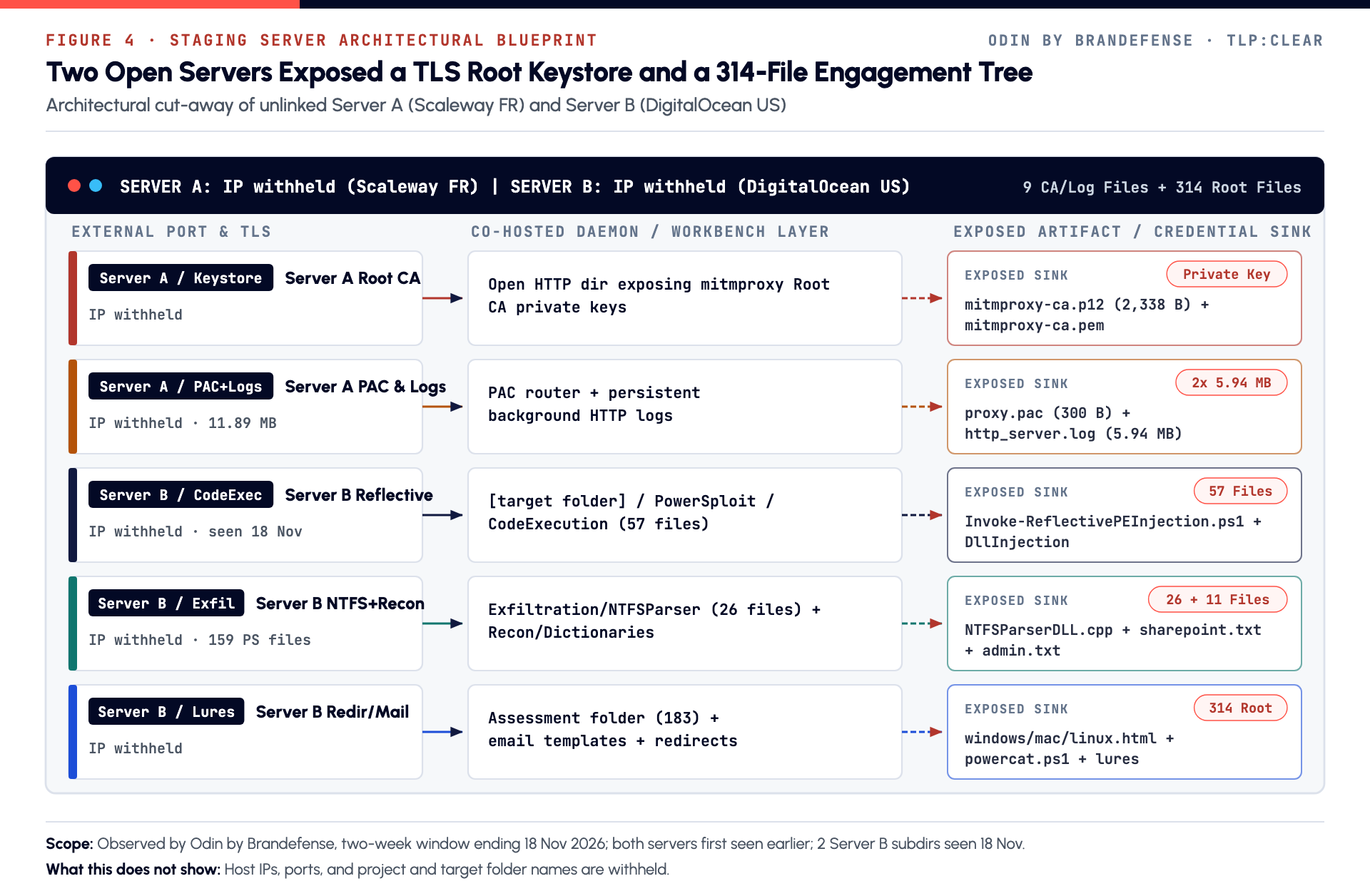
Server A, on Scaleway in France, served 9 files (11.89 MB). They include the mitmproxy root CA in PEM and PKCS#12 form with the private key, a 300-byte proxy auto-config script and two 5.94 MB logs. Its address and port are withheld so nobody can fetch the key.
Five tool fleets cover recon, lures and TLS interception.
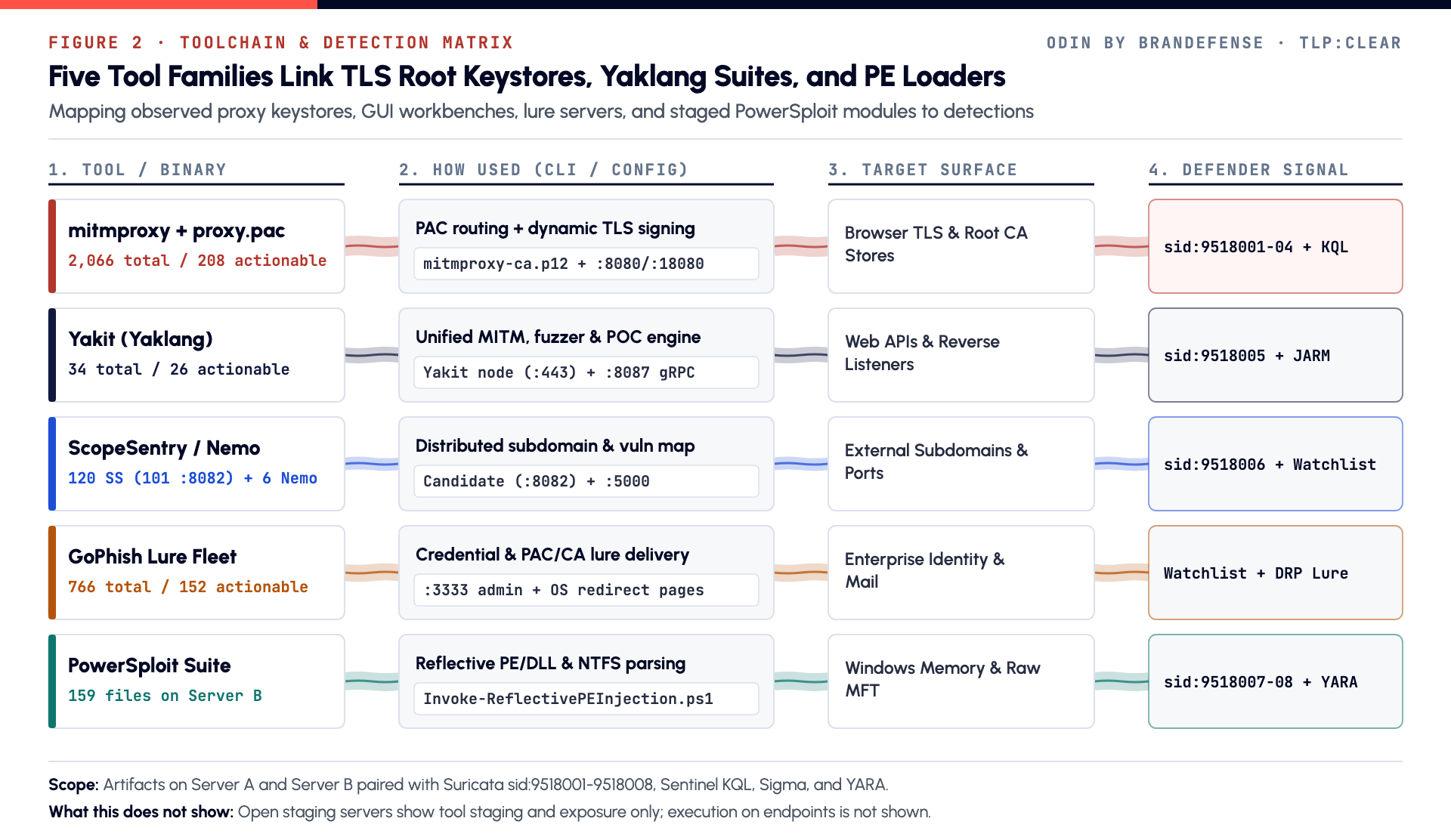
We counted 2,992 endpoints on 2,170 IPv4 addresses running mitmproxy, GoPhish, ScopeSentry, YakitSecurityTool and Nemo. Of 2,066 mitmproxy endpoints, 208 are confirmed or suspected interception listeners. Yakit has the densest high-signal share: 26 of 34 endpoints.
A 314-file staging server pairs lures with PowerSploit loaders.
Server B, on DigitalOcean in the United States, holds 314 files in 33 directories. They include OS-specific redirect pages, phishing templates and a 159-file PowerSploit tree with reflective loaders and raw NTFS parsers. Folder names suggest an authorized assessment, and no use against a target is shown.
Three Decisions for Leaders
- Audit root certificate stores and block unapproved imports. Compare endpoint root stores with your approved PKI thumbprints. Remove any mitmproxy root that nobody approved, and alert on command-line certificate imports.
- Lock proxy auto-config to approved gateways. Set the browser
AutoConfigURLvalue through Group Policy or MDM. Watch browser egress to ports 8080, 18080, 31280 and 32300 when a PAC or certificate signal backs it up. - Treat a leaked key differently from an assessment workspace. Use Server A's key material for root-store cleanup and historical hunting. Keep Server B and uncorroborated recon consoles on review watchlists, not automatic block lists.
The Study in Numbers
| Number | What it is |
|---|---|
| 9 files | Root CA keys and certificates, a proxy auto-config script and two 5.94 MB logs on Server A (11.89 MB in total) |
| 314 | Files in 33 directories on Server B, including 159 PowerSploit files |
| 2,992 | Proxy, workbench and phishing endpoints on 2,170 unique IPv4 addresses, across five tool families |
| 208 | Confirmed or suspected mitmproxy interception listeners, out of 2,066 mitmproxy endpoints |
| 152 | Actionable GoPhish lure servers, out of 766 GoPhish endpoints |
| 26 of 34 | Yakit (Yaklang) backends that are confirmed or suspected (76.5%) |
| 9 | Published indicators: Server B file SHA-256 hashes (6 host entries and 9 file hashes withheld) |
How to use this report.
Security leaders can read Chapter 1 and Chapter 7. PKI and endpoint teams should read Chapters 3 and 5, then the checklist in Chapter 7. Detection engineers should start with Chapters 8 and 9.
2. One Model, Four Roles
In short
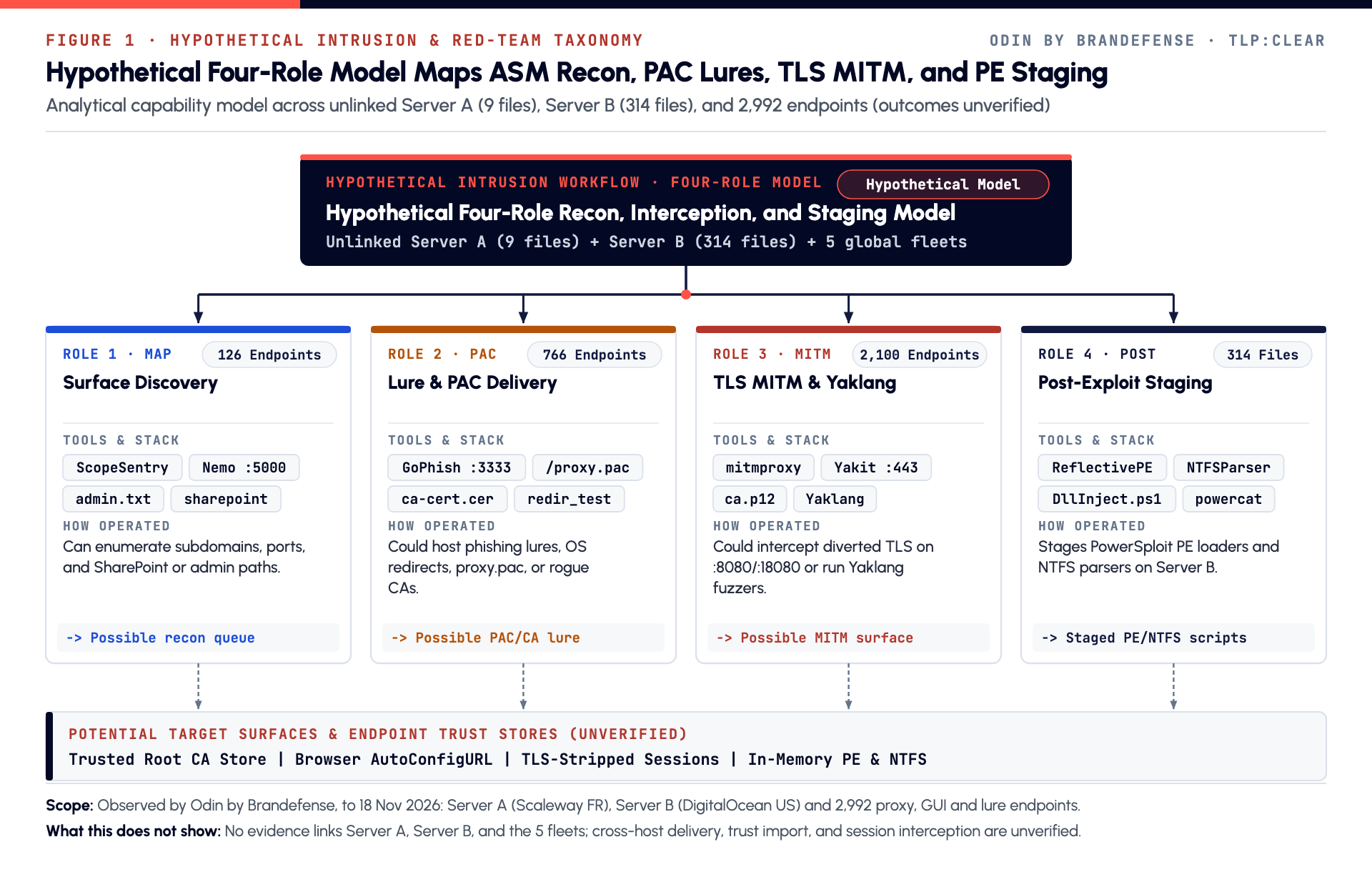
The two servers and five fleets are not linked to one actor. We use a four-role analytical model to show how these capabilities could chain, and where a defender can break the chain.
What the model is and is not
No shared credential, TLS certificate or network flow links Server A, Server B and the five fleets. The four roles below are an analytical model. They describe capabilities, not an observed campaign. Lure delivery, trust-store installation and session interception are all unverified.
What we looked at
| Cluster | Hosting | Size | How to treat it | Role in the model |
|---|---|---|---|---|
| Server A: exposed root CA | Scaleway, France | 9 files | Block list for root-store cleanup, after a fresh ownership check | mitmproxy root keys, proxy.pac and two logs |
| Server B: staged engagement tree | DigitalOcean, United States | 314 files | Watchlist and hunt | 159 PowerSploit files, powercat.ps1, OS redirect pages and lures |
| mitmproxy fleet | 1,345 IPs | 2,066 endpoints | Hunt and watch | Programmable TLS interception proxies, led by 32300 (505), 8080 (192), 8081 (125) and 18080 (25) |
| GoPhish fleet | 672 IPs | 766 endpoints | Hunt and watch | Phishing panels, led by 3333 (417) and 443 (127) |
| ScopeSentry fleet | 118 IPs | 120 endpoints | Watchlist | Attack surface consoles, led by 8082 (101) |
| Yakit (Yaklang) fleet | 31 IPs | 34 endpoints | Hunt and watch | MITM, fuzzing, PoC scanning and reverse-listener backends on 443 and 8087 |
| Nemo fleet | 6 IPs | 6 endpoints, all confirmed | Watchlist | Automated asset discovery consoles on 5000 |
The four roles
| Role | Capability | What we saw | What is not shown |
|---|---|---|---|
| 1. Surface discovery | Enumerate subdomains, ports and admin paths | ScopeSentry (120 endpoints, 101 on 8082), Nemo (6 on 5000), and admin.txt and sharepoint.txt wordlists on Server B | Any link from these consoles to Server B |
| 2. Lure and PAC delivery | Host lures that ask a user to import a root CA or set an external proxy.pac URL | GoPhish panels on 3333; OS-specific redirect pages on Server B; proxy.pac and the public CA certificate on Server A | Any delivery from these servers. No .pac or .cer page was seen on GoPhish endpoints |
| 3. TLS interception | Divert browser traffic and sign leaf certificates on the fly | mitmproxy listeners on 8080 and 18080; Yakit on 443 and 8087; the exposed root key on Server A | Any intercepted session |
| 4. Post-exploitation staging | Hold in-memory loaders and relays for download | Reflective PE and DLL loaders, NTFS parsers and powercat.ps1 on Server B | Any execution on a target |
3. The Exposed Root CA on Server A
In short
Server A exposed a full mitmproxy root CA, with the private key, next to a proxy auto-config script and two large logs. Anyone holding that key can forge certificates for any domain on endpoints that trust the root.
What the server held
Server A sits on Scaleway SAS in France. Its open directory listed 9 files totaling 11,891,086 bytes. The server was first seen before this window. We could not confirm that it was still online in November, so check liveness and ownership before any network block.
The address and port are withheld because the directory may still be reachable. Private key material and the client addresses inside the two logs are also withheld. The file names below are mitmproxy defaults, so hunters can search for them on their own systems.
| File name | Size (bytes) | What it exposes |
|---|---|---|
http_server.log | 5,940,980 | HTTP access log recording external fetches of proxy.pac and certificates |
nohup.out | 5,940,468 | Output of a background HTTP or proxy process |
mitmproxy-ca.pem | 2,851 | Unencrypted PEM bundle with the root CA private key and certificate |
mitmproxy-ca.p12 | 2,338 | PKCS#12 keystore with the root CA private signing key |
mitmproxy-ca-cert.cer | 1,172 | Public root CA certificate, in the format Windows uses for trust import |
mitmproxy-ca-cert.pem | 1,172 | The same public certificate in PEM form (same file hash as the .cer) |
mitmproxy-ca-cert.p12 | 1,035 | PKCS#12 wrapper of the public certificate, without the private key |
mitmproxy-dhparam.pem | 770 | Diffie-Hellman parameters generated by mitmproxy |
proxy.pac | 300 | JavaScript FindProxyForURL policy that steers browser traffic to an external proxy |
Why a leaked root key matters
mitmproxy creates its own root CA. To intercept HTTPS, an endpoint must trust that root. This happens in red-team tests, developer setups and rogue proxy schemes alike.
Once the root sits in the Trusted Root Certification Authorities store, its key can sign a certificate for any domain. That includes *.microsoftonline[.]com, internal single sign-on portals and banking sites. The endpoint will accept those certificates without a warning.
The usual safeguard is that only the person who ran mitmproxy holds the key. On Server A, the key sat in an open directory. Any third party who fetched it gained the same signing power over every endpoint that trusts this root.
A note for hunters: Windows root-store queries use the SHA-1 thumbprint of the decoded certificate (X509Certificate2.Thumbprint), not a file hash. Search stores by the CN=mitmproxy subject, and search disks by the default mitmproxy file names.
How a PAC file steers only the traffic that matters
A proxy auto-config (PAC) file is a small script that tells a browser which proxy to use for each URL. Setting Windows AutoConfigURL to an external proxy.pac makes the browser call FindProxyForURL(url, host) for every request.
This is quieter than a VPN. The PAC script can send chosen domains to a high-port mitmproxy listener and let all other traffic go DIRECT. Across the mitmproxy fleet, the common listener ports are shown below.
| Port | mitmproxy endpoints |
|---|---|
| 32300 | 505 |
| 8080 | 192 |
| 8081 | 125 |
| 8443 | 64 |
| 8888 | 55 |
| 18080 | 25 |
| 3128 and 31280 | 9 |
Of the 2,066 mitmproxy endpoints, 15 also serve an open HTTP directory on the same host. One of these is confirmed and 14 are candidates.
4. GUI Workbenches: Yakit, ScopeSentry, Nemo and GoPhish
In short
Graphical attack suites put reconnaissance, phishing and TLS interception behind one console. We counted 34 Yakit backends, 120 ScopeSentry consoles, 6 Nemo servers and 766 GoPhish endpoints.
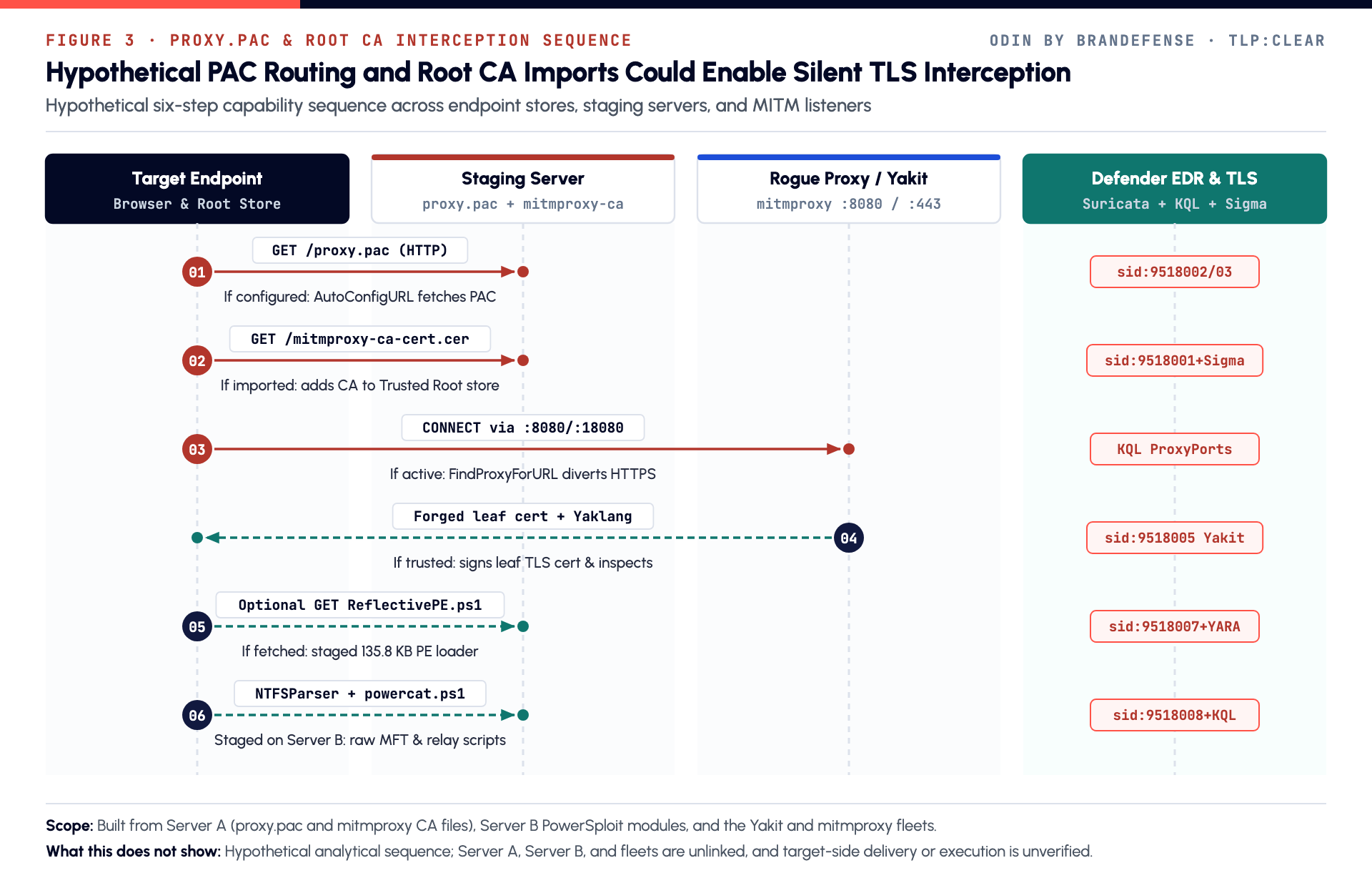
Figure 3 shows a hypothetical six-step sequence. A PAC fetch and a root CA import could let a mitmproxy or Yakit listener read diverted HTTPS, followed by a PowerSploit download. Every step is a capability. None was seen on a target.
Yakit and the Yaklang engine
Yakit pairs a desktop Electron GUI with a remote yak engine that speaks gRPC over TLS. One Yaklang daemon runs interactive MITM, parameter fuzzing, Nuclei-compatible PoC templates and reverse-shell listeners.
| Detail | Value |
|---|---|
| Endpoints | 34 on 31 IPs |
| Confirmed / suspected / candidate | 11 / 15 / 8 |
| Confirmed or suspected share | 26 of 34 (76.5%) |
| Ports | 443 (15), 8087 (6), 80 (2); 2800 also seen |
| Top countries | China (17), Hong Kong (9), United States (3) |
| Main hosting | Tencent, Alibaba, AWS |
One suspected Yakit backend on Alibaba Cloud in China, port 443, was seen on 18 November 2026. Its JARM value is 29d29d20d29d29d22c42d42d000000937221baefa0b90420c8e8e41903f1d5. Its address is withheld because it is suspected, not confirmed.
ScopeSentry and Nemo
Both platforms automate subdomain enumeration, port scanning, web spidering and vulnerability correlation across distributed worker nodes.
ScopeSentry clusters on its default port 8082, with 101 of 120 endpoints (84.2%). Only 10 rank as actionable, 109 are candidates and one sits on a dynamic-ISP watchlist. One uncorroborated candidate on Hetzner in Germany, port 8082, was seen on 18 November 2026. Its address is withheld.
All 6 Nemo instances are confirmed, and all listen on 5000.
GoPhish lure infrastructure
| Detail | Value |
|---|---|
| Endpoints | 766 on 672 IPs |
| Actionable lure servers | 152 (19.8%) |
| Watchlist or candidate | 614 |
| Ports | 3333 admin (417, 54.4%), 443 listener (127, 16.6%), 80 (37) |
| Top countries | United States (151), Germany (109), France (70) |
| Main hosting | AWS, OVH, DigitalOcean |
The GoPhish fleet fits credential lures. No .pac routing page or .cer onboarding page was seen on these endpoints. Using GoPhish to deliver a root CA or a PAC URL remains a hypothesis.
5. Inside Server B: PowerSploit and Lure Staging
In short
Server B is an open HTTP server holding 314 files across 33 directories, including a full PowerSploit tree and phishing material. Folder names point to an assessment workspace, so we treat it as a watchlist entry and hunt its file hashes.
What the server is
Server B sits on DigitalOcean in the United States. Its address, port and folder names are withheld. Folder names suggest a contracted red-team or awareness assessment, and some folders are named after a target organization. No working script bodies are reproduced here.
The root listing of 314 files was first seen before this window. In our two-week observation window, two PowerSploit subfolders were seen again on 18 November 2026: CodeExecution (57 files) and AntivirusBypass (4 files). Whether the rest of the tree is still online is not confirmed.
| Folder | Files | What it holds |
|---|---|---|
| Root | 314 | PowerSploit, phishing kits, executables and files flagged as secrets |
| Assessment parent folder (name withheld) | 183 | Engagement tree with cloud credential files, lures and powercat |
PowerSploit/ under a target-named folder | 159 | Full PowerSploit tree (mirrored under the assessment parent) |
PowerSploit/Exfiltration/ | 58 | Credential helpers and NTFSParser/ (26 files; 13 in NTFSParserDLL/) |
PowerSploit/CodeExecution/ | 57 | Invoke-ReflectivePEInjection.ps1, Invoke-DllInjection.ps1; seen again 18 November 2026 |
| Phishing email templates (folder name withheld) | 23 | 21 email templates, 18 of them in an archive subfolder |
PowerSploit/Recon/ | 11 | Web path wordlists generic.txt, admin.txt, sharepoint.txt |
| OS redirect test folder | 5 | Landing pages windows.html, mac.html, linux.html, android.html |
PowerSploit/AntivirusBypass/ | 4 | Find-AVSignature.ps1 (6,583 bytes) and module manifests; seen again 18 November 2026 |
A sample of 95 file records across 14 extension groups shows the mix: 18 .h, 15 .cpp, 10 .txt, 7 .asm, 6 .ps1, 6 .html, 6 .vcxproj and 27 project or image files.
In-memory PE and DLL loading
The CodeExecution folder holds the classic PowerSploit loaders. They are designed to map a PE file straight into powershell.exe or a remote process, without loading a DLL from disk.
| File | Size (bytes) |
|---|---|
Invoke-ReflectivePEInjection.ps1 | 135,782 |
Invoke-Shellcode.ps1 | 23,817 |
Invoke-WmiCommand.ps1 | 14,479 |
Invoke-DllInjection.ps1 | 12,721 |
The folder also holds Visual Studio C++ test harnesses (DemoDLL_RemoteProcess, ExeToInjectInTo). It has x86 and x64 assembly stubs as well: LoadLibraryA.asm, GetProcAddress.asm and CallDllMain.asm. These scripts are usually pulled into memory with a PowerShell download cradle.
Raw NTFS access and relays
The NTFSParserDLL folder (13 files) holds C++ code that reads raw NTFS volumes directly. Key files are NTFS_Attribute.h (38,460 bytes), NTFS_FileRecord.h (24,011 bytes) and NTFSParserDLL.cpp (3,795 bytes). Reading the raw volume can bypass operating system file locks.
Next to it, the assessment folder holds powercat.ps1 (37,641 bytes), a PowerShell TCP and UDP relay. Find-AVSignature.ps1 (6,583 bytes) tests where antivirus signatures start and end in a file.
SharePoint and admin portal wordlists
Three wordlists target enterprise portals: generic.txt (33,792 bytes), admin.txt (3,072 bytes) and sharepoint.txt (2,662 bytes). The SharePoint list includes paths such as _layouts/mngsiteadmin.aspx, _layouts/aclinv.aspx and _catalogs/masterpage/Forms/AllItems.aspx.
The server pairs these lists with the OS-specific redirect pages and awareness lure templates. Together they look like an engagement kit: map the portal, send a lure, then stage tooling.
6. Fleet Comparison and How to Treat Each Finding
In short
mitmproxy and GoPhish produce large candidate volumes, while Yakit and Nemo are small but mostly confirmed. Block only on several signals that agree.
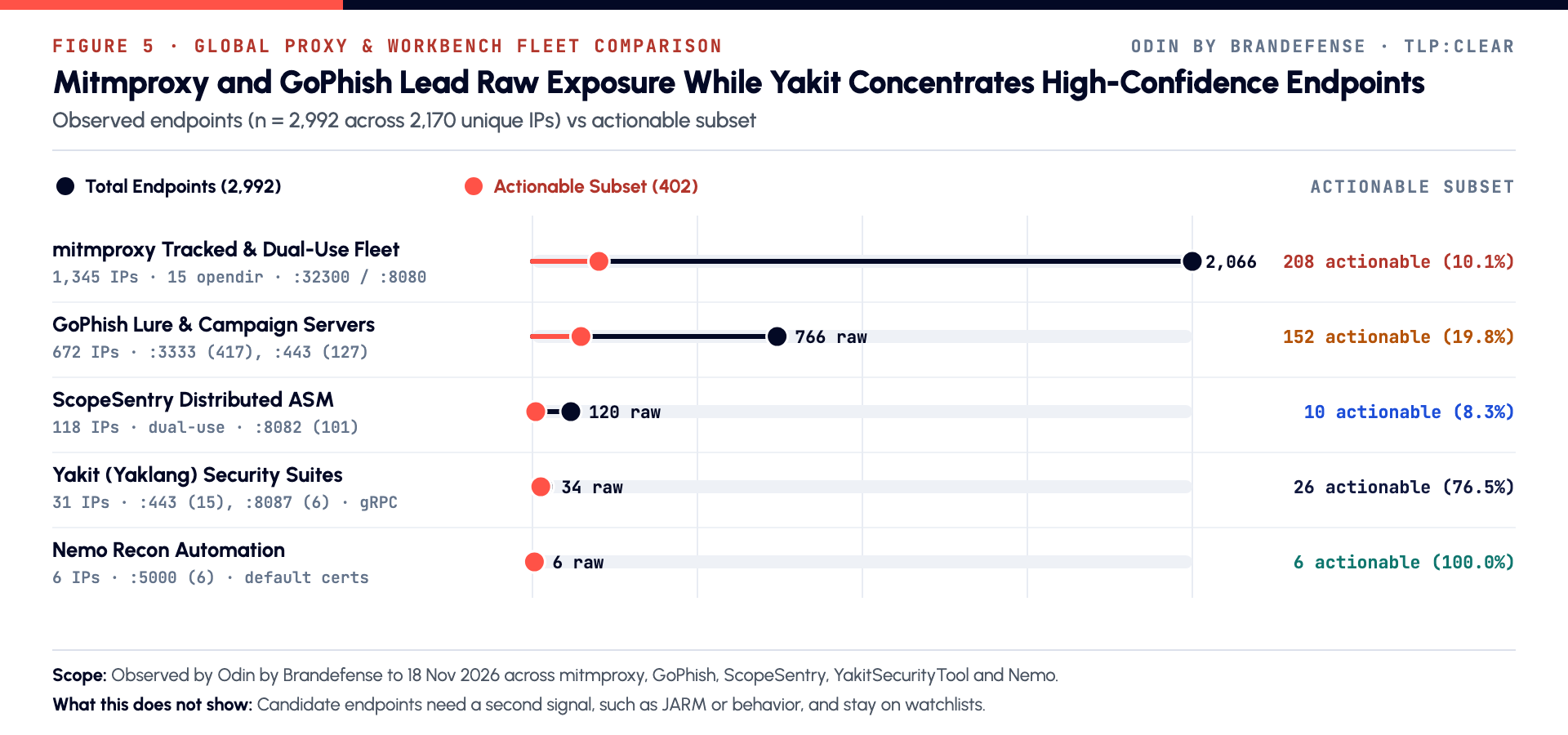
The five fleets side by side
| Fleet | Endpoints (IPs) | Actionable (share) | Main ports | Top countries | Main hosting |
|---|---|---|---|---|---|
| mitmproxy | 2,066 (1,345) | 208 (10.1%) | 32300 (505), 8080 (192), 8081 (125) | NL (592), CN (584), US (314) | ALFA TELECOM, Alibaba |
| GoPhish | 766 (672) | 152 (19.8%) | 3333 (417), 443 (127), 80 (37) | US (151), DE (109), FR (70) | AWS, OVH, DigitalOcean |
| ScopeSentry | 120 (118) | 10 (8.3%) | 8082 (101), 18082 (3), 8443 (3) | CN (37), HK (22), US (17) | Tencent, Alibaba |
| Yakit (Yaklang) | 34 (31) | 26 (76.5%) | 443 (15), 8087 (6), 80 (2) | CN (17), HK (9), US (3) | Tencent, Alibaba, AWS |
| Nemo | 6 (6) | 6 (100.0%) | 5000 (6) | CN (5), US (1) | Tencent, Alibaba, HostPapa |
mitmproxy is mostly noise, with a hard core
Of the 2,066 mitmproxy endpoints, 208 (10.1%) are confirmed (161) or suspected (47). The other 1,858 (89.9%) are candidates.
Many candidates sit on port 32300 (505 endpoints) inside commercial proxy networks. ALFA TELECOM s.r.o. hosts 377 of them and Serverel Inc. hosts 128. Ports 32300 and 8080 carry a lot of commercial and dual-use proxy traffic. Do not block by port alone. Require a PAC, JARM or certificate-store signal first.
Three alternative explanations, and what to do with each
| Question | What the evidence shows | What to do |
|---|---|---|
| Is Server B an authorized test or hostile staging? | Folder names, a proofs folder and an awareness page point to a contracted assessment. No use against a target is shown. | Watchlist pending review. Hunt its PowerSploit file hashes on endpoints. |
| Is Server A hostile? | It exposed a working root CA signing key and a proxy.pac router, whoever runs it. | Block list for root-store removal and historical egress hunting. Check liveness and ownership before a network block. |
| Are ScopeSentry and GoPhish candidates attacker C2? | Internal security teams and bug-bounty researchers use both tools widely. Only 10 of 120 ScopeSentry and 152 of 766 GoPhish endpoints are actionable. | Keep candidates, such as the Hetzner ScopeSentry console, on a dual-use scanner watchlist. |
| Is the suspected Yakit node an active workbench? | One strong signal, no endpoint evidence. | Watch and rate-limit. Contain a host only if endpoint signals agree: a root CA import, an AutoConfigURL change or a PowerShell loader. |
7. What Defenders Should Do
Within 24 hours
- Inventory Windows, macOS and browser root stores. Compare them with your approved SHA-1 thumbprints (
X509Certificate2.Thumbprint). Remove or distrust anyCN=mitmproxyroot that nobody approved. - Search disks and certificate stores for the default mitmproxy file names and
CN=mitmproxyroots. - Load the Suricata rules in alert mode and fill the approved PAC server list first.
Within 72 hours
- Lock
AutoConfigURLthrough Group Policy or MDM, and turn off unauthenticated WPAD fallback. - Alert on, or block, browser fetches of
proxy.pacfrom external hosts. - Watch browser egress to 8080, 8081, 8087, 8888, 18080, 31280 and 32300 outside documented gateways. Block when a PAC or root CA signal agrees.
Within 7 to 30 days
- Turn on PowerShell Script Block Logging and AMSI. Alert on
Invoke-ReflectivePEInjection,Invoke-DllInjectionandpowercat.ps1. - Audit raw volume reads (
\.C:) by processes other than backup tools, to catch NTFS parser use. - Rate-limit bursts of SharePoint
_layouts/enumeration. - Keep Server B, the suspected Yakit node and the ScopeSentry candidate on review watchlists, not block lists.
8. Detection Rules
The full rules are in the Detection rules tab. Every rule needs local tuning before automated action.
| Rule file | What it catches |
|---|---|
odin_mitmproxy_yakit_scopesentry_powersploit.rules | Suricata 7: eight signatures for mitmproxy CA downloads, external PAC files, Yakit and ScopeSentry markers, and PowerSploit fetches |
sentinel_rogue_root_ca_and_proxy_pac_tamper.kql | Microsoft Sentinel and Defender XDR: root CA imports, external AutoConfigURL edits, PowerSploit strings, and proxy-port egress |
sigma_windows_root_ca_install_and_proxy_pac_hijack.yml | Sigma (2 rules): certificate imports of mitmproxy roots, and external PAC registry edits or PowerSploit loader strings |
odin_mitmproxy_keystore_pac_and_powersploit.yar | YARA (4 rules): PEM root CA bundles, external PAC routing scripts, PowerSploit reflective loaders, and SharePoint recon wordlists |
How the Suricata signatures work
| SID | Looks for | Why |
|---|---|---|
| 9518001 | HTTP GET for mitmproxy-ca.p12, .pem, .cer or the -cert variants | Catches a root CA or keystore download |
| 9518002 | Outbound request for a URI ending in /proxy.pac to a host not on the approved PAC list | Catches a browser using an external PAC file |
| 9518003 | Inbound response with FindProxyForURL and PROXY from a host not on the approved PAC list | Catches the PAC script itself arriving |
| 9518004 | HTTP host mitm.it | Catches the mitmproxy certificate onboarding page |
| 9518005 | yakit, Yaklang or grpc-yakit in HTTP headers to 443, 2800 or 8087 | Catches Yakit engine traffic |
| 9518006 | /api/ request with a ScopeSentry header to 8082 or 18082 | Catches ScopeSentry console API use |
| 9518007 | GET for Invoke-ReflectivePEInjection, Invoke-DllInjection, Invoke-Shellcode or Invoke-WmiCommand .ps1 | Catches a PowerSploit loader download |
| 9518008 | GET under /PowerSploit/Exfiltration/NTFSParser/ or /PowerSploit/Recon/Dictionaries/ | Catches NTFS parser or recon wordlist downloads |
SIDs 9518002 and 9518003 need an APPROVED_PAC_SERVERS address group in suricata.yaml. Suricata will not load them without it. Leave it empty and normal cloud PAC delivery will fire both rules. Exclude mobile and QA lab VLANs from SID 9518004, since developers there may onboard mitm.it on purpose.
How the other rules work
The KQL query looks back 14 days and has three branches. The first reads process events. It flags certutil.exe, powershell.exe or pwsh.exe running -addstore, Import-Certificate or Import-PfxCertificate with a root or mitmproxy file. It also flags PowerSploit names on a command line.
The second branch reads registry events for AutoConfigURL. It parses the host from the URL with parse_url and compares it with an approved PAC host list. This stops a subdomain or query string from slipping past the list.
The third branch reads network events. It flags contact with withheld staging addresses you add from your own feed. It also flags browsers or PowerShell reaching public addresses on 8080, 8081, 8087, 8888, 18080, 31280 or 32300. Fill the approved PAC host list and the PKI admin host list before alerting.
The first Sigma rule fires on certutil or a PowerShell import cmdlet aimed at the root store, together with a mitmproxy file name. The second fires on an AutoConfigURL change to an external .pac that fails an anchored hostname check, or on PowerSploit loader strings.
| YARA rule | Fires when |
|---|---|
ODIN_Mitmproxy_Exposed_Root_CA_Keystore_Bundle | PEM private-key and certificate headers appear with one of the three Base64 forms of the string mitmproxy |
ODIN_Rogue_Proxy_PAC_External_Listener_Routing | A file under 64 KB has function FindProxyForURL, a PROXY directive and one of the ports 8080, 18080, 31280 or 32300 |
ODIN_PowerSploit_ReflectivePE_And_Injection_Staging | A file under 500 KB has two of four Invoke-ReflectivePEInjection loader strings |
ODIN_PowerSploit_SharePoint_And_Admin_Recon_List | A file under 256 KB has all three listed SharePoint paths, or all three listed admin paths |
Each YARA rule needs at least two strings, and all carry file-size limits. They have no allowlist, so tune them before automated action.
How to sort a host
The triage logic never contains a host on uncorroborated evidence.
| What the host shows | Action |
|---|---|
| A corroborated root-store implant or endpoint execution | Block and contain the host |
| An external PAC hijack | Isolate the browser and reset the PAC setting |
A single certificate hash, a CN=mitmproxy subject, PowerSploit staging or a suspected Yakit node | Watchlist and rate-limit |
| An uncorroborated recon console | Dual-use scanner watchlist |
| An authorized assessment | Allowlist |
| An approved corporate proxy | Ignore |
9. Indicators
The Indicators tab holds the 9 published file hashes, all public-tool or wordlist files from Server B. The other 15 records in the selected set are withheld.
| Type | Count |
|---|---|
| Root CA keystore host for root-store cleanup (address withheld) | 1 |
| Review or watchlist hosts (addresses withheld) | 5 |
| File hashes (SHA-256) for hunting, from Server B | 9 |
| Withheld file hashes (8 distinct hashes for Server A's 9 files, 1 Server B landing page) | 9 |
The five watchlist entries are Server B, the suspected Yakit node, the ScopeSentry candidate, and one representative node each for the mitmproxy and GoPhish fleets. Supporting fingerprints are the subject CN=mitmproxy, the onboarding host mitm.it, and the Yakit JARM value in Chapter 4.
File hashes from Server A
All Server A file hashes are withheld, because the server's owner is not established. Hunt by the default mitmproxy file names and the certificate subject CN=mitmproxy instead.
File hashes from Server B
| File | Size (bytes) | SHA-256 | Where to hunt |
|---|---|---|---|
Invoke-ReflectivePEInjection.ps1 | 135,782 | c81d0073c92d0b4d0cc66a4c1d64d4ca2afbe56d78eb9d9611be8055919fd8ba | Endpoint, EDR |
Invoke-Shellcode.ps1 | 23,817 | 457cd41fbb528812aa51bc4b31fce042cdf736281b162181d91c47733d0e9e4b | Endpoint, EDR |
Invoke-WmiCommand.ps1 | 14,479 | 2cdba7fab6f6fcec2e4f10fc1a45c13a6a9d26cca2ea8b8b4e15989a198618ef | Endpoint, EDR |
Invoke-DllInjection.ps1 | 12,721 | 788121850fe9095492f79af631d43e342cdcf7a09d1becf97356dc97e4ae869d | Endpoint, EDR |
powercat.ps1 | 37,641 | cb978873ed0877c8f2c9b4d9b4cfd1c3fc4eff223abb3afc24ec687cc77f93b8 | Endpoint, EDR |
Find-AVSignature.ps1 | 6,583 | 366f5b37821f4266697350847048d2df55f6de96ad1e578baf910b9da8eed742 | Endpoint, EDR |
NTFSParserDLL.cpp | 3,795 | 814a812279c600b707500322d4e1027795cd90ed09a69a2802078c075a0ac743 | Server and network |
admin.txt | 3,072 | f2e72552cd62d3e9ecc82b80a6918706d752fcf24799dd6b2c1c09caa96307b3 | Server and network |
sharepoint.txt | 2,662 | aafc643316b5486764cb99a655978860140dfdd2aa1a19f14e955ecf5683ef48 | Server and network |
Withheld from Server A: all file hashes, the key material and client addresses. Withheld from Server B: the landing page hash. Also withheld: both server addresses and ports, Server B folder names that identify an organization, and every suspected or candidate fleet address.
MITRE ATT&CK mapping
The rules map to three ATT&CK tactics.
| Tactic | How it applies here | Detection |
|---|---|---|
| Reconnaissance (TA0043) | ScopeSentry and Nemo consoles; SharePoint and admin wordlists | SID 9518006, 9518008; YARA wordlist rule |
| Credential Access (TA0006) | Root CA trust, external PAC routing and TLS interception that exposes session traffic | SID 9518001 to 9518005; KQL; Sigma rules |
| Stealth (TA0005) | Reflective in-memory loading with no DLL on disk | SID 9518007; YARA loader rule; Sigma rule 2 |
10. Scope and Limits
- Window. Fleet counts and the two Server B subfolders come from a two-week observation window ending 18 November 2026. Both servers were first seen before this window; no earlier dates are given.
- Server A may be gone. We could not confirm Server A was still online in November. Its key material stays useful for root-store cleanup and historical hunting either way.
- No links between clusters. Nothing ties Server A, Server B and the five fleets to one operator. The four-role model is analytical.
- Staged is not used. Server B holds tooling and lures. We saw no execution, delivery or interception on any target.
- Candidates are leads. Most mitmproxy, GoPhish and ScopeSentry endpoints are candidates, and these tools have wide legitimate use.
- Rule testing. Every published rule file loads without errors in its engine (Suricata 7.0.12, YARA-X, pySigma and Microsoft's Kusto.Language analyzer, checked on 20 November 2026). The rules were not replayed against live traffic, so test and tune them in your own environment before production use.
11. Sources
- MITRE ATT&CK. Reconnaissance tactic (TA0043). https://attack.mitre.org/tactics/TA0043/ (verified 19 November 2026)
- MITRE ATT&CK. Credential Access tactic (TA0006). https://attack.mitre.org/tactics/TA0006/ (verified 19 November 2026)
- MITRE ATT&CK. Stealth tactic (TA0005). https://attack.mitre.org/tactics/TA0005/ (verified 19 November 2026)
- mitmproxy project. About Certificates. https://docs.mitmproxy.org/stable/concepts-certificates/ (verified 19 November 2026)
- Yaklang project. Yakit and the Yaklang engine. https://www.yaklang.com/ (verified 19 November 2026)
- Autumn-27. ScopeSentry repository. https://github.com/Autumn-27/ScopeSentry (verified 19 November 2026)
- PowerShellMafia. PowerSploit repository. https://github.com/PowerShellMafia/PowerSploit (verified 19 November 2026)
What is…?
Short explanations of the tools and families named in this study.
What is mitmproxy?
mitmproxy is an open-source interactive HTTPS proxy. It installs its own root certificate to read encrypted traffic.
More about mitmproxyOffensive frameworkWhat is PowerSploit?
PowerSploit is an archived open-source collection of PowerShell modules for post-exploitation.
More about PowerSploitSecurity testing suiteWhat is Yakit?
Yakit is a security testing suite with a desktop interface and a remote engine that can intercept traffic, fuzz web parameters and run exploit checks.
More about YakitPhishing frameworkWhat is GoPhish?
GoPhish is an open-source phishing simulation framework. Companies use it for awareness training and attackers use it for real campaigns.
More about GoPhishReconnaissance platformWhat is ScopeSentry?
ScopeSentry is an open-source asset discovery and scanning platform that maps subdomains, ports and web services.
More about ScopeSentryReconnaissance platformWhat is Nemo?
Nemo is an open-source asset collection and reconnaissance platform with a web console.
More about NemoFrequently asked questions
Why does a leaked root key matter?
mitmproxy is a popular tool for reading HTTPS traffic. It creates its own root CA. To intercept a device's traffic, that device must trust the root. Developers, red teams and attackers all set this up.
How could traffic reach an interception proxy?
The server also held a 300-byte proxy.pac file. A proxy auto-config (PAC) file is a small script that tells a browser which proxy to use for each website. If a device's settings point to an external PAC file, that script decides where traffic goes.
What tools are out there?
Across five tool families, Odin by Brandefense counted 2,992 endpoints on 2,170 IPv4 addresses in a two-week observation window ending 18 November 2026. Most mitmproxy, GoPhish and ScopeSentry endpoints are uncorroborated candidates. Many mitmproxy listeners sit inside commercial proxy networks, and security teams use all three tools legitimately. Blocking them by port alone would cause real damage.
What was on the second server?
Server B, on DigitalOcean in the United States, held 314 files in 33 directories. It mixed phishing email templates, redirect pages for Windows, macOS, Linux and Android, and a 159-file copy of PowerSploit.