


1. Executive Summary
In short
In a two-week window ending 18 November 2026, Odin by Brandefense observed 1,613 command-and-control (C2) endpoints across six evasive frameworks, 32 Hashtopolis cracking servers and 618 infected IoT routers. Only 55 C2 endpoints are confirmed. Another 507 Brute Ratel C4 hits are commercial VPN exits sharing a Go TLS fingerprint. One Tencent Cloud host runs 177 listeners. Nothing links the three groups. Block the 55 confirmed C2s, watchlist Hashtopolis servers, and alert when one user requests five or more RC4 Kerberos tickets in five minutes.
Modern post-exploitation frameworks are built to stay quiet on monitored workstations. Their implants avoid hooked Windows APIs, hide in memory while they sleep, and talk over ordinary-looking HTTPS. On the other side, stolen password hashes can be cracked offline on rented GPU rigs, where no domain controller sees a failed login. This report maps the internet-facing side of both: the C2 servers, the hubs that stack many listeners on one address, and the Hashtopolis servers that coordinate GPU cracking.
Six evasive C2 frameworks run on 1,613 endpoints; 55 are confirmed.
Brute Ratel C4 leads with 690 endpoints on 434 hosts. Cobalt Strike (391), DarkSword (346), Overlord (107), Mythic (54) and Havoc (25) follow. Most Brute Ratel C4 hits are not C2 at all: 507 are commercial VPN exits with the same Go TLS fingerprint.
Thirty-five hubs pack up to 177 C2 listeners onto one cloud address.
The largest, Hub-01 on Shenzhen Tencent Cloud, mixes HypeAgent (161), Cobalt Strike (14) and PlugX (2) behind spoofed Chinese bank and security-vendor certificates. In Germany, 77.72.18[.]83 runs nine confirmed Cobalt Strike listeners with one shared certificate.
Thirty-two Hashtopolis servers show the GPU cracking side, but use stays unproven.
Hashtopolis splits password-cracking jobs across remote Hashcat GPU workers. It is open-source and widely used by auditors and red teams. No hostile cracking job was observed, so these servers belong on watchlists, not blocklists.
Three Decisions for Leaders
- Remove RC4 from Kerberos and watch for ticket bursts. Move service accounts to Group Managed Service Accounts (gMSA) or random passwords of 28 or more characters, with AES-only encryption. Alert when one user requests five or more RC4 service tickets within five minutes.
- Pair memory telemetry on endpoints with precise network rules. Alert on unbacked memory threads touching LSASS or sacrificial Windows processes. Block the 55 confirmed C2 endpoints, not every Go TLS fingerprint hit or every password-auditing server.
- Control who can run Hashtopolis and Hashcat. Allow them only on named red-team audit hosts. Put the large hubs, unattributed Hashtopolis servers, infected routers and dynamic telecom addresses on short-lived watchlists.
The Study in Numbers
| Number | What it is |
|---|---|
| 2,263 | Endpoints observed on 1,759 distinct hosts, across 10 C2, cracking and IoT families |
| 1,613 | Evasive C2 endpoints across six frameworks, on 1,191 hosts |
| 55 | Confirmed hostile C2 endpoints (2.4% of all endpoints) |
| 507 | Brute Ratel C4 hits that are commercial VPN exits, not C2 |
| 177 | Listeners on the single busiest hub (Hub-01, Tencent Cloud CN) |
| 32 | Hashtopolis cracking endpoints on 26 hosts, all watchlisted |
| 618 | Infected IoT router endpoints on 542 hosts (Mirai 353, Mozi 263, Moobot 2) |
How to use this report.
Security leaders can read Chapter 1, Chapter 6 and Chapter 7. Detection engineers and SOC teams should start with Chapters 7 to 9. CTI analysts and hunters will find the infrastructure detail in Chapters 2 to 5.
2. Three Populations and One Analytical Model
In short
The data holds three separate populations: evasive C2 servers, Hashtopolis cracking servers and infected IoT routers. No shared address, certificate or traffic connects them, so Figure 1 is an analytical model of their roles, not a map of one operation.
What was observed
| Population | Endpoints | Distinct hosts | Confirmed hostile |
|---|---|---|---|
| Evasive C2 (six frameworks) | 1,613 | 1,191 | 55 |
| Hashtopolis cracking servers | 32 | 26 | 0 |
| Infected IoT routers (Mirai, Mozi, Moobot) | 618 | 542 | 0 |
| Total | 2,263 | 1,759 | 55 |
Separately, 35 multi-listener hubs bind 391 sockets in total. Of the 35 hub addresses, 21 also appear in the main fleet. The 391 hub sockets happen to equal the 391 Cobalt Strike endpoints; the two numbers are unrelated.
The three populations share no address. We also observed no traffic, shared certificate or tasking log between them. They appear together in this report because they play complementary roles in documented intrusion tradecraft (MITRE T1558.003 Kerberoasting and T1110.002 Password Cracking).
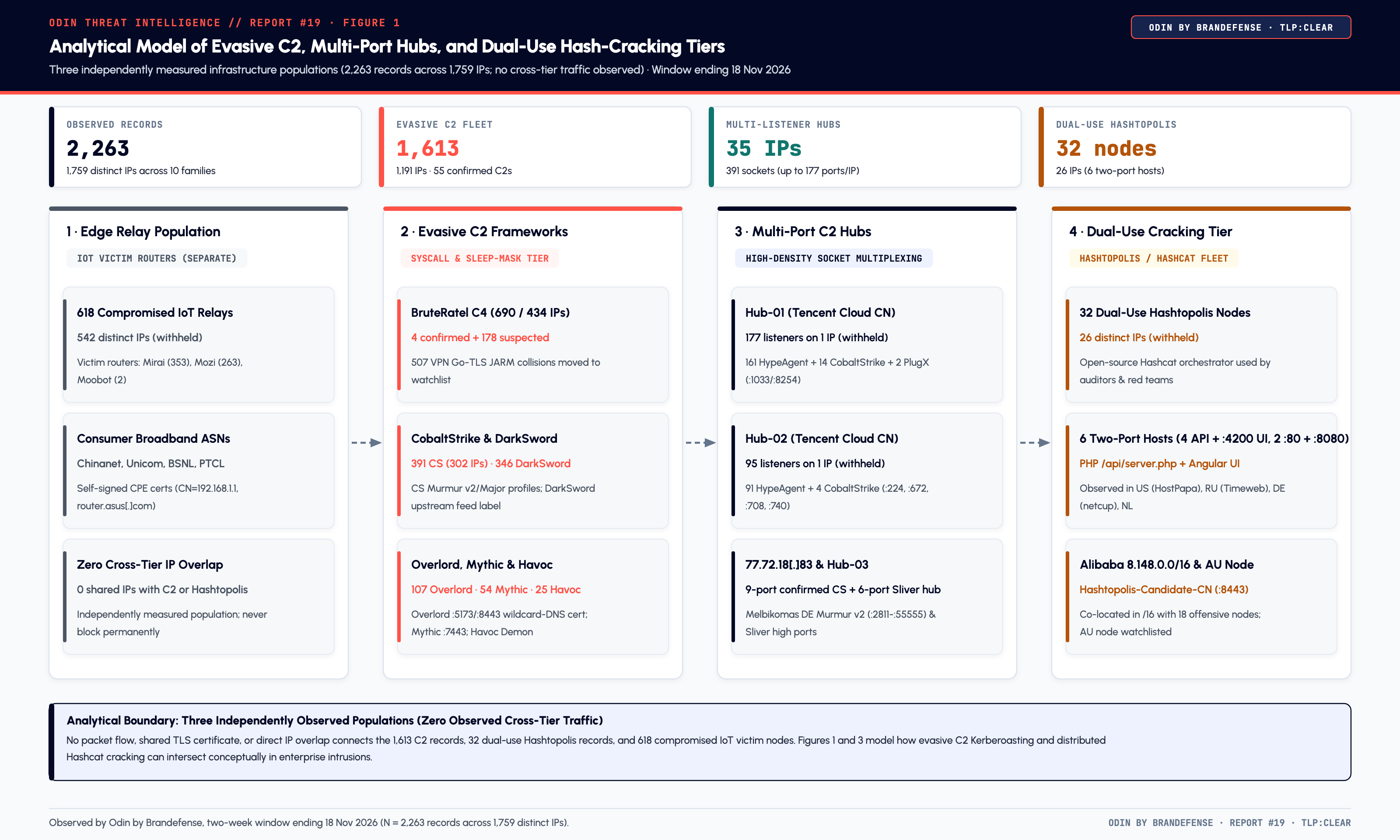
The four roles in the model
This is an analytical model. It explains why each population needs a different response.
| Role | What it is | Defender response |
|---|---|---|
| Evasive implant fleet | Brute Ratel C4, DarkSword, Overlord, Mythic and Havoc servers whose implants evade user-mode hooks and use flexible HTTPS or DNS-over-HTTPS profiles | Block confirmed listeners |
| Multi-implant hubs | Cloud servers that terminate dozens of Cobalt Strike, PlugX, HypeAgent and Sliver sockets | Watchlist and correlate; block only confirmed hubs |
| Dual-use cracking tier | Hashtopolis servers (ports 8080, 8081, 8443, 4200) that hand out Hashcat jobs through /api/server.php | Watchlist, and harden Active Directory |
| Infected IoT routers | Consumer routers showing CN=192.168.1.1, CN=router.asus[.]com or CN=ZXV10 | Victims; never block permanently |
Neighbours on the same hosts
Beyond stacking ports within one family, 59 hosts run one of the ten families next to other offensive tooling. Examples include Mythic with HexStrikeAI on confirmed host 138.197.31[.]70. Other pairs, on hosts not published here, include Mythic with AdaptixC2, DarkSword with CyberStrikeAI or mitmproxy, Havoc with HexStrikeAI, Overlord with Sliver, and Cobalt Strike with PentAGI.
3. Evasive C2 Fleets
In short
Five frameworks other than Cobalt Strike account for 1,222 endpoints. Their implants rely on indirect syscalls, hardware-breakpoint patching and encrypted sleep, and 20 of their endpoints are confirmed after the VPN look-alikes are removed.
How these implants avoid detection
Endpoint detection tools often watch Windows API calls in user mode. The implants in this chapter are documented to step around that.
| Technique | What it means |
|---|---|
| Indirect syscalls | The implant finds system call numbers itself and jumps into a syscall; ret instruction inside the real ntdll.dll, so hooks never see the call |
| Hardware-breakpoint patching | It disables AmsiScanBuffer and EtwEventWrite through CPU debug registers (Dr0 to Dr3) instead of writing to memory |
| Sleep masking | Between check-ins, it encrypts its own memory and marks it non-executable, then restores it on wake-up |
| Flexible channels | Check-ins travel over HTTPS, DNS-over-HTTPS (DoH) or SMB named pipes, shaped to look like normal traffic |
Figure 2 compares the ten families by volume, distinct hosts and port stacking, next to the top eight hubs.
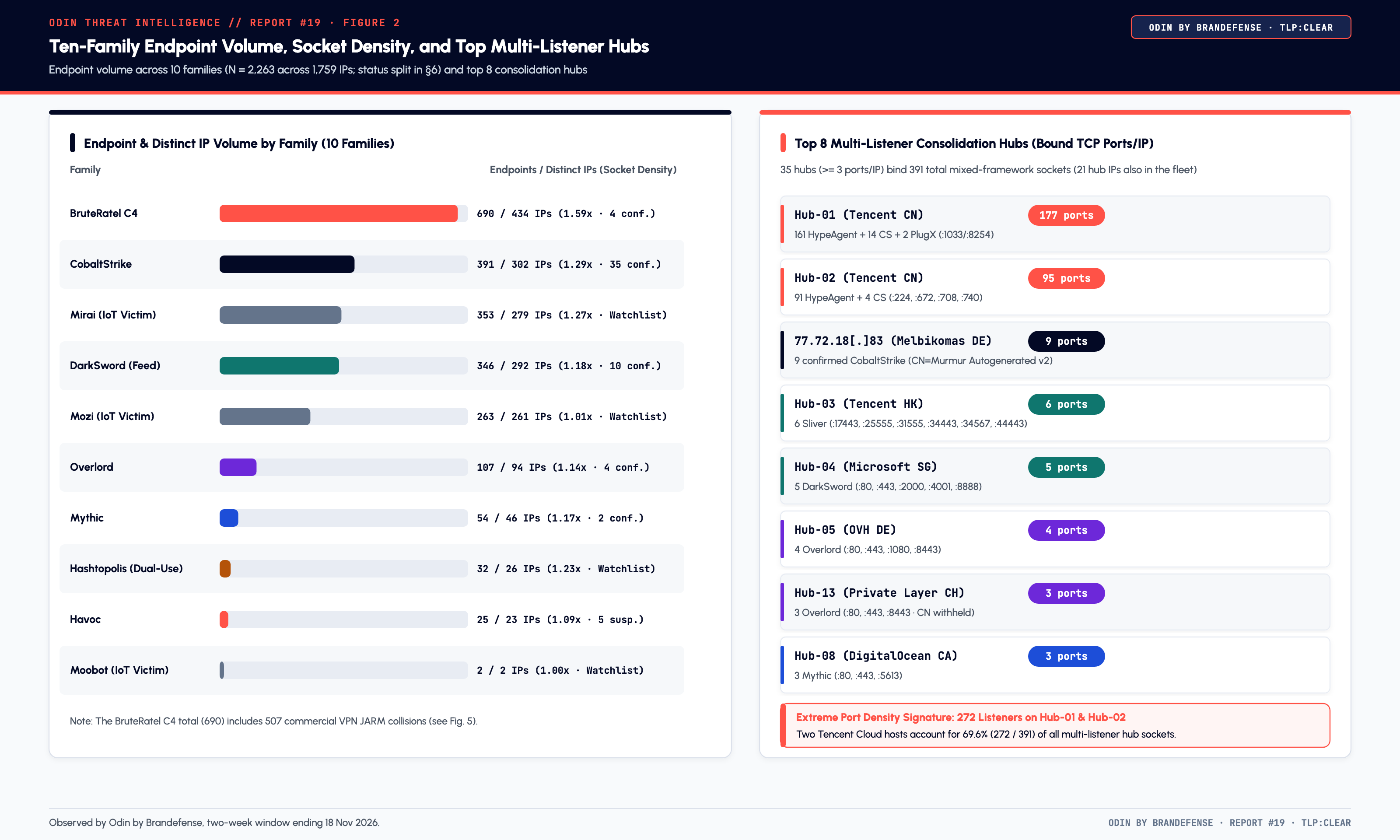
Brute Ratel C4: 690 endpoints, three very different groups
Brute Ratel C4 (MITRE S1063) has a Go teamserver called Ratel and a position-independent implant called Badger. Its 690 endpoints sit on 434 hosts, an average of 1.59 sockets per host. An upstream feed labels 523 of them "confirmed". They split into three main groups, plus one endpoint on a dynamic ISP line.
| Group | Endpoints | What it shows | Status |
|---|---|---|---|
| Dedicated Ratel servers with custom TLS | 4 confirmed, plus 23 suspected | Operator-set certificates such as CN=brute[.]bzh[.]ovh or the default placeholder CN=FQDN | Block the 4 confirmed |
| CTG Server Limited port-80 cluster | 155 | Plain HTTP on 80 in Singapore and Hong Kong, matching HTTP redirector profiles | Suspected |
| Commercial VPN exits | 507 | VPN city-rack certificates and the stock Go TLS fingerprint | Not C2; watchlist only |
| Dynamic ISP line | 1 | A match on a dynamic telecom network | 72-hour watchlist |
The four confirmed Ratel listeners all use custom TLS or custom ports. Two are published:
- 161.35.73[.]220:443 on DigitalOcean (DE), with
CN=brute[.]bzh[.]ovhand JARM3fd3fd20d...99b095c. - 78.90.248[.]224:7000 on Net-Surf.net (BG), a high-port listener with the same JARM.
The other two sit on hosts that also carry unconfirmed sockets, so their addresses are withheld. A suspected listener on Vultr in Israel shows CN=FQDN and JARM 3fd21b20d...c2286f5e on port 8081. A suspected LUCIDACLOUD host in Hong Kong listens on 9090, 9091 and 9200.
Of the 155 CTG Server Limited listeners, 11 carry an upstream "confirmed" label. They show no certificate subject or JARM, so they stay suspected until there is protocol evidence.
Badger check-ins use JSON keys such as "b_arch", "c_name" and "d_name". Badger can also run Beacon Object Files (COFF) in memory.
DarkSword, Overlord, Mythic and Havoc
DarkSword is a feed label, not an actor.
In this report, DarkSword means an upstream threat-feed label for multi-port TLS and HTTP C2 servers. It does not point to one named threat actor or to a known exploit kit.
| Framework | Endpoints (hosts) | Confirmed | Main hosting | Main ports |
|---|---|---|---|---|
| DarkSword | 346 (292) | 10 | CNServer LLC (189, 54.6%), cognetcloud INC (21), CTG Server Limited (12), NetLab Global (12), Alibaba (11) | 443 (222), 8888 (62), 80 (23), 2000 (22) |
| Overlord | 107 (94) | 4 | DE (42) and US (25); Blatant Technologies (16), OVH SAS (13), EggyWall.org (8), AWS (8), Hetzner (7), Private Layer (6) | 5173 (51, 47.7%), 443 (26), 8443 (13), 1080 SOCKS (3) |
| Mythic | 54 (46) | 2 | DigitalOcean (13), AWS (8) | 80 (18), 443 (14), 7443 (13), 4443 (3), 8443 (3) |
| Havoc | 25 (23) | 0 | AWS, DigitalOcean, Oracle, Hostinger | 443 (13), 8443 (4) |
DarkSword. Over half the fleet (183 endpoints, 52.9%) shares JARM 21d14d00021d21d00042d43d00000091f9827a8676a9d9f27d421962a09b5d. All 10 confirmed DarkSword rows sit on hosts that also carry unconfirmed sockets, so no DarkSword address is published. New candidates keep appearing on port 8888; one appeared on Alibaba Cloud Hong Kong on 18 November 2026.
Overlord. Confirmed single-socket hosts use hex-generated .invalid certificate subjects. Two are published:
| Endpoint | Hosting | Certificate subject |
|---|---|---|
| 194.26.192[.]57:9000 | 1337 Services GmbH (NL) | CN=host-43c6ed77a39b7312.invalid |
| 23.95.217[.]154:8443 | DataWagon LLC (US) | CN=host-21ffa7a17fac9f9a.invalid |
Two three-port Overlord hubs on Private Layer in Switzerland reuse a wildcard-DNS helper certificate. Each has two confirmed sockets on 80 and 8443 and one candidate on 443. Two OVH clusters share another third-party certificate pattern. Those certificate subjects are withheld.
Mythic. Mythic runs its admin and C2 service on port 7443 by default. Two confirmed listeners share JARM 1dd40d40d...9311926e:
| Endpoint | Hosting |
|---|---|
| 5.188.86[.]227:7443 | Global Layer B.V. (NL) |
| 138.197.31[.]70:7443 | DigitalOcean, LLC (US) |
Documented Mythic agents include Apollo (.NET), Poseidon (Go) and Apfell (macOS JXA). They send base64-encoded UUID and JSON messages with actions such as "checkin" and "get_tasking".
Havoc. None of the 25 Havoc endpoints is confirmed (5 suspected, 19 candidates, 1 open directory). One suspected server on Adsota Corporation in Vietnam shows CN=0.0.0.0 on 8443. Havoc's Demon implant is documented to use Ekko and Foliage sleep obfuscation. It queues timer callbacks that switch its memory to read-write, encrypts it with SystemFunction032 (RC4) while asleep, and restores execute rights on wake-up.
4. Multi-Listener Hubs and the Kerberoast Model
In short
Thirty-five hubs bind 391 mixed-framework sockets; two Tencent Cloud hosts hold 272 of them. This chapter also models, without observed evidence, how stolen Kerberos tickets could feed offline GPU cracking.
The Cobalt Strike fleet
Cobalt Strike (MITRE S0154) has 391 endpoints on 302 hosts. Of these, 35 are confirmed, 143 suspected, 207 candidates, 4 candidate open directories and 2 on dynamic ISPs. The top JARM 2ad2ad16d...ed24a4da appears on 36 endpoints, and the default teamserver port 50050 on 36.
Of the 35 confirmed, 32 sit on hosts where every socket is confirmed. Chapter 9 publishes a selected subset, including 47.239.109[.]26:3389 with CN=Major Cobalt Strike and 163.172.45[.]158:8086 with CN=Murmur Autogenerated Certificate v2.
Six flagship hubs
The 35 hubs carry 3 to 177 ports each. They split into 7 Cobalt Strike hubs, 14 Sliver hubs, 9 DarkSword hubs, 4 Overlord hubs and 1 Mythic hub.
| Hub | Hosting | Sockets | Framework mix | Certificates and status |
|---|---|---|---|---|
| Hub-01 | Shenzhen Tencent (CN) | 177 | HypeAgent 161, Cobalt Strike 14, PlugX 2 | Spoofed Chinese security-vendor, bank and cloud subjects; suspected |
| Hub-02 | Shenzhen Tencent (CN) | 95 | HypeAgent 91, Cobalt Strike 4 | Spoofed Chinese bank, payment and cloud subjects; suspected |
| 77.72.18[.]83 | Melbikomas UAB (DE) | 9 | Cobalt Strike 9 | CN=Murmur Autogenerated Certificate v2; confirmed, block |
| Hub-03 | Tencent-hosted (HK) | 6 | Sliver 6 | No certificate subject; ports 17443, 25555, 31555, 34443, 34567, 44443; candidate |
| Hub-04 | Microsoft Corp (SG) | 5 | DarkSword 5 | Third-party subject withheld; 2 confirmed, 1 suspected, 2 candidates |
| Hub-05 | OVH SAS (DE) | 4 | Overlord 4 | Third-party subject withheld; ports 80, 443, 1080, 8443; suspected |
Hub addresses other than 77.72.18[.]83 are withheld because their sockets are not all confirmed.
Hub-01: three families on one address
Hub-01 binds 161 suspected HypeAgent ports. Their certificates impersonate Chinese commercial banks and security vendors. It also binds 14 suspected Cobalt Strike ports on low ports such as 481, 490, 520, 571 and 749, with certificates that impersonate Chinese cloud and DNS providers.
The last two ports, 1033 and 8254, are suspected PlugX (Korplug, MITRE S0013). Both show a spoofed Chinese security-vendor certificate. In the hub data, PlugX appears only on Hub-01.
Hub-02 binds 95 sockets with the same spoofing template: 91 HypeAgent and 4 Cobalt Strike on 224, 672, 708 and 740. Together, Hub-01 and Hub-02 hold 272 of the 391 hub sockets (69.6%).
The Murmur certificate template
77.72.18[.]83 binds nine confirmed Cobalt Strike listeners on ports 2811, 3323, 4848, 5550, 7007, 8080, 9290, 50500 and 55555. All present CN=Murmur Autogenerated Certificate v2.
Across the data, 28 confirmed Cobalt Strike endpoints reuse this exact certificate. They include 15 listeners on 13 OVH France addresses in 92.222.152[.]0/24, on ports 10001 to 10025.
A workflow model: from Kerberos tickets to offline cracking
This section is a model, not an observation.
We saw no Kerberos tickets, hash lists, C2-to-Hashtopolis transfers, cracking results or service-account logons. Figure 3 is built from MITRE ATT&CK T1558.003 (Kerberoasting) and T1110.002 (Password Cracking).
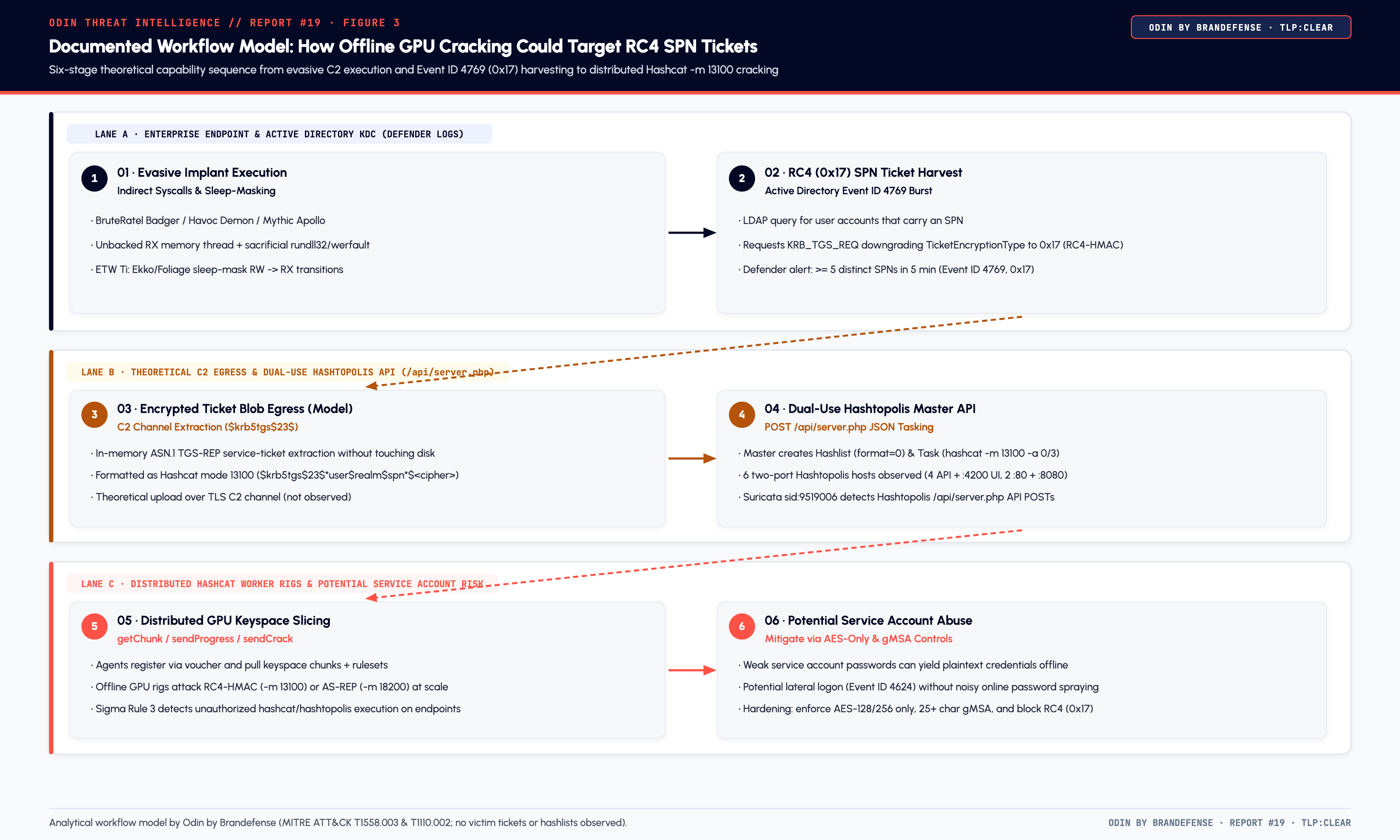
In a well-monitored domain, touching lsass.exe trips Credential Guard, Protected Process Light (PPL) or kernel ETW callbacks. Online password spraying trips lockouts. Offline cracking avoids both.
| Stage | What could happen | Where defenders can see it |
|---|---|---|
| 01 Implant runs | An evasive implant runs with any normal domain user token | Unbacked memory threads, sacrificial processes |
| 02 Ticket request | It requests service tickets for accounts with a Service Principal Name (SPN), asking for RC4-HMAC (etype 0x17) | Event 4769 bursts with encryption type 0x17 |
| 03 Exfiltration | Ticket blobs ($krb5tgs$23$) leave over the encrypted C2 channel | C2 egress rules |
| 04 Hashtopolis master | The hashes are loaded into a Hashtopolis server through /api/server.php | /api/server.php traffic from inside |
| 05 GPU workers | Remote Hashcat workers crack keyspace slices (-m 13100) | Hashcat or Hashtopolis processes on endpoints |
| 06 Account abuse | Weak service passwords are recovered with no failed logins on the domain controller | New logons (Event 4624) by service accounts |
The same path works for AS-REP roasting ($krb5asrep$23$, Hashcat -m 18200), Net-NTLMv2 (-m 5600), NTLM (-m 1000) and Domain Cached Credentials (DCC2, -m 2100).
The chain breaks at stage 02. Set SPN accounts to AES only (msDS-SupportedEncryptionTypes = 24, AES128 plus AES256, RC4 excluded) and move them to gMSAs.
5. Hashtopolis Servers and Infected IoT Routers
In short
The 32 Hashtopolis endpoints expose worker APIs and web consoles on predictable ports. Because the tool is dual-use and no hostile job was seen, every one of them is a watchlist entry, and every address is withheld.
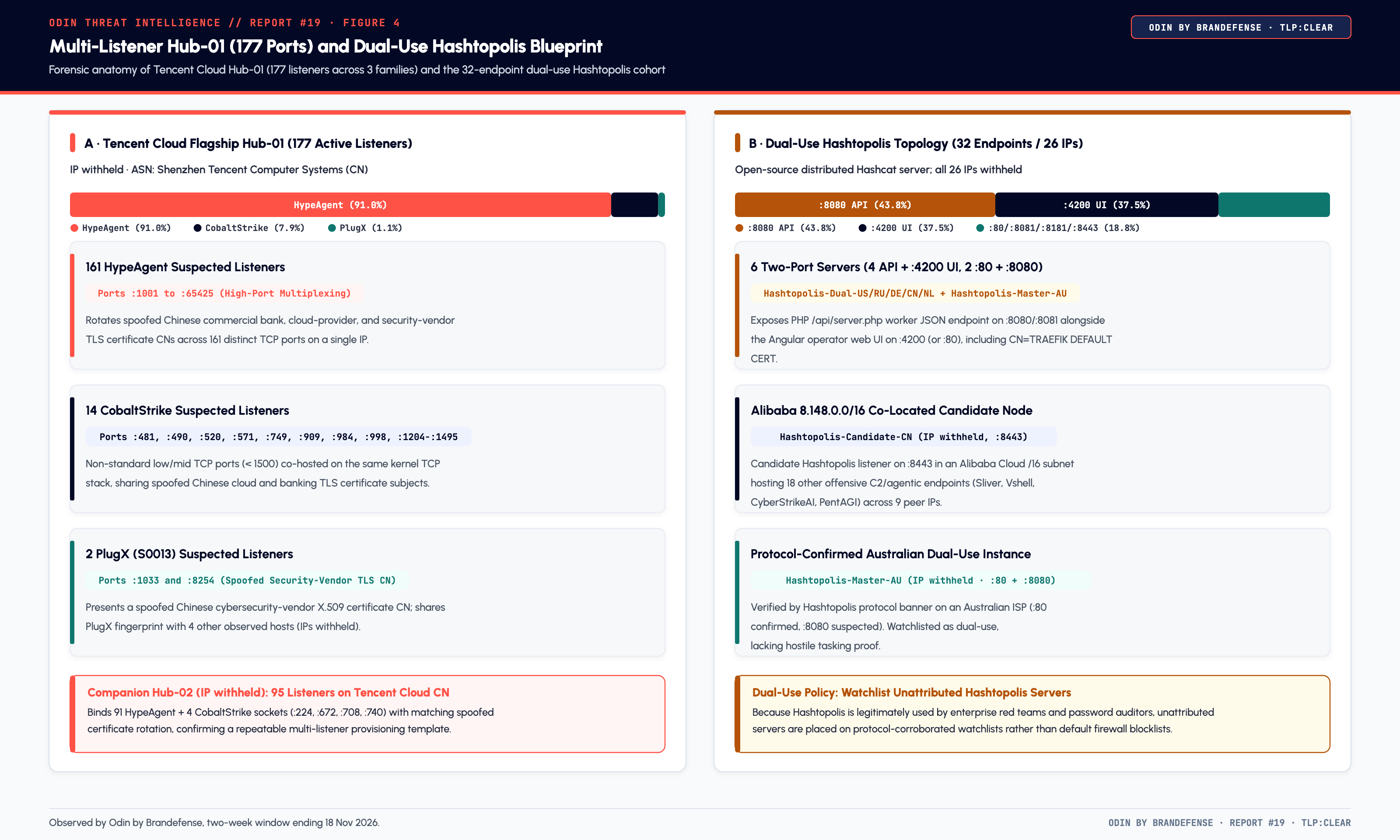
What Hashtopolis is
Hashtopolis is an open-source server that splits Hashcat cracking work across many GPU machines. Auditors use it for authorised password audits. Attackers can use it the same way. From the outside, an auditor's server and an attacker's rig look the same without evidence of their jobs.
Where the 32 endpoints sit
The endpoints span at least 10 countries: Russia 5, Germany 5, Netherlands 5, China 3, United States 3, Finland 3, Australia 2, Singapore 2, Ukraine 1 and Taiwan 1.
| Port | Role | Endpoints |
|---|---|---|
| 8080 | Worker API | 14 |
| 4200 | Hashtopolis v2 Angular web console | 12 |
| 80 | Web or API | 2 |
| 8081 | Worker API | 2 |
| 8181 | Worker API | 1 |
| 8443 | Worker API | 1 |
Six hosts expose two Hashtopolis ports at once: three with 8080 plus 4200, one with 8081 plus 4200, and two with 80 plus 8080. The hosts average 1.23 endpoints each.
Selected Hashtopolis servers (addresses withheld)
| Server | Ports | Hosting | Notes | Status |
|---|---|---|---|---|
| Australian master | 80, 8080 | An Australian ISP | Hashtopolis protocol confirmed on 80; API on 8080 | Watchlist (dual-use) |
| Alibaba candidate | 8443 | Hangzhou Alibaba Advertising (CN) | Sits in a /16 with other offensive tooling (below) | Watchlist (candidate) |
| Finnish console | 4200 | Hetzner Online GmbH (FI) | Third-party Hashtopolis certificate (withheld), JARM 15d3fd...ccbc0b6b | Watchlist (candidate) |
| US two-port | 8080, 4200 | HostPapa (US) | CN=TRAEFIK DEFAULT CERT | Watchlist (candidate) |
| Russian two-port | 8080, 4200 | JSC "TIMEWEB" (RU) | Third-party certificate withheld | Watchlist (candidate) |
| German two-port | 8081, 4200 | netcup GmbH (DE) | Third-party certificate withheld | Watchlist (candidate) |
| Chinese two-port | 80, 8080 | Hangzhou Alibaba Advertising (CN) | Web console on 80, API on 8080 | Watchlist (candidate) |
| Taiwan listener | 8080 | Chunghwa Telecom (TW) | Dynamic subscriber address | 72-hour watchlist |
How the worker protocol looks on the wire
Remote GPU workers download the Python or C# agent (hashtopolis.zip). They enrol once with a voucher through POST /api/server.php, then log in. After that they keep polling with the actions getTask and getChunk.
The server cuts a mask or rule attack into fixed keyspace slices. Workers send results back with sendProgress and sendCrack. Supported hash modes include Kerberoast RC4 (-m 13100), AS-REP (-m 18200), Net-NTLMv2 (-m 5600), NTLM (-m 1000) and DCC2 (-m 2100).
Suricata SID 9519006 and the third Sigma rule catch internal machines or GPU workers calling /api/server.php. No rule in this report covers the Hashtopolis web console.
The Alibaba /16 neighbourhood
The Alibaba candidate on 8443 was observed on 16 and 17 November 2026. Its /16 allocation, 8.148.0.0/16, holds 19 endpoints across 9 other addresses. Two were MySQL 3306 certificate collisions and are excluded. The other tooling includes:
- CyberStrikeAI (8080) and HexStrikeAI (5000)
- Metasploit Meterpreter (4446 and 443), sharing a host with Sliver (8888)
- VShell (443), mitmproxy, ARTEX (8787) and PentAGI
- DNSLog out-of-band testing (8000, 8443)
Sharing a public cloud /16 is circumstantial. It does not show that one operator controls all of these, so the Hashtopolis candidate stays on a watchlist.
Infected IoT routers: victims, not attackers
The 618 Mirai, Mozi and Moobot endpoints on 542 hosts share no address with the C2 or Hashtopolis populations. We observed no traffic between them. These are third-party consumer routers, so every address is withheld.
| Family | Endpoints (hosts) | Where | Fingerprints |
|---|---|---|---|
| Mirai | 353 (279) | CN 107 (China Unicom, Chinanet), TW 53 (Taiwan Fixed Network), ET 43 (EthioNet), PH 30 (Globe Telecom), AL 28 | CN=192.168.1.1 (16), CN=router.asus[.]com (3), CN=ZXV10 (2); 19 Taiwan routers share JARM 04b03b000...99e2262e |
| Mozi | 263 (261) | Consumer gateways, including BSNL India | CN=192.168.1.1, JARM 04d02d000...99e2262e; peer-to-peer DHT mesh |
| Moobot | 2 (2) | Bulgaria and Latvia | Candidates only |
In the Ethiopian group, 18 routers show a personal-name certificate subject, which is withheld. Of the Mirai endpoints, 63 are protocol-confirmed infections. They go on a watchlist for infected relays, never on a permanent block list. Infected routers are often reused as proxy or scanning hops in wider internet activity.
6. Telling Real C2 from Look-Alikes
In short
Internet-wide C2 hunting collides with VPN exits, password-auditing servers, home routers, database certificates and dynamic broadband. Removing those leaves 55 confirmed C2 endpoints, 2.4% of the 2,263 observed.
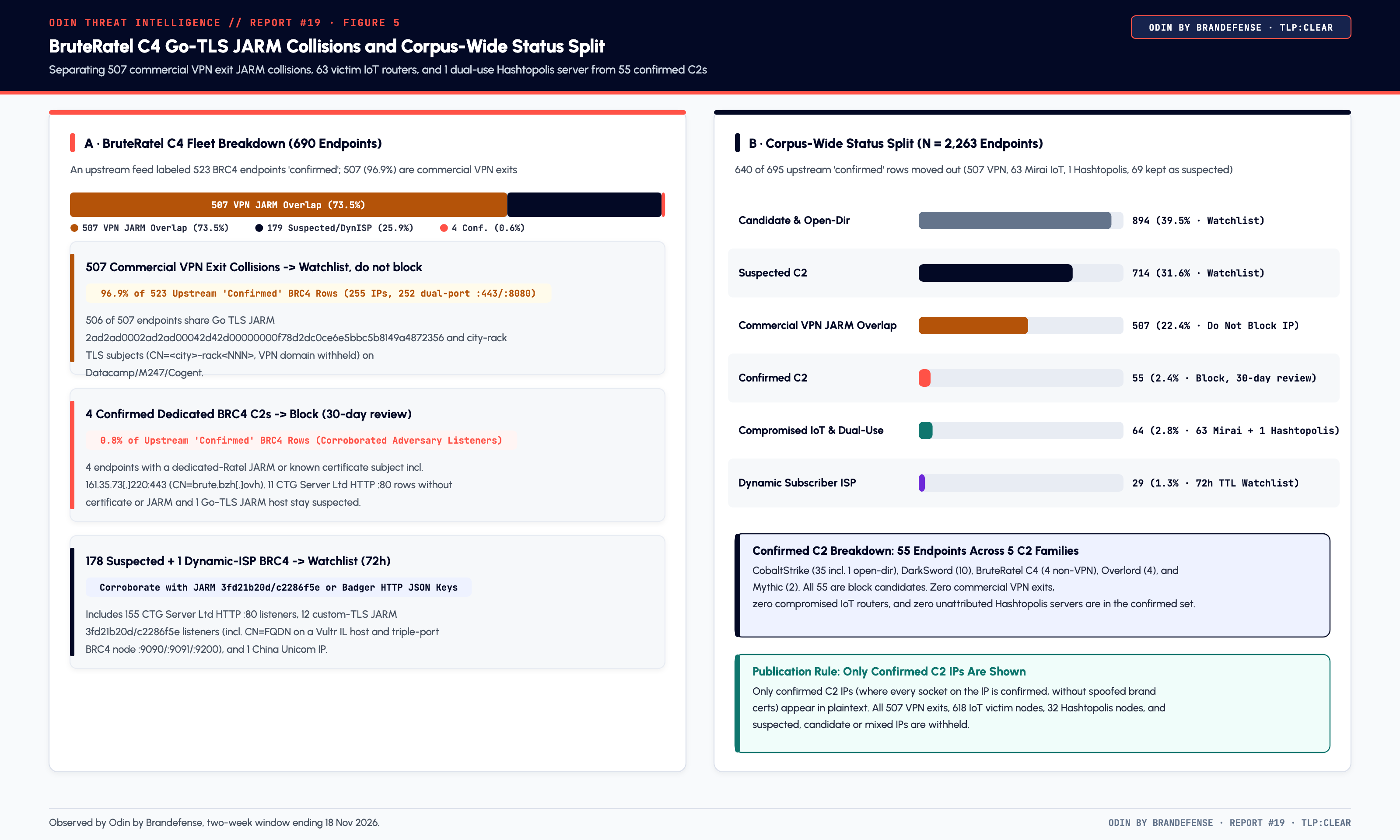
Five sources of false positives
Commercial VPN exits that look like Brute Ratel C4.
The Ratel teamserver is written in Go. Its default TLS stack gives the stock Go JARM 2ad2ad0002ad2ad00042d42d00000000f78d2dc0ce6e5bbc5b8149a4872356 and a minimal HTTP 404 reply. Commercial VPN exits give the same JARM and 404 profile.
The 507 VPN rows sit on 255 hosts: 252 with paired 443 and 8080 sockets, 3 with one port. Of the 507, 506 share the Go JARM; one has no JARM. Their certificates follow a VPN naming pattern: 322 use <city>-rack<NNN> names under a VPN domain, and 185 use labels such as sydney439.
| Hosting network | VPN rows |
|---|---|
| Datacamp Limited | 277 |
| M247 Europe SRL | 95 |
| Cogent Communications | 75 |
| Servers Australia | 20 |
| GSL Networks | 10 |
| GleSYS | 10 |
Blocking all 523 "confirmed" Brute Ratel C4 rows would cut off 255 VPN exits used by remote staff and customers. Only dedicated Ratel servers with a certificate subject or family JARM belong on a block list.
Dual-use servers and infected routers.
A Hashtopolis server is blocked only with separate evidence of hostile use. The Australian master lacks that evidence. The 63 confirmed Mirai routers are victims.
Large suspected hubs.
Every socket on Hub-01 and Hub-02 is suspected, while all nine on 77.72.18[.]83 are confirmed. The two Tencent hubs go on a hub watchlist, paired with the Cobalt Strike certificate rule (SID 9519007).
Dynamic telecom addresses.
Exactly 29 endpoints sit on subscriber telecom networks: 10 Mirai, 9 Mozi, 4 Mythic, 2 Cobalt Strike, 1 Brute Ratel C4, 1 DarkSword, 1 Overlord and the Taiwan Hashtopolis listener. Their addresses get reassigned, so they get 72-hour watchlists.
Internal audit rigs and port-only matches.
Internal red teams run Hashtopolis legitimately during password audits. Cloud MySQL servers with auto-generated certificates on 3306 can match port-based C2 rules. The rules exclude named internal audit hosts and ignore port-only matches.
The status split
The upstream feed marked 695 rows "confirmed", leaving out dynamic-ISP rows. Of these, 55 remain confirmed C2. Another 571 move to watchlists as VPN exits, infected routers or a dual-use server. The last 69 stay suspected because they lack a family JARM or known certificate subject (12 Brute Ratel C4, 29 Cobalt Strike, 18 DarkSword, 4 Overlord, 6 Mythic).
| Family | Endpoints | Upstream "confirmed" | Confirmed C2 | Watchlist (VPN, IoT, dual-use) | Suspected | Candidate and open directory | Dynamic ISP |
|---|---|---|---|---|---|---|---|
| Brute Ratel C4 | 690 | 523 | 4 | 507 (VPN) | 178 | 0 | 1 |
| Cobalt Strike | 391 | 64 | 35 | 0 | 143 | 211 | 2 |
| Mirai | 353 | 63 | 0 | 63 (IoT) | 41 | 239 | 10 |
| DarkSword | 346 | 28 | 10 | 0 | 230 | 105 | 1 |
| Mozi | 263 | 0 | 0 | 0 | 36 | 218 | 9 |
| Overlord | 107 | 8 | 4 | 0 | 31 | 71 | 1 |
| Mythic | 54 | 8 | 2 | 0 | 34 | 14 | 4 |
| Hashtopolis | 32 | 1 | 0 | 1 (dual-use) | 16 | 14 | 1 |
| Havoc | 25 | 0 | 0 | 0 | 5 | 20 | 0 |
| Moobot | 2 | 0 | 0 | 0 | 0 | 2 | 0 |
| Total | 2,263 | 695 | 55 | 571 | 714 | 894 | 29 |
Two other explanations we weighed
Red teams and hobbyists.
Brute Ratel C4, Mythic, Havoc, Cobalt Strike and Hashtopolis are all used by contracted red teams as well as attackers. Some Hashtopolis consoles on 4200, and some Mythic servers with third-party training certificates, likely belong to trainers, consultants or hobbyists. Blocking only the 55 confirmed endpoints avoids breaking legitimate audit infrastructure.
Decoy or redirector on Hub-01.
A single address with 177 ports spoofing Chinese bank, cloud and security-vendor certificates could be an attacker redirector built with iptables or socat. It could also be a high-interaction honeypot built to attract scanners. A watchlist entry alerts on any internal connection without claiming who runs it.
7. What Defenders Should Do
Within 24 hours
- Block the 11 published confirmed C2 addresses in the Indicators chapter. Recheck the certificate or JARM before keeping a cloud IP block longer than 30 days, because cloud addresses are reassigned after takedowns.
- Put Hub-01, Hub-02, unattributed Hashtopolis servers, infected routers and dynamic telecom addresses on time-bound watchlists, not block lists.
- Do not block on the Go TLS JARM
2ad2ad0002ad...alone. It matches commercial VPN exits.
Within 72 hours
- Turn on the domain controller audit policy Audit Kerberos Service Ticket Operations (Event 4769).
- Alert when one non-machine account requests five or more RC4 (0x17) tickets for different SPNs within five minutes.
- Deploy the Suricata rules for Brute Ratel C4, DarkSword, Overlord and Cobalt Strike certificates, Mythic check-ins and Hashtopolis polling.
Within 7 to 30 days
- Inventory every user account with a
ServicePrincipalName. Move eligible services to gMSAs or random passwords of 28 or more characters, and set AES-only encryption (msDS-SupportedEncryptionTypes = 24). - Turn on kernel ETW Threat Intelligence call-stack telemetry, Credential Guard and LSA RunAsPPL. Alert on Sysmon Event 10 with an
UNKNOWNcall trace touchinglsass.exe,rundll32.exe,dllhost.exeorwerfault.exe. - Use application control so Hashcat (
-m 13100,-m 18200,-m 1000,-m 2100) and Hashtopolis agents run only on named, isolated password-audit hosts. - Add the six JARM values in the Indicators chapter to external attack surface hunting, always paired with a certificate subject check.
8. Detection Rules
The full rules are in the Detection rules tab. Every rule file loads without errors in its engine (Suricata 7.0.12, YARA-X, pySigma, Kusto.Language); the rules were not replayed against live traffic. Test each rule in a lab before production use.
| Rule file | What it catches |
|---|---|
odin_bruteratel_mythic_plugx_hashtopolis.rules | Suricata 7: seven signatures for C2 certificates, Badger and Mythic check-ins, and Hashtopolis worker polling |
sentinel_evasive_c2_callstack_and_kerberoast_burst.kql | Microsoft Sentinel and Defender XDR: contact with confirmed C2s, injection followed by C2 egress, RC4 ticket bursts, and unauthorised Hashcat or Hashtopolis runs |
sigma_unbacked_memory_syscall_and_kerberoast_export.yml | Sigma (3 rules): unbacked call stacks touching LSASS, RC4 service-ticket requests, and Hashtopolis or Hashcat execution |
odin_brc4_havoc_mythic_and_hashtopolis_artifacts.yar | YARA (4 rules): Badger configs and syscall stubs, Havoc sleep-mask code, Mythic agent stubs, and Hashtopolis agents |
How the Suricata signatures work
| SID | Looks for | Why |
|---|---|---|
| 9519001 | Server certificate CN=brute[.]bzh[.]ovh or CN=FQDN | Dedicated or default Brute Ratel C4 teamservers (S1063) |
| 9519002 | Outbound POST whose body holds "b_arch" plus c_name, d_name, p_id or b_ver | Badger check-ins; needs TLS inspection when wrapped in HTTPS |
| 9519003 | Server certificate for one of three confirmed DarkSword domains on 443, 8443 or 8888 | Confirmed DarkSword listeners (T1071.001) |
| 9519004 | Server certificate CN=host-<16 hex>.invalid on Overlord ports | Overlord's generated certificates |
| 9519005 | Outbound POST /agent_message with a base64 body longer than 47 bytes | Mythic agent check-ins; needs TLS inspection on 7443 and similar |
| 9519006 | Outbound POST /api/server.php with actions register, login, getTask, getChunk, sendProgress or sendCrack | Hashtopolis workers (T1110.002); flagged as policy violation |
| 9519007 | Server certificate CN=Murmur Autogenerated Certificate v2 or CN=Major Cobalt Strike | Multi-port Cobalt Strike templates (S0154) |
The certificate rules need tls.cert_subject inspection on server handshakes. Suppress SID 9519006 only for named internal GPU audit hosts talking to an approved internal Hashtopolis server. If you run self-hosted Mumble voice servers (Murmur, default port 64738), exclude those exact internal IPs from SID 9519007 rather than disabling it.
How the KQL query works
The query looks back 14 days and has four branches.
| Branch | Fires when |
|---|---|
| C2 egress | A device connects to one of the 11 confirmed C2 addresses, or to a watchlist you add from your own CTI feed |
| Injection plus egress | A process injects into rundll32.exe, dllhost.exe, werfault.exe or similar from a temp or profile folder, and the same process reaches a listed address within 10 minutes |
| Kerberoast burst | Event 4769 shows one account requesting RC4 (0x17) tickets for five or more distinct SPNs in five minutes, excluding krbtgt and machine accounts |
| Cracking tools | hashcat or hashtopolis runs, or a command line holds /api/server.php, a Kerberos-related Hashcat mode or hashtopolis.zip |
Fill the approved audit-host and scanner-account lists with your own verified assets. In older forests where legacy SPNs still use RC4, raise the burst threshold from 5 to 8, or exclude exact service accounts while you migrate them to AES.
How the Sigma and YARA rules work
| Rule | Fires when |
|---|---|
| Sigma 1: unbacked memory call stack | Sysmon Event 10 shows a call trace containing UNKNOWN( while touching LSASS or a sacrificial host process |
| Sigma 2: Kerberoast RC4 request | Event 4769 with ticket encryption 0x17, excluding machine accounts and krbtgt |
| Sigma 3: Hashtopolis or Hashcat | Command lines with /api/server.php, hashtopolis.zip, --voucher, Kerberos-related Hashcat modes or $krb5tgs$23$, outside named audit hosts |
| YARA: Brute Ratel C4 Badger | At least two Badger JSON keys ("b_arch", "c_name", "d_name") appear with two evasion strings such as NtAllocateVirtualMemory, EtwEventWrite, AmsiScanBuffer or coffee |
| YARA: Havoc Demon sleep mask | SystemFunction032, CreateTimerQueueTimer and NtContinue appear together with a Havoc or Demon marker |
| YARA: Mythic agent stub | Mythic JSON actions (checkin, get_tasking, post_response) appear with Apollo, Poseidon or agent_message markers |
| YARA: Hashtopolis agent | /api/server.php appears with two worker actions and a hashcat or clientSignature string |
Each YARA rule has a strict file size bound.
How to sort a host
| What the host shows | Action |
|---|---|
| Dedicated C2 with a family certificate or JARM, every socket confirmed | Block |
| Multi-family hub with suspected sockets only | Hub watchlist |
| Hashtopolis server with no evidence of hostile use | Dual-use watchlist |
| Hashtopolis candidate inside an offensive cloud neighbourhood | Candidate watchlist |
| VPN city-rack certificate with the stock Go JARM on a VPN provider network | VPN watchlist, do not block |
| Any match on a dynamic telecom network | 72-hour watchlist |
| A named internal audit host | Allowlist |
| A MySQL or SSH port match with no family signal | Ignore |
9. Indicators
The Indicators tab holds 15 published indicators: 11 confirmed C2 addresses and the 4 JARM values tied to confirmed C2. The Brute Ratel 8081 and DarkSword JARM values, listed under JARM values for hunting in this chapter, are for hunting only.
| Type | Count |
|---|---|
| Confirmed C2 addresses to block | 11 |
| Watchlist hubs, Hashtopolis servers and cluster candidates (addresses withheld) | 11 |
| JARM values for TLS hunting | 6 (4 in the Indicators tab) |
No commercial VPN exit is in the set.
Confirmed C2 addresses to block
| Address and port | Framework | Hosting | Key fingerprint |
|---|---|---|---|
| 161.35.73[.]220:443 | Brute Ratel C4 | DigitalOcean (DE) | CN=brute[.]bzh[.]ovh |
| 191.96.31[.]13:443 | Cobalt Strike | Hostinger (US) | Dominant Cobalt Strike JARM |
| 78.90.248[.]224:7000 | Brute Ratel C4 | Net-Surf (BG) | JARM 3fd3fd20d...99b095c |
| 163.172.45[.]158:8086 | Cobalt Strike | Scaleway (FR) | CN=Murmur Autogenerated Certificate v2 |
| 200.105.111[.]26:50000 | Cobalt Strike | AR | CN=Murmur Autogenerated Certificate v2 |
| 194.26.192[.]57:9000 | Overlord | NL | CN=host-43c6ed77a39b7312.invalid |
| 23.95.217[.]154:8443 | Overlord | US | CN=host-21ffa7a17fac9f9a.invalid |
| 5.188.86[.]227:7443 | Mythic | Global Layer (NL) | Default 7443 TLS |
| 138.197.31[.]70:7443 | Mythic | DigitalOcean (US) | Default 7443 TLS |
| 77.72.18[.]83:50500 | Cobalt Strike | Melbikomas (DE) | Nine ports 2811 to 55555, Murmur certificate |
| 47.239.109[.]26:3389 | Cobalt Strike | Alibaba (HK) | CN=Major Cobalt Strike |
JARM values for hunting
Use these with a certificate subject or issuer check. Never block on a JARM value alone.
| Family | Port | JARM | Seen on |
|---|---|---|---|
| Brute Ratel C4 | 8081 | 3fd21b20d00000021c43d21b21b43de0a012c76cf078b8d06f4620c2286f5e | 12 suspected custom Ratel nodes |
| Brute Ratel C4 | 443 | 3fd3fd20d00000021c43d43d00043d15e5079913504d6ff89229f1f99b095c | Both published Ratel C2s |
| DarkSword | 443 | 21d14d00021d21d00042d43d00000091f9827a8676a9d9f27d421962a09b5d | 183 of 346 endpoints (52.9%) |
| Overlord | 8443 | 21d14d00021d21d00042d43d00041df8e4b7c874a766a0a2344c0afd986207 | 11 Overlord endpoints on 8443 and 9000, including both published Overlord C2s |
| Mythic | 7443 | 1dd40d40d00040d00042d43d000000831b6af40378e2dd35eeac4e9311926e | Both published Mythic C2s |
| Cobalt Strike | 10010 | 29d08d00029d0000000000000000001f93725095f606ed113a9a32b2392e62 | Confirmed Cobalt Strike cluster on 13 OVH addresses in 92.222.152[.]0/24 |
Withheld: all hub, Hashtopolis, cluster-candidate, suspected and candidate addresses; the 507 VPN exits and their VPN domain; all 618 router addresses; and every third-party or personal certificate subject. For watchlist entries, correlate outbound traffic with process lineage, the certificate rules or Kerberos anomalies over 72 to 168 hours.
MITRE ATT&CK mapping
| Tactic | Technique or software | How it appears here | Detection |
|---|---|---|---|
| Command and Control | T1071.001 Web Protocols | HTTPS and HTTP C2 on DarkSword, Overlord and Mythic | SIDs 9519003 to 9519005 |
| Command and Control | S1063 Brute Ratel C4 | Ratel teamservers and Badger check-ins | SIDs 9519001, 9519002; YARA Badger rule |
| Command and Control | S0154 Cobalt Strike, S0013 PlugX | Multi-port hubs and Murmur certificate templates | SID 9519007 |
| Defense Evasion | T1055 Process Injection | Injection into sacrificial host processes; indirect syscalls | KQL injection branch; Sigma 1 |
| Credential Access | T1558.003 Kerberoasting | Modeled RC4 SPN ticket requests | KQL burst branch; Sigma 2 |
| Credential Access | T1110.002 Password Cracking | Hashtopolis distributes offline Hashcat jobs | SID 9519006; Sigma 3; KQL tool branch |
10. Scope and Limits
- Window. The findings cover a two-week observation window ending 18 November 2026. Most endpoints were last seen between 13 and 18 November. Some records carry earliest first-seen dates back to 2022 from other sources; those are not a tracking start.
- Outside view only. The data shows internet-facing servers. It cannot show what happened inside any enterprise. No Kerberos ticket theft, cracked password or service-account logon was observed.
- The Kerberoast chain is a model. Chapter 4 and Figure 3 describe documented tradecraft. They are not a reconstruction of a real intrusion.
- No links between populations. The C2, Hashtopolis and IoT populations share no address, certificate or observed traffic. Nothing here ties them to one operator.
- Confirmed is not the same as attributed. Several frameworks are dual-use. A confirmed listener runs the framework; it may still belong to an authorised red team.
- Feed labels are labels. DarkSword is an upstream feed label. It does not attribute activity to a named actor.
- Rule testing. Every published rule file loads without errors in its engine (Suricata 7.0.12, YARA-X, pySigma and Microsoft's Kusto.Language analyzer, checked on 20 November 2026). The rules were not replayed against live traffic, so test and tune them in your own environment before production use.
11. Sources
- Palo Alto Networks Unit 42. When Pentest Tools Go Brutal: Red-Teaming Tool Being Abused by Malicious Actors. https://unit42.paloaltonetworks.com/brute-ratel-c4-tool/ (verified 18 November 2026)
- MITRE ATT&CK. Brute Ratel C4, S1063. https://attack.mitre.org/software/S1063/ (verified 18 November 2026)
- Mythic documentation. https://docs.mythic-c2.net/ (verified 18 November 2026)
- Havoc Framework documentation. https://havocframework.com/docs/welcome (verified 18 November 2026)
- MITRE ATT&CK. PlugX, S0013. https://attack.mitre.org/software/S0013/ (verified 19 November 2026)
- Hashtopolis project. Server repository. https://github.com/hashtopolis/server (verified 18 November 2026)
- MITRE ATT&CK. Steal or Forge Kerberos Tickets: Kerberoasting, T1558.003. https://attack.mitre.org/techniques/T1558/003/ (verified 18 November 2026)
- Salesforce Engineering. Easily Identify Malicious Servers on the Internet with JARM. https://engineering.salesforce.com/easily-identify-malicious-servers-on-the-internet-with-jarm-e095edac525a/ (verified 18 November 2026)
What is…?
Short explanations of the tools and families named in this study.
What is Hashtopolis?
Hashtopolis is an open-source server that splits Hashcat password cracking across many GPU machines.
More about HashtopolisC2 frameworkWhat is Cobalt Strike?
Cobalt Strike is commercial adversary simulation software. Its Beacon implant gives an operator remote control of a compromised host. Cracked and leaked copies are widely used by ransomware and espionage operators.
More about Cobalt StrikeTechniqueWhat is JARM?
JARM is an open TLS server fingerprinting method from Salesforce. It hashes how a server answers a set of crafted TLS handshakes.
More about JARMC2 frameworkWhat is Brute Ratel C4?
Brute Ratel C4 is a commercial red-team C2 framework built to evade endpoint detection. Leaked copies have been used by criminal operators.
More about Brute Ratel C4C2 frameworkWhat is Mythic?
Mythic is an open-source, multi-user C2 platform with pluggable agents and transports, built for red-team operations.
More about MythicFeed labelWhat is DarkSword?
DarkSword is a family label from an upstream threat feed for multi-port TLS and HTTP C2 servers. It names a fingerprint group, not an actor.
More about DarkSwordFrequently asked questions
What are evasive C2 frameworks?
Post-exploitation frameworks give an intruder a remote control channel into a breached network. The newer ones are built to stay quiet on monitored workstations. Their implants avoid the Windows API hooks that many endpoint tools watch, and they encrypt themselves in memory while they sleep.
Why are so few of them confirmed?
Because many hits are not C2 at all. Brute Ratel C4's teamserver is written in Go, and its default TLS setup produces the same fingerprint as many ordinary Go services. An upstream feed marked 523 Brute Ratel C4 endpoints as "confirmed". Of those, 507 turned out to be commercial VPN exits on 255 hosts, with VPN city-rack certificates and the same Go fingerprint.
What does a 177-port hub look like?
Operators often stack many listeners on one rented server. We observed 35 such hubs with 391 sockets between them. The largest, on Tencent Cloud in China, runs 177 listeners: 161 HypeAgent, 14 Cobalt Strike and 2 PlugX. Its certificates impersonate Chinese banks, cloud providers and security vendors. A second Tencent host runs 95 listeners with the same template.
Where does Hashtopolis fit in?
Hashtopolis splits password-cracking jobs across many remote GPU machines running Hashcat. We observed 32 Hashtopolis endpoints on 26 hosts, mostly on worker API port 8080 and web console port 4200.
What about the infected routers?
The 618 Mirai, Mozi and Moobot endpoints are home and small-business routers on consumer broadband in China, Taiwan, Ethiopia, the Philippines and elsewhere. Their owners are victims. The routers share no address and no observed traffic with the C2 or Hashtopolis servers. Their addresses also change hands often, so a permanent block mostly hurts the next customer. Treat them as short-lived watchlist entries.