


Key takeaways
- Odin observed 1,613 endpoints across six evasive C2 frameworks; only 55 are confirmed hostile C2.
- 507 Brute Ratel C4 hits are commercial VPN exits that share a stock Go TLS fingerprint.
- One Tencent Cloud address runs 177 C2 listeners behind spoofed Chinese bank certificates.
- 32 Hashtopolis cracking servers are dual-use, so they belong on watchlists, not blocklists.
- Remove RC4 from Kerberos and alert on bursts of RC4 service-ticket requests.
In a two-week observation window ending 18 November 2026, Odin by Brandefense observed 1,613 command-and-control (C2) endpoints across six evasive post-exploitation frameworks. We also observed 32 Hashtopolis password-cracking servers and 618 infected home routers. After removing look-alikes, 55 C2 endpoints are confirmed. For defenders, the lesson is twofold: block precisely, and close the Kerberos gap that offline cracking depends on.
What are evasive C2 frameworks?
Post-exploitation frameworks give an intruder a remote control channel into a breached network. The newer ones are built to stay quiet on monitored workstations. Their implants avoid the Windows API hooks that many endpoint tools watch, and they encrypt themselves in memory while they sleep.
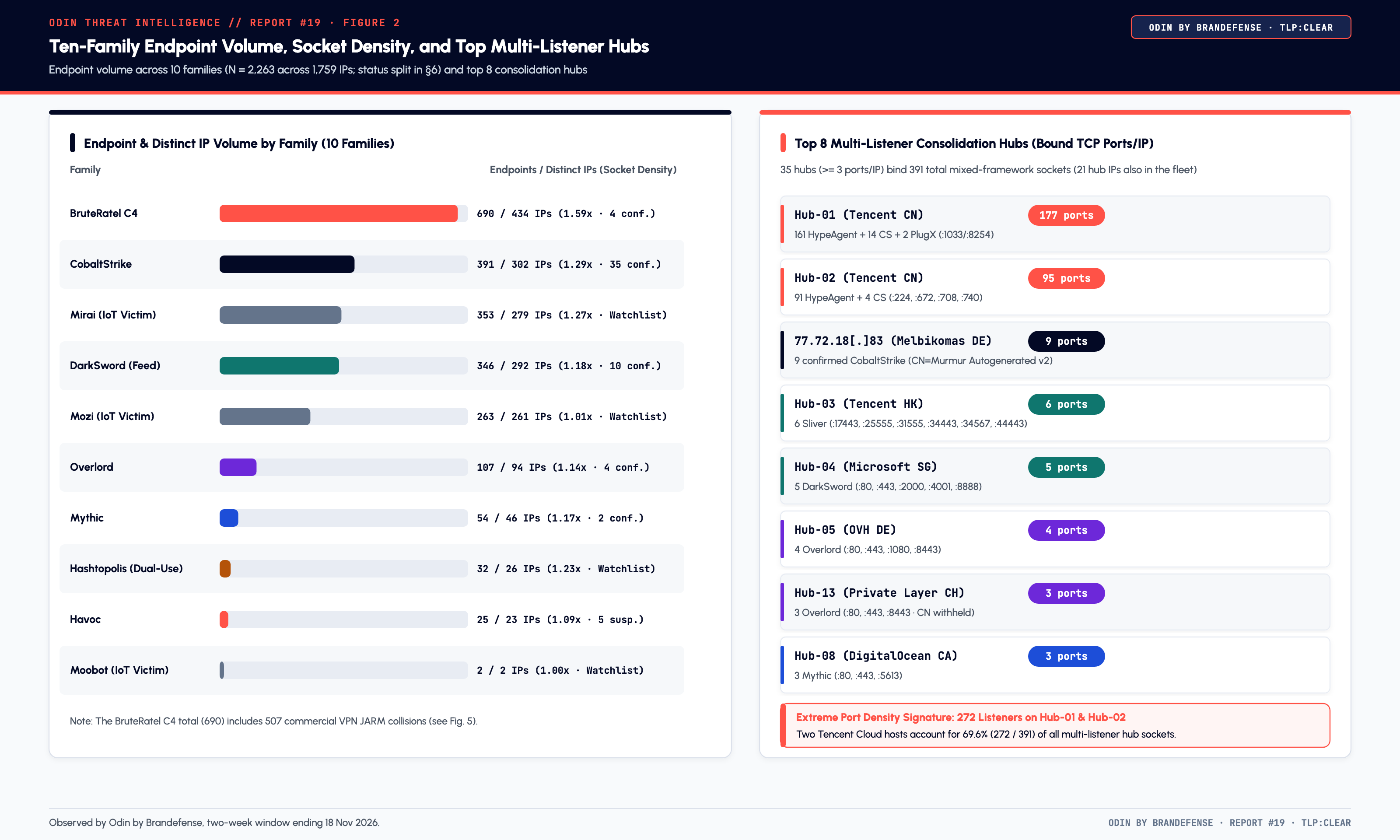
| Framework | Endpoints | Confirmed |
|---|---|---|
| Brute Ratel C4 | 690 | 4 |
| Cobalt Strike | 391 | 35 |
| DarkSword (feed label) | 346 | 10 |
| Overlord | 107 | 4 |
| Mythic | 54 | 2 |
| Havoc | 25 | 0 |
DarkSword here is a label from an upstream threat feed for multi-port C2 servers. It does not name a threat actor.
These tools are not only used by attackers. Brute Ratel C4, Cobalt Strike, Mythic and Havoc are also sold or shared for authorised red-team work. A server running one of them is a reason to look closer, not proof of an intrusion. That is why this report separates confirmed hostile listeners from everything else.
Why are so few of them confirmed?
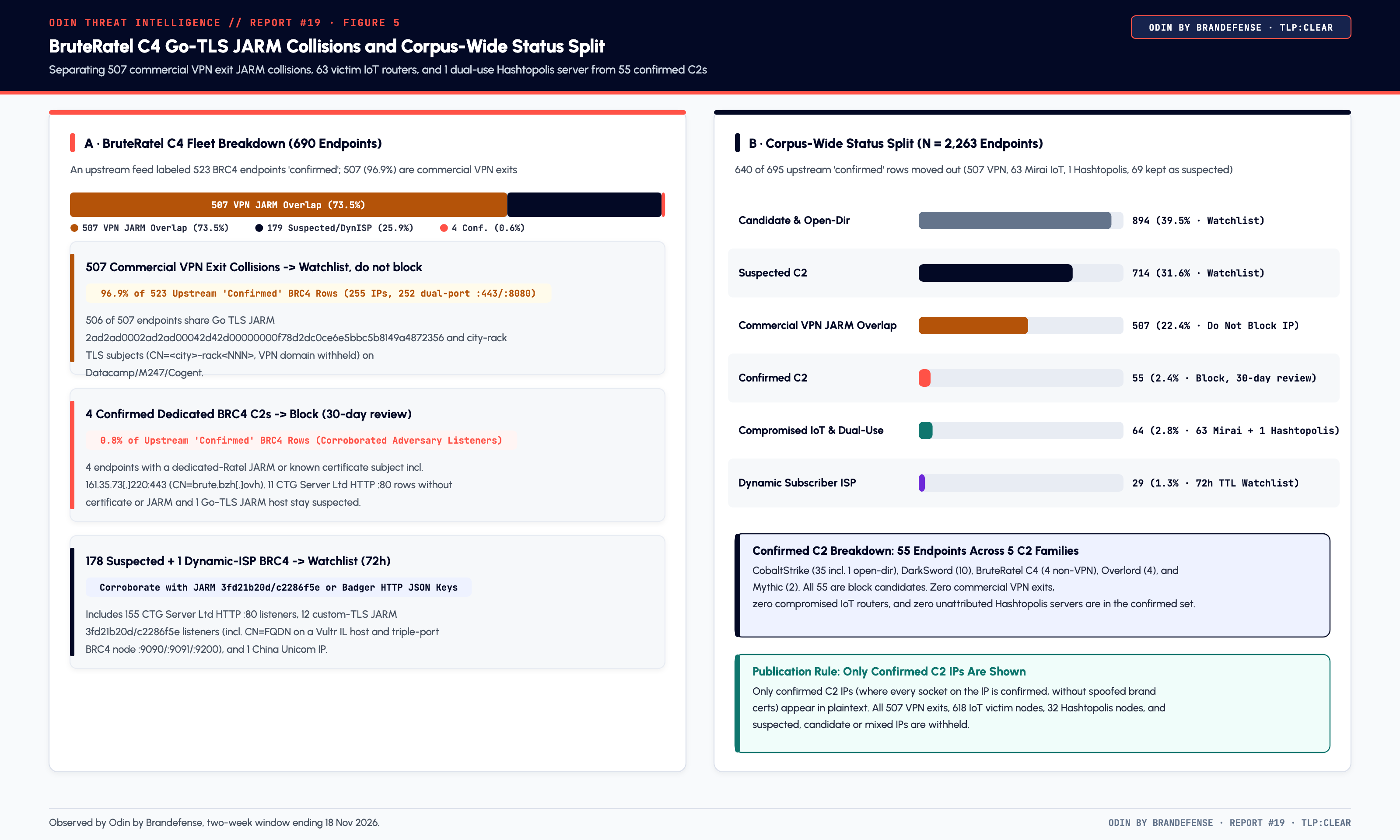
Because many hits are not C2 at all. Brute Ratel C4's teamserver is written in Go, and its default TLS setup produces the same fingerprint as many ordinary Go services. An upstream feed marked 523 Brute Ratel C4 endpoints as "confirmed". Of those, 507 turned out to be commercial VPN exits on 255 hosts, with VPN city-rack certificates and the same Go fingerprint.
Blocking them would cut off remote staff and customers who use those VPNs. Only four dedicated Brute Ratel C4 servers carry their own certificates or a family fingerprint. One, 161.35.73[.]220, presents the certificate CN=brute[.]bzh[.]ovh.
Other look-alikes include password-auditing servers, consumer routers, database certificates and dynamic home broadband addresses. Removing all of them leaves 55 confirmed C2 endpoints, 2.4% of the 2,263 endpoints observed.
What does a 177-port hub look like?
Operators often stack many listeners on one rented server. We observed 35 such hubs with 391 sockets between them. The largest, on Tencent Cloud in China, runs 177 listeners: 161 HypeAgent, 14 Cobalt Strike and 2 PlugX. Its certificates impersonate Chinese banks, cloud providers and security vendors. A second Tencent host runs 95 listeners with the same template.
Every socket on those two hubs is suspected rather than confirmed. The 177-port host could even be a decoy built to attract scanners. So they go on watchlists. In Germany, 77.72.18[.]83 is different: all nine of its Cobalt Strike listeners are confirmed, and it belongs on a block list. Its nine listeners share one auto-generated certificate, CN=Murmur Autogenerated Certificate v2, which 28 confirmed Cobalt Strike endpoints reuse across the data.
Where does Hashtopolis fit in?
Hashtopolis splits password-cracking jobs across many remote GPU machines running Hashcat. We observed 32 Hashtopolis endpoints on 26 hosts, mostly on worker API port 8080 and web console port 4200.
Hashtopolis is open-source and used by legitimate auditors and red teams. We saw no hostile cracking job, and no traffic links these servers to the C2 fleets. Their addresses are withheld, and they belong on watchlists.
The concern is a documented path, which we model but did not observe. An implant asks Active Directory for service tickets encrypted with the old RC4 cipher. The tickets are sent out and cracked offline on GPU rigs. No failed login ever reaches the domain controller. Forcing AES-only encryption on service accounts breaks this path early. Defenders can also watch for the request itself: a burst of RC4 ticket requests from one account shows up in domain controller event 4769.
What about the infected routers?
The 618 Mirai, Mozi and Moobot endpoints are home and small-business routers on consumer broadband in China, Taiwan, Ethiopia, the Philippines and elsewhere. Their owners are victims. The routers share no address and no observed traffic with the C2 or Hashtopolis servers. Their addresses also change hands often, so a permanent block mostly hurts the next customer. Treat them as short-lived watchlist entries.
What to do now
- Block the 11 published confirmed C2 addresses, listed in the full report's Indicators tab. Do not block on the shared Go TLS fingerprint alone.
- Watchlist, do not block, the large hubs, unattributed Hashtopolis servers, infected routers and dynamic broadband addresses.
- Remove RC4 from Kerberos. Move service accounts to Group Managed Service Accounts or long random passwords, with AES-only encryption.
- Alert on ticket bursts: five or more RC4 service tickets for different services requested by one user within five minutes.
- Limit Hashcat and Hashtopolis to named audit hosts. The full report's Detection rules tab has Suricata, Sentinel KQL, Sigma and YARA rules for these signals.
The full report covers the infrastructure, fingerprints, indicators and rule logic in detail.
What is…?
Short explanations of the tools and families named in this study.
What is Hashtopolis?
Hashtopolis is an open-source server that splits Hashcat password cracking across many GPU machines.
More about HashtopolisC2 frameworkWhat is Cobalt Strike?
Cobalt Strike is commercial adversary simulation software. Its Beacon implant gives an operator remote control of a compromised host. Cracked and leaked copies are widely used by ransomware and espionage operators.
More about Cobalt StrikeTechniqueWhat is JARM?
JARM is an open TLS server fingerprinting method from Salesforce. It hashes how a server answers a set of crafted TLS handshakes.
More about JARMC2 frameworkWhat is Brute Ratel C4?
Brute Ratel C4 is a commercial red-team C2 framework built to evade endpoint detection. Leaked copies have been used by criminal operators.
More about Brute Ratel C4C2 frameworkWhat is Mythic?
Mythic is an open-source, multi-user C2 platform with pluggable agents and transports, built for red-team operations.
More about MythicFeed labelWhat is DarkSword?
DarkSword is a family label from an upstream threat feed for multi-port TLS and HTTP C2 servers. It names a fingerprint group, not an actor.
More about DarkSwordFrequently asked questions
What are evasive C2 frameworks?
Post-exploitation frameworks give an intruder a remote control channel into a breached network. The newer ones are built to stay quiet on monitored workstations. Their implants avoid the Windows API hooks that many endpoint tools watch, and they encrypt themselves in memory while they sleep.
Why are so few of them confirmed?
Because many hits are not C2 at all. Brute Ratel C4's teamserver is written in Go, and its default TLS setup produces the same fingerprint as many ordinary Go services. An upstream feed marked 523 Brute Ratel C4 endpoints as "confirmed". Of those, 507 turned out to be commercial VPN exits on 255 hosts, with VPN city-rack certificates and the same Go fingerprint.
What does a 177-port hub look like?
Operators often stack many listeners on one rented server. We observed 35 such hubs with 391 sockets between them. The largest, on Tencent Cloud in China, runs 177 listeners: 161 HypeAgent, 14 Cobalt Strike and 2 PlugX. Its certificates impersonate Chinese banks, cloud providers and security vendors. A second Tencent host runs 95 listeners with the same template.
Where does Hashtopolis fit in?
Hashtopolis splits password-cracking jobs across many remote GPU machines running Hashcat. We observed 32 Hashtopolis endpoints on 26 hosts, mostly on worker API port 8080 and web console port 4200.
What about the infected routers?
The 618 Mirai, Mozi and Moobot endpoints are home and small-business routers on consumer broadband in China, Taiwan, Ethiopia, the Philippines and elsewhere. Their owners are victims. The routers share no address and no observed traffic with the C2 or Hashtopolis servers. Their addresses also change hands often, so a permanent block mostly hurts the next customer. Treat them as short-lived watchlist entries.