


1. Executive Summary
In short
In a two-week observation window ending 18 November 2026, Odin by Brandefense found 285 endpoints on 250 hosts running seven task-specialized AI vulnerability agents. Each tool does one job: source-code auditing, turning advisories into checks, mapping attack surface, or validating targets from containers. Only 17 endpoints on 13 dedicated cloud hosts are confirmed controllers. DeepAudit is dual-use and stays on review. Block the 13 confirmed addresses, send DeepAudit hits to policy review, and remove exposed .git folders from your perimeter.
Earlier AI offense consoles wrapped a chatbot around many tools at once. The agents in this report are narrower. Each one automates a single slow step in vulnerability work. This report maps where these agents run, how they are built, and which signals let defenders find them without blocking legitimate security teams.
AutoCVE turns new advisories into HTTP checks on 118 endpoints.
AutoCVE is the largest family here, at 41.4% of all endpoints. Seven dedicated cloud controllers on port 8000 are confirmed. Two more confirmed instances sit on dynamic telecom lines, and 109 uncorroborated candidates, 85 of them behind one shared CDN provider, are not blocked.
DeepAudit audits source code but is dual-use, so nothing is blocked.
DeepAudit runs on 61 endpoints across 49 hosts, pairing web consoles with Python analysis backends. Of these, 39 are confirmed DeepAudit services: 37 on cloud hosts and 2 on dynamic ISPs. None goes on a block list, because enterprise AppSec teams use the same open-source tool.
Recon miners and container swarms extend the chain to live targets.
Cairn (17 endpoints) and AutoHunter (21) map routes and parameters. Strix (40), RedAmon (17) and XingRin (11) run web and API checks from containers. Three hosts carry two agent families side by side.
Three Decisions for Leaders
- Block confirmed controllers, review dual-use tools. Block the 13 confirmed controller addresses. Send DeepAudit, CDN-fronted candidates and dynamic telecom addresses to analyst watchlists instead.
- Remove source leaks and shorten N-day patch windows. Find and remove exposed
.gitmetadata and source archives, which feed source-code miners. Patch internet-facing gateways listed in public advisory feeds faster. - Pair scan bursts with agent API and process signals. Alert when unapproved Python, Node or container processes connect out on ports 3000, 8000, 8083, 8084 to 8093 and 18800.
The Study in Numbers
| Number | What it is |
|---|---|
| 285 | Endpoints running one of seven specialized AI vulnerability agents, on 250 hosts |
| 17 | Confirmed controller endpoints to block, on 13 dedicated cloud addresses (6.0% of endpoints) |
| 118 | AutoCVE endpoints: 7 confirmed on port 8000, 2 on dynamic ISPs, 109 candidates |
| 61 | DeepAudit endpoints, all on review: 37 confirmed dual-use, 2 on dynamic ISPs, 22 candidates |
| 38 | Recon endpoints: Cairn (17, port 8000) and AutoHunter (21, mostly port 18800) |
| 1.74x | Strix endpoints per host (40 on 23 hosts), the highest multi-port density in the study |
| 3 | Hosts that run two specialized AI agent families on separate ports |
How to use this report.
Security leaders can read Chapter 1, Chapter 6 and Chapter 7. AppSec and cloud teams should read Chapters 3 to 5 on source mining, recon and swarms. Detection engineers and threat hunters should start with Chapters 7 to 9.
2. How the Specialized Agents Fit Together
In short
Second-generation tools split vulnerability work into narrow stages instead of one chat console. We describe four stages, which is an analytical model built from the tools' documented APIs.
From one console to narrow tools
First-generation AI offense frameworks wrapped a large language model (LLM) inside one chat dashboard. Those dashboards hit context limits and produced noisy command loops. The tools in this report each do one narrow job instead.
| Stage | Families | What the stage does |
|---|---|---|
| 1. Source auditing | DeepAudit | Traces untrusted input through source code to dangerous sinks |
| 2. Advisory to check | AutoCVE | Turns a public advisory or patch diff into an HTTP verification template |
| 3. Surface discovery | Cairn, AutoHunter | Maps subdomains, API routes and query parameters |
| 4. Container validation | Strix, RedAmon, XingRin | Runs web and API checks from isolated containers |
This four-stage chain is a model, not an observed campaign. Each family was observed on its own. Only three hosts link two families, and no single operator was seen running the whole chain. We saw controllers, not activity on any target system.
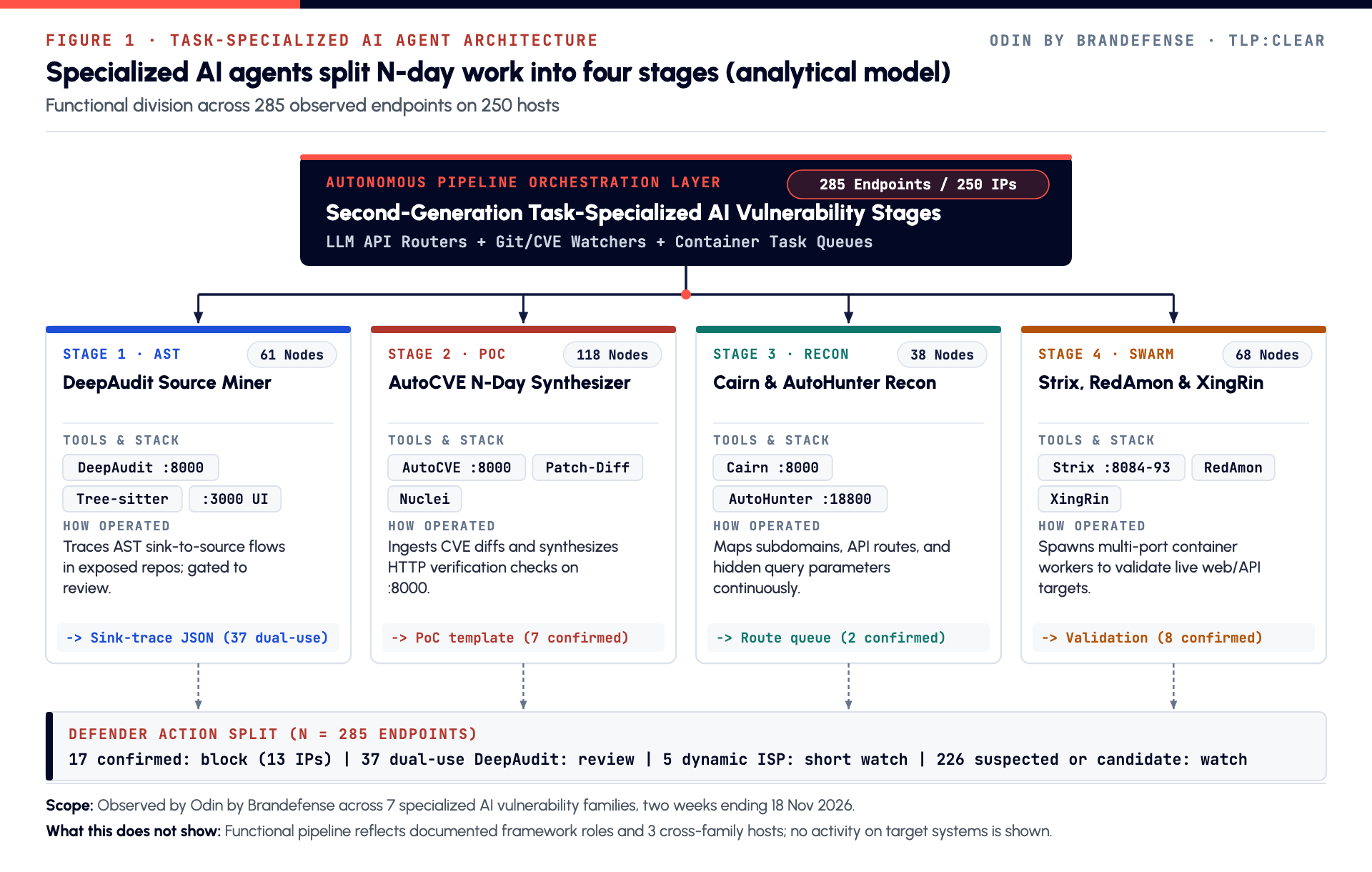
Counts by family
Each endpoint is an IP, port and family combination, labelled confirmed, suspected or candidate.
| Family | Stage | Endpoints | Hosts | Per host | Block | Watch or review |
|---|---|---|---|---|---|---|
| AutoCVE | Advisory to check | 118 | 116 | 1.02x | 7 | 111 (2 dynamic ISP, 109 candidates) |
| DeepAudit | Source auditing | 61 | 49 | 1.24x | 0 | 61 (37 dual-use, 2 dynamic ISP, 22 candidates) |
| Strix | Container validation | 40 | 23 | 1.74x | 5 | 35 candidates |
| AutoHunter | Surface discovery | 21 | 21 | 1.00x | 1 | 20 candidates |
| Cairn | Surface discovery | 17 | 17 | 1.00x | 1 | 16 (1 suspected, 15 candidates) |
| RedAmon | Container validation | 17 | 17 | 1.00x | 3 | 14 candidates |
| XingRin | Container validation | 11 | 10 | 1.10x | 0 | 11 (1 dynamic ISP, 3 suspected, 7 candidates) |
| Total | 285 | 250 | 17 | 268 |
The per-family host counts add up to 253. Three hosts run two families, so the study covers 250 distinct hosts.
Where the agents run
The United States hosts 149 endpoints (52.3%), China 59 (20.7%) and Hong Kong 24 (8.4%). Singapore (9), Germany (4), Canada (4), Finland (4) and the Netherlands (3) follow.
The US total needs care. Of the 100 US AutoCVE records, 85 sit behind one shared proxy provider, Uscloud Inc, on port 3000 with a CN=Cloudflare certificate. Confirmed controllers are spread more widely.
| Hosting network | Confirmed endpoints |
|---|---|
| Shenzhen Tencent Computer Systems | 5 |
| IXROOT LTD | 5 (all on one host) |
| Alibaba Cloud | 2 |
| HostPapa | 1 |
| cognetcloud INC | 1 |
| Oracle Cloud | 1 |
| Contabo | 1 |
| Leaseweb Singapore | 1 |
3. Source Mining and Advisory Synthesis: DeepAudit and AutoCVE
In short
DeepAudit and AutoCVE automate the two slowest manual steps in exploit development. Together they account for 179 of the 285 endpoints (62.8%).
For AppSec and perimeter teams, these two tools shrink the time between a code leak or a patch release and the first automated probe. Figure 2 sets out each family's ports, API routes, target surfaces and matching detection rules.
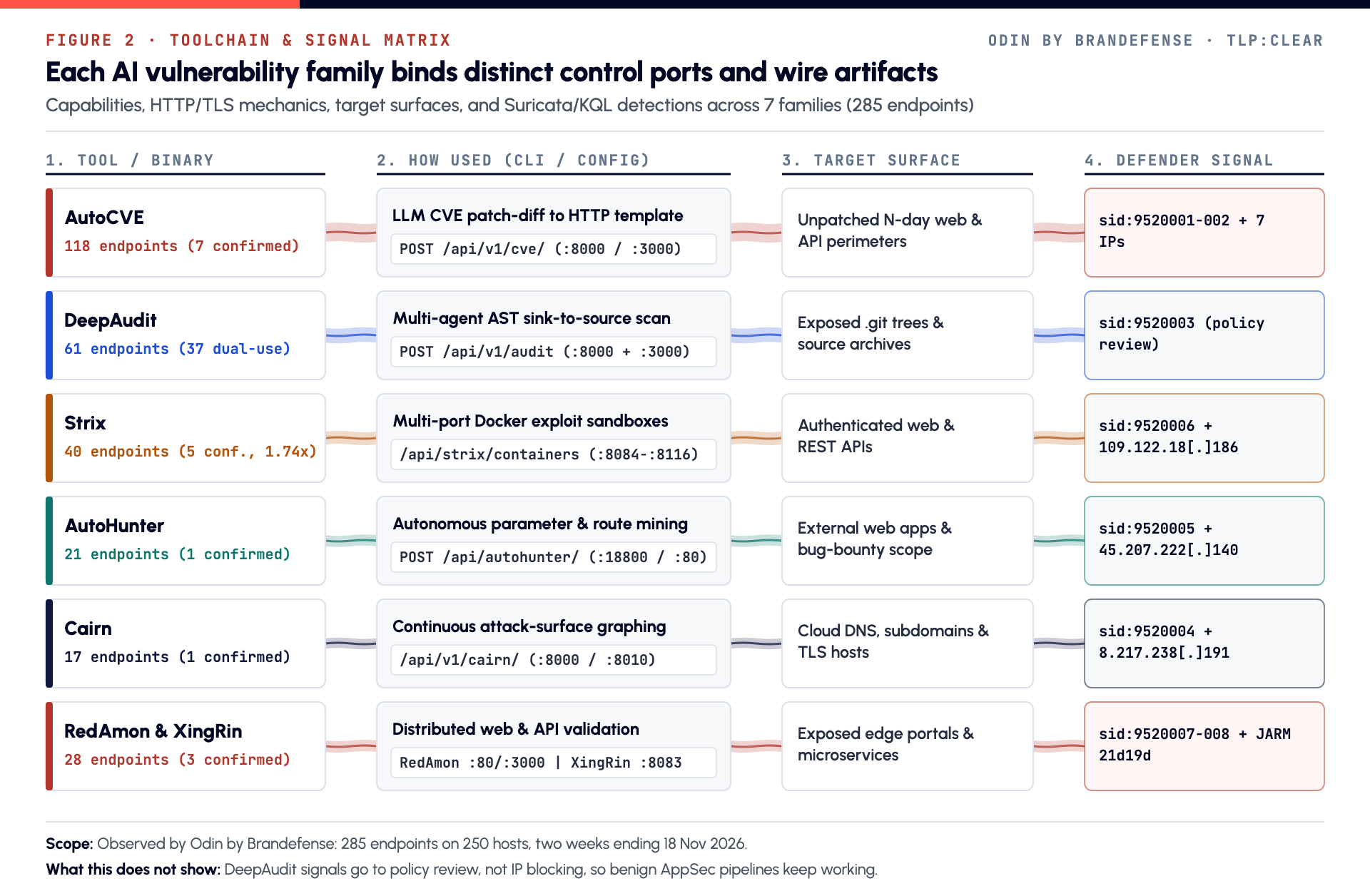
DeepAudit: multi-agent source-code auditing
DeepAudit runs several LLM sub-agents over Tree-sitter abstract syntax trees (AST). An AST is a structured map of source code. The agents trace user input from HTTP controllers into database queries, URL fetchers, deserializers and authentication code.
Engineering teams use DeepAudit for pre-release code review. An attacker can use the same tool on exposed .git folders, leaked source archives or open-source dependencies. Code submitted to /api/v1/audit comes back as candidate SQL injection, server-side request forgery and authentication bypass paths.
| Port | DeepAudit endpoints | Role |
|---|---|---|
| 8000 | 35 | FastAPI analysis backend |
| 3000 | 15 | Node or React web console |
| 8001 | 2 | Backend |
| 8888 | 2 | Backend |
| Other single ports, such as 3500 | 1 each | Console or backend |
Of the 49 DeepAudit hosts, 12 (24.5%) expose a web console and a backend on the same server. Examples sit on HostPapa (US), Hangzhou Alibaba (CN) and Netsec Limited (HK); their addresses are withheld. DeepAudit endpoints are in China (23), the United States (18) and Hong Kong (10).
Why DeepAudit is not blocked
From the outside, an approved DevSecOps code review server looks the same as an attacker mining a leaked repository. None of the 49 DeepAudit hosts also runs a confirmed offensive controller. So all 37 confirmed cloud instances stay on a dual-use watchlist, not a block list.
Two more confirmed instances sit on China Telecom and go to a 24-hour watchlist. Defenders should alert on behavior instead: an unapproved internal host posting corporate code or a .git archive to an external /api/v1/audit endpoint.
AutoCVE: from advisory to HTTP check
AutoCVE watches structured vulnerability feeds, such as the NVD REST API and vendor git commits. It turns a patch diff into a proof-of-concept HTTP request and a nuclei-compatible verification template. nuclei is a common template-based vulnerability scanner.
| Port | AutoCVE endpoints |
|---|---|
| 3000 | 105 |
| 8000 | 9 |
| 13000 | 2 |
| 80 | 1 |
| 8088 | 1 |
All nine confirmed AutoCVE backends listen on TCP 8000. Seven sit on dedicated cloud hosting at Shenzhen Tencent, Hangzhou Alibaba and HostPapa, and are block-ready. The other two sit on China Telecom and China Mobile and go to a 24-hour watchlist. Both also expose a 3000 console.
| Endpoint | Country | Hosting | Seen |
|---|---|---|---|
| 150.158.23[.]244:8000 | CN | Shenzhen Tencent Computer Systems | 13 Nov 2026 |
| 49.232.241[.]96:8000 | CN | Shenzhen Tencent Computer Systems | 13 Nov 2026 |
| 107.175.69[.]167:8000 | US | HostPapa | 13 Nov 2026 |
| 150.158.93[.]134:8000 | CN | Shenzhen Tencent Computer Systems | 13 Nov 2026 |
| 43.130.10[.]7:8000 | US | Shenzhen Tencent Computer Systems | 13 Nov 2026 |
| 43.159.59[.]133:8000 | SG | Shenzhen Tencent Computer Systems | 13 Nov 2026 |
| 8.147.132[.]181:8000 | CN | Hangzhou Alibaba Advertising | 13 Nov 2026 |
The CDN collision on port 3000
Most AutoCVE records are not confirmed. Of the 109 candidates, 85 listen on port 3000 inside Uscloud Inc in the United States. They present CN=Cloudflare certificates and share one JARM value. JARM is a fingerprint of how a server answers TLS handshakes.
A generic Node or React page on port 3000 behind a shared CDN edge says little about who runs it. Blocking those addresses would break unrelated web tenants. These candidates stay on watch until an AutoCVE API route is seen on the same endpoint.
4. Attack-Surface Discovery: Cairn and AutoHunter
In short
A synthesized check needs a matching live target. Cairn and AutoHunter keep mapping subdomains, API routes and query parameters so that checks have somewhere to land.
Figure 3 shows the modeled sequence from advisory and source input, through recon, to container validation. It also marks where each detection rule sits.
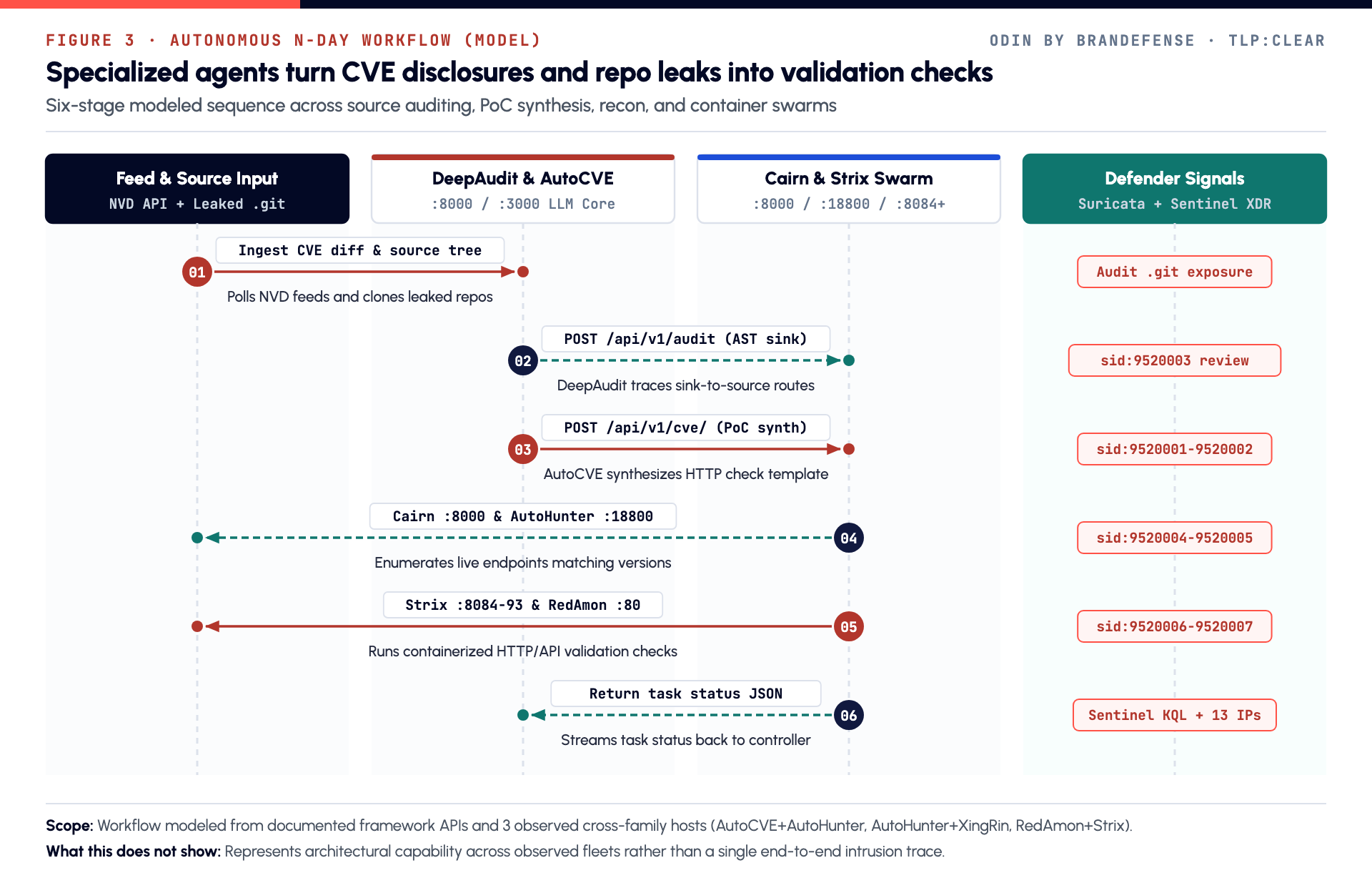
Cairn attack-surface controllers
Cairn keeps an asset graph built from DNS zones, TLS certificates and HTTP banners. It exposes worker coordination APIs on ports 8000 and 8010. Cairn runs 17 distinct endpoints on port 8000.
| Cairn endpoints by country | Count |
|---|---|
| Netherlands | 3 |
| Hong Kong | 3 |
| Canada | 3 |
| Finland | 2 |
| United States | 2 |
The main hosting networks are The Constant Company (4), Google LLC (3) and OVH SAS (2). One Cairn controller is confirmed: 8.217.238[.]191:8000 on Alibaba (US) Technology in Hong Kong, confirmed on 18 November 2026.
One more US instance, on Advin Services LLC, is suspected. The other 15 are uncorroborated candidates on port 8000. Their addresses are withheld.
AutoHunter parameter mining on port 18800
AutoHunter automates headless bug-bounty recon. It extracts endpoints from JavaScript and queues parameters for fuzzing. It runs on 21 endpoints, each on a separate host.
Fourteen of the 21 (66.7%) use the default control port 18800. Single listeners sit on 80, 443, 8080, 18081, 23253, 50000 and 60707. China hosts 14 endpoints, 11 of them on Shenzhen Tencent. Hong Kong hosts 6, led by 4 on cognetcloud INC.
One AutoHunter controller is confirmed: 45.207.222[.]140:80 on cognetcloud INC in Hong Kong, seen on 13 November 2026. The other 20 are uncorroborated candidates on 18800 and high ports, and stay on watch.
5. Container Validation Swarms and Co-Hosting
In short
Strix, RedAmon and XingRin run web and API checks inside short-lived containers. Operators put several container listeners on one host, and sometimes put two agent families on one server.
Container validation agents start an isolated sandbox for each target job. Each sandbox binds its own high port and streams HTTP replay logs and session state back to a parent controller. Figure 4 shows the observed port bindings and runtimes on multi-port and cross-family hosts.
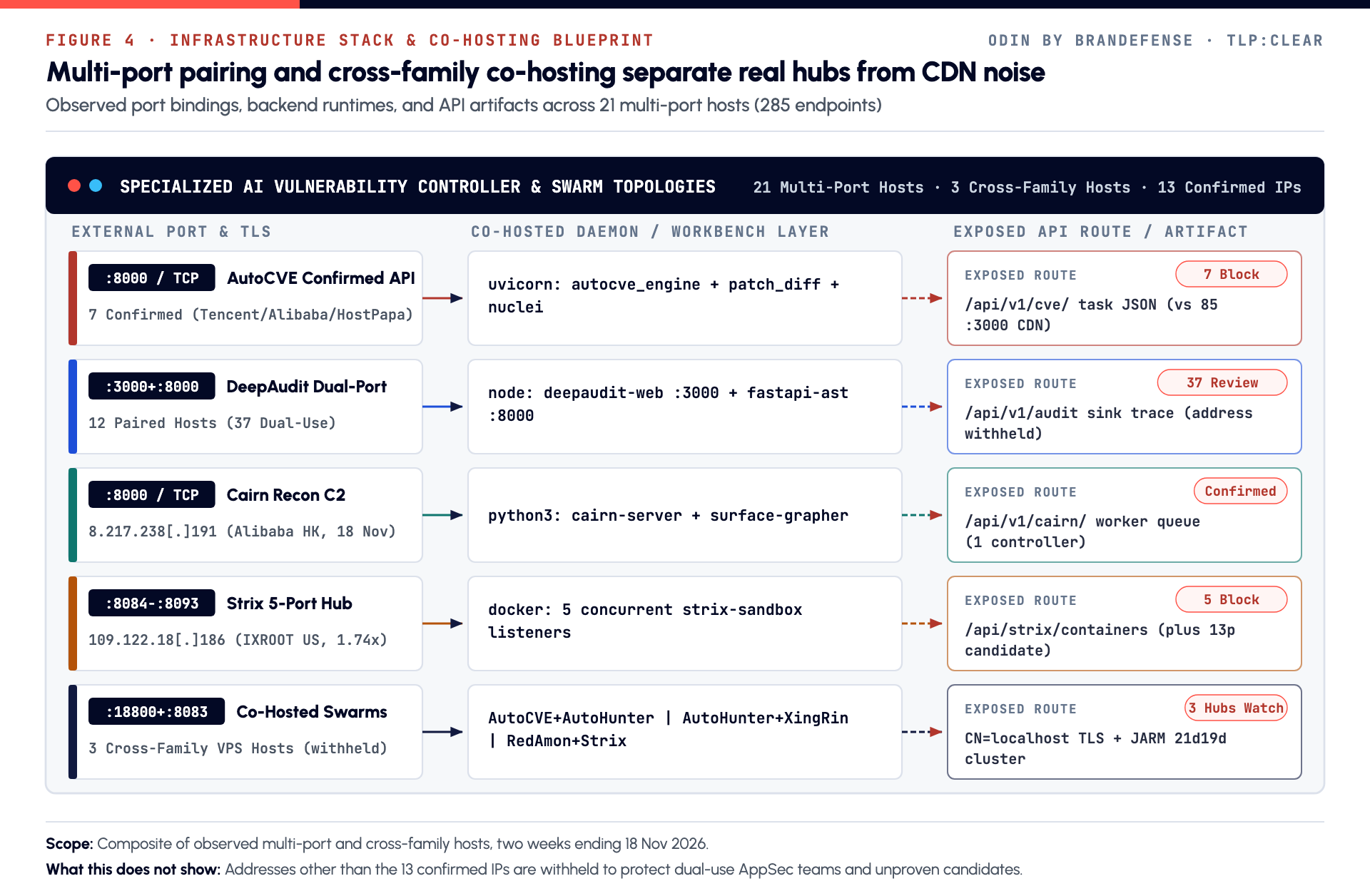
Strix multi-port container hubs
Strix has the highest port-to-host density in the study: 40 endpoints on 23 hosts (1.74x). IXROOT LTD in the United States hosts 18 of the 40 (45.0%), and Hetzner Online GmbH hosts 4. Two IXROOT hubs show how Strix gives each task its own Docker sandbox.
| Hub | Ports | Status |
|---|---|---|
| 109.122.18[.]186 (IXROOT LTD, US) | 8084, 8085, 8086, 8089, 8093 | Five confirmed Strix listeners, seen 13 November 2026; block |
| Address withheld (IXROOT LTD, US) | 13 ports: 8081, 8088, 8092, 8096, 8101, 8102, 8108 to 8112, 8114, 8116 | Candidates seen 16 November 2026; watch until an HTTP route confirms them |
RedAmon web and API validators
RedAmon has 17 endpoints, each on a separate host. Ten are candidate operator dashboards on port 3000. Agent listeners sit on 80 and 443. Three controllers on port 80 are confirmed, in three regions.
| Endpoint | Country | Hosting | Seen |
|---|---|---|---|
| 147.224.215[.]112:80 | US | Oracle Corporation | 13 Nov 2026 |
| 169.58.136[.]189:80 | DE | Contabo GmbH | 13 Nov 2026 |
| 23.111.14[.]152:80 | SG | Leaseweb Singapore | 13 Nov 2026 |
XingRin scanner nodes
XingRin has 11 endpoints on 10 hosts in China and Hong Kong. Seven sit on port 8083. Five of those present a self-signed CN=localhost certificate with the same JARM value:
21d19d00021d21d00042d43d00000091f9827a8676a9d9f27d421962a09b5d
The one confirmed XingRin instance sits on China Telecom, a dynamic telecom line, so it goes to a 24-hour watchlist. Three more XingRin endpoints are suspected. All XingRin addresses are withheld.
Three hosts run two families
Three servers run two specialized agent families at once. This is why 253 family-host pairs come down to 250 distinct hosts. None of these hosts is confirmed, so their addresses are withheld.
| Host | Families and ports | Hosting (country) | What the pairing suggests |
|---|---|---|---|
| Withheld | AutoCVE (3000) and AutoHunter (60707) | Shenzhen Tencent (CN) | An advisory-to-check console next to a parameter miner |
| Withheld | AutoHunter (18800) and XingRin (8083) | cognetcloud INC (HK) | Route discovery next to a CN=localhost scanner |
| Withheld | RedAmon (3000) and Strix (8080) | The Constant Company (KR) | Two web and API validation consoles on one VPS |
These three hosts are the only concrete links between families in this study. They show that some operators combine recon and validation tools. They do not show one operator running the full four-stage chain.
6. Separating Hostile Controllers from Benign Lookalikes
In short
Blocking every AI security tool banner would hit CDN tenants, AppSec teams and home broadband users. Only 17 of the 285 endpoints (6.0%) are block-ready.
AI vulnerability tools have three common benign or unattributable explanations. Each one calls for a different action.
| Situation | Endpoints | Why not block | What to do |
|---|---|---|---|
| Dual-use DeepAudit | 37 confirmed, plus 22 candidates | Enterprise AppSec teams run the same open-source auditor | Policy review; alert on internal code uploads to external /api/v1/audit |
| Shared CDN and uncorroborated candidates | 222 candidates, including 85 AutoCVE on Uscloud 3000 | Generic Node or React pages behind shared edges serve many unrelated tenants | Watch until a family-specific API route appears |
| Dynamic telecom lines | 5 confirmed: 2 AutoCVE, 2 DeepAudit, 1 XingRin | Addresses on China Telecom (4) and China Mobile (1) rotate between customers | 24-hour watchlist, never a permanent block |
| Dedicated cloud controllers | 17 confirmed: AutoCVE 7, Strix 5, RedAmon 3, AutoHunter 1, Cairn 1 | Confirmed offensive controller on dedicated cloud or VPS hosting | Block; re-check after 30 days |
Four endpoints are suspected rather than confirmed: one Cairn and three XingRin. They stay on watch until a second signal appears.
Cloud VPS addresses can be reassigned to new customers. Block entries for the 13 confirmed addresses should be re-checked after 30 days.
7. What Defenders Should Do
Within 24 hours
- Block the 13 confirmed controller addresses (17 endpoints) at perimeter firewalls and proxies. Re-check them after 30 days.
- Treat any agent match on a dynamic telecom line as a 24-hour watchlist item, not a permanent block.
- Route DeepAudit matches to policy review, not to automatic blocking.
Within 72 hours
- Scan external web properties and CDN origins for exposed
.git/configfiles, source-map bundles and backup archives, and remove them. - Shorten emergency patch deadlines for internet-facing gateways listed in the CISA Known Exploited Vulnerabilities catalog and NVD.
- Rate-limit unauthenticated API routes, and add bot challenges where recon swarms probe them.
Within 7 to 30 days
- Deploy the eight Suricata signatures, routing SID 9520003 (DeepAudit) to a policy queue.
- Enable the Sentinel KQL hunt and the three Sigma rules, with exact host names of approved AppSec runners in the allowlists.
- Add the JARM values in Chapter 9 to external attack-surface hunting.
- Watch container hosts for unapproved AutoCVE, Cairn, AutoHunter, Strix, RedAmon or XingRin worker processes.
8. Detection Rules
The full rules are in the Detection rules tab. Each file targets an API route, a header or a process pattern that the agents use.
| Rule file | What it catches |
|---|---|
odin_specialized_ai_vuln_agents.rules | Suricata 7: eight signatures for agent API calls and check-ins across all seven families |
sentinel_autocve_cairn_and_ai_scanner_burst.kql | Microsoft Sentinel and Defender XDR: contact with the 13 confirmed controllers, plus unapproved agent processes and high-rate egress on agent ports |
sigma_specialized_ai_exploit_agent_execution.yml | Sigma (3 rules): unapproved AutoCVE runners, DeepAudit backends and recon or swarm worker launches on Linux |
odin_deepaudit_autocve_cairn_strix_artifacts.yar | YARA (4 rules): configuration and orchestration files for each agent group |
How the Suricata signatures work
| SID | Looks for | Why |
|---|---|---|
| 9520001 | Outbound POST /api/v1/cve/ with "cve_id" and "patch_diff" in the body, to ports 8000, 3000 or 13000 | Catches an internal host sending an advisory to AutoCVE |
| 9520002 | An HTTP 200 response from ports 8000 or 3000 with "autocve_task" and "template_status" | Catches AutoCVE returning task status |
| 9520003 | Outbound POST /api/v1/audit with "repo_source" and "sink_trace" | Catches code sent to DeepAudit; policy alert only, since the tool is dual-use |
| 9520004 | Outbound request to /api/v1/cairn/ with an X-Cairn-Worker: header, to ports 8000 or 8010 | Catches Cairn worker check-ins |
| 9520005 | Outbound POST /api/autohunter/ with "target_scope" in the body | Catches AutoHunter recon queue dispatch |
| 9520006 | Outbound POST /api/strix/containers with "sandbox_port" in the body | Catches Strix sandbox control |
| 9520007 | Outbound request to /api/redamon/ with a user agent starting RedAmon-Agent/ | Catches RedAmon agent beacons |
| 9520008 | Outbound POST /api/xingrin/node with an X-XingRin-Token: header | Catches XingRin node heartbeats |
Suricata sees these signatures only in clear text. For TLS listeners on 443 or 8083, use TLS inspection or pair the signatures with the KQL hunt.
How the other rules work
The KQL query looks back 7 days. It alerts on any device that contacts one of the 13 confirmed controller addresses, whatever its name. It also flags Python, Node, nuclei, httpx or curl connections on agent ports from hosts outside an exact-name allowlist. Process launches that name an agent add context, and contact with 15 or more remote addresses marks a scan burst.
The query sorts each hit into one of three actions: block a confirmed controller, review an unapproved DeepAudit launch, or hunt a high-rate scanner swarm. The allowlist never hides a match on a confirmed controller address.
The first Sigma rule needs a runtime such as python3, uvicorn or nuclei and a command line naming autocve, cve_synthesizer, patch_diff_agent or --cve-feed. The second flags DeepAudit backends at medium severity for dual-use review. The third matches worker names such as cairn-worker, strix-sandbox or xingrin with port 8083. Each rule excludes only named, approved hosts.
Each YARA rule is limited to files under 512 KB and needs at least two independent strings.
| YARA rule | Fires when |
|---|---|
ODIN_DeepAudit_MultiAgent_AST_Config | A DeepAudit identifier, an AST marker such as sink_to_source, and /api/v1/audit appear together |
ODIN_AutoCVE_PatchDiff_Synthesizer_Manifest | An AutoCVE identifier, a patch-diff or NVD sync marker, and template_status appear together |
ODIN_Cairn_AutoHunter_Recon_Queue_Config | A Cairn header and route, or the AutoHunter route and port 18800, appear with target_scope |
ODIN_Strix_RedAmon_XingRin_Swarm_Compose | The Strix route and sandbox_port, the RedAmon user agent and route, or the XingRin route and token header appear |
Tuning
Approved internal tools are the main false positive. Add the exact host names of CI/CD static-analysis and vulnerability-management runners to the KQL and Sigma allowlists. Never use wildcard host patterns. Add Suricata pass rules for those runners by source address before any inline enforcement.
9. Indicators
The Indicators tab holds 17 published indicators: 17 controller endpoints (IP and port) on 13 distinct addresses, and no file hashes. Two JARM fingerprints for hunting appear in this report only. All other addresses are withheld.
| Type | Count | Where |
|---|---|---|
| Confirmed controller endpoints to block | 17 (13 addresses) | Indicators tab and the table below |
| JARM fingerprints for hunting | 2 | This report only |
| Selected watchlist, review or dual-use endpoints | 9 (of 268 watch records) | Withheld; described in Chapters 3 to 6 |
Confirmed endpoints to block
| Endpoint | Family | Country | Hosting | Seen |
|---|---|---|---|---|
| 150.158.23[.]244:8000 | AutoCVE | CN | Shenzhen Tencent | 13 Nov 2026 |
| 49.232.241[.]96:8000 | AutoCVE | CN | Shenzhen Tencent | 13 Nov 2026 |
| 107.175.69[.]167:8000 | AutoCVE | US | HostPapa | 13 Nov 2026 |
| 150.158.93[.]134:8000 | AutoCVE | CN | Shenzhen Tencent | 13 Nov 2026 |
| 43.130.10[.]7:8000 | AutoCVE | US | Shenzhen Tencent | 13 Nov 2026 |
| 43.159.59[.]133:8000 | AutoCVE | SG | Shenzhen Tencent | 13 Nov 2026 |
| 8.147.132[.]181:8000 | AutoCVE | CN | Hangzhou Alibaba | 13 Nov 2026 |
| 109.122.18[.]186:8084 | Strix | US | IXROOT LTD | 13 Nov 2026 |
| 109.122.18[.]186:8085 | Strix | US | IXROOT LTD | 13 Nov 2026 |
| 109.122.18[.]186:8086 | Strix | US | IXROOT LTD | 13 Nov 2026 |
| 109.122.18[.]186:8089 | Strix | US | IXROOT LTD | 13 Nov 2026 |
| 109.122.18[.]186:8093 | Strix | US | IXROOT LTD | 13 Nov 2026 |
| 45.207.222[.]140:80 | AutoHunter | HK | cognetcloud INC | 13 Nov 2026 |
| 8.217.238[.]191:8000 | Cairn | HK | Alibaba (US) Technology | 18 Nov 2026 |
| 147.224.215[.]112:80 | RedAmon | US | Oracle | 13 Nov 2026 |
| 169.58.136[.]189:80 | RedAmon | DE | Contabo | 13 Nov 2026 |
| 23.111.14[.]152:80 | RedAmon | SG | Leaseweb | 13 Nov 2026 |
JARM fingerprints for hunting
| JARM | Seen on | Use |
|---|---|---|
21d19d00021d21d00042d43d00000091f9827a8676a9d9f27d421962a09b5d | 5 XingRin listeners with CN=localhost on 8083, and 1 DeepAudit listener | Hunt only; pair with an API route before acting |
3fd3fd0003fd3fd21c42d42d000000bdfc58c9a46434368cf60aa440385763 | Strix (2), AutoHunter (1) and XingRin (1) listeners | Hunt only; pair with an API route before acting |
Withheld: the nine selected watch endpoints. They are two DeepAudit dual-use hosts, the 13-port Strix candidate hub and three cross-family hosts. The rest are one suspected Cairn node, one suspected XingRin node and the confirmed XingRin instance on a telecom line. Every candidate and dynamic-ISP address is also withheld, as are certificate names seen only on unconfirmed hosts.
10. Scope and Limits
- Window. The findings cover a two-week observation window ending 18 November 2026. Some records carry earlier first-seen dates; we do not treat those as a tracking start.
- Controllers, not intrusions. We saw controller infrastructure. We did not see activity on any target system, and nothing here shows that a check reached or affected a target.
- The four-stage chain is a model. It comes from the tools' documented APIs. Only three hosts link two families, and no single operator was seen running all four stages.
- Dual-use tools. These agents are open-source security tools. DeepAudit stays on review because legitimate AppSec teams use it. The 17 block entries are confirmed controllers on dedicated hosting; re-check them after 30 days, since cloud addresses are reassigned.
- Candidates are leads. The 222 candidates are hunting leads. Do not block them without corroboration.
- No growth claims. The data supports counts in the window, not trends over time.
- Rule testing. Every published rule file loads without errors in its engine (Suricata 7.0.12, YARA-X, pySigma and Microsoft's Kusto.Language analyzer, checked on 20 November 2026). The rules were not replayed against live traffic, so test and tune them in your own environment before production use.
11. Sources
- OWASP Foundation. OWASP Top 10 for Large Language Model Applications. https://genai.owasp.org/llm-top-10/ (verified 18 November 2026)
- NIST. SP 800-218A, Secure Software Development Practices for Generative AI and Dual-Use Foundation Models. https://csrc.nist.gov/pubs/sp/800/218/a/final (verified 18 November 2026)
- CISA. Known Exploited Vulnerabilities Catalog. https://www.cisa.gov/known-exploited-vulnerabilities-catalog (verified 18 November 2026)
- NIST National Vulnerability Database. Vulnerabilities API. https://nvd.nist.gov/developers/vulnerabilities (verified 18 November 2026)
- ProjectDiscovery. Nuclei overview. https://docs.projectdiscovery.io/tools/nuclei/overview (verified 18 November 2026)
- OISF. Suricata 7.0 User Guide, HTTP keywords. https://docs.suricata.io/en/suricata-7.0.0/rules/http-keywords.html (verified 18 November 2026)
- Salesforce Engineering. Easily Identify Malicious Servers on the Internet with JARM. https://engineering.salesforce.com/easily-identify-malicious-servers-on-the-internet-with-jarm-e095edac525a/ (verified 18 November 2026)
What is…?
Short explanations of the tools and families named in this study.
What is DeepAudit?
DeepAudit is an open-source AI code auditing tool. Application security teams use it to find flaws in source code.
More about DeepAuditAI security toolWhat is AutoCVE?
AutoCVE is an AI-assisted tool that turns new vulnerability advisories into HTTP checks.
More about AutoCVEAI security toolWhat is Strix?
Strix is an open-source AI agent framework that runs web and API security checks, giving each task its own container sandbox.
More about StrixAI security toolWhat is XingRin?
XingRin is a scanning platform that runs web and API checks from containers, seen mostly on Chinese and Hong Kong hosting.
More about XingRinAI security toolWhat is Cairn?
Cairn is a reconnaissance tool that keeps an asset graph built from DNS zones, TLS certificates and HTTP banners.
More about CairnAI security toolWhat is AutoHunter?
AutoHunter automates headless bug-bounty reconnaissance of subdomains, API routes and query parameters.
More about AutoHunterFrequently asked questions
What are these agents?
The seven families fall into four groups. Together they form a chain from vulnerability discovery to target validation. That chain is our analytical model, built from the tools' documented APIs. Only three servers in the data run two families side by side, and no single operator was seen running the whole chain.
Why not block all of them?
Because most of these endpoints are not clearly hostile. Only 17 of the 285 endpoints (6.0%) are confirmed controllers on dedicated cloud hosting. They sit on 13 addresses, and those are the ones to block.
What do the swarms look like?
The container tools are the most visible part of the chain. Strix gives each task its own Docker sandbox on its own port. One US server, 109.122.18[.]186, runs five confirmed Strix listeners on ports 8084 to 8093. A second US server binds 13 candidate ports; its address is withheld until the activity is confirmed.
What should security leaders take away?
Specialized agents compress the window between disclosure and probing. A newly released patch can quickly become an automated check against your perimeter. Exposed source code is now an input to an automated pipeline, not only a reconnaissance gift.