


Key takeaways
- Odin found 285 endpoints on 250 hosts running seven task-specialized AI vulnerability agents.
- AutoCVE, the largest family, turns new advisories into HTTP checks; 7 controllers are confirmed.
- DeepAudit audits source code and is dual-use, so none of its 61 endpoints is blocked.
- Only 17 endpoints on 13 dedicated cloud addresses are confirmed controllers to block.
- Remove exposed .git folders and shorten patch windows for internet-facing gateways.
In a two-week observation window ending 18 November 2026, Odin by Brandefense found 285 internet-facing endpoints on 250 hosts running seven specialized AI vulnerability agents. Earlier AI offense tools tried to do everything from one chat console. These newer tools each automate a single slow step: auditing source code, turning an advisory into a check, mapping a perimeter, or testing a target from a container. For defenders, that means less time between a code leak or a patch release and the first automated probe.
What are these agents?
The seven families fall into four groups. Together they form a chain from vulnerability discovery to target validation. That chain is our analytical model, built from the tools' documented APIs. Only three servers in the data run two families side by side, and no single operator was seen running the whole chain.
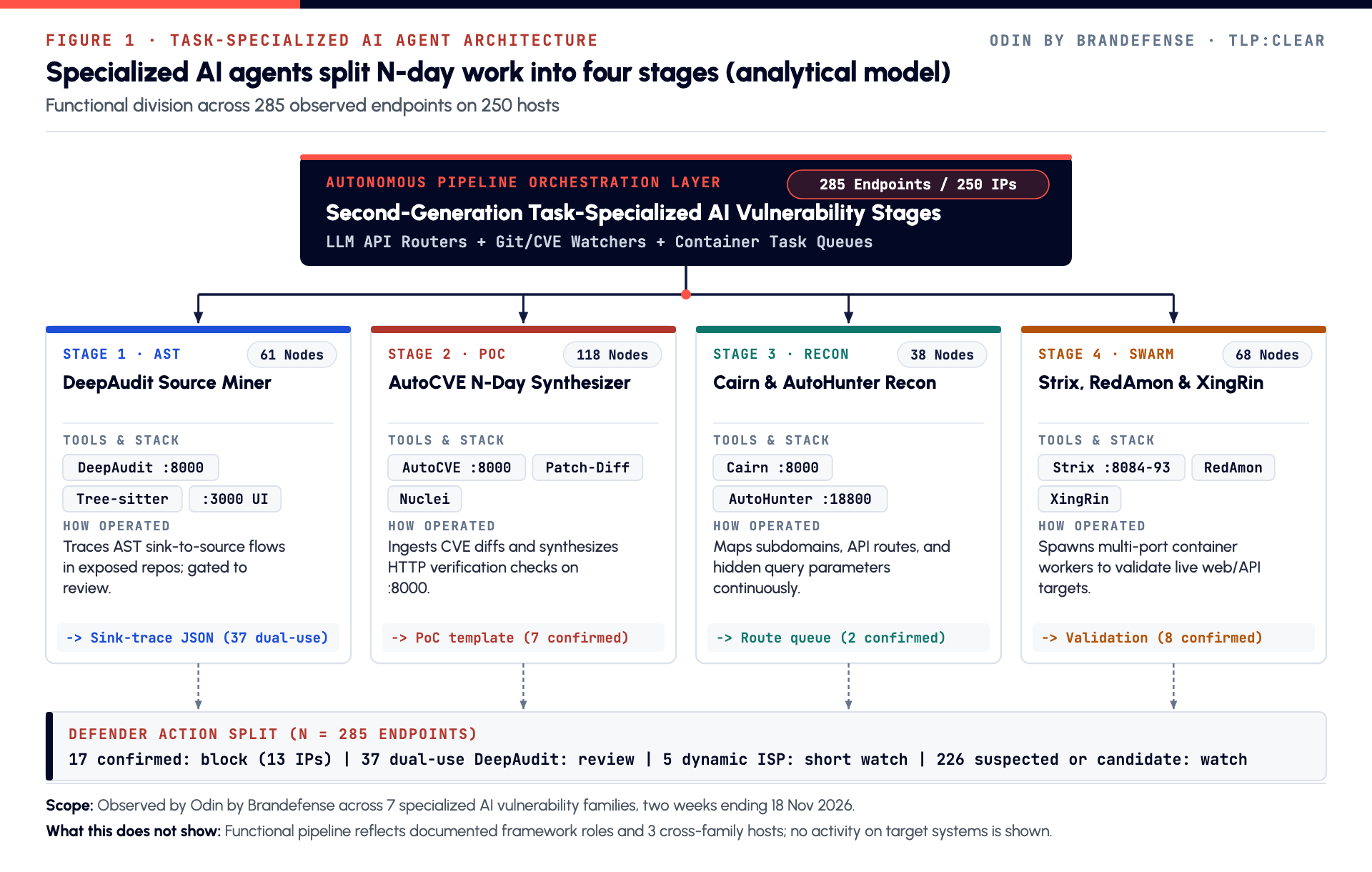
| Family | What it does | Endpoints | Confirmed to block |
|---|---|---|---|
| DeepAudit | Audits source code for reachable vulnerabilities | 61 | 0 (dual-use) |
| AutoCVE | Turns public advisories and patch diffs into HTTP checks | 118 | 7 |
| Cairn | Maps subdomains, certificates and services | 17 | 1 |
| AutoHunter | Mines API routes and query parameters | 21 | 1 |
| Strix | Runs web and API checks from Docker sandboxes | 40 | 5 |
| RedAmon | Validates web apps and APIs | 17 | 3 |
| XingRin | Distributed web scanner nodes | 11 | 0 |
AutoCVE is the largest family. It watches feeds such as the US National Vulnerability Database and vendor code commits. When a fix appears, it writes a test request that checks whether a server is still unpatched. Seven AutoCVE controllers on dedicated cloud hosting in China, the United States and Singapore are confirmed.
Why not block all of them?
Because most of these endpoints are not clearly hostile. Only 17 of the 285 endpoints (6.0%) are confirmed controllers on dedicated cloud hosting. They sit on 13 addresses, and those are the ones to block.
The rest fall into three groups that call for a lighter touch:
- Dual-use tools. DeepAudit is an open-source code auditor that enterprise AppSec teams use too. From outside, a company's code review server looks the same as an attacker mining a leaked repository. All 61 DeepAudit endpoints go to policy review.
- Shared CDN pages. Of 109 AutoCVE candidates, 85 sit behind one shared CDN provider on port 3000. Blocking those addresses would break unrelated websites.
- Home and small-business lines. Five confirmed endpoints sit on Chinese telecom networks where addresses rotate between customers. A 24-hour watchlist fits them better than a block.
The lesson is that a tool name on a web page is not enough. Defenders should act on a confirmed controller, or on a family-specific API route seen together with other signals.
What do the swarms look like?
The container tools are the most visible part of the chain. Strix gives each task its own Docker sandbox on its own port. One US server, 109.122.18[.]186, runs five confirmed Strix listeners on ports 8084 to 8093. A second US server binds 13 candidate ports; its address is withheld until the activity is confirmed.
RedAmon has three confirmed controllers in the United States, Germany and Singapore. XingRin nodes in China and Hong Kong share a self-signed CN=localhost certificate and a common TLS fingerprint, which is useful for hunting.
The recon tools feed the swarms. AutoHunter favors port 18800, and one controller in Hong Kong is confirmed. Cairn, which builds an asset graph from DNS and certificates, has one confirmed controller in Hong Kong, seen on 18 November 2026.
We saw controller infrastructure only. Nothing in the data shows that any check reached or affected a target system.
What should security leaders take away?
Specialized agents compress the window between disclosure and probing. A newly released patch can quickly become an automated check against your perimeter. Exposed source code is now an input to an automated pipeline, not only a reconnaissance gift.
At the same time, the tools are dual-use. A block list built on tool names would hit your own AppSec team, your CDN neighbors and home users. Precision matters more than volume.
The good news is that each family leaves clear traces. AutoCVE accepts advisories on a /api/v1/cve/ route, DeepAudit takes code on /api/v1/audit, and Strix controls its sandboxes through /api/strix/containers. The worker processes also carry telling names on the hosts that run them. Our Suricata, Sentinel, Sigma and YARA rules look for these routes, headers and process names. They also catch an internal machine that quietly sends company code to an outside audit service.
What to do now
- Block the 13 confirmed controller addresses (17 endpoints). The full report's Indicators tab lists all of them. Re-check the entries after 30 days.
- Send DeepAudit hits to policy review, and alert when an internal host uploads company code or a
.gitarchive to an outside audit service. - Remove exposed
.gitfolders, source maps and backup archives from websites and CDN origins. - Shorten patch deadlines for internet-facing gateways listed in the CISA Known Exploited Vulnerabilities catalog.
- Deploy the detection rules in the full report's Detection rules tab: Suricata, Sentinel KQL, Sigma and YARA, with exact host names of approved scanners in the allowlists.
The full report covers ports, API routes, fingerprints, rule logic and the complete indicator list.
What is…?
Short explanations of the tools and families named in this study.
What is DeepAudit?
DeepAudit is an open-source AI code auditing tool. Application security teams use it to find flaws in source code.
More about DeepAuditAI security toolWhat is AutoCVE?
AutoCVE is an AI-assisted tool that turns new vulnerability advisories into HTTP checks.
More about AutoCVEAI security toolWhat is Strix?
Strix is an open-source AI agent framework that runs web and API security checks, giving each task its own container sandbox.
More about StrixAI security toolWhat is XingRin?
XingRin is a scanning platform that runs web and API checks from containers, seen mostly on Chinese and Hong Kong hosting.
More about XingRinAI security toolWhat is Cairn?
Cairn is a reconnaissance tool that keeps an asset graph built from DNS zones, TLS certificates and HTTP banners.
More about CairnAI security toolWhat is AutoHunter?
AutoHunter automates headless bug-bounty reconnaissance of subdomains, API routes and query parameters.
More about AutoHunterFrequently asked questions
What are these agents?
The seven families fall into four groups. Together they form a chain from vulnerability discovery to target validation. That chain is our analytical model, built from the tools' documented APIs. Only three servers in the data run two families side by side, and no single operator was seen running the whole chain.
Why not block all of them?
Because most of these endpoints are not clearly hostile. Only 17 of the 285 endpoints (6.0%) are confirmed controllers on dedicated cloud hosting. They sit on 13 addresses, and those are the ones to block.
What do the swarms look like?
The container tools are the most visible part of the chain. Strix gives each task its own Docker sandbox on its own port. One US server, 109.122.18[.]186, runs five confirmed Strix listeners on ports 8084 to 8093. A second US server binds 13 candidate ports; its address is withheld until the activity is confirmed.
What should security leaders take away?
Specialized agents compress the window between disclosure and probing. A newly released patch can quickly become an automated check against your perimeter. Exposed source code is now an input to an automated pipeline, not only a reconnaissance gift.