


1. Executive Summary
In short
In a two-week observation window ending 18 November 2026, Odin by Brandefense mapped 79 endpoints on 50 hosts across eight threat-feed clusters. Relay clusters split VPN bridges from staging hosts. Extortion clusters stack six TLS ports on one server. Only 9 endpoints on 8 hosts are confirmed command-and-control (C2); the other 70 stay on watchlists. Block the 9 confirmed endpoints, keep dynamic ISPs and shared hosting on short watchlists, and alert on side-loaded DLLs, SoftEther tunnels and rclone transfers.
This report looks at the servers behind eight clusters that threat feeds label RedJuliett, ShadowPad, PlugX, Gh0stRAT, Kimsuky, LazarusGroup, BianLian and Coruna. These names are feed labels. They are not our attribution. Public advisories describe how these groups work; this report does not tie any address to an actor named in those advisories.
The study covers 79 unique endpoints (IP and port pairs) on 50 IPv4 hosts. No IPv4 address appears in more than one cluster.
Relay-labeled clusters split VPN bridges from staging hosts across providers.
The RedJuliett-labeled hosts separate two Azure US machines on port 3389 from three SoftEther VPN bridges on port 443 in India, Germany and Hong Kong. ShadowPad-labeled hosts add two confirmed C2 servers in Japan and the Netherlands. PlugX and Gh0stRAT labels sit on Tencent, Alibaba, telecom networks and small-office routers.
Seven confirmed Kimsuky-labeled endpoints form three matched pairs.
Two AWS servers share one JARM value. Two Akamai servers on port 999 share one certificate and one JARM. Two UCloud servers in adjacent Korean subnets serve plain HTTP on port 80. The LazarusGroup label sits on one shared web-and-mail host with six open ports.
BianLian-labeled hubs stack six TLS ports behind one fingerprint.
Two HostPapa servers expose the same ports (443, 666, 888, 1122, 5566, 7777). All 12 TLS sockets share one JARM value. Public advisories describe BianLian pairing Go backdoors with rclone bulk transfers instead of file encryption, so classic ransomware alerts stay quiet.
Three Decisions for Leaders
- Block confirmed C2 hosts, but keep shared and dynamic addresses on watchlists. Block the 9 confirmed endpoints. Hold dynamic telecom addresses and shared web-and-mail servers on time-bound SIEM watchlists, so you do not cut off unrelated customers.
- Tie DLL side-loading and VPN tools to outbound traffic. Alert when a signed program in a user-writable folder loads an unsigned DLL and reaches the internet within 15 minutes. Alert on SoftEther VPN tools outside named jump hosts.
- Watch for data leaving, not only for files being encrypted. Restrict rclone and SFTP transfers to named backup servers. Watch outbound TLS sessions to unusual high ports.
The Study in Numbers
| Number | What it is |
|---|---|
| 79 | Unique endpoints on 50 IPv4 hosts, across eight feed-labeled clusters |
| 9 | Confirmed C2 endpoints on 8 hosts (7 Kimsuky-labeled, 2 ShadowPad-labeled); the only addresses published |
| 70 | Endpoints held on watchlists: 57 suspected, 8 candidates and 5 on dynamic ISPs; addresses withheld |
| 14 | Hosts with two or more ports, holding 43 of the 79 endpoints (54.4%) |
| 12 | TLS sockets on two BianLian-labeled HostPapa hosts that share one JARM value |
| 54 | Endpoints with TLS (68.4%), showing 22 distinct JARM values |
| 0 | IPv4 addresses shared between clusters |
How to use this report.
Security leaders can read Chapter 1, Chapter 7 and Chapter 8. SOC and detection engineers should start with Chapters 8 to 10. CTI analysts will find cluster detail in Chapters 2 to 6.
2. Labels, Groups and Ports
In short
The 79 endpoints fall into three groups: relay and backdoor clusters, staging and collection clusters, and extortion listeners. Ports cluster inside each group, but no address is shared between groups.
What the cluster names mean
Each cluster name is the label a threat feed attaches to a set of hosts. The labels rest on protocol banners, certificates, port layouts and JARM fingerprints. JARM is a fingerprint of how a server answers TLS handshakes; servers with the same software and settings tend to share it.
A label is a lead, not an attribution. Where this report cites CISA or MITRE ATT&CK, it does so to explain known tradecraft. None of those sources is used to tie a specific address to a named actor.
Three groups
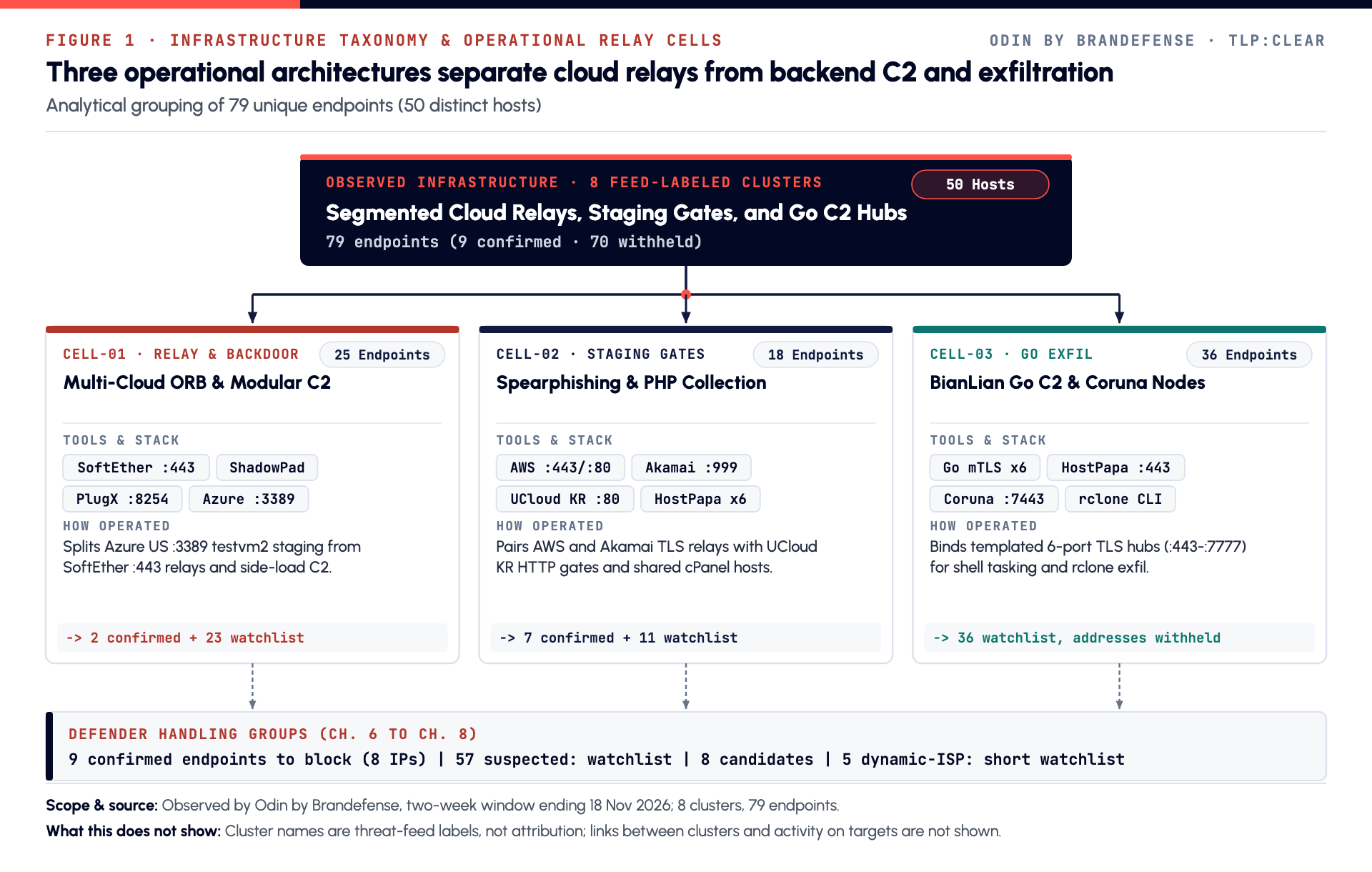
The grouping in Figure 1 is our analytical model. It sorts clusters by the role their servers seem to play. It does not claim that clusters in the same group work together.
| Group | Clusters | Endpoints (hosts) | Confirmed C2 |
|---|---|---|---|
| Relay and backdoor | RedJuliett, ShadowPad, PlugX, Gh0stRAT | 25 (21) | 2 (ShadowPad) |
| Staging and collection | Kimsuky, LazarusGroup | 18 (11) | 7 (Kimsuky) |
| Extortion listeners | BianLian, Coruna | 36 (18) | 0 |
Public reporting links the first two groups to China and North Korea. Together they hold 43 endpoints on 32 hosts, including all 9 confirmed C2 endpoints.
Clusters at a glance
| Cluster | Role | Endpoints (hosts) | Ports per host | Confirmed / suspected / candidate / dynamic ISP |
|---|---|---|---|---|
| BianLian | Go TLS C2, data-theft extortion | 29 (14) | 2.07 | 0 / 24 / 4 / 1 |
| Gh0stRAT | Binary zlib RAT, edge relays | 9 (6) | 1.50 | 0 / 3 / 4 / 2 |
| ShadowPad | Modular backdoor (S0596) | 3 (3) | 1.00 | 2 / 1 / 0 / 0 |
| PlugX | Side-loaded modular C2 (S0013) | 7 (6) | 1.17 | 0 / 7 / 0 / 0 |
| Kimsuky | Staging and PHP gates (G0094) | 12 (10) | 1.20 | 7 / 3 / 0 / 2 |
| LazarusGroup | Shared web and mail host (G0032) | 6 (1) | 6.00 | 0 / 6 / 0 / 0 |
| RedJuliett | SoftEther relays, Azure staging | 6 (6) | 1.00 | 0 / 6 / 0 / 0 |
| Coruna | Paired 7000 to 7443 listeners | 7 (4) | 1.75 | 0 / 7 / 0 / 0 |
Many ports, few hosts
Inside each cluster, operators reuse hosts. Fourteen hosts bind two or more ports and hold 43 of the 79 endpoints (54.4%). The two BianLian-labeled hubs (both bind the same six TLS ports; one also opens port 80) and the six-port LazarusGroup-labeled host lead this pattern.
3. Relay and Backdoor Clusters: RedJuliett, ShadowPad, PlugX, Gh0stRAT
In short
These four clusters hold 25 endpoints on 21 hosts. They place VPN bridges, staging machines and backdoor listeners on separate providers and regions; two ShadowPad-labeled servers are confirmed C2.
CISA advisory AA26-281A describes operators routing intrusion traffic through operational relay box (ORB) networks. An ORB network is a mesh of leased virtual servers, SoftEther VPN bridges and edge routers that hides where traffic really comes from. Behind such relays, public reporting describes modular backdoors loaded through DLL side-loading (T1574.002): ShadowPad (S0596), PlugX (S0013) and Gh0stRAT (S0032).
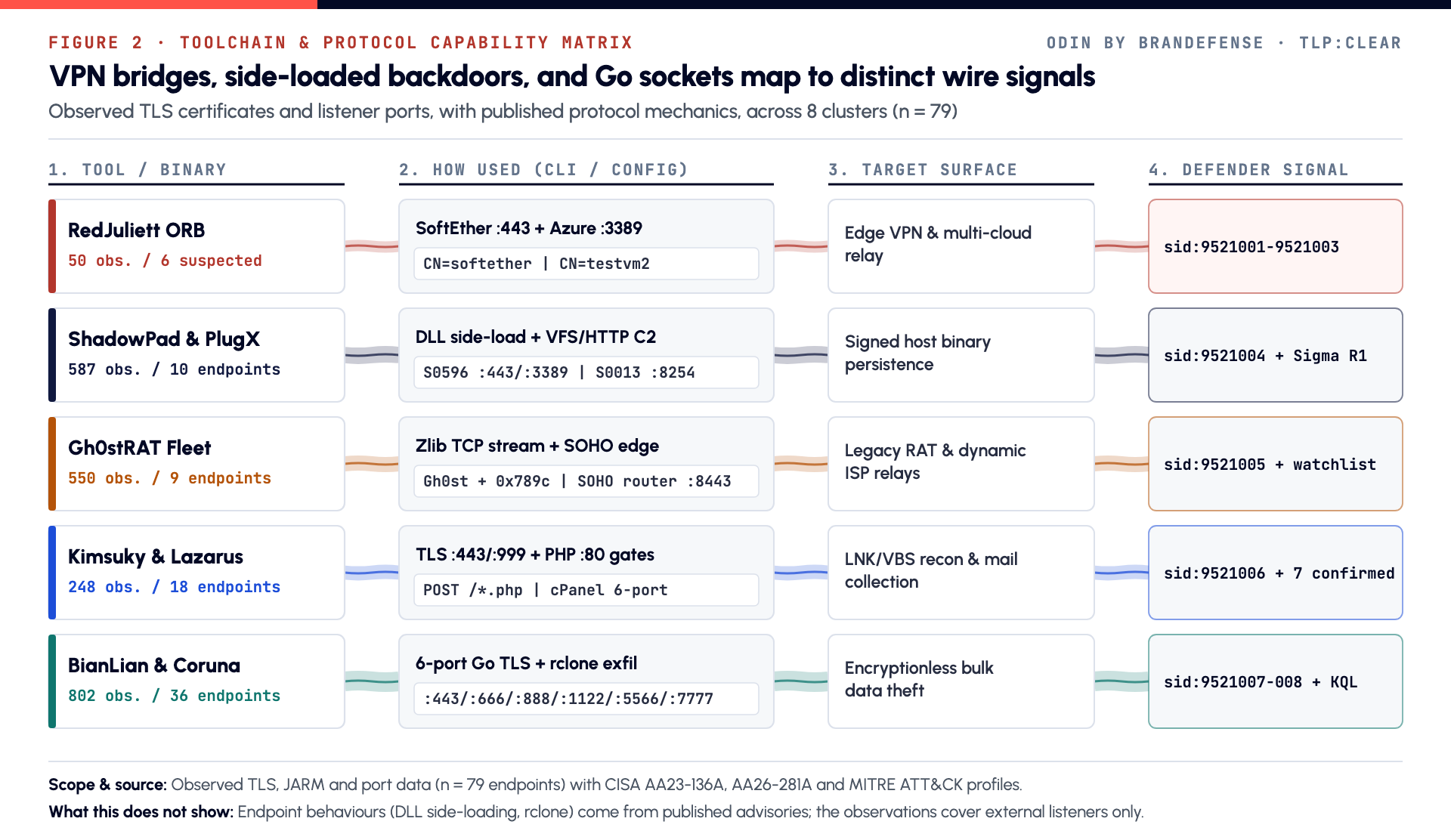
RedJuliett label: staging hosts apart from VPN bridges
All six RedJuliett-labeled endpoints are suspected, on six hosts. They fall into two roles.
| Role | Hosts | Hosting | Certificate subject |
|---|---|---|---|
| Windows staging machine on 3389 | 2 | Microsoft Azure, United States | CN=testvm2 (self-signed, identical on both) |
| SoftEther VPN bridge on 443 | 3 | Microsoft Azure India; Hetzner Online, Germany; Alibaba, Hong Kong | CN=softether |
| Relay on 443 | 1 | Regional telecom carrier, North Macedonia | Domain withheld |
The matching CN=testvm2 subjects suggest a templated Windows staging image. The CN=softether subject is the SoftEther default. The India and Hong Kong bridges also share a SoftEther JARM prefix (06d06d07d06d06d06c42d42d000000...). Their addresses are withheld because SoftEther and Azure test machines have common legitimate uses.
ShadowPad label: two confirmed servers
Two dedicated servers carry the ShadowPad label and are confirmed C2.
| Endpoint | Hosting | Country | Signal |
|---|---|---|---|
| 130.94.65[.]79:443 | LIGHT NODE LIMITED | Japan | HTTPS C2; JARM 21d14d...6cbe21 |
| 45.32.237[.]137:3389 | The Constant Company, LLC | Netherlands | Windows hostname certificate CN=WIN-JRJ4OQAGQ2I; serves a non-RDP listener on the RDP port |
A third ShadowPad-labeled host on Alibaba Hong Kong is suspected. It presents CN=CloudFlare Origin Certificate, which helps it blend in with CDN-style TLS. Its address is withheld.
PlugX label: custom and DNS ports
All seven PlugX-labeled endpoints, on six hosts, are suspected. Five of the seven sit in China or Hong Kong.
| Port(s) | Hosting | Note |
|---|---|---|
| 1033 and 8254 | Tencent Cloud, China | One host with both ports |
| 8000 | Tencent Cloud and Alibaba, China | Two hosts |
| 443 | Hetzner Online, Germany | CN=Root CA |
| 80 | CTG Server Limited, Hong Kong | |
| 53 | Nocix, LLC, United States | Listener on the DNS port, which permissive DNS firewall rules may let through |
Gh0stRAT label: why a label alone is not enough
The Gh0stRAT label covers 9 endpoints on 6 hosts. It shows why a feed match cannot drive an automatic block.
- The feed marks one endpoint as confirmed, but it sits on Chinanet, a dynamic carrier whose addresses rotate. This report holds it on the dynamic-ISP watchlist, not as confirmed C2.
- Another sits on Chunghwa Telecom, Taiwan, behind a consumer router certificate. That router may be a relay or a victim.
- One host on CTG Server Limited, Hong Kong, exposes the mail ports 465, 993 and 995.
- Four more endpoints are not corroborated. One is a server management controller, which can match a banner rule with no malware present.
None of these addresses is published.
4. Staging and Collection Clusters: Kimsuky and LazarusGroup
In short
The Kimsuky label covers 12 endpoints on 10 hosts, 7 of them confirmed and arranged in three matched pairs. The LazarusGroup label covers one shared web-and-mail host with six ports.
MITRE ATT&CK describes Kimsuky (G0094, also tracked as APT43 and Emerald Sleet) and Lazarus Group (G0032). Public reporting links both to North Korea. It describes credential harvesting, script-based spearphishing (LNK, CHM and VBS files) and light HTTP or PHP collection relays.
Three confirmed Kimsuky-labeled pairs
The seven confirmed endpoints sit on six hosts. Each pair shares at least one technical trait.
| Pair | Endpoints | Hosting | What they share |
|---|---|---|---|
| AWS TLS pair | 3.140.83[.]52:443 (US); 3.104.232[.]81:443 and :80 (AU) | Amazon.com, Inc. | JARM 29d29d00029d29d00041d41d00041dcb3f8752a2d70d1dbf446fc46ab5df96 |
| Akamai port-999 pair | 172.233.130[.]140:999; 172.236.231[.]228:999 (US) | Akamai Technologies (Linode) | Same domain certificate and JARM 29d29d20d29d29d21c29d29d29d29d89e97ba53da7e1515fb732a85cb371a3 |
| UCloud HTTP pair | 118.194.248[.]246:80; 118.194.249[.]154:80 (KR) | UCLOUD INFORMATION TECHNOLOGY (HK) LIMITED | Adjacent /24 subnets, no TLS |
The shared JARM on the AWS pair points to the same web server and OpenSSL setup in two AWS regions. The Akamai pair reuses one certificate on the non-standard port 999. The UCloud pair matches the plain HTTP collection gates that public reporting describes for this group.
The certificate domains on these hosts are not published.
Kimsuky-labeled endpoints held on watchlists
Five more Kimsuky-labeled endpoints sit on four hosts. None is published.
- One host with ports 4003 and 4004 sits on Deutsche Telekom in Germany. It is a dynamic subscriber network, so the address goes on a 72-hour watchlist only.
- Two suspected 443 endpoints, on Azure Netherlands and AWS US, share the JARM
2ad2ad00000000022c42d42d0000001f361a1bf80ed39a1e352adeb016a07b. Many unrelated servers share this value, so use it only alongside other signals. - One suspected endpoint on port 9090, hosted in Korea, presents a cryptocurrency-themed certificate (
CN=coin).
LazarusGroup label: one shared host
All six LazarusGroup-labeled endpoints sit on one HostPapa server in the United States. The ports are web (80, 443) and mail (143, 465, 587, 993). This profile fits a shared web-and-mail hosting account that may be abused to stage lures or PHP drop pages.
A shared host also serves many unrelated small-business sites and mailboxes. Blocking the whole address would cut them off. The host stays on a watchlist and its address is withheld.
5. Extortion Listeners: BianLian and Coruna
In short
BianLian and Coruna labels hold 36 endpoints on 18 hosts, 45.6% of the 79. BianLian-labeled hubs stack six TLS ports per server; public advisories describe the group stealing data with rclone instead of encrypting it.
CISA, FBI and ASD-ACSC advisory AA23-136A describes BianLian moving away from file encryption to pure data-theft extortion. The group uses custom Go backdoors, credential theft and bulk transfers through rclone, FTP and SFTP. Skipping encryption avoids mass file renaming, shadow-copy deletion and ransomware canary alerts.
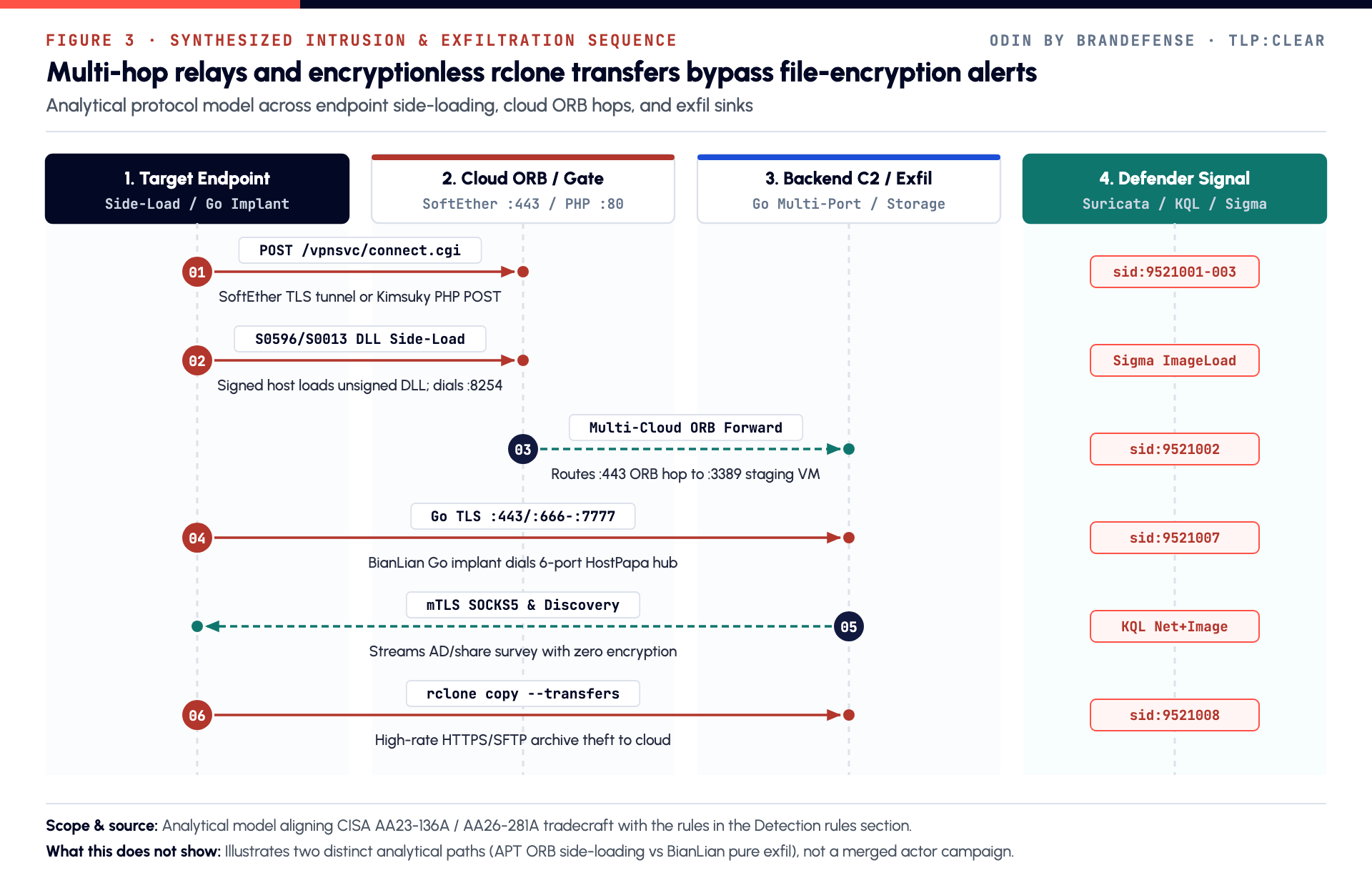
Figure 3 is an analytical model. It contrasts two paths, relay-based side-loading and BianLian-style data theft, and maps each step to a detection rule. It does not show one merged campaign.
BianLian label: 29 endpoints on 14 hosts
None of the 29 BianLian-labeled endpoints is confirmed: 24 are suspected, 4 are candidates and 1 sits on a dynamic ISP. They concentrate in North America.
| Country | Endpoints |
|---|---|
| United States | 22 (75.9%) |
| Canada | 2 |
| Germany | 2 |
| France | 1 |
| Poland | 1 |
| Russia | 1 |
Four groups stand out. All addresses are withheld.
| Group | Endpoints (hosts) | Hosting and ports | TLS fingerprint |
|---|---|---|---|
| Twin six-port hubs | 13 (2) | HostPapa US: 443, 666, 888, 1122, 5566, 7777 on both; one also 80 | All 12 TLS sockets share JARM 28d28d28d00028d1ec42...3386b |
| Go TLS trio | 3 (3) | Azure US 443, AWS US 443, and a small telecom network 8899 | All 3 share JARM 22d22d00022d...63261 |
| VPS and RDP nodes | 9 (6) | AWS Germany, OVH France 8080, M247 3389, and a host with 21, 110, 465 and 3389 | Mixed; the M247 RDP host shows a custom certificate name |
| Candidates | 4 (3) | OVH Canada 8443 and 8444; Russia and Poland 443 | Not corroborated |
The twin hubs
The two HostPapa hubs are the clearest signature in this report. Both bind the same six TLS ports. Each has its own domain certificate. All 12 TLS sockets return the same JARM value: 28d28d28d00028d1ec42d42d0000005557fe5c0eece598995bd43427a3386b.
Six ports on one daemon give implants fallback routes. If a firewall inspects or blocks 443, an implant can try 5566, 7777 or 1122.
Coruna label: paired ports from 7000 to 7443
Coruna is a smaller label for a modular C2 cluster with paired control and TLS ports. All seven endpoints, on four hosts, are suspected.
| Hosts | Hosting | Ports | Shared traits |
|---|---|---|---|
| 2 | Antbox Networks Limited, Singapore | 7001 and 7443 on each | Same domain certificate and JARM 28d28d28d00028d00042d42d000000831b6af40378e2dd35eeac4e9311926e on both 7443 listeners |
| 1 | cognetcloud INC, Hong Kong | 7000 and 7001 | |
| 1 | HostPapa, United States | 7000 |
The Singapore JARM also appears on one BianLian-labeled host in Germany. That shared value reflects a common TLS stack, not a proven link between the clusters. Ports in this range also match developer reverse proxies, so these hosts stay on a watchlist.
6. Fingerprints That Survive Rotation
In short
Operators move between Azure, AWS, Alibaba, Hetzner and HostPapa, but their deployment templates leave stable certificate names, JARM values and port sets. Hunt those, not single addresses.
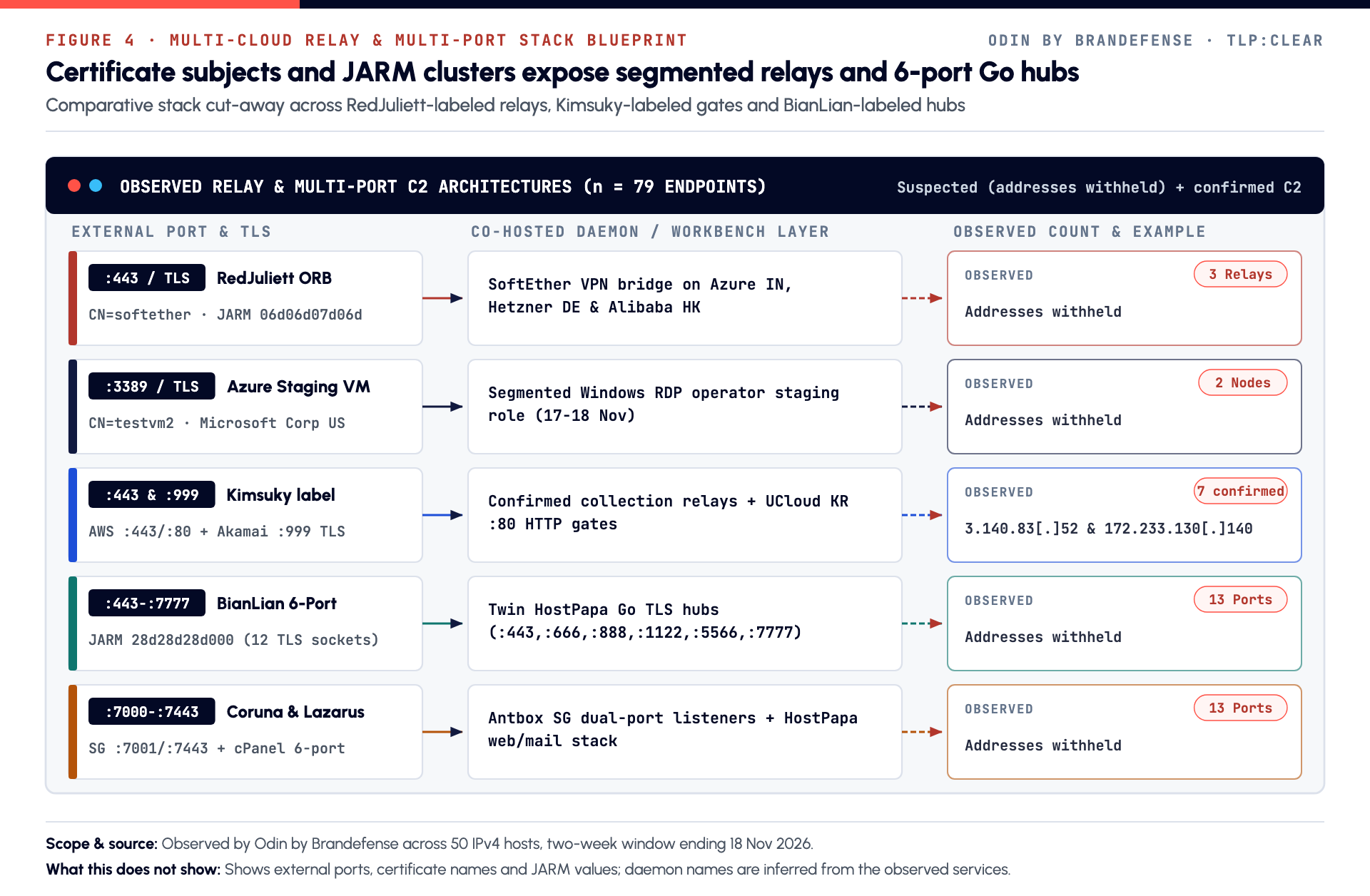
Certificates and JARM values
Of the 79 endpoints, 54 (68.4%) present TLS. They show 22 distinct JARM values. The five most common JARM values cover 21 TLS endpoints (38.9% of all TLS endpoints) and line up with clusters. The table lists the clearest certificate and JARM patterns.
| Cluster and role | Certificate pattern | JARM prefix | Where it appears |
|---|---|---|---|
| BianLian six-port hubs | Per-host domain certificates (withheld) | 28d28d28d00028d1ec42d42d...3386b | 12 sockets on 2 HostPapa US hosts |
| BianLian Go trio | Empty or per-host (withheld) | 22d22d00022d22d22c42d42d...63261 | Azure US 443, AWS US 443, telecom 8899 |
| Kimsuky AWS pair | Per-host domain certificates (withheld) | 29d29d00029d29d00041d41d...5df96 | 3.140.83[.]52 (US) and 3.104.232[.]81 (AU), both confirmed |
| Kimsuky Akamai pair | One shared domain certificate (withheld) | 29d29d20d29d29d21c29d29d...371a3 | 172.233.130[.]140 and 172.236.231[.]228, both confirmed |
| RedJuliett relays and staging | CN=softether (3), CN=testvm2 (2) | 06d06d07d06d06d06c42d42d... | JARM on the India and Hong Kong SoftEther bridges; certificates on all 3 bridges and 2 Azure US staging hosts |
| Coruna Singapore pair | One shared domain certificate (withheld) | 28d28d28d00028d00042d42d... | 2 Antbox Singapore hosts on 7443 |
Two lessons follow for attack surface and network detection teams.
Default names leak roles.
The RedJuliett-labeled hosts kept the default CN=softether on all three bridges and CN=testvm2 on both staging machines. The confirmed ShadowPad-labeled host 45.32.237[.]137 shows an auto-generated Windows name, CN=WIN-JRJ4OQAGQ2I.
Certificate reuse links distant hosts.
The two confirmed Kimsuky-labeled Akamai servers share one certificate. The two Coruna-labeled Singapore servers share another.
How the endpoint side works
External observations show only the server side. Public advisories explain how endpoint implants talk to these servers. Each point below names the rule that covers it.
- DLL side-loading (ShadowPad and PlugX). Both families drop three files in a user-writable folder such as
C:ProgramData,%PUBLIC%Downloadsor%TEMP%. The files are a signed third-party program, a malicious unsigned DLL with an expected library name, and an encrypted payload. The signed program loads the DLL. PlugX HTTP beacons sendPOSTrequests withX-Session:andX-Size:headers (SID 9521004). - SoftEther tunnels (ORB tradecraft). Per AA26-281A, operators install SoftEther VPN clients, often renamed or run from staging folders, that connect over 443 to external bridges. SoftEther wraps network frames in HTTPS
POST /vpnsvc/connect.cgisessions with aVPNCONNECThandshake (SID 9521003). Without TLS inspection or process auditing (vpnclient,vpncmd,SEVPNCLIENT), this traffic passes most firewalls. - Go implants and rclone (BianLian). Per AA23-136A, BianLian uses custom Go backdoors and rclone for bulk theft. Renamed rclone copies keep
OriginalFileName = rclone.exein their version data and send a defaultrclone/v...user agent (SID 9521008). Typical flags are--transfers,--tpslimitand--no-check-certificate.
7. What Not to Block
In short
Turning feed labels straight into firewall blocks would cut off broadband customers, shared mail hosts and ordinary server hardware. Only 9 of the 79 endpoints (11.4%) are ready to block.
Four kinds of host need care before anyone blocks them.
- Dynamic telecom addresses (5 endpoints). These sit on Deutsche Telekom (Germany), Chinanet (China), Chunghwa Telecom (Taiwan) and a small US telecom network. Leases rotate, so today's relay may be a household or a hospital within days. The Chunghwa host also looks like a consumer router that someone repurposed, not adversary-owned cloud space.
- Shared web-and-mail hosts. The LazarusGroup-labeled HostPapa host, a Gh0stRAT-labeled host in Hong Kong and a BianLian-labeled host in the United States expose mail ports. A shared host serves many benign domains, so these go on a watchlist, not a block list.
- Uncorroborated candidates (8 endpoints). Four Gh0stRAT-labeled and four BianLian-labeled endpoints are not corroborated. One is a server management controller. Hardware management interfaces and reverse proxies can match banner rules with no malware present.
- Dual-use software. SoftEther VPN, Azure test machines and rclone all have legitimate IT uses. That is why all six RedJuliett-labeled hosts stay on a watchlist, and why the rules allow named jump hosts and backup servers.
| Handling group | Endpoints | Hosts | Published? | Action |
|---|---|---|---|---|
| Confirmed C2 | 9 | 8 | Yes | Block at firewall, web gateway and EDR; re-check after 720 hours, since cloud addresses get reassigned |
| Suspected | 57 | 32 | No | SIEM or NDR watchlist for 168 hours; pair with a Suricata, JARM or EDR signal |
| Candidate | 8 | 6 | No | Low-priority hunting for 72 hours; needs process or TLS support |
| Dynamic ISP | 5 | 4 | No | Watchlist for 72 hours; never a permanent block |
The host counts add up to all 50 hosts (8 + 32 + 6 + 4). No host appears in two groups.
8. What Defenders Should Do
Day 1: contain and get visibility
- Block the 9 confirmed endpoints on 8 addresses (Chapter 10) at the firewall, web gateway and EDR. Re-check certificate or JARM state before keeping a block past 720 hours.
- Put dynamic telecom addresses and shared HostPapa mail hosts on SIEM watchlists for 72 to 168 hours, not on block lists.
- Run the Sentinel query over 14 days. Confirm there are no unknown SoftEther bridges, writable-folder DLL side-loads or rclone transfers.
Days 2 to 14: harden
- Use WDAC or AppLocker to stop unsigned DLLs from loading out of user-writable folders (
PublicDownloads,ProgramData,%TEMP%,%APPDATA%). - Allow SoftEther binaries (
vpnclient_x64.exe,vpnbridge_x64.exe,vpncmd.exe) and theSEVPNCLIENTservice only on named network jump hosts. - Allow
rclone.exe, matched byOriginalFileNameas well as file name, only on named backup servers. Alert on--transfers,--tpslimit,--bwlimitor--no-check-certificate. - Deploy the Suricata rules at egress and on TLS-inspection points.
- Scan quarantine stores, mail gateways and triage shares with the four YARA rules.
- Move RDP (3389), router and server management interfaces behind an admin-only network, so outsiders cannot turn them into relays.
9. Detection Rules
The full rules are in the Detection rules tab. Every rule file loads without errors in its engine (Suricata 7.0.12, YARA-X, pySigma, Kusto.Language); the rules were not replayed against live traffic. Test every rule in your own environment before you automate containment.
| Rule file | What it catches |
|---|---|
odin_shadowpad_plugx_kimsuky_bianlian.rules | Suricata 7: eight signatures for SoftEther and staging certificates, the SoftEther tunnel, PlugX, Gh0stRAT and Kimsuky-style traffic, BianLian high-port TLS and rclone uploads |
sentinel_dll_sideload_and_bianlian_go_exfil_hunt.kql | Microsoft Sentinel and Defender XDR: contact with confirmed C2, side-loading followed by egress, SoftEther tools, rclone theft and high-port egress |
sigma_shadowpad_plugx_sideload_and_extortion_exfil.yml | Sigma (3 rules): unsigned DLL side-loading in writable folders, SoftEther tools, and rclone bulk transfers |
odin_shadowpad_kimsuky_and_bianlian_implants.yar | YARA (4 rules): ShadowPad loader, PlugX side-load files, Kimsuky recon scripts and BianLian Go backdoors |
How the Suricata signatures work
| SID | Looks for | Why |
|---|---|---|
| 9521001 | Server certificate CN=softether on port 443 | SoftEther bridge default (T1090.002) |
| 9521002 | Server certificate CN=testvm2 on port 3389 | Templated staging machine (T1583.003); RDP wraps TLS, so check that your Suricata build parses it |
| 9521003 | Outbound POST to /vpnsvc/connect.cgi or /vpnsvc/vpn.cgi with VPNCONNECT in the body | SoftEther tunnel setup (T1133); needs TLS inspection |
| 9521004 | Outbound POST with X-Session: and X-Size: headers to ports 80, 443, 1033, 8000 or 8254 | PlugX HTTP beacon (S0013) |
| 9521005 | Outbound TCP payload starting with Gh0st followed by the zlib marker 78 9c | Classic Gh0stRAT framing (S0032) |
| 9521006 | Outbound POST to index, upload, view, check, down or log .php with a body field such as systeminfo= or whoami= | Kimsuky-style host survey upload (G0094) |
| 9521007 | Any server certificate on ports 666, 888, 1122, 5566, 7777 or 8899 | BianLian-style high-port TLS (T1573.002); a broad hunt, not a block signal |
| 9521008 | HTTP user agent starting with rclone/v | Unapproved rclone transfer (T1567.002); needs TLS inspection |
Add explicit pass rules for any approved SoftEther jump host (SIDs 9521001 and 9521003). Exempt SID 9521008 only for documented backup source addresses.
How the other rules work
The KQL query has five branches and a 14-day lookback. The first flags devices that connect to the 8 confirmed addresses. The second joins an unsigned DLL load in a writable folder with a public connection from the same process within 15 minutes. The third flags SoftEther binaries or command lines. The fourth flags rclone with copy, sync or move plus bulk-transfer flags. The fifth flags public connections to the six BianLian-style ports from unsigned or writable-folder programs.
The query keeps its exclusions to exact host names (ApprovedNetOpsJumpHosts, ApprovedBackupServers). Fill them with the names exactly as Defender records them, which is often a full domain name. A watchlist variable is left empty for your own CTI feed.
The first Sigma rule fires when both the loading program and an unsigned DLL sit in a writable folder. It has no built-in folder exclusions; tune it in your SIEM by exact file hash or exact path. The second Sigma rule flags SoftEther binaries or command lines (SEVPNCLIENT, AccountConnect, BridgeCreate) outside named jump hosts. The third flags rclone, including renamed copies, with a transfer verb and an exfiltration flag or remote (mega:, sftp:) outside named backup servers.
Each YARA rule has a file-size cap and needs several strings together.
| YARA rule | Size cap | Fires when |
|---|---|---|
ODIN_ShadowPad_Modular_VFS_Loader_And_Shellcode | 5 MB | A VFS or POISONPLUG marker, a plugin path marker, and the RtlDecompressBuffer and VirtualAllocEx imports |
ODIN_PlugX_Korplug_Sideload_Config_And_HTTP_Beacon | 4 MB | A config marker or two custom HTTP headers, plus RtlDecompressBuffer and RunDllEntry |
ODIN_Kimsuky_Recon_Stager_And_PHP_Collection_Script | 2 MB | An HTTP object, two survey commands (systeminfo, ipconfig /all, tasklist) and a PHP upload path |
ODIN_BianLian_Golang_mTLS_Backdoor_Implant | 15 MB | A Go build ID, TLS handshake and certificate-pool calls, net.DialTimeout and the hashicorp/yamux library |
10. Indicators
The Indicators tab holds 12 published indicators: 9 address entries (IP and port) on 8 IPv4 addresses, 0 file hashes and 3 JARM fingerprints. Three more JARM values, tied to suspected clusters, appear below as text-only hunting leads. The 70 suspected, candidate and dynamic-ISP endpoints are withheld, along with every certificate domain.
| Type | In the Indicators tab | Text only | Withheld |
|---|---|---|---|
| Confirmed C2 endpoints (IP and port) | 9 | 0 | 0 |
| Suspected, candidate and dynamic-ISP endpoints | 0 | 0 | 70 |
| JARM fingerprints | 3 | 3 | 0 |
| File hashes (SHA-256) | 0 | 0 | 0 |
Confirmed C2 endpoints to block
| Endpoint | Label | Hosting | Country | Key fingerprint | Seen |
|---|---|---|---|---|---|
| 3.140.83[.]52:443 | Kimsuky | Amazon.com, Inc. | US | JARM 29d29d000...5df96, shared with the AU host | 17 Nov 2026 |
| 3.104.232[.]81:443 | Kimsuky | Amazon.com, Inc. | AU | Same JARM; HTTP on 80 on the same host | 17 Nov 2026 |
| 3.104.232[.]81:80 | Kimsuky | Amazon.com, Inc. | AU | HTTP listener paired with 443 | 17 Nov 2026 |
| 172.233.130[.]140:999 | Kimsuky | Akamai Technologies, Inc. | US | Certificate and JARM 29d29d20d...371a3 shared with the next host | 13 Nov 2026 |
| 172.236.231[.]228:999 | Kimsuky | Akamai Technologies, Inc. | US | Same certificate and JARM | 13 Nov 2026 |
| 118.194.248[.]246:80 | Kimsuky | UCLOUD INFORMATION TECHNOLOGY (HK) LIMITED | KR | Plain HTTP gate, adjacent /24 pair | 13 Nov 2026 |
| 118.194.249[.]154:80 | Kimsuky | UCLOUD INFORMATION TECHNOLOGY (HK) LIMITED | KR | Plain HTTP gate, adjacent /24 pair | 13 Nov 2026 |
| 130.94.65[.]79:443 | ShadowPad | LIGHT NODE LIMITED | JP | HTTPS C2, JARM 21d14d...6cbe21 | 13 Nov 2026 |
| 45.32.237[.]137:3389 | ShadowPad | The Constant Company, LLC | NL | CN=WIN-JRJ4OQAGQ2I, non-RDP listener on 3389 | 13 Nov 2026 |
The Label column gives the threat-feed label, not an attribution.
JARM fingerprints
Never block on a JARM value alone. Use these in attack surface sweeps and TLS-aware network hunts, together with the certificate name and port.
| JARM | Port | Label | In the Indicators tab? | Where seen |
|---|---|---|---|---|
29d29d00029d29d00041d41d00041dcb3f8752a2d70d1dbf446fc46ab5df96 | 443 | Kimsuky | Yes | Confirmed AWS pair (US, AU) |
29d29d20d29d29d21c29d29d29d29d89e97ba53da7e1515fb732a85cb371a3 | 999 | Kimsuky | Yes | Confirmed Akamai pair (US) |
21d14d00021d21d21c42d43d0000007abc6200da92c2a1b69c0a56366cbe21 | 443 | ShadowPad | Yes | Confirmed host 130.94.65[.]79 |
28d28d28d00028d1ec42d42d0000005557fe5c0eece598995bd43427a3386b | 443 | BianLian | No, text only | 12 sockets on the twin HostPapa hubs (suspected) |
22d22d00022d22d22c42d42d000000faabb8fd156aa8b4d8a37853e1063261 | 443 | BianLian | No, text only | Go TLS trio on Azure, AWS and a telecom network (suspected) |
06d06d07d06d06d06c42d42d000000644097aad2d54615f61ac543d994271f | 443 | RedJuliett | No, text only | SoftEther bridge on Alibaba Hong Kong (suspected) |
Withheld: the addresses of all 70 non-confirmed endpoints, every certificate domain, and the certificate names of router, management-controller and dynamic-ISP hosts.
MITRE ATT&CK mapping
| Tactic | Technique or software | How it shows up here | Detection |
|---|---|---|---|
| Resource Development | T1583.003 Acquire Infrastructure: Virtual Private Server | Templated Azure staging machines (CN=testvm2); leased VPS relays | SID 9521002 |
| Command and Control | T1090.002 Proxy: External Proxy | SoftEther bridges on 443 across three providers | SID 9521001 |
| Persistence, Initial Access | T1133 External Remote Services | SoftEther tunnel sessions to /vpnsvc/connect.cgi | SID 9521003; Sigma rule 2; KQL branch 3 |
| Defense Evasion, Persistence | T1574.002 Hijack Execution Flow: DLL Side-Loading | ShadowPad (S0596) and PlugX (S0013) triads in writable folders | Sigma rule 1; KQL branch 2; YARA |
| Command and Control | T1573.002 Encrypted Channel: Asymmetric Cryptography | BianLian-style Go TLS on six ports | SID 9521007; KQL branch 5; YARA |
| Exfiltration | T1567.002 Exfiltration to Cloud Storage | rclone bulk transfers | SID 9521008; Sigma rule 3; KQL branch 4 |
| Command and Control | S0032 gh0st RAT | Binary zlib TCP framing | SID 9521005 |
11. Scope and Limits
- Window. The findings cover a two-week observation window ending 18 November 2026. Dates in the tables are the days we saw each endpoint.
- Labels are not attribution. Cluster names come from threat feeds and fingerprint matches. Public advisories explain tradecraft; they are not used to tie any address here to a named actor.
- External view only. The data shows listening servers, certificates and ports. Side-loading, tunnelling and rclone behaviour come from public advisories, not from these hosts. We did not see any activity on target systems.
- Groups are a model. The three groups in Chapter 2 sort clusters by role. No address, certificate or JARM value links clusters in different groups. The one JARM value shared between Coruna and BianLian hosts reflects a common TLS stack.
- Corroborated, not owned. Cloud providers reassign addresses after abuse reports. Re-check a block after 720 hours.
- Rule testing. Every published rule file loads without errors in its engine (Suricata 7.0.12, YARA-X, pySigma and Microsoft's Kusto.Language analyzer, checked on 20 November 2026). The rules were not replayed against live traffic, so test and tune them in your own environment before production use.
12. Sources
- CISA, FBI and ASD-ACSC. Joint Cybersecurity Advisory AA23-136A, #StopRansomware: BianLian Data Extortion Group. https://www.cisa.gov/news-events/cybersecurity-advisories/aa23-136a (verified 19 November 2026)
- CISA, FBI and NSA. Joint Cybersecurity Advisory AA26-281A, PRC state-sponsored operational relay box and SoftEther VPN bridge tradecraft. https://www.cisa.gov/news-events/cybersecurity-advisories/aa26-281a (verified 19 November 2026)
- MITRE ATT&CK. ShadowPad, S0596. https://attack.mitre.org/software/S0596/ (verified 19 November 2026)
- MITRE ATT&CK. PlugX, S0013, and T1574.002 DLL Side-Loading. https://attack.mitre.org/software/S0013/ (verified 19 November 2026)
- MITRE ATT&CK. gh0st RAT, S0032. https://attack.mitre.org/software/S0032/ (verified 19 November 2026)
- MITRE ATT&CK. Kimsuky, G0094. https://attack.mitre.org/groups/G0094/ (verified 19 November 2026)
- MITRE ATT&CK. Lazarus Group, G0032. https://attack.mitre.org/groups/G0032/ (verified 19 November 2026)
- Salesforce Engineering. Easily Identify Malicious Servers on the Internet with JARM. https://engineering.salesforce.com/easily-identify-malicious-servers-on-the-internet-with-jarm-e095edac525a/ (verified 19 November 2026)
What is…?
Short explanations of the tools and families named in this study.
What is JARM?
JARM is an open TLS server fingerprinting method from Salesforce. It hashes how a server answers a set of crafted TLS handshakes.
More about JARMThreat groupWhat is BianLian?
BianLian is a data extortion group that moved from ransomware encryption to stealing and leaking data.
More about BianLianThreat groupWhat is Kimsuky?
Kimsuky is a North Korea-linked espionage group that targets government, policy and research organisations, mostly through spear-phishing.
More about KimsukyBackdoorWhat is ShadowPad?
ShadowPad is a modular backdoor shared among several China-nexus threat groups, often described as a successor to PlugX.
More about ShadowPadRemote access trojanWhat is PlugX?
PlugX is a modular remote access trojan used by several China-nexus groups for over a decade, often loaded through DLL side-loading.
More about PlugXRemote access trojanWhat is Gh0st RAT?
Gh0st RAT is an old remote access trojan whose source code leaked, producing many variants used by criminal and state actors.
More about Gh0st RATFrequently asked questions
Are these servers really run by the named groups?
Not necessarily. The cluster names are labels that threat feeds attach to hosts, based on banners, certificates, ports and TLS fingerprints. They are leads, not attribution. Public advisories from CISA and profiles in MITRE ATT&CK describe how these groups work. We use them to explain the tradecraft. We do not use them to tie any address in this study to a named actor.
How do the espionage-labeled clusters build their relays?
They spread roles across providers. The RedJuliett-labeled hosts are the clearest example. Two Azure machines in the United States serve port 3389 with the same self-signed certificate, CN=testvm2. Three other hosts run SoftEther VPN bridges on port 443, in India, Germany and Hong Kong, all with the default CN=softether certificate.
Why do BianLian-labeled servers open six ports?
Two HostPapa servers in the United States expose the same six TLS ports: 443, 666, 888, 1122, 5566 and 7777. All 12 sockets return the same JARM value. Six ports give an implant fallback routes. If a firewall inspects 443, the implant can try 5566 or 7777.
Why not block everything on the list?
Because a feed label is not proof, and some of these hosts belong to someone else. Of the 79 endpoints, 70 stay on watchlists. The full report gives handling times for each group: re-check confirmed blocks after 720 hours, keep suspected hosts on a watchlist for 168 hours, and keep dynamic ISP addresses for 72 hours only.