


Key takeaways
- Odin mapped 79 endpoints on 50 hosts across eight threat-feed clusters; only 9 are confirmed C2.
- Relay-labeled clusters keep VPN bridges and staging machines on separate cloud providers.
- Seven confirmed Kimsuky-labeled endpoints form three pairs that share JARM values or certificates.
- Two BianLian-labeled servers expose the same six TLS ports behind one fingerprint.
- Block the 9 confirmed endpoints, watchlist the rest, and alert on side-loading, SoftEther and rclone.
In a two-week observation window ending 18 November 2026, Odin by Brandefense mapped 79 internet-facing endpoints on 50 hosts. Threat feeds label them with eight names: RedJuliett, ShadowPad, PlugX, Gh0stRAT, Kimsuky, LazarusGroup, BianLian and Coruna. Some of these servers relay espionage traffic. Others wait for extortion implants to call home. Only 9 endpoints, on 8 hosts, are confirmed command-and-control (C2). For defenders, the lesson is twofold: block the few confirmed servers, and hunt the stable fingerprints that survive when operators rent new ones.
Are these servers really run by the named groups?
Not necessarily. The cluster names are labels that threat feeds attach to hosts, based on banners, certificates, ports and TLS fingerprints. They are leads, not attribution.
Public advisories from CISA and profiles in MITRE ATT&CK describe how these groups work. We use them to explain the tradecraft. We do not use them to tie any address in this study to a named actor.
No IPv4 address appears in more than one cluster.
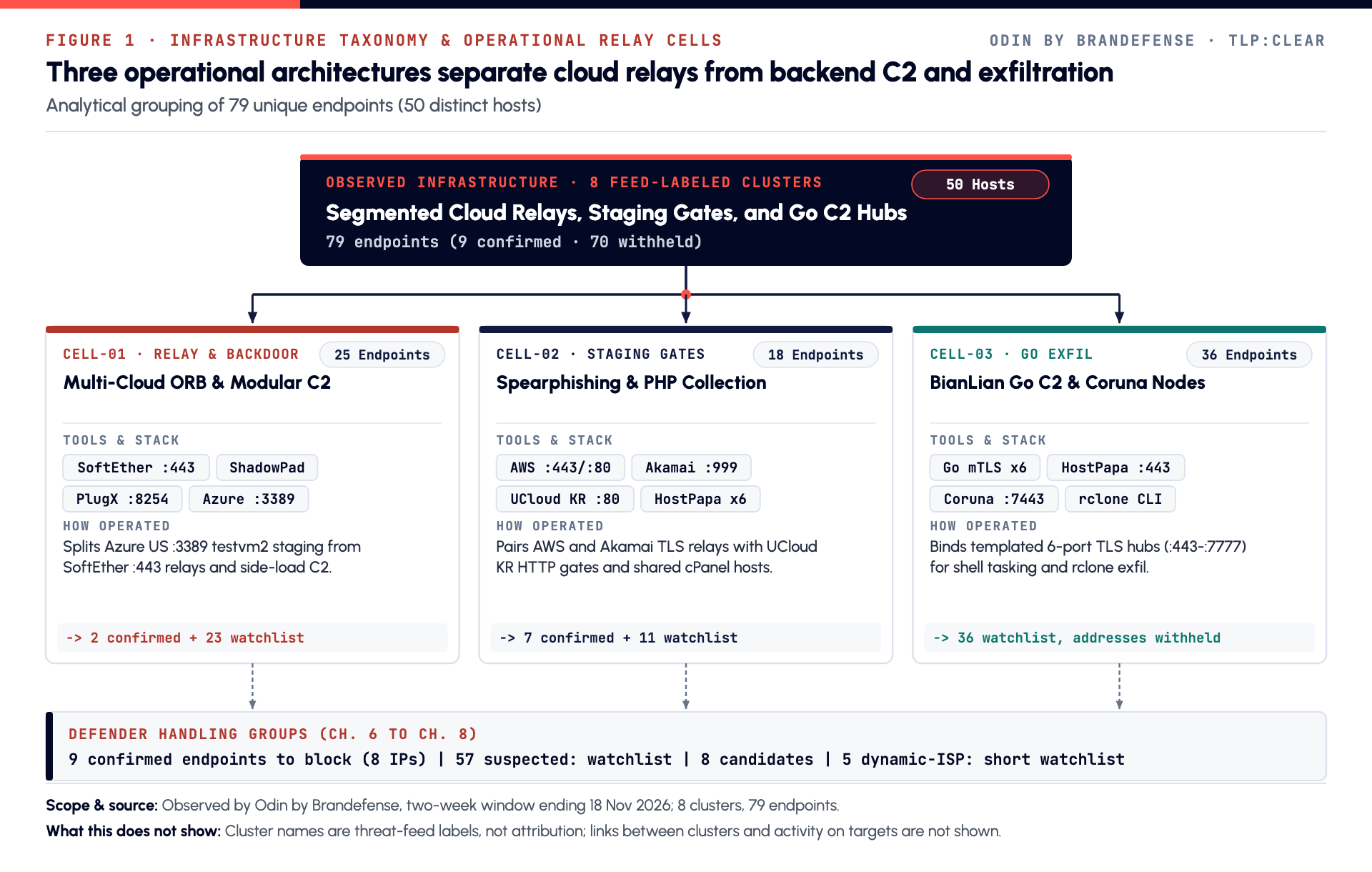
We sort the clusters into three groups by the role their servers seem to play. This grouping is an analytical model; it does not mean the clusters work together.
| Group | Clusters | Endpoints (hosts) | Confirmed C2 |
|---|---|---|---|
| Relay and backdoor | RedJuliett, ShadowPad, PlugX, Gh0stRAT | 25 (21) | 2 |
| Staging and collection | Kimsuky, LazarusGroup | 18 (11) | 7 |
| Extortion listeners | BianLian, Coruna | 36 (18) | 0 |
How do the espionage-labeled clusters build their relays?
They spread roles across providers. The RedJuliett-labeled hosts are the clearest example. Two Azure machines in the United States serve port 3389 with the same self-signed certificate, CN=testvm2. Three other hosts run SoftEther VPN bridges on port 443, in India, Germany and Hong Kong, all with the default CN=softether certificate.
CISA advisory AA26-281A describes this kind of relay network. Leased servers and VPN bridges hide where intrusion traffic really comes from. Behind them, public reporting describes backdoors such as ShadowPad and PlugX, which load through DLL side-loading: a signed program in a user-writable folder loads a malicious unsigned library.
Two ShadowPad-labeled servers are confirmed C2: 130.94.65[.]79 on port 443 in Japan and 45.32.237[.]137 on port 3389 in the Netherlands. The second one presents a Windows hostname certificate but does not speak RDP.
The seven confirmed Kimsuky-labeled endpoints come in three pairs:
- Two AWS servers in the United States and Australia share one JARM value, a fingerprint of how a server answers TLS.
- Two Akamai servers on the unusual port 999 share one certificate and one JARM value.
- Two UCloud servers in adjacent Korean subnets serve plain HTTP on port 80, like the collection gates public reporting describes.
Why do BianLian-labeled servers open six ports?
Two HostPapa servers in the United States expose the same six TLS ports: 443, 666, 888, 1122, 5566 and 7777. All 12 sockets return the same JARM value. Six ports give an implant fallback routes. If a firewall inspects 443, the implant can try 5566 or 7777.
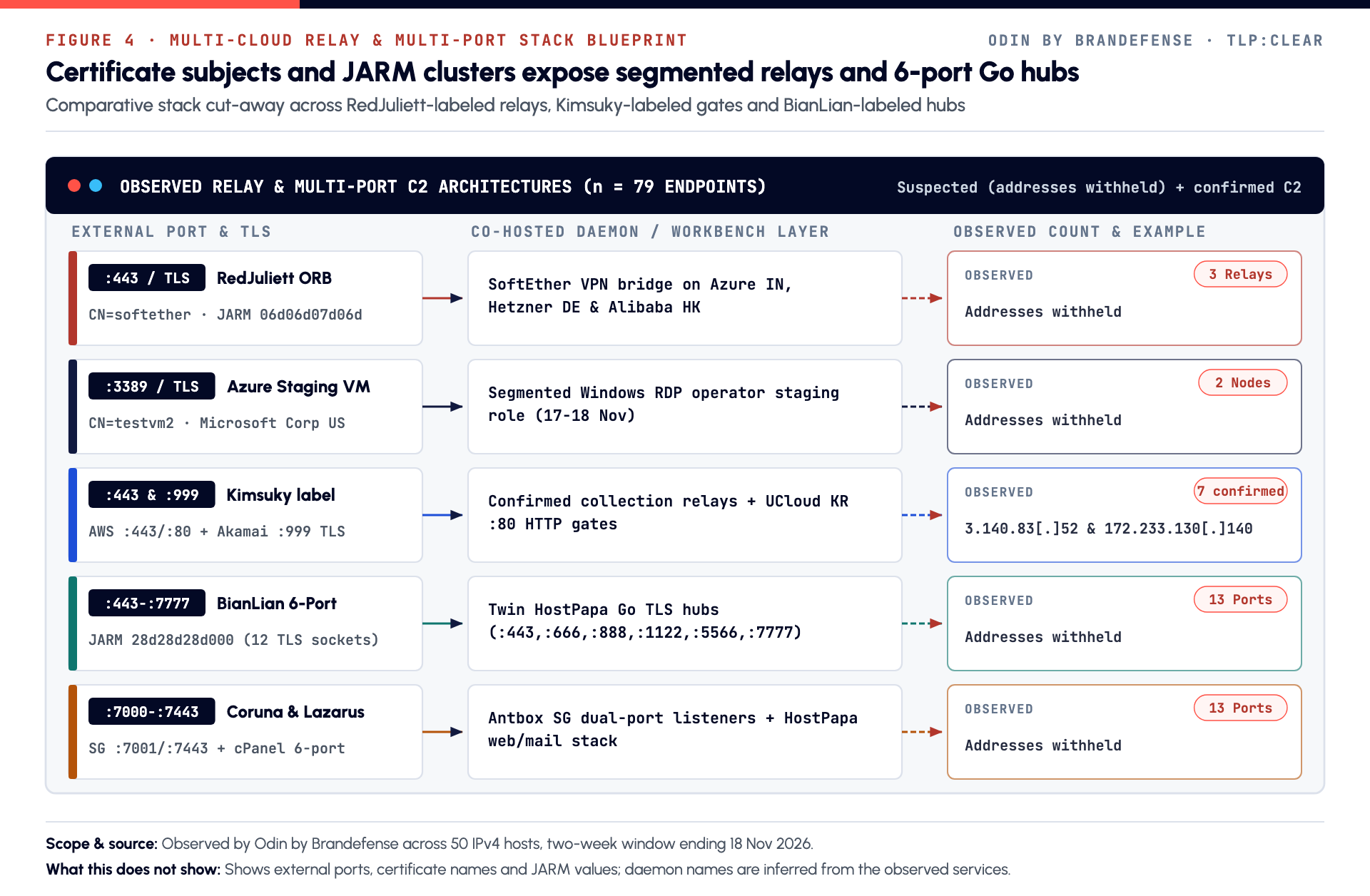
CISA advisory AA23-136A describes BianLian stealing data instead of encrypting it. The group uses custom Go backdoors and bulk transfer tools such as rclone. Without encryption, there is no mass file renaming and no shadow-copy deletion. Classic ransomware alerts never fire. The signal to watch is data leaving the network.
None of the 29 BianLian-labeled endpoints is confirmed, so their addresses are not published. The six-port layout and the shared JARM value are still useful hunting fingerprints.
Why not block everything on the list?
Because a feed label is not proof, and some of these hosts belong to someone else. Of the 79 endpoints, 70 stay on watchlists.
- Dynamic telecom addresses (5). Broadband leases rotate. Today's relay could be a household tomorrow. One looks like a consumer router that someone repurposed.
- Shared web-and-mail hosts. The LazarusGroup-labeled host has six web and mail ports on one shared server. Blocking it would cut off unrelated small businesses.
- Uncorroborated candidates (8). One is a server management controller. Hardware and reverse proxies can match a banner rule with no malware present.
- Dual-use tools. SoftEther, Azure test machines and rclone all have legitimate IT uses.
The full report gives handling times for each group: re-check confirmed blocks after 720 hours, keep suspected hosts on a watchlist for 168 hours, and keep dynamic ISP addresses for 72 hours only.
What to do now
- Block the 9 confirmed endpoints on 8 addresses. They are listed in the full report and the full report's Indicators tab. Re-check them after 720 hours, since cloud addresses get reassigned.
- Watchlist, do not block, dynamic ISPs and shared hosts. Use time-bound SIEM watchlists so you do not cut off unrelated customers.
- Tie DLL side-loading to outbound traffic. Alert when a signed program in a writable folder loads an unsigned DLL and connects out within 15 minutes. Use WDAC or AppLocker to stop it.
- Lock down SoftEther and rclone. Allow them only on named jump hosts and backup servers. Alert on rclone bulk-transfer flags such as
--transfers. - Deploy the detection rules. The full report's Detection rules tab holds Suricata, Sentinel KQL, Sigma and YARA rules for these patterns. Test them in your environment first.
What is…?
Short explanations of the tools and families named in this study.
What is JARM?
JARM is an open TLS server fingerprinting method from Salesforce. It hashes how a server answers a set of crafted TLS handshakes.
More about JARMThreat groupWhat is BianLian?
BianLian is a data extortion group that moved from ransomware encryption to stealing and leaking data.
More about BianLianThreat groupWhat is Kimsuky?
Kimsuky is a North Korea-linked espionage group that targets government, policy and research organisations, mostly through spear-phishing.
More about KimsukyBackdoorWhat is ShadowPad?
ShadowPad is a modular backdoor shared among several China-nexus threat groups, often described as a successor to PlugX.
More about ShadowPadRemote access trojanWhat is PlugX?
PlugX is a modular remote access trojan used by several China-nexus groups for over a decade, often loaded through DLL side-loading.
More about PlugXRemote access trojanWhat is Gh0st RAT?
Gh0st RAT is an old remote access trojan whose source code leaked, producing many variants used by criminal and state actors.
More about Gh0st RATFrequently asked questions
Are these servers really run by the named groups?
Not necessarily. The cluster names are labels that threat feeds attach to hosts, based on banners, certificates, ports and TLS fingerprints. They are leads, not attribution. Public advisories from CISA and profiles in MITRE ATT&CK describe how these groups work. We use them to explain the tradecraft. We do not use them to tie any address in this study to a named actor.
How do the espionage-labeled clusters build their relays?
They spread roles across providers. The RedJuliett-labeled hosts are the clearest example. Two Azure machines in the United States serve port 3389 with the same self-signed certificate, CN=testvm2. Three other hosts run SoftEther VPN bridges on port 443, in India, Germany and Hong Kong, all with the default CN=softether certificate.
Why do BianLian-labeled servers open six ports?
Two HostPapa servers in the United States expose the same six TLS ports: 443, 666, 888, 1122, 5566 and 7777. All 12 sockets return the same JARM value. Six ports give an implant fallback routes. If a firewall inspects 443, the implant can try 5566 or 7777.
Why not block everything on the list?
Because a feed label is not proof, and some of these hosts belong to someone else. Of the 79 endpoints, 70 stay on watchlists. The full report gives handling times for each group: re-check confirmed blocks after 720 hours, keep suspected hosts on a watchlist for 168 hours, and keep dynamic ISP addresses for 72 hours only.