


1. Executive Summary
In short
In a two-week observation window ending 18 November 2026, Odin by Brandefense mapped 1,794 out-of-band callback endpoints on 1,052 hosts. Of these, 757 are confirmed or suspected Interactsh, Burp Collaborator, DNSLog and workbench nodes. Most are dual-use testing servers. But 18 hosts share an IP with other offensive tools, and four offensive services appeared in one Alibaba Cloud subnet on the same day. Block direct DNS, HTTP and SMTP egress from internal servers and route their lookups through Protective DNS.
Many serious server bugs give no visible answer. A blind server-side request forgery (SSRF) or a blind SQL injection runs quietly in the back end. To confirm such a bug, testers and attackers both use Out-of-Band Application Security Testing (OAST) servers. The probe makes the target server call out to a domain the tester controls, by DNS, HTTPS or mail. A callback shows the server can be reached and can reach the internet.
This report maps self-hosted OAST servers, shows where they share hosts with command-and-control (C2) tools, and walks through one tight cluster of offensive services in Alibaba Cloud.
Most callback servers are dual-use, but 18 share hosts with offensive tools.
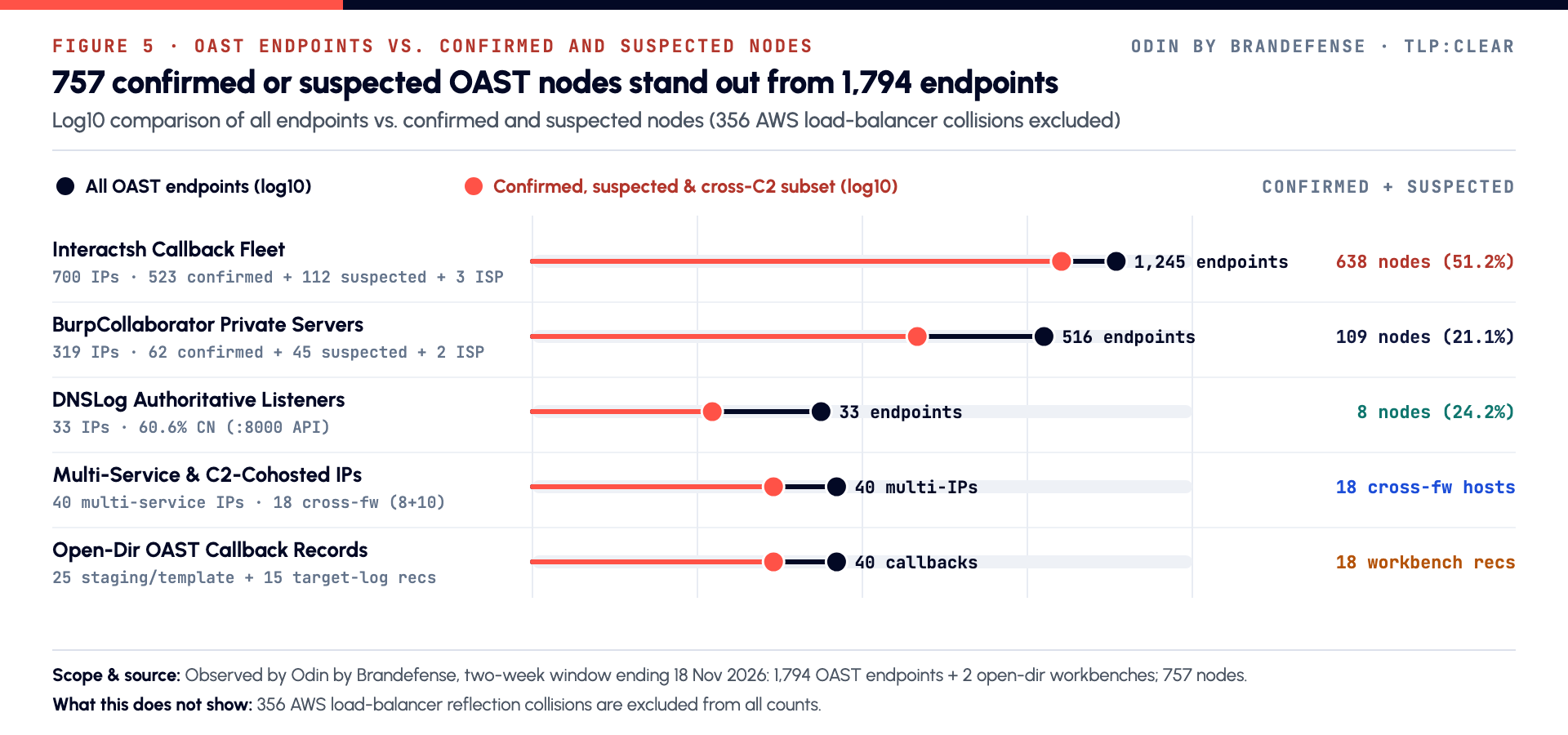
We count 638 Interactsh, 109 private Burp Collaborator and 8 DNSLog nodes, plus 2 co-hosted offensive workbenches. Most look like ordinary testing servers. Across the fleet, 40 hosts expose four or more listener ports or extra services. Of these, 18 put a callback listener on the same IP as another offensive framework: 8 corroborated and 10 candidates.
Four unlinked offensive services sat in one Alibaba Cloud subnet.
On 18 November 2026, Odin first observed a DNSLog collector, a VShell WebSocket listener, a CyberStrikeAI engine and a HexStrikeAI tool bridge in 8.148.0.0/16. All four sit on separate IPs. Nothing links the four servers, so treat them as separate hosts in a busy cloud range.
Exposed attacker files tie OAST callbacks to exfiltration scripts and Java exploit templates.
Open web directories held 40 callback records. Of these, 18 sit on three confirmed offensive servers, in Python DNS exfiltration scripts and Java exploit templates. Another 15 records were incoming probes logged on a scanned third-party web application, not attacker files.
Three Decisions for Leaders
- Restrict outbound DNS, HTTP and SMTP from internal application and database servers. Back-end web servers, middleware containers and databases should resolve names only through internal Protective DNS forwarders.
- Watch recursive DNS for callback-style lookups. Alert when a server process queries a public callback zone or resolves a 26 to 36 character random-looking label.
- Block only callback servers with independent offensive evidence. Raise priority when a listener shares a host with a C2 framework or an offensive workbench. Send standalone listeners to analyst review, because authorized testers run them too.
The Study in Numbers
| Number | What it is |
|---|---|
| 1,794 | OAST endpoints on 1,052 IPv4 hosts, after 356 AWS load-balancer reflection collisions were set aside |
| 757 | Confirmed or suspected callback nodes (755 listeners plus 2 co-hosted offensive workbenches) |
| 638 | Interactsh endpoints among them (523 confirmed, 112 suspected, 3 on dynamic ISPs) |
| 109 and 8 | Private Burp Collaborator endpoints (109) and DNSLog listeners (8) |
| 4 | Complementary offensive services first observed in 8.148.0.0/16 on 18 November 2026 |
| 40 and 18 | Multi-service hosts (40) and hosts where a listener shares an IP with another offensive framework (18) |
| 40 | Callback records found in exposed web directories, 18 of them on confirmed offensive workbenches |
| 9 of 28 | Selected indicators ready to block; the other 19 are watchlist, review or reference entries |
How to use this report.
Security leaders can read Chapter 1, Chapter 6 and Chapter 7. Network, cloud and database teams should read Chapters 2 to 5 and use the checklist in Chapter 7. Detection engineers and hunters will find the rule logic in Chapter 8 and the indicators in Chapter 9.
2. The Callback Fleet and the Four-Role Model
In short
The 1,794 endpoints break down into 757 confirmed or suspected nodes and 1,039 candidates. Most are standalone testing servers, so the useful signal is co-hosting with C2 and reconnaissance tools.
OAST servers fix a visibility problem. Many server-side flaws return no output in the HTTP response. An OAST server runs its own authoritative DNS name server and a wildcard TLS listener. When the target server looks up or fetches a tagged address, the OAST server logs it. That turns a silent bug into a record the tester can read.
For defenders, this creates a choke point. The callback has to leave the internal server. Egress filtering and DNS logging can see it. External listener data alone does not show whether any target was breached.
An analytical model of four roles
Figure 1 is an analytical model, not an observed operation. It shows how four cloud roles could link an attack from probe to implant.
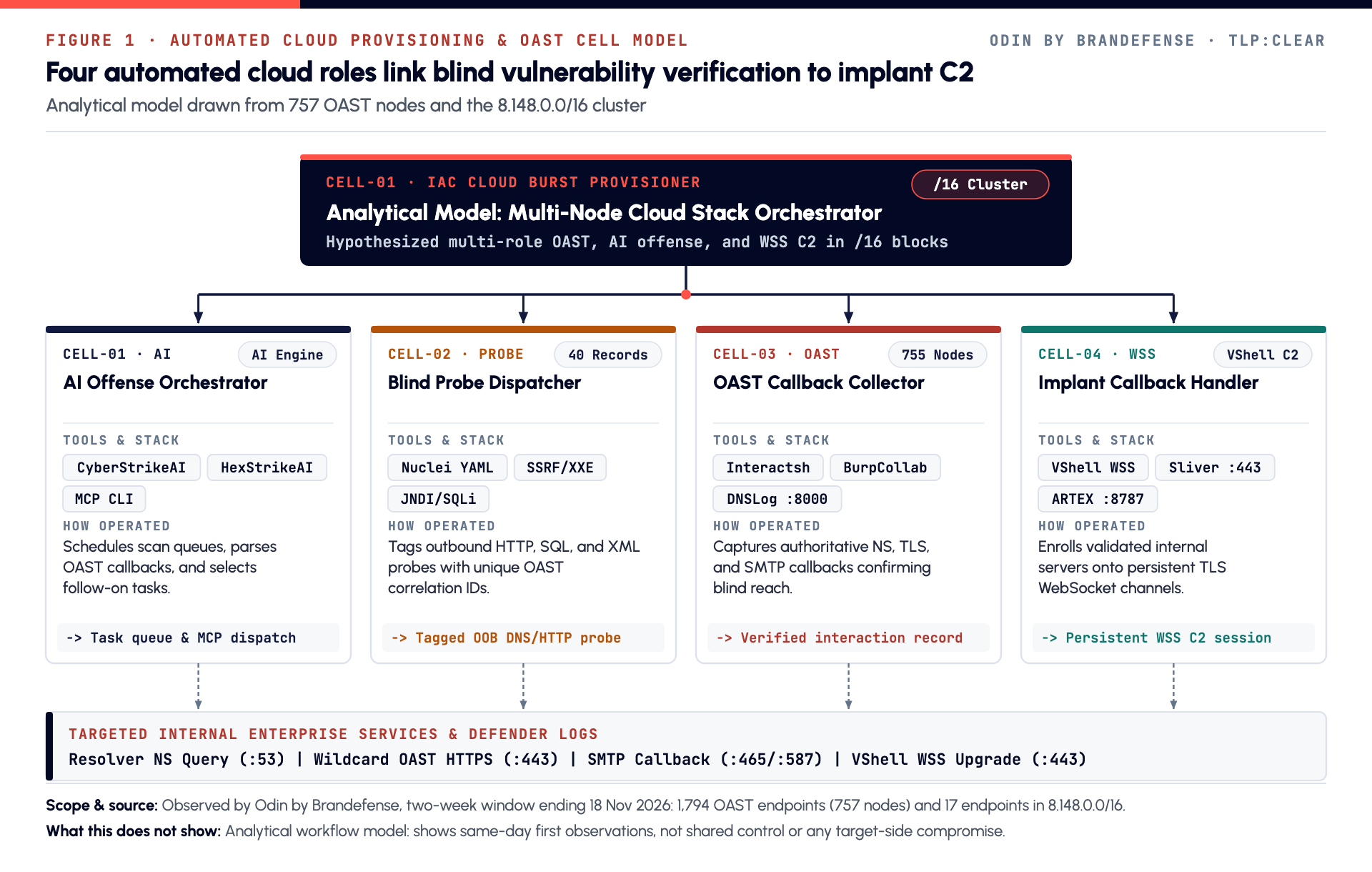
| Role | Example tools | What it does in the model |
|---|---|---|
| AI offense orchestrator | CyberStrikeAI, HexStrikeAI, MCP command-line bridges | Queues scans, reads callback results and picks the next task |
| Blind probe dispatcher | Nuclei YAML templates, SSRF, XXE, JNDI and SQLi payloads | Tags outbound probes with a unique correlation ID |
| OAST callback collector | Interactsh, Burp Collaborator, DNSLog on 8000 | Captures DNS, TLS and SMTP callbacks that confirm blind reach |
| Implant callback handler | VShell WebSocket, Sliver on 443, ARTEX on 8787 | Would hold implant sessions from servers that answered, over a TLS WebSocket channel |
MCP, the Model Context Protocol, lets a language model call external tools. Nothing in our data shows one operator running all four roles. The model is a way to read the co-hosting and the subnet cluster in later chapters.
Fleet counts by platform
Each endpoint is an IP and port pair.
| Platform | Endpoints (IPs) | Confirmed | Suspected + dynamic ISP | Confirmed or suspected | Candidates |
|---|---|---|---|---|---|
| Interactsh | 1,245 (700) | 523 (6 with open directory) | 112 + 3 | 638 | 607 (6 with open directory) |
| Burp Collaborator | 516 (319) | 62 | 45 + 2 | 109 | 407 |
| DNSLog | 33 (33) | 1 | 7 + 0 | 8 | 25 |
| Offensive open-directory workbenches | 2 (2 shared) | 2 | 0 | 2 | 0 |
| Total | 1,796 (1,052) | 588 | 164 + 5 | 757 | 1,039 |
The total row counts 1,796 records: the 1,794 OAST endpoints plus the 2 workbenches. A further 356 AWS Application Load Balancer endpoints echo any header they receive. They look like OAST servers but are not, so they are left out of every count.
Where the fleet is hosted
Hosting splits by platform. Interactsh and Burp Collaborator sit mostly on Western cloud providers. DNSLog sits mostly in China.
| Platform | Top providers (endpoints) | Top countries (endpoints) |
|---|---|---|
| Interactsh | Amazon.com, Inc. (360), DigitalOcean, LLC (180) | United States (575), Germany (145) |
| Burp Collaborator | Amazon.com, Inc. (142), DigitalOcean, LLC (108) | United States (180), Germany (84) |
| DNSLog | Tencent (11), Hangzhou Alibaba Advertising Co.,Ltd. (9) | China (20), Hong Kong (6) |
Co-hosting: the strongest signal
Across the 1,052 hosts, 40 IPv4 addresses expose several services. Of these, 22 are standalone listener matrices with four or more callback ports. The other 18 put a callback listener on the same IP as a C2, reconnaissance or open-directory service. Eight of those 18 are corroborated and listed below. One of the eight has its address withheld, because its Sliver port is only suspected. The 10 candidate co-locations are withheld.
| Host (country) | Hosting network | Callback listener ports | Co-hosted offensive service |
|---|---|---|---|
| Address withheld (US) | NetLab Global | Interactsh 465, 587, 18080 | Suspected Sliver on 443, plus an offensive open directory on 8000 (1,417 files) |
| 49.232.168[.]207 (CN) | Shenzhen Tencent | DNSLog 8000 (confirmed) | VShell WebSocket C2 listener on 5030 |
| 101.33.231[.]97 (CN) | Shenzhen Tencent | Interactsh 443 | Cobalt Strike listener on 8080 |
| 43.153.118[.]75 (US) | Shenzhen Tencent | Interactsh 8300 | VShell WebSocket listeners on 8084 and 8094 |
| 23.94.214[.]197 (US) | HostPapa | Interactsh 465, 587, 443 | ARTEX post-exploitation listener on 8787 |
| 150.158.9[.]124 (CN) | Shenzhen Tencent | DNSLog 8000 | ARL (Asset Reconnaissance Lighthouse) on 5003 |
| 51.15.224[.]47 (FR) | Scaleway SAS | Interactsh 80, 443, 465, 587, 3000 | ezXSS blind XSS payload manager on 9443 |
| 49.51.187[.]59 (US) | Shenzhen Tencent | Interactsh 80 (confirmed) | Offensive open-directory workbench on 8090 (67 files) |
3. How the Three Platforms Look on the Wire
In short
Interactsh, Burp Collaborator and DNSLog each leave their own headers, routes and TLS fingerprints. Multi-port listeners on 53, 80, 443, 465, 587 and 8000 catch a callback over whichever protocol the firewall leaves open.
Public shared callback zones such as oast[.]pro and oastify[.]com are well known. Many Protective DNS services already sinkhole them. To avoid those blocks, operators can run private collectors on their own domains and cheap cloud servers. Authorized red teams do the same, for the same reason.
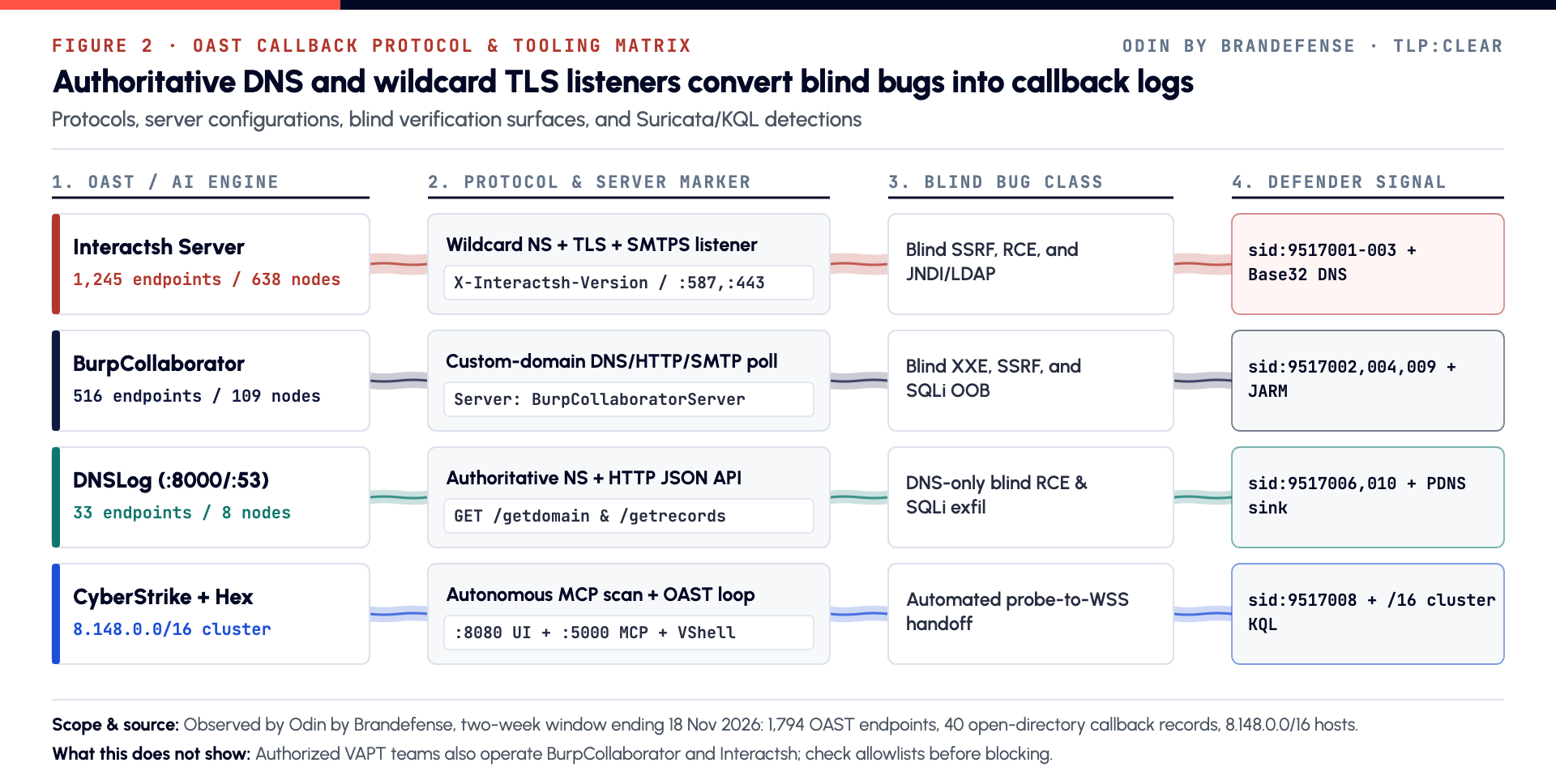
Self-hosted Interactsh
ProjectDiscovery's interactsh-server runs DNS, HTTP, HTTPS and SMTP collectors under one wildcard domain. It answers with an X-Interactsh-Version header or Server: Interactsh-Server.
| Feature | Value |
|---|---|
| Endpoints (IPs) | 1,245 (700) |
| Most common ports | 80 (374), 587 (303), 443 (267), 465 (216) |
| TLS fingerprint | 229 of 267 HTTPS nodes on 443 (85.8%) share the Go TLS JARM 29d29d00029d29d00041d... |
| Client polling route | /poll?id= with a secret parameter |
A JARM value is a fingerprint of how a server answers TLS handshakes. A shared JARM points to the same software stack, not the same owner. Standalone Interactsh matrices with four ports and no other tooling stay on the watchlist.
Private Burp Collaborator
PortSwigger lets customers run a private Collaborator server. It is set up with a JSON file (serverDomain, eventCapture, polling) and answers with Server: BurpCollaboratorServer.
| Feature | Value |
|---|---|
| Endpoints (IPs) | 516 (319) |
| Most common ports | 443 (213), 80 (199), 465 (34), 587 (27), and 8443, 3380, 33443 (6 each) |
| TLS fingerprint | 236 of 259 TLS nodes (91.1%) share the Java JARM 28d28d28d00028d00042d... |
Several standalone Collaborator servers bind custom certificate domains, and one hub listens on 18 ports. None shows co-hosted C2 tooling, so they stay on the watchlist and their addresses are withheld.
DNSLog
DNSLog pairs an authoritative DNS listener on 53 with an HTTP API. The API runs on 8000 on 18 of 33 endpoints (54.5%).
Two route families exist. dnslog[.]cn-compatible panels expose /getdomain and /getrecords (or the .php forms). BugScanTeam's DNSLog uses /api/ routes instead. Suricata SID 9517006 covers only the first family.
Two DNSLog hosts share an IP with offensive tools: 49.232.168[.]207 with VShell on 5030, and 150.158.9[.]124 with ARL on 5003.
4. From Blind Probe to Callback: What Exposed Directories Held
In short
Exposed web directories held 40 callback records. Eighteen sit on three confirmed offensive servers, one is a standalone client log, six are template mirrors, and fifteen were logged on a scanned third-party target.
In manual testing, an analyst pastes one Collaborator address into a request and checks for callbacks by hand. In automated work, scanners such as Nuclei, HexStrikeAI and CyberStrikeAI poll the OAST API themselves. Every probe carries a unique correlation ID, so each callback maps back to one probe.
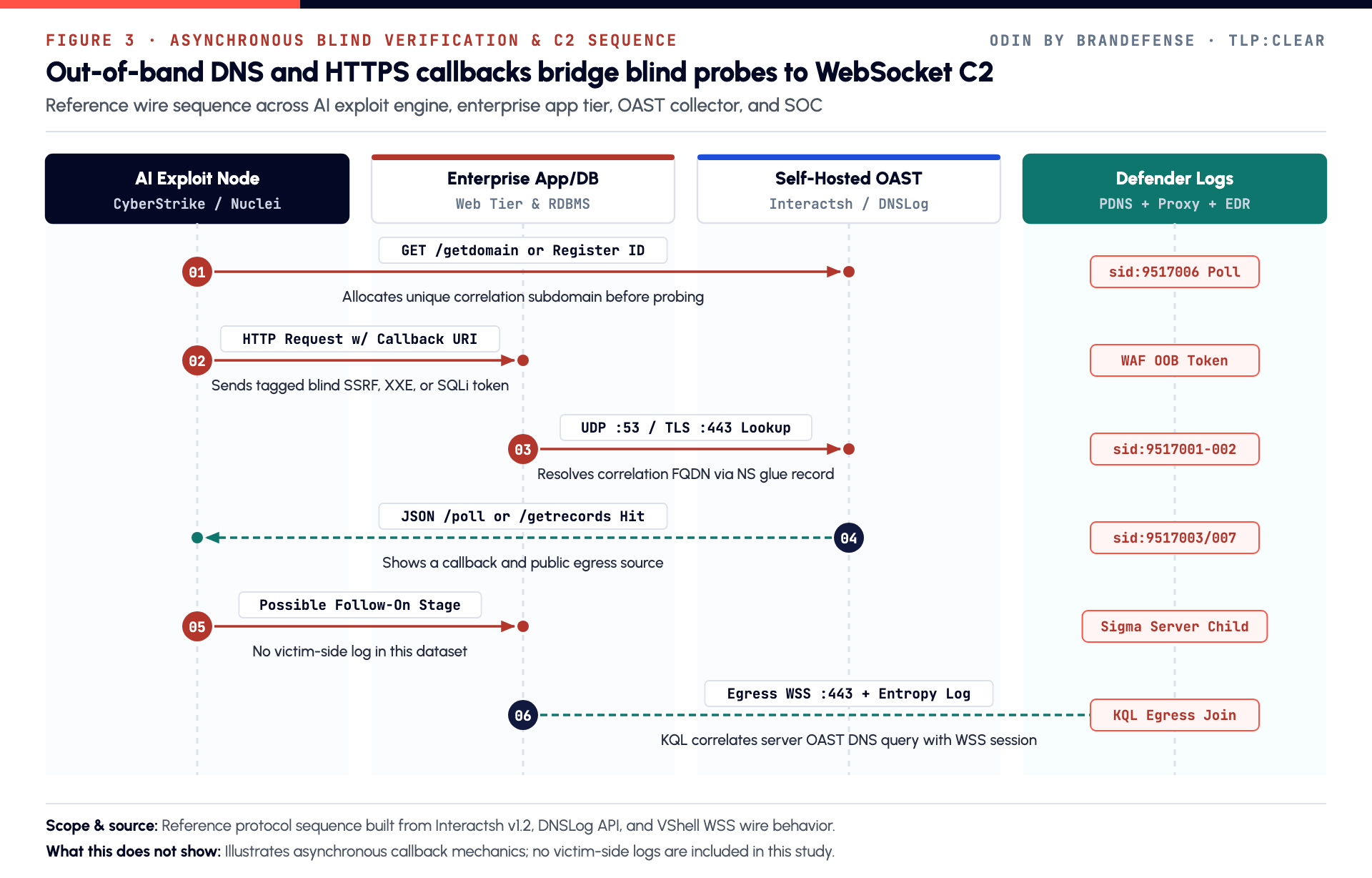
Figure 3 is a reference sequence built from public protocol behaviour. Steps 5 and 6 show a possible follow-on stage. No victim-side logs are part of this study.
Four blind bug classes that call out
Firewalls often block inbound traffic but allow recursive DNS on UDP 53 or outbound TLS on 443. That lets a blind bug call out by one of four routes.
| Bug class | How the callback happens |
|---|---|
| Blind SSRF | A web app, webhook previewer or PDF generator fetches an attacker-supplied https://<correlation-id>.<oast-zone> URL. This reveals the server's egress IP and HTTP client. |
| Blind SQL injection | With errors hidden, a query calls database network functions such as xp_dirtree (SQL Server) or UTL_HTTP and UTL_INADDR (Oracle). These trigger a DNS lookup. |
| Blind XXE and JNDI | An XML parser fetches an external DTD, or a Java logging sink makes an anonymous LDAPv3 bind on 389 or 1389. |
| Asynchronous command execution | A worker runs nslookup, curl or wget on a multi-label name such as <hex-chunk>.<correlation-id>.oast.pro. This confirms execution or leaks short strings. |
The 40 callback records
The 40 records use 15 distinct callback names or wildcard patterns across 8 public shared OAST zones. The 18 records on confirmed workbenches use 8 distinct callback names.
| Source | Files | Records (distinct) | What they show |
|---|---|---|---|
| 144.172.99[.]199:8080, confirmed workbench | /dns_exfil.py, /dns_mass_exfil.py, /assemble_dnslog.py, /dbg*.log | 12 (5) | DNS exfiltration scripts using oast[.]pro, oast[.]site, oast[.]me and v9gcgt.dnslog[.]cn |
| 47.101.51[.]235:8888, confirmed workbench | /EvilTemplate.java, /D2.java, /ET.java, /M.java, /M2.java | 5 (2) | Java exploit templates calling 57v1we22.dnslog[.]cn and 25cot090vm.dnslog[.]cn |
| 45.145.228[.]16:8080, confirmed workbench | /memshell/ExploitScriptEngineFactory.java | 1 (1) | Java memory-shell template calling wiiesroglrl1t9t7ljwhkjvo1f7cv1.oastify[.]com |
| Standalone host (withheld) | /att_interactsh.out | 1 (1) | Captured Interactsh client output for an oast[.]pro name; watchlist |
| Template mirrors on 5 hosts (withheld) | Nuclei templates and vulnerability wiki pages | 6 (5) | Public scanner templates using *.oast[.]online, *.oast[.]pro, *.interact[.]sh and *.burpcollaborator[.]net |
| Scanned third-party web application (withheld) | A Laravel session file | 15 (1) | Incoming scanner probes using an oast[.]site name, logged by the target |
These are staged files. They show intent and tooling. They do not show that any probe or script worked against a real target.
The last row matters for hygiene. That host is a probable target of scanning, not an attacker. It is withheld and should not be blocked.
5. Four Services in Alibaba Cloud 8.148.0.0/16
In short
On 18 November 2026, Odin first observed four complementary offensive services in Alibaba Cloud 8.148.0.0/16. They sit inside a wider set of 17 endpoints on 13 hosts in the same range.
Single-host indicators miss how cloud infrastructure clusters. All four services sat in one Alibaba Cloud range (Hangzhou Alibaba Advertising Co.,Ltd., CN).
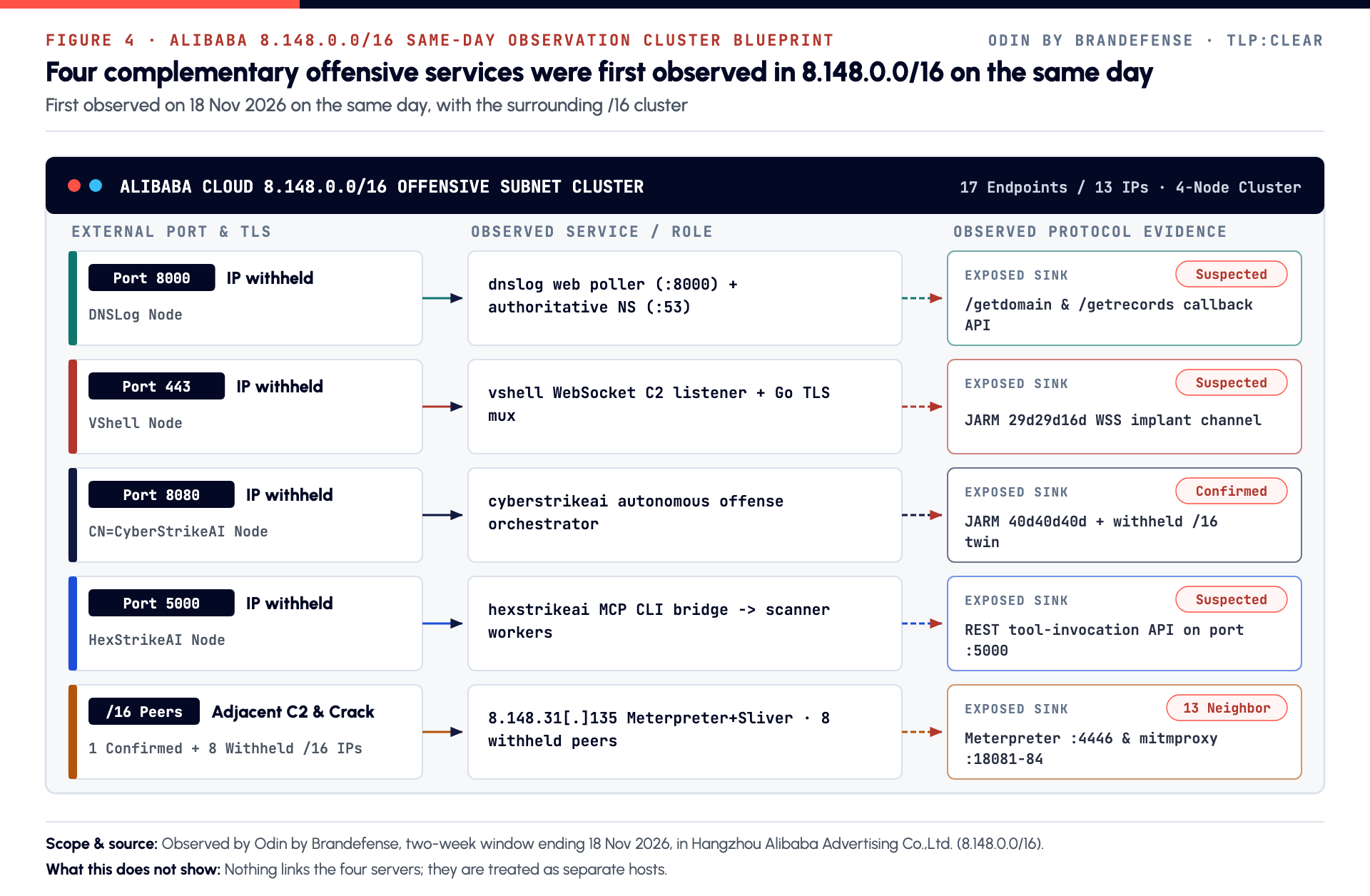
The four services in order
| Port | Service | Framework label | Fingerprint and role |
|---|---|---|---|
| 8000 | DNSLog | Suspected | HTTP /getdomain and /getrecords callback collector |
| 443 | VShell | Suspected | Go TLS JARM 29d29d16d..., WebSocket C2 listener; certificate domain withheld |
| 8080 | CyberStrikeAI | Confirmed | CN=CyberStrikeAI, JARM 40d40d40d..., autonomous offense engine |
| 5000 | HexStrikeAI | Suspected | REST MCP bridge that hands command-line scanners to a model |
The four IPs fall between 8.148.195.0/24 and 8.148.233.0/24. Each exposes a different port and a different role: callback collection, WebSocket C2, AI orchestration and MCP tool execution. Their addresses are withheld.
What links them
Nothing does. We found no shared certificate, cross-host control link or provisioning file on any of the four servers. Alibaba Cloud ranges host many unrelated customers, including testers. The roles fit together on paper, but that is not evidence of one operator.
Because nothing proves shared control, all four hosts stay on the watchlist. They are not on the block list.
The rest of the /16
Beyond the four, the range holds 13 more records on 9 sibling IPs. That makes 17 endpoints on 13 IPs, after setting aside 2 unrelated 3306 false positives.
Only one host in the whole range has the same-host evidence we need for blocking. 8.148.31[.]135 runs a confirmed Metasploit Meterpreter listener on 4446 and 443, plus a Sliver listener on 8888. Its certificate domains are withheld.
The 8 other siblings carry 10 endpoints, all withheld:
| Service | Port | Note |
|---|---|---|
| CyberStrikeAI | 8080 | CN=CyberStrikeAI; carries an earlier first-seen date of 2 November 2026 |
| PentAGI | 8443 | Single listener |
| DNSLog (TLS) | 8443 | Standalone |
| ARTEX | 8787 | Candidate |
| Hashtopolis (password-cracking manager) | 8443 | Candidate |
| Sliver | 8443 | Candidate |
| VShell | 8090 | Candidate |
| mitmproxy | 18081, 18082, 18084 | One host, three ports |
6. Telling Testers from Attackers
In short
Interactsh and Burp Collaborator are everyday tools for contracted testers and bug-bounty researchers. Blocking every listener breaks legitimate work, so only 9 of 28 selected indicators are block-ready.
Figure 5 shows how far the confirmed and suspected set shrinks from the full endpoint count for each platform.
What earns a block
A callback server goes on the block list only with independent offensive evidence. Two kinds qualify. The first is a C2 or reconnaissance framework on the same IP. The second is an exposed directory holding offensive scripts or exploit templates.
On that basis, 9 selected indicators are block-ready. That is 7 co-hosted callback or C2 nodes and 2 offensive workbenches. The 7 are six callback hosts from Chapter 2 plus 8.148.31[.]135 from Chapter 5. One more co-hosted host is withheld, because its Sliver port is only suspected and a red team cannot be ruled out.
What stays off the block list
| Group | Size | Why not block | Action |
|---|---|---|---|
| AWS load-balancer reflections | 356 records | They echo headers and only look like OAST servers | Exclude before any analysis |
Standalone listeners and single-service /16 hosts | 7 standalone OAST and 7 /16 entries in the selected set | No independent offensive evidence; often authorized testers | Watchlist; enrich with passive DNS |
| Consultancy Collaborator server | 1 | Carries an identifiable testing-firm certificate and no C2 | Analyst review; check test scope |
| Listeners on dynamic subscriber lines | 5 endpoints (3 Interactsh in Vietnam and China, 2 Burp Collaborator in the UK) | Home and small-business addresses change hands | Short watchlist that expires after 24 hours |
| Scanned third-party web application | 1 host, 15 records | It logged incoming probes; it is a likely target | Withhold and exclude from threat lists |
| Your own approved scanners | Not counted | Internal DAST and red-team runners use the same tools | Allowlist by exact host, for scheduled windows |
The same caution applies to the subnet cluster. Shared cloud ranges also host independent security researchers and commercial testing tenants.
7. What Defenders Should Do
Within 24 hours
- Block the 9 block-ready endpoints in Chapter 9 at the perimeter, proxy and server egress.
- Hunt past DNS and HTTP logs for contact with those hosts and the eight workbench callback names in Chapter 4.
- Put the 18 watchlist and review entries in enrichment tables, not in firewall blocks.
Within 72 hours
- Block direct outbound UDP and TCP 53, HTTP and HTTPS (80, 443, 8000), SMTP (465, 587) and LDAP (389, 1389) from web, middleware and database subnets, except to explicit allowlists.
- Force all server DNS through internal Protective DNS forwarders that sinkhole
oast.*,interact[.]sh,oastify[.]com,burpcollaborator[.]netanddnslog[.]cn. - Register every internal DAST or red-team scanner IP and private Collaborator or Interactsh domain in a versioned allowlist before each test window.
Within 7 to 30 days
- Disable or restrict database network functions:
xp_dirtreeandxp_subdirson SQL Server,UTL_HTTPandUTL_INADDRon Oracle, andCOPY ... FROM PROGRAMon PostgreSQL. - Deploy Suricata SIDs 9517001 to 9517010, the Sentinel server-egress query and the three Sigma rules.
- Alert on server lookups of 26 to 36 character random-looking labels.
- Recheck TLS certificate subjects and JARM values on elastic cloud IPs at regular intervals, since addresses get reassigned.
8. Detection Rules
The full rules are in the Detection rules tab. They use explicit host allowlists rather than wildcard exclusions.
| Rule file | What it catches |
|---|---|
odin_oast_interactsh_burpcollab_dnslog.rules | Suricata 7: ten signatures for callback DNS lookups, OAST server headers, DNSLog and Interactsh polling, and anonymous LDAP callbacks |
sentinel_internal_server_oast_egress_hunt.kql | Microsoft Sentinel and Defender XDR: application and database server processes that reach OAST zones or the corroborated hosts, with follow-on activity |
sigma_server_tier_oast_dns_and_http_callback.yml | Sigma (3 rules): server OAST lookups, database or web workers starting lookup tools, and unapproved OAST or offense bridge daemons |
odin_oast_payload_and_provisioning_scripts.yar | YARA (4 rules): Interactsh and Collaborator server configs, DNSLog polling files, and multi-stack cloud provisioning files |
How the Suricata signatures work
| SID | Looks for | Where to deploy |
|---|---|---|
| 9517001 | DNS query to .oast[.]pro, .live, .site, .online, .fun or .me | DNS forwarder egress |
| 9517002 | DNS query for a long label under .oastify[.]com | DNS forwarder egress |
| 9517003 | HTTP response header X-Interactsh-Version or Server: Interactsh-Server | TLS inspection point |
| 9517004 | HTTP response header BurpCollaboratorServer | TLS inspection point |
| 9517005 | Outbound anonymous LDAPv3 bind to 389, 1389 or 10389 | Perimeter TCP egress |
| 9517006 | HTTP request to /getrecords or /getrecords.php (BugScanTeam /api/ routes not covered) | TLS inspection point |
| 9517007 | Interactsh client polling with /poll?id= and &secret= | TLS inspection point |
| 9517008 | DNS query for a 20 to 36 character label under .interact[.]sh | DNS forwarder egress |
| 9517009 | DNS query for a long label under .burpcollaborator[.]net | DNS forwarder egress |
| 9517010 | DNS query under .dnslog[.]cn | DNS forwarder egress |
Bypass SIDs 9517001 to 9517004 and 9517007 to 9517010 only for documented scanner source IPs during scheduled test windows. Treat any SID 9517005 alert as high priority. Treat the DNS and header SIDs as high priority when they fire from a server subnet.
How the Sentinel query works
The query looks back 14 days. It watches network events from server processes such as java, w3wp.exe, sqlservr.exe, postgres, mysqld, node and dotnet. It skips listed scanner devices.
| Signal | Fires when |
|---|---|
| Callback followed by follow-on | A server process reaches an OAST zone or a correlation-style name, then within 10 minutes starts a shell or curl/wget, or connects to a corroborated C2 or workbench endpoint |
| Standalone server callback | A server process reaches an OAST zone or correlation-style name |
| Egress to a corroborated host | A server process connects directly to one of the 11 corroborated hosts in the query's list |
| Port-only review | A server process reaches a public IP on 465, 587, 389, 1389 or 8000 with no OAST indicator and no approved relay |
Fill in the approved scanner hostnames and the approved SMTP, LDAP or webhook relay IPs before use. The port-only signal is the weakest and is meant for review.
How the Sigma and YARA rules work
| Rule | Fires when |
|---|---|
| Sigma 1: server OAST DNS query | A Windows web, middleware or database process queries an OAST zone, outside approved scanner hosts |
| Sigma 2: worker spawns lookup tool | A database or web worker starts nslookup.exe, curl.exe, wget.exe or certutil.exe, outside health checks |
| Sigma 3: OAST or offense daemon | A Linux host runs interactsh-server, --collaborator-server, dnslog, cyberstrikeai or hexstrikeai, outside sanctioned red-team hosts |
ODIN_Interactsh_SelfHosted_Server_Config | An Interactsh server name appears with SMTP port settings or wildcard and listen settings |
ODIN_BurpCollaborator_Custom_Server_Config | Collaborator JSON keys such as serverDomain, polling and eventCapture appear together |
ODIN_DNSLog_And_OAST_Polling_Descriptor | A small poller file holds full http URLs for both /getrecords and /getdomain |
ODIN_IaC_MultiStack_Offensive_Burst_Manifest | A Terraform file declares an Alibaba Cloud instance and lists quoted roles such as cyberstrikeai, hexstrikeai, vshell or dnslog with ports |
The YARA rules were checked against four sanitized, non-executable descriptors and against BIND9 and Terraform baselines, with no false positives. The provisioning rule is built from an illustrative example; no such Terraform file was recovered.
How to sort a host
| What the host shows | Action |
|---|---|
| A callback listener plus a C2 or recon framework on the same IP | Block |
| An exposed directory with offensive scripts or exploit templates | Block |
| A standalone listener, or a single-service host inside a cloud cluster | Watchlist and analyst review |
| A consultancy certificate with no C2 | Analyst review |
| A listener on a dynamic subscriber line | 24-hour watchlist |
| A third-party app logging incoming probes | Exclude from threat lists |
| A load-balancer reflection | Suppress |
| A documented internal scanner | Allow |
9. Indicators
The Indicators tab holds the 9 block-ready endpoints. The other 19 records in the selected set are withheld.
| Type | Count |
|---|---|
| Block-ready endpoints (IP and port) | 9 |
| Watchlist and review entries (addresses withheld) | 18 |
| Load-balancer collision reference (withheld) | 1 |
| Distinct callback names in confirmed workbench files | 8 |
Supporting fingerprints: the Interactsh JARM prefix 29d29d00029d29d00041d..., the Burp Collaborator JARM prefix 28d28d28d00028d00042d..., the VShell JARM prefix 29d29d16d..., the CyberStrikeAI JARM prefix 40d40d40d... and the certificate subject CN=CyberStrikeAI.
Block-ready endpoints
| Endpoint | Role | Country | Hosting | Evidence | Earliest first seen on record |
|---|---|---|---|---|---|
| 8.148.31[.]135:4446 | Metasploit Meterpreter | CN | Alibaba Cloud | Meterpreter on 4446 and 443, Sliver on 8888 | 13 Nov 2026 |
| 49.232.168[.]207:8000 | DNSLog | CN | Tencent | Confirmed DNSLog with VShell on 5030 | 13 Nov 2026 |
| 101.33.231[.]97:443 | Interactsh | CN | Tencent | Cobalt Strike on 8080 | 13 Nov 2026 |
| 43.153.118[.]75:8300 | Interactsh | US | Tencent | VShell on 8084 and 8094 | 13 Nov 2026 |
| 23.94.214[.]197:587 | Interactsh | US | HostPapa | Interactsh on 443, 465, 587; ARTEX on 8787 | 13 Nov 2026 |
| 150.158.9[.]124:8000 | DNSLog | CN | Tencent | ARL recon panel on 5003 | 13 Nov 2026 |
| 51.15.224[.]47:587 | Interactsh | FR | Scaleway | Five-port Interactsh with ezXSS on 9443 | 13 Nov 2026 |
| 45.145.228[.]16:8080 | Offensive open directory | HK | Cloudie | /memshell/ExploitScriptEngineFactory.java with an oastify[.]com callback | Before this window |
| 47.101.51[.]235:8888 | Offensive open directory | CN | Alibaba Cloud | /EvilTemplate.java and five dnslog[.]cn callbacks | Before this window |
Records marked "Before this window" carry first-seen dates older than our observation. They are not the start of our observation, which covers the two weeks ending 18 November 2026.
The Sentinel query also lists two more corroborated hosts from earlier chapters: the workbench 144.172.99[.]199:8080 and the co-hosted workbench on 49.51.187[.]59:8090.
Withheld: the four /16 cluster hosts, the eight /16 siblings, and standalone Interactsh and Collaborator listeners with their certificate domains. Also withheld: the client log host, the five template mirrors, the consultancy Collaborator, the five subscriber addresses, the scanned Laravel target and the load-balancer collision host.
ATT&CK context
This activity maps to three MITRE ATT&CK tactics: Initial Access (blind probes and JNDI callbacks), Discovery (callback DNS lookups) and Command and Control (polling and co-hosted C2). See the Suricata table in Chapter 8 for which SID covers each.
10. Scope and Limits
- Window. The findings cover a two-week observation window ending 18 November 2026. Some records carry earlier first-seen dates; we do not use those as a tracking start.
- Dual-use by default. Interactsh, Burp Collaborator and DNSLog are standard testing tools. A listener alone says nothing about intent.
- Candidates are leads. The 1,039 candidates are hunting leads. Do not block them.
- Proximity is not control. Four services in one range show where they sat, not who runs them. No cross-host link was found.
- Files are not outcomes. Workbench scripts and templates show tooling and intent. We did not see any of them used against a target system.
- No victim view. This study looks at listeners from the outside. It has no logs from any target network.
- Collisions removed. 356 AWS load-balancer reflections are excluded from every count.
- Rule testing. Every published rule file loads without errors in its engine (Suricata 7.0.12, YARA-X, pySigma and Microsoft's Kusto.Language analyzer, checked on 20 November 2026). The rules were not replayed against live traffic, so test and tune them in your own environment before production use.
11. Sources
- MITRE ATT&CK Enterprise tactics. https://attack.mitre.org/tactics/enterprise/ (verified 19 November 2026)
- ProjectDiscovery. Interactsh repository. https://github.com/projectdiscovery/interactsh (verified 19 November 2026)
- PortSwigger. Deploying a private Burp Collaborator server. https://portswigger.net/burp/documentation/collaborator/deploying (verified 19 November 2026)
- BugScanTeam. DNSLog repository. https://github.com/BugScanTeam/DNSLog (verified 19 November 2026)
- NSA and CISA. Selecting a Protective DNS Service. https://www.nsa.gov/Press-Room/News-Highlights/Article/Article/2523771/nsa-and-cisa-release-cybersecurity-information-on-protective-dns/ (verified 19 November 2026)
- OWASP. Server-Side Request Forgery Prevention Cheat Sheet. https://cheatsheetseries.owasp.org/cheatsheets/Server_Side_Request_Forgery_Prevention_Cheat_Sheet.html (verified 19 November 2026)
What is…?
Short explanations of the tools and families named in this study.
What is Interactsh?
Interactsh is ProjectDiscovery's open-source OAST server and client for catching DNS, HTTP and other callbacks.
More about InteractshOAST serviceWhat is DNSLog?
DNSLog is a family of open-source DNS callback collectors used to confirm blind injection and SSRF flaws.
More about DNSLogTechniqueWhat is OAST?
Out-of-band application security testing (OAST) detects blind vulnerabilities by making a target call back to a server the tester controls, usually over DNS or HTTP.
More about OASTOAST serviceWhat is Burp Collaborator?
Burp Collaborator is PortSwigger's callback service for Burp Suite, used to detect out-of-band vulnerabilities.
More about Burp CollaboratorRemote access implantWhat is VShell?
VShell is a remote access implant and C2 panel that talks over WebSocket and other transports. It is popular with Chinese-speaking operators.
More about VShellTechniqueWhat is JARM?
JARM is an open TLS server fingerprinting method from Salesforce. It hashes how a server answers a set of crafted TLS handshakes.
More about JARMFrequently asked questions
What is a callback server, and why should I care?
Some of the worst server bugs are silent. A blind server-side request forgery or a blind SQL injection runs in the back end and shows nothing in the web page. To confirm such a bug, the tester plants a unique address in the probe. If the target server looks up or fetches that address, a callback server logs it.
Is every callback server a threat?
No. Contracted penetration testers and bug-bounty researchers run these tools every day. Blocking all of them would break legitimate work and add little. The signal that matters is company. Across the fleet, 40 hosts expose several services. On 18 of them, a callback listener shares an IP with another offensive framework. Eight of those are corroborated.
What sat in one cloud range?
On 18 November 2026, Odin first observed four offensive services in Alibaba Cloud's 8.148.0.0/16 range, on four separate servers. They were a DNSLog callback collector, a VShell WebSocket C2 listener, a CyberStrikeAI engine and a HexStrikeAI tool bridge. Each covered a different role.