


1. Executive Summary
In short
In a two-week observation window ending 18 November 2026, Odin by Brandefense reviewed 87 servers exposing Hermes Agent folders over open HTTP. On 47 of them (54.0%), the files show unattended automation: schedules, task boards, skill curators and upgrade snapshots. Retry dumps keep full API requests with bearer headers. One US server also exposed TLS private keys for two web panels. Bind file servers on agent hosts to loopback, keep certificate keys out of home folders, and purge dumps and snapshots when you rotate keys.
Hermes Agent is an open-source AI agent from Nous Research. It keeps its state in a hidden ~/.hermes folder. Unlike a chat assistant, it can run as a background service. It schedules recurring jobs, splits projects into task cards for worker agents, and tidies its own skill library without a human prompt. This report looks at what that folder reveals when a server shares it over plain HTTP.
All 87 servers are exposed systems, not attacker infrastructure. Their owners are users who left a directory listing open. Every address, domain, path name and secret value in this report is withheld.
Over half of exposed Hermes servers run unattended automation, not chats.
On 47 of 87 hosts (54.0%), the exposed files belong to background subsystems. Skill Curators appear on 41 hosts, code language servers on 7, upgrade snapshots on 6, schedulers on 5 and task boards on 4. One German server exposes all eight subsystems in 14,914 files.
Retry dumps and upgrade snapshots keep old credentials after rotation.
When the model provider returns a temporary error, Hermes writes the whole failed request to disk. That file holds the bearer header, the agent's persona and memory, and 31 tool definitions. Upgrade snapshots and .env backups keep older keys next to the live ones.
One open file server exposed agent state and web-panel TLS keys together.
On a US virtual server, a Python file server started in /root exposed 7,643 Hermes files and 2,222 scheduler files. The same listing exposed 277 acme.sh certificate files, including ECDSA private keys for two co-hosted web-panel domains.
Three Decisions for Leaders
- Treat unattended agents as privileged service accounts. Any agent that runs scheduled jobs, task queues or email skills needs registration, an outbound allowlist and short-lived, scoped tokens.
- Ban open file servers on hosts that hold agent state or keys. Ad-hoc Python or Node listeners in
/rootor/homeexpose every hidden folder beside them, including snapshots, dumps and certificate keys. - Triage by what is exposed, not by the folder name. A host that shows only bundled skill documents is noise. A host that shows task databases, schedules, retry dumps or private keys needs action.
The Study in Numbers
| Number | What it is |
|---|---|
| 87 | Distinct exposed hosts behind the 1,100 directory entries analysed, holding 235,644 indexed files |
| 47 (54.0%) | Hosts exposing background subsystems: schedulers, task boards, Curators, language servers or snapshots |
| 14,914 | Indexed files on one German server that exposes all eight subsystems |
| 277 | Certificate files exposed next to 7,643 Hermes files on one US server, including two TLS private keys |
| 68 to 42 | Skills the agent itself merged and archived in one 591-second Curator run |
| 11 | Verified secret findings: private keys, bot tokens, API keys and endpoint strings |
How to use this report.
Security leaders can read Chapter 1 and Chapter 7. Platform and cloud teams should read Chapters 2 to 5. SOC and detection engineers should start with Chapters 6, 8 and 9.
2. What a Hermes Daemon Leaves on Disk
In short
A Hermes install stores scheduler jobs, task boards, curator runs, logs and snapshots under one folder. When a high-port HTTP listener serves that folder, all of it becomes readable.
From chat transcripts to background services
An earlier Odin report looked at exposed .claude, .codex and .cursor folders. Those mostly held interactive coding sessions. The .hermes folders in this study look different. They belong to an agent built to keep working when nobody is typing.
Odin by Brandefense analysed 1,100 open .hermes directory entries. They sit on 87 distinct IPv4 hosts, which together list 235,644 indexed files.
Nine path families
Of the 1,100 entries, 859 (78.1%) map to a named subsystem. The other 241 (21.9%) are root credential files (.env, auth.json, config.yaml), named bot profiles, runtime routers and paste buffers.
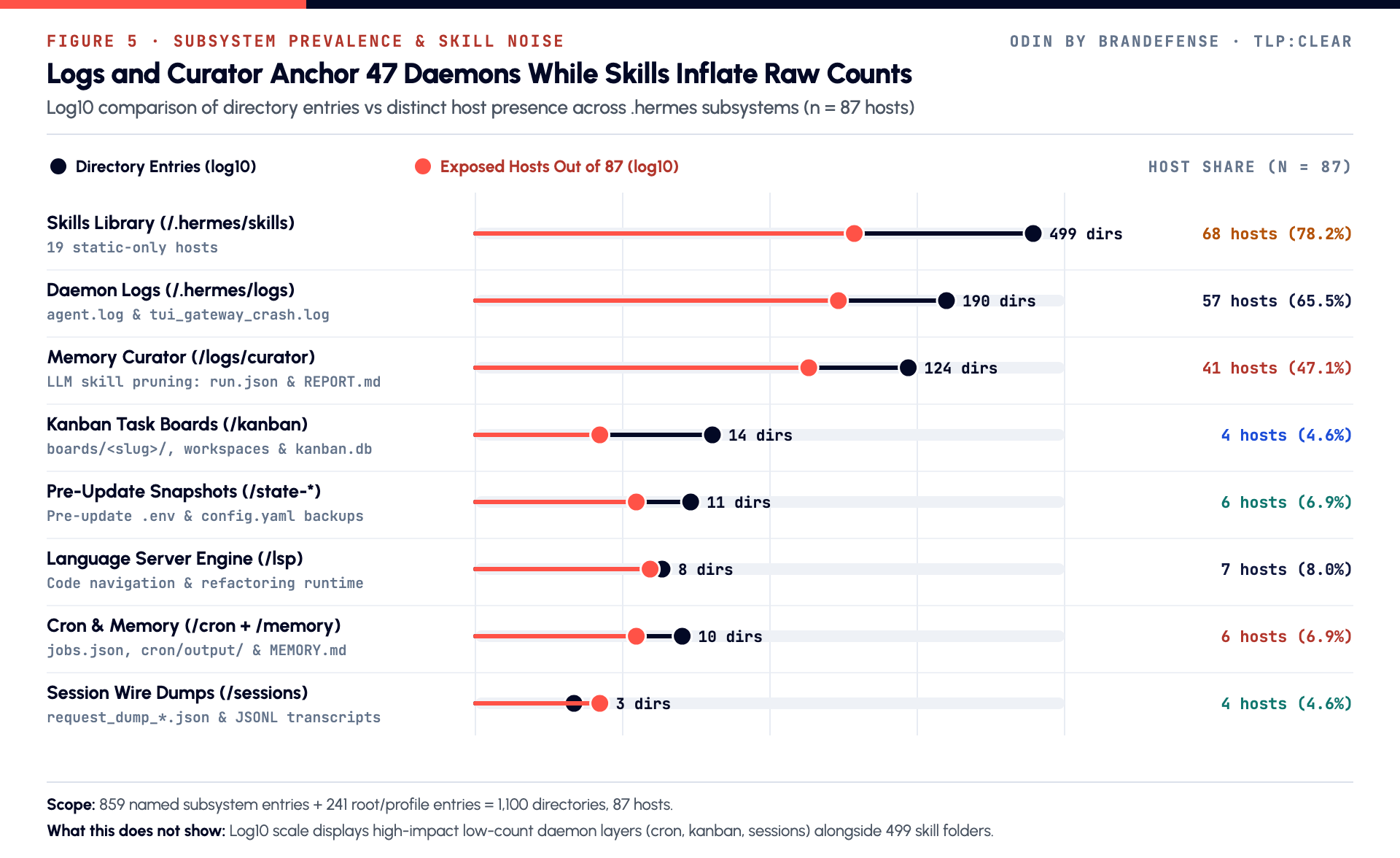
| Subsystem | Path under ~/.hermes | Entries | Share of 1,100 | Hosts (of 87) | What it does |
|---|---|---|---|---|---|
| Skills library | skills/, skills/.archive/ | 499 | 45.4% | 68 (78.2%) | Playbooks such as kanban-worker, cron-pipelines and himalaya, plus bundled docs |
| Daemon logs | logs/ | 190 | 17.3% | 57 (65.5%) | agent.log, gateway.log and tui_gateway_crash.log |
| Memory Curator | logs/curator/ | 124 | 11.3% | 41 (47.1%) | Unattended skill merging and pruning (run.json, REPORT.md) |
| Kanban boards | kanban/, kanban.db | 14 | 1.3% | 4 (4.6%) | SQLite task queues, project boards and t_<id> worker folders |
| State snapshots | state-snapshots/ | 11 | 1.0% | 6 (6.9%) | *-pre-update/ copies of .env and config.yaml |
| Language server | lsp/ | 8 | 0.7% | 7 (8.0%) | Headless Language Server Protocol runtime for code navigation |
| Durable memory | memories/, SOUL.md | 6 | 0.5% | 2 (2.3%) | MEMORY.md and USER.md, injected into every prompt |
| Cron scheduler | cron/ | 4 | 0.4% | 5 (5.7%) | jobs.json, executions.db, .tick.lock and cron/output/<job_id>/ |
| Session dumps | sessions/ | 3 | 0.3% | 4 (4.6%) | request_dump_*.json retry payloads and .jsonl transcripts |
Top-level counts understate how deep some folders go. This likely explains why the Cron and session rows show more hosts than entries. On one US server, cron/ alone holds 2,222 files, and sessions/ holds dozens of 87 to 256 KB request dumps.
Where the hosts are and how they listen
Half of the hosts are in China. The rest spread across ten other countries.
| Country | Hosts | Share |
|---|---|---|
| China | 44 | 50.6% |
| United States | 14 | 16.1% |
| Germany | 8 | 9.2% |
| Singapore | 8 | 9.2% |
| Indonesia | 4 | 4.6% |
| France, Japan, Canada | 2 each | |
| South Korea, Malaysia, Netherlands | 1 each |
Almost every exposure comes from a plain HTTP server on a non-standard port, bound to all interfaces.
| Port | Hosts | Share |
|---|---|---|
| 8080 | 38 | 43.7% |
| 8000 | 8 | 9.2% |
| 8899 | 8 | 9.2% |
| 8888 | 7 | 8.0% |
| 9090 | 4 | 4.6% |
| 8765, 9999, 18080, 80 | 3 each | 3.4% each |
How the subsystems fit together
The Hermes TUI gateway (tui_gateway/entry.py) and a policy router (runtime-controller/runtime_router.py) sit on top. Below them, four units work on their own: the Cron scheduler, the Kanban board manager, the skill and language-server executor, and the Curator. All four write into the same plaintext credential and snapshot files on disk.
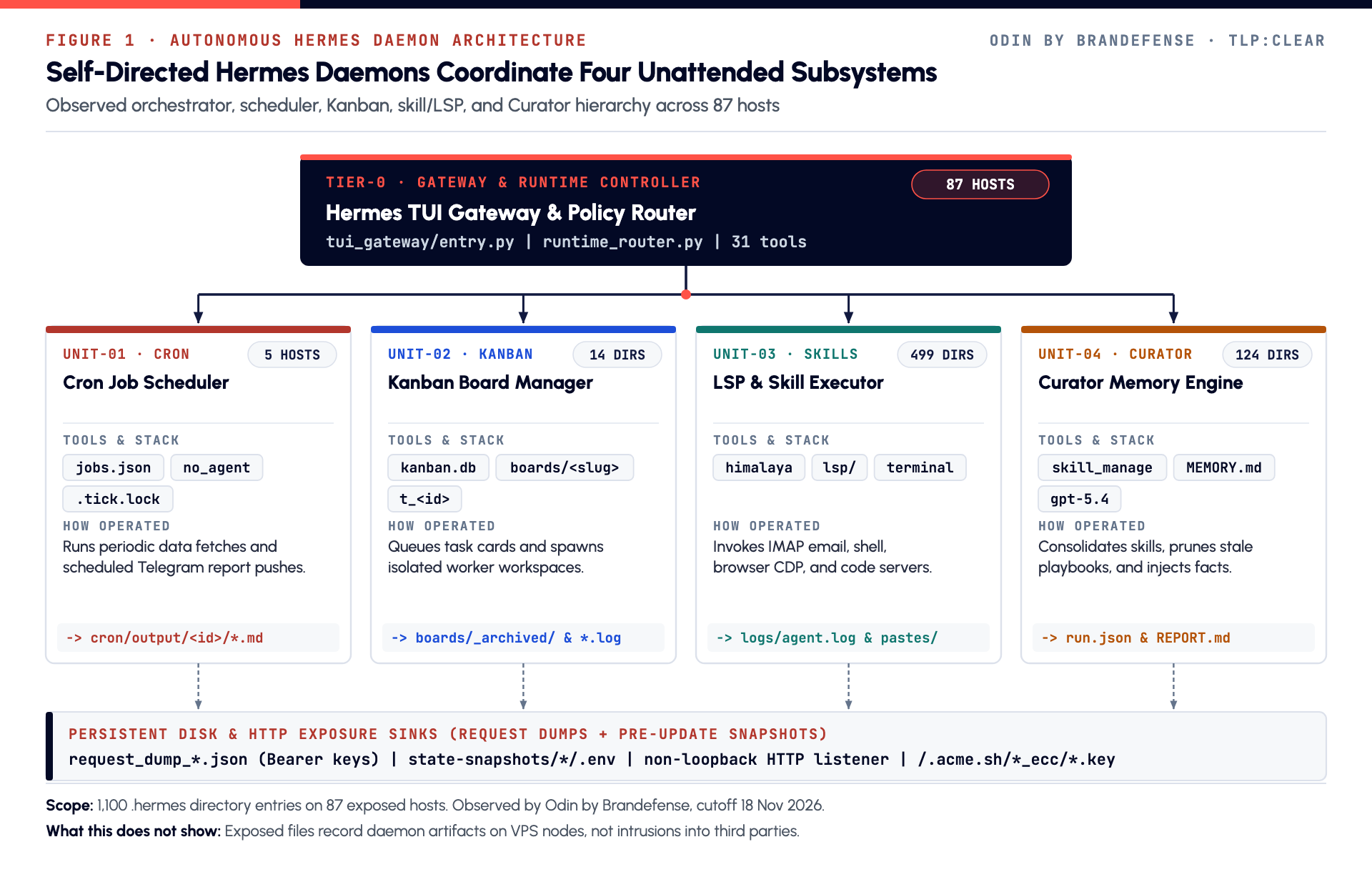
The fullest example: one server, eight subsystems
A virtual server in Germany (Host A in Figure 4, Chapter 5) exposes all eight runtime subsystems at once. It lists 14,914 indexed files.
| Exposed path | Files | What it shows |
|---|---|---|
/.hermes/ | 14,914 | Full tree: cron, kanban, curator, lsp, sessions, skills, logs, state-snapshots |
/hermes-webui.old.*/.venv/ | 883 | Virtual environment kept from an older Hermes WebUI install |
/hermes-webui.old.*/tests/ | 652 | A second WebUI backup left under the HTTP root |
/.hermes/profiles/<name>/ | 176 | A dedicated persona profile with its own config and state |
/.hermes/logs/curator/ | 26 | Past Curator run folders |
/.config/ and project logs | 30 | Service configs (21 files) and agent-managed project logs (9 files) |
/.hermes/.env | 1 | Root environment file holding a Telegram bot token |
Two WebUI backups, a custom profile and 26 Curator entries point to a workbench that has been upgraded many times. This is a long-lived install, not a one-off test.
3. Task Boards, Schedules and 31 Tools
In short
Hermes replaces prompting with two scheduling tools: SQLite Kanban boards that hand cards to isolated workers, and a Cron dispatcher that runs scripts and model briefings on a timer. Monitor both on engineering hosts.
The tools the agent can call
Retry dumps on one server contain the agent's full tool list. Hermes registers 31 tools in five groups.
| Group | Count | Tools | What they allow |
|---|---|---|---|
| Headless browser | 10 | browser_navigate, browser_snapshot, browser_vision, browser_click and 6 DOM or tab helpers | Drive a Chromium browser and read pages visually |
| Scheduling and delegation | 4 | cronjob, delegate_task, mixture_of_agents, todo | Schedule jobs, fan out to sub-agents, track cards |
| Code and shell | 5 | execute_code, terminal, process, patch, write_file | Run shell commands, manage processes, patch files |
| Files and retrieval | 5 | read_file, search_files, session_search, web_extract, web_search | Search local files and past sessions, scrape the web |
| Memory, skills and messaging | 7 | memory, skill_manage, skill_view, skills_list, send_message and 2 runtime helpers | Update memory, prune skills, push to Telegram or Discord |
An agent with terminal, cronjob and send_message can run shell commands on a timer and report the results to a chat bot. No person needs to be present.
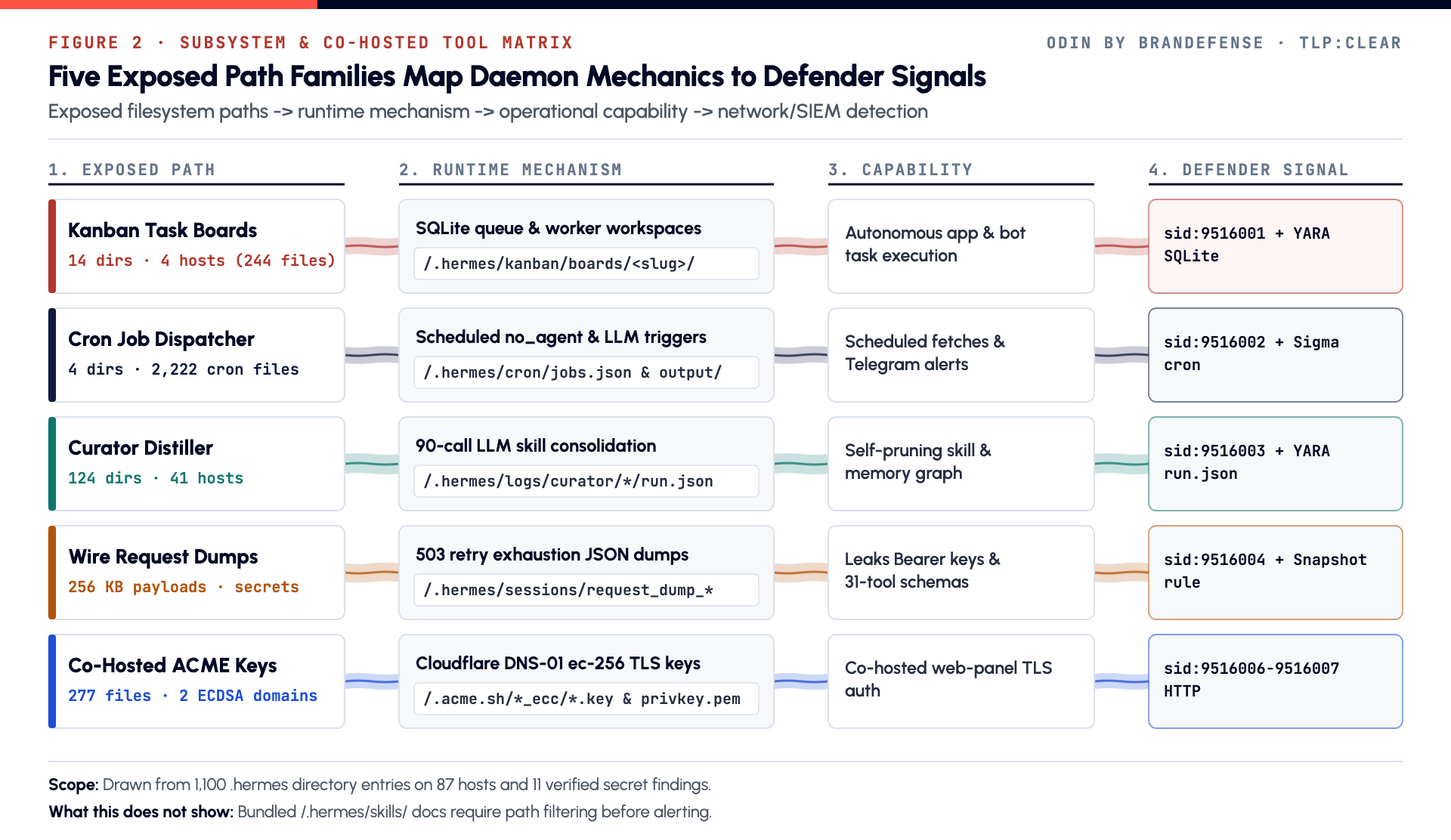
Kanban boards and Cron jobs
Multi-subsystem hosts pair a cron-pipelines skill with two Kanban skills: kanban-orchestrator and kanban-worker. The orchestrator breaks a project into SQLite cards. Each worker runs a card in its own workspaces/t_<id>/ folder. Task state lives in kanban.db and in one kanban.db per board.
The Cron dispatcher reads cron/jobs.json. It runs two kinds of job. Some are plain no_agent Python scripts, guarded by .tick.lock and logged in executions.db. Others call the model and push a briefing to Telegram.
| Host (country) | Exposed path | Files or size | What it holds |
|---|---|---|---|
| Host C (KR) | kanban/boards/<board>/ | 76 files, 258,048-byte DB | Live board database and task cards |
| Host C (KR) | kanban/boards/_archived/ | 82 files, 105,904-byte log | Archived worker folders and worker logs |
| Host C (KR) | cron/output/<job_id>/ | 1 file | Scheduled Markdown summary that records a callback endpoint |
| Host D (DE) | kanban/boards/ | 49 files | Two German-language project boards (23 and 26 files) |
| Host B (US) | cron/, jobs.json | 2,222 files, 12,048-byte JSON | An hourly no_agent fetch job and a thrice-weekly report job |
| Host E (US) | cron/output/<job_id>/ | 88 files | Scheduled output, with four Telegram bot tokens in .hermes_history |
| Host G (CN) | kanban.db, cron/executions.db | 143,360 bytes in total | Task board (118,784 bytes) and Cron execution log (24,576 bytes) |
Job IDs, board names and script names are withheld.
Skills that reach beyond the agent
The skill manifest on one US server (.skills_prompt_snapshot.json, 57,659 bytes) shows how Hermes extends its own tools.
- Delegation to other coding agents. Hermes ships playbooks for
claude-code,codexandopencode. They tell the daemon to start separate Claude Code or OpenAI Codex CLI processes for multi-PR coding work. The same US server also exposes a/.codex/folder with 688 files, including thecodex-linux-sandboxandcodex-execve-wrapperbinaries. A Korean server has the Claude Code CLI wrapper installed under/.hermes/node/lib/node_modules/. - Terminal email. Several servers stage
skills/email/himalaya/. This playbook wires the Rusthimalayaclient into theterminaltool, so the agent can read IMAP mail and send through SMTP. The same hosts stageskills/mcp/native-mcp/andskills/red-teaming/.
4. Curator Runs, Retry Dumps and Snapshots
In short
Hermes keeps three kinds of file that outlive a key rotation: Curator run logs, raw retry dumps and pre-update snapshots. Rotating a key is not enough; these files must be purged too.
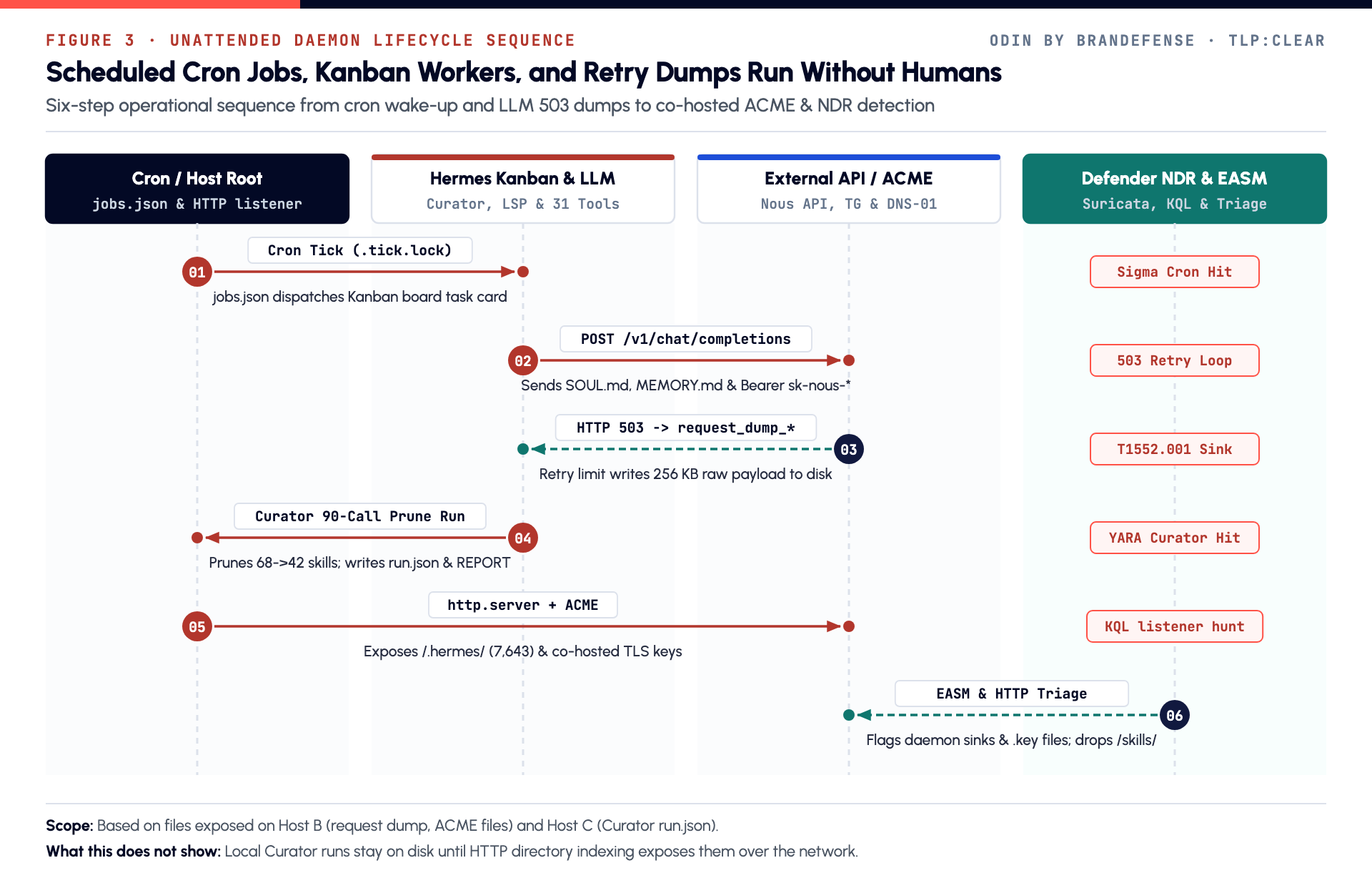
Inside one Curator run
The Curator is the second most common background subsystem after logs. It appears on 41 hosts (47.1%), in 124 directory entries. It reviews the skills the agent has written and merges or archives them.
A Korean server (Host C in Figure 4, Chapter 5) exposes one full run. The run log, run.json, is 34,236 bytes. The summary, REPORT.md, is 8,294 bytes. The log carries its own timestamp of 17 June 2026. The run took 591.25 seconds (9 minutes 51 seconds) and used model gpt-5.4 through provider copilot.
| Stage | What happened |
|---|---|
| 1. Pre-check | Reviewed 68 agent-written skills without calling the model. None were marked stale or reactivated; one was seeded. |
| 2. Model pass | Made 90 tool calls: skill_manage 35, read_file 31, terminal 12, search_files 6, skill_view 5, execute_code 1. Merged nine skill clusters into broader skills. |
| 3. Clean-up | Found a missing path, located the support files with terminal and moved them. Archived 26 skills (68 down to 42) into skills/.archive/, which exposes 100 files. Rewrote no Cron jobs. |
The merges are ordinary engineering housekeeping. kanban-orchestrator and kanban-worker became kanban-operations. Six GitHub skills became github-operations. Debugging, document and travel-planning skills were also combined. The point for defenders is that the agent edits its own playbooks and runs shell commands while nobody watches.
Four files that hold secrets
| Mechanism | File and size | When it is written | What it keeps |
|---|---|---|---|
| Retry dump | sessions/request_dump_*.json, 87 to 256 KB each | Upstream HTTP 503 or timeout (max_retries_exhausted) | The full POST /v1/chat/completions body sent to inference-api.nousresearch[.]com, with the Authorization: Bearer header, SOUL.md, MEMORY.md, 31 tool definitions and terminal output |
| Pre-update snapshot | state-snapshots/*-pre-update/.env | Automatically before hermes update | Older .env and config.yaml with Anthropic, OpenRouter, Telegram and Discord keys |
| Config backups | .env.bak.* (23,157 bytes) and 8 config.yaml.bak.* copies | Config or router edits | Plaintext key rings and provider fallback lists across many edits |
| Crash logs | logs/tui_gateway_crash.log (219,915 bytes) and gateway-exit-diag.log (40,786 bytes) | SIGTERM to the gateway | Thread stacks, module paths, process IDs and restart rhythm |
The retry dump is the most direct leak. One case on the US server (Host B in Figure 4, Chapter 5) shows how it happens. A user asked Hermes, in Chinese, to report the current fallback provider and model without showing any API key. The agent searched state-snapshots/ and old request dumps.
The upstream model (deepseek/deepseek-v4-flash) then returned HTTP 503. The gateway wrote the whole 256,668-byte request to sessions/, bearer header included. The user's request to hide the key did not stop the client from saving it.
5. Shared Servers: Agent State Next to TLS Keys
In short
An open file server in /root does not stop at .hermes. On one US server it also exposed web-panel TLS private keys, a Codex install and backups; on a Korean server it exposed PM2 web workers.
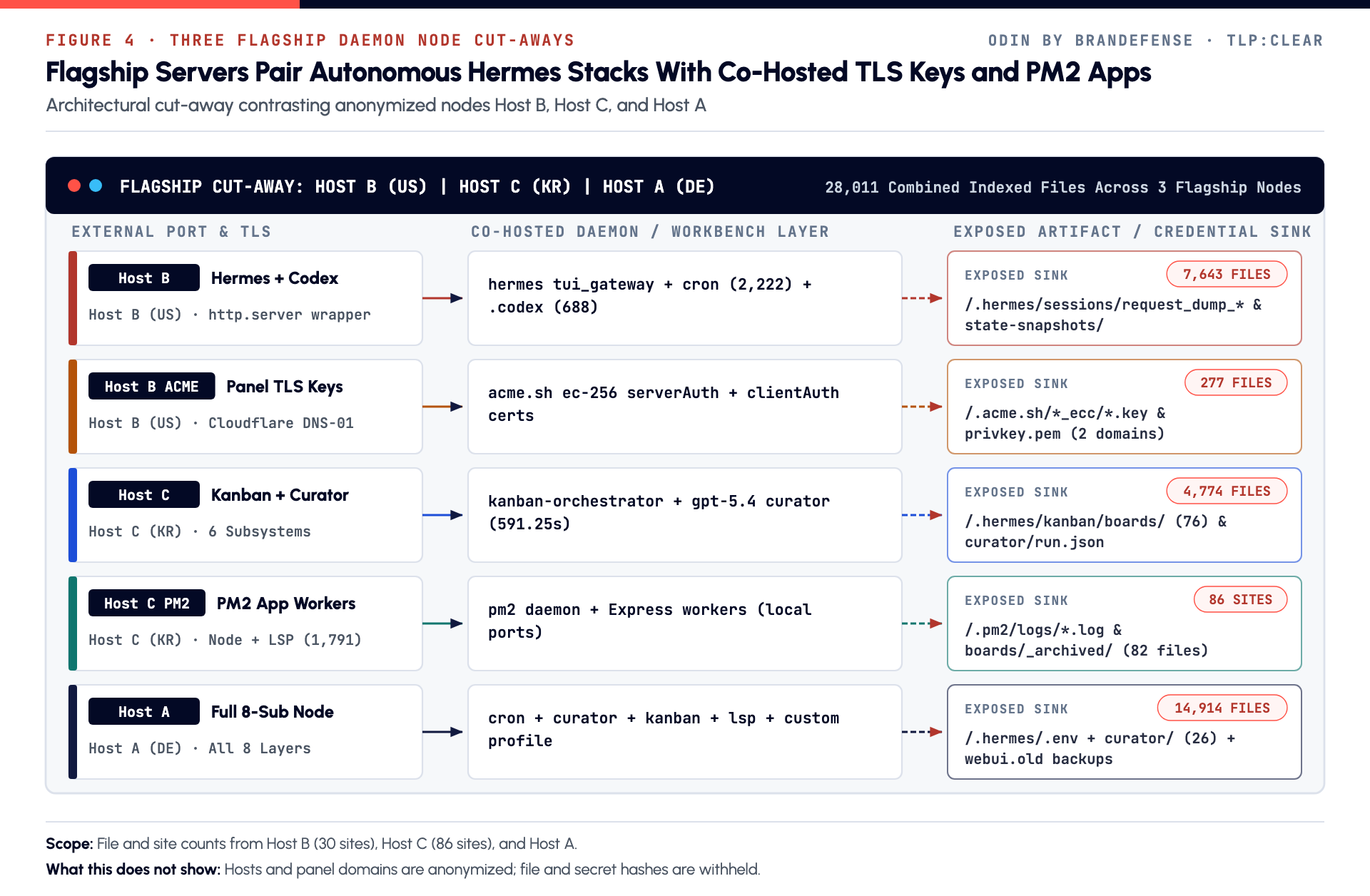
Language servers on seven hosts
Seven hosts stage ~/.hermes/lsp/, a headless Language Server Protocol toolchain. On the Korean server it holds 1,791 files. It lets the agent navigate and refactor code across services on the same machine. A US server also carries lsp/package.json.
The US server: Hermes, Codex and ACME keys under one root
The US virtual server (Host B) exposes 30 open-directory sites. A retry dump dated May 2026 contains a ps aux listing captured by the agent's own terminal tool. It shows a bash login shell that changed into /root and started a Python script importing http.server.
That script served a generated analytics dashboard from /root on a high TCP port. Because http.server has no path limits, it served everything else in /root too. The files cannot tell us whether the owner or the agent started the listener.
| Exposed folder | Files | What it holds |
|---|---|---|
/.hermes/ | 7,643 | 2,222 Cron files with jobs.json, kanban.db (114,688 bytes), runtime_router.py, .env (23,252 bytes), retry dumps and a pre-update snapshot |
/ and /backups/ | 6,258 | 5,974 root files plus 284 backup files, including a recovery archive and project archives |
/.codex/ | 688 | OpenAI Codex CLI: logs_2.sqlite-wal (4.19 MB), shell snapshots, sessions and sandbox binaries |
/.acme.sh/ | 277 | 169 DNS API hooks, 26 notification scripts and two ECDSA ec-256 certificate folders |
Panel domain 2 _ecc/ | 10 | Private key (227 bytes), privkey.pem, backup/key.bak, fullchain.cer and a .conf with Le_Webroot='dns_cf' |
Panel domain 1 _ecc/ | 6 | Private key, seen on 18 November 2026 |
The certificate request config for the second domain sets extendedKeyUsage=serverAuth,clientAuth. Both certificates were issued through Cloudflare DNS-01 validation (dns_cf). Anyone holding these keys could impersonate the two web panels until the certificates are revoked.
The folders share a root, but that is all the files show. They do not tell us whether the agent managed the panels, or who runs the server.
The Korean server: Kanban, Curator and PM2
The Korean server exposes 86 open-directory sites and 4,774 files across six Hermes subsystems.
| Component | Files | Note |
|---|---|---|
| Active Kanban board | 76 | Includes the 258,048-byte kanban.db |
| Archived boards | 82 | Worker folders and logs |
lsp/ | 1,791 | Language server runtime |
node/lib/ | 1,779 | Node.js modules, including the Claude Code CLI wrapper |
| Curator runs | 2 folders | Includes the run described in Chapter 4 |
/.pm2/ | 17 | PM2 logs, including dashboard-error.log, for Node and Express workers bound locally |
| Application folder | 7 | Name withheld |
/.hermes/.env | 1 | Holds a Discord bot token |
Multi-profile servers
A third US server (Host F) lists 8,440 files across four subsystems: curator, logs, lsp and skills. It runs separate bot profiles under profiles/<name>/.env. One profile holds a DeepSeek API key and a Telegram bot token. A Chinese server shows the same profile layout.
6. Separating Real Daemons From Skill Mirrors
In short
Skill folders are the most common path but the weakest signal. Logs and Curator runs mark a working daemon; task boards, schedules, dumps and keys mark a host that needs action.
Why skills inflate the count
The skills/ folder makes up 499 of 1,100 entries (45.4%) and appears on 68 hosts. Much of it is bundled open-source documentation. Some bundled docs contain example strings that look like secrets, such as localhost REST examples. Alerting on every /.hermes/ path would flood analysts with this material.
Logs (57 hosts) and Curator runs (41 hosts) are better markers of a running daemon. Task boards, Cron files, retry dumps and private keys are the paths that call for containment.
The verified secret findings
Eleven secret findings are verified against the original files. They hold 10 distinct values, because one private key appears in two files. All 11 are real exposures; none is a test fixture.
| Type | Count |
|---|---|
| TLS private keys | 3 |
| Telegram bot tokens | 2 |
| Callback endpoint strings | 2 |
| Anthropic API key | 1 |
| DeepSeek API key | 1 |
| Discord bot token | 1 |
| Pastebin drop link | 1 |
Seven of the 11 are application or corporate secrets: the three key files, root .env files and a profile token. Four come from agent session files: request dumps, snapshot .env files and Cron output. This is a verified sample, not a census. We do not claim a ratio of real secrets to fixtures.
Four kinds of host (analytical model)
The table below is our analytical model. It groups the 87 hosts by what their files show. The files record what was on disk, not what the owner intended.
| Model group | Hosts | Share | What the files show | Suggested response |
|---|---|---|---|---|
| H1: Static skills or minimal config | 25 | 28.7% | 19 hosts expose only skills/ (one lists 11,899 static files); 6 expose root .env or auth.json without logs | Suppress skill hits; review only if .env or auth.json is exposed |
| H2: Active gateway with logs or memory | 15 | 17.2% | logs/ or memories/ next to skills/, but no Curator, Kanban or Cron | Rotate exposed model and bot keys; close the listener |
| H3: Self-directed workflow daemon | 46 | 52.9% | 32 Curator or snapshot hosts plus 14 multi-subsystem Kanban, Cron or language-server hosts | Check egress for unsanctioned automation; purge snapshots and dumps when rotating keys |
| H4: Daemon plus co-hosted web-panel keys | 1 | 1.1% | The US server with 7,643 Hermes files, 2,222 Cron files, Codex and two ACME key folders | Revoke the TLS certificates and bot tokens; move acme.sh out of /root |
H3 and H4 together are the 47 hosts with background subsystems.
Other explanations to weigh
Three explanations apply across all four groups. None of them points to an attack.
- Authorized testing. Some hosts stage
skills/red-teaming/playbooks next to normal developer tools. Offensive skill templates inside a bundled skill tree fit an authorized test bench or a default checkout. They do not show intrusion activity. - Research benches. Heavy Curator use (41 hosts) and Kanban use (4 hosts), including the multi-profile servers, fit engineering teams or labs testing unattended agent memory and task splitting.
- Decoys and unconfigured mirrors. Some of the 25 static H1 hosts may be decoys or unused mirrors that attract scanners.
Across all groups, the files record past runs and local configuration. They do not show attacks on third-party networks.
7. What Defenders Should Do
Within 24 hours
- Deny hidden-folder URIs at the web edge (Nginx, Caddy, Apache, CDN). Requests for
/.hermes,/.acme.sh,/.pm2and/.codexshould return 403 or 404, withautoindex off. - Find and stop non-loopback
python3 -m http.serverprocesses, or scripts that importhttp.server, running in/rootor/home/. Local previews must use--bind 127.0.0.1. - If you find your own host in this pattern, revoke any TLS certificate whose key sat in an exposed
acme.shfolder.
Within 72 hours
- Move
acme.shkeys out of home folders, for example with--cert-home /etc/ssl/acme, and setchmod 600. - Each time you rotate a model, Telegram or Discord token, also delete
sessions/request_dump_*.json,state-snapshots/*-pre-update/.envand.env.bak.*. - Review
himalayamail credentials, and the permissions of anyclaude-codeorcodexsub-process, on shared hosts.
Within 7 to 30 days
- Register every unattended agent Cron job and Kanban board as a service account. Give it token spend caps and an egress allowlist.
- Deploy the Suricata signatures 9516001 to 9516010 and check that 9516005 excludes
/skills/. - Compare internal vault entries against exposed-secret alerts, and check certificate transparency logs for unexpected certificates on your panel domains.
8. Detection Rules
The full rules are in the Detection rules tab. Each rule excludes the bundled Hermes skills folder or loopback traffic, so static mirrors and local previews do not fire.
| Rule file | What it catches |
|---|---|
odin_hermes_daemon_and_panel_exposure.rules | Suricata 7: ten signatures for requests to Hermes daemon paths and acme.sh keys, and for responses that deliver keys, configs, dumps or directory listings |
sentinel_unattended_ai_daemon_cron_and_acme_leak.kql | Microsoft Sentinel and Defender XDR: open file-server commands, writes to daemon and key files, unattended Hermes processes, and listeners on daemon ports |
sigma_hermes_autonomous_agent_cron_and_daemon.yml | Sigma (3 rules): Hermes gateway and Curator processes, web servers returning daemon files or keys, and ad-hoc file servers in dotfile paths |
odin_hermes_kanban_curator_and_request_dumps.yar | YARA (4 rules): Curator run files, retry dumps and crash logs, Kanban and Cron stores, and ACME key material |
How the Suricata signatures work
Signatures 9516001 to 9516006 watch requests. Each one sets a flowbit. Signatures 9516007 to 9516009 only fire on a 200 response in a flow where that flowbit is set. Suricata 7.0 or later is needed, with the http.uri, http.stat_code and file.data buffers.
| SID | Looks for | Why |
|---|---|---|
| 9516001 | GET for /.hermes/kanban with /boards/, kanban.db or /workspaces/t_<hex> | Task board and worker folders (T1213) |
| 9516002 | GET for /.hermes/cron/ with jobs.json, executions.db, .tick.lock or /output/ | Scheduler jobs and output (T1213) |
| 9516003 | GET for /.hermes/logs/curator/ with run.json, REPORT.md or a dated run folder | Curator runs (T1213) |
| 9516004 | GET for request_dump_*.json under /.hermes/sessions/ | Retry dumps with bearer headers (T1552.001) |
| 9516005 | GET under /.hermes/ for state-snapshots/, a profile auth.json or .env, or tui_gateway_crash.log, excluding /skills/ | Snapshot and profile secrets (T1552.001) |
| 9516006 | GET under /.acme.sh/ for .key, privkey.pem, key.bak or an _ecc .conf | Certificate keys and DNS-01 configs (T1552.004) |
| 9516007 | 200 response body with -----BEGIN ... PRIVATE KEY----- | A private key was actually served |
| 9516008 | 200 response body with Le_RealKeyPath= and Le_Webroot= or Le_Keylength= | An acme.sh domain config was served |
| 9516009 | 200 response body with Hermes Agent Persona and max_retries_exhausted or upstream_timeout | A retry dump was served |
| 9516010 | 200 listing (Index of / or Directory listing for /) that links to .hermes/ or .acme.sh/ | An open directory exposing either folder |
Suppress your own authorized attack-surface scanners by exact source address in threshold.conf, not by CIDR ranges.
How the other rules work
The KQL query has four branches and a 14-day lookback. Results are grouped per device and day, and device-days with two or more distinct signals come first.
| Branch | Looks for |
|---|---|
| Process | http.server, SimpleHTTPServer, http-server, npx serve or miniserve started from /root, /home/, .hermes or .acme.sh, without a loopback bind |
| File | Files created, changed or renamed under .hermes daemon folders or acme.sh .key files |
| Daemon | tui_gateway/entry.py, runtime_router.py, hermes curator or kanban-orchestrator, or a Hermes parent that starts himalaya or acme.sh |
| Network | A web-server process listening on a daemon port (for example 8080, 8899, 8765, 18080) on a non-loopback address, or accepting public connections |
The network branch matters because a custom wrapper script can import http.server without naming it on the command line. Fill the ApprovedInternalBuildHosts list with exact host names of sanctioned automation runners.
The three Sigma rules need Linux auditd and web access logs. The first flags Hermes gateway, router and Curator processes, excluding pytest. The second flags a web server returning 200 for daemon files or acme.sh key files; check cs-username to confirm anonymous access. The third flags non-loopback file servers or root Python wrappers in dotfile paths.
| YARA rule | Fires on |
|---|---|
ODIN_Hermes_Curator_Distillation_Run_And_Report | Curator run.json and REPORT.md content |
ODIN_Hermes_Request_Dump_And_Gateway_Crash | Retry dumps and gateway crash logs |
ODIN_Hermes_Kanban_Board_And_Cron_Scheduler | Kanban SQLite databases and Cron job stores |
ODIN_Cohosted_Panel_ACME_TLS_Material | acme.sh key and config files |
Each YARA rule is limited to files under 20 MB and needs YARA 4.3 or later.
| What triage sees | Action |
|---|---|
| Listener bound to loopback only | Ignore: local development |
Only skills/ or node_modules/ paths | Compare with the upstream package before closing |
Gateway logs or a root .env | Review and rotate keys |
| Any Kanban, Cron, Curator or retry-dump path | Treat as an unattended daemon exposure |
Daemon paths plus an exposed acme.sh .key or private key | Most urgent: revoke certificates and tokens |
Every rule file loads without errors in its engine (Suricata 7.0.12, YARA-X, pySigma, Kusto.Language); the rules were not replayed against live traffic. Their logic was checked in Python against sample files and negative controls. Load and test each rule in staging before production use.
9. Indicators
No indicator from this study is published as a value. All 28 point to exposed owners, not to attackers.
| Type | Count | Status |
|---|---|---|
| Flagship exposed Hermes hosts (Hosts A to F) | 6 | Withheld: exposed owners |
| Co-hosted web-panel domains | 2 | Withheld: exposed owners |
| File hashes of exposed key, database, Cron, Curator, dump and crash-log files | 10 | Withheld: owners' files |
| Hashes of exposed secret values | 10 | Withheld: secret material |
Host G and the other labelled hosts appear in the text but are not counted as indicators.
Withheld: all host addresses and ports, both panel domains, board, job, profile and script names, and every file or secret-value hash.
What to hunt for instead
The patterns below are stable across installs and safe to publish.
| Pattern | Where to look | Typical size |
|---|---|---|
/.hermes/kanban.db, kanban/boards/<slug>/kanban.db | Web logs, file scans | 114,688 to 258,048 bytes |
/.hermes/cron/jobs.json, cron/executions.db | Web logs, file scans | 12,048 and 24,576 bytes |
/.hermes/logs/curator/<run>/run.json, REPORT.md | Web logs, file scans | 34,236 and 8,294 bytes |
/.hermes/sessions/request_dump_*.json | Web logs, file scans | 87 to 256 KB |
/.hermes/logs/tui_gateway_crash.log | Web logs, file scans | 219,915 bytes |
/.hermes/state-snapshots/*-pre-update/.env, .env.bak.* | Web logs, file scans | 23,157 bytes for one backup |
/.acme.sh/*_ecc/*.key, privkey.pem, backup/key.bak | Web logs, file scans | 227 bytes for one key |
Directory listing for / or Index of / linking to .hermes/ | HTTP responses | n/a |
MITRE ATT&CK mapping
These techniques describe what an attacker could do with the exposed files. They do not mean the owners were attacked.
| Tactic | Technique | Exposure | Detection |
|---|---|---|---|
| Collection | T1213 Data from Information Repositories | Kanban boards, Cron stores and Curator runs readable over HTTP | SIDs 9516001 to 9516003, 9516010; Sigma rule 2 |
| Credential Access | T1552.001 Unsecured Credentials: Credentials In Files | Bearer headers in retry dumps; keys in .env, snapshots and backups | SIDs 9516004, 9516005, 9516009; YARA dump rule |
| Credential Access | T1552.004 Unsecured Credentials: Private Keys | acme.sh ECDSA keys for two web-panel domains | SIDs 9516006 to 9516008; YARA ACME rule |
10. Scope and Limits
- Window. The findings come from a two-week observation window ending 18 November 2026. Files on the exposed servers carry their own earlier dates. These include a retry dump dated May 2026 and a Curator run log dated 17 June 2026, both written by the agents themselves. Some servers were first listed before this window; no dates are given for those listings. They are file timestamps, not the span of our observation.
- A sample, not a census. The counts describe these hosts, not every Hermes install online.
- Files, not activity. Directory listings show what was stored on disk. They do not show running processes, intent, or whether a scheduled job ran at a given time.
- Owners are not attackers. All 87 hosts are exposed systems. Red-team skills on some hosts fit authorized testing as well as misuse.
- No downstream compromise shown. Nothing here shows a breach of the model providers, of the panel domains' users, or of any third-party network.
- Unknown listener origin. On the US server, the files cannot tell us whether a person or the agent started the file server.
- Verified secrets only. The 11 secret findings are those matched to original files. Other secrets may exist on these hosts.
- Rule testing. Every published rule file loads without errors in its engine (Suricata 7.0.12, YARA-X, pySigma and Microsoft's Kusto.Language analyzer, checked on 20 November 2026). The rules were not replayed against live traffic, so test and tune them in your own environment before production use.
11. Sources
- Nous Research. Hermes Agent documentation. https://hermes-agent.nousresearch.com/docs (verified 18 November 2026)
- Nous Research. hermes-agent repository. https://github.com/NousResearch/hermes-agent (verified 18 November 2026)
- acmesh-official. acme.sh repository. https://github.com/acmesh-official/acme.sh (verified 18 November 2026)
- PM2. Quick start and log management. https://pm2.keymetrics.io/docs/usage/quick-start/ (verified 18 November 2026)
- Pimalaya. Himalaya CLI email client. https://github.com/pimalaya/himalaya (verified 18 November 2026)
- MITRE ATT&CK. T1213 Data from Information Repositories. https://attack.mitre.org/techniques/T1213/ (verified 18 November 2026)
- MITRE ATT&CK. T1552.004 Unsecured Credentials: Private Keys. https://attack.mitre.org/techniques/T1552/004/ (verified 18 November 2026)
- Python Software Foundation.
http.serverdocumentation and security warning. https://docs.python.org/3/library/http.server.html (verified 18 November 2026)
What is…?
Short explanations of the tools and families named in this study.
What is Hermes Agent?
Hermes Agent is an open-source autonomous AI agent from Nous Research. It keeps sessions, profiles, skills and scheduled jobs in a .hermes folder.
More about Hermes AgentAI agentWhat is Claude Code?
Claude Code is Anthropic's command-line coding agent. It stores project sessions and settings in a .claude folder.
More about Claude CodeFrequently asked questions
What does an unattended agent leave behind?
Hermes keeps its state in a hidden ~/.hermes folder. On a busy install, that folder holds far more than chat history. One server in Germany exposes all eight subsystems in 14,914 files. Two old WebUI backups and 26 Curator entries show it has been upgraded and used for a long time.
How do keys end up on disk?
Three Hermes features keep secrets long after an owner thinks they are gone. On one US server, a user asked the agent to report its fallback model without showing any key. The upstream model then failed, and the gateway saved the full request, bearer header included, to disk.
Why does one open folder expose the whole server?
Most of these servers run a simple HTTP server on a high port: 38 of the 87 use 8080. When that server starts in /root, it serves everything next to .hermes as well.
Is every exposed Hermes folder a problem?
No. The skills folder is the most common path, at 499 of 1,100 directory entries. Much of it is bundled documentation. Our analytical model puts 25 hosts (28.7%) in a static group with only skills or a minimal config.