


Key takeaways
- Odin found 87 servers exposing Hermes Agent folders over open HTTP.
- 47 of them (54.0%) show unattended automation, not interactive chats.
- Failed model requests are saved to disk with the bearer header inside.
- One open file server also exposed TLS private keys for two web panels.
- Bind file servers to loopback, move certificate keys, and purge dumps on key rotation.
In a two-week observation window ending 18 November 2026, Odin by Brandefense reviewed 87 servers that expose a Hermes Agent folder over plain HTTP. Hermes is an open-source AI agent that can run as a background service. On 47 of these servers (54.0%), the exposed files show schedules, task boards and self-maintaining skill libraries running without a person at the keyboard. Several also hold API keys, bot tokens and, in one case, TLS private keys. For defenders, this is a new kind of exposure: a service account that writes its own secrets to disk.
All 87 servers belong to users who left a directory listing open. They are victims of their own configuration, not attacker infrastructure. We withhold every address, domain and secret.
What does an unattended agent leave behind?
Hermes keeps its state in a hidden ~/.hermes folder. On a busy install, that folder holds far more than chat history.
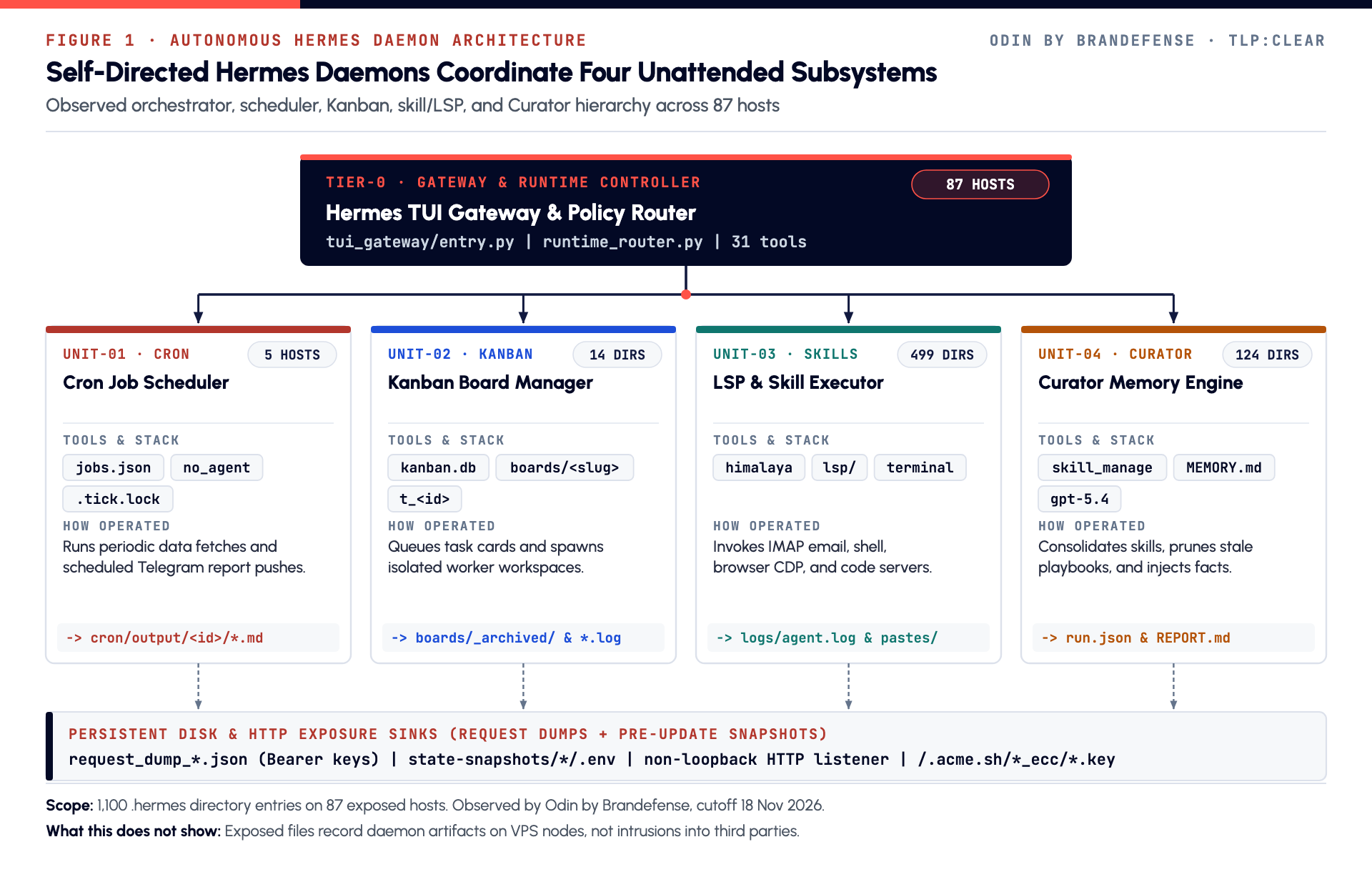
| Subsystem | What it does | Hosts (of 87) |
|---|---|---|
| Skills library | Playbooks the agent follows, plus bundled docs | 68 |
| Logs | Gateway and agent logs | 57 |
| Curator | The agent reviews, merges and archives its own skills | 41 |
| Language server | Code navigation across the machine | 7 |
| State snapshots | Copies of .env and config taken before each upgrade | 6 |
| Cron scheduler | Timed scripts and model briefings sent to Telegram | 5 |
| Kanban boards | Task cards handed to isolated worker agents | 4 |
One server in Germany exposes all eight subsystems in 14,914 files. Two old WebUI backups and 26 Curator entries show it has been upgraded and used for a long time.
On a Korean server, one Curator run took 591 seconds. The agent made 90 tool calls, including 12 shell commands, and cut its skills from 68 to 42. Nobody prompted it. This is ordinary housekeeping, but it shows how much an unattended agent does on its own.
The agent's toolset explains why this matters. Hermes registers 31 tools, including a shell, a headless browser, a scheduler and a message sender. An agent with those tools can run commands on a timer and post the results to a chat bot. Some installs also hand coding work to Claude Code or OpenAI Codex, or read and send email through a terminal mail client.
How do keys end up on disk?
Three Hermes features keep secrets long after an owner thinks they are gone.
- Retry dumps. When the model provider returns a temporary error, Hermes saves the whole failed request. That file holds the bearer header, the agent's persona and memory, and its 31 tool definitions. One dump was 256,668 bytes.
- Upgrade snapshots. Before each update, Hermes copies
.envandconfig.yamlinto a snapshot folder. Older Anthropic, OpenRouter, Telegram and Discord keys stay there. - Config backups. Edits leave
.env.bakandconfig.yaml.bakfiles behind, each a full plaintext copy.
On one US server, a user asked the agent to report its fallback model without showing any key. The upstream model then failed, and the gateway saved the full request, bearer header included, to disk.
We verified 11 secret findings across these hosts. They include 3 TLS private keys, 2 Telegram bot tokens, and one key each for Anthropic, DeepSeek and Discord.
The lesson is simple. Rotating a key is not enough. The dumps, snapshots and backups must be deleted too.
Why does one open folder expose the whole server?
Most of these servers run a simple HTTP server on a high port: 38 of the 87 use 8080. When that server starts in /root, it serves everything next to .hermes as well.
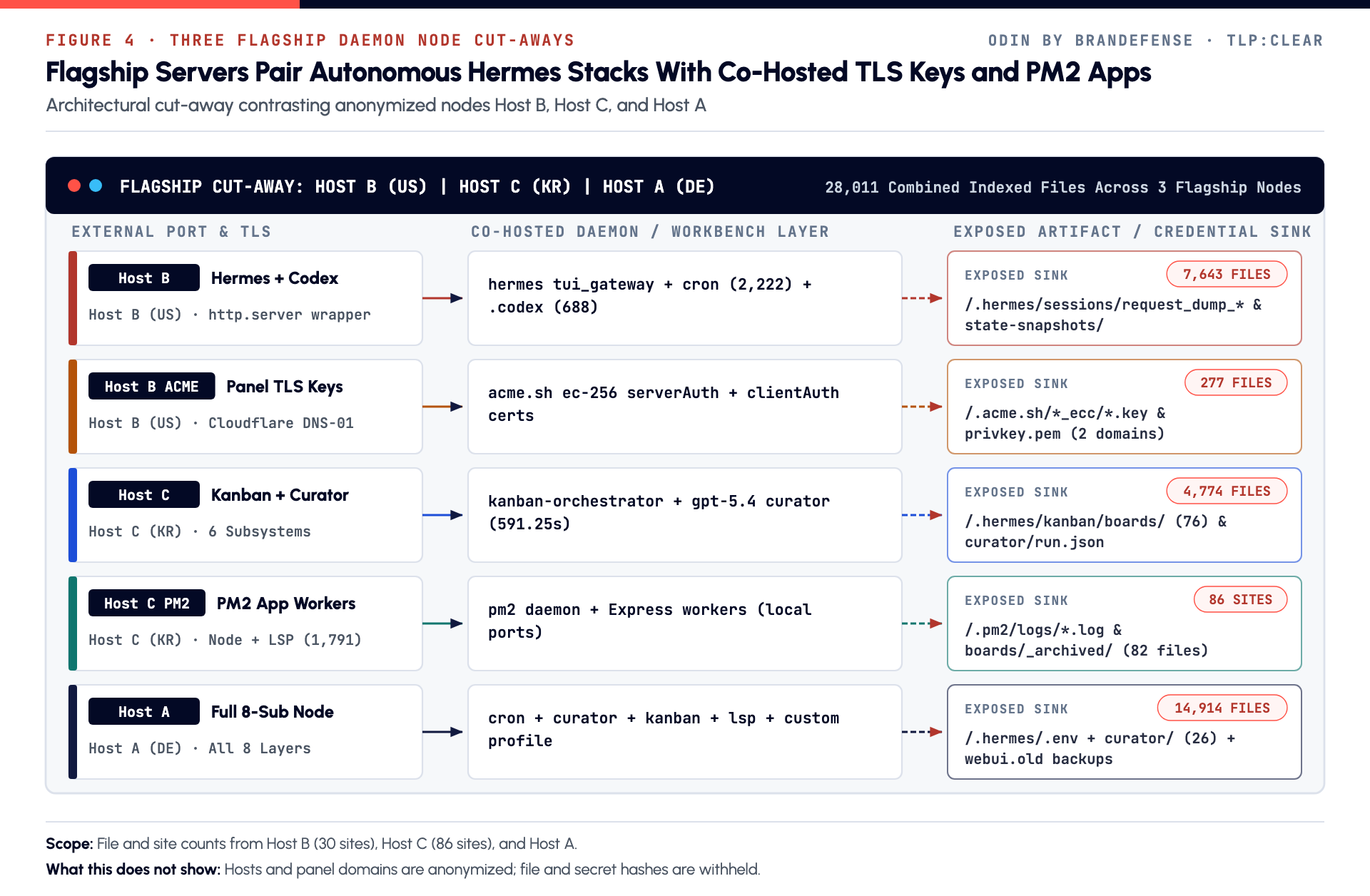
On the US server, a Python script started in /root to show a dashboard. It exposed 7,643 Hermes files, 2,222 scheduler files, an OpenAI Codex install with 688 files, and backups. It also exposed 277 certificate files from acme.sh. Among them were the ECDSA private keys for two web-panel domains. Anyone with those keys could pose as the panels until the certificates are revoked.
The files cannot tell us whether a person or the agent started that file server. Either way, the result was the same.
Is every exposed Hermes folder a problem?
No. The skills folder is the most common path, at 499 of 1,100 directory entries. Much of it is bundled documentation. Our analytical model puts 25 hosts (28.7%) in a static group with only skills or a minimal config.
Logs (57 hosts) and Curator runs (41 hosts) are better signs of a working agent. The hosts that need action show task databases, schedules, retry dumps or private keys. Some hosts also carry red-team skill templates. These fit authorized testing or research benches as well as misuse, and nothing here shows an attack on a third party.
What to do now
- Bind to loopback. Stop any
http.serveror similar listener in/rootor/homethat is not bound to127.0.0.1, and deny/.hermesand/.acme.shat the web edge. - Move certificate keys. Keep
acme.shkeys outside home folders, readable only by their owner. Revoke any certificate whose key was exposed. - Purge on rotation. When you rotate a model or bot token, delete request dumps, pre-update snapshots and
.envbackups too. - Govern unattended agents. Register scheduled agent jobs and task boards as service accounts, with egress allowlists and short-lived tokens.
- Deploy the rules. The full report's Detection rules tab has Suricata, Sentinel KQL, Sigma and YARA rules that skip bundled skill folders.
The full report covers the subsystems, file sizes, rule logic and hunting patterns in detail.
What is…?
Short explanations of the tools and families named in this study.
What is Hermes Agent?
Hermes Agent is an open-source autonomous AI agent from Nous Research. It keeps sessions, profiles, skills and scheduled jobs in a .hermes folder.
More about Hermes AgentAI agentWhat is Claude Code?
Claude Code is Anthropic's command-line coding agent. It stores project sessions and settings in a .claude folder.
More about Claude CodeFrequently asked questions
What does an unattended agent leave behind?
Hermes keeps its state in a hidden ~/.hermes folder. On a busy install, that folder holds far more than chat history. One server in Germany exposes all eight subsystems in 14,914 files. Two old WebUI backups and 26 Curator entries show it has been upgraded and used for a long time.
How do keys end up on disk?
Three Hermes features keep secrets long after an owner thinks they are gone. On one US server, a user asked the agent to report its fallback model without showing any key. The upstream model then failed, and the gateway saved the full request, bearer header included, to disk.
Why does one open folder expose the whole server?
Most of these servers run a simple HTTP server on a high port: 38 of the 87 use 8080. When that server starts in /root, it serves everything next to .hermes as well.
Is every exposed Hermes folder a problem?
No. The skills folder is the most common path, at 499 of 1,100 directory entries. Much of it is bundled documentation. Our analytical model puts 25 hosts (28.7%) in a static group with only skills or a minimal config.