


Key takeaways
- Odin mapped 1,794 out-of-band callback endpoints; 757 are confirmed or suspected nodes.
- Most callback servers are dual-use testing tools, so a listener alone is not a threat.
- 18 hosts put a callback listener on the same IP as another offensive framework.
- Four unlinked offensive services sat in one Alibaba Cloud subnet.
- Stop internal servers from calling the internet directly and route their DNS through Protective DNS.
In a two-week observation window ending 18 November 2026, Odin by Brandefense mapped 1,794 out-of-band callback endpoints on 1,052 hosts. These servers help testers, and attackers, confirm bugs that give no visible answer. Of the 1,794, 757 are confirmed or suspected Interactsh, Burp Collaborator, DNSLog and workbench nodes. Most are ordinary testing servers. A small group shares hosts with command-and-control tools, and one cloud subnet held four complementary offensive services on separate servers. For defenders, the lesson is about egress: these attacks only work if your servers can call out.
What is a callback server, and why should I care?
Some of the worst server bugs are silent. A blind server-side request forgery or a blind SQL injection runs in the back end and shows nothing in the web page. To confirm such a bug, the tester plants a unique address in the probe. If the target server looks up or fetches that address, a callback server logs it.
This approach is called Out-of-Band Application Security Testing (OAST). Three tools dominate: ProjectDiscovery's Interactsh, PortSwigger's Burp Collaborator and DNSLog. Each runs its own DNS name server and web listener, and often a mail listener too.
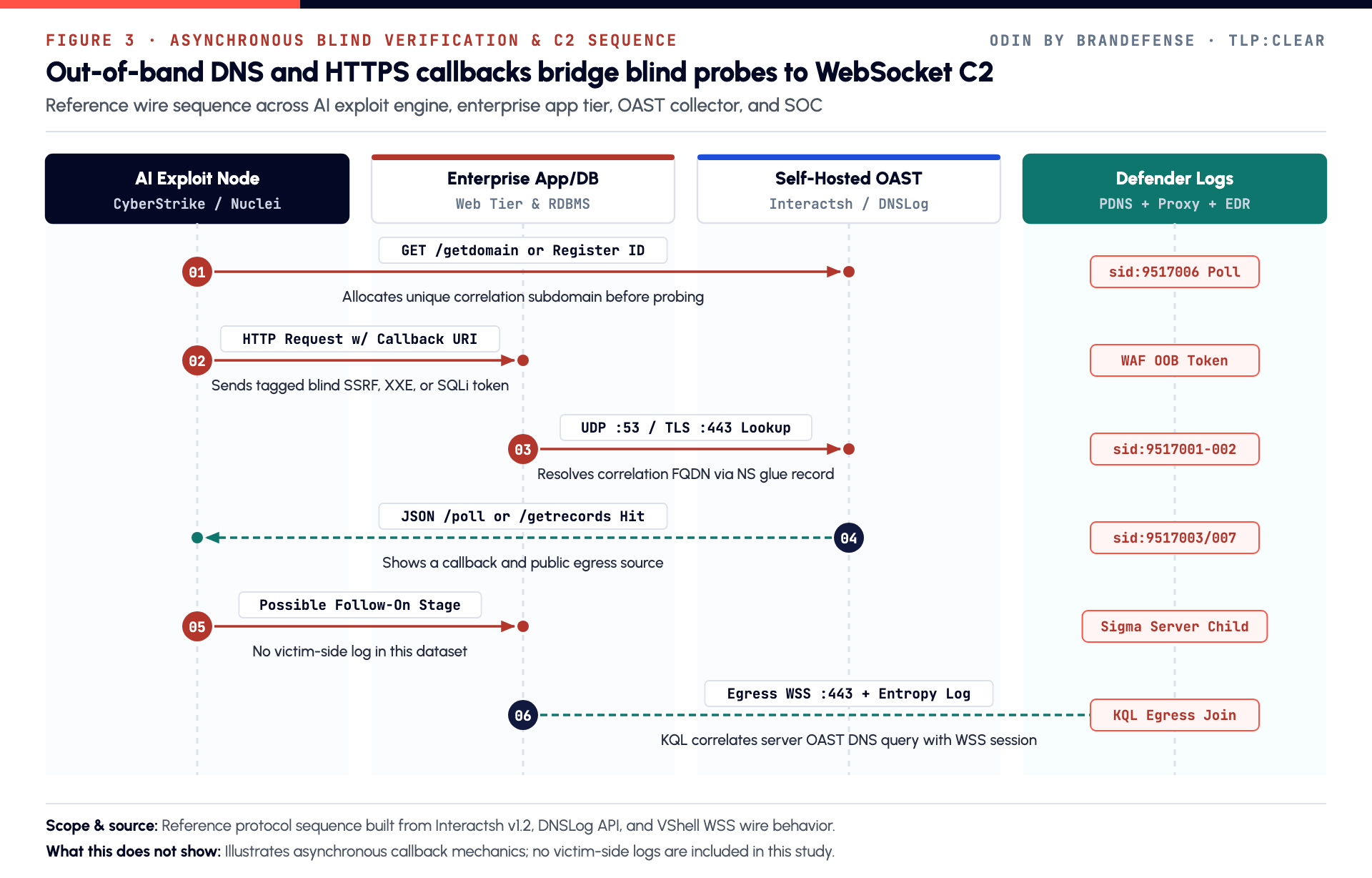
The callback has to leave your network. It goes out by DNS on port 53, HTTPS on 443 or mail on 465 and 587. That is the defender's opening. A database server has no reason to resolve a random label under oast[.]pro or dnslog[.]cn. If it does, someone is probing it.
| Platform | Endpoints | Confirmed or suspected | Where it runs |
|---|---|---|---|
| Interactsh | 1,245 | 638 | Mostly Amazon and DigitalOcean, United States and Germany |
| Burp Collaborator | 516 | 109 | Mostly Amazon and DigitalOcean, United States and Germany |
| DNSLog | 33 | 8 | Mostly Tencent and Alibaba, China and Hong Kong |
A further 356 AWS load-balancer endpoints echoed headers and only looked like callback servers. They are left out of every count.
Is every callback server a threat?
No. Contracted penetration testers and bug-bounty researchers run these tools every day. Blocking all of them would break legitimate work and add little.
The signal that matters is company. Across the fleet, 40 hosts expose several services. On 18 of them, a callback listener shares an IP with another offensive framework. Eight of those are corroborated. They sit next to Sliver, VShell, Cobalt Strike, ARTEX, the ARL reconnaissance panel or the ezXSS blind cross-site scripting manager.
We also looked at exposed web directories. They held 40 callback records. Eighteen sat on three confirmed offensive servers, inside Python DNS exfiltration scripts and Java exploit templates. These files show intent and tooling, not a working attack on any target.
Fifteen other records came from a different kind of host. A third-party web application had logged incoming scanner probes in a session file. That host is a likely target, not an attacker, so we withhold it and do not list it for blocking.
In the end, 9 of 28 selected indicators are ready to block. The rest go to watchlists or analyst review. That group includes standalone listeners, a consultancy's Collaborator server and five listeners on home broadband lines whose addresses change hands.
Hunters can still use the standalone servers. Interactsh servers often share one TLS fingerprint, and so do Burp Collaborator servers. Their response headers name the software outright. These traits help you spot a callback server in your own logs, even when you should not block it on sight.
What sat in one cloud range?
On 18 November 2026, Odin first observed four offensive services in Alibaba Cloud's 8.148.0.0/16 range, on four separate servers. They were a DNSLog callback collector, a VShell WebSocket C2 listener, a CyberStrikeAI engine and a HexStrikeAI tool bridge. Each covered a different role.
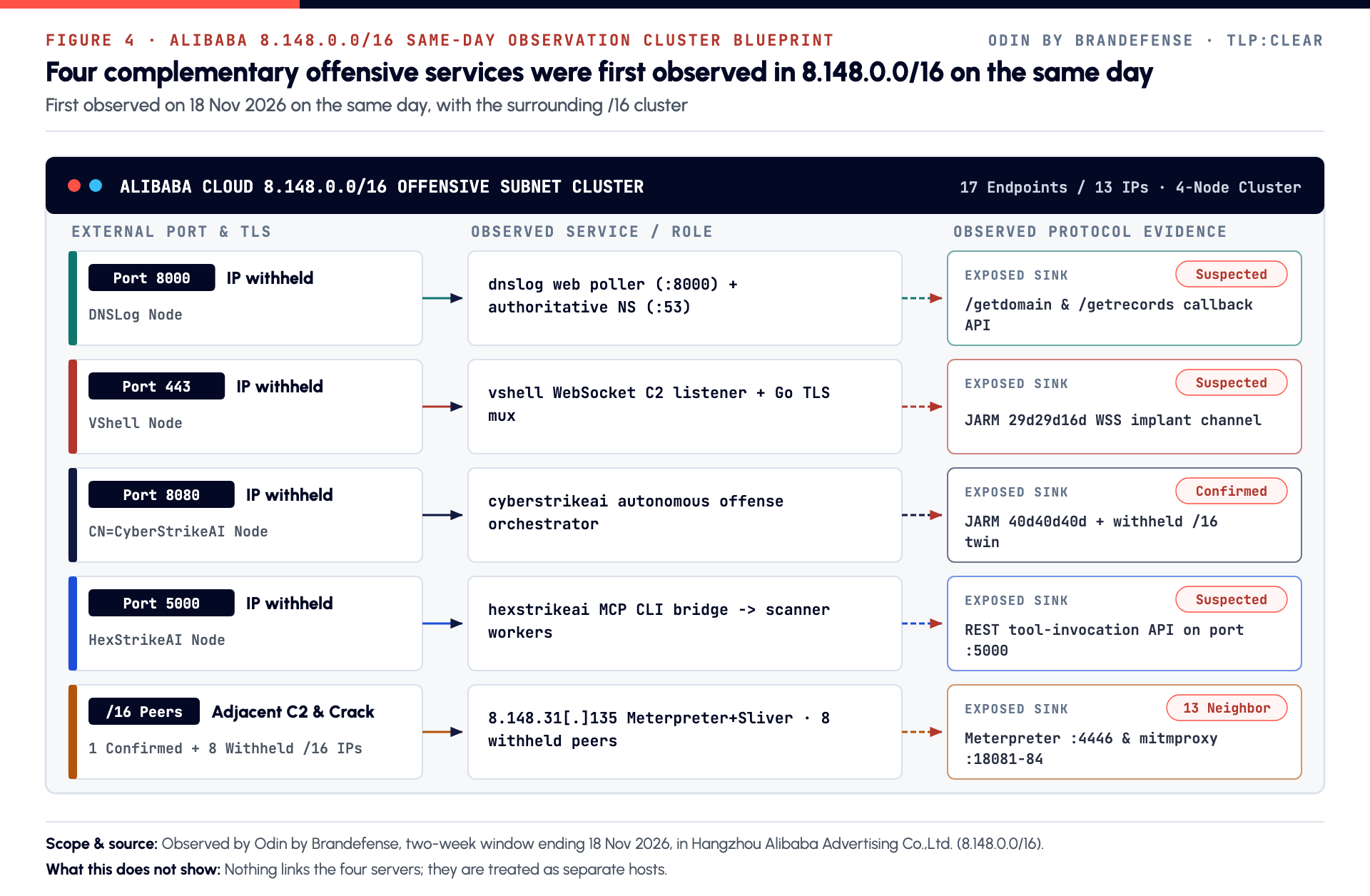
Together these roles could form one pipeline. An AI engine sends tagged probes. The callback collector shows which servers answered. The C2 listener stands ready for implants on those servers. Nothing we found links the four servers, so this pipeline is a model, not a finding.
We are careful here. First-seen times are not boot times, and we found no shared certificate or control link between the four servers. Busy cloud ranges also host many unrelated customers, including testers. So the four servers stay on the watchlist, not the block list.
The wider range holds 17 endpoints on 13 hosts. Only one has the same-host evidence for a block: 8.148.31[.]135, which runs a Metasploit Meterpreter listener alongside a Sliver listener.
What to do now
- Cut server egress. Block direct outbound DNS, HTTP, HTTPS, SMTP and LDAP from web, middleware and database subnets, except to explicit allowlists.
- Route server DNS through Protective DNS. Sinkhole
oast.*,interact[.]sh,oastify[.]com,burpcollaborator[.]netanddnslog[.]cn, and alert on random-looking 26 to 36 character labels. - Block only with evidence. Block the 9 block-ready endpoints in the full report's Indicators tab. Keep standalone listeners, subscriber lines and scanned targets on watchlists.
- Allowlist your own testers. Register approved scanner IPs and private callback domains before each test window, so real alerts stand out.
- Turn off database network functions such as
xp_dirtreeandUTL_HTTPwhere you do not need them.
The full report's Detection rules tab has Suricata, Sentinel KQL, Sigma and YARA rules. The full report covers the fingerprints, the workbench files and the rule logic in detail.
What is…?
Short explanations of the tools and families named in this study.
What is Interactsh?
Interactsh is ProjectDiscovery's open-source OAST server and client for catching DNS, HTTP and other callbacks.
More about InteractshOAST serviceWhat is DNSLog?
DNSLog is a family of open-source DNS callback collectors used to confirm blind injection and SSRF flaws.
More about DNSLogTechniqueWhat is OAST?
Out-of-band application security testing (OAST) detects blind vulnerabilities by making a target call back to a server the tester controls, usually over DNS or HTTP.
More about OASTOAST serviceWhat is Burp Collaborator?
Burp Collaborator is PortSwigger's callback service for Burp Suite, used to detect out-of-band vulnerabilities.
More about Burp CollaboratorRemote access implantWhat is VShell?
VShell is a remote access implant and C2 panel that talks over WebSocket and other transports. It is popular with Chinese-speaking operators.
More about VShellTechniqueWhat is JARM?
JARM is an open TLS server fingerprinting method from Salesforce. It hashes how a server answers a set of crafted TLS handshakes.
More about JARMFrequently asked questions
What is a callback server, and why should I care?
Some of the worst server bugs are silent. A blind server-side request forgery or a blind SQL injection runs in the back end and shows nothing in the web page. To confirm such a bug, the tester plants a unique address in the probe. If the target server looks up or fetches that address, a callback server logs it.
Is every callback server a threat?
No. Contracted penetration testers and bug-bounty researchers run these tools every day. Blocking all of them would break legitimate work and add little. The signal that matters is company. Across the fleet, 40 hosts expose several services. On 18 of them, a callback listener shares an IP with another offensive framework. Eight of those are corroborated.
What sat in one cloud range?
On 18 November 2026, Odin first observed four offensive services in Alibaba Cloud's 8.148.0.0/16 range, on four separate servers. They were a DNSLog callback collector, a VShell WebSocket C2 listener, a CyberStrikeAI engine and a HexStrikeAI tool bridge. Each covered a different role.