
Key takeaways
- One open server held four ADCS ESC8 relay logs, the largest 3.99 MB, beside a text file named for DCSync.
- A PHP kit whose file names split login, token checks and commands into small files, a layout that can slip past single-file scanners.
- A GoPhish tree with macro-enabled Word templates sat beside Adminer and a 616.6 MB archive.
- 1,166 dual-use scanner endpoints share no link with these servers; treat scanner banners as context, never as a block list.
Three open web servers exposed files named for ADCS certificate relay, a PHP webshell kit and GoPhish macro templates. Odin by Brandefense recorded their directory listings on 20 November 2026.
One holds logs named for attacks on Active Directory certificate services. One holds a small PHP webshell kit that appears to hide behind login tokens. One holds a phishing framework with macro-enabled Word templates.
None of these needs a new exploit. Each one targets a configuration that many organisations still run.
We also mapped 1,166 vulnerability scanner endpoints, which defenders can filter in a cyber threat intelligence platform. They show why a scanner banner is not, on its own, a sign of an attacker.
What do the ADCS relay logs show?
Active Directory Certificate Services (ADCS) can offer a web enrollment page. If that page accepts Windows NTLM logins over plain HTTP, an attacker inside the network can relay a machine's login to it.
The certificate authority may then issue a certificate in that machine's name. This is known as ESC8. With a domain controller's certificate, an attacker can move towards full directory replication rights.
A server in Moldova lists 276 files on a non-standard port, an exposure defenders can surface with external attack surface management. Four of them are relay logs whose names point to ESC8 attempts. The four files range from 619 bytes to 3.99 MB; file size alone does not establish run order or duration. Next to them sit a text file named for DCSync, a way to copy password data from a domain controller, and a small archive.
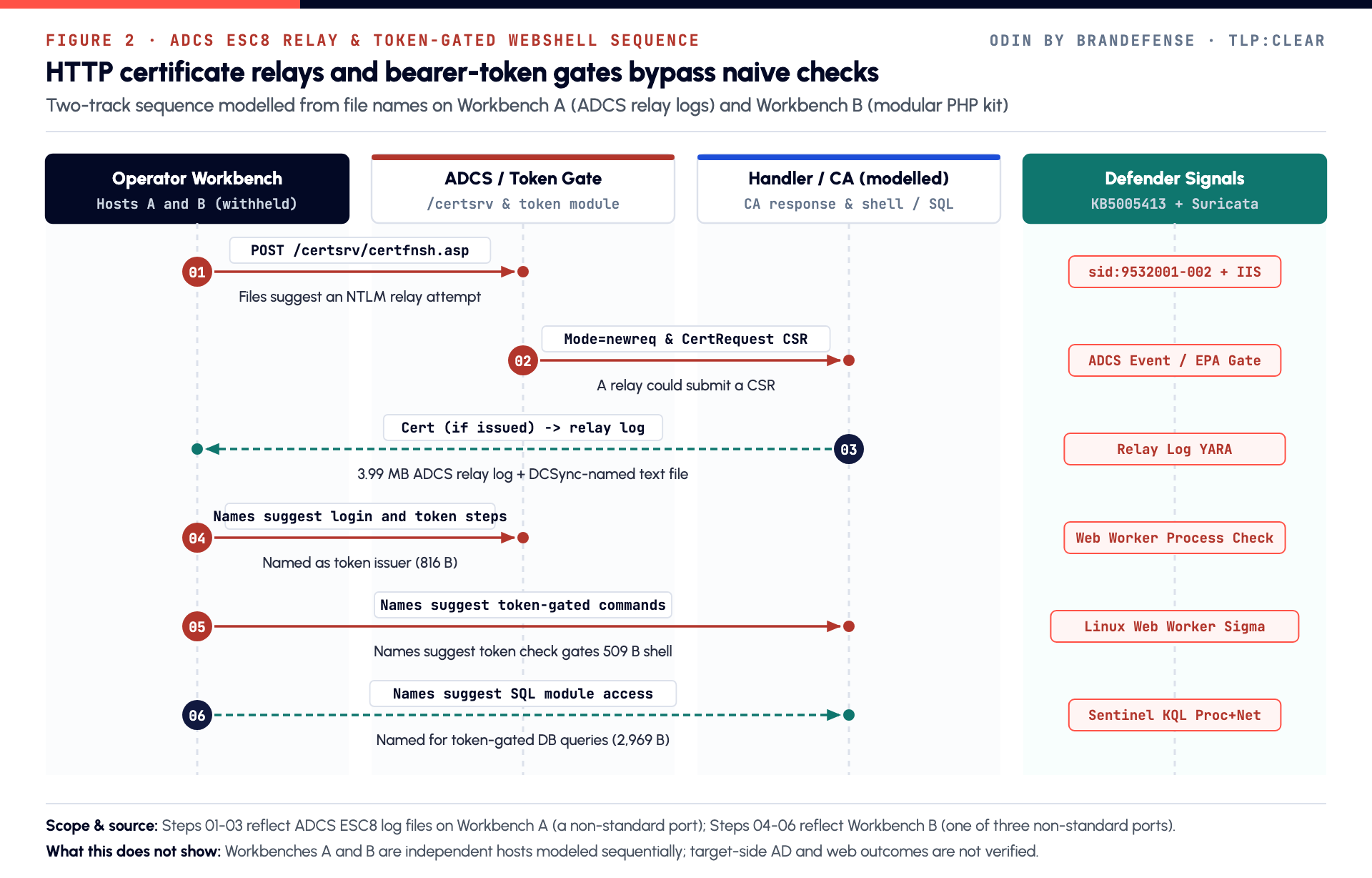
The same server shows a headless browser setup and 100 PNG screenshots. Repeated names and sizes suggest login-screen captures; image contents were not verified. Others are before-and-after pairs named for domain controller, command and Group Policy checks.
This could be an attacker's workbench or a penetration tester's evidence folder. Either way, relay logs on an open web server put credentials at risk. The fix is the same in both cases: remove HTTP enrollment where it is not needed. Elsewhere, require HTTPS with Extended Protection for Authentication, as Microsoft's KB5005413 describes.
How does the PHP kit avoid detection?
Many webshell scanners look for one large PHP file that does everything. A server in China takes a different approach.
It repeats an eight-file login and token core on three ports. We saw file names and sizes, not code. Going by the names, one file handles the operator's login, another issues a bearer token, and two more check that token.
The names suggest those checks guard a 509-byte command entry point and a small SQL module. Each file is small and looks harmless on its own. If the kit works as its names suggest, an outside scan without a token would see nothing unusual.
The kit also hides two 117-byte PHP files in folders meant for fonts and JavaScript. Their names look like Bootstrap and jQuery assets. They work only on servers that run every .php file anywhere in the web root. A larger 52 KB web manager, a 28-byte stager and a Base64 archive complete the set.
For defenders, the lesson is to watch behaviour. Alert when a PHP worker starts a shell or a database client. Turn off PHP in static folders. Do not wait for a single file to look malicious.
Why does a phishing tree next to Adminer matter?
A server in India serves the same 290 files on two web listeners. They include a GoPhish source tree in a folder whose name is withheld. The folder name uses a version above v0.12.1, the latest public GoPhish release, so this may be a renamed or modified copy. A custom Python module is named for directory sync; its behaviour was not verified.
GoPhish can take a macro-enabled Word file and fill in each recipient's name and tracking link. The macro itself stays the same.
Every recipient gets a file with a different hash, so hash blocking alone does not help. The template on this server is a public GoPhish test file. It shows what the tree can do, not that a campaign was sent.
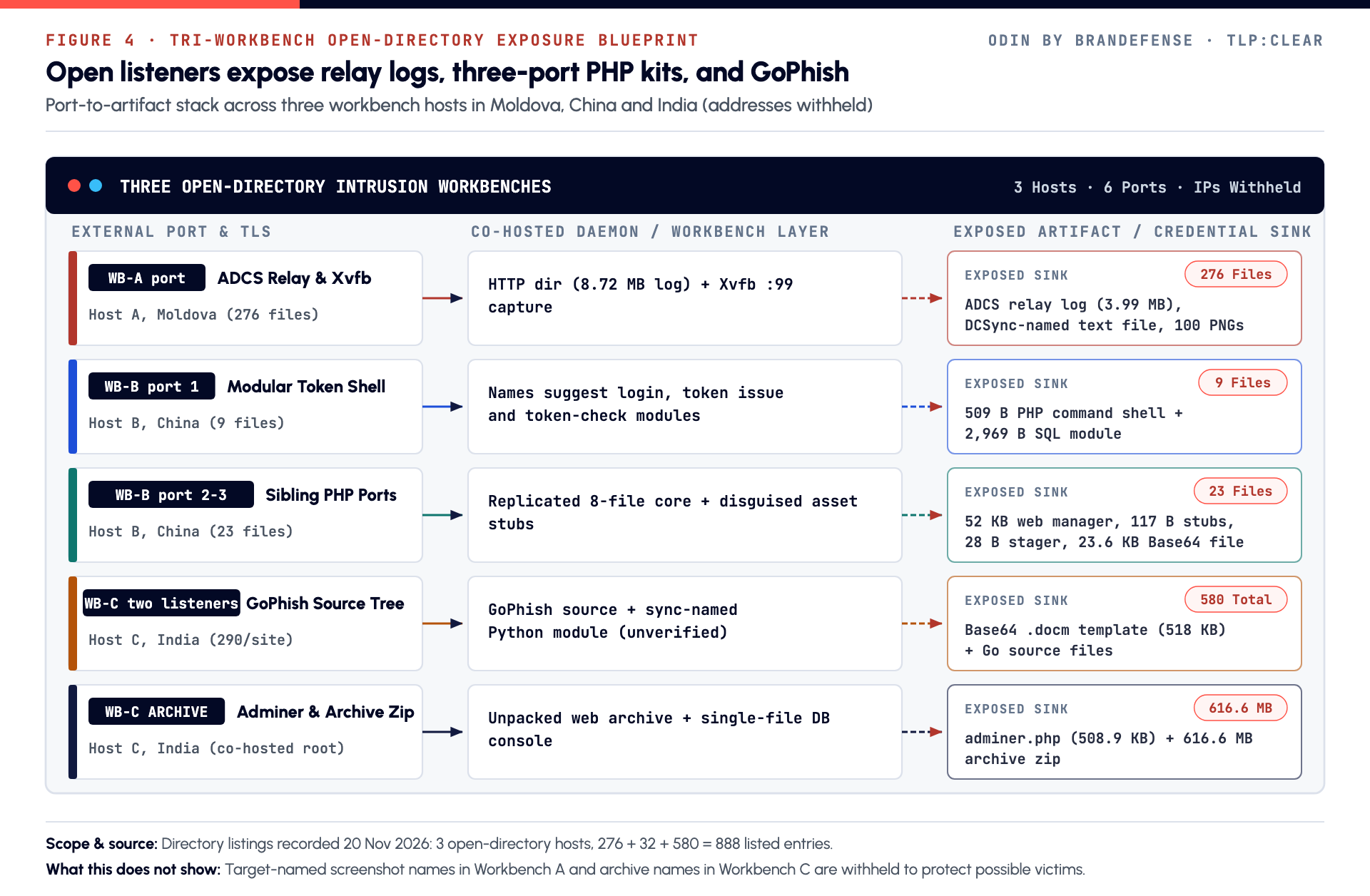
Beside the phishing tree sit a 616.6 MB archive and a single-file Adminer database console. Adminer is a legitimate tool.
An exposed copy next to a large archive is still a risk. The archive may be a backup, or it may be stolen data. Its name is withheld.
Should scanner addresses go on a block list?
No. We mapped 1,166 Nessus, Acunetix, OpenVAS and OWASP ZAP endpoints on 1,063 hosts. Most sit on large cloud providers such as Amazon Web Services, Contabo, OVH and Hetzner.
Nine sit on telecom networks that rotate customer addresses. Their TLS fingerprints match the products, not any operator.
No shared address, certificate or file links these scanners to the three workbenches. Security teams and auditors run the same consoles every day. Blocking them by address breaks legitimate work and adds little protection. Use them to add context to alerts instead.
We publish no host addresses, host-specific file names or file hashes for this research. None of the hosts is confirmed adversary infrastructure. Each workbench could also belong to a tester, a training provider or a victim. The detection rules and the behavioural and structural patterns in the full report are the useful part for defenders.
What to do now
- Remove ADCS HTTP Web Enrollment where you do not need it. Elsewhere, require HTTPS with Extended Protection for Authentication and enforce SMB and LDAP signing.
- Alert when PHP or web server workers start shells or database clients, and turn off PHP in static asset folders.
- Keep Microsoft's default block on macros in files from the internet, and quarantine inbound
.docmattachments from unknown senders. - Remove exposed Adminer consoles, backup archives and open directory listings from public and staging servers.
- Treat dual-use scanner feeds as context with a short expiry, never as a firewall block list.
What is…?
Short explanations of the tools and families named in this study.
What is GoPhish?
GoPhish is an open-source phishing simulation framework. Companies use it for awareness training and attackers use it for real campaigns.
More about GoPhishTechniqueWhat is DCSync?
DCSync abuses the Active Directory replication protocol to ask a domain controller for password hashes, as if the caller were another domain controller.
More about DCSyncTechniqueWhat is JARM?
JARM is an open TLS server fingerprinting method from Salesforce. It hashes how a server answers a set of crafted TLS handshakes.
More about JARMOffensive libraryWhat is Impacket?
Impacket is an open-source Python library for Windows network protocols. Its example scripts are widely used for lateral movement and credential theft.
More about ImpacketFrequently asked questions
What do the ADCS relay logs show?
Active Directory Certificate Services (ADCS) can offer a web enrollment page. If that page accepts Windows NTLM logins over plain HTTP, an attacker inside the network can relay a machine's login to it.
How does the PHP kit avoid detection?
Many webshell scanners look for one large PHP file that does everything. A server in China takes a different approach. It repeats an eight-file login and token core on three ports. We saw file names and sizes, not code. Going by the names, one file handles the operator's login, another issues a bearer token, and two more check that token.
Why does a phishing tree next to Adminer matter?
A server in India serves the same 290 files on two web listeners. They include a GoPhish source tree in a folder whose name is withheld. The folder name uses a version above v0.12.1, the latest public GoPhish release, so this may be a renamed or modified copy. A custom Python module is named for directory sync; its behaviour was not verified.
Should scanner addresses go on a block list?
No. We mapped 1,166 Nessus, Acunetix, OpenVAS and OWASP ZAP endpoints on 1,063 hosts. Most sit on large cloud providers such as Amazon Web Services, Contabo, OVH and Hetzner. Nine sit on telecom networks that rotate customer addresses. Their TLS fingerprints match the products, not any operator.