
1. Executive Summary
In short
On 20 November 2026, Odin by Brandefense recorded three open directories containing files associated with intrusion work. One holds Active Directory Certificate Services (ADCS) relay logs of up to 3.99 MB. One holds a small PHP webshell kit that appears to hide behind bearer tokens. One holds GoPhish macro templates next to an Adminer database console. We also mapped 1,166 dual-use scanner endpoints, which are context, not indicators. Enforce Extended Protection on ADCS web enrollment, watch PHP workers for shells, and block internet macros.
Enterprise intrusions rarely depend on custom malware at every step. Operators mix commercial scanners, public relay tools, small PHP kits and open-source phishing frameworks. Defenders, managed security providers and red teams use the same tools every day. This report separates what defenders can use with a cyber threat intelligence platform from what is only noise.
Scanner banners are context, not indicators.
We mapped 1,166 Nessus, Acunetix, OpenVAS and OWASP ZAP endpoints on 1,063 hosts. Most sit on major cloud providers, and nine sit on dynamic telecom networks. No shared address, certificate or file hash links them to the three workbenches.
Open directories hold ADCS ESC8 relay logs and a token-gated PHP kit.
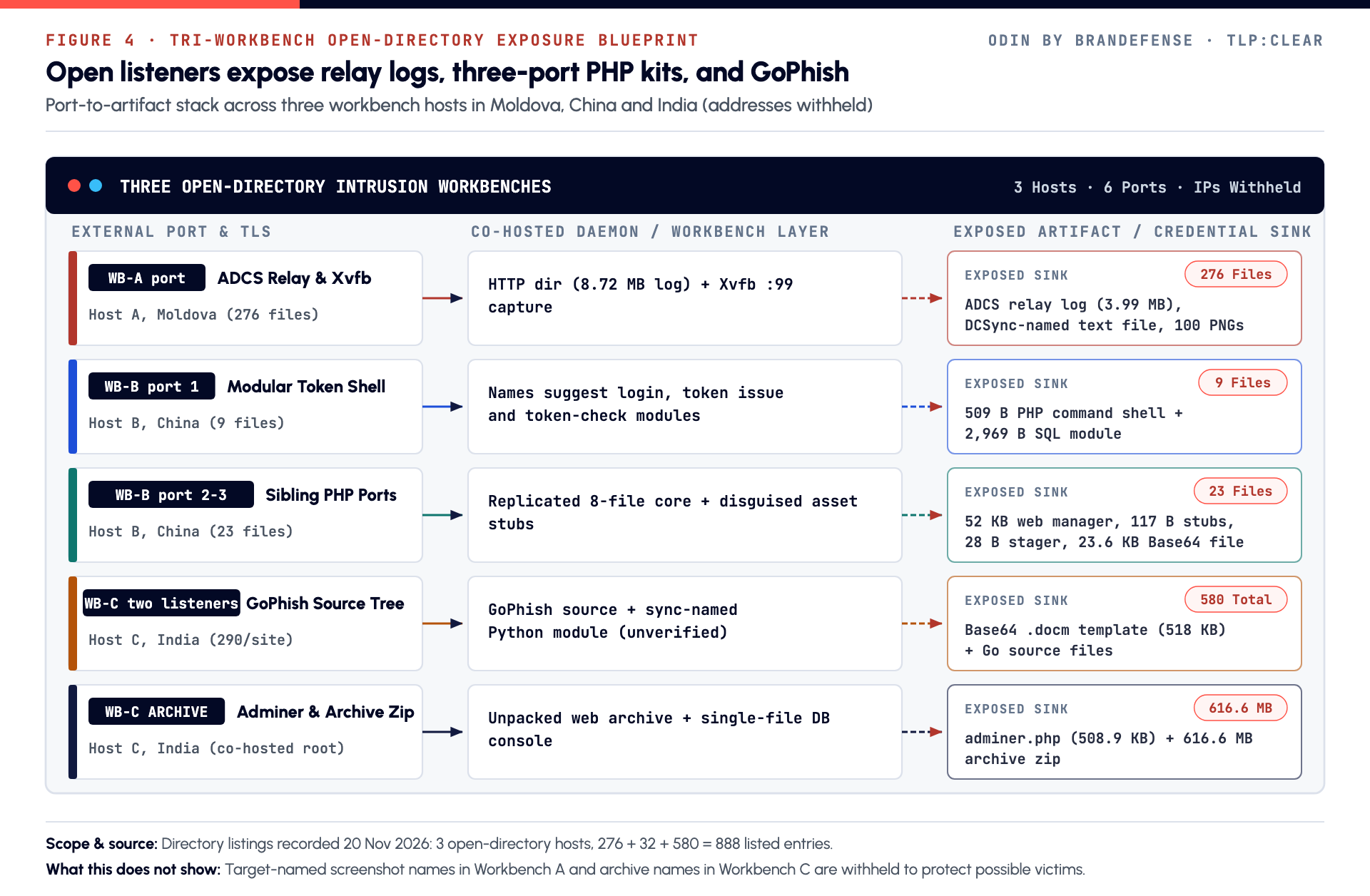
A server in Moldova lists 276 files, including four ADCS relay logs ranging from 619 bytes to 3.99 MB. A server in China repeats an eight-file PHP login and token core across three ports. Going by the file names, that core guards a 509-byte command entry point and hides 117-byte PHP stubs in asset folders.
A GoPhish source tree sits beside a large archive and Adminer.
A server in India mirrors 290 files across two web listeners, an exposure defenders can track with external attack surface management. They include a GoPhish source tree with Base64 macro-enabled Word templates, a sync-named Python service, a single-file Adminer console and a 616.6 MB archive.
Three Decisions for Leaders
- Close the ADCS HTTP relay path. Remove HTTP Web Enrollment where it is not needed. Elsewhere, require HTTPS with Extended Protection for Authentication, as Microsoft KB5005413 describes.
- Detect webshells by behaviour, not by one file. Alert when PHP workers start shells or database clients, turn off PHP in static asset folders, and remove unapproved Adminer consoles.
- Keep scanner banners out of block lists. Use them as enrichment. Put the effort into mail and endpoint controls: block macros in files from the internet and review inbound
.docmattachments.
The Study in Numbers
| Number | What it is |
|---|---|
| 1,166 | Dual-use scanner endpoints on 1,063 hosts (Nessus, Acunetix, OpenVAS, OWASP ZAP) |
| 0 | Shared addresses, certificates or file hashes between the scanners and the three workbenches |
| 3 | Open-directory workbenches, with 888 listed entries across six ports |
| 3.99 MB | Largest ADCS relay log (path withheld), among 276 files on the Moldovan server |
| 32 | Files in the token-gated PHP kit across three ports on the Chinese server |
| 290 | Files per listener in the GoPhish and Adminer tree on the Indian server (580 in total) |
| 9 | Detection rules: 3 Suricata, 3 Sigma, 2 YARA and 1 Sentinel KQL query |
How to use this report.
Security leaders can read Chapters 1, 6 and 7. Active Directory, Linux web and messaging teams should read Chapters 3 to 5 and Chapter 7. SOC and detection engineers should start with Chapters 8 and 9. CTI analysts will find the scanner and workbench detail in Chapters 2 to 5.
2. Dual-Use Scanners: Context, Not Indicators
In short
The 1,166 scanner endpoints run the same software that security teams run every day. None of them links to the three workbenches, so treat them as enrichment and never as a block list.
A vulnerability scanner banner tells you which product listens on a port. It does not tell you who owns the server or why. Many of these consoles belong to internal security teams, managed security providers and auditors. Blocking them by address breaks legitimate work and protects little.
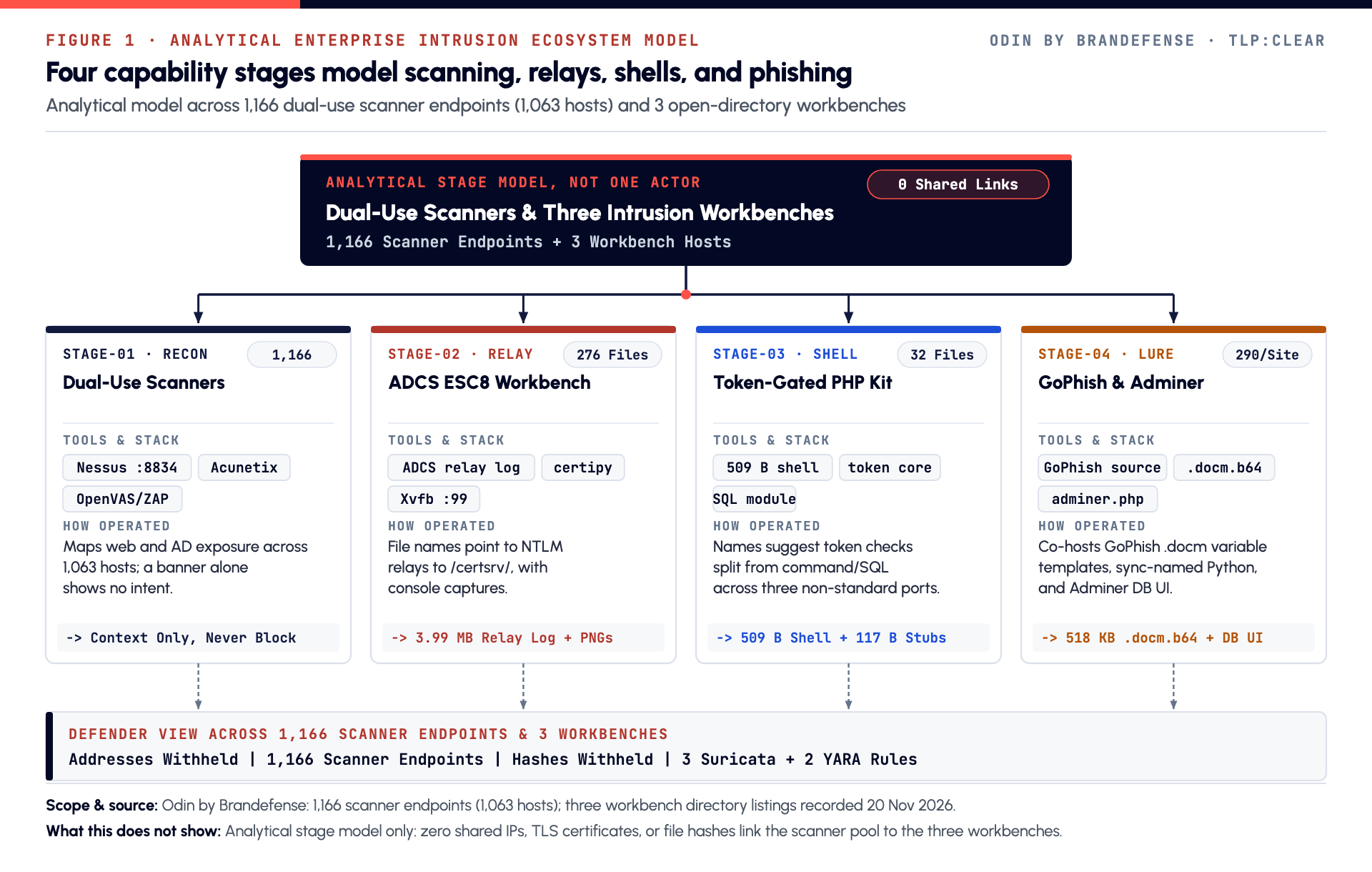
We organise the scanners and the three workbenches as an analytical four-stage model: perimeter discovery, internal certificate relay, web persistence and macro phishing. This is a model, not one actor. No shared address, TLS certificate or file hash links the scanners to the workbenches, or the workbenches to each other.
Four scanner families
The 1,166 endpoints sit on 1,063 distinct hosts. The per-family host counts add up to 1,070 because seven hosts expose two scanner families at once. Four of those pair Nessus with OpenVAS. The other three pair Nessus with Acunetix, Acunetix with OpenVAS, and Acunetix with OWASP ZAP.
| Scanner family | Endpoints | Share | Distinct hosts | Main ports (endpoints) |
|---|---|---|---|---|
Tenable Nessus (nessusva) | 489 | 41.9% | 461 | 8834 (370, 75.7%) |
Acunetix (acunetix) | 474 | 40.7% | 428 | 3443 (235, 49.6%), 7880 (69, 14.6%), 13443 (33, 7.0%) |
Greenbone OpenVAS (openvas) | 180 | 15.4% | 163 | 443 (99), 80 (34), 9392 (9) |
OWASP ZAP API (owaspzapapi) | 23 | 2.0% | 18 | 443 (8), 80 (6), 8080 to 8091 (6) |
| Total | 1,166 | 100% | 1,063 |
Nessus and Acunetix mostly keep their default management ports. OpenVAS and ZAP sit mostly behind ordinary web ports, which suggests a reverse proxy in front.
Where the scanners live
Most endpoints sit on large cloud and VPS providers. The top six are Amazon Web Services (86), Contabo (75), OVH (58), Hetzner (47), Microsoft Azure (39) and DigitalOcean (37). By country, the largest groups are the United States (294), France (112), Germany (108), China (99) and India (63).
Nine endpoints (0.8%) sit on dynamic telecom networks. Telecom providers rotate subscriber addresses, so a static block can hit an unrelated customer hours later. Three endpoints sit on hosts that also expose an open directory, which deserves a closer look by an analyst.
TLS fingerprints and certificates
Of the 1,166 endpoints, 723 (62.0%) present a TLS JARM fingerprint and 443 (38.0%) do not. JARM describes how a server's TLS stack answers a set of handshakes. It identifies the software stack, not the operator. The three most common JARM values cover 186 of the 723 TLS endpoints (25.7%).
| Scanner family | JARM | Endpoints |
|---|---|---|
| Acunetix | 2ad2ad0002ad2ad0002ad2ad2ad2ad02098c5f1b1aef82f7daaf9fed36c4e8 | 79 |
| Nessus | 2ad2ad0002ad2ad00042d42d000000020120996177a65431cde640fa58d2e8 | 59 |
| OpenVAS-linked stacks | 21d19d00021d21d00042d43d0000005ad20eceaf7f71ae0887d2ff117bf97f | 48 |
Certificate subjects tell the same story of ordinary deployments.
| Certificate subject | Endpoints |
|---|---|
| No certificate (plain HTTP) | 386 |
| A domain name (withheld) | 376 |
| Generic VM or appliance hostname | 277 |
localhost default | 57 |
| Self-signed, IP address as subject | 36 |
buildkitsandbox container default | 26 |
CloudFlare Origin Certificate | 8 |
Use these JARM values only to label traffic. Legitimate installations of the same products present the same values.
3. Workbench A: ADCS ESC8 Relay Logs
In short
A server in Moldova lists 276 files on a non-standard port, including four ADCS relay logs ranging from 619 bytes to 3.99 MB. The file names suggest ESC8 relay activity against certificate web enrollment, next to a text file named for directory replication. Enforce EPA on /certsrv/, or remove HTTP enrollment.
What ESC8 is
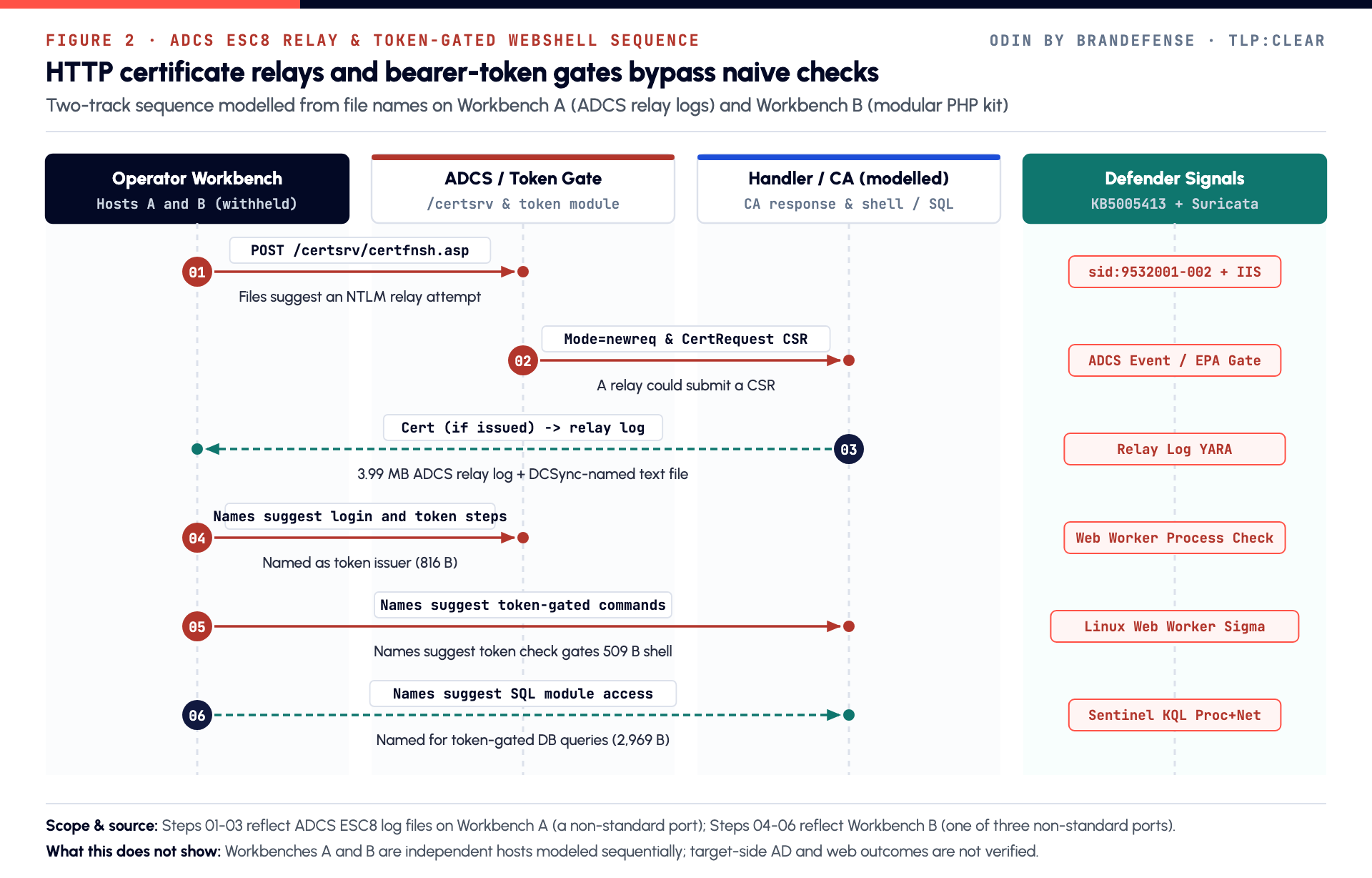
Active Directory Certificate Services (ADCS) can offer a web enrollment page at /certsrv/. When that page accepts NTLM over plain HTTP without Extended Protection for Authentication (EPA), it is open to relay.
An attacker on the internal network coerces or intercepts NTLM authentication from a domain machine. The attacker then forwards it to /certsrv/certfnsh.asp. This attack is known as ESC8 (T1557.001, T1649).
If the Certification Authority accepts the request, it issues a client-authentication certificate for the relayed account. The holder can use that certificate to request Kerberos tickets (PKINIT). If the relayed account is a domain controller, that can lead to directory replication rights such as DCSync (T1003.006). Microsoft's KB5005413 describes the fix.
Four relay logs
The directory's own HTTP server log, named after the listening port (withheld), is 8,720,527 bytes. Of 180 entries described in detail, 100 are PNG images, 28 are .log files, 18 are .txt notes, 13 are HTML pages and 13 have no extension. Four .log file names suggest ADCS relay activity; their contents and run history were not verified.
| File | Size (bytes) | What it suggests |
|---|---|---|
| Certipy-named relay log (path withheld) | 619 | File named for the public Certipy relay tool |
| ADCS relay log 1 (path withheld) | 15,586 | File named for an ADCS relay |
| Root-named ADCS relay log (path withheld) | 21,212 | File named for privileged-account relay targeting |
| ADCS relay log 2 (path withheld) | 3,995,499 | Large file named for a relay listener; duration unverified |
File size alone does not show how long a relay listener ran. Relay tools of this kind usually log the targeted enrollment URL, the account and template requested, and whether a certificate came back. Impacket can also print the certificate as Base64 PKCS#12. We did not publish or rely on the log content, and we cannot confirm any certificate was issued.
Beside the logs sit a 594-byte text file named for DCSync replication and a 19,353-byte compressed archive (paths withheld).
A headless browser and paired screenshots
The PNG images make up 55.6% (100 of 180) of the entries described in detail. The host also exposes a virtual X display: an 11-byte Xvfb display lock file, an X11 socket and two 54-byte xvfb-run authority files (paths withheld). Five HTML loop pages of about 26.7 KB each fit a headless browser harness.
Two kinds of image sit side by side:
| Image group | Sizes | What names and sizes suggest |
|---|---|---|
| Automated login frames | 9,539 bytes each | Repeated names and uniform size suggest login-screen captures (contents unverified) |
| Error stubs | 212 bytes each | Tiny uniform files that suggest empty or failed captures |
| Console captures | 342 KB to 1.03 MB | Larger PNG files named like desktop or terminal screenshots (contents unverified) |
| Paired before-and-after captures | 56 KB to 85 KB | Pairs named for domain controller, command, Group Policy and identity checks |
Target-named screenshot names are withheld, and so is the port number, because the host may itself belong to a victim. The paired naming fits someone documenting each step, which matters for the red-team reading in Chapter 6.
4. Workbench B: A Modular Token-Gated PHP Kit
In short
A server in China repeats an eight-file PHP login and token core across three ports. The file names suggest the core guards a 509-byte command entry point and a SQL module, while 117-byte PHP stubs hide in font and JavaScript folders. Turn off PHP in static asset folders.
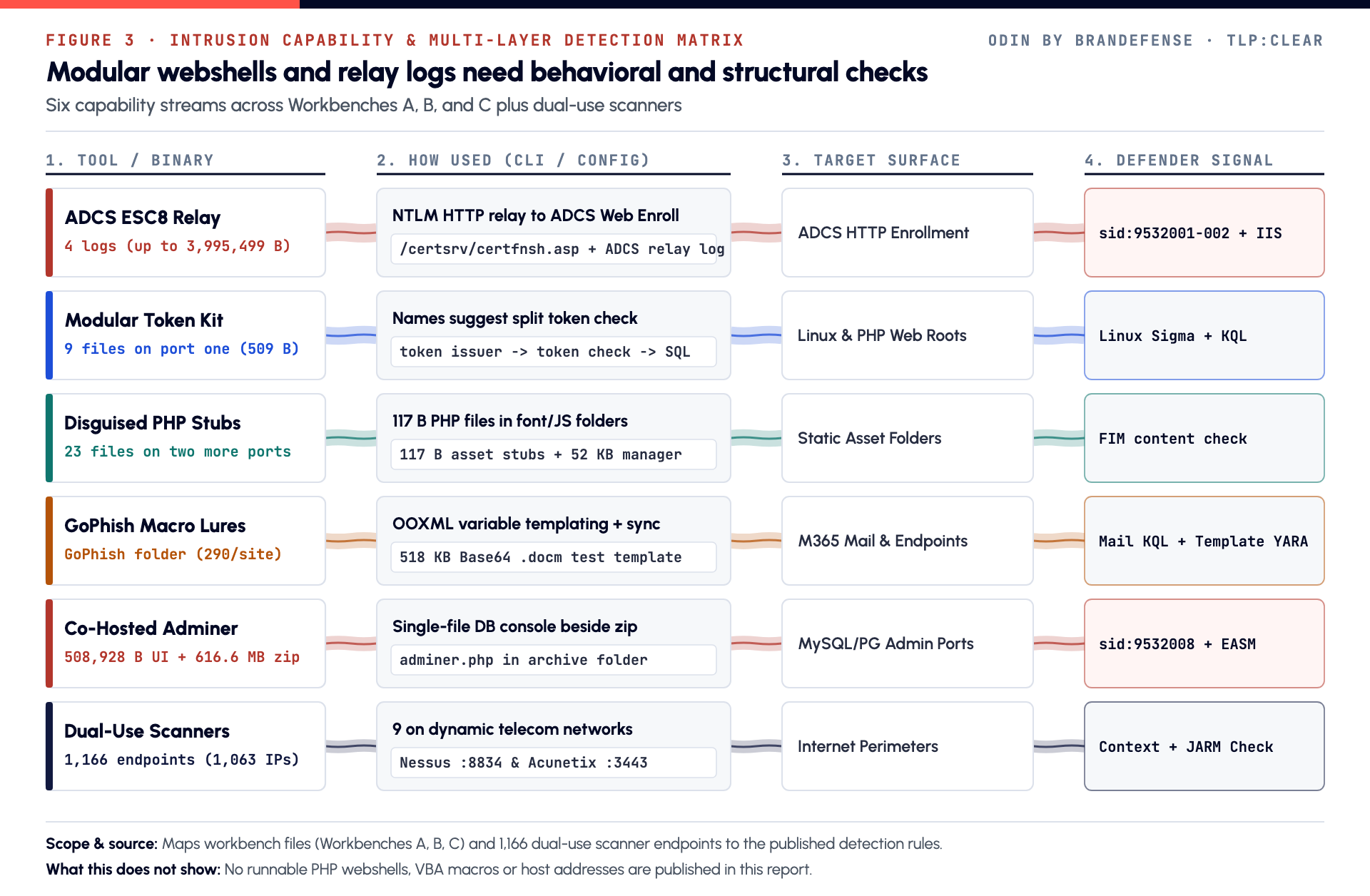
Classic webshell scanners look for one large PHP file that holds a login form, a file manager and encoded eval or passthru calls. Going by the file names, this kit splits those jobs into small files. Login, token issue, token check, SQL access and command dispatch each live in a separate include. Each file stays small.
The server exposes 32 files on three non-standard ports (9, 10 and 13 files). They are 20 PHP files, 6 JavaScript files, 3 web fonts, 1 Base64 file, 1 text file and 1 file with no extension. We publish no PHP code bodies.
The shared core
All three ports carry the same eight-file shared library core (paths withheld), which accounts for 24 of the 32 files. The front end loads standard jQuery 3.5.1 (287,744 bytes) and a web font (119,221 bytes). A custom 372-byte JavaScript loader named like the jQuery library sits beside it; we did not see what it does.
We saw file names and sizes, not code. Going by the names, the server side runs through five small PHP files (T1505.003):
- Login and token issue. A 2,662-byte PHP file is named as the operator login. An 816-byte PHP file is named as a token issuer, perhaps for a bearer token in the style of a JSON Web Token (JWT).
- Token check. A 659-byte PHP file and a 267-byte PHP file are named as a token verifier and an include guard. The names suggest a token check before the command and SQL handlers.
- Command and SQL entry points. On one port, the main command entry point is only 509 bytes, which fits login and interface code living in the shared PHP library folder. On all three ports, a 2,969-byte PHP file is named as a SQL database module (all paths withheld).
If the kit works as its names suggest, a scanner without a token would see nothing unusual.
Sibling ports: stubs in asset folders
The other two ports add fallback footholds next to the same core.
| File (path withheld) | Port | Size (bytes) | Role |
|---|---|---|---|
| Modular PHP command entry point | Port 1 | 509 | Command entry point, by name |
| PHP SQL database module | all three | 2,969 | SQL module, by name |
| PHP login handler | all three | 2,662 | Operator login, by name |
| PHP token issuer module | all three | 816 | Token issuer, by name |
| PHP token verifier module | all three | 659 | Token check, by name |
| PHP include guard module | all three | 267 | Shared include guard, by name |
| Custom JavaScript loader | all three | 372 | Custom script loader named like jQuery |
| Font-folder PHP stub | Port 3 | 117 | PHP stub named like a Bootstrap font asset |
| Script-folder PHP stub | Port 3 | 117 | PHP stub named like a jQuery asset |
| Full PHP web manager | Port 3 | 52,224 | PHP web manager, going by name and size |
| Base64 staged archive | Port 3 | 23,552 | Base64 staged archive in a subfolder |
| Minimal PHP stager | Port 2 | 28 | Minimal PHP stager |
| Text marker | Port 2 | 20 | Small marker file |
Ports 1, 2 and 3 are the three non-standard ports, holding 9, 10 and 13 files. We withhold the port numbers because the host may itself be a victim.
A PHP file in a font or JavaScript asset folder should never exist. It works only when Nginx or Apache passes every *.php request to PHP-FPM, instead of a short list of application entry points. On such a server, a 117-byte PHP file blends into the static theme tree.
5. Workbench C: GoPhish Macro Templates Beside Adminer
In short
A server in India mirrors 290 files across two web listeners. A GoPhish source tree with macro-enabled Word templates and a sync-named Python service sits beside an Adminer console and a 616.6 MB archive. Block internet macros and remove exposed Adminer copies.
Phishing infrastructure often mixes open-source automation with custom tools for importing recipients. On this server, two web listeners serve the same 290-file web root, 580 entries in total. Of 360 entries described in detail, Go source files (158), HTML templates (36), CSS (28), Python scripts (22), Markdown (18) and Base64 fixtures (16) dominate.
A GoPhish tree and a sync-named Python service
The tree sits in a folder whose name is withheld. The public GoPhish releases page lists v0.12.1 as the latest release, so the folder name does not match a public release. It may be a renamed or modified copy. Beside the Go source sits a custom Python orchestrator in its own Docker container: a Dockerfile (526 bytes) and three Python modules of 4,288 to 7,260 bytes.
A custom Python module is named for directory sync; its behaviour was not verified. If paired with GoPhish's REST API for campaigns and imports, such a service could automate recipient groups and campaign scheduling.
Macro-enabled Word templates
The GoPhish test-data folder holds eight Base64 OpenXML fixtures, 16 across both ports. GoPhish's 5,072-byte attachment handler decodes a Base64 .docm file and opens the archive in memory.
It then fills per-recipient variables such as {{.FirstName}}, {{.RId}} and {{.URL}} inside the XML parts. It keeps the macro project word/vbaProject.bin as it is. Each recipient gets a file with a different hash, which defeats simple hash blocking (T1566.001).
| File (path withheld) | Size (bytes) | Role |
|---|---|---|
Base64 .docx test fixture | 599,737 | Upstream GoPhish Base64 .docx test fixture |
Base64 .docm variable template | 517,989 | Upstream GoPhish Base64 macro-enabled .docm template |
Rendered Base64 .docm fixture | 183,256 | The same template after variable substitution |
| GoPhish attachment handler | 5,072 | GoPhish code that fills variables into Office files |
| GeoLite2 City database | 38,708,418 | MaxMind database bundled for click geolocation |
A note of caution: the public GoPhish project ships the 517,989-byte .docm Base64 template as a unit-test file. Its presence shows that the tree can template .docm lures. It does not show custom VBA work or that any lure was sent.
The archive and the Adminer console
The tree shares a web root with a second folder. That folder appears to be an unpacked copy of an organisation's web archive; its name is withheld.
| File | Size (bytes) | Role |
|---|---|---|
| Archive ZIP at the web root (name withheld) | 616,562,688 | A 616.6 MB web or organisation archive |
adminer.php (folder path withheld) | 508,928 | Single-file console for MySQL, PostgreSQL, SQLite and MS SQL |
| PHP dependency lock file (path withheld) | 265,318 | Dependency list inside the unpacked archive |
| Backup HTML page (path withheld) | 10,671 | Backup page at the web root |
Adminer is a legitimate tool. An exposed copy next to a large archive and a phishing tree is still a risk, whoever owns the server.
6. Other Explanations
In short
Each surface has a plausible benign or authorised reading. Defensive actions stay the same whichever is true, so fix ADCS, PHP and macro settings without waiting for attribution.
- Authorised scanning. Organisations run Nessus on 8834, Acunetix on 3443, OpenVAS on 443 and OWASP ZAP on 8080 to 8091 across AWS, Azure, OVH and Hetzner. Security engineers also test from home and mobile telecom networks. A scanner banner alone says nothing about intent.
- A red-team server on Workbench A. Before-and-after screenshot pairs next to four Certipy- and ADCS-named relay logs could be a penetration-testing team keeping report evidence. Even so, relay logs on open HTTP put credentials at risk, and the ESC8 fix still applies.
- A custom admin tool on Workbench B. On their own, the login, token-issuer, token-verifier and SQL modules could be a small custom session library. Next to a 509-byte command entry point, a 52,224-byte web manager, a 28-byte stager, a 23,552-byte Base64 file and PHP stubs in font and script folders, webshell staging is the better reading. The server's owner is not established and may itself be a victim.
- Awareness training on Workbench C. A GoPhish tree with a sync-named Python module could belong to a security awareness provider that also hosts Adminer and a backup ZIP. It could also be an operator staging a stolen archive beside GoPhish. Behaviour-based detection works in both cases.
For these reasons, all three host addresses, host-specific file paths and file hashes are withheld.
7. What Defenders Should Do
Active Directory and PKI
- List every ADCS server. Remove the HTTP Web Enrollment role (
/certsrv/) where it is not needed. - Where web enrollment stays, require HTTPS and turn on Extended Protection for Authentication, as KB5005413 describes. Enforce SMB and LDAP signing.
- Run Suricata SID 9532002 in alert mode first, to find clients that still use NTLM over HTTP before you turn HTTP off.
Linux and web platforms
- Send only approved front-controller paths to PHP-FPM or FastCGI. Turn off PHP in static font, JavaScript, image and upload folders.
- Alert when a PHP or web server worker starts a shell,
id,whoamior a database client. - Remove unapproved
adminer.phpand phpMyAdmin copies, backup.zipand.bakfiles, and open directory listings from public and staging servers.
Messaging and endpoints
- Keep Microsoft's default that blocks macros in files from the internet. Enforce it by Group Policy or Intune.
- Quarantine inbound
.docmattachments from unapproved external domains. Alert when Word starts PowerShell,cmd.exeor a script host.
Detection and CTI
- Deploy the rules in Chapter 8. Fill the named allowlists with your PKI proxies, admin hosts and phishing-simulation senders first.
- Keep dual-use scanner feeds as enrichment with a short expiry. Never send them to a firewall block list.
8. Detection Rules
The full rules are in the Detection rules tab. The Suricata file passes a syntax lint. We could not load the rules in live Suricata, YARA, Sigma or Sentinel engines for this edition, and they were not replayed against live traffic. Test and tune them before production use.
| Rule file | What it catches |
|---|---|
odin_adcs_esc8_webshell_and_macro_gophish.rules | Suricata 7: three signatures for ADCS web enrollment POSTs, NTLM over HTTP to /certsrv/, and exposed Adminer logins |
sentinel_adcs_esc8_relay_jwt_webshell_and_gophish.kql | Microsoft Sentinel and Defender XDR: web or Word processes starting shells and requests to /certsrv/certfnsh.asp or adminer.php, enriched with inbound .docm mail to the same user |
sigma_adcs_certsrv_relay_jwt_webshell_and_docm.yml | Sigma (3 rules): ADCS enrollment POSTs in IIS logs, PHP workers starting shells on Linux, and Word .docm files starting script hosts on Windows |
odin_adcs_relay_logs_webshell_kit_and_gophish_docm.yar | YARA (2 rules): ADCS ESC8 relay logs and Base64 macro-enabled .docm template files |
How the Suricata signatures work
| SID | Looks for | Why |
|---|---|---|
| 9532001 | Internal POST /certsrv/certfnsh.asp with Mode=newreq and CertRequest= in the body | Hunt signal: a web enrollment certificate request to review for ESC8 relay |
| 9532002 | Authorization: NTLM on any /certsrv/ request | Hunt signal: NTLM over plain HTTP to ADCS, the precondition for ESC8 |
| 9532008 | POST to adminer.php with an auth[driver]= field | A login to an exposed Adminer console |
SIDs 9532001 and 9532002 need visibility of plain HTTP on the ADCS network segment.
How the other rules work
The KQL query looks back seven days and builds three views. The mail view finds inbound .docm attachments, excludes approved simulation domains and senders, and joins the results to a matching device user.
The process view finds web workers (php-fpm, php-cgi, apache2, httpd, w3wp.exe) or Word starting shells and script hosts. It also finds commands that name certfnsh.asp or Certipy.
The network view finds requests to /certsrv/certfnsh.asp or adminer.php. Defender often records only the host name in RemoteUrl, so path matches require full URLs; use proxy or IIS logs as well.
Each match gets one of four INVESTIGATE_* or HUNT_* labels: an ADCS relay source, a token webshell host, a .docm macro run, or a hunt lead. A label starts an investigation; it is not a verdict on its own. Approved PKI and admin hosts go in a named allowlist. There are no wildcards.
The first Sigma rule is a hunt signal that reads IIS logs on ADCS servers. It flags successful POST requests to /certsrv/certfnsh.asp for relay review, except from two exact PKI proxy addresses and one enrollment service account.
The second flags PHP or web workers on Linux that start shells, id, whoami, uname or database clients. The third flags Word opening a .docm file and starting PowerShell, cmd.exe, mshta.exe, rundll32.exe or a script host. Each filter names exact hosts or accounts.
| YARA rule | Fires when |
|---|---|
ODIN_ADCS_ESC8_NTLM_Relay_Capture_Log | A file under 8 MB holds Certipy relay output (/certsrv/certfnsh.asp, (ESC8) and a certificate request or write line), or Impacket output (Generating CSR and GOT CERTIFICATE! ID or a PKCS#12 line) |
ODIN_GoPhish_Base64_Docm_Variable_Template_Artifact | A file between 100 KB and 2 MB starts with a Base64 ZIP header and holds the Base64 form of the macro project name word/vbaProject.bin, as in a .docm.b64 template. Recipient variables sit in compressed XML, so the rule does not look for them |
MITRE ATT&CK mapping
| Technique | How it shows up | Detection |
|---|---|---|
| T1557.001 Adversary-in-the-Middle: Name Resolution Poisoning and SMB Relay | NTLM relay to ADCS web enrollment | SIDs 9532001 and 9532002; Sigma rule 1 |
| T1649 Steal or Forge Authentication Certificates | Certificates issued for the relayed account | SID 9532001; KQL; YARA relay log rule |
| T1003.006 OS Credential Dumping: DCSync | A staged text file named for replication beside the relay logs | Directory replication auditing (no rule here) |
| T1505.003 Server Software Component: Web Shell | The modular PHP kit, the 52 KB web manager and asset-folder PHP stubs | KQL; Sigma rule 2 |
| T1566.001 Phishing: Spearphishing Attachment | GoPhish .docm templates with recipient variables | KQL; Sigma rule 3; YARA template rule |
9. Indicators
The Indicators tab holds no indicators for this report: 0 addresses and 0 file hashes. No host in this study is confirmed adversary infrastructure. The scanners may be legitimate, and each workbench has a plausible benign or victim reading (Chapter 6).
The patterns below appear in this report only. Use them for hunting, not for blocking by themselves.
| Pattern | Type | Use |
|---|---|---|
/certsrv/certfnsh.asp | Standard ADCS enrollment path | Hunt in IIS logs and internal network traffic for potential relay requests |
| Certipy and Impacket ADCS relay log strings | Relay console output patterns | Hunt on file servers with the YARA relay log rule (paths withheld) |
| PHP files in font, JavaScript or static asset folders | Asset-folder PHP stub pattern | Hunt in web roots and disable PHP execution in static asset folders (paths withheld) |
Base64-encoded .docm archives with word/vbaProject.bin | Macro template archive pattern | Hunt on staging servers with the YARA template rule (paths withheld) |
adminer.php | Single-file database console | Hunt at the WAF and in web roots for unapproved database consoles |
| Three JARM values in Chapter 2 | TLS fingerprints of scanner products | Enrichment only, never block |
Withheld: all three workbench host addresses, all scanner host addresses and the 14 file hashes recorded for the workbenches. The workbench port numbers and all host-specific file and folder names are also withheld.
10. Scope and Limits
- Capture date. These findings reflect directory listings recorded on 20 November 2026.
- Files, not outcomes. We looked at directory listings, file names and sizes. We ran no files and contacted no system named in them. Nothing we saw confirms that a relay issued a certificate, that the webshells reached a victim, or that any lure was sent.
- Three hosts, no link. The three workbenches share no address, certificate or file. The four-stage picture is an analytical model, not one actor.
- Owners are not established. Each workbench may belong to an attacker, an authorised tester, a training provider or a victim. For that reason no address, host-specific path or hash is published.
- Scanners are dual-use. The 1,166 endpoints run widely sold or open-source products. Their presence says nothing about intent.
- GoPhish fixtures are public. The
.docmtemplate is a GoPhish unit-test file. It shows capability, not a campaign. - No CVE. ESC8 is a configuration weakness, not a single software flaw, so this report cites no CVE.
- Rule testing. The Suricata file passes a syntax lint. The rules were not loaded in live engines or replayed against live traffic for this edition.
11. Sources
- Microsoft Support. KB5005413: Mitigating NTLM Relay Attacks on Active Directory Certificate Services (AD CS). https://support.microsoft.com/en-us/topic/kb5005413-mitigating-ntlm-relay-attacks-on-active-directory-certificate-services-ad-cs-3612b773-4043-4aa9-b23d-b87910cd3429 (verified 20 November 2026)
- MITRE ATT&CK. T1649 Steal or Forge Authentication Certificates. https://attack.mitre.org/techniques/T1649/ (verified 20 November 2026)
- MITRE ATT&CK. T1557.001 Adversary-in-the-Middle: Name Resolution Poisoning and SMB Relay. https://attack.mitre.org/techniques/T1557/001/ (verified 20 November 2026)
- MITRE ATT&CK. T1003.006 OS Credential Dumping: DCSync. https://attack.mitre.org/techniques/T1003/006/ (verified 20 November 2026)
- IETF. RFC 7519, JSON Web Token (JWT). https://datatracker.ietf.org/doc/html/rfc7519 (verified 20 November 2026)
- MITRE ATT&CK. T1505.003 Server Software Component: Web Shell. https://attack.mitre.org/techniques/T1505/003/ (verified 20 November 2026)
- OWASP Cheat Sheet Series. File Upload Cheat Sheet. https://cheatsheetseries.owasp.org/cheatsheets/File_Upload_Cheat_Sheet.html (verified 20 November 2026)
- MITRE ATT&CK. T1566.001 Phishing: Spearphishing Attachment. https://attack.mitre.org/techniques/T1566/001/ (verified 20 November 2026)
- GoPhish documentation. Templates. https://docs.getgophish.com/user-guide/documentation/templates (verified 20 November 2026)
- GoPhish documentation. Template Reference. https://docs.getgophish.com/user-guide/template-reference (verified 20 November 2026)
- GoPhish on GitHub. Releases. https://github.com/gophish/gophish/releases (verified 20 November 2026)
- Microsoft Learn. Macros from the internet are blocked by default in Office. https://learn.microsoft.com/en-us/microsoft-365-apps/security/internet-macros-blocked (verified 20 November 2026)
What is…?
Short explanations of the tools and families named in this study.
What is GoPhish?
GoPhish is an open-source phishing simulation framework. Companies use it for awareness training and attackers use it for real campaigns.
More about GoPhishTechniqueWhat is DCSync?
DCSync abuses the Active Directory replication protocol to ask a domain controller for password hashes, as if the caller were another domain controller.
More about DCSyncTechniqueWhat is JARM?
JARM is an open TLS server fingerprinting method from Salesforce. It hashes how a server answers a set of crafted TLS handshakes.
More about JARMOffensive libraryWhat is Impacket?
Impacket is an open-source Python library for Windows network protocols. Its example scripts are widely used for lateral movement and credential theft.
More about ImpacketFrequently asked questions
What do the ADCS relay logs show?
Active Directory Certificate Services (ADCS) can offer a web enrollment page. If that page accepts Windows NTLM logins over plain HTTP, an attacker inside the network can relay a machine's login to it.
How does the PHP kit avoid detection?
Many webshell scanners look for one large PHP file that does everything. A server in China takes a different approach. It repeats an eight-file login and token core on three ports. We saw file names and sizes, not code. Going by the names, one file handles the operator's login, another issues a bearer token, and two more check that token.
Why does a phishing tree next to Adminer matter?
A server in India serves the same 290 files on two web listeners. They include a GoPhish source tree in a folder whose name is withheld. The folder name uses a version above v0.12.1, the latest public GoPhish release, so this may be a renamed or modified copy. A custom Python module is named for directory sync; its behaviour was not verified.
Should scanner addresses go on a block list?
No. We mapped 1,166 Nessus, Acunetix, OpenVAS and OWASP ZAP endpoints on 1,063 hosts. Most sit on large cloud providers such as Amazon Web Services, Contabo, OVH and Hetzner. Nine sit on telecom networks that rotate customer addresses. Their TLS fingerprints match the products, not any operator.