
1. Executive Summary
In short
From 18 to 20 November 2026, Odin by Brandefense recorded 438 newly observed endpoints of seven autonomous-offense frameworks. Eleven, on 10 addresses, carry an upstream command-and-control flag without independent per-address validation; all 10 addresses are withheld. Two exposed web directories held 8,173 files. A 270-entry sample from one includes 26 numbered task folders, a layout that fits subagent tooling, staging GodPotato, PrintSpoofer, Chisel tunnels and .NET single-sign-on cipher files. Audit SeImpersonatePrivilege, retire SMBv1, and inspect outbound chisel-v3 WebSocket upgrades.
Autonomous penetration-testing frameworks split a job into many small worker tasks. Each worker, or subagent, gets its own folder for scan output, captured tokens and the tools it needs next. When an operator serves that folder tree over plain HTTP, anyone can read how the swarm moves from a web bug to a Windows server. This report covers the wider framework population and two exposed workbenches whose layout fits this pattern.
Eleven of 438 new autonomous-offense endpoints carry an upstream C2 flag on 10 addresses.
ARTEX accounts for 57.1% of the new endpoints, followed by HexStrikeAI and CyberStrikeAI. Eleven endpoints on 10 dedicated addresses carry an upstream C2 flag that the study records do not independently validate, and the other 427 are suspected or candidate endpoints. The addresses of all 438 endpoints are withheld.
Byte-identical Windows impersonation tools appear at the root and in one sampled task folder.
In a 270-entry sample of Workbench A, GodPotato and PrintSpoofer binaries at the root match files inside one numbered task folder. Sibling task folders in the sample stage Chisel tunnels, Socat-named logs, an MS17-010 script and .NET single-sign-on (SSO) assemblies with a disassembly and password-cracking logs.
A second host pairs SQL injection batch logs with large HTTP listener logs.
Workbench B holds five sqlmap logs (3.49 MB) next to 34.94 MB of HTTP listener logs across two web listeners. Nothing links the two workbenches, so we treat them as separate examples of the same staging habit.
Three Decisions for Leaders
- Require multi-signal proof before blocking framework addresses. All 10 flagged C2 addresses are withheld pending per-address signal validation. Treat autonomous-agent hits as hunting leads until a certificate, JARM value and endpoint process agree.
- Harden Windows service accounts and watch WebSocket egress. Limit which accounts hold the impersonation right, run IIS and SQL Server pools as low-privilege managed accounts, retire SMBv1 and inspect outbound WebSocket upgrades on unusual ports.
- Remove static application keys and parameterize queries. Move hard-coded keys out of .NET SSO components into a managed secret store, enforce parameterized SQL and stop servers from pulling binaries over plain HTTP.
The Study in Numbers
| Number | What it is |
|---|---|
| 438 / 415 | Newly observed autonomous-offense endpoints, on 415 distinct hosts, across seven framework families |
| 11 / 10 | Endpoints with an upstream C2 flag on 10 dedicated IPv4 addresses (unvalidated; addresses withheld) |
| 427 | Suspected or candidate endpoints on 405 hosts; addresses withheld |
| 6,203 | Files exposed on Workbench A (26 numbered task folders observed in a 270-entry sample) |
| 1,970 | Files exposed on Workbench B across three HTTP listeners (984 on the runner listener) |
| 38.43 MB | HTTP listener logs (34.94 MB) plus sqlmap batch logs (3.49 MB) on Workbench B |
| 0 / 4 | Published IP or hash indicators in the Indicators tab (all withheld); 4 text-only hunting selectors in Chapter 9 |
How to use this report.
Security leaders can read Chapters 1, 6 and 7. Windows, Active Directory and application teams should read Chapters 3 to 5 and the checklist in Chapter 7. SOC analysts and detection engineers should start with Chapters 8 and 9. CTI analysts will find the framework population in Chapter 2.
2. Autonomous Offense Endpoints: 438 New, 11 Flagged as C2
In short
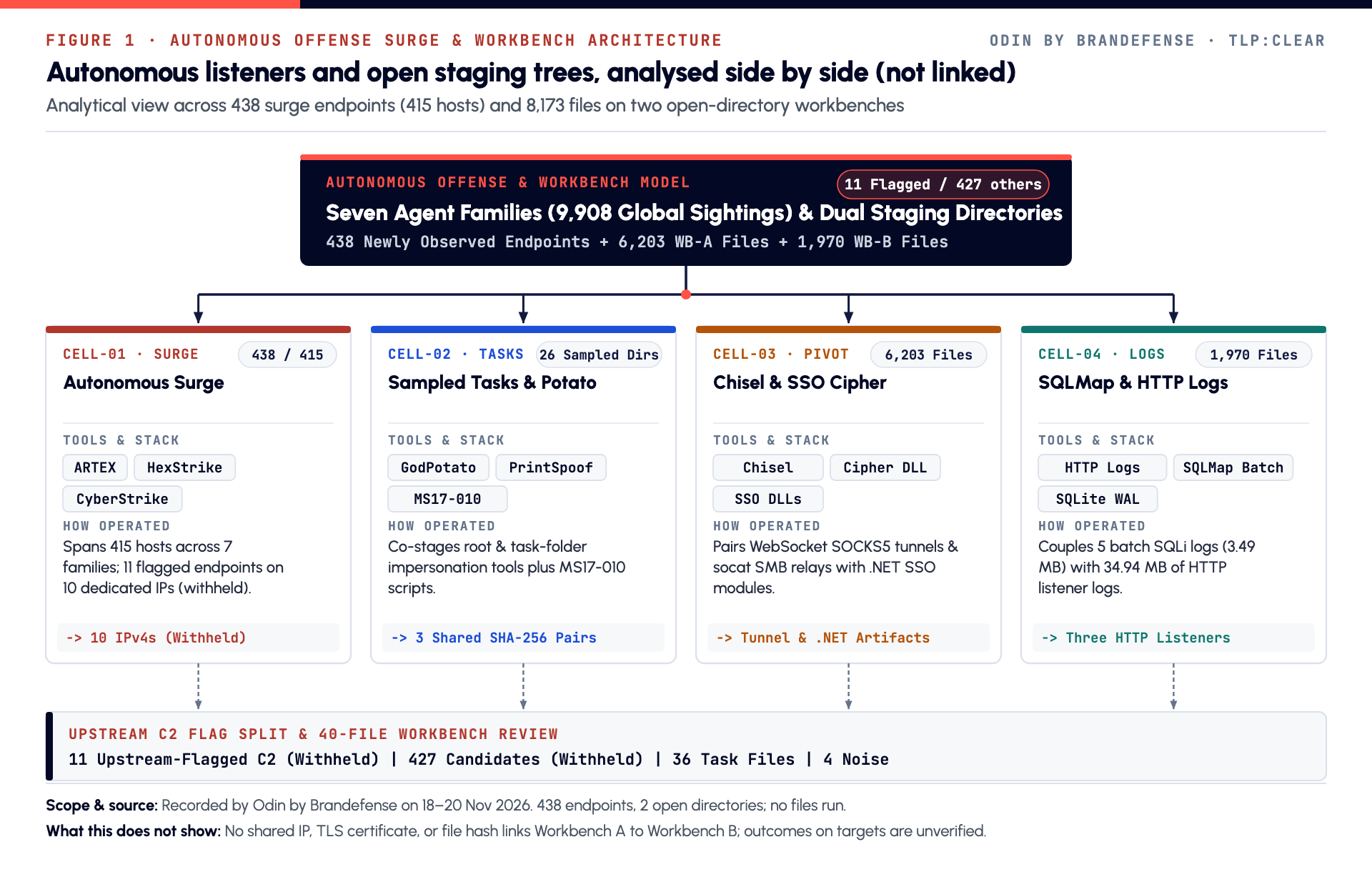
Seven autonomous-offense frameworks account for 438 newly observed endpoints on 415 hosts. Eleven endpoints on 10 dedicated addresses carry an upstream C2 flag that the study records do not independently validate, so all 10 addresses are withheld. Hunt with the JARM and certificate selectors instead of blocking single banners.
In threat intelligence, a family label such as "ARTEX" or "CyberStrikeAI" describes a product fingerprint: a banner, an API route or a TLS certificate. It says nothing about who runs the server. Developers, consultants and intruders all deploy the same containers on the same cloud ranges, where cyber threat intelligence helps defenders separate hostile use from testing. So a single matching banner is not a reason to block an address.
We pair the 438 endpoints with two exposed HTTP directories holding 8,173 files. No shared IP, TLS certificate or file hash links Workbench A to Workbench B, so we analyse them as separate examples.
Nothing in either listing names an AI agent framework. No IP, certificate or hash links the workbenches to the 438 endpoints. We treat the 26 sampled numbered folders as subagent tasks only as an analytical model. Figure 1 shows how the parts fit together.
Seven families, one dominant framework
Odin holds 9,908 endpoint records for the same seven families. ARTEX (4,597), CyberStrikeAI (3,425) and PentAGI (1,297) make up 94.1% of them. Among the 438 newly observed endpoints, ARTEX leads with 250 (57.1%).
| Family | All records | New endpoints | Distinct hosts | Flagged C2 | Other endpoints | Main ports |
|---|---|---|---|---|---|---|
| ARTEX | 4,597 (46.4%) | 250 (57.1%) | 238 | 6 (5 IPs) | 244 | 8787 (137), 8790 (28), 80 (21) |
| HexStrikeAI | 268 (2.7%) | 69 (15.8%) | 66 | 0 | 69 | 80 (38), 5000 (11), 443 (8) |
| CyberStrikeAI | 3,425 (34.6%) | 62 (14.2%) | 58 | 3 (3 IPs) | 59 | 8080 (36), 443 (5), 8081 (3) |
| PentAGI | 1,297 (13.1%) | 39 (8.9%) | 39 | 1 (1 IP) | 38 | 8443 (31), 8666 (3), 8444 (1) |
| AutoHunter | 101 (1.0%) | 12 (2.7%) | 12 | 0 | 12 | 18800 (9), 80 (1), 18801 (1) |
| Cairn | 170 (1.7%) | 5 (1.1%) | 5 | 1 (1 IP) | 4 | 8000 (4), 443 (1) |
| Strix | 50 (0.5%) | 1 (0.2%) | 1 | 0 | 1 | 8080 (1) |
The per-family host counts add up to 419, not 415. Four hosts run two families at once. Three pair ARTEX on port 8787 with CyberStrikeAI on port 8080. One pairs ARTEX on 8787 with AutoHunter on 18800.
Where the endpoints sit
The 438 endpoints concentrate in a few countries and hosting networks.
| Country | Endpoints | Share |
|---|---|---|
| United States | 138 | 31.5% |
| Hong Kong | 94 | 21.5% |
| China | 62 | 14.2% |
| Singapore | 26 | 5.9% |
| Japan | 19 | 4.3% |
| Hosting network | Endpoints |
|---|---|
| PEG TECH INC | 63 |
| Amazon.com, Inc. | 55 (including 50 of 69 HexStrikeAI endpoints) |
| Hangzhou Alibaba Advertising Co.,Ltd. | 23 |
| NetLab Global | 22 |
| CTG Server Limited | 18 |
The 11 endpoints with an upstream C2 flag
Eleven endpoints (2.5% of 438) on 10 dedicated IPv4 addresses carry an upstream C2 flag; the study records do not independently validate that classification. Because independent per-address corroboration is absent, all 10 addresses are withheld. None of the 10 addresses overlaps with the 405 hosts that hold the other endpoints.
All three flagged CyberStrikeAI controllers present the certificate subject CN=CyberStrikeAI and the same TLS JARM value, 40d40d40d00000000043d43d00043d6aff5ab0f4fc31897186312c9e639319.
The 11 flagged endpoints comprise six ARTEX, three CyberStrikeAI, one PentAGI and one Cairn endpoint. Their host-level details are withheld pending independent validation.
Cloud leases change hands. Require a matching certificate subject, JARM value or endpoint process before blocking any framework address.
3. Workbench A: Numbered Task Folders and Windows Impersonation Staging
In short
Workbench A serves 6,203 files; a 270-entry sample includes a root tool store and 26 numbered task folders. Byte-identical GodPotato and PrintSpoofer files appear at the root and in one task folder. Hunt for GodPotato and PrintSpoofer execution on IIS and SQL Server hosts.
Multi-agent offense frameworks hand each worker a dedicated directory. It holds that worker's scan output, session caches and the post-exploitation tools it needs. If the operator serves the parent directory over HTTP, the whole task tree becomes readable; external attack surface management can surface such exposed directories.
A folder listing shows what was staged. It does not show what happened on any target. Nothing in either listing names an AI agent framework. No IP, certificate or hash links the workbenches to the 438 endpoints. We treat the 26 sampled numbered folders as subagent tasks only as an analytical model.
Workbench A serves its directory tree over an unauthenticated HTTP listener. In a sample of 270 catalog entries, Python scripts lead with 127 files (47.0%), ahead of 16 logs, 11 JavaScript files and 9 PHP files. The sample also holds seven .dll, seven .sql, seven .json, seven .ps1 and six .exe files.
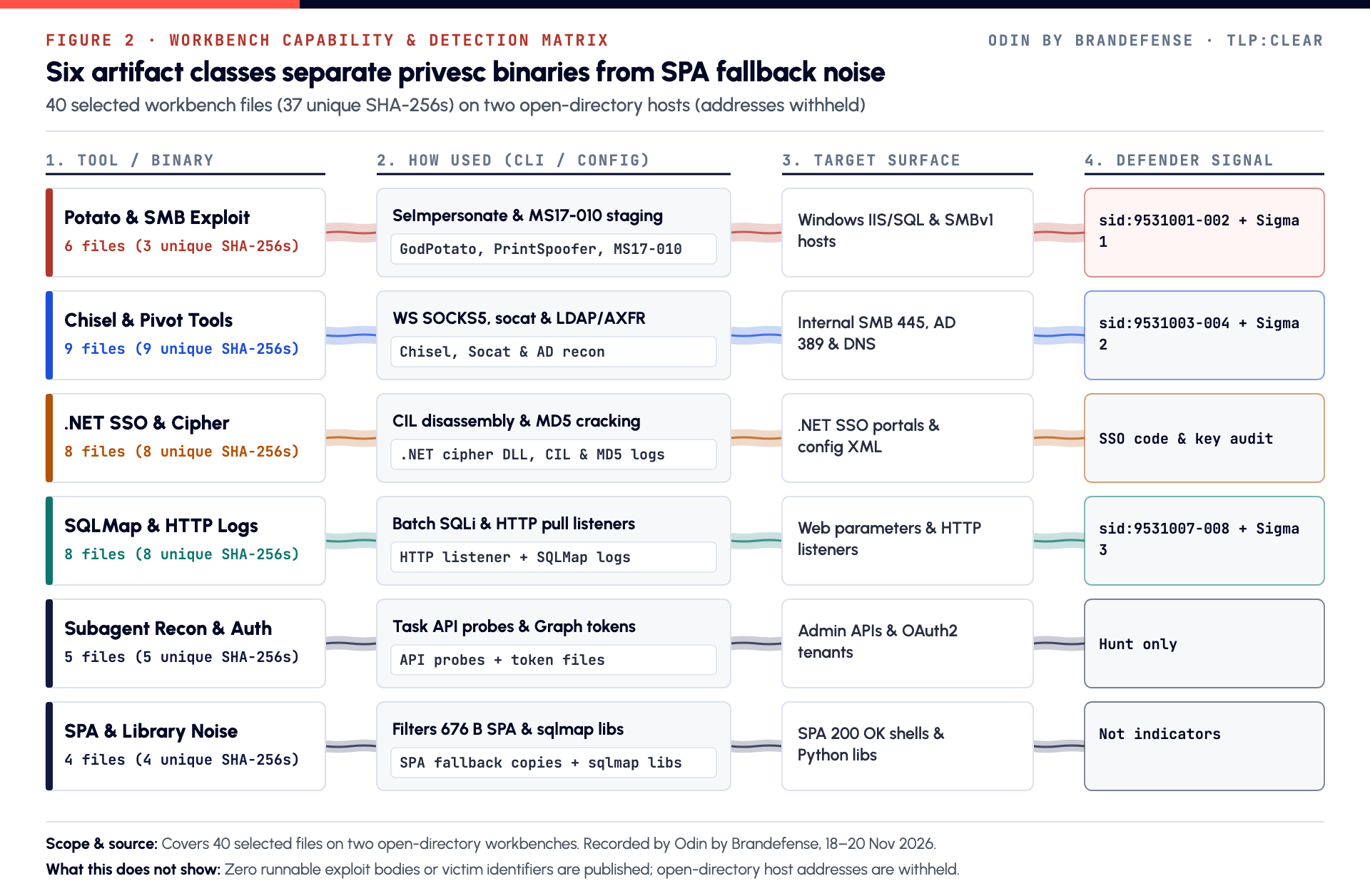
In that 270-entry sample, 26 numbered folders split the work by assignment (folder IDs withheld). Several folders add a letter suffix to the task number, which looks like re-runs of the same task. Figure 2 groups the 40 files we selected from both workbenches into six classes.
Matching files at the root and in task folders
Matching Windows binaries appear at the web root and in a numbered task folder. The listing does not establish who placed them there or which copy came first. Each pair has identical byte sizes and matching SHA-256 values.
| Tool | Root store | Task folder file | Size | What it does |
|---|---|---|---|---|
| GodPotato | Name withheld | Name withheld | 57,344 bytes | Abuses DCOM/RPC OXID resolution to impersonate NT AUTHORITYSYSTEM from a service account |
| PrintSpoofer | Name withheld | Name withheld | 27,136 bytes | Abuses Print Spooler named pipes for the same elevation |
| MS17-010 script | Name withheld | Name withheld | 43,626 bytes | Public SMBv1 exploit script for CVE-2017-0144 |
GodPotato and PrintSpoofer both need a Windows service account that holds SeImpersonatePrivilege. IIS worker processes (w3wp.exe) and SQL Server (sqlservr.exe) often run under such accounts. An attacker who lands a web shell or a SQL command shell under that account can use either tool to reach SYSTEM (T1134.001).
Staging both in the same task folder gives a fallback. If the Print Spooler service (spoolsv.exe) is off, GodPotato still has the RPC path. The same folder holds a 69,632-byte binary file and a PKCS#12 certificate bundle whose names are withheld.
The MS17-010 script in another sampled task folder sits with a 16,974-byte SMB transport helper script (name withheld) from the same public toolkit. Together they target unpatched SMBv1 servers. Microsoft fixed CVE-2017-0144 in security bulletin MS17-010 on 14 March 2017.
NVD rates it 8.8 (High) under CVSS 3.1. Affected desktop editions are Windows Vista SP2, 7 SP1, 8.1, RT 8.1, and 10 original, 1511 and 1607. Affected server editions are Windows Server 2008 SP2, 2008 R2 SP1, 2012, 2012 R2 and 2016 (NVD; MS17-010).
Re-used files across tasks
Other sampled folders show workers reusing the same staging data. Four copies of one 71,165-byte admin JavaScript bundle sit at the root and in three task folders, all with one SHA-256 value. Three SQL archives across three other numbered task folders also share digests. That pattern fits repeated task runs over shared staging data.
| Sampled location | What it holds (paths and owner-specific names withheld) | Size range (bytes) | Role (not confirmed on any target) |
|---|---|---|---|
| Root and privesc task folder | GodPotato, PrintSpoofer and a 69,632-byte binary payload | 27,136 to 69,632 | Windows impersonation elevation |
| Root and SMB relay task folder | MS17-010 exploit script, SMB transport helper, Socat relay logs and a Chisel tunnel log | 4,811 to 43,626 | MS17-010 SMB relay and Chisel tunnel logs |
| Directory-discovery task folder | Three short Python scripts and RDP/SMB banner logs | 135 to 6,565 | Active Directory LDAP, DNS zone transfer, SMB and RDP discovery |
| SSO analysis task folder | SSO assembly copies, a CIL disassembly file, an MD5 cracking log and a potfile | 2,121 to 1,975,808 | .NET SSO disassembly and offline MD5 cracking |
| SQLi session task folder | sqlmap SQLite session journals | 8,272 to 61,832 | SQL injection session state |
| Three token task folders | JSON files named after OAuth and Microsoft Graph tokens | 6,548 to 8,276 | Files named as OAuth and Microsoft Graph tokens |
| Two API-test task folders | Authorization-matrix and admin API test scripts | 804 to 71,165 | Admin API and access-control testing |
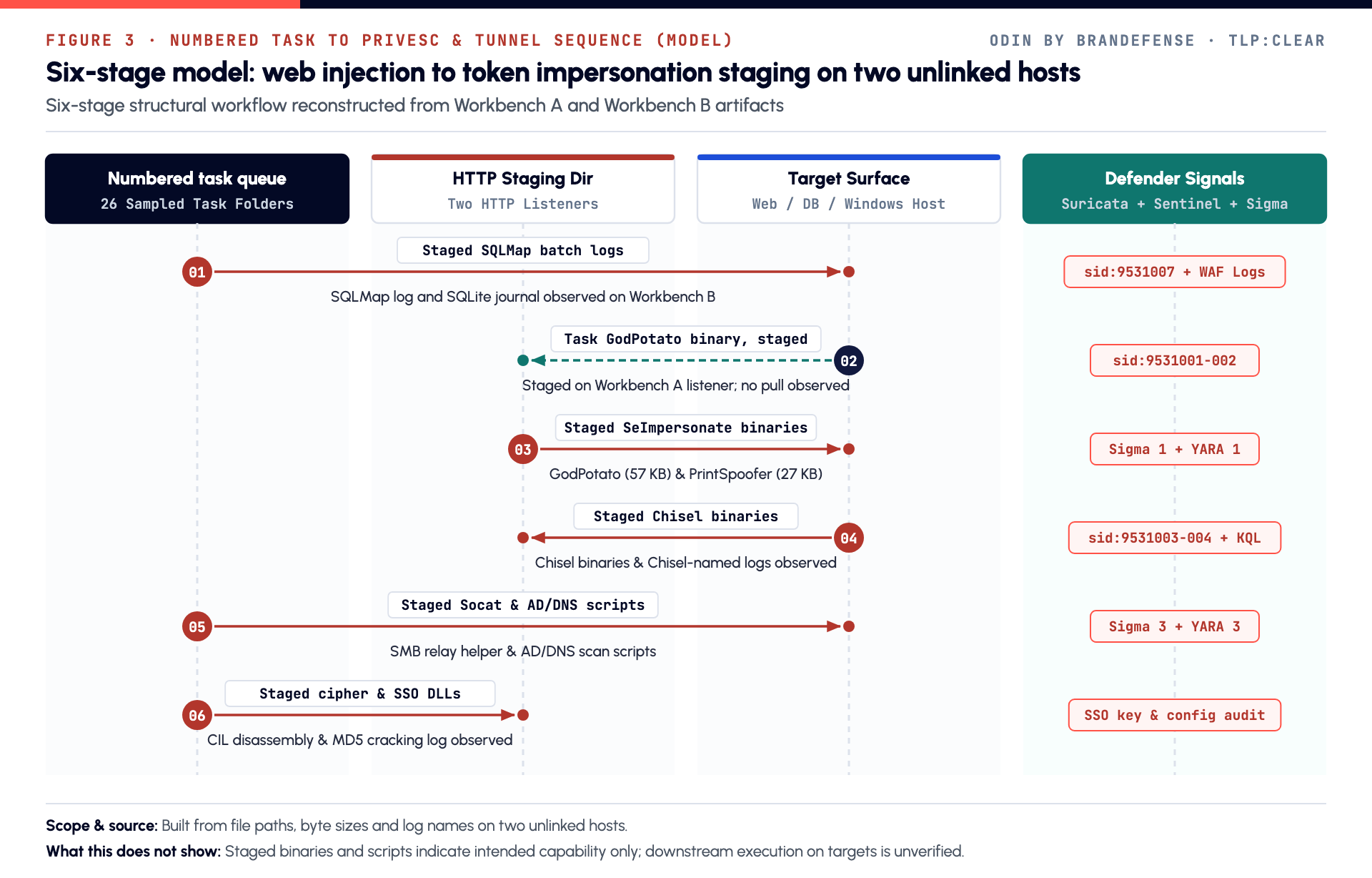
Figure 3 lays out the six-stage sequence these folders suggest, from web injection on Workbench B to tunnelling on Workbench A. It is a reconstruction from file names and sizes, not a log of events. The two hosts are not linked; the figure combines them only to illustrate the pattern.
4. Tunnels, Pivot Scripts and .NET Cipher Files
In short
Beyond elevation, Workbench A stages two Chisel builds, Socat SMB relay logs, directory discovery scripts and a .NET SSO cipher analysis kit. Each points to a different defender control. Inspect egress for chisel-v3 and audit SSO components for static keys.
After local elevation, an operator needs a way into segmented internal networks and a way to read application secrets. Workbench A stages both.
Chisel reverse SOCKS tunnels and Socat relays
Two Windows Chisel builds sit in the root store (names and paths withheld). One measures 11,954,176 bytes, and the version 1.8.1 build measures 8,676,864 bytes.
Chisel is a public TCP/UDP tunnel carried over HTTP and secured with SSH. Its reverse SOCKS mode (R:socks) lets a client inside a network open a SOCKS5 proxy on the operator's server. The client starts with an HTTP-to-WebSocket upgrade that carries the header Sec-WebSocket-Protocol: chisel-v3 (T1572).
The listing includes two Chisel-named logs: one at the root (152,308 bytes) and one in a task folder (4,811 bytes). Their names reference high-numbered listener ports (withheld), but the listing does not confirm that a tunnel ran.
The same task folder holds two Socat-named logs (7,797 bytes and 6,417 bytes; names withheld). Their file names pair local relay ports (withheld) with the SMB helper script, suggesting a planned relay to SMB port 445. The listing does not confirm that a relay connection ran or fed the MS17-010 script.
A sibling task folder holds three short Python scripts (1,319 to 1,561 bytes). From their file names, they cover an LDAP check on port 389, a directory attribute scan and a DNS zone transfer check. Two companion logs carry names pointing to RDP NTLM and legacy SMB checks, though their contents are not confirmed. All script and log names, paths and hashes are withheld because the workbench owner is not established.
| Artifact | Sampled location | Size (bytes) | Role |
|---|---|---|---|
| Chisel Windows binary (name withheld) | Root store | 11,954,176 | Go WebSocket SOCKS5 tunnel |
| Chisel 1.8.1 build (name withheld) | Root store | 8,676,864 | Chisel 1.8.1 Windows build |
| Two Chisel-named logs (names withheld) | Root and task folder | 4,811 to 152,308 | Files named after high-port Chisel listeners |
| Two Socat-named logs and SMB helper script (names withheld) | SMB relay task folder | 6,417 to 16,974 | Files named after local Socat relay listeners, plus SMB helper |
| Three discovery scripts (names withheld) | Discovery task folder | 1,319 to 1,561 | AD LDAP and DNS zone transfer checks |
.NET single-sign-on cipher analysis
A third cluster targets custom .NET single-sign-on and portal login libraries. All vendor, campus, payment-SDK and gateway names in these files are withheld.
In the root store sits a .NET symmetric cipher DLL (40,960 bytes; name and path withheld). Next to it are a 1.18 MB archive and its extracted folder (names withheld). That folder holds a 46,310-byte Common Intermediate Language (CIL) disassembly file (name withheld) and seven SSO module assemblies (19,456 to 1,975,808 bytes). A 2,121-byte XML configuration file sits with them, and matching binary copies appear in a numbered task folder.
Many intranet and campus SSO agents written in C# wrap AES (Rijndael) or 3DES in a helper DLL. They use it to encrypt cookies, database connection strings and SSO tickets. Disassembling such a library to CIL, with ildasm or ilspycmd, can expose hard-coded keys, IVs or unsalted MD5 routines (T1552.001).
The SSO analysis task folder fits that reading. It holds an offline MD5 cracking log (10,266 bytes) and a potfile (13,484 bytes; names withheld). Another sampled task folder holds two Base64-encoded application and database configuration files (names and contents withheld).
| Artifact | Sampled location | Size (bytes) | Role |
|---|---|---|---|
| .NET symmetric cipher DLL (name withheld) | Root store | 40,960 | .NET symmetric cipher helper |
| CIL disassembly file (name withheld) | Extracted archive | 46,310 | CIL disassembly |
| SSO module assemblies (7; names withheld) | Extracted archive | 19,456 to 1,975,808 | Third-party .NET SSO libraries |
| MD5 cracking log (name withheld) | SSO task folder | 10,266 | Offline MD5 cracking session |
Three other sampled task folders hold files named after OAuth and Microsoft Graph tokens (folder IDs, file names and contents withheld). The listing entries suggest interest in application access tokens (T1528).
5. Workbench B: SQLMap Batch Runs and HTTP Listener Logs
In short
Workbench B serves 1,970 files across three HTTP listeners. Five sqlmap logs sit beside 34.94 MB of HTTP listener logs, the web-injection side of the same staging habit. Block the sqlmap/ user agent and parameterize queries.
SQL injection rarely stops at reading a database banner. An operator testing stacked queries, xp_cmdshell or file writes often runs a plain Python HTTP listener on the scanner host. The target database can then pull a second-stage file from it, or call back to confirm a blind injection (T1190).
Workbench B shows that pattern across three unauthenticated HTTP listeners (ports withheld), holding 1,970 files in total (984 on the runner listener). Like Workbench A, it exposes sqlmap SQLite session files next to an open HTTP tree. No shared IP, certificate or file hash links it to Workbench A. Figure 4 compares the layers of both hosts.
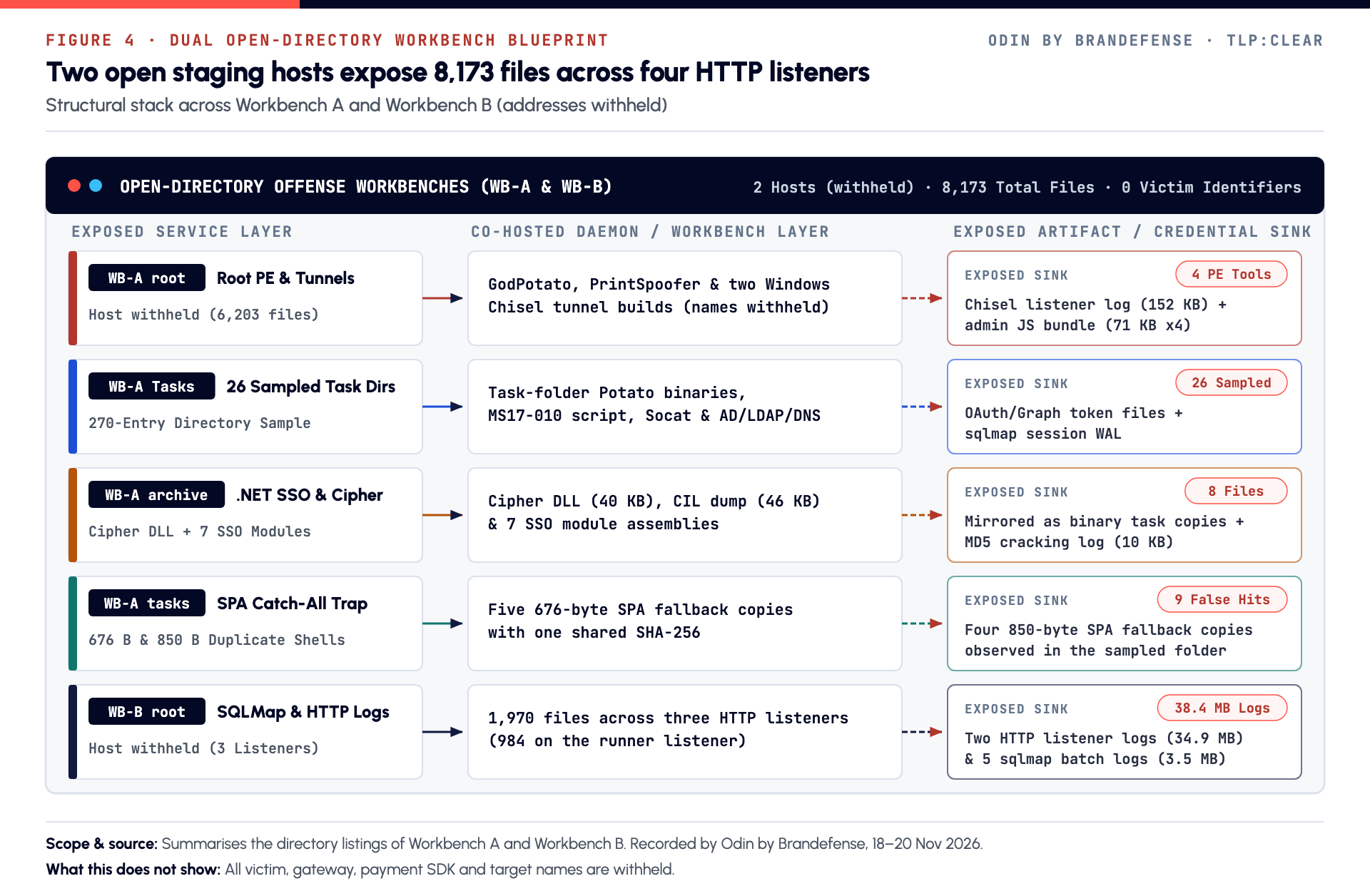
What the runner tree holds
In a sample of 362 entries from the runner listener, 284 .py files and 18 .xml files belong to a full Git checkout of upstream sqlmap. The tree also holds a compiled Dart web bundle (3.76 MB) and a 35,849-byte word list (file names and paths withheld).
The notable files are seven logs at the root, 38,429,854 bytes in total. Two carry HTTP listener names for two web listeners (ports withheld). Five carry sqlmap names and range from 40,930 to 1,743,251 bytes, though the listing does not establish their run order or contents.
| Log artifact (name and path withheld) | Size (bytes) | What the listing shows |
|---|---|---|
| HTTP-named listener log 1 | 17,833,637 | HTTP-named log file at the root; contents not confirmed |
| HTTP-named listener log 2 | 17,110,690 | Second HTTP-named log file at the root; contents not confirmed |
sqlmap-named log 1 | 1,743,251 | sqlmap-named log file; run order and contents not confirmed |
sqlmap-named log 2 | 1,550,847 | sqlmap-named log file; run order and contents not confirmed |
sqlmap-named log 3 | 103,244 | sqlmap-named log file; run order and contents not confirmed |
sqlmap-named log 4 | 47,255 | sqlmap-named log file; run order and contents not confirmed |
sqlmap-named log 5 | 40,930 | sqlmap-named log file; run order and contents not confirmed |
A sqlmap output folder also holds a 32,768-byte SQLite shared-memory file for a target host. The target name is withheld.
The two HTTP-named logs account for most of that volume. Their names and sizes suggest HTTP listener output across two web listeners, though the listing does not include log contents or confirm callback activity.
6. Noise, False Positives and Other Explanations
In short
Some files that look like leaked secrets are blank web-app pages, and none of the new framework endpoints has independent C2 validation. Hash before you trust a scraped file, and never auto-block a candidate address.
This study has three sources of noise and one open alternative explanation. Figure 5 sets the 9,908 records against the 438 new endpoints and the 11 endpoints that carry an upstream C2 flag.
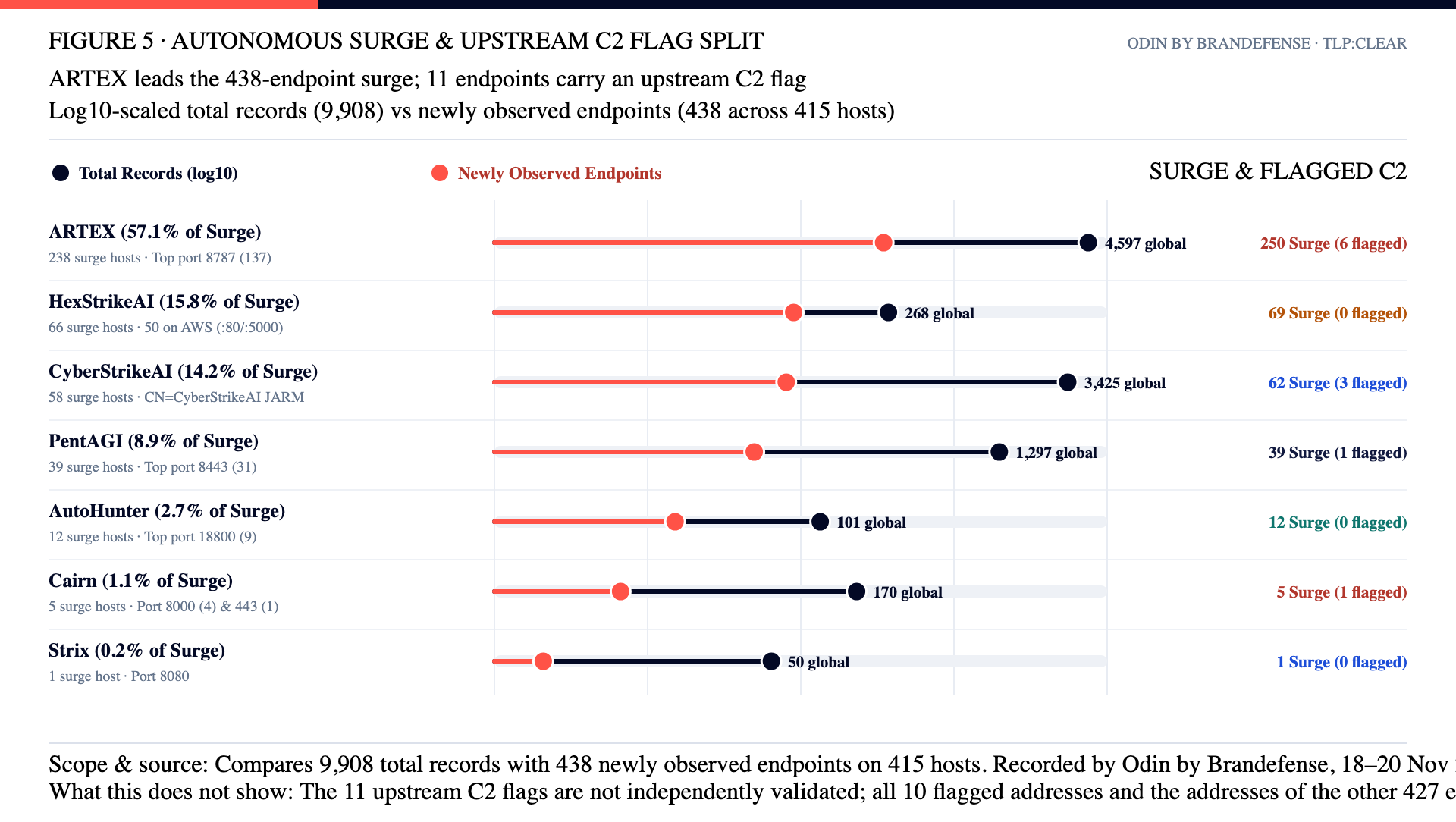
Single-page app pages saved as secrets
On Workbench A, five differently named files all measure 676 bytes and share one SHA-256 value. Their names suggest environment-variable files, Git configuration and an app script. Four more output files in one sampled task folder share one 850-byte value (names, paths and folder IDs withheld).
A single-page application (SPA) returns the same HTML start page, with status 200, for any path it does not know. A scraper or worker that checks only for status 200 saves that page under whatever name it asked for. So nine "credential leaks" are really nine copies of two blank pages. Compare file hashes against a known page before treating a scraped configuration file as a secret.
Library code is not operator code
The sqlmap checkout on Workbench B adds 284 ordinary Python files from the scanner's core library and bundled web helpers (file names and paths withheld). They are public library code. Hunt for the operator's logs, not the scanner's source.
Upstream flags and banners are not C2 proof
Of the 438 new endpoints, 11 carry an upstream C2 flag without independent per-address validation, and 427 (97.5%) are suspected or candidates. In HexStrikeAI, 50 of 69 endpoints (72.5%) sit on short-lived AWS leases. Some candidate certificates are default Kubernetes (CN=k3s) certificates on DigitalOcean. Others carry test strings planted by scanners. These are reasons not to block on a single banner.
| Artifact class | Files | Unique SHA-256 | Workbench | Defender action |
|---|---|---|---|---|
| Windows privilege escalation and exploit | 6 | 3 | A | Hunt on endpoints; restrict SeImpersonatePrivilege |
| Tunnel and pivot tools | 9 | 9 | A | Hunt network and process activity |
| .NET SSO and cipher files | 8 | 8 | A | Audit SSO components; hunt for the cipher DLL |
| SQL injection and HTTP runner files | 8 | 8 | A and B | Hunt web and staging logs |
| Subagent discovery and token files | 5 | 5 | A | Hunt only |
| SPA pages and library code | 4 | 4 | A and B | Not indicators |
The 40 selected files hash to 37 unique SHA-256 values. Thirty-six are offense or task files; four are noise.
A contracted red team is possible
Authorized consultancies and intruders use the same tools: numbered task queues, ARTEX, sqlmap and Chisel. A paid penetration-testing service could have left these trees open. Even so, serving 6,203 task files, .NET SSO libraries and OAuth token files through unauthenticated services exposes third parties to real risk. The workbench owners are not established, so both host addresses are withheld.
7. What Defenders Should Do
Network and threat intelligence
- Do not block dual-use framework addresses on a single banner; the 10 flagged C2 addresses are withheld pending per-address validation.
- Use the two JARM values and
CN=CyberStrikeAIas hunting selectors only. Pair them with a certificate subject, URI or endpoint process before acting.
Windows and Active Directory
- Review which accounts hold "Impersonate a client after authentication" (
SeImpersonatePrivilege). Run IIS and SQL Server pools as group managed service accounts or virtual accounts with least privilege. - Disable the Print Spooler service on servers that do not print. Block unapproved GodPotato, PrintSpoofer and Chisel binaries with application control or EDR.
- Remove SMBv1 everywhere, confirm the MS17-010 update for CVE-2017-0144 is installed, and restrict DNS zone transfers to secondary authoritative servers.
Network security
- Inspect outbound HTTP-to-WebSocket upgrades at egress proxies for
Sec-WebSocket-Protocol: chisel-v3. - Stop database and web tiers from opening direct HTTP connections to raw IP addresses or unapproved high ports.
Application security and IAM
- Audit custom .NET SSO and portal components for hard-coded symmetric keys and plain MD5 password hashes. Move keys into DPAPI- or HSM-backed vaults, and hash passwords with Argon2id or PBKDF2.
- Enforce parameterized SQL queries in web portals, and block the
sqlmap/user agent at the WAF. - Deploy the rules in Chapter 8, and test them on your own traffic first.
8. Detection Rules
The full rules are in the Detection rules tab. The Suricata file passes a syntax lint. Suricata, YARA, Sigma and KQL engines were not available to load the files, and the rules were not replayed against live traffic. Test and tune them in your own environment before production use.
| Rule file | What it catches |
|---|---|
odin_subagent_workspaces_and_potato_chisel.rules | Suricata 7: seven signatures for GodPotato, PrintSpoofer and Chisel downloads, the chisel-v3 WebSocket handshake, the CyberStrikeAI certificate, the sqlmap user agent and exposed workbench listings |
sentinel_subagent_task_privesc_and_chisel_hunt.kql | Microsoft Sentinel and Defender XDR: impersonation tools, Chisel SOCKS, service-process shells and connections to locally validated C2 addresses |
sigma_potato_spoofer_chisel_and_task_staging.yml | Sigma (3 rules): GodPotato and PrintSpoofer use on Windows, Chisel reverse SOCKS clients, and Linux staging listeners, Socat SMB relays and sqlmap batch runs |
odin_potato_privesc_and_task_runners.yar | YARA (3 rules): the impersonation tools, Chisel binaries, and MS17-010 or sqlmap task files |
How the Suricata signatures work
| SID | Looks for | Why |
|---|---|---|
| 9531001 | Outbound GET for a GodPotato .exe binary | A server pulling an impersonation tool over plain HTTP |
| 9531002 | Outbound GET for a PrintSpoofer .exe binary | The same, for the Print Spooler tool |
| 9531003 | Outbound GET for a Chisel .exe binary | A host fetching a tunnel binary |
| 9531004 | Outbound request headers with Sec-WebSocket-Protocol: chisel-v and Upgrade: websocket | The Chisel tunnel handshake itself |
| 9531006 | A server certificate subject with CN=CyberStrikeAI | Hunt only: pair with an address or process before acting |
| 9531007 | An inbound request whose user agent contains sqlmap/ | Automated SQL injection against your web tier |
| 9531008 | An outbound HTTP 200 directory listing from a protected host that names GodPotato, PrintSpoofer, Chisel or sqlmap | An exposed staging directory on a protected server |
Start all SIDs in alert mode. After tuning, convert only SID 9531004 to drop on production Windows server subnets. Keep SID 9531006 as a hunting signal.
How the other rules work
The KQL query looks back 7 days and joins two views of each device. The process view finds locally supplied tool hashes and binary names, command lines naming the tools or R:socks, and service processes such as w3wp.exe starting a shell. The network view finds connections to locally validated C2 addresses, URLs naming the tools, and outbound connections from Chisel processes. Exact hostnames go in two named allowlists, which never hide a locally validated C2 address match.
| Sigma rule | Fires when |
|---|---|
| Rule 1 (critical, Windows) | GodPotato or PrintSpoofer image names appear, or IIS, SQL Server, Apache or PHP-CGI starts a process with -cmd, -i -c or a named pipe |
| Rule 2 (high, Windows) | A Chisel Windows binary runs, or a client command line ends in R:socks or :socks |
| Rule 3 (high, Linux) | Python runs http.server, Socat relays SMB port 445, or a command line runs sqlmap in batch mode |
Each Sigma rule excludes only exact named hosts or service accounts. There are no wildcard or prefix exclusions.
| YARA rule | Fires when |
|---|---|
ODIN_Windows_GodPotato_PrintSpoofer_Impersonation_Tool | A PE under 256 KB holds SeImpersonatePrivilege, a named-pipe API and a tool name or ncacn_ip_tcp |
ODIN_Go_Chisel_WebSocket_Reverse_SOCKS_Binary | A PE under 16 MB holds chisel-v3 and Sec-WebSocket-Protocol with jpillora/chisel or R:socks |
ODIN_Subagent_MultiTask_SMB_AD_And_SQLMap_Runner | A file holds two MS17-010 toolkit markers, or both sqlmap injection-report strings |
For custom .NET single-sign-on helpers whose file names are withheld, audit portal assemblies for static Rijndael or 3DES keys rather than matching one DLL name.
MITRE ATT&CK mapping
| Tactic | Technique | How the workbenches use it | Detection |
|---|---|---|---|
| Initial Access | T1190 Exploit Public-Facing Application | sqlmap batch runs and HTTP callback listeners | SID 9531007; Sigma rule 3 |
| Privilege Escalation | T1134.001 Token Impersonation/Theft | GodPotato and PrintSpoofer staged in task folders | SIDs 9531001, 9531002; KQL; Sigma rule 1; YARA |
| Command and Control | T1572 Protocol Tunneling | Chisel reverse SOCKS over WebSocket | SIDs 9531003, 9531004; KQL; Sigma rule 2; YARA |
| Credential Access | T1552.001 Credentials In Files | .NET SSO assembly disassembly and cipher helper | Hunting and code review |
| Credential Access | T1528 Steal Application Access Token | OAuth and Graph token files in task folders | Hunting only |
9. Indicators
The workbench file hashes are withheld because the host owner is unknown. All 10 flagged C2 addresses and all workbench download paths are also withheld, leaving 0 published IP or hash indicators in the Indicators tab. Four text-only hunting selectors appear in this report: two JARM values, one certificate subject and one WebSocket header.
| Type | Count | Where to use it |
|---|---|---|
| Flagged C2 addresses (IPv4, withheld) | 0 published (10 withheld) | Withheld pending per-address validation |
| Workbench file hashes (SHA-256, withheld) | 0 published (12 withheld) | Withheld because the host owner is unknown |
| TLS JARM values and certificate subject | 3 | Hunting, paired with another signal |
| WebSocket header | 1 | Egress proxy inspection |
Hunting selectors
| Indicator | Type | Use |
|---|---|---|
40d40d40d00000000043d43d00043d6aff5ab0f4fc31897186312c9e639319 | JARM of the three flagged CyberStrikeAI controllers | Hunt with CN=CyberStrikeAI |
27d40d40d00040d00042d43d000000d2e61cae37a985f75ecafb81b33ca523 | JARM observed on a flagged ARTEX endpoint | Hunt with another signal |
CN=CyberStrikeAI | TLS certificate subject | Hunt (SID 9531006) |
Sec-WebSocket-Protocol: chisel-v3 | WebSocket header | Hunt at egress proxies |
Withheld: the 10 flagged C2 addresses (pending per-address corroborating signals), their host-level details and the addresses of the 427 suspected and candidate endpoints. Both workbench addresses and their service ports are also withheld. All workbench file hashes, task-folder IDs, file and log names, and download paths are withheld because the host owners are not established. So are all victim and target names.
10. Scope and Limits
- Window. The findings were recorded on 18–20 November 2026, covering the 438 newly observed endpoints and both exposed workbench directory listings.
- Files, not outcomes. The workbench files were read as listings and file metadata. We ran no binary and contacted no system named in them. Nothing we saw confirms use against any target.
- No independently validated C2 addresses. Eleven endpoints carry an upstream C2 flag, but the study records do not independently corroborate each address. A family label on the other 427 endpoints is a product fingerprint, not proof of hostile use.
- No link between workbenches. No shared IP, certificate or file hash ties Workbench A to Workbench B.
- An authorized test is possible. The tooling fits a contracted red team as well as an intruder. The open directories still expose third-party data.
- Rule testing. The Suricata file passes a syntax lint. The rule engines were not available to load the files, and no rule was replayed against live traffic. Test and tune them before production use.
11. Sources
- Microsoft Learn. Impersonate a client after authentication (security policy setting). https://learn.microsoft.com/en-us/windows/security/threat-protection/security-policy-settings/impersonate-a-client-after-authentication (verified 20 November 2026)
- Microsoft Security Bulletin MS17-010, Critical: Security Update for Microsoft Windows SMB Server (published 14 March 2017). https://learn.microsoft.com/en-us/security-updates/securitybulletins/2017/ms17-010 (verified 20 November 2026)
- NIST National Vulnerability Database. CVE-2017-0144 (CVSS 3.1 base score 8.8, High). https://nvd.nist.gov/vuln/detail/CVE-2017-0144 (verified 20 November 2026)
- CVE Program. CVE-2017-0144 record. https://www.cve.org/CVERecord?id=CVE-2017-0144 (verified 20 November 2026)
- jpillora. Chisel: a fast TCP/UDP tunnel over HTTP. https://github.com/jpillora/chisel (verified 20 November 2026)
- MITRE ATT&CK. T1134.001 Access Token Manipulation: Token Impersonation/Theft. https://attack.mitre.org/techniques/T1134/001/ (verified 20 November 2026)
- MITRE ATT&CK. T1572 Protocol Tunneling. https://attack.mitre.org/techniques/T1572/ (verified 20 November 2026)
- MITRE ATT&CK. T1190 Exploit Public-Facing Application. https://attack.mitre.org/techniques/T1190/ (verified 20 November 2026)
- MITRE ATT&CK. T1552.001 Unsecured Credentials: Credentials In Files. https://attack.mitre.org/techniques/T1552/001/ (verified 20 November 2026)
- MITRE ATT&CK. T1528 Steal Application Access Token. https://attack.mitre.org/techniques/T1528/ (verified 20 November 2026)
- OWASP Cheat Sheet Series. SQL Injection Prevention Cheat Sheet. https://cheatsheetseries.owasp.org/cheatsheets/SQL_Injection_Prevention_Cheat_Sheet.html (verified 20 November 2026)
What is…?
Short explanations of the tools and families named in this study.
What is PrintSpoofer?
PrintSpoofer is a public Windows privilege escalation tool that abuses impersonation privileges to gain SYSTEM.
More about PrintSpooferAI offensive toolWhat is CyberStrikeAI?
CyberStrikeAI is a public AI-driven offensive security platform. It spreads its operator interface, API and agent listener across several ports on one host and exposes tools through MCP.
More about CyberStrikeAIAI offensive toolWhat is ARTEX?
ARTEX is an autonomous red-team console that chains AI agents and security tools. Operators fork and rebrand it; its default listener port is 8787.
More about ARTEXTechniqueWhat is JARM?
JARM is an open TLS server fingerprinting method from Salesforce. It hashes how a server answers a set of crafted TLS handshakes.
More about JARMAI offensive toolWhat is HexStrike AI?
HexStrikeAI is a public project that exposes many security tools to AI agents through the Model Context Protocol (MCP).
More about HexStrike AIAI offensive toolWhat is PentAGI?
PentAGI is an open-source autonomous penetration testing system that coordinates AI agents and security tools in containers.
More about PentAGIFrequently asked questions
What are autonomous-offense frameworks, and how many did we see?
Frameworks such as ARTEX, CyberStrikeAI, HexStrikeAI and PentAGI let an operator hand a target to an AI-driven swarm. The swarm splits the job into many small tasks and runs each one with a separate worker, or subagent.
What do the exposed task folders hold?
The first workbench serves 6,203 files, the kind of open web root external attack surface management flags on internet-facing hosts. The sampled tree includes files at the web root and in 26 numbered task folders.
What does the second workbench add?
The second workbench serves 1,970 files across three HTTP listeners. It holds a copy of sqlmap, the public SQL injection tool, and five sqlmap-named logs (3.49 MB). Next to them sit two HTTP-named listener logs of 34.94 MB in total, though the listing does not include their contents. A listener like this can let a target database pull a second-stage file or call back to confirm an injection.
Are all these findings real threats?
Not all of them. Two kinds of noise matter for anyone who collects data from exposed servers. First, nine files named like environment or Git configuration secrets turned out to be copies of two blank web-app pages. Many modern web apps return the same start page for any path. A worker that only checks for a "200 OK" saves that page under a secret-sounding name. Comparing file hashes catches this at once.